SCIENCE AND TECHNOLOGY FOR GRADES III-X 1
SCIENCE AND TECHNOLOGY CURRICULUM
Grades III – X
2019
PUNJAB CURRICULUM AND TEXTBOOK BOARD LAHORE
TABLE OF CONTENTS
SCIENCE AND TECHNOLOGY FOR GRADES III-X 2
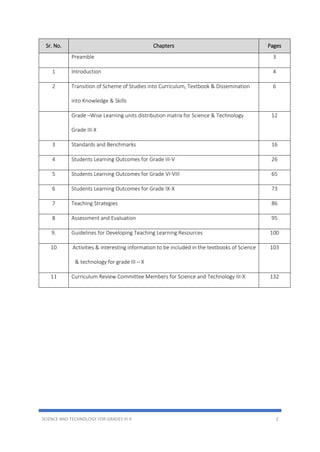
Sr. No. Chapters Pages
Preamble 3
1 Introduction 4
2 Transition of Scheme of Studies into Curriculum, Textbook & Dissemination
into Knowledge & Skills
6
Grade –Wise Learning units distribution matrix for Science & Technology
Grade III-X
12
3 Standards and Benchmarks 16
4 Students Learning Outcomes for Grade III-V 26
5 Students Learning Outcomes for Grade VI-VIII 65
6 Students Learning Outcomes for Grade IX-X 73
7 Teaching Strategies 86
8 Assessment and Evaluation 95
9. Guidelines for Developing Teaching Learning Resources 100
10 Activities & interesting information to be included in the textbooks of Science
& technology for grade III – X
103
11 Curriculum Review Committee Members for Science and Technology III-X 132
SCIENCE AND TECHNOLOGY FOR GRADES III-X 3
PREAMBLE
Curriculum lies at the heart of the educational enterprise. It is a mean through which
nations transmit their philosophy of life and its spirit to exemplify their value system to its
young generations. The development of curriculum requires inputs from the stakeholders to
reflect the needs of the society and interests of the learners.
Curriculum, syllabus and standards of education were on the concurrent list under Entry
38 of the Concurrent Legislative List to the Fourth Schedule of the Constitution of Islamic
Republic of Pakistan, 1973. After 18th Constitutional Amendment, development of curricula and
approval of textbook manuscripts and supplementary reading material relating to textbooks,
production of reference and research material in respect of the problems relating to the
Schemes of Studies and curricula / textbooks etc. are now the exclusive domain of the Punjab
Curriculum and Textbook Board under Punjab Curriculum and Textbook Board Act, 2015 (Act VI
of 2015).
To carry out its mandate, the Punjab Curriculum and Textbook Board has prepared
Scheme of Studies from Pre-Primary Education to Intermediate Level for the province of Punjab
in consultation with all the stakeholders involved in the delivery of education. This Scheme of
Studies has been prepared keeping in view the arising need of Science & Technology in our
society, modern trends in education and the need to bridge the gap between public / private
schools and Deeni Madaris of the Punjab.
This Curriculum will hopefully pave the way for bringing about qualitative change in
education at this level.
Managing Director
SCIENCE AND TECHNOLOGY FOR GRADES III-X 4
1. INTRODUCTION
The curriculum of Science and Technology from grade III-X has been introduced in new
scheme of studies. This curriculum is prepared by keeping in view the arising need of technology
in our society, modern trends in education system and also based on 21st century skills required
for new generation to cope up with new challenges. This curriculum of Science & Technology is
to act as a foundation document for achieving the goal of developing scientific literacy with
technological knowhow in a systematic way for all students.
The curriculum of Science and Technology is based on four standards i.e. Life Sciences,
Physical Science, Earth and Space Science and Technology / Technical & Vocational Education.
Life Sciences, Physical Sciences and Earth & Space Sciences will constitute Part-I of the
Curriculum of Science & Technology carrying weightage of 75 percent while Technology &
Technical Education with a weightage of 25 percent shall constitute Part-II of Curriculum for
each grade.
Our aspiration is to; “Enable all students to develop their capacities as successful
learners, confident individuals, responsible citizens and effective contributors to society.” This
will help in the holistic development of the child towards life. This Curriculum will hopefully
pave the way for bringing about qualitative change in education at this level as well as to
inculcate values in young generation like, sharing, caring, and curiosity. It is earnestly hoped
that this curriculum will meet the requirements and expectations of all those for whom it has
been written.
OBJECTIVES
The objectives of this course are as follows:
 Encourage students at all grade levels to develop a critical sense for wonder and
curiosity about scientific and technological endeavours;
 Enable students to use Science and Technology to acquire new knowledge and solve
problems, so that they may improve the quality of their own lives and lives of others;
 Prepare students to critically address social, economic, ethical, and environmental
issues related to science and technology;
 Provide students with a foundation in Science that creates opportunities for them to
pursue progressively higher levels of study, prepares them for science-related
SCIENCE AND TECHNOLOGY FOR GRADES III-X 5
occupations, and engages them in Science-related activities appropriate to their
Interests and abilities; and
 Develop in students, of varying aptitudes and interests, and the knowledge of wide
variety of careers related to science, technology, society and the environment.
The overall goal of Science Education is therefore to develop scientific literacy. The
accomplishment of this goal within the school context can take place only if certain
opportunities are presented. The curriculum for Science & Technology, inter alia, is
fundamental to the Science Education, which provides a systematic approach to the students'
learning in Science in a well-defined and organized framework. While teachers shall play the
most significant role in helping students achieve scientific literacy, they will need support from
the rest of educational system in terms of necessary training in teaching science, teaching
aids/material, and most importantly an enabling and conducive environment, if the challenge
of Science Education is to be met.
SCIENCE AND TECHNOLOGY FOR GRADES III-X 6
2. TRANSITION OF SCHEME OF STUDIES INTO CURRICULUM, TEXTBOOKS &
DISSEMINATION OF KNOWLEDGE & SKILLS FOR SCIENCE & TECHNOLOGY FROM
GRADE III – X
1. Sustainable technical development is the pathway to the socio-economic development
of a nation. To have technologically vibrant, industrialized and knowledge-based
Pakistan, maximum efforts must be directed towards imparting high quality education
covering emerging trends, modern developments and scientific learning.
2. The Scheme of Studies has laid down the following Aims and Objectives which are
mainly related to 21st century skills:
 To Impart high-quality student-centred learning
 To introduce emerging trends, modern developments and scientific learning
 To produce disciplined, motivated and enlightened youth with high moral
character, sound ethical values and resilience to face adversities and challenges
 To produce creative, constructive, communicative and critical thinking youth
with clear concepts and in-depth knowledge, ready to participate in the highly
competitive globalized knowledge-based economy
3. Aforementioned Aims and objectives have to be achieved through curriculum,
textbooks and dissemination of knowledge & skills to the students.
4. Based on the Scheme of Studies, Curricular Outline of Science & Technology from Grade
III – X will be as under:
Sr.
Grade /
Class
Contents
Periods
per
week
Marks
/
Grade
Medium
Remarks
1 III – V Science & Technology for Grade III
Life Science
 Earth as living planet
 Changes in living things
 Food and Teeth
Physical Science
 Materials and their properties
 Inventors and Inventions
 Forces and machines
Earth and Space Science
 Sun
Technology / Technical & Vocational
Education
 Basic drawing
6 100 English Other core
subjects
prescribed for
Grade III-V are
Urdu, English,
Islamiyat,
Mathematics
and Social
Studies
SCIENCE AND TECHNOLOGY FOR GRADES III-X 7
Sr.
Grade /
Class
Contents
Periods
per
week
Marks
/
Grade
Medium
Remarks
 Basic craft making
 Basic Technical model making
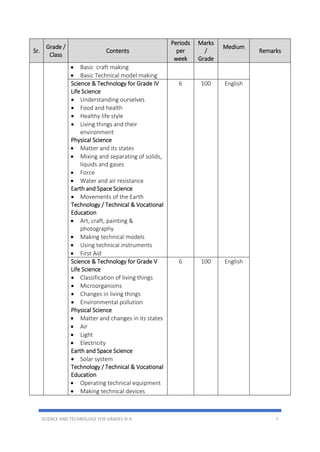
Science & Technology for Grade IV
Life Science
 Understanding ourselves
 Food and health
 Healthy life style
 Living things and their
environment
Physical Science
 Matter and its states
 Mixing and separating of solids,
liquids and gases
 Force
 Water and air resistance
Earth and Space Science
 Movements of the Earth
Technology / Technical & Vocational
Education
 Art, craft, painting &
photography
 Making technical models
 Using technical instruments
 First Aid
6 100 English
Science & Technology for Grade V
Life Science
 Classification of living things
 Microorganisms
 Changes in living things
 Environmental pollution
Physical Science
 Matter and changes in its states
 Air
 Light
 Electricity
Earth and Space Science
 Solar system
Technology / Technical & Vocational
Education
 Operating technical equipment
 Making technical devices
6 100 English
SCIENCE AND TECHNOLOGY FOR GRADES III-X 8
Sr.
Grade /
Class
Contents
Periods
per
week
Marks
/
Grade
Medium
Remarks
 First aid and disaster
management
 Technical activities
2 VI – VIII Science & Technology for Grade VI
Life Science
 Cellular organization of plants
and animals
 Sense organs
 Photosynthesis and respiration
in plants
 Environment and interactions
Physical Science
 Soil
 Atoms, molecules, mixtures and
compounds
 Solutions
 Simple machines
 Work and energy
 Reflection of light
 sound
Earth and Space Science
 Space and satellites
Technology / Technical & Vocational
Education
 Farming & Agriculture
 Food Processing and
Preservation
 Operating Electrical & Electro-
Mechanical Technical
Equipment
 Making Electrical & Electro-
Mechanical Technical Devices
6 100 English Other core
subjects
prescribed for
Grade VI-VIII are
Urdu, English,
Islamiyat,
Languages,
Computer
Education,
Mathematics,
History and
Geography
Science & Technology for Grade VII
Life Science
 Human organ systems
 Transport in humans and plants
 Reproduction in plants
Physical Science
 Water
 Structure of an atom
 Physical and chemical changes
and processes
6 10 0 English
SCIENCE AND TECHNOLOGY FOR GRADES III-X 9
Sr.
Grade /
Class
Contents
Periods
per
week
Marks
/
Grade
Medium
Remarks
 Heat and temperature
 Refraction of light
 Sound waves
 Electric current and circuits
Earth and Space Science
 Exploring space
Technology / Technical & Vocational
Education
 Farming & Agriculture (for male
students)
 Embroidery, dress making &
fashion designing (for female
students)
 Making electrical & electro-
mechanical technical devices
 Technical & Computer Drawing
Science & Technology for Grade VIII
Life Science
 Human organ systems
 Heredity in organisms
 Bio-technology
 Pollutants and their effects on
environment
Physical Science
 Chemical reactions
 Acids, bases and salts
 Measurements of physical
quantities
 Force and pressure
 Thermal expansion
 Spherical mirrors and lenses
 Electricity in action
Earth and Space Science
 Investigating universe
Technology / Technical & Vocational
Education
 Elementary construction
technology
 Making techno-chemical
products
 Making electrical & electro-
mechanical technical devices
6 100 English
SCIENCE AND TECHNOLOGY FOR GRADES III-X 10
Sr.
Grade /
Class
Contents
Periods
per
week
Marks
/
Grade
Medium
Remarks
IX – X Science & Technology for
Humanities and General Group
Grade IX
Life Science
 Nature and Role of Science
 Food and Health
 Blood and its Functions
Physical Science
 Energy Sources
 Chemistry in Everyday Life
 Water Resources
Earth and Space Science
 Continents and Oceans
Technology / Technical & Vocational
Education
 Technology in Power Production
 Technology in Agriculture and
Chemical Industry
6 75 English Other core
subjects
prescribed for
Science Group
Grade IX-X are
Urdu, English,
Islamiyat,
Mathematics,
Pakistan Studies,
Physics,
Chemistry,
Biology /
Computer
Science & IT
Science & Technology for
Humanities and General Group
Grade X
Life Science
 Human Diseases
 Environmental Problems and
Management
Physical Science
 Chemical Reactions & their
applications
 Electricity in Everyday Life
 Optics in Everyday Life
Earth and Space Science
 Space and Nuclear Programme
of Pakistan
Technology / Technical & Vocational
Education
 Technology in health Care
 Technology in Everyday Life
 Technology in Banking and
Business Sector
6 75 English
Grade IX Science & Technology for General
Science / Business Administration
Group
6 75 English
SCIENCE AND TECHNOLOGY FOR GRADES III-X 11
Sr.
Grade /
Class
Contents
Periods
per
week
Marks
/
Grade
Medium
Remarks
Same as for Humanities and
General Group Grade IX
Grade X Science & Technology for General
Science / Business Administration
Group
Same as for Humanities and
General Group Grade X
6 75 English
5. Above Curricular Outline will be translated into relevant Learning Units Matrix and
Learning Outcomes for the preparation of textbooks and other reading material.
SCIENCE AND TECHNOLOGY FOR GRADES III-X 12
3. GRADE-WISE LEARNING UNITS DISTRIBUTION MATRIX FOR
SCIENCE & TECHNOLOGY GRADE III TO V
PART – I PART - II
Grade
/
Strands
Life Science Physical Science Earth and Space Science
Technology and
Technical Education
GRADE
III
1. Earth as Living
planet
2. Changes in living
things
3. Food and teeth
4. Materials and their
properties
5. Inventors and
inventions
6. Forces and
machines
7. Sun 8. Basic Technical
drawing
9. Basic Technical
craft making
10. Basic Technical
model making
GRADE
–IV
1. Understanding
ourselves
2. Food and health
3. Healthy life style
4. Living things and
their environment
5. Matter and its
states
6. Mixing and
separating of solids
and liquids
7. Force
8. Water and air
resistance
9. Movements of the
Earth
10. Art, craft, painting
& photography
11. Making technical
models
12. Using technical
instruments
13. First Aid
GRADE
-V
1. Classification of
living things
2. Microorganisms
3. Changes in living
things
4. Environmental
pollution
5. Matter and
changes in its
states
6. Light
7. Electricity
8. Solar system 9. Operating
technical
equipment
10. Making
technical
devices
11. First aid and
disaster
management
12. Technical
activities
SCIENCE AND TECHNOLOGY FOR GRADES III-X 13
4. GRADE-WISE LEARNING UNITS DISTRIBUTION MATRIX FOR
SCIENCE & TECHNOLOGY GRADE VI TO VIII
PART – I PART - II
Grade
/
Strands
Life Science Physical Science
Earth and Space
Science
Technology and Technical
Education
GRADE
VI
1. Cellular
organization of
plants and animals
2. Sense organs
3. Photosynthesis
and respiration in
plants
4. Environment and
interactions
5. Soil
6. Atoms, molecules,
mixtures and
compounds
7. Solutions
8. Simple machines
9. Work and energy
10. Reflection of light
11. sound
12. Space and
satellites
13. Farming & Agriculture
14.Food Processing and
Preservation
15.Operating Electrical &
Electro-Mechanical
Technical Equipments
16.Making Electrical &
Electro-Mechanical
Technical Devices
GRADE
–VII
1. Human organ
systems
2. Transport in humans
and plants
3. Reproduction in
plants
4. Water
5. Structure of an
atom
6. Physical and
chemical changes
and processes
7. Heat and
temperature
8. Refraction of light
9. Sound waves
10. Electric current and
circuits
11. Exploring space 12. Farming &
Agriculture (for
male students)
13. Embroidery, dress
making & fashion
designing (for
female students)
14. Making electrical
& electro-
mechanical
technical devices
15. Technical &
Computer
Drawing
SCIENCE AND TECHNOLOGY FOR GRADES III-X 14
PART – I PART - II
GRADE
-VIII
1. Human organ
systems
2. Heredity in
organisms
3. Biotechnology
4. Pollutants and
their effects on
environment
5. Chemical reactions
6. Acids, bases and
salts
7. Measurements of
physical quantities
8. Force and
pressure
9. Thermal expansion
10. Spherical mirrors
and lenses
11. Electricity in action
12. Investigating
universe
13. Elementary
construction
technology
14. Making techno-
chemical products
15. Making electrical
& electro-
mechanical
technical devices
SCIENCE AND TECHNOLOGY FOR GRADES III-X 15
5. GRADE-WISE LEARNING UNITS DISTRIBUTION MATRIX FOR
SCIENCE & TECHNOLOGY GRADE IX TO X
PART – I PART - II
Grade
/
Strands
Life Science Physical Science Earth and Space Science
Technology and
Technical Education
GRADE
IX
1. Nature and Role of
Science and Technology
2. Food and Health
3. Blood and its
Function
4. Energy Sources
5. Chemistry in
Everyday Life
6. Water Resources
7. Technology in Power
Production
8. Technology in
Agriculture and
Chemical Industry
GRADE
–X
1. Human Diseases
2. Environmental
Problems and
Management
3. Chemical Reactions
& their applications
4. Electricity in
Everyday Life
5. Space and Nuclear
Programme of Pakistan
6. Technology in Health
Care
7. Technology in
Everyday Life
8. Technology in
Banking and Business
sector
SCIENCE AND TECHNOLOGY FOR GRADES III-X 16
3. Key Learning Areas, Standards and Benchmarks
Introduction
Science is a systematic process of inquiry about natural phenomena. Curriculum of
Science and Technology follows a specific structure whose sequence is as under:
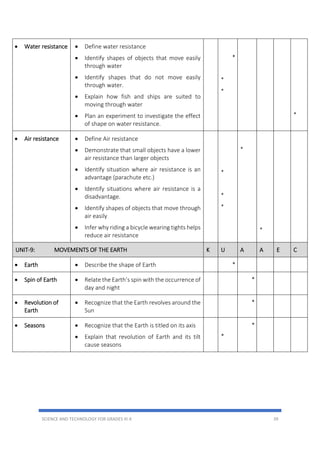
Key Learning Area Standard Benchmark Student Learning Outcome
Curriculum of Science and Technology comprised of five (4) Key Learning Areas (KLA)
as follows which serve to define the major learning areas / sections of a subject , the concepts
and practices to be acquired by every student of grade III – X.
1. Life Science
2. Physical Science
3. Earth and Space Science
4. Technology and Technical Education
The Standards and benchmarks, thereafter, will serve as a guide indicating how
competencies has to be attained in order to meet the standards. They will provide indicators
of expectations from students at completion of the said grade level.
Science is both a process of inquiry and a body of knowledge. The development of
scientific skills and attitudes is inextricably linked to the development of ideas in science.
Similarly, as students' ideas evolve, they should be acquiring an understanding of the nature of
science and its relationship to technology, society, and the environment.
Standards
Standards are basically the descriptions of the learning strands. Standards outline what
students should know and be able to do in a learning strand.
Benchmarks
Benchmarks are the statements that identify what students are expected to know, be
able to do, and value by the end of for example, Grades V, VIII, X and XII. Benchmarks represent
what is intended or what learning outcome is expected from students at the end of a grade-
cluster.
Students' Learning Outcomes - SLOs
SCIENCE AND TECHNOLOGY FOR GRADES III-X 17
Students' Learning Outcomes are the learning statements, specifically describing what
students are supposed to know and be able to do in each topic / content in order to achieve
the specified benchmarks. In other words, SLOs are the incremental steps toward
accomplishment of benchmarks, which are organized around the standards.
Therefore, well-defined SLOs for the Grades III- X have been provided in the following
pages, which reflect the desired learning outcomes towards achieving the required
benchmarks for grade-cluster III-X for the four (4) Key Learning areas.
KLA-1: Life Science (III-V)
Standard
Students will understand, explain and differentiate between the structure,
characteristics and basic needs of living things, the processes of life, and will also investigate
the diversity of life and how living things interact with each other and their environment.
Benchmarks
By the end of Grade V, students will be expected to:
1. Identify the needs and characteristics of plants and animals;
2. Compare major plant and animal structures and their functions;
3. Describe the diversity among organisms;
4. Explain the food groups necessary to maintain a healthy body;
5. Compare and group plants and animals according to similarities and/or
differences;
6. Examine the habitats of plants and animals and determine how basic needs are
met within each habitat; and
7. Explore interaction or interdependence between animals and plants.
SCIENCE AND TECHNOLOGY FOR GRADES III-X 18
KLA-2: Physical Science (III-V)
Standard
Students will describe and explain common properties, forms, and interactions of
energy and matter, their transformations and applications in chemical, physical, and biological
systems.
Benchmarks
By the end of Grade V, students will be expected to:
1. Classify objects by properties that can be observed, measured, and recorded
including Colour, shape, size, weight, volume, texture, and temperature;
2. Describe the properties of the different states of matter and identify the
condition that cause matter to change states; explain the processes associated
with it;
3. Identify changes when matter experiences an external influence in terms of push
or pull;
4. Describe simple energy transformations and the uses of energy at school and
home, and to observe safety.
KLA-3: Earth and Space Science (III-V)
Standard
Students will be knowledgeable of the composition, structure, processes, and
interactions among the Earth's systems; they will compare and contrast our planet and sun to
other planets and star Systems; and explain how we learn about the universe.
Benchmarks
By the end of Grade V, students will be expected to:
1. Observe and describe the characteristics of objects in the sky;
2. Observe and record the changing appearances and positions of the Moon in the
sky at night and determining the monthly pattern of lunar change;
3. Prepare a Model to show changes that occur because of the rotation of the Earth
and the revolution of the Earth around the Sun;
4. Understand that the Sun, a star, is a source of heat and light energy and
identifying its effects upon the Earth;
SCIENCE AND TECHNOLOGY FOR GRADES III-X 19
5. Compare celestial bodies in our solar system; and
6. Demonstrate how the relationship of the Earth, Moon, and Sun causes eclipses
and Moon phases.
KLA-4: Technology & Technical Education (III-V)
Standard
Students will be knowledgeable and will get practical experience of art, craft, painting,
photography, first aid, personal hygiene, technical devices and models, and operating technical
equipment.
Benchmarks
By the end of Grade V, students will be expected to:
1. Draw and paint different articles they see in their surroundings.
2. Make models of different objects they see in their surroundings.
3. Use / operate technical tools and instrument e.g. spirit level / water level, plumb
line, wire cutter, chisel, saw, file, juicer, toaster, cell phone, sewing machine, metal
hack-saw, hand-drill machine, light electric hand-drill machine, and sewing
machine.
4. Assemble simple technical instruments e.g. torch light, laser pointer, syphon,
electromagnet, solenoid, and LED light strings.
5. Operate mobile phone for use of calculator, alarm clock and calendar and for audio
video recording.
6. Identify the functions of items of first aid box and practice using first aid box and
emergency treatments.
7. Provide emergency treatment to a drowning person.
8. Observe and practise workshop safety rules.
9. Practise earthquake / fire / flood drill.
SCIENCE AND TECHNOLOGY FOR GRADES III-X 20
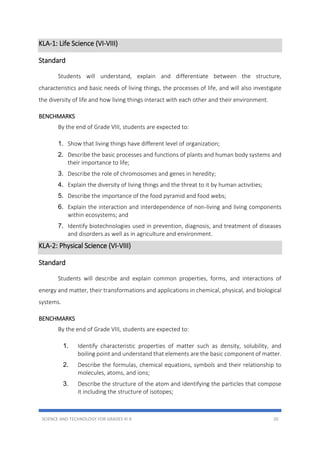
KLA-1: Life Science (VI-VIII)
Standard
Students will understand, explain and differentiate between the structure,
characteristics and basic needs of living things, the processes of life, and will also investigate
the diversity of life and how living things interact with each other and their environment.
BENCHMARKS
By the end of Grade VIII, students are expected to:
1. Show that living things have different level of organization;
2. Describe the basic processes and functions of plants and human body systems and
their importance to life;
3. Describe the role of chromosomes and genes in heredity;
4. Explain the diversity of living things and the threat to it by human activities;
5. Describe the importance of the food pyramid and food webs;
6. Explain the interaction and interdependence of non-living and living components
within ecosystems; and
7. Identify biotechnologies used in prevention, diagnosis, and treatment of diseases
and disorders as well as in agriculture and environment.
KLA-2: Physical Science (VI-VIII)
Standard
Students will describe and explain common properties, forms, and interactions of
energy and matter, their transformations and applications in chemical, physical, and biological
systems.
BENCHMARKS
By the end of Grade VIII, students are expected to:
1. Identify characteristic properties of matter such as density, solubility, and
boiling point and understand that elements are the basic component of matter.
2. Describe the formulas, chemical equations, symbols and their relationship to
molecules, atoms, and ions;
3. Describe the structure of the atom and identifying the particles that compose
it including the structure of isotopes;
SCIENCE AND TECHNOLOGY FOR GRADES III-X 21
4. Explain the relationships among temperature, molecular motion, phase
changes, and physical properties of matter;
5. Recognize different forces and describe their effects and how different
structures overcome the effect of force;
6. Observe and describe the interactions of light and matter;
7. Investigate and describe the movement of heat and the effects of heat in
objects and systems;
8. Describe the types of energy that can be involved, converted, or released in
electrical circuits; and
9. Manipulate and analyse quantitative data using the SI system.
KLA-3: Earth and Space Science (VI-VIII)
Standard
Students will be knowledgeable of the composition, structure, processes, and
interactions among the Earth's systems; they will compare and contrast our planet and sun to
other planets and star Systems; and explain how we learn about the universe.
Benchmarks
By the end of Grade VIII, students are expected to:
1. Identify the characteristics of the Sun and other stars;
2. Compare and contrast the celestial bodies in our solar system;
3. Investigate the force of gravity and the ways gravity governs motion in the solar system
and objects on Earth;
4. Model the position of the Earth in relationship to other objects in the solar system; and
5. Understand that space exploration is an active area of scientific and technological
research and development.
KLA-4: Technology & Technical Education (VI-VIII)
Standard
Students will be knowledgeable and will get practical experience of art, craft, painting,
photography, first aid, personal hygiene, technical devices and models, and operating technical
equipment.
SCIENCE AND TECHNOLOGY FOR GRADES III-X 22
Benchmarks
By the end of Grade VIII, students are expected to:
1. Operate electrical & electro-mechanical technical equipment (e.g. wood saw,
hand drill, UPS, sewing machine, simple wind turbine etc.)
2. Make electrical & electro-mechanical technical devices (e.g. two-way light
switch circuit, trip wire security alarm system, mini solar panel, a small solar
powered system for water heating etc.)
3. Practise the skills of food processing and preservation.
4. Grow seasonal plants and vegetables in earthen pots and rear domesticated
birds and other animals.
5. Do embroidery work, make a school uniform on motor operated sewing
machine, and do simple dress designing.
6. Perform soil testing to select fertilizers.
7. Demonstrate drip & sprinkle irrigation.
8. Develop crops in a tunnel farming environment
9. Do elementary technical drawing.
10. Demonstrate basic brick work, plastering a brick wall and tile fixing.
11. Make techno-chemical products (e.g. writing ink, distemper and paints, tooth
paste, detergents etc.)
KLA-1: Life Science (IX-X)
Standard
Students will be able to understand, explain, analyse, assess the contribution of
eminent Islamic and Pakistani scientists, prospects of science and technology in future
development, significance of food and health, and will also investigate importance of different
blood groups and blood transfusion.
Benchmarks
By the end of Grade X, students will be able to:
1. Investigate the prospects and limitations of science and technology for future
development.
2. Analyze the various aspects of health and healthy life style.
3. Explain the causes, effects and preventive measures of different dietary
disorders and diseases.
SCIENCE AND TECHNOLOGY FOR GRADES III-X 23
4. Describe the importance of composition and functions of blood.
5. Identify different blood groups.
6. Assess the importance of blood transfusion
7. Analyze the relationships among various organisms and their environment.
8. Explain the structure and function of ecosystems and relate how ecosystems
change over time.
9. Describe the role of energy within living systems.
10. Identify technologies used in agriculture, medical diagnostics and treatments,
and improving the quality and carrying capacity of environment.
11. Analyze t h e g l o b a l e n v i r o n m e n t a l i s s u e s a n d e v a l u a t e t h e
e n v i r o n m e n t a l management strategies which are in practice.
KLA-2: Physical Science (IX-X)
Standard
Students will analyze (quantitatively and qualitatively) the demand and production of
energy (electricity& natural gas), conservation and management of energy, significance of
chemistry in daily life, and will analyze threats to water resources and recharging of ground
water and its management, predict changes and interactions in matter and energy, and
evaluate theories and structures using knowledge of chemistry and physics.
BENCHMARKS
By the end of Grade X, students will be able to:
1. Relate the properties of chemicals with their usage, effects on our lives,
the technologies depended, and the careers associated with them.
2. Identify the chemical reactions, their ingredients used in the production of
the common consumer products.
3. Explain the impact of chemicals on the individuals and environment and suggest
solutions to problems they create.
4. Identify the water and energy resources and discuss their importance for
the development of a country.
5. Analyze the availability of water and energy resources, their current utilization
and conservation practices and their future requirements in Pakistan.
6. Design a plan for the development, protection and management of new
water and energy resources.
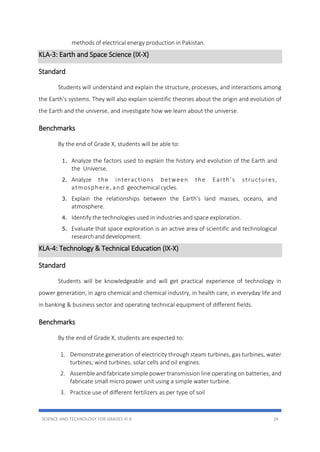
7. Explain the characteristics, effects and uses of static electricity in our daily life.
8. Examine the social, economic and environmental costs and benefits of the
SCIENCE AND TECHNOLOGY FOR GRADES III-X 24
methods of electrical energy production in Pakistan.
KLA-3: Earth and Space Science (IX-X)
Standard
Students will understand and explain the structure, processes, and interactions among
the Earth’s systems. They will also explain scientific theories about the origin and evolution of
the Earth and the universe, and investigate how we learn about the universe.
Benchmarks
By the end of Grade X, students will be able to:
1. Analyze the factors used to explain the history and evolution of the Earth and
the Universe.
2. Analyze the interactions between the Earth’s structures,
atmosphere, and geochemical cycles.
3. Explain the relationships between the Earth’s land masses, oceans, and
atmosphere.
4. Identify the technologies used in industries and space exploration.
5. Evaluate that space exploration is an active area of scientific and technological
research anddevelopment.
KLA-4: Technology & Technical Education (IX-X)
Standard
Students will be knowledgeable and will get practical experience of technology in
power generation, in agro chemical and chemical industry, in health care, in everyday life and
in banking & business sector and operating technical equipment of different fields.
Benchmarks
By the end of Grade X, students are expected to:
1. Demonstrate generation of electricity through steam turbines, gas turbines, water
turbines, wind turbines, solar cells and oil engines.
2. Assemble and fabricate simple power transmission line operating on batteries, and
fabricate small micro power unit using a simple water turbine.
3. Practice use of different fertilizers as per type of soil
SCIENCE AND TECHNOLOGY FOR GRADES III-X 25
4. Develop simple paints and distempers, cosmetic soap and detergents taking
guidance from internet.
5. Recognize that there are two types of ultra-sonic equipment working diagnostic
and therapeutic.
6. Examine the working of ECG, FEG, MRI, and CT scan and Angiography systems.
7. Assemble simple the equipment used in weather forecasting.
SCIENCE AND TECHNOLOGY FOR GRADES III-X 26
4. Learning Contents and Students’ Learning Outcomes Grade III-V
Learning Contents and Students’ Learning Outcomes Grade III
Part 1: Learning Strands: Life Science, Physical Science, Earth & Space Science
Contents Students’ Learning Outcomes Cognitive Level
Students will be able to:
R
R U A A E C
UNIT-1: EARTH AS LIVING PLANET
 Environment
and its
components
 Types of
environment
 Factors
required to
sustain life on
Earth
 Describe what is meant by environment
 List the living and non-living components of
environment with examples
 Differentiate between various types of
environment (e.g. rural and urban
environments, desert environment,
mountain environment, aquatic
environment)
 Identify the environmental factors ) that
support life on Earth (temperature, light,
water, air and soil)
 Identify and categorise organisms as per
environment
*
*
*
*
*
*
*
 Habitat and its
types
 Recognize what is habitat
 Identify different habitats for living things
(plain region, desert, forest, mountains,
rivers and sea)
 State that different animals are found in
different habitats and are suited to the
environment in which they are found
 Observe the conditions in a local habitat
 Make predictions of organisms that will be
found in a habitat
*
*
*
UNIT-2: CHANGES IN LIVING THINGIS
SCIENCE AND TECHNOLOGY FOR GRADES III-X 27


 Living things
and non-living
things
 Plants
 Animals
 Comparison of
young living
things with
their parents
 Differentiate between living and non- living
things
 Name main parts of plants and describe
their function.
 Describe that water is taken in through
roots and transported through the stem to
the leaves.
 Recognize that some plants provide food
for us and are grown for the same reason.
 Identify the parts of the plants
• leaves
• stems
• flowers
• roots
• fruits
 Name main parts of animals and describe
their function.
 Compare young plants and animals with
their parents (from pictures and by
observations)
*
*
*
*
*
*
 Changes in
plants and
animals
 Identify the changes that animals and
plants undergo during their life (hen, pea)
 Investigate the conditions (water and light)
plants need to grow and stay
 Make careful observations and
measurements of plants growing and make
predictions about the outcomes of a test.
*
UNIT-3: FOOD AND TEETH R U A A E C
 Foods  Recognise that foods are a source of raw
materials for humans and animals to grow
well
*
 Food groups  Sort foods into food groups and classify
them accordingly. (Foods can be grouped
into fruits and Vegetables, meats and nuts,
*
SCIENCE AND TECHNOLOGY FOR GRADES III-X 28
sweet foods…
 Diet and
Fitness
 Explain that a certain amount and varied
type of foods are needed to keep healthy
 Describe the role of fuel foods
 Identify the adverse effects of fatty and
sweet foods on health
 Investigate the importance of exercise to
stay fit and healthy
*
*
*
 Balanced Diet  Describe what is meant by balanced diet
 Recognize that healthy living requires
eating a balanced diet.
 Suggest that to keep healthy diet must be
kept varied and adequate
 Evaluate your own diet and select food for
a healthy diet
*
*
 Human Teeth  Observe and compare different types of
teeth and label their important features
 Relate the shape to the function of teeth
helps animals to eat their particular foods
 Label different parts of a tooth and
describe its functions
 Recognize that some foods can be
damaging to our teeth
 Define tooth decay and how to prevent it
 Make observations and comparison of
different teeth, identify important features
*
*
*
*
*
 Animal teeth  Describe that how the teeth of different
animals adapted to their diet like
herbivores & carnivores
*
UNIT-4: MATERIALS AND THEIR PROPERTIES


SCIENCE AND TECHNOLOGY FOR GRADES III-X 29
 Materials  Distinguish between natural and man-
made materials.
 Identify a variety of materials e.g. plastic,
glass, rubber, metals, ceramics, wood,
cotton, Wool etc.
 Identify that these materials are used to
make different objects Identify various
materials used to make some objects in
their surroundings.
 Investigate properties of materials for their
appropriate selection for different objects
*
*
*
 Characteristics
of materials
 Evaluate specific properties of every
materials (hardness and softness, elasticity
and plasticity, toughness and brittleness)
*
 Uses of
different
materials
 List uses of some materials (wood, glass,
plastic, iron) based on their properties with
examples
 Classify materials according to their
properties.
 Explain why it is important to test
materials.
 Identify alternative materials for the same
use.
 Investigate the properties of fabric for
making clothes for different seasons
*
*
*
*
UNIT-5: INVENTORS AND INVENTIONS
 
 Major
inventions and
their inventors
 Identify the major objects invented and
their inventors (steam engine, electric
generator, train, aeroplane, TV, computer)
*
 Impact of
major
inventions on
life
 Recognize the benefits of major inventions
 Analyse the impacts of major inventions on
daily life
 Evaluate the effects of major inventions on
environment
 Express the ways to improve the standards
*
*
*
SCIENCE AND TECHNOLOGY FOR GRADES III-X 30
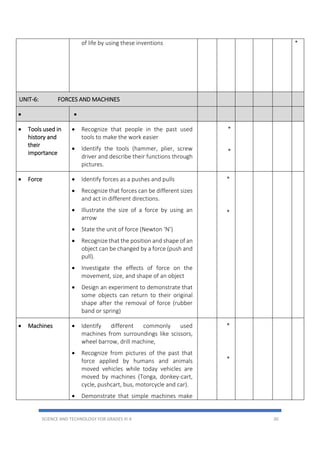
of life by using these inventions *
UNIT-6: FORCES AND MACHINES
 
 Tools used in
history and
their
importance
 Recognize that people in the past used
tools to make the work easier
 Identify the tools (hammer, plier, screw
driver and describe their functions through
pictures.
*
*
 Force  Identify forces as a pushes and pulls
 Recognize that forces can be different sizes
and act in different directions.
 Illustrate the size of a force by using an
arrow
 State the unit of force (Newton ‘N’)
 Recognize that the position and shape of an
object can be changed by a force (push and
pull).
 Investigate the effects of force on the
movement, size, and shape of an object
 Design an experiment to demonstrate that
some objects can return to their original
shape after the removal of force (rubber
band or spring)
*
*
 Machines  Identify different commonly used
machines from surroundings like scissors,
wheel barrow, drill machine,
 Recognize from pictures of the past that
force applied by humans and animals
moved vehicles while today vehicles are
moved by machines (Tonga, donkey-cart,
cycle, pushcart, bus, motorcycle and car).
 Demonstrate that simple machines make
*
*
SCIENCE AND TECHNOLOGY FOR GRADES III-X 31
work easier.
UNIT-7: SUN R U A A E C
 Light sources  Identify natural and artificial light sources.
 Distinguish between objects that produce
their own light and those that reflect light
from another source
*
*
 Sun rise and
sun set
 Relate rising and setting of Sun with
cardinal directions
 Investigate sunrise and sunset for a week
*
 Shadows  Explain how shadows are formed
 Predict about formation of shadows by
different objects or materials
*
 Change in size
of shadows
 Describe the size of the shadow with the
position of the sun in the sky.
 Recognize that shadows of object in
sunlight change during the course of the
day.
 Observe and describe how shadows
change in length during the day
 Observe and describe how shadows
change in direction during the day
 Explain that shadows can be used to tell the
approximate time of the day: Sundial
 Predict the time of the day by observing the
shadow during the day
*
*
*
*
*
Part – 2: Learning Strand: Technology and Technical Education
8. Basic drawing

 Sketch Pakistan flag & map.
 Sketch bus, pedestal fan, aeroplane.
 Sketch hockey stick, cricket bat and ball,
flowers, fruits, vegetables.
*
*
*
9. Basic Craft Making (out of paper, cardboard, reeds, packing material etc.)
SCIENCE AND TECHNOLOGY FOR GRADES III-X 32

 Practise techniques of folding, cutting,
tearing and pasting papers / cardboards to
make objects / patterns.
 Create paper bags, envelops, cards,
baskets.
*
*
10. Basic Technical Model Making (Out of Clay)
 Create collage model of aeroplane, boat,
bus, tuck etc.
 Design models of sphere, cube, prism,
cylinder and cone.
 Design hammer, wheels, rollers and gears.
 Make movable van, bus, trolley etc.
*
*
*
SCIENCE AND TECHNOLOGY FOR GRADES III-X 33
Learning Contents and Students’ Learning Outcomes Grade IV
Part 1: Learning Strands: Life Science, Physical Science, Earth & Space Science
Contents Students’ Learning Outcomes Cognitive level
Students will be able to:
R
R U A A E C
UNIT-1: UNDERSTANDING OURSELVES
 Major body
parts and their
functions
 Skeleton and
bones
 State functions of major parts of the body
 Observe and Demonstrate understanding
that humans and some other animals have
skeletons and some have no Skelton
 Differentiate between vertebrates and
invertebrates with examples
 Label the diagrams of given bones and joints
of the human body: Skull, ribs, spine
(backbone), elbow joint, pelvis (hip joint),
femur, tibia, fibula, humerus, radius, ulna
 Identify that human skeletons are internal
 Describe how bones and muscles work
together to produce movement
 Record observations of bones and skeletons
different class fellows by measuring heights
*
*
*
*
*
 Muscles and
Bones
 Describe that animals with the skeleton have
muscles attached to the bones
 Describe that muscle has to contract
(shorten) to make a bone move
 Explain that muscles act in pairs
 Recognize the need and uses of skeleton,
bones and muscles.
 Investigate that when someone is exercising
or moving fast, the muscles work hard
*
*
*
*
*
SCIENCE AND TECHNOLOGY FOR GRADES III-X 34
UNIT-2: FOOD AND HEALTH
 
 Sources of food  Identify the sources of common food i.e.
plant sources (vegetables, fruits, cereals etc.
and animal sources (meat, milk, eggs etc.)
*
 Main groups of
food
 Explain the properties of major food groups
(carbohydrates, proteins, minerals, vitamins
and fats)
 Classify variety of food into various food
groups (carbohydrates, fats, proteins,
vitamins, minerals and fiber).
 Identify the sources of the major nutrients
 Explain the functions of main food groups
and their effects on human body.
 Identify what nutrition information labels
show.
*
*
*
*
*
 Balanced diet  Define balanced diet.
 Differentiate between balanced and
unbalanced diet
 Interpret a food pyramid to show the relative
importance of various food groups
 Suggest a balanced meal from the given list
of foods and give reasons to explain why each
food was chosen
 Explain the effects of unbalanced diet on
health
*
*
*
*
*
*
 Hygiene and
food safety
 Explain personal hygiene and food safety
principles
*
UNIT-3: HEALTHY LIFE STYLE
 
 Heart and pulse
rates
 Discuss the role of human heart as a pump
 Infer the relationship between heartbeat
and pulse rate
*
*
SCIENCE AND TECHNOLOGY FOR GRADES III-X 35
 Exercise and
health
 Investigate the effect of exercise on pulse
rate.
 Demonstrate that pulse rate increases during
exercise, and that harder exercise makes the
pulse rate increase even more.
*
*
 Regular physical
activities & active
sports
 Encourage physical activities and
participation in sports and games
 Stay involved in healthy activities at home
and school
*
*
 Avoid junk food  Emphasize impact of healthy food and junk
food on life
*
 Avoiding
prolonged
computer games
and small screen
entertainments
 Limit TV video game and computer time and
discourage sedentary life style
*
UNIT-4: LIVING THINGS AND THEIR ENVIRONMENT
 
 Environment  Define environment.
 Explain the characteristics of animals and
plants, which enable them to survive in a
particular environment
*
 Habitat  Make predictions of organisms that will be
found in a habitat
 Describe different places where animals live
e.g., land, water or both (terrestrial and
aquatic)
 Discuss animal adaptation with reference to
their specific habitats
 Identify the specialized structures of
terrestrial and aquatic plants and animals
 Describe that desert animals and arctic
animals are suited to the habitat
*
*
*
*
*
 Producers,
consumers
 Define producer and consumer with
examples
SCIENCE AND TECHNOLOGY FOR GRADES III-X 36
 Simple food
chain
 Identify the food sources of different animals
in different habitats
 Explain what is meant by food chain
 Identify that most food chains start with
green plants
 Describe the importance of producers,
consumers and decomposers in a food chain
 Sketch a simple food chain to show the
relationship between producers, consumers
and decomposers
*
*
*
*
*
 Humans
effecting
environment
 Describe the way in which humans damage
habitats and how habitat change can affect
living things
 Recognize ways in which living things and the
environment need protection
 Recognize ways that human affects the
environment by creating pollution e.g., river
pollution, air pollution, deforestation for
farmlands, building dams
*
*
*
UNIT-5: MATTER AND ITS STATES
 Three states of
matter
 Identify that matter can be solid, liquid or gas
 Identify and compare solids and liquids
 Define matter and give examples
 Recognise differences between solids, liquids
in terms of ease of flow, shape and volume.
 Analyse that liquids do not change in volume
when they are poured into different
container
 Identify the three states of matter with
examples
 Compare solids, liquids and gases on the
basis of shape and volume
 Use measuring cylinders to measure the
volume of liquid and know that unit to
measure volume is milliliter(ml)
*
*
*
*
*
*
*
SCIENCE AND TECHNOLOGY FOR GRADES III-X 37
 Effect of
temperature on
matter
 Demonstrate freezing and melting as
reversible changes.
 Describe reversible changes.
 State main differences between behaviour of
solids and liquids and recognise its shape
changes upon heating or cooling to cause a
change in state.
 Explain that liquids can be changed to a solid
by cooling.
 Demonstrate and explain how matter
changes its state on heating.
 Analyse that melting and solidifying or
freezing are changes that can be reversed.
 Differentiate between melting and freezing.
*
*
*
*
*
*
Unit 6: MIXING AND SEPARATING OF SOLIDS AND LIQUIDS
 Mixtures of
solids
 Demonstrate that solids can be mixed
together
 Describe the term Mixture.
*
*
 Solutions  Define solution
 Differentiate between a mixture and a
solution. *
 Soluble and
insoluble solids
 Predict and demonstrate how various solids
mix with water
 Describe the terms soluble and insoluble.
 Justify that solids can be mixed together and
it is often possible to get the original
materials back
 Choose appropriate apparatus for separating
a mixture of solids.
*
*
*
*
 Separation of
insoluble solids
from water
 Explain what ‘separate’ means and be able to
separate mixtures.
 Differentiate between sieve and a filter
paper.
*
*
*
SCIENCE AND TECHNOLOGY FOR GRADES III-X 38
 Analyse mixtures and identify which ones
can be separated by filtration and which
ones by sieving.
 Demonstrate separation of insoluble solids
from water by decantation and filtration
 Observe and describe dissolving as some
solids seem to disappear when mixed with
water
 Explain that solution cannot be separated by
filtration
 Explain that solution is formed when a solid
is dissolved completely in a liquid.
*
*
*
*
UNIT-7: FORCE K U A A E C
 Effects of force  Demonstrates understanding of the effects
of force on the movement, size, and shape of
an object.
 Investigate how forces can make objects to
move faster or change its direction of motion
*
*
 Force of Friction  Define force of friction
 Demonstrate how friction effect any object
from starting to move or slow it down
 Investigate how friction can make objects
move slower
 Design an experiment to show that friction
can be useful by relating examples from daily
life
 Relate examples from daily life where friction
is not useful.
 Conduct an experiment to show how friction
and surface texture can increase or decrease
motion , polishing, lubricating, streamlining.
 Interpret why tyres have treads to
understand that worn-out tires have reduced
friction.
*
*
*
*
*
*
UNIT-8: WATER AND AIR RESISTANCE
U A A E C
SCIENCE AND TECHNOLOGY FOR GRADES III-X 39
 Water resistance  Define water resistance
 Identify shapes of objects that move easily
through water
 Identify shapes that do not move easily
through water.
 Explain how fish and ships are suited to
moving through water
 Plan an experiment to investigate the effect
of shape on water resistance.
*
*
*
*
 Air resistance  Define Air resistance
 Demonstrate that small objects have a lower
air resistance than larger objects
 Identify situation where air resistance is an
advantage (parachute etc.)
 Identify situations where air resistance is a
disadvantage.
 Identify shapes of objects that move through
air easily
 Infer why riding a bicycle wearing tights helps
reduce air resistance
*
*
*
*
*
UNIT-9: MOVEMENTS OF THE EARTH K U A A E C
 Earth  Describe the shape of Earth *
 Spin of Earth  Relate the Earth’s spin with the occurrence of
day and night
*
 Revolution of
Earth
 Recognize that the Earth revolves around the
Sun
*
 Seasons  Recognize that the Earth is titled on its axis
 Explain that revolution of Earth and its tilt
cause seasons
*
*
SCIENCE AND TECHNOLOGY FOR GRADES III-X 40
Part – 2: Learning Strand: Technology and Technical Education
Contents
Students' Learning Outcomes
All students will be able to;
K U A A E C
UNIT-10 :
Elementary art,
craft, painting,
photography
 Draw & colour.
 Paint birds, flowers, etc.
 Paint glass ware, wooden objects and
small steel articles.
*
*
*
UNIT-11
Elementary
making technical
models (out of
clay, paper, card
board, reeds,
packing material)
 Make models of wall clock, truck, car,
ship/boat, and aeroplane.
 Make model of Foot Bridge, cot, and
rail track.
*
*
UNIT-12
Elementary using
technical
instruments
 Use spirit level / water level to level a
table.
 Use a plumb line to install a flag pole
vertically or make a Sun clock.
 Use a wire cutter and stripper to
make electrical wire joints.
*
*
*
UNIT-13
Elementary first
aid
 Identify the items of first aid box.
 Use Digital clinical thermometer
externally to measure body
temperature.
 Practise dressing of a wound using
articles from the first aid box.
 Check blood pressure by digital blood
pressure monitor.
 Observe and practise workshop
safety rules.
*
*
*
*
*
SCIENCE AND TECHNOLOGY FOR GRADES III-X 41
Learning Contents and Students’ Learning Outcomes Grade V
Part 1: Learning Strands: Life Science, Physical Science, Earth & Space Science
Contents
Students' Learning Outcomes
Students will be able to;
K U A A E C
UNIT 1 : CLASSIFICATION OF LIVING THINGS
 Classification  Define classification.
 Explain the importance of
classification.
*
*
 Main groups of
organisms
 Classify animals into groups
according to observable features
 Use keys to identify the
organisms
 Use keys to identify local plants
and animals
 Enlist the main groups of
organisms (bacteria, algae, fungi,
plants, animals).
*
*
*
*
 Classification of
animals
 Differentiate between
vertebrates and invertebrates
 List vertebrates and
invertebrates from their
surroundings.
 Classify vertebrates into
mammals, reptiles, fish, birds and
amphibians on the basis of their
characteristics.
*
*
*
 Classification of
plants
 Compare flowering and non-
flowering plants.
 Classify the flowering plants into
two major groups (monocots and
dicots) and list their
distinguishing characteristics.
 Differentiate between monocot
and dicot plants on the basis of
their seeds, flowers and leaves.
*
*
*
UNIT 2 : MICROORGANISMS
SCIENCE AND TECHNOLOGY FOR GRADES III-X 42
K U A A E C
 Microorganisms  Recognise that micro-organisms
are living things which are too
small to be seen.
 Define microorganisms
 Identify and describe micro-
organisms as microscopic
creatures, causing diseases.
*
*
*
 Types of
microorganisms
 Identify the main groups of
microorganisms (viruses,
bacteria, fungi).and protozoa.
*
 Useful
microorganisms
 Describe the advantages of
microorganisms in daily life.
*
 Harmful
microorganisms
 Identify some common illnesses
caused by micro-organisms.
 Identify ways by which
microorganisms enter the human
body to cause infections.
 Explain why cleaning teeth
regularly helps prevent tooth
decay and gum diseases.
 Discuss that micro-organisms
cause decay and how this can be
harmful or beneficial
 Suggest ways to avoid infections.
*
*
*
*
*
 Food Poisoning  Explain that micro-organisms
grow and reproduce on food and
this cause food Poisoning.
 Identify the ways to handle and
store food to prevent food decay
and food poisoning.
 Analyse situation if things do not
decay.
 Highlight the role of micro-
organisms in decomposition and
discuss its harmful and beneficial
*
*
*
*
SCIENCE AND TECHNOLOGY FOR GRADES III-X 43
effects
UNIT 3: CHANGES IN LIVING THINGS
K U A A E C
 Changes in living
things
 Observe changes in different
stages of a plant and an animal
like hen.
*
 Growth of plants  List things which plants need to
grow.
 Identify and explain the function
of each plant part.
*
*
 Types of plants  Identify the two types of plant
classifications.
 Grow their own plants.
*
*
 Germination  Identify the conditions necessary
for germination.
 Predict what would happen to
plant, if conditions necessary for
germination are not fulfilled.
 Conduct an investigation to
assess your prediction by
discussing the variables used in
experiment.
*
*
*
 Life Cycle of a
plant
 Define life cycle
 Draw out a plant lifecycle
*
*
 Animal life cycle  Draw and label key stages in the
life cycle of a frog, butterfly or a
hen.
*
 Extinction  Explain the impacts of humans on
biological diversity.
 Compare and contrast the causes
of extinction of few animals
 Evaluate criteria for setting
species conservation priorities.
*
*
*
*
SCIENCE AND TECHNOLOGY FOR GRADES III-X 44
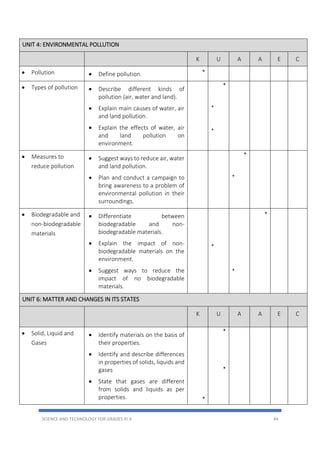
UNIT 4: ENVIRONMENTAL POLLUTION
K U A A E C
 Pollution  Define pollution. *
 Types of pollution  Describe different kinds of
pollution (air, water and land).
 Explain main causes of water, air
and land pollution.
 Explain the effects of water, air
and land pollution on
environment.
*
*
*
 Measures to
reduce pollution
 Suggest ways to reduce air, water
and land pollution.
 Plan and conduct a campaign to
bring awareness to a problem of
environmental pollution in their
surroundings.
*
*
 Biodegradable and
non-biodegradable
materials
 Differentiate between
biodegradable and non-
biodegradable materials.
 Explain the impact of non-
biodegradable materials on the
environment.
 Suggest ways to reduce the
impact of no biodegradable
materials.
*
*
*
UNIT 6: MATTER AND CHANGES IN ITS STATES
K U A A E C
 Solid, Liquid and
Gases
 Identify materials on the basis of
their properties.
 Identify and describe differences
in properties of solids, liquids and
gases
 State that gases are different
from solids and liquids as per
properties. *
*
*
SCIENCE AND TECHNOLOGY FOR GRADES III-X 45
 Investigate that gases flow more
easily than liquids, and in all
directions *
 Processes involving
change in states
 Demonstrate and explain the
processes that are involved in the
change of states (melting,
freezing, boiling, evaporation and
condensation).
*
 Application of
evaporation and
condensation in
nature
 Describe water cycle with help of
diagram
 Describe the role of evaporation
and condensation in the water
cycle by citing examples of rain,
snow, dew, frost.
*
*
UNIT 7 : AIR
K U A A E C
 Air  Investigate that air has weight
and is all around us.
 Provide evidence that air is real
 Explain that air is made of
different gases
 List the names of some of gases
present in air and state how they
are useful.
 State the properties of air and
recognise other gases in the
environment.
 Investigate presence of air spaces
in different soils.
*
*
*
*
*
*
 Uses of gases  Cite examples from everyday life
about uses of gases such as to
make fizzy drinks, use in neon
lights and use of helium to make
floating balloons. etc.
 Explain that substance will
eventually reach the same
temperature as their
*
*
SCIENCE AND TECHNOLOGY FOR GRADES III-X 46
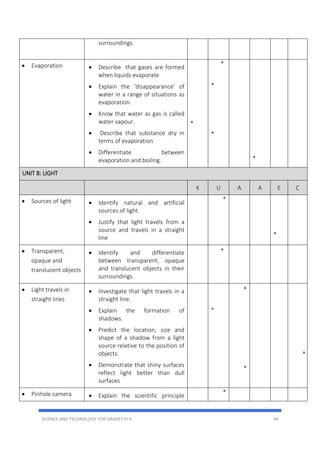
surroundings.
 Evaporation  Describe that gases are formed
when liquids evaporate
 Explain the ‘disappearance’ of
water in a range of situations as
evaporation.
 Know that water as gas is called
water vapour.
 Describe that substance dry in
terms of evaporation.
 Differentiate between
evaporation and boiling.
*
*
*
*
*
UNIT 8: LIGHT
K U A A E C
 Sources of light  Identify natural and artificial
sources of light.
 Justify that light travels from a
source and travels in a straight
line
*
*
 Transparent,
opaque and
translucent objects
 Identify and differentiate
between transparent, opaque
and translucent objects in their
surroundings.
*
 Light travels in
straight lines
 Investigate that light travels in a
straight line.
 Explain the formation of
shadows.
 Predict the location, size and
shape of a shadow from a light
source relative to the position of
objects.
 Demonstrate that shiny surfaces
reflect light better than dull
surfaces
*
*
*
*
 Pinhole camera  Explain the scientific principle
*
SCIENCE AND TECHNOLOGY FOR GRADES III-X 47
that works in a pinhole camera.
UNIT 9: ELECTRICITY
 K U A A E C
Circuit and
switches
 Name and identify the
components of an electric circuit:
battery/cell, bulb, buzzer, circuit,
switches and wires
 Describe the function of basic
electrical components
 Experiment that complete circuit
is needed in order for a circuit to
work
 Describe function of a switch
*
*
*
*
 Simple electric
circuit
 Make a simple circuit using a
lamp, switch, battery and wires.
 Demonstrate open and close
circuit
 Demonstrate how changing the
number or type of component in
a series circuit can make bulbs
glow brighter or dimmer
 Identify good insulating material
used in electricity
*
*
*
 Conductors and
insulators
 Identify various materials as
conductors and insulators using
simple circuit.
*
 Electricity at home  List various electric appliances in
their home and school.
 State the dangers of electricity
and related safety rules
 List examples of items that use
batteries and some that use main
electricity
*
*
*
UNIT 10: SOLAR SYSTEM
K U A A E C
SCIENCE AND TECHNOLOGY FOR GRADES III-X 48
Sun ,Earth and
Moon
 Explain the formation of day and
night
 Represent the Sun, Earth and
Moon by Spheres and use the
model to explain the formation of
day and night, month and year.
 Distinguish between luminous
and non-luminous objects and
recognise objects
 Recognise that the Sun is a
natural source of light and the
Earth and the Moon can be
 seen by reflected light.
 Describe the formation of
different phases of the moon.
 Describe what is meant by
satellite.
 Describe moon as a natural
satellite of Earth.
*
*
*
*
*
*
*
 Stars and planets  Differentiate between a star and
a planet.
 Explain that the Sun is a star.
*
*
 Solar system (Sun
and planets)
 Describe the Sun and its
planetary system showing
position of Earth in our solar
system.
 Explain the relative sizes of the
planets and their distance from
the Sun using a model.
*
*
 Solar and Lunar
eclipse
 Illustrate and explain how solar
and lunar eclipses occur
*
 Seasons  Illustrate and explain how
seasons are formed
*
SCIENCE AND TECHNOLOGY FOR GRADES III-X 49
Part – 2 (Learning Strand: Technology and Technical Education)
Contents
Students’ Learning Outcomes
All students will be able to;
UNIT 11 :
Operating
technical
equipment
 Operate a manual hand-drill machine and a
light electric hand-drill machine to make
small holes in wood and metal sheet pieces.
 Use a metal hack-saw to cut metal sheet or
pieces of pipe.
 Operate a juicer and toaster.
 Practise hand sewing and operate a sewing
machine.
*
UNIT 12: Making
technical devices
 Assemble a torch light using a battery cell,
bulb and wire,
 Make and operate a syphon.
 Prepare LED light strings working with 12Volt
battery.
*
UNIT 13: First aid
and disaster
management
 Use a First Aid box to measure body
temperature and to dress a wound.
 Practise shifting a person to hospital.
 Practise earthquake / fire / flood drill.
*
UNIT 14:
Technical
activities
 Operate mobile phone for use of calculator,
alarm clock and calendar
 Operate mobile phone for audio video
recording
*
SCIENCE AND TECHNOLOGY FOR GRADES III-X 50
5. Learning Contents and Students’ Learning Outcomes Grade VI –VIII
Learning Contents and Students’ Learning Outcomes Grade VI
Part 1 : Learning Strands: Life science, Physical science and Earth & Space science
Contents Students’ Learning Outcomes
Students will be able to:
Unit-1: Cellular Organization of Plants and Animals K U A A E C
1. Cell i. Identify cells as the basic unit of life.
ii. Define cell. *
*
2. Microscope i. Describe the major different parts of a
light microscope and its working.
ii. Set -up a microscope ready for use.
iii. Use a microscope effectively to make
observations.
*
*
*
3. Animal Cell and
Plant Cell
i. Draw, label and describe the basic
structure of an animal cell and a plant cell.
ii. State the function of important parts of
the cell.
iii. Compare and contrast an animal cell with
a plant cell.
*
*
*
4. Unicellular and
Multicellular
Organisms
iv. Differentiate between unicellular and
multicellular organisms with examples.
*
5. Cellular
Organization in
Multicellular
Organisms
v. Recognize the levels of cellular hierarchy
from cell to organ systems in multicellular
organisms.
*
6. Tissues vi. Define tissue with examples.
vii. State the characteristics (locations and
functions) of animal tissues (muscular
tissue, bone and blood) and plant tissues
(epithelial tissue and vascular tissue).
*
*
7. Organs viii. Define organ with examples.
ix. Describe the functions of human organs
*
*
SCIENCE AND TECHNOLOGY FOR GRADES III-X 51
(stomach, lungs and heart).
x. Describe the functions of plant organs
(root, leaf, and stem).
*
8. Organ Systems xi. Recognize root and shoot systems in
plants.
xii. State the functions of the major systems
of the human body (digestive, respiratory
and circulatory systems).
*
*
Unit-2: Sense Organs K U A A E C
1. Sense Organs i. Explain how animals can sense the
changes in environment by using sense
organs.
ii. Enlist names of sense organs.
*
*
2. Nose iii. State the basic structure of nose (receptor
cells in nose) and describe how it provides
the sensation of smell.
*
3. Tongue iv. State the basic structure of tongue (taste
buds on tongue) and describe how it
provides the sensation of taste.
*
Unit-3: Photosynthesis and Respiration in Plants K U A A E C
1. Internal structure
of a leaf
i. Draw, label and describe the internal
structure of a leaf.
ii. Explain that the structure of leaf facilitates
photosynthesis.
*
*
2. Photosynthesis
and Conditions
necessary for this
process
iii. Define photosynthesis (with word
equation) and describe the importance of
this process.
iv. Recognize the importance of water,
carbon dioxide, light, temperature and
chlorophyll for the process of
photosynthesis.
v. Prove with the help of an experiment that
photosynthesis takes place in a leaf.
*
*
*
SCIENCE AND TECHNOLOGY FOR GRADES III-X 52
3. Respiration in
Plants
vi. Define respiration in plants (with word
equation) and describe the importance
and this process.
vii. Compare and contrast the processes of
photosynthesis and respiration in plants.
*
*
Unit-4: Environment and Interactions K U A A E C
1. Environment i. Define environment. *
2. Components of
Environment
ii. Describe the basic components of
environment.
iii. Explain the importance of biotic
components (producers, consumers,
decomposers).
iv. Explain the importance of abiotic
components (light, air, soil, temperature
and water).
*
*
*
3. Relationships
among Organisms
v. Describe that living things depend on one
another for food, shelter and protection.
vi. Describe different relationships between
organisms (Predation, Parasitism, and
Mutualism).
vii. Explain the importance of physical factors
like air, water, temperature, light,minerals
salts and ph to the life of the living
organisms
viii. Describe the adaptations to living in a
variety of habitats and how these help the
organisms to survive (biotic factors)
ix. State that the habitat together with the
organisms living in it forms ecosystem
x. List some examples of ecosystems found
on earth Describe some strategies which
plants adopt to avoid climatic stress
*
*
*
*
*
*
4. Food web i. Define and Describe food web.
ii. Explore and construct food chains in a
particular habitat
iii. Identify food chains within food webs and
describe what a food web shows
*
*
*
SCIENCE AND TECHNOLOGY FOR GRADES III-X 53
iv. Predict how changing the size of one
population in a food web will affect the
numbers of other species
Unit-5: Soil K U A A E C
1. Characteristics of
Soil
i. Describe the characteristics of soil.
ii. Investigate and describe soil components.
iii. Enlist and recognize types of Soil.
*
*
*
2. Types of Soil iv. Identify similarities and differences
among the different types of soil.
v. Compare the absorption of water by
different soils.
vi. Observe and describe the effects of
moving water on different soils.
*
*
*
3. Life in the Soil vii. Investigate and describe how living things
affect and are affected by soils.
*
Unit-6: Atoms, Molecules, Mixtures and Compounds K U A A E C
1. Introduction to
Atoms and
Molecules
i. Define and describe atom and molecule.
ii. Differentiate between an atom and a
molecule.
*
*
2. Some Common
Elements and
their Symbols
iii. Recognize the symbols of some common
elements.
*
3. Classification of
Elements (metals
and non-metals)
iv. Classify elements into metals and non-
metals.
*
4. Uses of Some
Common
Elements
v. Relate the physical properties of elements
to their uses.
*
5. Compounds and
Mixtures
vi. Define and explain compound and
mixture.
vii. Differentiate between elements, by citing
examples.
*
*
6. Uses of
Compounds and
viii. Explain uses of common mixtures and
compounds in daily life.
*
SCIENCE AND TECHNOLOGY FOR GRADES III-X 54
Mixtures
7. Separating
Mixtures
(Sublimation and
Distillation)
ix. Separate mixtures using a variety of
techniques.
x. Demonstrate with an experiment to
separate the components of a mixture.
xi. Use safety measures to conduct science
experiments.
*
*
*
Unit-7: Solutions K U A A E C
1. Solution and its
Components
i. Define solute and solvent and describe
solution.
*
2. Particle Model of
Solution
ii. Explain and demonstrate the formation of
solution by the particle model.
*
3. Water as a
Universal Solvent
iii. Demonstrate the use of water as a universal
solvent.
*
4. Dilute ,
concentrated,
saturated and
unsaturated
aqueous
Solutions
iv. Describe dilute and concentrated
solutions.
v. Define saturated and unsaturated
aqueous solution.
*
*
5. Solubility and
effect of
temperature on
Solubility
vi. Define solubility.
vii. Investigate the effect of temperature on
solubility using a variety of compounds.
*
*
6. Uses of Solutions viii. Identify uses of solution in daily life. *
Unit-8: Simple Machines K U A A E C
1. Wheel and Axle i. Recognize wheel and axle and identify
their uses.
*
2. Pulley and its
Types
ii. Explain pulleys and their kinds with their
uses in daily life.
iii. Investigate with the help of an
experiment the effort up to four pulleys
required by different pulley systems (up
to four pulleys) to lift the same load.
*
*
SCIENCE AND TECHNOLOGY FOR GRADES III-X 55
3. Gear and its Uses iv. Describe the structure of gear and
explain the working of gear systems.
v. Explain the uses of gears in daily life.
*
*
Unit-9: Work and Energy K U A A E C
1. Work i. Explain that work is done when a force
moves a body through some distance.
*
2. Energy ii. Explain that energy provides the ability to
do work and can exist in different forms.
*
3. Forms of Energy iii. Identify different forms of energy
(Potential, Kinetic, Heat, Electrical, Light,
Sound) with examples
iv. Define kinetic and potential energy.
*
*
4. Conversion of
different Forms
of Energy
v. Demonstrate how one form of energy is
converted into other form of energy.
*
5. Conservation of
Energy
vi. Explain that energy is conserved during
conversion of different forms of energy.
*
6. Sources of Energy vii. Describe some non-renewable and
renewable energy sources.
viii. Describe the advantages of using
renewable energy sources.
*
*
Unit-10: Reflection of Light K U A A E C
1. Transmission,
Absorption and
Reflection of Light
i. Differentiate between transmission,
absorption and reflection of light.
*
2. Laws of Reflection ii. Demonstrate the laws of reflection with
the help of ray diagram.
*
3. Regular and
Diffused
Reflection
iii. Compare the regular and diffused
reflection.
iv. Identify everyday applications which
involve regular reflection and diffused
reflection.
*
*
4. Images Formed
by a Plane Mirror
v. Describe image formation by a plane
mirror and mention its characteristics.
*
SCIENCE AND TECHNOLOGY FOR GRADES III-X 56
5. Uses of Reflecting
Surfaces
vi. Describe the uses of reflecting surfaces
(Rear View Mirror, Road Mirrors and
Periscope)
*
Unit-11: Sound K U A A E C
1. Sound as a Form
of Energy
i. Describe sound as a form of energy
produced by a vibrating body.
*
2. Propagation of
Sound
ii. Identify a variety of materials through
which sound can travel.
iii. Identify that the speed of sound in solids,
liquids and gaseous mediums is different.
*
3. Human Ear as
Detector of Sound
iv. Explain how human ear detects sound. *
Unit-12: Space and Satellites K U A A E C
1. Space i. Define the term space and emphasize the
need to explore it.
*
2. Satellites ii. Define the term satellite and describe its
importance.
*
3. Natural
Satellites
iii. Describe natural satellite and mention
the natural satellites of the planets of
solar system.
*
4. Artificial
Satellites
iv. Define artificial satellites and explain
their importance in exploring the Earth
and space.
*
5. Kinds of Artificial
Satellites and
their Uses
v. Recognize the key milestones in space
technology.
vi. Describe the uses of various artificial
satellites in space i.e., Geostationary,
Weather, Landsat, Communication,
Polar, Earth Orbit, and Global Positioning
System.
*
*
6. Space Stations vii. Describe Space Station and its
importance.
*
Part – 2 (Learning Strand: Technology and Technical Education)
SCIENCE AND TECHNOLOGY FOR GRADES III-X 57
Contents
Students’ Learning Outcomes
All students will be able to;
Unit 13: K U A A E C
Farming &
Agriculture
a. Grow seasonal plants and vegetables in
earthen pots and demonstrate the effect
of use of fertilizers on the growth of
plants.
b. Rear domesticated birds and animals such
as pigeon, hen, rabbit etc.
c. Use face mask to investigate the
impurities it prevents from entering
human body.
*
Unit 14: K U A A E C
Food Processing and
Preservation
a. Prepare yoghurt and cheese from milk.
b. Prepare pickles of onion, lemon and
mango etc. in acetic acid.
c. Use different techniques of preserving
foods like orange juice, apple jam.
*
Unit 15: K U A A E C
Operating Electrical
& Electro-
Mechanical
Technical Equipment
a. Operate a sewing machine and adjust the
chain of a bicycle.
b. Operate wood saw and hand drill to make
a wooden chowki or small stool.
c. Operate electro-mechanical toys.
*
Unit 16: K U A A E C
Making Electrical &
Electro-Mechanical
Technical Devices
b. Assemble and operate trip wire security
alarm system.
c. Assemble mini solar panel and operate a
small fan.
d. Assemble a periscope from mirrors and
plastic pipe.
SCIENCE AND TECHNOLOGY FOR GRADES III-X 58
Learning Contents and Students’ Learning Outcomes Grade VII
Part 1 (Learning Strands: Life science, Physical science and Earth & Space science)
Contents Students’ Learning Outcomes
Students will be able to:
Unit-1: Human Organ Systems K U A A E C
1. Human Digestive
System
i. Define digestion and describe its
importance.
ii. Identify the parts of human digestive
system (oral cavity, pharynx, oesophagus,
stomach, small and large intestine) and
describe their functions.
*
*
2. Human
Respiratory
System
iii. Identify the parts of human respiratory
system (nose, pharynx, larynx, trachea,
bronchi and lungs) and describe their
functions.
*
Unit-2: Transport in Humans and Plants K U A A E C
1. Transport in
Humans
i. Describe the concept of transportation
and its importance.
ii. Identify the parts of human blood
circulatory system (heart and blood
vessels).
iii. Describe the structure heart (four
chambers) and blood vessels (arteries,
veins, capillaries), with their functions.
*
*
*
2. Transport of
Water in Plants
iv. Describe absorption of water in plants
through roots.
v. Explain how water and salts are
transported from roots to the aerial parts
of plant.(Xylem tissues)
*
3. Transport of
Food in Plants
vi. Explain how food is transported from one
part of the plant to the other. (Phloem
tissues)
*
Unit-3: Reproduction in Plants K U A A E C
SCIENCE AND TECHNOLOGY FOR GRADES III-X 59
1. Kinds of
Reproduction in
Plants
i. Define reproduction and differentiate
between sexual and asexual reproduction
in plants.
*
2. Flower ii. Draw, label and describe the structure of
flower.
*
3. Pollination and
its types
iii. Define pollination.
iv. Compare self and cross- pollinations in
plants with examples.
v. List various agents involved in cross-
pollination.
*
*
*
4. Fertilization in
Plants
vi. Describe how, after pollination,
fertilization occurs in flowers.
*
5. Formation of
Fruit and Seed
vii. Describe seed and fruit formation. *
6. Germination of
Seed
Define germination and describe the
conditions necessary for germination.
Study and state the steps of germination of
bean seed.
*
Unit-4: Air and Water K U A A E C
1. Air and its
importance
i. Recognize the importance of air. *
2. Composition
of Air
ii. Identify the composition of air. *
3. Properties and
uses of Gases in
Air
iii. Describe the properties of gases (Oxygen,
Nitrogen, Carbon dioxide) in air and some
of their uses.
iv. Identify the sources of carbon dioxide and
explain how its level is maintained in
nature.
*
4. Water for Life v. Describe the ways in which clean water is
vital for meeting the needs of humans and
other living things.
*
5. Sources of
Water
vi. Identify the sources of water. *
SCIENCE AND TECHNOLOGY FOR GRADES III-X 60
6. Impurities of
Water
vii. Recognize the substances present in water
that makes the water impure.
*
7. Cleaning of
Water
viii. Suggest different methods to clean the
impure water (Distillation, Water
Treatment Plant).
*
8. Uses of Water ix. Investigate the uses of water in our daily
life (drinking, House hold use, Irrigation,
Industrialise). and suggest ways to reduce
the wastage of water.
*
Unit-6: Structure of an Atom K U A A E C
1. Structure of an
Atom
i. Describe the structure of an atom
(protons, neutrons and electrons).
*
2. Atomic Number
and Mass
Number
ii. Define atomic number and mass number. *
3. Elements and
their Symbols
iii. Describe elements and their symbols. *
4. Distribution of
Electrons in
Shells (KLM
only) using 2n2
Formula
iv. Draw diagrams of the atomic structures of
the first 13 elements in the Periodic Table.
*
5. Valence and
Ions
v. Define Valency.
vi. Explain the formation of ions.
vii. Differentiate between cations and anions.
*
*
6. Elements make
Compounds
viii. Identify the types and number of elements
present in simple molecules and
compounds.
*
7. Chemical
Formulae
ix. Make chemical formulae from list of
anions and cations.
*
8. Law of Constant
Composition
x. State the law of constant composition and
give examples.
*
Unit-7: Physical and Chemical Changes and Processes K U A A E C
1. Physical and
Chemical
i. Define and differentiate between physical *
SCIENCE AND TECHNOLOGY FOR GRADES III-X 61
Changes and chemical changes.
ii. Identify the physical and chemical changes
taking place in environment.
*
2. Applications of
Chemical
Changes in
everyday life
iii. Explain the uses of natural gas and
petroleum as fuels and in fertilizers.
iv. Explain the chemical changes involved in
(burning wood, mixing acid and base:
lemon juice and baking soda, rusting of
iron)
*
3. Safe Use of
Chemicals
v. Discuss the safe uses and harmful effects
of improper use of chemicals (Battery aid.)
*
Unit-8: Heat and Temperature K U A A E C
1. Heat and
Temperature
i. Describe heat and temperature and
distinguish between these terms.
*
2. Modes of Heat
Transfer
ii. Explain that temperature determines the
flow of heat energy from one body to
another.
iii. Explain conduction, convection and
radiation as the modes of heat transfer.
*
3. Conduction and
its application in
everyday life
iv. Describe conduction and its applications in
everyday life.
*
4. Good and Poor
Conductors of
Heat
v. Identify good and poor conductors of
heat.
*
5. Convection and
its application in
everyday life
vi. Demonstrate convection currents in water
and air and describe some applications of
convection in everyday life including
natural phenomena.
*
6. Radiation and its
application in
everyday life
vii. Describe radiation by experimentation
and its applications in everyday life.
*
7. Good and Poor
Radiators and
Absorbers of
Heat
viii. Give examples of good and poor radiators
and absorbers of heat.
*
SCIENCE AND TECHNOLOGY FOR GRADES III-X 62
8. Vacuum Flask ix. Describe the working of vacuum flask with
reference to all modes of heat transfer.
*
Unit-9: Refraction of Light K U A A E C
1. Refraction i. Define and Explain refraction of light. *
2. Refraction in
different
Mediums
ii. Discuss the refraction of light in different
mediums (glass and water).
*
3. Laws of
Refraction
iii. Demonstrate the laws of refraction with
the help of ray diagram.
*
4. Colours of Light iv. Demonstrate how spinning of a coloured
wheel results in the appearance of white
disc (Newton’s colour discs) to show that
light consists of seven colours.
v. Identify different uses of lights of different
colours in everyday life (traffic lights).
*
*
5. Colours of
Objects
vi. Explain why an opaque or non-luminous
object appears to be of certain colour.
*
Unit-10: Sound Waves K U A A E C
1. Waves –
Transverse and
Longitudinal
i. Define wave and demonstrate transverse
and longitudinal waves.
*
2. Sound as a
Compressional
Wave
ii. Explain sound as a series of compressions
and rarefactions in air.
*
3. Audible
Frequency Range
iii. Identify the wavelength, frequency and
amplitude of sound and give their units.
iv. Compare audible frequency range of
humans and different animals.
*
4. Characteristics of
Sound
v. Describe pitch and loudness of sound. *
5. Applications of
different Sounds
in everyday life
vi. Investigate objects in homes and
surroundings that are designed and made
to produce different sounds (door bell,
security alarms and musical instruments).
*
SCIENCE AND TECHNOLOGY FOR GRADES III-X 63
Unit-11: Electric Current and Circuits K U A A E C
1. Potential
Difference,
Current and
Resistance
i. Define potential difference, current, and
resistance and state their units.
ii. Demonstrate the relationship between
potential difference and current.
*
2. Sources of
Potential
Difference /
Voltage
iii. Identify cell or battery as source of
potential difference / voltage.
*
3. Instruments used
for measuring
Potential
Difference,
Current and
Resistance
iv. Identify the instruments used for
measuring potential difference, current
and resistance.
*
4. Effects of an
Electric Current
v. Demonstrate the effects of electric
current (heating, chemical and magnetic
effects).
*
Unit-12: Exploring Space K U A A E C
1. Tools and
Technologies
used in Space
Exploration
i. Explain the necessity and advantages of
space vehicles for detailed exploration of
the outer space.
ii. Describe different types of space vehicles
e.g. Manned and Unmanned Spacecraft
(Space Probe), Space Shuttle and Space
Station.
*
*
2. Astronauts in
Outer Space
iii. Explain how astronauts survive and work
in space.
*
3. Benefits of Space
Technology
iv. Identify benefits of new technologies such
as weather satellite, satellite
communication, GPS, …
*
SCIENCE AND TECHNOLOGY FOR GRADES III-X 64
Part – 2 : Learning Strand: Technology and Technical Education
Contents
Students’ Learning Outcomes
All students will be able to;
Unit 13:(A) K U A A E C
Farming &
Agriculture (For
Male Students)
a. Perform soil testing to select appropriate
fertilizers.
b. Demonstrate to drip & sprinkle irrigation.
c. Develop crops in a tunnel farming
environment.
*
Unit 13(B): K U A A E C
Embroidery, Dress
making & Fashion
Designing (For
Female Students)
a. Do embroidery work on an automatic
embroidery machine.
b. Make a school uniform on motor operated
sewing machine.
c. Stitch simple Bib/ apron with pocket on
sewing machine.
*
Unit 14: K U A A E C
Making Electrical &
Electro-Mechanical
Technical Devices
a. Install & operate solar photovoltaic panel
to run a fan or charge a battery.
b. Install & operate a sound / public address
system.
c. Assemble a small solar thermal panel for
heating water.
d. Assemble an astronomical telescope or
periscope and use it.
*
Unit 15: K U A A E C
Technical &
Computer Drawing
a. Use Paintbrush or ColorPaintU12 software
to make elementary technical drawings.
b. Use Coral Draw for making simple designs.
*
SCIENCE AND TECHNOLOGY FOR GRADES III-X 65
Learning Contents and Students’ Learning Outcomes Grade VIII
Part 1: Learning Strands: Life science, Physical science and Earth & Space science
Contents Students’ Learning Outcomes
Students will be able to:
Unit-1: Human Organ Systems K U A A E C
1. Human Nervous
System
i. Describe coordination and its importance.
ii. Describe the structure of the nervous
system (parts of Central and Peripheral
nervous system).
iii. Describe the working of the nervous
system through Stimulus-Response model.
iv. Describe briefly the structure of neuron
and its role in coordination.
*
2. Reflex Action v. Differentiate between voluntary and
involuntary actions they have experienced.
vi. Explain reflex action with an example.
*
*
3. Human Excretory
System
vii. Define excretion and describe its
importance.
viii. Describe the components of human
excretory system (kidneys, ureters, urinary
bladder and urethra)
*
*
4. Structure and
Function of
Kidneys
ix. Describe the internal structure of the
kidney (Longitudinal Section showing
nephron).
x. Describe the role of kidney (Steps of urine
formation).
*
Unit-2: Heredity in Organisms K U A A E C
1. Chromosomes,
DNA and Genes
i. Describe the relationship between DNA,
genes and chromosomes.
ii. Identify DNA and chromosomes in the cell
diagram.
*
2. Cell Division iii. Define cell division, its types (mitosis and
meiosis) and their importance.
SCIENCE AND TECHNOLOGY FOR GRADES III-X 66
3. Heredity iv. Define heredity and recognize its
importance.
v. Identify the characteristics that can be
transferred from parents to offspring.
vi. Compare characteristics related to ear
shape and eye colour.
*
*
Unit-3: Biotechnology K U A A E C
1. Biotechnology i. Define biotechnology.
ii. Describe the features of bacteria and
yeasts that enable them to be used in
biotechnology.
*
*
2. Introduction of
Gene into
Bacterium
iii. Explain how genes are introduced into a
bacterium.
*
3. Biotechnology
Products
iv. List some biotechnological products
(insulin, vaccines etc.) used in daily life.
*
4. General
Applications of
Biotechnology
v. List general applications of biotechnology
in various fields i.e. agriculture,
environment, food and health.
*
Unit-4: Pollutants and their Effects on Environment K U A A E C
1. Air Pollutants
and their
Sources
i. Identify main air pollutants (sulphur
dioxide, carbon monoxide, oxides of
nitrogen and chloro-fluorocarbons) and
their sources.
ii. Plan and conduct a campaign that can help
to reduce air pollution in the local
environment.
*
*
2. Effects of Air
Pollutants on
Human Health
iii. Explain the effects of air pollutants on
human health (lung diseases, brain
damage, breathing problems etc.)
*
3. Impacts of
Pollution on
Environment
iv. Explain the Greenhouse effect.
v. Describe the causes and effects of ozone
depletion.
vi. Carry out a research to explain global
warming and its likely effects on life on
Earth.
SCIENCE AND TECHNOLOGY FOR GRADES III-X 67
vii. Design a model to explain the Greenhouse
effect.
viii. Explain the formation of acid rain and
identify its consequences
*
4. Deforestation
and its effects
ix. Define deforestation.
x. State the effects of deforestation on the
environment.
*
5. Saving the Earth xi. Suggest ways in which earth can be made a
better place to live (less use and reuse of
resources, recycling of materials,
environmental campaigns etc.).
*
Unit-5: Chemical Reactions K U A A E C
1. Chemical
Reactions
i. Define chemical reactions and give
examples.
ii. Explain the re-arrangement of atoms in
chemical reactions.
*
*
2. Chemical
Equation
iii. Explain the chemical reaction with help of
equation.
*
3. Law of
Conservation of
Mass
iv. Explain the law of conservation of mass. *
4. Energy Changes
in Chemical
Reactions
(Exothermic and
Endothermic
reactions)
v. Explain the energy changes in chemical
reactions.
vi. Describe the importance of exothermic
reactions in daily life.
*
Unit-6: Acids, Bases and Salts K U A A E C
1. Introduction to
Acids, Bases and
Salts
i. Define with examples the terms acid, base
and salt.
*
2. Properties of
Acids, Bases and
Salts
ii. Describe the properties of acids, bases and
salts.
3. Uses of Acids, iii. Explain the uses of acids, bases and salts in
SCIENCE AND TECHNOLOGY FOR GRADES III-X 68
Bases and Salts daily life.
4. Indicators and
their Uses
iv. Define indicators and describe their use to
identify acids, bases and neutral
substances.
5. Natural
Indicators from
Fruits and
Vegetables
v. Investigate various flowers and vegetables
which can be used as indicators to identify
the nature of aqueous solution.
*
Unit-7: Measurements of Physical Quantities K U A A E C
1. Physical
Quantities
(Length, Volume,
Mass, Time)
i. Define a physical quantity with examples. *
2. System
International
Units (Metre,
Litre, Kilogram
and Second)
ii. Interpret System International (SI) units in
the daily life.
iii. Explain why it is desirable for a scientist to
use the SI units in their work.
iv. Apply the prefixes milli-, kilo-, centi-, and
interpret the units.
v. Interconvert smaller units and bigger units.
*
*
*
3. Instruments for
Measurements
vi. Select and use proper measuring
instruments (Metre Rule, Measuring
Cylinder, Physical Balance and Stop Watch)
for physical measurements.
vii. Measure the physical quantities by using
Metre Rule, Measuring Cylinder, Physical
Balance and Stop Watch.
*
*
Unit-8: Force and Pressure K U A A E C
1. Force, Area and
Pressure
i. Define the terms force, area and pressure
and mention their SI units.
ii. Give examples of high and low pressure.
2. Fluid Pressure iii. Demonstrate variation of liquid pressure
with depth.
iv. Explain that pressure is exerted equally in
all directions.
*
SCIENCE AND TECHNOLOGY FOR GRADES III-X 69
3. Hydraulic
Systems
v. Explain hydraulic systems by giving
examples.
*
4. Atmospheric
Pressure
vi. Describe the term atmospheric pressure
and explain how it affects the weather.
5. Applications of
Gas Pressure
(Pneumatic
System and
Aerosol)
vii. Identify the applications of gas pressure
including the working of aerosols.
*
Unit-9: Thermal Expansion K U A A E C
1. Thermal
Expansion of
Solids
i. Explain thermal expansion of solids and its
effects in daily life.
*
2. Thermal
Expansion of
Liquids and it
applications
ii. Explain thermal expansion of liquid and
describe its uses e.g. thermometer.
3. Peculiar
Behaviour of
Water during
Contraction and
Expansion
iii. Describe the peculiar behaviour of water
during contraction and expansion and its
effects on marine life.
4. Thermal
Expansion of
Gases
iv. Demonstrate the thermal expansion of
gases.
v. Describe the use of thermal expansion of
gases.
Unit-10: Spherical Mirrors and Lenses K U A A E C
1. Spherical Mirrors
and their types
i. Define mirror and describe its types (Plane,
Convex and Concave mirrors).
ii. Describe the terminologies used in
spherical mirrors and lenses.
*
2. Image Formation
by Spherical
Mirrors using Ray
Diagrams
iii. Describe the principle of image formation
by spherical mirror and lens by three
principle rays.
iv. Explain image formation by spherical
mirrors using ray diagrams.
*
SCIENCE AND TECHNOLOGY FOR GRADES III-X 70
3. Lenses and their
types
v. Define lens and differentiate between the
different types of lenses (Converging and
Diverging lenses).
*
4. Image Formation
by Lenses using
Ray Diagrams
vi. Describe the image formation by lenses
using ray diagrams.
5. Image Formation
in Simple Camera
and Human Eye
vii. Compare the working of a human eye with
the simple camera.
*
6. Uses of Spherical
Mirrors and
Lenses
viii. Identify the types of lenses and mirrors
used for various purposes in daily life.
*
Unit-11: Electricity in Action K U A A E C
1. Direct and
Alternating
Current
i. Explain direct current (DC) and alternating
current (AC) and describe their uses.
2. Sources of D.C
and A.C
ii. Describe the sources of A.C and D.C.
iii. Compare the advantages and dis
advantages of D.C and A.C .
iv. Demonstrate that D.C can be produce by
chemical reaction in different types of
batteries such as Zn- C and lead – acid cell.
v. Use photovoltaic cell to generate D.C and
operate a fan with it.
3. Dynamo and
Generator
vi. Identify the simple devices that generate
electricity in daily life such as dynamo and
generator.
4. Working of a
Power Station
vii. Describe the working of a power station by
giving a block diagram.
viii. Describe energy sources to generate
electricity in power stations.
5. Problem of
Generating
Electricity
Relate problems involved in generating
electricity.
6. Hazards and
Safety Measures
ix. Describe the hazards of electricity.
SCIENCE AND TECHNOLOGY FOR GRADES III-X 71
for using
Electricity at
home
x. Describe safe use of electricity by using a
fuse, earth wire and circuit breakers.
Unit-12: Investigating Universe K U A A E C
1. Star and
Constellations
i. Recognize stars by different constellations
ii. Explain stars are shining objects of gases.
2. Life of Stars
(Birth and Death
of Stars)
iii. Describe the life cycle of a star (blue giant,
white and red giant, red dwarf, white
dwarf, supernova, neutron stars and black
holes).
3. Asteroids,
Comets and
Meteoroids
iv. Describe asteroids, comets and meteoroids
with the help of examples.
4. Galaxies v. Describe galaxy a huge collection of stars.
vi. Discuss types of galaxies (milky way and
Andromeda)
SCIENCE AND TECHNOLOGY FOR GRADES III-X 72
Part – 2: Learning Strand: Technology and Technical Education
Contents
Students’ Learning Outcomes
All students will be able to;
Unit 13: K U A A E C
Elementary
Construction
Technology
a. Do the basic brick work using brick &
mortar.
b. Plaster a brick wall.
c. Demonstrate the method of tile fixing.
*
Unit 14: K U A A E C
Making Techno-
Chemical Products
a. Demonstrate the making of writing ink
from primary dyes.
b. Demonstrate the making and use of
distemper and paints.
c. Make tooth paste & detergent powder.
*
Unit 15: K U A A E C
Making Electrical &
Electro-Mechanical
Technical devices
a. Assemble and operate a simple wind
turbine to produce electricity.
b. Use a pressure gauge to monitor the level
of water in overhead tank.
c. Demonstrate the functioning of air
compressor and operate a pneumatic tool
such as drill machine or screw driver with
it.
d. Demonstrate the working of UPS and use it
to operate fan or energy saver bulb.
e. Make a two-way light switch for stairs/.
f. Assemble and operate a concave mirror
type solar cooker.
SCIENCE AND TECHNOLOGY FOR GRADES III-X 73
6. Learning Contents and Students’ Learning Outcomes Grade IX-X
Part 1: Learning Strands: Life Science, Physical Science, Earth & Space Science
Contents Students’ Learning Outcomes
Students will be able to:
UNIT-1: NATURE AND ROLE OF SCIENCE AND TECHNOLOGY K U A A E C
 Nature and
History of
Science
 Define science and briefly explain the history
of science.
 Describe how the nature of science &
technology makes it different from other
modes of knowledge.
*
*
 Science and
Islam
 Explain the concept of science in Islam that
how Islam supports the acquisition of
scientific knowledge.
*
 Disciplines of
Science and
their Inter-
Relationship
 Describe branches of science and their inter-
relationship.
*
 Eminent
Muslims
Scientists
 Describe the contributions of some eminent
Muslim scientists e.g. Jabar Bin Hayyan,
Muhammad Bin Zikrya Al-Razi, Abni-ul-
Haitham, Al-Bairuni and Bu Ali Sina in science.
*
 Eminent
Pakistani
Scientists
 Describe the contributions of some eminent
Pakistani scientists e.g. Dr. Abdus Salam, Dr.
Abdul Qadeer Khan, Dr. Munir Ahmad, Dr.
Ashfaq Ahmad, Dr. Samar Mubarak Mand, Dr.
Atta ur Rehman, Dr. Muzaffar Ahmad, Dr.
Syed Irtifaq Ali, Dr. Umar Saif and Dr. Nargis
Mavalvala in science.
*
 Limitations
and
Development
of Science
 Describe the limitations of science &
technology and its prospects for future
development.
*
UNIT-2: FOOD AND HEALTH K U A A E C
SCIENCE AND TECHNOLOGY FOR GRADES III-X 74
 Major
Components
of Food
 Explain the major components of food i.e.
carbohydrates, proteins, fats, vitamins and
minerals, water, fibre etc.
 Describe the biochemistry of the basic
components i.e. carbohydrates, fats and
proteins of food.
*
 Metabolism
of Food
 Describe metabolism and utilization of
carbohydrates, fats and proteins in human
body.
*
 Enzymes and
their Role in
Metabolism
 Define enzymes and describe their role in
metabolism.
*
 Energy Values
of Different
Foods
 Explain energy values of different foods and
human energy requirements regarding age,
gender, body size, climate and working
conditions.
*
 Balanced Diet
and Dietary
Disorders
 Define balanced diet and describe the
importance of balanced diet to different age
groups.
 Explore the reasons for dietary disorders
(Malnutrition, under nutrition, overeating
and obesity).
*
 Necessary
Factors for
Healthy Life
 Discuss the necessary factors i.e. cleanliness,
sleep and rest, abuses of drugs & smoking,
physical fitness / exercise etc. for healthy life.
*
UNIT-3: BLOOD AND ITS FUNCTIONS K U A A E C
 Blood
Composition
 Describe the composition of blood i.e.
plasma, red blood cells, white blood cells,
platelets.
*
 Functions of
Blood
 Describe the major functions of blood.
 Blood Groups  Identify different blood groups and its
importance.
*
 Blood
Transfusion
 Explain why blood transfusion is important to
save human life and the precautionary
measures to be adopted during blood
*
SCIENCE AND TECHNOLOGY FOR GRADES III-X 75
transfusion.
UNIT-4: ENERGY SOURCES K U A A E C
 Work and
Energy
 Describe work and energy with examples. *
 Different
Forms of
Energy
 Describe different forms of energy like
kinetic energy, potential energy, elastic
potential energy, chemical energy, heat
energy, light energy, electrical energy and
nuclear energy.
*
 Inter-
Conversion of
Energy
 Explain how one form of energy is converted
into another form of energy.
*
 Energy
Sources and
their
Significance
 Identify the role of energy sources play in
the development of a country and explain
that the limited energy sources are available
to Pakistan.
 Describe different energy sources (fossil
fuels, hydrogen as fuel, nuclear energy,
hydal, wind, tidal, geo-thermal, biomass and
solar energy) and their significance.
*
*
 Demand and
Production of
Electrical
Energy
 Recognize the demand of electrical energy
and its use in daily life.
 Describe various methods for production of
electrical energy like hydro-electric power,
thermal power, nuclear power, solar power,
wind power, tidal power, geo-thermal
power with block diagrams.
*
*
 Measurement
of Energy
(Natural Gas
and Electricity)
 Recognize methods of measurement of
energy (natural gas and electricity), their
units and instruments to measure the same.
*
 Energy
Consumption
and
Conservation
 Recognize environmental issues associated
with power generation.
 Describe energy consumption and evaluate
the ways of conservation and effective
utilization of the available energy sources in
Pakistan.
SCIENCE AND TECHNOLOGY FOR GRADES III-X 76
 Energy and
the
Environment;
Nuclear Fuel
Hazards-
Remedial
Measures
 Analyze various factors existing in their
surroundings leading to thermal pollution,
fossil fuel pollution and nuclear fuel hazards
and suggest remedial measures to
overcome it.
*
 Conservation
and
Management of
Energy Sources
 Suggest various methods of conservation
and management of energy sources.
*
UNIT-5: CHEMISTRY IN EVERYDAY LIFE K U A A E C
 Carbon and
its
Importance
 Explain the importance of carbon in daily life. *
 Forms of
Carbon
 Identify the allotropic and non-allotropic
forms of carbon.
*
 Chemical
Composition
of Common
Materials
used in our
Daily Life
 Identify the chemical composition of
common materials such as plastic, polyester,
nylon, polythene, polystyrene, rubber, glass,
sugar, table salt, soaps and detergents
(washing powder).
*
 Water, its
Importance
and
Properties
 Describe the importance and properties of
water.
*
 Air, its
Importance
and
Properties
 Describe the importance and properties of
air.
*
 Role of
Different
Gases in Air
 Identify role of different gases i.e. oxygen,
nitrogen and carbon dioxide in air.
*
 Rare Gases
and their Uses
 Define and explain rare gases and their uses. *
 Important
Elements and
 Describe the physical and chemical
properties of elements like iron, copper,
*
SCIENCE AND TECHNOLOGY FOR GRADES III-X 77
their Physical
and Chemical
Properties
and Uses
aluminium, silver, gold, magnesium, calcium,
phosphors, chlorine, fluorine and iodine and
their uses in daily life.
 Impact of
Production of
Chemical
Products on
our Lives and
Environment
 Investigate how the production of chemical
products (aerosol, CFCs, fertilizers,
pesticides) has an impact on our lives and
environment.
*
 Chemical
Changes in
the Events
that we
Encounter
Daily
 Find examples of chemical changes in the
events that we encounter daily (burning,
rusting, fermentation, respiration and
decaying).
*
 Recycling of
Elements and
Chemical
Compounds
and its
Benefits
 Identify the recycling of elements and
compounds (copper, iron, aluminium, plastic,
glass, paper and rubber) and its benefits.
*
UNIT-6: WATER RESOURCES K U A A E C
 Water
Resources in
Pakistan
 Recognize the various sources of water
available on Earth.
 Discuss the availability of freshwater on Earth
and in our country.
*
 Utilization of
Water
Resources in
Pakistan and
Emerging
Issues
 Describe the utilization of water resources in
Pakistan and explain the issues / problems
Pakistan is facing in utilizing the water
resources effectively especially in agriculture
and industry.
*
 Growing
Demand for
Water
Resources
 Describe the implication of the growing
demand of water in the world and in our
country.
*
 Threats to
Water
Resources
 Explain that water resources are facing
serious threats such as pollution, climate
change, urban growth and landscape
*
SCIENCE AND TECHNOLOGY FOR GRADES III-X 78
changes (deforestation) that are mainly
caused by human activity.
 Water
Reclamation
(Waste
Water
Treatment)
 Identify methods of reclamation and
recycling of water in industry.
*
 Recharging of
Groundwater
and its
Management
 Describe the methods of recharging of
groundwater for the stability of water table.
*
Part – 2 (Learning Strand: Technology and Technical Education)
UNIT-7: TECHNOLOGY IN POWER GENERATION K U A A E C
 Introduction
to generator
of fossil fuel
energy
 Demonstrate generation of electricity
through steam turbines, gas turbines and oil
engines
*
 Introduction
to generator
of renewable
energy
 Demonstrate generation of electricity
through water turbines, wind turbines and
solar cells
 Power
transmission
and
distribution
 Assemble simple power transmission line
operating on batteries
*
 Introduction
to micro
power
projects
 Fabricate a small micro power units using a
simple water turbine
UNIT-8: TECHNOLOGY IN AGRO CHEMICAL AND CHEMICAL
INDUSTRY
K U A A E C
 Introduction
to fertilizers
 Recognize different types of fertilizers *
 Introduction  Practice use of different fertilizers as per type
SCIENCE AND TECHNOLOGY FOR GRADES III-X 79
to pesticides of soil
 Identify proper use of domestic pesticide
 Development
of paints and
distempers
 Develop simple paints and distempers taking
guidance from internet.
 Development
of cosmetics
and
detergents
 Develop cosmetic, soap and detergents
getting tips from internet.
SCIENCE AND TECHNOLOGY FOR GRADES III-X 80
Learning Contents and Students’ Learning Outcomes Grade X
(Learning Strands: Life Science, Physical Science, Earth & Space Science and Technology &
Technical Education)
Contents Students’ Learning Outcomes
Students will be able to:
UNIT-1: HUMAN DISEASES K U A A E C
 Infectious
Diseases
 Define infectious disease and give
examples.
*
 Viral Infections /
Diseases
 Briefly describe the symptoms; causes
and treatments of viral diseases i.e., flu,
measles, smallpox, polio, dengue fever,
hepatitis and HIV-AIDS.
 Design brochures and conduct walks for
drug free society
*
 Bacterial
Infections /
Diseases
 Briefly describe the symptoms; causes
and treatments of bacterial diseases i.e.,
typhoid, cholera, tuberculosis, whooping
cough, diphtheria and tetanus.
*
 Fungal Infections
/ Disease
 Briefly describe symptoms, cause and
treatment of fungal infection Ring Worm
*
 Diseases by
other Parasites
 Briefly describe the symptoms; causes
and treatments of diseases caused by
other parasites i.e., malaria, thread
worms, round worms (Ascaris).
*
 Prevention and
Cure
(Vaccination,
Antibiotic etc.)
 Describe the importance of vaccination
for prevention of different diseases i.e.
polio, measles, hepatitis etc.
 Sate the role of antibiotics for the
treatment of bacterial infections and
describe the safe usage of antibiotics.
*
 Emergency and
First Aid
 Describe the first aid of dog bites, snake
bites, insect bites and artificial
respiration and role play the same
situations for the First-Aid.
*
SCIENCE AND TECHNOLOGY FOR GRADES III-X 81

UNIT-2: ENVIRONMENTAL PROBLEMS AND MANAGEMENT K U A A E C
 Regional and
Global
Environmental
Problems and
Natural
Disasters
 Describe the regional and global
environmental problems such as ozone
depletion, global warming, acid rain,
greenhouse effect, desertification and
climate change, solid and hazardous
wastes.
 Describe the natural disasters caused by
earthquakes, landslides, floods and
storms etc.
*
 Environmental
Pollution and
its Types
 Explain environment pollution and its
different types. *
 Measures to
Reduce
Environmental
Pollution
 Explain different methods to reduce
environmental pollution.
*
 Growth of
Human
Population
 Assess how the size and the rate of
growth of human population are
determined by birth rate, death rate,
immigration, migration, urbanization
and carrying capacity of the
environment.
*
 Impact of
Human
Overpopulation
on
Environment
 Explain the impact of overpopulation on
the environment.
*
 Conservation of
Wildlife and
Marine Life and
Endangered
Species
 Describe the importance of wildlife and
marine life and how we can protect
endangered species. *
 Legislation or
Laws on
Environmental
Problems and
 Recognize the legislation or laws on
environmental pollution such as ozone
depletion, global warming, air pollution,
water pollution and on drinking water
*
SCIENCE AND TECHNOLOGY FOR GRADES III-X 82
Related Matters quality and toxic substances.
UNIT-3: CHEMICAL REACTIONS AND THEIR APPLICATIONS K U A A E C
 Chemical
Reactions in
Everyday Life
and their
Applications
 Recognize the characteristics which
indicate that a chemical reaction has
taken place.
 Describe the chemical reactions that
take place in preparation of soaps and
detergents, lead storage batteries and
bakery products etc.
 Relate chemical reactions to familiar
processes encountered in everyday life
e.g., reactions in food processing, fabric
and hair dyeing, agriculture and mineral
processing.
*
*
 Important
Industries in
Pakistan
 Describe the chemical reactions and
processes involved in different
industries e.g. sugar, steel, synthetic
fiber, chemical fertilizers, garments,
leather, pharmaceuticals, cement, pulp
and paper and acid industry etc.
*
 Methods for the
Disposal of
Waste
Chemicals
 Describe the impact and safe disposal of
waste chemicals.
UNIT-4: ELECTRICITY IN EVERYDAY LIFE K U A A E C
 Static Charges,
their
Characteristics
and Effects
 Describe the characteristics and effects
of static charges.
*
 Electronic and
Conventional
Current
 Differentiate between electronic and
conventional current.
 Describe various terms i.e. potential
difference, resistance relating to current
electricity and Ohm’s law.
*
 Electrical
Circuits and
their
 Describe household wiring and typical
components e.g. switches, fuses, circuit
breakers, capacitors and transformers
*
SCIENCE AND TECHNOLOGY FOR GRADES III-X 83
Components
used in
Everyday Life
etc.
 Electrical
Measuring
Instruments
 Explain the working of different
electrical measuring instruments e.g.
Ammeter, Voltmeter, Ohmmeter and
multi-meter (analogue and digital).
*
 Safety Measures
 Describe safety measures related to the
use of electricity in homes, school or
community e.g. choose an appropriate
fuse or circuit breaker for a specific
circuit and handle electric hazards.
 Practical Uses of
Static and
Current
Electricity and
their Impact on
Everyday Life
 Identify different phenomena related to
electrostatic charges in everyday life
e.g., use of an electrostatic paint sprayer
for uniform paint; use of electrostatic
insect killers, use of photocopier, use of
lightning conductors to protect
buildings, use of static straps to reduce
charge build-up in automobiles and use
of electrostatic precipitators to decrease
pollution.
*
 Social,
Economic and
Environmental
Costs and
Benefits of the
Methods of
Electrical Energy
Production used
in Pakistan
 Describe a plan for a self-contained
system to generate energy, using
renewable energy resources, to meet
the energy requirements of a dwelling,
farm, or community in Pakistan. *
UNIT-5: SPACE AND NUCLEAR PROGRAMME OF PAKISTAN K U A A E C
 Importance of
Space
Exploration
 Describe space exploration and its
benefit to Science and Technology. *
 Space
Programme of
Pakistan
 Know landing of man on Moon,
communication and weather satellites,
rockets and space shuttles.
 Discuss Pakistan’s space programme and
the contribution that SUPARCO has
*
*
SCIENCE AND TECHNOLOGY FOR GRADES III-X 84
made in the development and progress
of our country.
 Pakistan’s
Missile
Programme
 Describe Pakistan’s missile programme
and recognize that the advancement in
the missile programme of the country is
the best deterrent for national defence.
*
 Nuclear Power
Programme of
Pakistan
 Discuss the contributions of Pakistan
Atomic Energy Commission (PAEC) in the
development and progress of our
country.
 Explain nuclear power programme of
Pakistan used for peaceful purposes in
power generation and nuclear
medicines.
*
Part – 2 (Learning Strand: Technology and Technical Education)
UNIT-6: TECHNOLOGY IN HEALTH CARE K U A A E C
 X-Rays  Explain how X-rays are produced and
used for diagnostic processes.
*
 Ultra Sound  Explain the basic working of an ultra
sound instrument.
 ECG, EEG, MRI,
CT Scan,
Angiography
 Recognize that there are two types of
ultra-sonic equipment working
diagnostic and therapeutic.
 Examine the working of ECG, FEG, MRI,
CT Scan and Angiography systems.
UNIT-7: TECHNOLOGY IN EVERYDAY LIFE K U A A E C
 Communication  Practice use of receiver – transmitters in
communication.
*
 Security
Services
 Demonstrate use of CCTV camera and
metal detectors
 Weather
Forecasting
 Assemble simple equipment used in
weather forecasting
 Transportation  Understand operation of various types
of transports
SCIENCE AND TECHNOLOGY FOR GRADES III-X 85
UNIT-8: TECHNOLOGY IN BANKING & BUSINESS SECTOR K U A A E C
 Online banking  Discuss on line / mobile banking. *
 ATM services  Operate ATM machine
SCIENCE AND TECHNOLOGY FOR GRADES III-X 86
7. TEACHING STRATEGIES
OUR APPROACH TO SCIENCE EDUCATION
Science is a systematic process of enquiry about natural phenomena and through this
our knowledge and understanding of the world, our scientific knowledge, is derived. In this
curriculum we advocate enquiry-based teaching and learning of science which focuses on
student- constructed learning as opposed to teacher-transmitted information. The aim of
catering for learning diversity through student- constructed learning is achieved through the
use of suitable approaches to science education. In this curriculum, inquisitiveness is
incorporated by guiding teachers to adopt the use of science process skills, reflecting the
teaching and learning of science as a life-long process.
Science and Technology combines observation, intuition, theory, hypothesis,
experimentation and analysis; it is our way of observing the world around us, understanding
and relating to it. Because of our over-riding philosophy, the major feature of this document is
the selection of content within a framework of developing scientific skills, scientific attitudes
and interests, research-based significance and daily experiences. The approach is simple:
Providing a 'hands on, minds-on and hearts-on' authentic learning experience for Science and
Technology.
Minds-on: Activities focus on core concepts, allowing students to develop thinking process and
encouraging them to question and seek answers that enhance their knowledge and thereby
acquire an understanding of the physical universe in which they live. Hands-on: Students
perform science experiments and investigations as they construct meaning and acquire
understanding. Hearts-on: Students are presented with problem-solving activities that
incorporate authentic, real-life questions and issues in a format that encourages collaborative
effort, dialogue with informed expert sources, and generalization to broader ideas and
applications.
SCIENCE PROCESS SKILLS
 Observing - using your senses to gather information about an object or event. It is a
description of what was actually perceived. This information is considered qualitative
data.
 Measuring - using standard measures or estimations to describe specific dimensions of
an object or event. This information is considered quantitative data.
SCIENCE AND TECHNOLOGY FOR GRADES III-X 87
 Inferring - formulating assumptions or possible explanations based upon observations.
 Classifying - grouping or ordering objects or events into categories based upon
characteristics or defined criteria.
 Predicting - guessing the most likely outcome of a future event based upon a pattern
of evidence.
 Communicating - using words, symbols, or graphics to describe an object, action or
event.
INTEGRATED SCIENCE PROCESS SKILLS
 Formulating Hypotheses - stating the proposed solutions or expected outcomes for
experiments. These proposed solutions to a problem must be testable.
 Identifying of Variables - stating the changeable factors that can affect an experiment.
It is important to change only the variable being tested and keep the rest constant. The
one being manipulated is the independent variable; the one being measured to
determine its response is the dependent variable; and all variables that do not change
and may be potential independent variables are constants.
 Defining Variables Operationally - explaining how to measure a variable in an
experiment.
 Describing Relationships between Variables - explain relationships between variables in
an experiment such as between the independent and dependent variables plus the
standard of comparison.
 Designing Investigations - designing an experiment by identifying materials and
describing appropriate steps in a procedure to test a hypothesis.
 Experimenting - carrying out an experiment by carefully following directions of the
procedure so the results can be verified by repeating the procedure several times.
 Acquiring Data - collecting qualitative and quantitative data as observations and
measurements.
 Organising Data in Tables and Graphs - making data tables and graphs for data collected.
 Analyzing Investigations and Interpreting data statistically; identifying human mistakes
and experimental errors; evaluating the hypothesis; formulating conclusions; and
recommending further testing where necessary.
 Understanding Cause and Effect Relationships - What happened and why.
 Formulating Models - Recognizing patterns in data and making comparisons to familiar
objects or ideas.
SCIENCE AND TECHNOLOGY FOR GRADES III-X 88
Learning Environment
Designing learning environments that attend to individual students and their
interactions with one another may seem an impossible task in a course of 30-50 students.
However, there are simple teaching strategies rooted in research on teaching and learning that
can support science teachers/teachers in paying attention to whom they are trying to help
learn. These teaching strategies are sometimes referred to as “equitable teaching strategies,”
whereby striving for “classroom equity” is about teaching all the students in your classroom,
not just those who are already engaged, already participating, and perhaps already know the
concepts being taught.
Equity, then, is about striving to structure classroom environments that maximize
fairness, wherein all students have opportunities to verbally participate, all students can see
their personal connections to Science and Technology, all students have the time to
think, all students can pose ideas and construct their knowledge, and all students are explicitly
welcomed into the intellectual discussion of subject. Without attention to the structure of
classroom interactions, what can often ensure is a wonderfully designed lesson that can be
accessed by only a small subset of students in a classroom.
Below are some simple teaching strategies that teachers can use to promote student
engagement and cultivate classroom equity.
A. Giving students opportunities to think and talk about science
Human learning is a biological phenomenon of the brain. Synapses need time to fire,
and relevant circuits in the brain need time to be recruited. As experts with thousands of hours
of thinking about different topics of science, we as teachers no doubt think quite quickly about
the topics we are attempting to teach students. And we as teachers can be misled that all
students have had ample time to think by those few students in our courses who have more
background in the concepts under discussion and raise their hands to share almost
immediately. However, those students in our courses who are more biologically naïve may
need more time to think and talk about the biological concepts under discussion. Below are
four simple teaching strategies grounded in research to structure classroom time for students
to think and talk about science.
1. Wait Time
SCIENCE AND TECHNOLOGY FOR GRADES III-X 89
Perhaps the simplest teaching strategy to increase time for student thinking and to
expand the number of students participating verbally in a classroom is to lengthen one's “wait
time” after posing a question to your class Thinking biologically about increasing wait time to
promote student engagement and participation, it seems likely that this increase in time allows
critical neural processing time for students, and perhaps also allows more introverted students
time to rally the courage to volunteer an answer.
2. Allow Students Time to Write
Practicing wait time may still not give enough time for some students to gather a
thought and or screw up the confidence to share that thought. Many students may need more
scaffolding—more instruction and guidance—about how to use the time they have been given
to think. One simple way to scaffold wait time is to explicitly require students to write out one
idea, two ideas, three ideas that would capture their initial thoughts on how to answer the
question posed. This act of writing itself may even lead students to discover points of confusion
or key insights. In addition, if collected, this writing can hold students accountable in thinking
and recording their ideas. Giving students time to write is one way that teachers can structure
the learning environment to maximize the number of students who have access (in this case
enough time) to participate in thinking about different concepts of science .
3. Think–Pair–Share
The mechanics of a think–pair–share generally involve giving all students a minute or
so to think (or usually write) about their ideas on a question. Then, students are charged to
turn and talk with a neighboring student, compare ideas, and identify points of agreement and
misalignment. These pair discussions may or may not be followed by a whole-group
conversation in which individual students are asked to share the results of their pair discussion
aloud with the whole class. Importantly, the teacher's role in facilitating a think–pair–share
activity is to be explicit that students need not agree and also to convey that practicing talking
about concept is an essential part of learning about science.
Integrating one or more think–pair–share opportunities during a class session has the
potential to cultivate classroom equity in multiple ways: providing individual students time to
verbalize their thoughts about concepts; promoting comparison of ideas among classmates;
transforming the nature of the classroom environment to be more participatory; and
SCIENCE AND TECHNOLOGY FOR GRADES III-X 90
promoting a collaborative, rather than competitive, culture in undergraduate science classes.
Methodologically, a think–pair–share activity need not take more than a few minutes of class
time, yet may allow students the neural processing time needed before being ready to take on
new information offered by an teacher. It is also during these pair discussions that students
may discover new confusions or points of disagreement about concepts with fellow students,
which can drive questions to be asked of the teacher.
B. Encouraging, demanding, and actively managing the participation of all students
If learning requires that students construct ideas for themselves, then demanding the
active participation of every single student in a class is essential to learning. The participation
of only few students in our classrooms on a regular basis, often from the front rows, distracts
us from the fact that usually the vast majority of students are not participating in the
conversation. To encourage, and in fact demand, the participation of all students in a
classroom, you can use the following strategies with little to no preparation or use of class
time.
Hand Raising
Actively enforcing the use of hand raising and turn taking in a classroom is likely to
provide greater access to more students than an open, unregulated discussion. With hand
raising, the teacher can also be explicit about asking for “hands from those of us who haven't
had a chance yet to share” and strive to cultivate a classroom conversation that goes beyond
a few students in the front row.
Multiple Hands, Multiple Voices
One simple strategy for broadening participation and increasing the breadth of ideas
flowing from students to teachers is to generally ask for multiple hands and multiple voices to
respond to any question posed during class time. Teachers can set the stage for this by
asserting, “I’m going to pose a question, and I’d like to see at least three hands of colleagues
here who would share their ideas. I won't hear from anyone until I’ve got those three
volunteers.”
Random Calling Using Popsicle Sticks/Index Cards
SCIENCE AND TECHNOLOGY FOR GRADES III-X 91
Raising hands allows for the teacher to structure and choose which students are
participating verbally in a class, but what if no one is raising a hand or the same students
continually raise their hands? Establishing the culture in a classroom that any student can be
called on at any time is another option for promoting student engagement and participation.
How this is done can be critical. If the spirit of calling on students feels like a penalty, it may do
more harm than good. However, if the teacher is explicit that all students in the class have
great ideas and perspectives to share, then random calling on students can be a useful strategy
for broadening student participation. Practically, there are a variety of ways to call randomly
on students. In smaller-sized class, having a cup with Popsicle sticks, each with the name of a
student on it, can make the process transparent for students, as the teacher can clearly hold
up the cup, draw three names, read the names, and begin the sharing. This can minimize
suspicions that the teacher is preferentially calling on certain students.
Monitor Student Participation
Many teachers are familiar with collecting classroom evidence to monitor students’
thinking, using clicker questions, minute papers, and a variety of other assessment strategies.
Less discussed is the importance of monitoring students’ participation in a classroom on a
regular basis. It is not unusual to have a subset of students who are enthusiastic in their
participation, sometimes to the point that the classroom dialogue becomes dominated by a
few students in a room filled with 20 or 40 students. To structure the classroom dialogue in
such a way as to encourage, demand, and actively manage the participation of all students,
teachers can do a variety of things. During each class session, teachers can keep a running list—
in smaller classes mentally and in larger classes on a piece of paper—of those students who
have contributed to the discussion that day, such as by answering or asking a question. When
the same students attempt to volunteer for the second, third, or subsequent times, teachers
can explicitly invite participation from other students, using language such as “I know that
there are lots of good ideas on this in here, and I’d like to hear from some members of our
community who I haven't heard from yet today.” At this juncture, wait time is key, as it will
likely take time for those students who have not yet participated to gather the courage to join
the conversation. If there are still no volunteers after the teacher practices wait time, it may
be time to insert a pair discussion, using language such as “We cannot go on until we hear ideas
from more members of our scientific community. So, take one minute to check in with a
SCIENCE AND TECHNOLOGY FOR GRADES III-X 92
neighbor and gather your thoughts about what you would say to a scientific colleague who had
asked you the same question that I’m asking in class right now.” At this point it is essential not
to resort to the usual student volunteers and not to simply go on with class, because students
will learn from that behavior by the teacher that participation of all students will not be
demanded.
C. Building an inclusive and fair classroom community for all students
The following strategies may assist teachers in working toward an inclusive, fair, and
equitable classroom community for all of their students.
Work in Stations or Small Groups
To promote an inclusive community within the classroom, teachers can integrate
opportunities for students to work in small groups during time spent within the larger class.
For some students, participation in a whole-group conversation may be a persistently daunting
experience. However, teachers can structure opportunities for such students to practice
thinking and talking about science by regularly engaging students in tasks that require students
to work together in small groups. Care must be taken to be explicit with students about the
goal of the group work and, whenever possible, to assign roles so that no student in a small
group is left out. It can be challenging to design group work that is sufficiently complex so as
to require the participation of all group members. Keeping group sizes as small as possible, no
more than three or four students, can mitigate potential for unfairness caused by the act of
putting students into groups. Additionally, explicit statements from the teacher about
expectations that group members will include and support one another in their work can be
especially helpful. How teachers structure small-group interactions has the potential to provide
a feeling of inclusion, community, and collaboration for students who may otherwise feel
isolated in a science classroom.
Use Varied Active-Learning Strategies
To engage the broadest population of students, teachers may be best served by using
a variety of active-learning strategies from class session to class session. For each strategy,
some students will be out of their comfort zones, and other students will be in their comfort
zones. Students who may be more reflective in their learning may be most comfortable during
reflective writing or thinking about a clicker question. Other students may prefer learning by
SCIENCE AND TECHNOLOGY FOR GRADES III-X 93
talking with peers after a clicker question or in a whole class conversation. Still others may
prefer the opportunity to evaluate animations and videos or represent their understanding of
science in more visual ways through drawing, concept mapping, or diagramming. By using
varied active-learning strategies for each biological topic explored, teachers can work toward
building an inclusive and equitable learning environment for a wide range of students with
different approaches to learning.
Ask Open-Ended Questions
One critical tool for teachers aspiring to cultivate divergent biological thinking in their
classrooms is the use of open-ended questions, which are those questions that cannot be
answered with a simple “yes” or “no” or even easily answered with a single word or phrase.
Open-ended questions can be posed orally to frame a class discussion and followed by a quick
write or pair discussion to give students time to consider their responses. Alternatively,
teachers can plan these questions in advance, so they can be given as brief homework
assignments, allowing students time to consider the questions before coming to class. In
general, open-ended questions require some design time and may not be easily improvised by
most science teachers. Prior to asking open-ended questions, teachers can attempt to
anticipate the likely responses they may get from students. This serves the dual purpose of
checking that the question is really all that open-ended, as well as preparing for how one will
handle students sharing a wide variety of ideas, which may or may not be scientifically
accurate.
Do Not Judge Responses
Encourage all students—not just those who have already constructed biologically
accurate ideas—to exercise their voices in class and to make their thinking about science
visible. To create a safe environment that encourages students to share all of their ideas,
teachers may be best served in acknowledging student responses as neutrally as possible. This
does not require inadvertently supporting a scientifically inaccurate idea. Clearly stating “I’d
like to hear from a number of us about our thinking on this, and then we can sort out what we
are sure of and what we are confused about,” sets the stage that all the responses may not be
correct. Even the most simple “Thanks for sharing your ideas” after each student responds,
without any immediate judgment on the correctness of the comments, can set a culture of
SCIENCE AND TECHNOLOGY FOR GRADES III-X 94
sharing that has the potential to significantly expand the number of students willing to verbally
participate. Any incorrect statements that are shared can be returned to at a later point in the
same class or the next class and considered generally, so the individual student who happened
to share the idea is not penalized for sharing.
Teach Them from the Moment They Arrive
As science teachers, we assume that the only thing being learned in our classrooms is
science. However, student learning does not begin and end with the science being explored
and discussed. Increasingly, research from a host of fields—educational psychology, sociology,
and science education—suggests that learning is not discrete and delimited by concepts under
study, but rather continuous and pervasive. Learning is happening about everything going on
in the classroom. As such, teachers are best served by considering what students are learning,
not just about the subject matter, but also about culture of the classroom from the moment
they enter the room. Consider students’ opportunities to learn about classroom culture in just
two of many ways: students’ impression on the first day of class and students’ impressions as
they enter the classroom for each class session. What a teacher chooses to do on the first day
of a course likely sends a strong message to students about the goals of the course, the role of
the teacher, and the role of the students. If one wants to convey to students that the course is
about learning science, then reading the syllabus and spending the first class session discussing
how grades are assigned is incongruous. Without intent, this teacher is implicitly teaching
students that the course is primarily about assigning grades. If the course is about learning
science, then teachers can implicitly and explicitly teach this by engaging students in exciting,
intellectually challenging, and rewarding experiences about science on the first day of a course.
Similarly, if an teacher has as a goal that verbal participation by students is key to success in
the course, then all students should be engaged in and experience talking about science from
the very first day of class.
SCIENCE AND TECHNOLOGY FOR GRADES III-X 95
8. ASSESSMENT AND EVALUATION
Pre-assessment or diagnostic assessment
Before creating the instruction, it’s necessary to know for what kind of students you’re
creating the instruction. Your goal is to get to know your student’s strengths, weaknesses and
the skills and knowledge they possess before taking the instruction. Based on the data you’ve
collected, you can create your instruction.
Formative assessment
Formative assessment is used in the first attempt of developing instruction. The goal is
to monitor student learning to provide feedback. It helps identifying the first gaps in your
instruction. Based on this feedback you’ll know what to focus on for further expansion for your
instruction.
Summative assessment
Summative assessment is aimed at assessing the extent to which the most important
outcomes at the end of the instruction have been reached. But it measures more: the
effectiveness of learning, reactions on the instruction and the benefits on a long-term base.
The long-term benefits can be determined by following students who attend your course, or
test. You are able to see whether and how they use the learned knowledge, skills and attitudes.
Confirmative assessment
When your instruction has been implemented in your classroom, it’s still necessary to
take assessment. Your goal with confirmative assessments is to find out if the instruction is still
a success after a year, for example, and if the way you're teaching is still on point. You could
say that a confirmative assessment is an extensive form of a summative assessment.
Norm-referenced assessment
This compares a student’s performance against an average norm. This could be the
average national norm for the subject History, for example. Other example is when the teacher
compares the average grade of his or her students against the average grade of the entire
school.
SCIENCE AND TECHNOLOGY FOR GRADES III-X 96
Criterion-referenced assessment
It measures student’s performances against a fixed set of predetermined criteria or
learning standards. It checks what students are expected to know and be able to do at a specific
stage of their education. Criterion-referenced tests are used to evaluate a specific body of
knowledge or skill set, it’s a test to evaluate the curriculum taught in a course.
Ipsative assessment
It measures the performance of a student against previous performances from that
student. With this method you’re trying to improve yourself by comparing previous results.
You’re not comparing yourself against other students, which may be not so good for your self-
confidence.
Glossary of terms used in science papers
During the moderation of a question paper, care is taken to ensure that the paper and
its individual questions are, in relation to the syllabus, fair as regards balance, overall difficulty
and suitability. Attention is also paid to the wording of questions to ensure that it is as concise
and as unambiguous as possible. In many instances, Examiners are able to make appropriate
allowance for an interpretation that differs, but acceptably so, from the one intended.
It is hoped that the glossary (which is relevant only to science, human and social science
and agriculture) will prove helpful to candidates as a guide (i.e. it is neither exhaustive nor
definitive). The glossary has been deliberately kept brief not only with respect to the number
of terms included but also to the descriptions of their meanings. Students should appreciate
that the meaning of a term must depend, in part, on its context.
1. Define (the term(s) … ) is intended literally, only a formal statement or equivalent
paraphrase being required.
2. What is meant by (the term(s) … ) normally implies that a definition should be given,
together with some relevant comment on the significance or context of the term(s) concerned,
especially where two or more terms are included in the question. The amount of
supplementary comment intended should be interpreted in the light of the indicated mark
value.
SCIENCE AND TECHNOLOGY FOR GRADES III-X 97
3. State implies a concise answer with little or no supporting argument (e.g. a numerical
answer that can readily be obtained ‘by inspection’).
4. List requires a number of points, generally each of one word, with no elaboration. Where a
given number of points is specified, this should not be exceeded.
5. (a) Explain may imply reasoning or some reference to theory, depending on the context. It
is another way of asking candidates to give reasons for something. The candidate needs to
leave the examiner in no doubt why something happens. (b) Give a reason/Give reasons is
another way of asking candidates to explain why something happens.
6. (a) Describe the data or information given in a graph, table or diagram requires the candidate
to state the key points that can be seen in the stimulus material. Where possible, reference
should be made to numbers drawn from the stimulus material. (b) Describe a process requires
the candidate to give a step-by-step written statement of what happens during the process.
Describe and explain may be coupled, as may state and explain.
7. Discuss requires the candidate to give a critical account of the points involved in the topic.
8. Outline implies brevity (i.e. restricting the answer to giving essentials).
9. Predict implies that the candidate is not expected to produce the required answer by recall
but by making a logical connection between other pieces of information. Such information may
be wholly given in the question or may depend on answers extracted in an earlier part of the
question. Predict also implies a concise answer, with no supporting statement required.
10. Deduce is used in a similar way to predict except that some supporting statement is
required (e.g. reference to a law/principle, or the necessary reasoning is to be included in the
answer).
11. Suggest is used in two main contexts, i.e. either to imply that there is no unique answer
(e.g. in science, there are a variety of factors that might limit the rate of photosynthesis in a
plant kept in a glasshouse) or to imply that candidates are expected to apply their general
knowledge and understanding of science to a ‘novel’ situation, one that may be formally ‘not
in the syllabus’ – many data response and problem-solving questions are of this type.
12. Find is a general term that may variously be interpreted as calculate, measure, determine,
etc.
SCIENCE AND TECHNOLOGY FOR GRADES III-X 98
13. Calculate is used when a numerical answer is required. In general, working should be
shown, especially where two or more steps are involved.
14. Measure implies that the quantity concerned can be directly obtained from a suitable
measuring instrument (e.g. length, using a ruler, or mass, using a balance).
15. Determine often implies that the quantity concerned cannot be measured directly but is
obtained by calculation, substituting measured or known values of other quantities into a
standard formula (e.g. the Young modulus, relative molecular mass).
16. Estimate implies a reasoned order of magnitude statement or calculation of the quantity
concerned, making such simplifying assumptions as may be necessary about points of principle
and about the values of quantities not otherwise included in the question.
17. Sketch, when applied to graph work, implies that the shape and/or position of the curve
need only be qualitatively correct, but candidates should be aware that, depending on the
context, some quantitative aspects may be looked for (e.g. passing through the origin, having
an intercept, asymptote or discontinuity at a particular value). In diagrams, sketch implies that
a simple, freehand drawing is acceptable; nevertheless, care should be taken over proportions
and the clear exposition of important details.
SCIENCE AND TECHNOLOGY FOR GRADES III-X 99
Assessment Scheme for III-X
M.C.Q's
Short Questions Section
A
Short Questions Section
B
Activity/ Practical
Allotted Marks 20 Allotted Marks 30 Allotted Marks 25 Allotted Marks 25
Q. to be asked 20
Q. to be attempted 20
Q. to be asked 12
Q. to be attempted 10
Q. to be asked 6
Q. to be attempted 5
Q. to be asked 3
Q. to be attempted 2
Time 30 Minutes Time 2 Hours & 30 Minutes
Every unit/chapter will be given equal percentage
Knowledge and understanding = 50%
Application, Analysis, Evaluation and Creation = 50 % [Short Questions Section B( 25 marks)
& practical /activity (25 marks) ]
Short answer Section A = (Separate knowledge/understanding based questions)
Short answer Section B = (Series of concept based questions related to diagram, graph, table
or any other type of question)
SCIENCE AND TECHNOLOGY FOR GRADES III-X 100
9. GUIDELINES FOR DEVELOPING TEACHING LEARNING RESOURCES
In most schools the textbook is the only teaching-learning tool. Rarely teachers use
other resources to support the learning. However, many other resources that can be available,
accessible and affordable must be used to achieve desired outcomes. These are: Textbooks,
Reference books, charts, models etc.
Computers (computer software & internet websites; online libraries etc.) and through
different activities like field trip & guest speaker.
Guidelines to the Textbook Authors
A textbook is an important teaching and learning resource and one of the most
extensively used resources in our classrooms. The textbooks provide science information for
the acquisition of knowledge. Writing a textbook is an extremely important and technical task
in the sense that it requires the translation of curriculum learning outcomes at the proper
cognitive level of the students. Textbook authors need to consider, among others, following
guidelines.
 Introduction to textbook explaining the structure and format of the book,
 Organization of concepts in connection with the curriculum objectives, and
 Directions to use the textbook must be stated in the beginning of the textbook.
 The textbook must have accurate, authentic, and up-to-date material.
 The language structure should be written in such a way as if talking to audience.
The material must be sufficient to give students the knowledge they need to
understand the concepts, develop the inquiry skills and engage in higher order thinking. The
material should help students understand the world in which they live, and prepare for lifelong
learning. The material must be error free so it can be trusted. The material must be unbiased.
The book must be attractive and engaging. The textbook should be well illustrated i.e.,
illustrations are clearly, accurately, appropriately and neatly drawn. These must be properly
labelled and captioned. The textbook should have variety of practical and thinking activities to
engage students in learning. The textbook should be made user friendly by developing colour
coding, different levels of headings and subheadings, titbits and examples from real life
applications. Exercises should be included to encourage students to think, develop skills, and
SCIENCE AND TECHNOLOGY FOR GRADES III-X 101
use information for a variety of purpose. The textbook must contain table of contents, index
and glossary. The textbook must be contextually relevant (feasible to use in classrooms,
affordable, examples from context to increase relevance and meaning).
Guidelines for Writing a Chapter
To make the learning of science interesting and exciting and to provide a strong
foundation for higher learning, each chapter in the Science & Technology textbooks must have,
among others, the following features:
 Students’ Learning Outcomes (SLOs) at the beginning of each chapter clearly describing
the objectives and tasks to be achieved in the chapter.
 Key words, terms and definitions to be highlighted in the text.
 Science titbits to provide snippets of interesting and useful knowledge.
 Attractive and colourful illustrations to captivate students.
 Do you know? Questions to recall, think and apply what they have learnt as well as to
reinforce the learning of key concepts and principles.
 Mini-exercise to provide questions involving scientific investigations and relating
Science contents with the technology, society and environment.
 Awareness beyond the classroom to widen the horizon of the students by Providing
interesting information and introducing related, more advanced concepts according to
grade level in an understandable way.
 Key points to provide a summary of the concepts and principles in the chapter.
 Review questions at the end of each chapter to :
a. Recall and integrate previous learning
b. Engage students and develop their creativity
c. Move from lower to higher order thinking
d. Develop process skills
e. Develop multiple intelligences
 Think-tank/investigation to include open-ended questions to provoke students'
Thinking, creatively and investigation skills.
 Test review/theme reinforcements after 2-3 units, as an additional drill to include
interactive and useful activities, strengthening students' Vocabulary,
Understanding, Critical thinking, Process skills and Performance assessment.
SCIENCE AND TECHNOLOGY FOR GRADES III-X 102
Teacher's Guide
Teacher guides provide detailed explanation of key concepts. Textbooks usually come
with a teacher's guide aimed at informing teachers of how the textbook is written and how
best to use it to facilitate student learning. It is a way to teach a particular topic, provide further
activities and examples that could be given to facilitate learning.
Guidelines for Writing Workbooks
Workbooks are books that contain writing activities and exercises that are related to
each chapter in the textbook. Workbook exercises help to develop students' conceptual
understanding of the concepts dealt within the text, to develop skills and to apply knowledge
to new situations. Workbooks should have:
 Many exercises and activities for each chapter, topic, subtopic.
 Exercises and activities that will enable student to develop and practice the content
knowledge, skills and higher order thinking.
 Accurate exercises.
 Clear instructions i.e., easy for students to understand and follow.
 Clear illustrations/ examples/ explanations.
 Enough space for students' responses (where appropriate).
 Relevant material and age appropriate vocabulary.
 Exercises and activities with a variety of purposeful, stimulating, challenging and
innovative items to encourage students to review and practice the knowledge and skills
they have learnt.
 Exercises that include constructed and restricted response items.
SCIENCE AND TECHNOLOGY FOR GRADES III-X 103
10. ACTIVITIES & INTERESTING INFORMATION
TO BE INCLUDED IN THE TEXTBOOKS OF
SCIENCE & TECHNOLOGY
FOR GRADE III – X
SCIENCE AND TECHNOLOGY FOR GRADES III-X 104
Annex “A”
ACTIVITIES & INTERESTING INFORMATION
FOR GRADE III – V
1. Create pressed leaves card:
Making of card with local plants leaves after pressing them and pasting them on a card
and fill colors to share with class fellows on events like birthday etc. Help learner to build all
these skills while appreciating nature’s beauty—and making a keepsake that preserves it, too.
2. Single fixed pulley system:
To create your pulley, duct tape the dowel to a table, the side of some stairs, or
something else that’s relatively high off the ground. Make sure the dowel sticks out
over the edge of whatever surface you’re using. Place the empty spool of ribbon onto
the dowel. This acts as your pulley. Now, cut a piece of thin rope or string and drape it
over your spool so that equal lengths of string hang over either side of the pulley. Move
it back and forth to make sure it won’t fall off.
3. Build a balloon powered car:
You can build a balloon powered car with the following material: Clean, dry,
half-gallon milk carton with the top cut off, cut in half along the length of the carton, 4
spools (or substitute your own items for wheels, such as large bottle caps), Straws,
Balloon (and some extra ones, too!), Hot glue gun and glue, decorate the milk carton.
don't cut holes in the milk carton. The only holes will be those you make for your
balloon and the axles.
Cut a hole in the middle of the back side of the carton for the balloon. Put the
open end of the balloon through the hole.
Be sure to explain the principle behind it. Have your child fully inflate a new
balloon, hold onto the end without tying it, and then let it go. What happens? It should
zip around the room until the balloon is fully deflated. When the air comes out, it
SCIENCE AND TECHNOLOGY FOR GRADES III-X 105
pushes the balloon with equal force in the opposite direction. The gas powers the
movement of the balloon. The same principle works for the car as well.
Ask your child to predict what is going to happen when he inflates the balloon
in the car, and lets it go.
Now, try it out! Inflate the balloon, but don’t tie it closed. Let go. What
happened?
Note: You may need to make some adjustments to tweak the design of the car,
the size of the hole holding the balloon, or the size of the balloon. It’s all about problem-
solving. Encourage your child to keep trying until it works—just like all the great
inventors of the world!
4. Make your own rainbow:
With this Making a Rainbow experiment, you’ll be able to understand how rainbows
are formed because you are going to make one yourself.
5. How plants drink water:
 To demonstrate how plants drink water
 To discover the effects of certain substances on certain flowering plants
 To create a colourful floral display
6. How to make a thermometer
 How does a thermometer measure temperature?
 Investigate which liquids work best for thermometer by making three of them –
each with a different liquid.
Hint: Thermometer made with the rubbing alcohol snow the fastest and most
significant liquid movement and the thermometer made with water show the
slowest and least significant liquid movement.
7. How to make a lemon battery:
8. Learn shadow science:
9. Build a model of volcano and observe reaction:
10. The speed of sound on a string:
SCIENCE AND TECHNOLOGY FOR GRADES III-X 106
11. Exploring static electricity with sticky balloon:
12. Explore magnet attraction:
13. Learning about insulation with socks:
14. Make bottle cap magnet:
15. Watering can craft:
16. Make wire sculpture of a cow/horse:
17. Make a clay landscape:
18. Make an orange bird feeder:
19. How to make a water wheel:
20. Make layers of earth out of vegetable:
21. Make a bendable column out of plastic:
22. Make a mini water fall:
23. Homemade thermometer:
24. Do experiment of Tornado in a bottle:
25. How the Amount of Light Affects Germination and Growth:
26. Make your own barometer to test weather conditions:
SCIENCE AND TECHNOLOGY FOR GRADES III-X 107
27. Can magnets affect the growth process of radish?
28. Making a simple sundial and testing its accuracy:
29. Build and test a paper bridge:
30. Make your own microscope with water:
31. Make the Egg float:
The Salt Water Egg Experiment explains why materials (such as an egg) float more in
salt water than in fresh water.
32. Making hot air balloon:
33. Introducing defy gravity:
34. Learn how electricity circuits works:
35. Learning about robot activities:
36. Build a soap powered model boat:
37. Make an electro magnet:
38. Make a balloon rocket:
39. Making coloured bubbles:
 The "Making a Rainbow"-Experiment
 The "Volcano Experiment"
 In the Volcano Experiment, you will learn how different substances react when they are
mixed with each other.
 The Balloon Rocket Car Experiment
SCIENCE AND TECHNOLOGY FOR GRADES III-X 108
 Creating your own Balloon Rocket Car has got to be one of the most exciting experiments
that you can do at home, with your friends and family.
 Do you have a heavy load? If so, things are looking up. Experiment with a single fixed
pulley system and see how a pulley can make a load seem lighter.
SCIENCE AND TECHNOLOGY FOR GRADES III-X 109
Annex “B”
ACTIVITIES & INTERESTING INFORMATION
FOR GRADE VI – VIII
Grade – VI
Theme Activity
Science, its
importance and our
scientists
 Albert Einstein (1879-1955) was perhaps the greatest of all
times. Born in Germany, he is best remembered for his ‘Theory
of Relativity’. But Einstein also worked on many mathematical
researches works and on the atomic theory. He showed that
mass can be completely converted to energy and this was the
basis of the nuclear bomb. Einstein received the Nobel Prize in
Physics for this ‘Theory of Photoemission’. On his way to receive
the Nobel Prize in Stockholm, he travelled in third class on train
and carried only his violin which he was very fond of playing.
Our Earth
 The biggest mystery that has alluded scientists to date is the
possibility of life outside Earth. Though many places have been
found with physical condition resembling the Earth, no trace of
life has been found yet. Find out more about this and quiz
yourself on how you can help to find out if there exists life
anywhere else.
The nature of matter
 Find out why a small volume of iron weighs more than a big ball
of cotton. In the text we have said that matter has weight. Is
weight a property of matter? Or is mass a property of matter?
Find out what mass and weight mean in scientific terms.
Changes around us
 “The only thing permanent is change”. Did you know how true
this statement is? Read on and enjoy!
 Mount Everest, the highest peak in the world rises by an inch
every year.
 At a time when the Earth formed, Australia was attached to the
Indian sub-continent.
 Once the Aravallis, the low lying ranges in the middle part of the
country, were the highest ranges in the sub-continent.
 Even the sea bed changes. With under-sea volcanic eruptions,
an island may spring up from nowhere!
SCIENCE AND TECHNOLOGY FOR GRADES III-X 110
Theme Activity
Separation of
substances
 It is very difficult to obtain pure milk or ghee or food grains. But
do you know that we can not drink pure distilled water! Some
minerals occurring naturally in water are essential for body
functions.
 Drivers dive down into the sea with oxygen cylinders that do not
carry pure oxygen. Pure oxygen can give them cramps and
hence some helium is added to the under water breathing
apparatus cylinders.
Classification of living
things
 Most animals have a mechanism of exchanging information
among their members by sound, sight, touch or chemicals.
Honey bees exhibit a specific dance pattern to indicate the
direction of food source.
 Ants release chemicals which help them to find their path from
the colony to the source of food and then back to colony.
Characteristics of
living things
 The period from birth to death constitutes the life-span. Why
does death occur? Why does one organism live for a few days
and another for many years? Uptill now, biologists have not
been able to answer such questions.
Structure and
functions of plants
 Tomato, Okra (Lady’s finger), Bell pepper (capsicum) are
included in the list of vegetables. But these are actually fruits.
Find out the real difference between fruits and vegetables.
Name two real vegetables and two false fruits.
Structure and
functions of animals
 In one year an adult human consumes about 500 kg of food.
 The lungs of human being have an internal area of 93 square
metres which is 40 times the total external body surface area.
 Adults have 5.5 litres of blood, having 30 billion red blood cells
and 75 million white blood cells. About 96,000 km of blood
vessels are present in our body.
Measurement
 An atom is so small that 4 million of them pack up in a single
milli-metre. Quite obviously, the metre is a very inappropriate
scale to measure atomic distances. Find out the special sub-
multiple units of length devised by the Scientist Anders
Angstrom that makes atomic units look better. Also write the
conversion factor.
 A light year is a unit of length. A light year is the distance
travelled by light in 1 year (i.e. 365.25 days x 24 hrs x 60 min x
60 sec) and light itself travels at an incredibly fast speed of
SCIENCE AND TECHNOLOGY FOR GRADES III-X 111
Theme Activity
300000000 m/s. So find out the distance described by a light
year in metres.
Motion, force and
pressure
 In principle, gravitational force acts between every two particles
/ bodies of matter in this universe. So if we take Newton’s
example of the falling apple, the apple should attract the Earth
as much as the Earth attracts the apple. So why doesn’t the
Earth go up to meet the apple instead of the apple falling to
meet the Earth! Find out.
 Have you ever seen on T.V or otherwise, astronauts floating
freely in space? Or astronauts jumping very high with little effort
on the Moon. Find out why does this happen? For a hint, when
coming down a fast giant wheel, do you suddenly feel a
weightless sensation? This is exactly what the astronauts feel in
space, not momentarily but for a long time.
Work and energy
 Atomic fuel or Nuclear fuel is an extremely clean and powerful
source of energy. However, nuclear plants, designed to
generate atomic power can at times prove hazardous. The
reactor burst at Three Mile Island (1980) in the USA, and the
Chernobyl nuclear plant disaster in 1986 killing thousands of
people and spreading radiation that affected millions more, is
still fresh in our memory. Hence, although they are good
sources of energy, they need to be operated upon very
carefully.
Technology in
everyday life
 The physical and chemical properties of water mostly result
from the attraction that the hydrogen atoms in water molecules
have for one another. It is because of this strong attraction that
the energy required to melt ice and boil liquid water is greater
than might other wise be predicted. Have you heard of this
strong attraction? You must take the help of your teacher.
 Water quality has become major concern in all countries. In
some countries, legislative actions have been initiated to
protect water resources from pollution. The pH of water, which
is a measure of acidity and alkalinity, is an important quality
factor. Stream waters usually range from pH 6.5 (slightly acidic)
to pH 8.5 (slightly alkaline). Ain water is acidic with pH about 5.6.
However, the acidity of rain water is greatly increased in some
regions (pH 4 to 5) by atmospheric pollutants, mine effluents
and dissolved plant materials.
SCIENCE AND TECHNOLOGY FOR GRADES III-X 112
Grade – VII
Theme Activity
Environment
 Record the daily temperature and humidity for a week and
analyse the pattern of change in respect of these parameters.
 Collect information on the various types of animals found in
an aquatic habitat.
 Make a list of ways by which you can save electricity at home
Technology in Everyday
life
 Add two to three table spoon of yogurt to some milk and
gently heat them together. Now otir it well. This process
causes the milk to ferment. The bacteria present in the yogurt
turns the lactose (milk sugar) in the milk into lactic acid. Thus
the milk gets thickened. The result is again yogurt.
Health and diseases
 List out some common superstitions that you have come
across in your neighborhood. How can you disprove them?
Our Food
 Take a raw potato and cut it into two equal halves. Now add
two drop of iodine solution on the cut end of the potato and
observe. You will find that iodine will turn blue-black. Can you
explain why is it so? Potato contains starch and starch gives a
blue-black colour with iodine.
 Take apiece f white paper and put a drop of ghee, butter or
any other cooking oil on it and rub. You will find that the
portion of the paper becomes translucent. This indicate that
the substance has fat in it.
Electric Charges
 Take a plastic pen, or plastic ruler and rub it on the sleeve of
your woolen coat or jersey. Bring it near small bit of paper.
What do you observe? The piece of paper will jump up and
stick to the pen, or ruler.
 Take a balloon and inflate it. Rub it against a woolen coat, or
woolen jersey and place it against a wall. What do you find?
You will observe that it sticks to the wall.
 Take a glass road and rub it with a piece of dry silk. You will
find that it gets charged because it can attract small bits of
paper. Suspend this charged glass rod from its middle with a
silk thread. Bring near this rod another glass rod, after rubbing
it with a silk piece. What happens? You will find that, it repels
the suspended rod.
 Take two ballons and charge them by rubbing. Now bring
them near each other. What do you observe? You will find that
SCIENCE AND TECHNOLOGY FOR GRADES III-X 113
Theme Activity
they repel each other because they have like (negative)
charges.
Sound
 Make a list of any ten types of sound heard by you. Write down
the names of the object living, or non-living which makes
different types of sound. Which sound is the loudest and
which is the faintest?
 Cut a rubber band. Hold one end of it in your mouth and the
other end in your hand and stretch it. Now, pull it with the
other hand and release it. What happens to the rubber band?
You will notice that it moves to and fro or vibrates and it also
produces sound.
SCIENCE AND TECHNOLOGY FOR GRADES III-X 114
Grade – VIII
Theme Activity
The Universe
 The biggest mystery that has alluded scientists to date is the
possibility of life outside the Earth. Though many places have
been found with physical condition resembling the Earth, no
trace of life has been found yet. Find out more about this and
quiz yourself on how you can help to find out if there exists life
anywhere else.
 UFOs or Unidentifiable Flying Objects are another mystery.
Many people are said to have seen disc shaped crafts and
aliens from UFOs but nobody has been able to either capture
them or photograph them. Try to find out the truth behind
UFOs.
Soil
 Once the river Nile across the valley of Egypt used to be a big
river with huge water carrying capacity. Every year it used to
get flooded and the silt carried by the river, made the
adjoining area very fertile. But now river Nile has dried and it
does not exist anymore. Why do you think this happened?
 All the organic materials in the soil get decayed easily by the
action of microbes. They get mixed with the soil and form
humus. But some substances take more than a thousand years
to get decomposed.
Air
 Suppose, the Olympics were held in a city at high altitude such
as Darjeeling. Would this have any effect on the performance
of the athletes? Why?
 Litmus is a pigment used to differentiate between acids and
bases. When red in a solution, it shows that the solution is
acidic and when it is blue, it shows that the solution is basic.
Dry litmus retains its own colour. We have sometimes seen
that a yellow stain of turmeric on our clothes while washing
with soap, turns brick-red in colour. But when the brick-red
stain is treated with lemon juice it turns yellow. In this
example, the turmeric stain is an indication, soap is basic and
lemon juice is acidic.
Chemical
transformation of
substance
 Solar energy is a term used to identify the electromagnetic
radiation emitted by the Sun and intercepted by the Earth. It
is the world’s most abundant permanent source of energy.
The amount of solar energy intercepted by the Earth is about
170 trillion kilowatts (kW), an amount 5000 times greater than
the sum of all other energy inputs, such as terrestrial nuclear
SCIENCE AND TECHNOLOGY FOR GRADES III-X 115
Theme Activity
energy, geothermal energy, and gravitational energy. About
30 percent of solar radiation is reflected into space, 47
percent is converted to heat on Earth and re-radiated to
space, and 23 percent powers the evaporation-precipitation
cycle of the biosphere. The amount of the Sun’s energy
intercepted by the Earth is only one thousandth of one
millionth of the total released by the conversion of 4 million
tons of hydrogen per second to helium in the Sun.
Structure of atoms
 The mass of an electron is very small. Its value is 9.1 x 10⁻³¹
kg. The charge of an electron is negative. Its numerical value
is 1.602 x 101-19 C, where C denotes coulomb. Now, can you
calculate the number of electrons present in 1 coulomb.
Metals and non-metals
 Quartz, which is the most abundant silica mineral and which
occurs in most igneous and practically all metamorphic and
sedimentary rocks, is nearly pure silicon dioxide. It has also
been found in some lunar rocks and meteorites. Quartz was
well known to the ancients, who called it crystal or rock
crystal. Quartz is also used as a component of glass, ceramics,
refractories, cements, and mortar; as an abrasive; as a
chemical raw material for the manufacture of sodium silicate,
silicon carbide, silicon metals, organic silicates, and silicones;
and as a component in numerous other industrial materials.
Carbon – a special
element
 Radiometric age-dating, or radiometric dating, is the
determination of the age of materials by means of their
radioactive contents. When scientists first began to try to
establish the ages of rocks, minerals, and other Earth
materials, they had to resort to deductive methods. They
observed rock strata in different regions for comparative
dating, and through growing knowledge of the physical
processes involved they would try to estimate the time
needed for formative physical processes to have taken place.
Carbon-14 is a relatively short-lived radio isotope of carbon
that is produced in the upper levels of the atmosphere by the
interaction of energetic neutrons, produced by cosmic rays,
with the nuclei of stable Nitrogen-14. The Carbon-14 atoms
are rapidly incorporated into molecules of carbon dioxide,
which is taken up by green plants in the course of
photosynthesis. As long as the plants, or animals that feed on
them, are alive, the level of radioactivity from Carbon-14 in
their tissues is constant, because the loss by decay is
compensated by addition of Carbon-14 from the atmosphere.
When the organism dies, however, the radioactivity decreases
SCIENCE AND TECHNOLOGY FOR GRADES III-X 116
Theme Activity
with time at a well-established rate. Dating by this method,
which was developed by Willard Libby, is applicable primarily
to materials such as wood, seeds, and bones. It has been used
by archaeologists, anthropologists, and geologists to date
samples as old as 35,000 years, although 10,000 years has
been the more practical limit. Using accelerator-augmented
techniques, scientists hope to push this limit back toward
100000 years.
Cellular level of
organization
 When a person bleeds profusely or is suffering from blood
cancer, he may require blood from outside. This process of
transfer of blood from a healthy person to a sick person is
called blood transfusion. In blood transfusion, blood is drawn
from a vein rather than an artery. Why?
 Secretions from living organisms are non-living as they lack a
cellular structure. Milk and saliva are two secretions from the
living body but they are non-living. Silk is also non-living. It is
actually a salivary secretion of the silkmoth.
Light
 In olden days, civilizations in South America used a lens to start
a fire. What kind of a lens did they use and how did the fire
start? Try the same technique to burn a paper yourself (in the
presence of your parents).
 Albert Einstein during his research on the theories of general
relativity proved that nothing can travel faster than light. He
also classified light as acting as waves at times and as a particle
otherwise. Find out more about this strange behavior of light.
 In a medium different to vacuum, the speed of light is different
than the speed of light in vacuum. Now, if light from one
medium with a certain speed passes in an angle into another
medium with a different speed, then it will be deflected
according to Snell’s law. Hence, if light from the near vacuum
of outer space goes through the atmospheric air of the Earth,
then it will be deflected as well. This process is called
atmospheric refraction.
Magnetism and
electricity at work
 The principal of a Magnet train is that it floats on a magnetic
field and is propelled by a linear induction motor. They follow
guidance tracks with magnets. These trains are often referred
to as Magnetically Levitated trains which is abbreviated to
MagLev. Although maglevs don’t use steel wheel on steel rail
usually associated with trains, the dictionary definition of a
train is a long line of vehicles travelling in the same direction –
it is a train. A maglev train floats about 10 mm above the
SCIENCE AND TECHNOLOGY FOR GRADES III-X 117
Theme Activity
guideway on a magnetic field. It is propelled by the guideway
itself rather than an onboard engine by changing magnetic
fields. Once the train is pulled into the next section the
magnetism switches so that the train is pulled on again. The
Electromagnets run the length of the guideway.
Sources of Energy
 We all know that hydrogen is lighter than air. Hence one of the
earliest aviation means was an airship which had hydrogen
filled in its balloon. However, in a tragic incident, when the
balloon blew up and all passengers on board were killed,
brought the idea of the airship to a complete stop. Why do
you think the airship exploded?
Some common
diseases
 The first polio vaccine was prepared by Jonas Salt (1953) at
University of Pittsburg by killing polio virus with formaldehyde.
The killed virus is called “Salk Vaccine” and injected to develop
immunity. However Sabin prepared an oral polio vaccine
known as OPV. It consists of living but attenuated polio virus.
 AIDS is a 100% fatal disease. It is causes by HIV and
characterized by reduced helper T-Cells. AIDS related complex
is severe from AIDS. We cannot cure AIDS, but we can certainly
avoid it by certain measures.
Food production and
management
 There is increasing sewage discharge due to increased
industrialization. However sewage has a rich content of some
substances which make it suitable for the growth of some
plants like sugarcane, groundnut, tomato, fodder crops, etc. A
special name has been given to this kind of farming that uses
industrial waste for growing some crops. What is that? Which
substances in the sewage help the plants to grow?
 There is an evidence that our own poultry (Aseel and Malay
fowl) were carried to Europe through the Middle East about
2000 years ago and have given rise to the present day
European breeds.
Technology in everyday
life
 The oceans comprise about 75% of the Earth’s surface. They
serve as a vast collector of solar energy. These oceans have an
enormous storage capacity. Due to high specific heat capacity
of water, the oceans serve as a big store-house of energy. This
energy has the potential of yielding a renewable source of
energy. The energy from oceans is available in different forms,
such as: energy of sea waves, energy from sea vegetation, tidal
energy. However, there is another form of energy known as
ocean thermal energy (OTE). This arises due to difference in
SCIENCE AND TECHNOLOGY FOR GRADES III-X 118
Theme Activity
temperature of water at different levels of an ocean. At some
places, this temperature difference is even upto 20oC. Can
you think of some possible uses of tis OTE?
 The raw food material for getting sugar is sugar-cane or sugar
beet. The process, however, is not so simple. The various
processes applied for getting sugar from sugarcanes are:
crushing, bleaching and crystallization. Sugar-canes are first
crushed to obtain sugarcane juice. It is then bleached to
remove organic colouring matter. This bleached solution is
then subjected to crystallization. The crystals of sugar are
again bleached for getting the pure refined sugar crystals.
Our Scientists
 The six noble gases are so inert, or stable, that they hardly
react with other materials. In chemistry, ‘noble’ means
unreactive. None of these gases have any smell, colour or
taste and they do not burn. The noble gases are, in order of
lightest to heaviest: Helium, Neon, Argon, Krypton, Xenon and
Radon. After Hydrogen, Helium is the second most common
element in the Universe and only hydrogen is lighter than
helium. Since it is lighter than air, helium is used to fill
balloons. Argon and neon give out brightly coloured light
when an electric current tis passed through them and are used
to produce the light beams of gas Lasers. Radon is highly
radioactive.
Life and environment
 About 2 m (7 ft) across the pads of the Amazon water lily are
strong enough to hold a child without sinking. Each pad owes
its strength to a web of veins, full of air pockets that grow on
the underside. This remarkably light weight, yet sturdy design,
inspired much of the steel-beam architectures that holds up
modern cities.
SCIENCE AND TECHNOLOGY FOR GRADES III-X 119
ENLARGE YOUR HORIZON
 Television
 Television has dominated modern living rooms for years, learn how it works. Find
information related to the history of television, modern technology, popular shows and
much more.
 Video Games
 Video games have become a popular form of mainstream entertainment, a multi-billion
dollar industry at the cutting edge of technology. Read some great facts about a range of
video game related topics
 Cell Phones
 Mobile phones have become an important part of our everyday lives. We use these
powerful tools to keep in touch with friends, search the web, take photos and more. Find
more information related to cell phone.

Computers
 Learn about hardware, software, the history of computing, networks, how we use
computers and much more.
 The Internet
 Internet has transformed the way we gather information, interact with friends and family
and entertain ourselves. Collect facts that cover everything from emails to the World Wide
Web.

Magnet Facts
 Learn about magnets with a range of fun facts and understand what magnetism is, how
magnetic fields work, which metals are magnetic and lots more.

Metal Facts
SCIENCE AND TECHNOLOGY FOR GRADES III-X 120
 Read fascinating facts about metals such as gold, silver, copper, aluminum and iron. Learn
why steel is important for making tools and what metals are most likely to explode!
 Light Facts
 Read amazing light facts with fun information about the visible spectrum, sunlight,
ultraviolet light, infrared light and electromagnetic radiation.
 Sports Science Facts
 Learn about sports science and understand how sports equipment, technology, physics,
exercise and injuries relate to sports such as golf, tennis and baseball.
 Recycling Facts
 Recycling plays an important role in helping to reduce waste and look after our
environment. Find out why we do it and how it works with our interesting recycling facts.
 Time Facts
 Time is an important part of life but it can be a difficult thing to explain. Have fun learning
about this interesting topic with range of time facts and information.
 Health Facts
 Learn about important health topics that affect the lives of people around the world. Read
facts about allergies, obesity, exercise, disease, cancer, medicine, clean water and more.
 Electricity Facts
 Check out these shocking electricity facts that cover circuits, solar power generation, wind
power, positive and negative charges, currents, volts and everything in between.
 Sound Facts
 Find out where sound comes from, what the speed of sound is, how sound relates to music,
interesting properties of sound and much more.
 Famous Scientist Facts
SCIENCE AND TECHNOLOGY FOR GRADES III-X 121
 Learn about scientists who helped change the way we think about chemistry, biology,
physics and our world in general. Read facts about Einstein, Darwin, Newton, Pasteur and
more.
 Food Facts
 Check out food facts and learn more about what you eat. Read interesting info related to
the fast food industry, nutrition, fruit, vegetables, popular foods and much more.
 Water Facts
 Read our range of amazing water facts and discover why water is so important to life on
Earth. Learn about ice, steam, rivers, drinking water, pollution, the water cycle and much
more.
 Weather Facts
 Enjoy weather facts that will teach you more about exciting weather and climate related
topics such as lightning, snow, record temperatures, tornadoes and tropical cyclones.
 Human Body Facts
 Check out these fun human body facts for kids and find out more about bones, skeletons,
eyes, blood, muscles, the brain, heart and other amazing parts of the human body.
 How We See
 Learn about how we see and enjoy the challenge of illuminating a range of different objects
using light and mirrors.
 Material Properties
 Experiment with a range of different materials to find out their properties. Are they strong,
flexible and water proof?
 Forces in Action
 Use gradients, weights, motion and resistance to learn more about forces in action.
 Electricity Circuits
 Complete fun electricity-based activities involving batteries, light bulbs and voltages.
SCIENCE AND TECHNOLOGY FOR GRADES III-X 122
 Friction
 What kind of surfaces offer the least amount of resistance to a vehicle traveling along
them? Check out this interactive game and find out.
 Dam Facts
 Why do we build dams? How much do they cost? Do they ever fail? Answer these questions
and more with amazing dam facts.
 Make a Robot
 Make a robot from household items or electronic equipment.

Magnets and Springs
 Combine the properties of magnets and springs to complete challenges and learn more
about how they work.
 Steel Wool and Vinegar
 Learn about chemical reactions by experimenting with vinegar and steel wool, what
happens to steel wool after you soak it in vinegar?
 Invisible Ink
 As well as making a nice drink, lemon juice is great for making invisible ink. Write secret
messages and pretend you're a secret agent.
 Global Warming Basics
 Learn about climate change issues, the greenhouse effect, carbon dioxide, fossil fuels and
other topics related to global warming.
 Nature Facts
 Recycling is a great way to help look after nature. Learn some cool facts about animals,
plants and the Earth we live on.
 Balloon Speakers
SCIENCE AND TECHNOLOGY FOR GRADES III-X 123
 Experiment with compressed air, a balloon and your own ears to see if you can successfully
amplify sound.
 Oil and Water
 Oil and water just don't get along, or do they? Experiment with oil and water and find out
what can be added to help them mix.
 Ice Cube Magic
 Use pressure to cut ice cubes in half and learn how the experiment relates to the science
of ice skating.
 Ocean Facts
 Most of the Earth's surface is covered by oceans. Find out what lives in oceans, why tides
occur and much more.
 Water Facts
 Liquid water is one of the things that makes our planet special. Learn some interesting
chemical properties and everyday uses of water.
 Space Quiz
 Can you name the second biggest planet in our solar system?

Sun Facts
 Located at the center of the Solar System, the Sun is the closest star to Earth and provides
the light and heat we need to survive.
 Moon Facts
 Did you know that because of the way the Moon rotates as it orbits the Earth, we only see
around half of its surface? Enjoy more fun moon facts.
 Health and Growth
 Provide a human body with lots of exercise and the right amount of food, water and rest
to ensure it grows up to be healthy and strong.
SCIENCE AND TECHNOLOGY FOR GRADES III-X 124
 Exercise and Staying Healthy
 Use exercise to control the heart rate of a human body. Learn how this relates to the
circulatory system and staying healthy.
 Fast Food Facts
 How is fast food produced? Is it related to obesity? How much money do we spend on it?
Check out range of interesting fast food facts.
Weather Facts
 Learn about extreme weather conditions, record temperatures, lightning, tornadoes,
cyclones and more.
SCIENCE AND TECHNOLOGY FOR GRADES III-X 125
Annex “C”
ACTIVITIES & INTERESTING INFORMATION
FOR GRADE IX – X
 If a key is stiff in a lock, rub the end of the key with a soft pencil. This contains lots of
graphite which will lubricate the movement of the key and hopefully, make the lock
easier to open.
 Ethene gas can be used to help to ripen fruits specially bananas before they are sold.
Crates of green bananas are left to ripen in special ripening rooms high in concentration
of ethene gas.
 The body of a young boys contains approximately 35 litres of water. This is over two
thirds of the body weight. However girls have very slightly less water per body weight. It
is for this reason that certain medicines or drugs are faster acting on girls than on boys.
 Each day a normal man breathe in 15,000 to 20,000 litres of air.
 Landsteiner in 1902 divided human population in four groups on the basis of blood
groups.
 All the proteins are made up of twenty different types of amino acids.4Deficiency of
vitamin K slows down the blood clothing mechanism.
 Dengue fever is caused by dengue virus. Dengue fever is also known as break bone fever
due to severe joint pain.
 Protect your child by giving polio vaccine at birth then at 6th week, 10th week, 14th week
and finally at 9th month.
 At the age of 9 months, the child should get measles vaccination done. The children must
be given good nutritional diet to save them from dying of measles.
 TB is a dangerous and rapidly spreading infectious disease. It can be prevented by BCG
vaccination given at birth.
 Diphtheria is a fatal disease. It can be prevented through DPT vaccination.
 The germs of typhoid multiply and grow rapidly in milk without changing its taste and
colour.
 The pollution caused in the environment by heat, smoke harmful gases is called as
thermal pollution.
 When pollution more than a certain limit is added to the environment, it is known as
degradation of the environment.
SCIENCE AND TECHNOLOGY FOR GRADES III-X 126
 Positive donors are needed more frequently than any other blood type. O positive is the
most common blood type and most likely to be transfused. O negative donors are the
“Universal Donor.” People with O negative blood are universal red blood cell donors.
 The test to determine your blood group is called ABO typing. Your blood sample is mixed
with antibodies against type A and B blood. Then, the sample is checked to see whether
or not the blood cells stick together. If blood cells stick together, it means
the blood reacted with one of the antibodies
 Hens lay an average of 259 eggs per year and start laying when they are 19 weeks of age.
 Turkeys have about 3500 feathers at maturity.
 Electronics is the knowledge of behavior and control of electric current.
 Computer is an electronic machine that receives raw data and processes it into useful
information under the given instructions.
 The instructions given to the computer for some task by electronic method are called
software.
 The methods used for instant communication of information to far off places are called
telecommunication.
 The first laser ever used is ruby crystal which is excited by a powerful flash of light.
 X-rays can be harmful for the cells of human body, therefore, these should be applied
very carefully and used if necessary.
 Sounds having frequency greater than 20 kHz are said to be ultrasound or ultrasonic.
 If dirty object is dipped in water and ultrasound is switched on, the dirt separates from
the object due to vibration.
 As more x-rays are involved in C.T. Scan than an ordinary X-ray so the doctors recommend
C.T. Scan in a sound medical reason.
 In 1976, America sent two space probes namely Viking-1 and 2 into space, which
collected different samples of soil and rocks after landing on the surface of Mars.
 In 1986, Russia launched space station ‘Mir’ into space from Kazakistan which is the
biggest and vital space station. The laboratories of the station were assembled in space.
Mir is such a big space station that it looks like a shining planet in space.
 The first man went into space on 12th April 1961 was Russian cosmonaut Yuri Gagrin.
 Astronauts wear a special kind of dress which is called space suit. It keeps them safe from
the effects of extremely low pressure in space. A part from this, it also keeps them secure
from the temperature ranging from 150oC to 185oC.
 Pakistan by making atomic explosion on 28th May, 1998 joined the countries of the world
bearing nuclear capability. Moreover, the scientists and engineers of Pakistan Atomic
Energy Commission, for strengthening the defence of the country, have played a vital
role by making the series of Shaheen and Ghauri indigenous missiles.
SCIENCE AND TECHNOLOGY FOR GRADES III-X 127
SCIENCE AND TECHNOLOGY FOR GRADES III-X 128
ENLARGE YOUR HORIZON
Types of Robots
Get some information on the world's most exciting and technologically advanced robots. These
robots range from cute and smart to feature packed and functional.
Engineering Facts
Collect facts related to bridges, tunnels, dams and buildings while learning about civil,
mechanical, genetic and other types of engineering.
Energy Facts
Explore the power of energy and fun facts that will teach you about kinetic energy, elastic
potential energy, joules, calories, motion, nuclear energy, geo thermal energy and more.
Vehicle Facts
Read about all kinds of different vehicles and facts related to trains, planes, submarines, cars,
boats, helicopters, bicycles and hot air balloons etc.
Photography Facts
Explore the world of photography without range of fun facts. Learn basic concepts, easy
definitions, how cameras work and much more.
Nuclear Facts
Learn a range of interesting nuclear facts including information related to nuclear power,
radioactive waste, nuclear weapons and much more.
 In adult men, about 60% of their bodies are water. However, fat tissue does not have
as much water as lean tissue. In adult women, fat makes up more of the body than men, so
they have about 55% of their bodies made of water.
 Why water is so important to life on Earth?
Firstly, it is the only substance on Earth that is in liquid form at the temperatures commonly
found on the Surface of our planet. Secondly, it is a superb solvent, meaning that other
substances regularly and easily dissolve into it. This allows water to carry nutrients to cells,
and carry waste away from them.
 The importance of water. Water is one of the most important substances on earth. All plants
and animals must have water to survive. Apart from drinking it to survive, people have
many other uses for water.
 The forest floor is comprised of soil, dead plants and animals and small plants such as
grasses and wildflowers. The understory contains small trees or bushes and is also called
the shrub layer. The canopy is made up of the leaves and branches of the trees that
dominate the forest.
 Forests also provide habitat for a vast array of plants and animals, many of which are still
undiscovered. They protect our watersheds. They inspire wonder and provide places for
recreation. Forests are so much more than a collection of trees.
SCIENCE AND TECHNOLOGY FOR GRADES III-X 129
 Congo rainforest is part of the Congo Basin in the African Continent, which is about 2,023,428
square kilometers or 781,249 square miles, which is more than the size of Alaska or Saudi
Arabia! Congo Rainforest is the second largest tropical forest in the world.
 A living fossils of Ziarat, Junipers forests, which are also found in Zarghoon mount and some
other mounted areas of Balochistan and famous for being the second largest Juniper forest
in the world, which covers an area of about 999.60 hectares.
 WORLD'S LARGEST CHILGHOZA FOREST ('Tukht-e-Sulaiman' Zhob, Balochistan). Pinus
gerardiana, known as the Chilgoza Pine (Urdu: ‫غوزا‬‫ل‬ ‫چ‬ ‫ن‬ ‫ائ‬ ‫)پ‬, 'noosa', or 'neoza', is a pine
native to the northwestern Himalaya in eastern Afghanistan, Pakistan, and northwest India,
growing at elevations between 1800-3350 m.
 Earth is the third planet from the Sun and is the largest of the terrestrial planets. The Earth
is the only planet in our solar system not to be named after a Greek or Roman deity. The
Earth was formed approximately 4.54 billion years ago and is the only known planet to
support life.
 The Earth was once believed to be the centre of the universe. Due to the apparent
movements of the Sun and planets in relation to their viewpoint, ancient scientists insisted
that the Earth remained static, whilst other celestial bodies travelled in circular orbits
around it. Eventually, the view that the Sun was at the centre of the universe was
postulated by Copernicus, though this is also not the case.
 The Earth is the densest planet in the Solar System. This varies according to the part of the
planet; for example, the metallic core is denser than the crust. The average density of the
Earth is approximately 5.52 grams per cubic centimetre.
 You can cry in space but your tears don’t fall
 On-board the International Space Station, water floats like bubbles or spheres. However
the water will cling to a surface until it is dislodged. This means that tears start to form
bubbles around your eyes as the weightless environment is not causing your tears to fall.
 Space is not that far away.
 Space officially begins at the universal marker of the Karman Line. This invisible boundary
is 100km above the Earth. In theory if you could drive your car upwards, you could be in
space in less than hour.
 Albert Einstein was a German-born theoretical physicist and philosopher of science who
developed the general theory of relativity, one of the two pillars of modern physics. He is
best known in popular culture for his mass–energy equivalence formula E = mc2 which has
been called “the world’s most famous equation”.
 The radio took 38 years to reach a market audience of 50 million. The television took 13
years and the iPod only took 3 years to reach a market audience of 50 million.
SCIENCE AND TECHNOLOGY FOR GRADES III-X 130
Pixels
Our TV’s have them as do our cameras and phones, but do you know what a pixel is?
Pixel stands for ‘Picture Element’. The display on a digital device divides the screen into
thousands or millions of pixels, arranged in rows and columns.
Each pixel has its own address in this grid and is represented by dots or squares, and
the more pixels used, the closer the created image will resemble the original image.
The number of pixels used is often referred to as resolution, and high-quality digital
cameras will have the highest pixel count as they need to produce higher-quality images.
Fuses
All electrical devices have fuses in their plugs, but do you know where fuses are there?
Fuses are essentially fire breaks – points of weakness that if there was a power surge, will break
to prevent damage or fire.
This is achieved by the fuse’s central component, a strip or strand of metal which has a
low breaking capacity. The metal’s breaking capacity is the maximum current that can be
passed through it safely, while anything above that will cause it to melt and break the circuit.
Zinc, copper, silver and aluminium are all commonly used as fuse wire.
The fuse wire is placed between two terminals, wrapped in a non-conductive material
and then put in place. Then, if a power surge happens, the fuse will break, severing the
connection, closing the circuit and minimizing further damage.
Wi-Fi
Most people have lap-tops or tablet devices at home that access the internet without
any wires, by using Wi-Fi. But do you know what Wi-Fi is?
To connect to the internet, every home needs a router – this is a gadget that sends and
receives information through a phone line or TV cable, connecting to several computers
around the house or office at the same time.
SCIENCE AND TECHNOLOGY FOR GRADES III-X 131
Computers can be plugged into the router using a network cable, but Wi-Fi is more
convenient as it uses radio signals. The wireless device in the computer and router work like
two-way radios, sharing large amounts of information. Whilst a router can use different radio
channels, the information carried is addressed to a specific machine. To ensure the
communications stay safe, there are different ways to encrypt it, and that’s why you need to
set up a password.
SCIENCE AND TECHNOLOGY FOR GRADES III-X 132
11. CURRICULUM REVIEW COMMITTEE MEMBERS
1. Dr. Zaheer-ud-Din Khan, Professor ( R), Botany Department, Govt. College University,
Lahore
2. Dr. Abid Zia, Vice Principal (Retired) , Govt. College of Science, Wahdat Road, Lahore
3. Mr. Aurangzeb Rehman, Joint Educational Adviser ( Retired), Curriculum Wing,
Defunct Ministry of Education, Islamabad
4. Mr. Muhammad Ali Shahid, Ex-Director (Technical), Punjab Textbook Board(Defunct),
Lahore
5. Prof. Dr.Jafar Jaskani, Faculty of Agriculture, University of Agriculture, Faisalabad
6. Mr. Zafar Mehdi Zafar, Senior Teacher (Retired), Divisional Public School and Inter
College, Model Town, Lahore
7. Mr. Arif Amin, Freelance Consultant(TAMO), House No. 255, Street No. 46, Sector D-
12/2, Islamabad
8. Mr. Nadeem Asgher, Deputy Director, QAED, Wahdat Colony Lahore
9. Prof. (R).Fayyaz Mahmood, Govt. College of Science, Wahdat Road Lahore
10. Ms. Tanzeela, Lecturer, University of Lahore, Lahore
11. Mr. Ghulam Yaseen , Subject Specialist, Govt. Higher Secondary School, Tibba
Sultanpur, Melsi, District Vehari
12. Ms. Naila Shahid, Govt. ND High School, Ichra, Lahore
13. Ms. Saima Khalid, O level teacher,( Curriculum Coordinator), The City School , Lahore
14. Mr. Aamir Riaz, Additional Director, Curriculum Wing, Punjab Curriculum and Textbook
Board, Lahore
15.Mr. Atta Dastageer, Subject Specialist, Manuscript Wing, Punjab Curriculum and
Textbook Board, Lahore
16.Mrs. Mamoonah Yasmeen, Deputy Director Sciences, (Coordinator), Curriculum Wing,
Punjab Curriculum and Textbook Board, Lahore

Science Technology III-X

  • 1.
    SCIENCE AND TECHNOLOGYFOR GRADES III-X 1 SCIENCE AND TECHNOLOGY CURRICULUM Grades III – X 2019 PUNJAB CURRICULUM AND TEXTBOOK BOARD LAHORE TABLE OF CONTENTS
  • 2.
    SCIENCE AND TECHNOLOGYFOR GRADES III-X 2 Sr. No. Chapters Pages Preamble 3 1 Introduction 4 2 Transition of Scheme of Studies into Curriculum, Textbook & Dissemination into Knowledge & Skills 6 Grade –Wise Learning units distribution matrix for Science & Technology Grade III-X 12 3 Standards and Benchmarks 16 4 Students Learning Outcomes for Grade III-V 26 5 Students Learning Outcomes for Grade VI-VIII 65 6 Students Learning Outcomes for Grade IX-X 73 7 Teaching Strategies 86 8 Assessment and Evaluation 95 9. Guidelines for Developing Teaching Learning Resources 100 10 Activities & interesting information to be included in the textbooks of Science & technology for grade III – X 103 11 Curriculum Review Committee Members for Science and Technology III-X 132
  • 3.
    SCIENCE AND TECHNOLOGYFOR GRADES III-X 3 PREAMBLE Curriculum lies at the heart of the educational enterprise. It is a mean through which nations transmit their philosophy of life and its spirit to exemplify their value system to its young generations. The development of curriculum requires inputs from the stakeholders to reflect the needs of the society and interests of the learners. Curriculum, syllabus and standards of education were on the concurrent list under Entry 38 of the Concurrent Legislative List to the Fourth Schedule of the Constitution of Islamic Republic of Pakistan, 1973. After 18th Constitutional Amendment, development of curricula and approval of textbook manuscripts and supplementary reading material relating to textbooks, production of reference and research material in respect of the problems relating to the Schemes of Studies and curricula / textbooks etc. are now the exclusive domain of the Punjab Curriculum and Textbook Board under Punjab Curriculum and Textbook Board Act, 2015 (Act VI of 2015). To carry out its mandate, the Punjab Curriculum and Textbook Board has prepared Scheme of Studies from Pre-Primary Education to Intermediate Level for the province of Punjab in consultation with all the stakeholders involved in the delivery of education. This Scheme of Studies has been prepared keeping in view the arising need of Science & Technology in our society, modern trends in education and the need to bridge the gap between public / private schools and Deeni Madaris of the Punjab. This Curriculum will hopefully pave the way for bringing about qualitative change in education at this level. Managing Director
  • 4.
    SCIENCE AND TECHNOLOGYFOR GRADES III-X 4 1. INTRODUCTION The curriculum of Science and Technology from grade III-X has been introduced in new scheme of studies. This curriculum is prepared by keeping in view the arising need of technology in our society, modern trends in education system and also based on 21st century skills required for new generation to cope up with new challenges. This curriculum of Science & Technology is to act as a foundation document for achieving the goal of developing scientific literacy with technological knowhow in a systematic way for all students. The curriculum of Science and Technology is based on four standards i.e. Life Sciences, Physical Science, Earth and Space Science and Technology / Technical & Vocational Education. Life Sciences, Physical Sciences and Earth & Space Sciences will constitute Part-I of the Curriculum of Science & Technology carrying weightage of 75 percent while Technology & Technical Education with a weightage of 25 percent shall constitute Part-II of Curriculum for each grade. Our aspiration is to; “Enable all students to develop their capacities as successful learners, confident individuals, responsible citizens and effective contributors to society.” This will help in the holistic development of the child towards life. This Curriculum will hopefully pave the way for bringing about qualitative change in education at this level as well as to inculcate values in young generation like, sharing, caring, and curiosity. It is earnestly hoped that this curriculum will meet the requirements and expectations of all those for whom it has been written. OBJECTIVES The objectives of this course are as follows:  Encourage students at all grade levels to develop a critical sense for wonder and curiosity about scientific and technological endeavours;  Enable students to use Science and Technology to acquire new knowledge and solve problems, so that they may improve the quality of their own lives and lives of others;  Prepare students to critically address social, economic, ethical, and environmental issues related to science and technology;  Provide students with a foundation in Science that creates opportunities for them to pursue progressively higher levels of study, prepares them for science-related
  • 5.
    SCIENCE AND TECHNOLOGYFOR GRADES III-X 5 occupations, and engages them in Science-related activities appropriate to their Interests and abilities; and  Develop in students, of varying aptitudes and interests, and the knowledge of wide variety of careers related to science, technology, society and the environment. The overall goal of Science Education is therefore to develop scientific literacy. The accomplishment of this goal within the school context can take place only if certain opportunities are presented. The curriculum for Science & Technology, inter alia, is fundamental to the Science Education, which provides a systematic approach to the students' learning in Science in a well-defined and organized framework. While teachers shall play the most significant role in helping students achieve scientific literacy, they will need support from the rest of educational system in terms of necessary training in teaching science, teaching aids/material, and most importantly an enabling and conducive environment, if the challenge of Science Education is to be met.
  • 6.
    SCIENCE AND TECHNOLOGYFOR GRADES III-X 6 2. TRANSITION OF SCHEME OF STUDIES INTO CURRICULUM, TEXTBOOKS & DISSEMINATION OF KNOWLEDGE & SKILLS FOR SCIENCE & TECHNOLOGY FROM GRADE III – X 1. Sustainable technical development is the pathway to the socio-economic development of a nation. To have technologically vibrant, industrialized and knowledge-based Pakistan, maximum efforts must be directed towards imparting high quality education covering emerging trends, modern developments and scientific learning. 2. The Scheme of Studies has laid down the following Aims and Objectives which are mainly related to 21st century skills:  To Impart high-quality student-centred learning  To introduce emerging trends, modern developments and scientific learning  To produce disciplined, motivated and enlightened youth with high moral character, sound ethical values and resilience to face adversities and challenges  To produce creative, constructive, communicative and critical thinking youth with clear concepts and in-depth knowledge, ready to participate in the highly competitive globalized knowledge-based economy 3. Aforementioned Aims and objectives have to be achieved through curriculum, textbooks and dissemination of knowledge & skills to the students. 4. Based on the Scheme of Studies, Curricular Outline of Science & Technology from Grade III – X will be as under: Sr. Grade / Class Contents Periods per week Marks / Grade Medium Remarks 1 III – V Science & Technology for Grade III Life Science  Earth as living planet  Changes in living things  Food and Teeth Physical Science  Materials and their properties  Inventors and Inventions  Forces and machines Earth and Space Science  Sun Technology / Technical & Vocational Education  Basic drawing 6 100 English Other core subjects prescribed for Grade III-V are Urdu, English, Islamiyat, Mathematics and Social Studies
  • 7.
    SCIENCE AND TECHNOLOGYFOR GRADES III-X 7 Sr. Grade / Class Contents Periods per week Marks / Grade Medium Remarks  Basic craft making  Basic Technical model making Science & Technology for Grade IV Life Science  Understanding ourselves  Food and health  Healthy life style  Living things and their environment Physical Science  Matter and its states  Mixing and separating of solids, liquids and gases  Force  Water and air resistance Earth and Space Science  Movements of the Earth Technology / Technical & Vocational Education  Art, craft, painting & photography  Making technical models  Using technical instruments  First Aid 6 100 English Science & Technology for Grade V Life Science  Classification of living things  Microorganisms  Changes in living things  Environmental pollution Physical Science  Matter and changes in its states  Air  Light  Electricity Earth and Space Science  Solar system Technology / Technical & Vocational Education  Operating technical equipment  Making technical devices 6 100 English
  • 8.
    SCIENCE AND TECHNOLOGYFOR GRADES III-X 8 Sr. Grade / Class Contents Periods per week Marks / Grade Medium Remarks  First aid and disaster management  Technical activities 2 VI – VIII Science & Technology for Grade VI Life Science  Cellular organization of plants and animals  Sense organs  Photosynthesis and respiration in plants  Environment and interactions Physical Science  Soil  Atoms, molecules, mixtures and compounds  Solutions  Simple machines  Work and energy  Reflection of light  sound Earth and Space Science  Space and satellites Technology / Technical & Vocational Education  Farming & Agriculture  Food Processing and Preservation  Operating Electrical & Electro- Mechanical Technical Equipment  Making Electrical & Electro- Mechanical Technical Devices 6 100 English Other core subjects prescribed for Grade VI-VIII are Urdu, English, Islamiyat, Languages, Computer Education, Mathematics, History and Geography Science & Technology for Grade VII Life Science  Human organ systems  Transport in humans and plants  Reproduction in plants Physical Science  Water  Structure of an atom  Physical and chemical changes and processes 6 10 0 English
  • 9.
    SCIENCE AND TECHNOLOGYFOR GRADES III-X 9 Sr. Grade / Class Contents Periods per week Marks / Grade Medium Remarks  Heat and temperature  Refraction of light  Sound waves  Electric current and circuits Earth and Space Science  Exploring space Technology / Technical & Vocational Education  Farming & Agriculture (for male students)  Embroidery, dress making & fashion designing (for female students)  Making electrical & electro- mechanical technical devices  Technical & Computer Drawing Science & Technology for Grade VIII Life Science  Human organ systems  Heredity in organisms  Bio-technology  Pollutants and their effects on environment Physical Science  Chemical reactions  Acids, bases and salts  Measurements of physical quantities  Force and pressure  Thermal expansion  Spherical mirrors and lenses  Electricity in action Earth and Space Science  Investigating universe Technology / Technical & Vocational Education  Elementary construction technology  Making techno-chemical products  Making electrical & electro- mechanical technical devices 6 100 English
  • 10.
    SCIENCE AND TECHNOLOGYFOR GRADES III-X 10 Sr. Grade / Class Contents Periods per week Marks / Grade Medium Remarks IX – X Science & Technology for Humanities and General Group Grade IX Life Science  Nature and Role of Science  Food and Health  Blood and its Functions Physical Science  Energy Sources  Chemistry in Everyday Life  Water Resources Earth and Space Science  Continents and Oceans Technology / Technical & Vocational Education  Technology in Power Production  Technology in Agriculture and Chemical Industry 6 75 English Other core subjects prescribed for Science Group Grade IX-X are Urdu, English, Islamiyat, Mathematics, Pakistan Studies, Physics, Chemistry, Biology / Computer Science & IT Science & Technology for Humanities and General Group Grade X Life Science  Human Diseases  Environmental Problems and Management Physical Science  Chemical Reactions & their applications  Electricity in Everyday Life  Optics in Everyday Life Earth and Space Science  Space and Nuclear Programme of Pakistan Technology / Technical & Vocational Education  Technology in health Care  Technology in Everyday Life  Technology in Banking and Business Sector 6 75 English Grade IX Science & Technology for General Science / Business Administration Group 6 75 English
  • 11.
    SCIENCE AND TECHNOLOGYFOR GRADES III-X 11 Sr. Grade / Class Contents Periods per week Marks / Grade Medium Remarks Same as for Humanities and General Group Grade IX Grade X Science & Technology for General Science / Business Administration Group Same as for Humanities and General Group Grade X 6 75 English 5. Above Curricular Outline will be translated into relevant Learning Units Matrix and Learning Outcomes for the preparation of textbooks and other reading material.
  • 12.
    SCIENCE AND TECHNOLOGYFOR GRADES III-X 12 3. GRADE-WISE LEARNING UNITS DISTRIBUTION MATRIX FOR SCIENCE & TECHNOLOGY GRADE III TO V PART – I PART - II Grade / Strands Life Science Physical Science Earth and Space Science Technology and Technical Education GRADE III 1. Earth as Living planet 2. Changes in living things 3. Food and teeth 4. Materials and their properties 5. Inventors and inventions 6. Forces and machines 7. Sun 8. Basic Technical drawing 9. Basic Technical craft making 10. Basic Technical model making GRADE –IV 1. Understanding ourselves 2. Food and health 3. Healthy life style 4. Living things and their environment 5. Matter and its states 6. Mixing and separating of solids and liquids 7. Force 8. Water and air resistance 9. Movements of the Earth 10. Art, craft, painting & photography 11. Making technical models 12. Using technical instruments 13. First Aid GRADE -V 1. Classification of living things 2. Microorganisms 3. Changes in living things 4. Environmental pollution 5. Matter and changes in its states 6. Light 7. Electricity 8. Solar system 9. Operating technical equipment 10. Making technical devices 11. First aid and disaster management 12. Technical activities
  • 13.
    SCIENCE AND TECHNOLOGYFOR GRADES III-X 13 4. GRADE-WISE LEARNING UNITS DISTRIBUTION MATRIX FOR SCIENCE & TECHNOLOGY GRADE VI TO VIII PART – I PART - II Grade / Strands Life Science Physical Science Earth and Space Science Technology and Technical Education GRADE VI 1. Cellular organization of plants and animals 2. Sense organs 3. Photosynthesis and respiration in plants 4. Environment and interactions 5. Soil 6. Atoms, molecules, mixtures and compounds 7. Solutions 8. Simple machines 9. Work and energy 10. Reflection of light 11. sound 12. Space and satellites 13. Farming & Agriculture 14.Food Processing and Preservation 15.Operating Electrical & Electro-Mechanical Technical Equipments 16.Making Electrical & Electro-Mechanical Technical Devices GRADE –VII 1. Human organ systems 2. Transport in humans and plants 3. Reproduction in plants 4. Water 5. Structure of an atom 6. Physical and chemical changes and processes 7. Heat and temperature 8. Refraction of light 9. Sound waves 10. Electric current and circuits 11. Exploring space 12. Farming & Agriculture (for male students) 13. Embroidery, dress making & fashion designing (for female students) 14. Making electrical & electro- mechanical technical devices 15. Technical & Computer Drawing
  • 14.
    SCIENCE AND TECHNOLOGYFOR GRADES III-X 14 PART – I PART - II GRADE -VIII 1. Human organ systems 2. Heredity in organisms 3. Biotechnology 4. Pollutants and their effects on environment 5. Chemical reactions 6. Acids, bases and salts 7. Measurements of physical quantities 8. Force and pressure 9. Thermal expansion 10. Spherical mirrors and lenses 11. Electricity in action 12. Investigating universe 13. Elementary construction technology 14. Making techno- chemical products 15. Making electrical & electro- mechanical technical devices
  • 15.
    SCIENCE AND TECHNOLOGYFOR GRADES III-X 15 5. GRADE-WISE LEARNING UNITS DISTRIBUTION MATRIX FOR SCIENCE & TECHNOLOGY GRADE IX TO X PART – I PART - II Grade / Strands Life Science Physical Science Earth and Space Science Technology and Technical Education GRADE IX 1. Nature and Role of Science and Technology 2. Food and Health 3. Blood and its Function 4. Energy Sources 5. Chemistry in Everyday Life 6. Water Resources 7. Technology in Power Production 8. Technology in Agriculture and Chemical Industry GRADE –X 1. Human Diseases 2. Environmental Problems and Management 3. Chemical Reactions & their applications 4. Electricity in Everyday Life 5. Space and Nuclear Programme of Pakistan 6. Technology in Health Care 7. Technology in Everyday Life 8. Technology in Banking and Business sector
  • 16.
    SCIENCE AND TECHNOLOGYFOR GRADES III-X 16 3. Key Learning Areas, Standards and Benchmarks Introduction Science is a systematic process of inquiry about natural phenomena. Curriculum of Science and Technology follows a specific structure whose sequence is as under: Key Learning Area Standard Benchmark Student Learning Outcome Curriculum of Science and Technology comprised of five (4) Key Learning Areas (KLA) as follows which serve to define the major learning areas / sections of a subject , the concepts and practices to be acquired by every student of grade III – X. 1. Life Science 2. Physical Science 3. Earth and Space Science 4. Technology and Technical Education The Standards and benchmarks, thereafter, will serve as a guide indicating how competencies has to be attained in order to meet the standards. They will provide indicators of expectations from students at completion of the said grade level. Science is both a process of inquiry and a body of knowledge. The development of scientific skills and attitudes is inextricably linked to the development of ideas in science. Similarly, as students' ideas evolve, they should be acquiring an understanding of the nature of science and its relationship to technology, society, and the environment. Standards Standards are basically the descriptions of the learning strands. Standards outline what students should know and be able to do in a learning strand. Benchmarks Benchmarks are the statements that identify what students are expected to know, be able to do, and value by the end of for example, Grades V, VIII, X and XII. Benchmarks represent what is intended or what learning outcome is expected from students at the end of a grade- cluster. Students' Learning Outcomes - SLOs
  • 17.
    SCIENCE AND TECHNOLOGYFOR GRADES III-X 17 Students' Learning Outcomes are the learning statements, specifically describing what students are supposed to know and be able to do in each topic / content in order to achieve the specified benchmarks. In other words, SLOs are the incremental steps toward accomplishment of benchmarks, which are organized around the standards. Therefore, well-defined SLOs for the Grades III- X have been provided in the following pages, which reflect the desired learning outcomes towards achieving the required benchmarks for grade-cluster III-X for the four (4) Key Learning areas. KLA-1: Life Science (III-V) Standard Students will understand, explain and differentiate between the structure, characteristics and basic needs of living things, the processes of life, and will also investigate the diversity of life and how living things interact with each other and their environment. Benchmarks By the end of Grade V, students will be expected to: 1. Identify the needs and characteristics of plants and animals; 2. Compare major plant and animal structures and their functions; 3. Describe the diversity among organisms; 4. Explain the food groups necessary to maintain a healthy body; 5. Compare and group plants and animals according to similarities and/or differences; 6. Examine the habitats of plants and animals and determine how basic needs are met within each habitat; and 7. Explore interaction or interdependence between animals and plants.
  • 18.
    SCIENCE AND TECHNOLOGYFOR GRADES III-X 18 KLA-2: Physical Science (III-V) Standard Students will describe and explain common properties, forms, and interactions of energy and matter, their transformations and applications in chemical, physical, and biological systems. Benchmarks By the end of Grade V, students will be expected to: 1. Classify objects by properties that can be observed, measured, and recorded including Colour, shape, size, weight, volume, texture, and temperature; 2. Describe the properties of the different states of matter and identify the condition that cause matter to change states; explain the processes associated with it; 3. Identify changes when matter experiences an external influence in terms of push or pull; 4. Describe simple energy transformations and the uses of energy at school and home, and to observe safety. KLA-3: Earth and Space Science (III-V) Standard Students will be knowledgeable of the composition, structure, processes, and interactions among the Earth's systems; they will compare and contrast our planet and sun to other planets and star Systems; and explain how we learn about the universe. Benchmarks By the end of Grade V, students will be expected to: 1. Observe and describe the characteristics of objects in the sky; 2. Observe and record the changing appearances and positions of the Moon in the sky at night and determining the monthly pattern of lunar change; 3. Prepare a Model to show changes that occur because of the rotation of the Earth and the revolution of the Earth around the Sun; 4. Understand that the Sun, a star, is a source of heat and light energy and identifying its effects upon the Earth;
  • 19.
    SCIENCE AND TECHNOLOGYFOR GRADES III-X 19 5. Compare celestial bodies in our solar system; and 6. Demonstrate how the relationship of the Earth, Moon, and Sun causes eclipses and Moon phases. KLA-4: Technology & Technical Education (III-V) Standard Students will be knowledgeable and will get practical experience of art, craft, painting, photography, first aid, personal hygiene, technical devices and models, and operating technical equipment. Benchmarks By the end of Grade V, students will be expected to: 1. Draw and paint different articles they see in their surroundings. 2. Make models of different objects they see in their surroundings. 3. Use / operate technical tools and instrument e.g. spirit level / water level, plumb line, wire cutter, chisel, saw, file, juicer, toaster, cell phone, sewing machine, metal hack-saw, hand-drill machine, light electric hand-drill machine, and sewing machine. 4. Assemble simple technical instruments e.g. torch light, laser pointer, syphon, electromagnet, solenoid, and LED light strings. 5. Operate mobile phone for use of calculator, alarm clock and calendar and for audio video recording. 6. Identify the functions of items of first aid box and practice using first aid box and emergency treatments. 7. Provide emergency treatment to a drowning person. 8. Observe and practise workshop safety rules. 9. Practise earthquake / fire / flood drill.
  • 20.
    SCIENCE AND TECHNOLOGYFOR GRADES III-X 20 KLA-1: Life Science (VI-VIII) Standard Students will understand, explain and differentiate between the structure, characteristics and basic needs of living things, the processes of life, and will also investigate the diversity of life and how living things interact with each other and their environment. BENCHMARKS By the end of Grade VIII, students are expected to: 1. Show that living things have different level of organization; 2. Describe the basic processes and functions of plants and human body systems and their importance to life; 3. Describe the role of chromosomes and genes in heredity; 4. Explain the diversity of living things and the threat to it by human activities; 5. Describe the importance of the food pyramid and food webs; 6. Explain the interaction and interdependence of non-living and living components within ecosystems; and 7. Identify biotechnologies used in prevention, diagnosis, and treatment of diseases and disorders as well as in agriculture and environment. KLA-2: Physical Science (VI-VIII) Standard Students will describe and explain common properties, forms, and interactions of energy and matter, their transformations and applications in chemical, physical, and biological systems. BENCHMARKS By the end of Grade VIII, students are expected to: 1. Identify characteristic properties of matter such as density, solubility, and boiling point and understand that elements are the basic component of matter. 2. Describe the formulas, chemical equations, symbols and their relationship to molecules, atoms, and ions; 3. Describe the structure of the atom and identifying the particles that compose it including the structure of isotopes;
  • 21.
    SCIENCE AND TECHNOLOGYFOR GRADES III-X 21 4. Explain the relationships among temperature, molecular motion, phase changes, and physical properties of matter; 5. Recognize different forces and describe their effects and how different structures overcome the effect of force; 6. Observe and describe the interactions of light and matter; 7. Investigate and describe the movement of heat and the effects of heat in objects and systems; 8. Describe the types of energy that can be involved, converted, or released in electrical circuits; and 9. Manipulate and analyse quantitative data using the SI system. KLA-3: Earth and Space Science (VI-VIII) Standard Students will be knowledgeable of the composition, structure, processes, and interactions among the Earth's systems; they will compare and contrast our planet and sun to other planets and star Systems; and explain how we learn about the universe. Benchmarks By the end of Grade VIII, students are expected to: 1. Identify the characteristics of the Sun and other stars; 2. Compare and contrast the celestial bodies in our solar system; 3. Investigate the force of gravity and the ways gravity governs motion in the solar system and objects on Earth; 4. Model the position of the Earth in relationship to other objects in the solar system; and 5. Understand that space exploration is an active area of scientific and technological research and development. KLA-4: Technology & Technical Education (VI-VIII) Standard Students will be knowledgeable and will get practical experience of art, craft, painting, photography, first aid, personal hygiene, technical devices and models, and operating technical equipment.
  • 22.
    SCIENCE AND TECHNOLOGYFOR GRADES III-X 22 Benchmarks By the end of Grade VIII, students are expected to: 1. Operate electrical & electro-mechanical technical equipment (e.g. wood saw, hand drill, UPS, sewing machine, simple wind turbine etc.) 2. Make electrical & electro-mechanical technical devices (e.g. two-way light switch circuit, trip wire security alarm system, mini solar panel, a small solar powered system for water heating etc.) 3. Practise the skills of food processing and preservation. 4. Grow seasonal plants and vegetables in earthen pots and rear domesticated birds and other animals. 5. Do embroidery work, make a school uniform on motor operated sewing machine, and do simple dress designing. 6. Perform soil testing to select fertilizers. 7. Demonstrate drip & sprinkle irrigation. 8. Develop crops in a tunnel farming environment 9. Do elementary technical drawing. 10. Demonstrate basic brick work, plastering a brick wall and tile fixing. 11. Make techno-chemical products (e.g. writing ink, distemper and paints, tooth paste, detergents etc.) KLA-1: Life Science (IX-X) Standard Students will be able to understand, explain, analyse, assess the contribution of eminent Islamic and Pakistani scientists, prospects of science and technology in future development, significance of food and health, and will also investigate importance of different blood groups and blood transfusion. Benchmarks By the end of Grade X, students will be able to: 1. Investigate the prospects and limitations of science and technology for future development. 2. Analyze the various aspects of health and healthy life style. 3. Explain the causes, effects and preventive measures of different dietary disorders and diseases.
  • 23.
    SCIENCE AND TECHNOLOGYFOR GRADES III-X 23 4. Describe the importance of composition and functions of blood. 5. Identify different blood groups. 6. Assess the importance of blood transfusion 7. Analyze the relationships among various organisms and their environment. 8. Explain the structure and function of ecosystems and relate how ecosystems change over time. 9. Describe the role of energy within living systems. 10. Identify technologies used in agriculture, medical diagnostics and treatments, and improving the quality and carrying capacity of environment. 11. Analyze t h e g l o b a l e n v i r o n m e n t a l i s s u e s a n d e v a l u a t e t h e e n v i r o n m e n t a l management strategies which are in practice. KLA-2: Physical Science (IX-X) Standard Students will analyze (quantitatively and qualitatively) the demand and production of energy (electricity& natural gas), conservation and management of energy, significance of chemistry in daily life, and will analyze threats to water resources and recharging of ground water and its management, predict changes and interactions in matter and energy, and evaluate theories and structures using knowledge of chemistry and physics. BENCHMARKS By the end of Grade X, students will be able to: 1. Relate the properties of chemicals with their usage, effects on our lives, the technologies depended, and the careers associated with them. 2. Identify the chemical reactions, their ingredients used in the production of the common consumer products. 3. Explain the impact of chemicals on the individuals and environment and suggest solutions to problems they create. 4. Identify the water and energy resources and discuss their importance for the development of a country. 5. Analyze the availability of water and energy resources, their current utilization and conservation practices and their future requirements in Pakistan. 6. Design a plan for the development, protection and management of new water and energy resources. 7. Explain the characteristics, effects and uses of static electricity in our daily life. 8. Examine the social, economic and environmental costs and benefits of the
  • 24.
    SCIENCE AND TECHNOLOGYFOR GRADES III-X 24 methods of electrical energy production in Pakistan. KLA-3: Earth and Space Science (IX-X) Standard Students will understand and explain the structure, processes, and interactions among the Earth’s systems. They will also explain scientific theories about the origin and evolution of the Earth and the universe, and investigate how we learn about the universe. Benchmarks By the end of Grade X, students will be able to: 1. Analyze the factors used to explain the history and evolution of the Earth and the Universe. 2. Analyze the interactions between the Earth’s structures, atmosphere, and geochemical cycles. 3. Explain the relationships between the Earth’s land masses, oceans, and atmosphere. 4. Identify the technologies used in industries and space exploration. 5. Evaluate that space exploration is an active area of scientific and technological research anddevelopment. KLA-4: Technology & Technical Education (IX-X) Standard Students will be knowledgeable and will get practical experience of technology in power generation, in agro chemical and chemical industry, in health care, in everyday life and in banking & business sector and operating technical equipment of different fields. Benchmarks By the end of Grade X, students are expected to: 1. Demonstrate generation of electricity through steam turbines, gas turbines, water turbines, wind turbines, solar cells and oil engines. 2. Assemble and fabricate simple power transmission line operating on batteries, and fabricate small micro power unit using a simple water turbine. 3. Practice use of different fertilizers as per type of soil
  • 25.
    SCIENCE AND TECHNOLOGYFOR GRADES III-X 25 4. Develop simple paints and distempers, cosmetic soap and detergents taking guidance from internet. 5. Recognize that there are two types of ultra-sonic equipment working diagnostic and therapeutic. 6. Examine the working of ECG, FEG, MRI, and CT scan and Angiography systems. 7. Assemble simple the equipment used in weather forecasting.
  • 26.
    SCIENCE AND TECHNOLOGYFOR GRADES III-X 26 4. Learning Contents and Students’ Learning Outcomes Grade III-V Learning Contents and Students’ Learning Outcomes Grade III Part 1: Learning Strands: Life Science, Physical Science, Earth & Space Science Contents Students’ Learning Outcomes Cognitive Level Students will be able to: R R U A A E C UNIT-1: EARTH AS LIVING PLANET  Environment and its components  Types of environment  Factors required to sustain life on Earth  Describe what is meant by environment  List the living and non-living components of environment with examples  Differentiate between various types of environment (e.g. rural and urban environments, desert environment, mountain environment, aquatic environment)  Identify the environmental factors ) that support life on Earth (temperature, light, water, air and soil)  Identify and categorise organisms as per environment * * * * * * *  Habitat and its types  Recognize what is habitat  Identify different habitats for living things (plain region, desert, forest, mountains, rivers and sea)  State that different animals are found in different habitats and are suited to the environment in which they are found  Observe the conditions in a local habitat  Make predictions of organisms that will be found in a habitat * * * UNIT-2: CHANGES IN LIVING THINGIS
  • 27.
    SCIENCE AND TECHNOLOGYFOR GRADES III-X 27    Living things and non-living things  Plants  Animals  Comparison of young living things with their parents  Differentiate between living and non- living things  Name main parts of plants and describe their function.  Describe that water is taken in through roots and transported through the stem to the leaves.  Recognize that some plants provide food for us and are grown for the same reason.  Identify the parts of the plants • leaves • stems • flowers • roots • fruits  Name main parts of animals and describe their function.  Compare young plants and animals with their parents (from pictures and by observations) * * * * * *  Changes in plants and animals  Identify the changes that animals and plants undergo during their life (hen, pea)  Investigate the conditions (water and light) plants need to grow and stay  Make careful observations and measurements of plants growing and make predictions about the outcomes of a test. * UNIT-3: FOOD AND TEETH R U A A E C  Foods  Recognise that foods are a source of raw materials for humans and animals to grow well *  Food groups  Sort foods into food groups and classify them accordingly. (Foods can be grouped into fruits and Vegetables, meats and nuts, *
  • 28.
    SCIENCE AND TECHNOLOGYFOR GRADES III-X 28 sweet foods…  Diet and Fitness  Explain that a certain amount and varied type of foods are needed to keep healthy  Describe the role of fuel foods  Identify the adverse effects of fatty and sweet foods on health  Investigate the importance of exercise to stay fit and healthy * * *  Balanced Diet  Describe what is meant by balanced diet  Recognize that healthy living requires eating a balanced diet.  Suggest that to keep healthy diet must be kept varied and adequate  Evaluate your own diet and select food for a healthy diet * *  Human Teeth  Observe and compare different types of teeth and label their important features  Relate the shape to the function of teeth helps animals to eat their particular foods  Label different parts of a tooth and describe its functions  Recognize that some foods can be damaging to our teeth  Define tooth decay and how to prevent it  Make observations and comparison of different teeth, identify important features * * * * *  Animal teeth  Describe that how the teeth of different animals adapted to their diet like herbivores & carnivores * UNIT-4: MATERIALS AND THEIR PROPERTIES  
  • 29.
    SCIENCE AND TECHNOLOGYFOR GRADES III-X 29  Materials  Distinguish between natural and man- made materials.  Identify a variety of materials e.g. plastic, glass, rubber, metals, ceramics, wood, cotton, Wool etc.  Identify that these materials are used to make different objects Identify various materials used to make some objects in their surroundings.  Investigate properties of materials for their appropriate selection for different objects * * *  Characteristics of materials  Evaluate specific properties of every materials (hardness and softness, elasticity and plasticity, toughness and brittleness) *  Uses of different materials  List uses of some materials (wood, glass, plastic, iron) based on their properties with examples  Classify materials according to their properties.  Explain why it is important to test materials.  Identify alternative materials for the same use.  Investigate the properties of fabric for making clothes for different seasons * * * * UNIT-5: INVENTORS AND INVENTIONS    Major inventions and their inventors  Identify the major objects invented and their inventors (steam engine, electric generator, train, aeroplane, TV, computer) *  Impact of major inventions on life  Recognize the benefits of major inventions  Analyse the impacts of major inventions on daily life  Evaluate the effects of major inventions on environment  Express the ways to improve the standards * * *
  • 30.
    SCIENCE AND TECHNOLOGYFOR GRADES III-X 30 of life by using these inventions * UNIT-6: FORCES AND MACHINES    Tools used in history and their importance  Recognize that people in the past used tools to make the work easier  Identify the tools (hammer, plier, screw driver and describe their functions through pictures. * *  Force  Identify forces as a pushes and pulls  Recognize that forces can be different sizes and act in different directions.  Illustrate the size of a force by using an arrow  State the unit of force (Newton ‘N’)  Recognize that the position and shape of an object can be changed by a force (push and pull).  Investigate the effects of force on the movement, size, and shape of an object  Design an experiment to demonstrate that some objects can return to their original shape after the removal of force (rubber band or spring) * *  Machines  Identify different commonly used machines from surroundings like scissors, wheel barrow, drill machine,  Recognize from pictures of the past that force applied by humans and animals moved vehicles while today vehicles are moved by machines (Tonga, donkey-cart, cycle, pushcart, bus, motorcycle and car).  Demonstrate that simple machines make * *
  • 31.
    SCIENCE AND TECHNOLOGYFOR GRADES III-X 31 work easier. UNIT-7: SUN R U A A E C  Light sources  Identify natural and artificial light sources.  Distinguish between objects that produce their own light and those that reflect light from another source * *  Sun rise and sun set  Relate rising and setting of Sun with cardinal directions  Investigate sunrise and sunset for a week *  Shadows  Explain how shadows are formed  Predict about formation of shadows by different objects or materials *  Change in size of shadows  Describe the size of the shadow with the position of the sun in the sky.  Recognize that shadows of object in sunlight change during the course of the day.  Observe and describe how shadows change in length during the day  Observe and describe how shadows change in direction during the day  Explain that shadows can be used to tell the approximate time of the day: Sundial  Predict the time of the day by observing the shadow during the day * * * * * Part – 2: Learning Strand: Technology and Technical Education 8. Basic drawing   Sketch Pakistan flag & map.  Sketch bus, pedestal fan, aeroplane.  Sketch hockey stick, cricket bat and ball, flowers, fruits, vegetables. * * * 9. Basic Craft Making (out of paper, cardboard, reeds, packing material etc.)
  • 32.
    SCIENCE AND TECHNOLOGYFOR GRADES III-X 32   Practise techniques of folding, cutting, tearing and pasting papers / cardboards to make objects / patterns.  Create paper bags, envelops, cards, baskets. * * 10. Basic Technical Model Making (Out of Clay)  Create collage model of aeroplane, boat, bus, tuck etc.  Design models of sphere, cube, prism, cylinder and cone.  Design hammer, wheels, rollers and gears.  Make movable van, bus, trolley etc. * * *
  • 33.
    SCIENCE AND TECHNOLOGYFOR GRADES III-X 33 Learning Contents and Students’ Learning Outcomes Grade IV Part 1: Learning Strands: Life Science, Physical Science, Earth & Space Science Contents Students’ Learning Outcomes Cognitive level Students will be able to: R R U A A E C UNIT-1: UNDERSTANDING OURSELVES  Major body parts and their functions  Skeleton and bones  State functions of major parts of the body  Observe and Demonstrate understanding that humans and some other animals have skeletons and some have no Skelton  Differentiate between vertebrates and invertebrates with examples  Label the diagrams of given bones and joints of the human body: Skull, ribs, spine (backbone), elbow joint, pelvis (hip joint), femur, tibia, fibula, humerus, radius, ulna  Identify that human skeletons are internal  Describe how bones and muscles work together to produce movement  Record observations of bones and skeletons different class fellows by measuring heights * * * * *  Muscles and Bones  Describe that animals with the skeleton have muscles attached to the bones  Describe that muscle has to contract (shorten) to make a bone move  Explain that muscles act in pairs  Recognize the need and uses of skeleton, bones and muscles.  Investigate that when someone is exercising or moving fast, the muscles work hard * * * * *
  • 34.
    SCIENCE AND TECHNOLOGYFOR GRADES III-X 34 UNIT-2: FOOD AND HEALTH    Sources of food  Identify the sources of common food i.e. plant sources (vegetables, fruits, cereals etc. and animal sources (meat, milk, eggs etc.) *  Main groups of food  Explain the properties of major food groups (carbohydrates, proteins, minerals, vitamins and fats)  Classify variety of food into various food groups (carbohydrates, fats, proteins, vitamins, minerals and fiber).  Identify the sources of the major nutrients  Explain the functions of main food groups and their effects on human body.  Identify what nutrition information labels show. * * * * *  Balanced diet  Define balanced diet.  Differentiate between balanced and unbalanced diet  Interpret a food pyramid to show the relative importance of various food groups  Suggest a balanced meal from the given list of foods and give reasons to explain why each food was chosen  Explain the effects of unbalanced diet on health * * * * * *  Hygiene and food safety  Explain personal hygiene and food safety principles * UNIT-3: HEALTHY LIFE STYLE    Heart and pulse rates  Discuss the role of human heart as a pump  Infer the relationship between heartbeat and pulse rate * *
  • 35.
    SCIENCE AND TECHNOLOGYFOR GRADES III-X 35  Exercise and health  Investigate the effect of exercise on pulse rate.  Demonstrate that pulse rate increases during exercise, and that harder exercise makes the pulse rate increase even more. * *  Regular physical activities & active sports  Encourage physical activities and participation in sports and games  Stay involved in healthy activities at home and school * *  Avoid junk food  Emphasize impact of healthy food and junk food on life *  Avoiding prolonged computer games and small screen entertainments  Limit TV video game and computer time and discourage sedentary life style * UNIT-4: LIVING THINGS AND THEIR ENVIRONMENT    Environment  Define environment.  Explain the characteristics of animals and plants, which enable them to survive in a particular environment *  Habitat  Make predictions of organisms that will be found in a habitat  Describe different places where animals live e.g., land, water or both (terrestrial and aquatic)  Discuss animal adaptation with reference to their specific habitats  Identify the specialized structures of terrestrial and aquatic plants and animals  Describe that desert animals and arctic animals are suited to the habitat * * * * *  Producers, consumers  Define producer and consumer with examples
  • 36.
    SCIENCE AND TECHNOLOGYFOR GRADES III-X 36  Simple food chain  Identify the food sources of different animals in different habitats  Explain what is meant by food chain  Identify that most food chains start with green plants  Describe the importance of producers, consumers and decomposers in a food chain  Sketch a simple food chain to show the relationship between producers, consumers and decomposers * * * * *  Humans effecting environment  Describe the way in which humans damage habitats and how habitat change can affect living things  Recognize ways in which living things and the environment need protection  Recognize ways that human affects the environment by creating pollution e.g., river pollution, air pollution, deforestation for farmlands, building dams * * * UNIT-5: MATTER AND ITS STATES  Three states of matter  Identify that matter can be solid, liquid or gas  Identify and compare solids and liquids  Define matter and give examples  Recognise differences between solids, liquids in terms of ease of flow, shape and volume.  Analyse that liquids do not change in volume when they are poured into different container  Identify the three states of matter with examples  Compare solids, liquids and gases on the basis of shape and volume  Use measuring cylinders to measure the volume of liquid and know that unit to measure volume is milliliter(ml) * * * * * * *
  • 37.
    SCIENCE AND TECHNOLOGYFOR GRADES III-X 37  Effect of temperature on matter  Demonstrate freezing and melting as reversible changes.  Describe reversible changes.  State main differences between behaviour of solids and liquids and recognise its shape changes upon heating or cooling to cause a change in state.  Explain that liquids can be changed to a solid by cooling.  Demonstrate and explain how matter changes its state on heating.  Analyse that melting and solidifying or freezing are changes that can be reversed.  Differentiate between melting and freezing. * * * * * * Unit 6: MIXING AND SEPARATING OF SOLIDS AND LIQUIDS  Mixtures of solids  Demonstrate that solids can be mixed together  Describe the term Mixture. * *  Solutions  Define solution  Differentiate between a mixture and a solution. *  Soluble and insoluble solids  Predict and demonstrate how various solids mix with water  Describe the terms soluble and insoluble.  Justify that solids can be mixed together and it is often possible to get the original materials back  Choose appropriate apparatus for separating a mixture of solids. * * * *  Separation of insoluble solids from water  Explain what ‘separate’ means and be able to separate mixtures.  Differentiate between sieve and a filter paper. * * *
  • 38.
    SCIENCE AND TECHNOLOGYFOR GRADES III-X 38  Analyse mixtures and identify which ones can be separated by filtration and which ones by sieving.  Demonstrate separation of insoluble solids from water by decantation and filtration  Observe and describe dissolving as some solids seem to disappear when mixed with water  Explain that solution cannot be separated by filtration  Explain that solution is formed when a solid is dissolved completely in a liquid. * * * * UNIT-7: FORCE K U A A E C  Effects of force  Demonstrates understanding of the effects of force on the movement, size, and shape of an object.  Investigate how forces can make objects to move faster or change its direction of motion * *  Force of Friction  Define force of friction  Demonstrate how friction effect any object from starting to move or slow it down  Investigate how friction can make objects move slower  Design an experiment to show that friction can be useful by relating examples from daily life  Relate examples from daily life where friction is not useful.  Conduct an experiment to show how friction and surface texture can increase or decrease motion , polishing, lubricating, streamlining.  Interpret why tyres have treads to understand that worn-out tires have reduced friction. * * * * * * UNIT-8: WATER AND AIR RESISTANCE U A A E C
  • 39.
    SCIENCE AND TECHNOLOGYFOR GRADES III-X 39  Water resistance  Define water resistance  Identify shapes of objects that move easily through water  Identify shapes that do not move easily through water.  Explain how fish and ships are suited to moving through water  Plan an experiment to investigate the effect of shape on water resistance. * * * *  Air resistance  Define Air resistance  Demonstrate that small objects have a lower air resistance than larger objects  Identify situation where air resistance is an advantage (parachute etc.)  Identify situations where air resistance is a disadvantage.  Identify shapes of objects that move through air easily  Infer why riding a bicycle wearing tights helps reduce air resistance * * * * * UNIT-9: MOVEMENTS OF THE EARTH K U A A E C  Earth  Describe the shape of Earth *  Spin of Earth  Relate the Earth’s spin with the occurrence of day and night *  Revolution of Earth  Recognize that the Earth revolves around the Sun *  Seasons  Recognize that the Earth is titled on its axis  Explain that revolution of Earth and its tilt cause seasons * *
  • 40.
    SCIENCE AND TECHNOLOGYFOR GRADES III-X 40 Part – 2: Learning Strand: Technology and Technical Education Contents Students' Learning Outcomes All students will be able to; K U A A E C UNIT-10 : Elementary art, craft, painting, photography  Draw & colour.  Paint birds, flowers, etc.  Paint glass ware, wooden objects and small steel articles. * * * UNIT-11 Elementary making technical models (out of clay, paper, card board, reeds, packing material)  Make models of wall clock, truck, car, ship/boat, and aeroplane.  Make model of Foot Bridge, cot, and rail track. * * UNIT-12 Elementary using technical instruments  Use spirit level / water level to level a table.  Use a plumb line to install a flag pole vertically or make a Sun clock.  Use a wire cutter and stripper to make electrical wire joints. * * * UNIT-13 Elementary first aid  Identify the items of first aid box.  Use Digital clinical thermometer externally to measure body temperature.  Practise dressing of a wound using articles from the first aid box.  Check blood pressure by digital blood pressure monitor.  Observe and practise workshop safety rules. * * * * *
  • 41.
    SCIENCE AND TECHNOLOGYFOR GRADES III-X 41 Learning Contents and Students’ Learning Outcomes Grade V Part 1: Learning Strands: Life Science, Physical Science, Earth & Space Science Contents Students' Learning Outcomes Students will be able to; K U A A E C UNIT 1 : CLASSIFICATION OF LIVING THINGS  Classification  Define classification.  Explain the importance of classification. * *  Main groups of organisms  Classify animals into groups according to observable features  Use keys to identify the organisms  Use keys to identify local plants and animals  Enlist the main groups of organisms (bacteria, algae, fungi, plants, animals). * * * *  Classification of animals  Differentiate between vertebrates and invertebrates  List vertebrates and invertebrates from their surroundings.  Classify vertebrates into mammals, reptiles, fish, birds and amphibians on the basis of their characteristics. * * *  Classification of plants  Compare flowering and non- flowering plants.  Classify the flowering plants into two major groups (monocots and dicots) and list their distinguishing characteristics.  Differentiate between monocot and dicot plants on the basis of their seeds, flowers and leaves. * * * UNIT 2 : MICROORGANISMS
  • 42.
    SCIENCE AND TECHNOLOGYFOR GRADES III-X 42 K U A A E C  Microorganisms  Recognise that micro-organisms are living things which are too small to be seen.  Define microorganisms  Identify and describe micro- organisms as microscopic creatures, causing diseases. * * *  Types of microorganisms  Identify the main groups of microorganisms (viruses, bacteria, fungi).and protozoa. *  Useful microorganisms  Describe the advantages of microorganisms in daily life. *  Harmful microorganisms  Identify some common illnesses caused by micro-organisms.  Identify ways by which microorganisms enter the human body to cause infections.  Explain why cleaning teeth regularly helps prevent tooth decay and gum diseases.  Discuss that micro-organisms cause decay and how this can be harmful or beneficial  Suggest ways to avoid infections. * * * * *  Food Poisoning  Explain that micro-organisms grow and reproduce on food and this cause food Poisoning.  Identify the ways to handle and store food to prevent food decay and food poisoning.  Analyse situation if things do not decay.  Highlight the role of micro- organisms in decomposition and discuss its harmful and beneficial * * * *
  • 43.
    SCIENCE AND TECHNOLOGYFOR GRADES III-X 43 effects UNIT 3: CHANGES IN LIVING THINGS K U A A E C  Changes in living things  Observe changes in different stages of a plant and an animal like hen. *  Growth of plants  List things which plants need to grow.  Identify and explain the function of each plant part. * *  Types of plants  Identify the two types of plant classifications.  Grow their own plants. * *  Germination  Identify the conditions necessary for germination.  Predict what would happen to plant, if conditions necessary for germination are not fulfilled.  Conduct an investigation to assess your prediction by discussing the variables used in experiment. * * *  Life Cycle of a plant  Define life cycle  Draw out a plant lifecycle * *  Animal life cycle  Draw and label key stages in the life cycle of a frog, butterfly or a hen. *  Extinction  Explain the impacts of humans on biological diversity.  Compare and contrast the causes of extinction of few animals  Evaluate criteria for setting species conservation priorities. * * * *
  • 44.
    SCIENCE AND TECHNOLOGYFOR GRADES III-X 44 UNIT 4: ENVIRONMENTAL POLLUTION K U A A E C  Pollution  Define pollution. *  Types of pollution  Describe different kinds of pollution (air, water and land).  Explain main causes of water, air and land pollution.  Explain the effects of water, air and land pollution on environment. * * *  Measures to reduce pollution  Suggest ways to reduce air, water and land pollution.  Plan and conduct a campaign to bring awareness to a problem of environmental pollution in their surroundings. * *  Biodegradable and non-biodegradable materials  Differentiate between biodegradable and non- biodegradable materials.  Explain the impact of non- biodegradable materials on the environment.  Suggest ways to reduce the impact of no biodegradable materials. * * * UNIT 6: MATTER AND CHANGES IN ITS STATES K U A A E C  Solid, Liquid and Gases  Identify materials on the basis of their properties.  Identify and describe differences in properties of solids, liquids and gases  State that gases are different from solids and liquids as per properties. * * *
  • 45.
    SCIENCE AND TECHNOLOGYFOR GRADES III-X 45  Investigate that gases flow more easily than liquids, and in all directions *  Processes involving change in states  Demonstrate and explain the processes that are involved in the change of states (melting, freezing, boiling, evaporation and condensation). *  Application of evaporation and condensation in nature  Describe water cycle with help of diagram  Describe the role of evaporation and condensation in the water cycle by citing examples of rain, snow, dew, frost. * * UNIT 7 : AIR K U A A E C  Air  Investigate that air has weight and is all around us.  Provide evidence that air is real  Explain that air is made of different gases  List the names of some of gases present in air and state how they are useful.  State the properties of air and recognise other gases in the environment.  Investigate presence of air spaces in different soils. * * * * * *  Uses of gases  Cite examples from everyday life about uses of gases such as to make fizzy drinks, use in neon lights and use of helium to make floating balloons. etc.  Explain that substance will eventually reach the same temperature as their * *
  • 46.
    SCIENCE AND TECHNOLOGYFOR GRADES III-X 46 surroundings.  Evaporation  Describe that gases are formed when liquids evaporate  Explain the ‘disappearance’ of water in a range of situations as evaporation.  Know that water as gas is called water vapour.  Describe that substance dry in terms of evaporation.  Differentiate between evaporation and boiling. * * * * * UNIT 8: LIGHT K U A A E C  Sources of light  Identify natural and artificial sources of light.  Justify that light travels from a source and travels in a straight line * *  Transparent, opaque and translucent objects  Identify and differentiate between transparent, opaque and translucent objects in their surroundings. *  Light travels in straight lines  Investigate that light travels in a straight line.  Explain the formation of shadows.  Predict the location, size and shape of a shadow from a light source relative to the position of objects.  Demonstrate that shiny surfaces reflect light better than dull surfaces * * * *  Pinhole camera  Explain the scientific principle *
  • 47.
    SCIENCE AND TECHNOLOGYFOR GRADES III-X 47 that works in a pinhole camera. UNIT 9: ELECTRICITY  K U A A E C Circuit and switches  Name and identify the components of an electric circuit: battery/cell, bulb, buzzer, circuit, switches and wires  Describe the function of basic electrical components  Experiment that complete circuit is needed in order for a circuit to work  Describe function of a switch * * * *  Simple electric circuit  Make a simple circuit using a lamp, switch, battery and wires.  Demonstrate open and close circuit  Demonstrate how changing the number or type of component in a series circuit can make bulbs glow brighter or dimmer  Identify good insulating material used in electricity * * *  Conductors and insulators  Identify various materials as conductors and insulators using simple circuit. *  Electricity at home  List various electric appliances in their home and school.  State the dangers of electricity and related safety rules  List examples of items that use batteries and some that use main electricity * * * UNIT 10: SOLAR SYSTEM K U A A E C
  • 48.
    SCIENCE AND TECHNOLOGYFOR GRADES III-X 48 Sun ,Earth and Moon  Explain the formation of day and night  Represent the Sun, Earth and Moon by Spheres and use the model to explain the formation of day and night, month and year.  Distinguish between luminous and non-luminous objects and recognise objects  Recognise that the Sun is a natural source of light and the Earth and the Moon can be  seen by reflected light.  Describe the formation of different phases of the moon.  Describe what is meant by satellite.  Describe moon as a natural satellite of Earth. * * * * * * *  Stars and planets  Differentiate between a star and a planet.  Explain that the Sun is a star. * *  Solar system (Sun and planets)  Describe the Sun and its planetary system showing position of Earth in our solar system.  Explain the relative sizes of the planets and their distance from the Sun using a model. * *  Solar and Lunar eclipse  Illustrate and explain how solar and lunar eclipses occur *  Seasons  Illustrate and explain how seasons are formed *
  • 49.
    SCIENCE AND TECHNOLOGYFOR GRADES III-X 49 Part – 2 (Learning Strand: Technology and Technical Education) Contents Students’ Learning Outcomes All students will be able to; UNIT 11 : Operating technical equipment  Operate a manual hand-drill machine and a light electric hand-drill machine to make small holes in wood and metal sheet pieces.  Use a metal hack-saw to cut metal sheet or pieces of pipe.  Operate a juicer and toaster.  Practise hand sewing and operate a sewing machine. * UNIT 12: Making technical devices  Assemble a torch light using a battery cell, bulb and wire,  Make and operate a syphon.  Prepare LED light strings working with 12Volt battery. * UNIT 13: First aid and disaster management  Use a First Aid box to measure body temperature and to dress a wound.  Practise shifting a person to hospital.  Practise earthquake / fire / flood drill. * UNIT 14: Technical activities  Operate mobile phone for use of calculator, alarm clock and calendar  Operate mobile phone for audio video recording *
  • 50.
    SCIENCE AND TECHNOLOGYFOR GRADES III-X 50 5. Learning Contents and Students’ Learning Outcomes Grade VI –VIII Learning Contents and Students’ Learning Outcomes Grade VI Part 1 : Learning Strands: Life science, Physical science and Earth & Space science Contents Students’ Learning Outcomes Students will be able to: Unit-1: Cellular Organization of Plants and Animals K U A A E C 1. Cell i. Identify cells as the basic unit of life. ii. Define cell. * * 2. Microscope i. Describe the major different parts of a light microscope and its working. ii. Set -up a microscope ready for use. iii. Use a microscope effectively to make observations. * * * 3. Animal Cell and Plant Cell i. Draw, label and describe the basic structure of an animal cell and a plant cell. ii. State the function of important parts of the cell. iii. Compare and contrast an animal cell with a plant cell. * * * 4. Unicellular and Multicellular Organisms iv. Differentiate between unicellular and multicellular organisms with examples. * 5. Cellular Organization in Multicellular Organisms v. Recognize the levels of cellular hierarchy from cell to organ systems in multicellular organisms. * 6. Tissues vi. Define tissue with examples. vii. State the characteristics (locations and functions) of animal tissues (muscular tissue, bone and blood) and plant tissues (epithelial tissue and vascular tissue). * * 7. Organs viii. Define organ with examples. ix. Describe the functions of human organs * *
  • 51.
    SCIENCE AND TECHNOLOGYFOR GRADES III-X 51 (stomach, lungs and heart). x. Describe the functions of plant organs (root, leaf, and stem). * 8. Organ Systems xi. Recognize root and shoot systems in plants. xii. State the functions of the major systems of the human body (digestive, respiratory and circulatory systems). * * Unit-2: Sense Organs K U A A E C 1. Sense Organs i. Explain how animals can sense the changes in environment by using sense organs. ii. Enlist names of sense organs. * * 2. Nose iii. State the basic structure of nose (receptor cells in nose) and describe how it provides the sensation of smell. * 3. Tongue iv. State the basic structure of tongue (taste buds on tongue) and describe how it provides the sensation of taste. * Unit-3: Photosynthesis and Respiration in Plants K U A A E C 1. Internal structure of a leaf i. Draw, label and describe the internal structure of a leaf. ii. Explain that the structure of leaf facilitates photosynthesis. * * 2. Photosynthesis and Conditions necessary for this process iii. Define photosynthesis (with word equation) and describe the importance of this process. iv. Recognize the importance of water, carbon dioxide, light, temperature and chlorophyll for the process of photosynthesis. v. Prove with the help of an experiment that photosynthesis takes place in a leaf. * * *
  • 52.
    SCIENCE AND TECHNOLOGYFOR GRADES III-X 52 3. Respiration in Plants vi. Define respiration in plants (with word equation) and describe the importance and this process. vii. Compare and contrast the processes of photosynthesis and respiration in plants. * * Unit-4: Environment and Interactions K U A A E C 1. Environment i. Define environment. * 2. Components of Environment ii. Describe the basic components of environment. iii. Explain the importance of biotic components (producers, consumers, decomposers). iv. Explain the importance of abiotic components (light, air, soil, temperature and water). * * * 3. Relationships among Organisms v. Describe that living things depend on one another for food, shelter and protection. vi. Describe different relationships between organisms (Predation, Parasitism, and Mutualism). vii. Explain the importance of physical factors like air, water, temperature, light,minerals salts and ph to the life of the living organisms viii. Describe the adaptations to living in a variety of habitats and how these help the organisms to survive (biotic factors) ix. State that the habitat together with the organisms living in it forms ecosystem x. List some examples of ecosystems found on earth Describe some strategies which plants adopt to avoid climatic stress * * * * * * 4. Food web i. Define and Describe food web. ii. Explore and construct food chains in a particular habitat iii. Identify food chains within food webs and describe what a food web shows * * *
  • 53.
    SCIENCE AND TECHNOLOGYFOR GRADES III-X 53 iv. Predict how changing the size of one population in a food web will affect the numbers of other species Unit-5: Soil K U A A E C 1. Characteristics of Soil i. Describe the characteristics of soil. ii. Investigate and describe soil components. iii. Enlist and recognize types of Soil. * * * 2. Types of Soil iv. Identify similarities and differences among the different types of soil. v. Compare the absorption of water by different soils. vi. Observe and describe the effects of moving water on different soils. * * * 3. Life in the Soil vii. Investigate and describe how living things affect and are affected by soils. * Unit-6: Atoms, Molecules, Mixtures and Compounds K U A A E C 1. Introduction to Atoms and Molecules i. Define and describe atom and molecule. ii. Differentiate between an atom and a molecule. * * 2. Some Common Elements and their Symbols iii. Recognize the symbols of some common elements. * 3. Classification of Elements (metals and non-metals) iv. Classify elements into metals and non- metals. * 4. Uses of Some Common Elements v. Relate the physical properties of elements to their uses. * 5. Compounds and Mixtures vi. Define and explain compound and mixture. vii. Differentiate between elements, by citing examples. * * 6. Uses of Compounds and viii. Explain uses of common mixtures and compounds in daily life. *
  • 54.
    SCIENCE AND TECHNOLOGYFOR GRADES III-X 54 Mixtures 7. Separating Mixtures (Sublimation and Distillation) ix. Separate mixtures using a variety of techniques. x. Demonstrate with an experiment to separate the components of a mixture. xi. Use safety measures to conduct science experiments. * * * Unit-7: Solutions K U A A E C 1. Solution and its Components i. Define solute and solvent and describe solution. * 2. Particle Model of Solution ii. Explain and demonstrate the formation of solution by the particle model. * 3. Water as a Universal Solvent iii. Demonstrate the use of water as a universal solvent. * 4. Dilute , concentrated, saturated and unsaturated aqueous Solutions iv. Describe dilute and concentrated solutions. v. Define saturated and unsaturated aqueous solution. * * 5. Solubility and effect of temperature on Solubility vi. Define solubility. vii. Investigate the effect of temperature on solubility using a variety of compounds. * * 6. Uses of Solutions viii. Identify uses of solution in daily life. * Unit-8: Simple Machines K U A A E C 1. Wheel and Axle i. Recognize wheel and axle and identify their uses. * 2. Pulley and its Types ii. Explain pulleys and their kinds with their uses in daily life. iii. Investigate with the help of an experiment the effort up to four pulleys required by different pulley systems (up to four pulleys) to lift the same load. * *
  • 55.
    SCIENCE AND TECHNOLOGYFOR GRADES III-X 55 3. Gear and its Uses iv. Describe the structure of gear and explain the working of gear systems. v. Explain the uses of gears in daily life. * * Unit-9: Work and Energy K U A A E C 1. Work i. Explain that work is done when a force moves a body through some distance. * 2. Energy ii. Explain that energy provides the ability to do work and can exist in different forms. * 3. Forms of Energy iii. Identify different forms of energy (Potential, Kinetic, Heat, Electrical, Light, Sound) with examples iv. Define kinetic and potential energy. * * 4. Conversion of different Forms of Energy v. Demonstrate how one form of energy is converted into other form of energy. * 5. Conservation of Energy vi. Explain that energy is conserved during conversion of different forms of energy. * 6. Sources of Energy vii. Describe some non-renewable and renewable energy sources. viii. Describe the advantages of using renewable energy sources. * * Unit-10: Reflection of Light K U A A E C 1. Transmission, Absorption and Reflection of Light i. Differentiate between transmission, absorption and reflection of light. * 2. Laws of Reflection ii. Demonstrate the laws of reflection with the help of ray diagram. * 3. Regular and Diffused Reflection iii. Compare the regular and diffused reflection. iv. Identify everyday applications which involve regular reflection and diffused reflection. * * 4. Images Formed by a Plane Mirror v. Describe image formation by a plane mirror and mention its characteristics. *
  • 56.
    SCIENCE AND TECHNOLOGYFOR GRADES III-X 56 5. Uses of Reflecting Surfaces vi. Describe the uses of reflecting surfaces (Rear View Mirror, Road Mirrors and Periscope) * Unit-11: Sound K U A A E C 1. Sound as a Form of Energy i. Describe sound as a form of energy produced by a vibrating body. * 2. Propagation of Sound ii. Identify a variety of materials through which sound can travel. iii. Identify that the speed of sound in solids, liquids and gaseous mediums is different. * 3. Human Ear as Detector of Sound iv. Explain how human ear detects sound. * Unit-12: Space and Satellites K U A A E C 1. Space i. Define the term space and emphasize the need to explore it. * 2. Satellites ii. Define the term satellite and describe its importance. * 3. Natural Satellites iii. Describe natural satellite and mention the natural satellites of the planets of solar system. * 4. Artificial Satellites iv. Define artificial satellites and explain their importance in exploring the Earth and space. * 5. Kinds of Artificial Satellites and their Uses v. Recognize the key milestones in space technology. vi. Describe the uses of various artificial satellites in space i.e., Geostationary, Weather, Landsat, Communication, Polar, Earth Orbit, and Global Positioning System. * * 6. Space Stations vii. Describe Space Station and its importance. * Part – 2 (Learning Strand: Technology and Technical Education)
  • 57.
    SCIENCE AND TECHNOLOGYFOR GRADES III-X 57 Contents Students’ Learning Outcomes All students will be able to; Unit 13: K U A A E C Farming & Agriculture a. Grow seasonal plants and vegetables in earthen pots and demonstrate the effect of use of fertilizers on the growth of plants. b. Rear domesticated birds and animals such as pigeon, hen, rabbit etc. c. Use face mask to investigate the impurities it prevents from entering human body. * Unit 14: K U A A E C Food Processing and Preservation a. Prepare yoghurt and cheese from milk. b. Prepare pickles of onion, lemon and mango etc. in acetic acid. c. Use different techniques of preserving foods like orange juice, apple jam. * Unit 15: K U A A E C Operating Electrical & Electro- Mechanical Technical Equipment a. Operate a sewing machine and adjust the chain of a bicycle. b. Operate wood saw and hand drill to make a wooden chowki or small stool. c. Operate electro-mechanical toys. * Unit 16: K U A A E C Making Electrical & Electro-Mechanical Technical Devices b. Assemble and operate trip wire security alarm system. c. Assemble mini solar panel and operate a small fan. d. Assemble a periscope from mirrors and plastic pipe.
  • 58.
    SCIENCE AND TECHNOLOGYFOR GRADES III-X 58 Learning Contents and Students’ Learning Outcomes Grade VII Part 1 (Learning Strands: Life science, Physical science and Earth & Space science) Contents Students’ Learning Outcomes Students will be able to: Unit-1: Human Organ Systems K U A A E C 1. Human Digestive System i. Define digestion and describe its importance. ii. Identify the parts of human digestive system (oral cavity, pharynx, oesophagus, stomach, small and large intestine) and describe their functions. * * 2. Human Respiratory System iii. Identify the parts of human respiratory system (nose, pharynx, larynx, trachea, bronchi and lungs) and describe their functions. * Unit-2: Transport in Humans and Plants K U A A E C 1. Transport in Humans i. Describe the concept of transportation and its importance. ii. Identify the parts of human blood circulatory system (heart and blood vessels). iii. Describe the structure heart (four chambers) and blood vessels (arteries, veins, capillaries), with their functions. * * * 2. Transport of Water in Plants iv. Describe absorption of water in plants through roots. v. Explain how water and salts are transported from roots to the aerial parts of plant.(Xylem tissues) * 3. Transport of Food in Plants vi. Explain how food is transported from one part of the plant to the other. (Phloem tissues) * Unit-3: Reproduction in Plants K U A A E C
  • 59.
    SCIENCE AND TECHNOLOGYFOR GRADES III-X 59 1. Kinds of Reproduction in Plants i. Define reproduction and differentiate between sexual and asexual reproduction in plants. * 2. Flower ii. Draw, label and describe the structure of flower. * 3. Pollination and its types iii. Define pollination. iv. Compare self and cross- pollinations in plants with examples. v. List various agents involved in cross- pollination. * * * 4. Fertilization in Plants vi. Describe how, after pollination, fertilization occurs in flowers. * 5. Formation of Fruit and Seed vii. Describe seed and fruit formation. * 6. Germination of Seed Define germination and describe the conditions necessary for germination. Study and state the steps of germination of bean seed. * Unit-4: Air and Water K U A A E C 1. Air and its importance i. Recognize the importance of air. * 2. Composition of Air ii. Identify the composition of air. * 3. Properties and uses of Gases in Air iii. Describe the properties of gases (Oxygen, Nitrogen, Carbon dioxide) in air and some of their uses. iv. Identify the sources of carbon dioxide and explain how its level is maintained in nature. * 4. Water for Life v. Describe the ways in which clean water is vital for meeting the needs of humans and other living things. * 5. Sources of Water vi. Identify the sources of water. *
  • 60.
    SCIENCE AND TECHNOLOGYFOR GRADES III-X 60 6. Impurities of Water vii. Recognize the substances present in water that makes the water impure. * 7. Cleaning of Water viii. Suggest different methods to clean the impure water (Distillation, Water Treatment Plant). * 8. Uses of Water ix. Investigate the uses of water in our daily life (drinking, House hold use, Irrigation, Industrialise). and suggest ways to reduce the wastage of water. * Unit-6: Structure of an Atom K U A A E C 1. Structure of an Atom i. Describe the structure of an atom (protons, neutrons and electrons). * 2. Atomic Number and Mass Number ii. Define atomic number and mass number. * 3. Elements and their Symbols iii. Describe elements and their symbols. * 4. Distribution of Electrons in Shells (KLM only) using 2n2 Formula iv. Draw diagrams of the atomic structures of the first 13 elements in the Periodic Table. * 5. Valence and Ions v. Define Valency. vi. Explain the formation of ions. vii. Differentiate between cations and anions. * * 6. Elements make Compounds viii. Identify the types and number of elements present in simple molecules and compounds. * 7. Chemical Formulae ix. Make chemical formulae from list of anions and cations. * 8. Law of Constant Composition x. State the law of constant composition and give examples. * Unit-7: Physical and Chemical Changes and Processes K U A A E C 1. Physical and Chemical i. Define and differentiate between physical *
  • 61.
    SCIENCE AND TECHNOLOGYFOR GRADES III-X 61 Changes and chemical changes. ii. Identify the physical and chemical changes taking place in environment. * 2. Applications of Chemical Changes in everyday life iii. Explain the uses of natural gas and petroleum as fuels and in fertilizers. iv. Explain the chemical changes involved in (burning wood, mixing acid and base: lemon juice and baking soda, rusting of iron) * 3. Safe Use of Chemicals v. Discuss the safe uses and harmful effects of improper use of chemicals (Battery aid.) * Unit-8: Heat and Temperature K U A A E C 1. Heat and Temperature i. Describe heat and temperature and distinguish between these terms. * 2. Modes of Heat Transfer ii. Explain that temperature determines the flow of heat energy from one body to another. iii. Explain conduction, convection and radiation as the modes of heat transfer. * 3. Conduction and its application in everyday life iv. Describe conduction and its applications in everyday life. * 4. Good and Poor Conductors of Heat v. Identify good and poor conductors of heat. * 5. Convection and its application in everyday life vi. Demonstrate convection currents in water and air and describe some applications of convection in everyday life including natural phenomena. * 6. Radiation and its application in everyday life vii. Describe radiation by experimentation and its applications in everyday life. * 7. Good and Poor Radiators and Absorbers of Heat viii. Give examples of good and poor radiators and absorbers of heat. *
  • 62.
    SCIENCE AND TECHNOLOGYFOR GRADES III-X 62 8. Vacuum Flask ix. Describe the working of vacuum flask with reference to all modes of heat transfer. * Unit-9: Refraction of Light K U A A E C 1. Refraction i. Define and Explain refraction of light. * 2. Refraction in different Mediums ii. Discuss the refraction of light in different mediums (glass and water). * 3. Laws of Refraction iii. Demonstrate the laws of refraction with the help of ray diagram. * 4. Colours of Light iv. Demonstrate how spinning of a coloured wheel results in the appearance of white disc (Newton’s colour discs) to show that light consists of seven colours. v. Identify different uses of lights of different colours in everyday life (traffic lights). * * 5. Colours of Objects vi. Explain why an opaque or non-luminous object appears to be of certain colour. * Unit-10: Sound Waves K U A A E C 1. Waves – Transverse and Longitudinal i. Define wave and demonstrate transverse and longitudinal waves. * 2. Sound as a Compressional Wave ii. Explain sound as a series of compressions and rarefactions in air. * 3. Audible Frequency Range iii. Identify the wavelength, frequency and amplitude of sound and give their units. iv. Compare audible frequency range of humans and different animals. * 4. Characteristics of Sound v. Describe pitch and loudness of sound. * 5. Applications of different Sounds in everyday life vi. Investigate objects in homes and surroundings that are designed and made to produce different sounds (door bell, security alarms and musical instruments). *
  • 63.
    SCIENCE AND TECHNOLOGYFOR GRADES III-X 63 Unit-11: Electric Current and Circuits K U A A E C 1. Potential Difference, Current and Resistance i. Define potential difference, current, and resistance and state their units. ii. Demonstrate the relationship between potential difference and current. * 2. Sources of Potential Difference / Voltage iii. Identify cell or battery as source of potential difference / voltage. * 3. Instruments used for measuring Potential Difference, Current and Resistance iv. Identify the instruments used for measuring potential difference, current and resistance. * 4. Effects of an Electric Current v. Demonstrate the effects of electric current (heating, chemical and magnetic effects). * Unit-12: Exploring Space K U A A E C 1. Tools and Technologies used in Space Exploration i. Explain the necessity and advantages of space vehicles for detailed exploration of the outer space. ii. Describe different types of space vehicles e.g. Manned and Unmanned Spacecraft (Space Probe), Space Shuttle and Space Station. * * 2. Astronauts in Outer Space iii. Explain how astronauts survive and work in space. * 3. Benefits of Space Technology iv. Identify benefits of new technologies such as weather satellite, satellite communication, GPS, … *
  • 64.
    SCIENCE AND TECHNOLOGYFOR GRADES III-X 64 Part – 2 : Learning Strand: Technology and Technical Education Contents Students’ Learning Outcomes All students will be able to; Unit 13:(A) K U A A E C Farming & Agriculture (For Male Students) a. Perform soil testing to select appropriate fertilizers. b. Demonstrate to drip & sprinkle irrigation. c. Develop crops in a tunnel farming environment. * Unit 13(B): K U A A E C Embroidery, Dress making & Fashion Designing (For Female Students) a. Do embroidery work on an automatic embroidery machine. b. Make a school uniform on motor operated sewing machine. c. Stitch simple Bib/ apron with pocket on sewing machine. * Unit 14: K U A A E C Making Electrical & Electro-Mechanical Technical Devices a. Install & operate solar photovoltaic panel to run a fan or charge a battery. b. Install & operate a sound / public address system. c. Assemble a small solar thermal panel for heating water. d. Assemble an astronomical telescope or periscope and use it. * Unit 15: K U A A E C Technical & Computer Drawing a. Use Paintbrush or ColorPaintU12 software to make elementary technical drawings. b. Use Coral Draw for making simple designs. *
  • 65.
    SCIENCE AND TECHNOLOGYFOR GRADES III-X 65 Learning Contents and Students’ Learning Outcomes Grade VIII Part 1: Learning Strands: Life science, Physical science and Earth & Space science Contents Students’ Learning Outcomes Students will be able to: Unit-1: Human Organ Systems K U A A E C 1. Human Nervous System i. Describe coordination and its importance. ii. Describe the structure of the nervous system (parts of Central and Peripheral nervous system). iii. Describe the working of the nervous system through Stimulus-Response model. iv. Describe briefly the structure of neuron and its role in coordination. * 2. Reflex Action v. Differentiate between voluntary and involuntary actions they have experienced. vi. Explain reflex action with an example. * * 3. Human Excretory System vii. Define excretion and describe its importance. viii. Describe the components of human excretory system (kidneys, ureters, urinary bladder and urethra) * * 4. Structure and Function of Kidneys ix. Describe the internal structure of the kidney (Longitudinal Section showing nephron). x. Describe the role of kidney (Steps of urine formation). * Unit-2: Heredity in Organisms K U A A E C 1. Chromosomes, DNA and Genes i. Describe the relationship between DNA, genes and chromosomes. ii. Identify DNA and chromosomes in the cell diagram. * 2. Cell Division iii. Define cell division, its types (mitosis and meiosis) and their importance.
  • 66.
    SCIENCE AND TECHNOLOGYFOR GRADES III-X 66 3. Heredity iv. Define heredity and recognize its importance. v. Identify the characteristics that can be transferred from parents to offspring. vi. Compare characteristics related to ear shape and eye colour. * * Unit-3: Biotechnology K U A A E C 1. Biotechnology i. Define biotechnology. ii. Describe the features of bacteria and yeasts that enable them to be used in biotechnology. * * 2. Introduction of Gene into Bacterium iii. Explain how genes are introduced into a bacterium. * 3. Biotechnology Products iv. List some biotechnological products (insulin, vaccines etc.) used in daily life. * 4. General Applications of Biotechnology v. List general applications of biotechnology in various fields i.e. agriculture, environment, food and health. * Unit-4: Pollutants and their Effects on Environment K U A A E C 1. Air Pollutants and their Sources i. Identify main air pollutants (sulphur dioxide, carbon monoxide, oxides of nitrogen and chloro-fluorocarbons) and their sources. ii. Plan and conduct a campaign that can help to reduce air pollution in the local environment. * * 2. Effects of Air Pollutants on Human Health iii. Explain the effects of air pollutants on human health (lung diseases, brain damage, breathing problems etc.) * 3. Impacts of Pollution on Environment iv. Explain the Greenhouse effect. v. Describe the causes and effects of ozone depletion. vi. Carry out a research to explain global warming and its likely effects on life on Earth.
  • 67.
    SCIENCE AND TECHNOLOGYFOR GRADES III-X 67 vii. Design a model to explain the Greenhouse effect. viii. Explain the formation of acid rain and identify its consequences * 4. Deforestation and its effects ix. Define deforestation. x. State the effects of deforestation on the environment. * 5. Saving the Earth xi. Suggest ways in which earth can be made a better place to live (less use and reuse of resources, recycling of materials, environmental campaigns etc.). * Unit-5: Chemical Reactions K U A A E C 1. Chemical Reactions i. Define chemical reactions and give examples. ii. Explain the re-arrangement of atoms in chemical reactions. * * 2. Chemical Equation iii. Explain the chemical reaction with help of equation. * 3. Law of Conservation of Mass iv. Explain the law of conservation of mass. * 4. Energy Changes in Chemical Reactions (Exothermic and Endothermic reactions) v. Explain the energy changes in chemical reactions. vi. Describe the importance of exothermic reactions in daily life. * Unit-6: Acids, Bases and Salts K U A A E C 1. Introduction to Acids, Bases and Salts i. Define with examples the terms acid, base and salt. * 2. Properties of Acids, Bases and Salts ii. Describe the properties of acids, bases and salts. 3. Uses of Acids, iii. Explain the uses of acids, bases and salts in
  • 68.
    SCIENCE AND TECHNOLOGYFOR GRADES III-X 68 Bases and Salts daily life. 4. Indicators and their Uses iv. Define indicators and describe their use to identify acids, bases and neutral substances. 5. Natural Indicators from Fruits and Vegetables v. Investigate various flowers and vegetables which can be used as indicators to identify the nature of aqueous solution. * Unit-7: Measurements of Physical Quantities K U A A E C 1. Physical Quantities (Length, Volume, Mass, Time) i. Define a physical quantity with examples. * 2. System International Units (Metre, Litre, Kilogram and Second) ii. Interpret System International (SI) units in the daily life. iii. Explain why it is desirable for a scientist to use the SI units in their work. iv. Apply the prefixes milli-, kilo-, centi-, and interpret the units. v. Interconvert smaller units and bigger units. * * * 3. Instruments for Measurements vi. Select and use proper measuring instruments (Metre Rule, Measuring Cylinder, Physical Balance and Stop Watch) for physical measurements. vii. Measure the physical quantities by using Metre Rule, Measuring Cylinder, Physical Balance and Stop Watch. * * Unit-8: Force and Pressure K U A A E C 1. Force, Area and Pressure i. Define the terms force, area and pressure and mention their SI units. ii. Give examples of high and low pressure. 2. Fluid Pressure iii. Demonstrate variation of liquid pressure with depth. iv. Explain that pressure is exerted equally in all directions. *
  • 69.
    SCIENCE AND TECHNOLOGYFOR GRADES III-X 69 3. Hydraulic Systems v. Explain hydraulic systems by giving examples. * 4. Atmospheric Pressure vi. Describe the term atmospheric pressure and explain how it affects the weather. 5. Applications of Gas Pressure (Pneumatic System and Aerosol) vii. Identify the applications of gas pressure including the working of aerosols. * Unit-9: Thermal Expansion K U A A E C 1. Thermal Expansion of Solids i. Explain thermal expansion of solids and its effects in daily life. * 2. Thermal Expansion of Liquids and it applications ii. Explain thermal expansion of liquid and describe its uses e.g. thermometer. 3. Peculiar Behaviour of Water during Contraction and Expansion iii. Describe the peculiar behaviour of water during contraction and expansion and its effects on marine life. 4. Thermal Expansion of Gases iv. Demonstrate the thermal expansion of gases. v. Describe the use of thermal expansion of gases. Unit-10: Spherical Mirrors and Lenses K U A A E C 1. Spherical Mirrors and their types i. Define mirror and describe its types (Plane, Convex and Concave mirrors). ii. Describe the terminologies used in spherical mirrors and lenses. * 2. Image Formation by Spherical Mirrors using Ray Diagrams iii. Describe the principle of image formation by spherical mirror and lens by three principle rays. iv. Explain image formation by spherical mirrors using ray diagrams. *
  • 70.
    SCIENCE AND TECHNOLOGYFOR GRADES III-X 70 3. Lenses and their types v. Define lens and differentiate between the different types of lenses (Converging and Diverging lenses). * 4. Image Formation by Lenses using Ray Diagrams vi. Describe the image formation by lenses using ray diagrams. 5. Image Formation in Simple Camera and Human Eye vii. Compare the working of a human eye with the simple camera. * 6. Uses of Spherical Mirrors and Lenses viii. Identify the types of lenses and mirrors used for various purposes in daily life. * Unit-11: Electricity in Action K U A A E C 1. Direct and Alternating Current i. Explain direct current (DC) and alternating current (AC) and describe their uses. 2. Sources of D.C and A.C ii. Describe the sources of A.C and D.C. iii. Compare the advantages and dis advantages of D.C and A.C . iv. Demonstrate that D.C can be produce by chemical reaction in different types of batteries such as Zn- C and lead – acid cell. v. Use photovoltaic cell to generate D.C and operate a fan with it. 3. Dynamo and Generator vi. Identify the simple devices that generate electricity in daily life such as dynamo and generator. 4. Working of a Power Station vii. Describe the working of a power station by giving a block diagram. viii. Describe energy sources to generate electricity in power stations. 5. Problem of Generating Electricity Relate problems involved in generating electricity. 6. Hazards and Safety Measures ix. Describe the hazards of electricity.
  • 71.
    SCIENCE AND TECHNOLOGYFOR GRADES III-X 71 for using Electricity at home x. Describe safe use of electricity by using a fuse, earth wire and circuit breakers. Unit-12: Investigating Universe K U A A E C 1. Star and Constellations i. Recognize stars by different constellations ii. Explain stars are shining objects of gases. 2. Life of Stars (Birth and Death of Stars) iii. Describe the life cycle of a star (blue giant, white and red giant, red dwarf, white dwarf, supernova, neutron stars and black holes). 3. Asteroids, Comets and Meteoroids iv. Describe asteroids, comets and meteoroids with the help of examples. 4. Galaxies v. Describe galaxy a huge collection of stars. vi. Discuss types of galaxies (milky way and Andromeda)
  • 72.
    SCIENCE AND TECHNOLOGYFOR GRADES III-X 72 Part – 2: Learning Strand: Technology and Technical Education Contents Students’ Learning Outcomes All students will be able to; Unit 13: K U A A E C Elementary Construction Technology a. Do the basic brick work using brick & mortar. b. Plaster a brick wall. c. Demonstrate the method of tile fixing. * Unit 14: K U A A E C Making Techno- Chemical Products a. Demonstrate the making of writing ink from primary dyes. b. Demonstrate the making and use of distemper and paints. c. Make tooth paste & detergent powder. * Unit 15: K U A A E C Making Electrical & Electro-Mechanical Technical devices a. Assemble and operate a simple wind turbine to produce electricity. b. Use a pressure gauge to monitor the level of water in overhead tank. c. Demonstrate the functioning of air compressor and operate a pneumatic tool such as drill machine or screw driver with it. d. Demonstrate the working of UPS and use it to operate fan or energy saver bulb. e. Make a two-way light switch for stairs/. f. Assemble and operate a concave mirror type solar cooker.
  • 73.
    SCIENCE AND TECHNOLOGYFOR GRADES III-X 73 6. Learning Contents and Students’ Learning Outcomes Grade IX-X Part 1: Learning Strands: Life Science, Physical Science, Earth & Space Science Contents Students’ Learning Outcomes Students will be able to: UNIT-1: NATURE AND ROLE OF SCIENCE AND TECHNOLOGY K U A A E C  Nature and History of Science  Define science and briefly explain the history of science.  Describe how the nature of science & technology makes it different from other modes of knowledge. * *  Science and Islam  Explain the concept of science in Islam that how Islam supports the acquisition of scientific knowledge. *  Disciplines of Science and their Inter- Relationship  Describe branches of science and their inter- relationship. *  Eminent Muslims Scientists  Describe the contributions of some eminent Muslim scientists e.g. Jabar Bin Hayyan, Muhammad Bin Zikrya Al-Razi, Abni-ul- Haitham, Al-Bairuni and Bu Ali Sina in science. *  Eminent Pakistani Scientists  Describe the contributions of some eminent Pakistani scientists e.g. Dr. Abdus Salam, Dr. Abdul Qadeer Khan, Dr. Munir Ahmad, Dr. Ashfaq Ahmad, Dr. Samar Mubarak Mand, Dr. Atta ur Rehman, Dr. Muzaffar Ahmad, Dr. Syed Irtifaq Ali, Dr. Umar Saif and Dr. Nargis Mavalvala in science. *  Limitations and Development of Science  Describe the limitations of science & technology and its prospects for future development. * UNIT-2: FOOD AND HEALTH K U A A E C
  • 74.
    SCIENCE AND TECHNOLOGYFOR GRADES III-X 74  Major Components of Food  Explain the major components of food i.e. carbohydrates, proteins, fats, vitamins and minerals, water, fibre etc.  Describe the biochemistry of the basic components i.e. carbohydrates, fats and proteins of food. *  Metabolism of Food  Describe metabolism and utilization of carbohydrates, fats and proteins in human body. *  Enzymes and their Role in Metabolism  Define enzymes and describe their role in metabolism. *  Energy Values of Different Foods  Explain energy values of different foods and human energy requirements regarding age, gender, body size, climate and working conditions. *  Balanced Diet and Dietary Disorders  Define balanced diet and describe the importance of balanced diet to different age groups.  Explore the reasons for dietary disorders (Malnutrition, under nutrition, overeating and obesity). *  Necessary Factors for Healthy Life  Discuss the necessary factors i.e. cleanliness, sleep and rest, abuses of drugs & smoking, physical fitness / exercise etc. for healthy life. * UNIT-3: BLOOD AND ITS FUNCTIONS K U A A E C  Blood Composition  Describe the composition of blood i.e. plasma, red blood cells, white blood cells, platelets. *  Functions of Blood  Describe the major functions of blood.  Blood Groups  Identify different blood groups and its importance. *  Blood Transfusion  Explain why blood transfusion is important to save human life and the precautionary measures to be adopted during blood *
  • 75.
    SCIENCE AND TECHNOLOGYFOR GRADES III-X 75 transfusion. UNIT-4: ENERGY SOURCES K U A A E C  Work and Energy  Describe work and energy with examples. *  Different Forms of Energy  Describe different forms of energy like kinetic energy, potential energy, elastic potential energy, chemical energy, heat energy, light energy, electrical energy and nuclear energy. *  Inter- Conversion of Energy  Explain how one form of energy is converted into another form of energy. *  Energy Sources and their Significance  Identify the role of energy sources play in the development of a country and explain that the limited energy sources are available to Pakistan.  Describe different energy sources (fossil fuels, hydrogen as fuel, nuclear energy, hydal, wind, tidal, geo-thermal, biomass and solar energy) and their significance. * *  Demand and Production of Electrical Energy  Recognize the demand of electrical energy and its use in daily life.  Describe various methods for production of electrical energy like hydro-electric power, thermal power, nuclear power, solar power, wind power, tidal power, geo-thermal power with block diagrams. * *  Measurement of Energy (Natural Gas and Electricity)  Recognize methods of measurement of energy (natural gas and electricity), their units and instruments to measure the same. *  Energy Consumption and Conservation  Recognize environmental issues associated with power generation.  Describe energy consumption and evaluate the ways of conservation and effective utilization of the available energy sources in Pakistan.
  • 76.
    SCIENCE AND TECHNOLOGYFOR GRADES III-X 76  Energy and the Environment; Nuclear Fuel Hazards- Remedial Measures  Analyze various factors existing in their surroundings leading to thermal pollution, fossil fuel pollution and nuclear fuel hazards and suggest remedial measures to overcome it. *  Conservation and Management of Energy Sources  Suggest various methods of conservation and management of energy sources. * UNIT-5: CHEMISTRY IN EVERYDAY LIFE K U A A E C  Carbon and its Importance  Explain the importance of carbon in daily life. *  Forms of Carbon  Identify the allotropic and non-allotropic forms of carbon. *  Chemical Composition of Common Materials used in our Daily Life  Identify the chemical composition of common materials such as plastic, polyester, nylon, polythene, polystyrene, rubber, glass, sugar, table salt, soaps and detergents (washing powder). *  Water, its Importance and Properties  Describe the importance and properties of water. *  Air, its Importance and Properties  Describe the importance and properties of air. *  Role of Different Gases in Air  Identify role of different gases i.e. oxygen, nitrogen and carbon dioxide in air. *  Rare Gases and their Uses  Define and explain rare gases and their uses. *  Important Elements and  Describe the physical and chemical properties of elements like iron, copper, *
  • 77.
    SCIENCE AND TECHNOLOGYFOR GRADES III-X 77 their Physical and Chemical Properties and Uses aluminium, silver, gold, magnesium, calcium, phosphors, chlorine, fluorine and iodine and their uses in daily life.  Impact of Production of Chemical Products on our Lives and Environment  Investigate how the production of chemical products (aerosol, CFCs, fertilizers, pesticides) has an impact on our lives and environment. *  Chemical Changes in the Events that we Encounter Daily  Find examples of chemical changes in the events that we encounter daily (burning, rusting, fermentation, respiration and decaying). *  Recycling of Elements and Chemical Compounds and its Benefits  Identify the recycling of elements and compounds (copper, iron, aluminium, plastic, glass, paper and rubber) and its benefits. * UNIT-6: WATER RESOURCES K U A A E C  Water Resources in Pakistan  Recognize the various sources of water available on Earth.  Discuss the availability of freshwater on Earth and in our country. *  Utilization of Water Resources in Pakistan and Emerging Issues  Describe the utilization of water resources in Pakistan and explain the issues / problems Pakistan is facing in utilizing the water resources effectively especially in agriculture and industry. *  Growing Demand for Water Resources  Describe the implication of the growing demand of water in the world and in our country. *  Threats to Water Resources  Explain that water resources are facing serious threats such as pollution, climate change, urban growth and landscape *
  • 78.
    SCIENCE AND TECHNOLOGYFOR GRADES III-X 78 changes (deforestation) that are mainly caused by human activity.  Water Reclamation (Waste Water Treatment)  Identify methods of reclamation and recycling of water in industry. *  Recharging of Groundwater and its Management  Describe the methods of recharging of groundwater for the stability of water table. * Part – 2 (Learning Strand: Technology and Technical Education) UNIT-7: TECHNOLOGY IN POWER GENERATION K U A A E C  Introduction to generator of fossil fuel energy  Demonstrate generation of electricity through steam turbines, gas turbines and oil engines *  Introduction to generator of renewable energy  Demonstrate generation of electricity through water turbines, wind turbines and solar cells  Power transmission and distribution  Assemble simple power transmission line operating on batteries *  Introduction to micro power projects  Fabricate a small micro power units using a simple water turbine UNIT-8: TECHNOLOGY IN AGRO CHEMICAL AND CHEMICAL INDUSTRY K U A A E C  Introduction to fertilizers  Recognize different types of fertilizers *  Introduction  Practice use of different fertilizers as per type
  • 79.
    SCIENCE AND TECHNOLOGYFOR GRADES III-X 79 to pesticides of soil  Identify proper use of domestic pesticide  Development of paints and distempers  Develop simple paints and distempers taking guidance from internet.  Development of cosmetics and detergents  Develop cosmetic, soap and detergents getting tips from internet.
  • 80.
    SCIENCE AND TECHNOLOGYFOR GRADES III-X 80 Learning Contents and Students’ Learning Outcomes Grade X (Learning Strands: Life Science, Physical Science, Earth & Space Science and Technology & Technical Education) Contents Students’ Learning Outcomes Students will be able to: UNIT-1: HUMAN DISEASES K U A A E C  Infectious Diseases  Define infectious disease and give examples. *  Viral Infections / Diseases  Briefly describe the symptoms; causes and treatments of viral diseases i.e., flu, measles, smallpox, polio, dengue fever, hepatitis and HIV-AIDS.  Design brochures and conduct walks for drug free society *  Bacterial Infections / Diseases  Briefly describe the symptoms; causes and treatments of bacterial diseases i.e., typhoid, cholera, tuberculosis, whooping cough, diphtheria and tetanus. *  Fungal Infections / Disease  Briefly describe symptoms, cause and treatment of fungal infection Ring Worm *  Diseases by other Parasites  Briefly describe the symptoms; causes and treatments of diseases caused by other parasites i.e., malaria, thread worms, round worms (Ascaris). *  Prevention and Cure (Vaccination, Antibiotic etc.)  Describe the importance of vaccination for prevention of different diseases i.e. polio, measles, hepatitis etc.  Sate the role of antibiotics for the treatment of bacterial infections and describe the safe usage of antibiotics. *  Emergency and First Aid  Describe the first aid of dog bites, snake bites, insect bites and artificial respiration and role play the same situations for the First-Aid. *
  • 81.
    SCIENCE AND TECHNOLOGYFOR GRADES III-X 81  UNIT-2: ENVIRONMENTAL PROBLEMS AND MANAGEMENT K U A A E C  Regional and Global Environmental Problems and Natural Disasters  Describe the regional and global environmental problems such as ozone depletion, global warming, acid rain, greenhouse effect, desertification and climate change, solid and hazardous wastes.  Describe the natural disasters caused by earthquakes, landslides, floods and storms etc. *  Environmental Pollution and its Types  Explain environment pollution and its different types. *  Measures to Reduce Environmental Pollution  Explain different methods to reduce environmental pollution. *  Growth of Human Population  Assess how the size and the rate of growth of human population are determined by birth rate, death rate, immigration, migration, urbanization and carrying capacity of the environment. *  Impact of Human Overpopulation on Environment  Explain the impact of overpopulation on the environment. *  Conservation of Wildlife and Marine Life and Endangered Species  Describe the importance of wildlife and marine life and how we can protect endangered species. *  Legislation or Laws on Environmental Problems and  Recognize the legislation or laws on environmental pollution such as ozone depletion, global warming, air pollution, water pollution and on drinking water *
  • 82.
    SCIENCE AND TECHNOLOGYFOR GRADES III-X 82 Related Matters quality and toxic substances. UNIT-3: CHEMICAL REACTIONS AND THEIR APPLICATIONS K U A A E C  Chemical Reactions in Everyday Life and their Applications  Recognize the characteristics which indicate that a chemical reaction has taken place.  Describe the chemical reactions that take place in preparation of soaps and detergents, lead storage batteries and bakery products etc.  Relate chemical reactions to familiar processes encountered in everyday life e.g., reactions in food processing, fabric and hair dyeing, agriculture and mineral processing. * *  Important Industries in Pakistan  Describe the chemical reactions and processes involved in different industries e.g. sugar, steel, synthetic fiber, chemical fertilizers, garments, leather, pharmaceuticals, cement, pulp and paper and acid industry etc. *  Methods for the Disposal of Waste Chemicals  Describe the impact and safe disposal of waste chemicals. UNIT-4: ELECTRICITY IN EVERYDAY LIFE K U A A E C  Static Charges, their Characteristics and Effects  Describe the characteristics and effects of static charges. *  Electronic and Conventional Current  Differentiate between electronic and conventional current.  Describe various terms i.e. potential difference, resistance relating to current electricity and Ohm’s law. *  Electrical Circuits and their  Describe household wiring and typical components e.g. switches, fuses, circuit breakers, capacitors and transformers *
  • 83.
    SCIENCE AND TECHNOLOGYFOR GRADES III-X 83 Components used in Everyday Life etc.  Electrical Measuring Instruments  Explain the working of different electrical measuring instruments e.g. Ammeter, Voltmeter, Ohmmeter and multi-meter (analogue and digital). *  Safety Measures  Describe safety measures related to the use of electricity in homes, school or community e.g. choose an appropriate fuse or circuit breaker for a specific circuit and handle electric hazards.  Practical Uses of Static and Current Electricity and their Impact on Everyday Life  Identify different phenomena related to electrostatic charges in everyday life e.g., use of an electrostatic paint sprayer for uniform paint; use of electrostatic insect killers, use of photocopier, use of lightning conductors to protect buildings, use of static straps to reduce charge build-up in automobiles and use of electrostatic precipitators to decrease pollution. *  Social, Economic and Environmental Costs and Benefits of the Methods of Electrical Energy Production used in Pakistan  Describe a plan for a self-contained system to generate energy, using renewable energy resources, to meet the energy requirements of a dwelling, farm, or community in Pakistan. * UNIT-5: SPACE AND NUCLEAR PROGRAMME OF PAKISTAN K U A A E C  Importance of Space Exploration  Describe space exploration and its benefit to Science and Technology. *  Space Programme of Pakistan  Know landing of man on Moon, communication and weather satellites, rockets and space shuttles.  Discuss Pakistan’s space programme and the contribution that SUPARCO has * *
  • 84.
    SCIENCE AND TECHNOLOGYFOR GRADES III-X 84 made in the development and progress of our country.  Pakistan’s Missile Programme  Describe Pakistan’s missile programme and recognize that the advancement in the missile programme of the country is the best deterrent for national defence. *  Nuclear Power Programme of Pakistan  Discuss the contributions of Pakistan Atomic Energy Commission (PAEC) in the development and progress of our country.  Explain nuclear power programme of Pakistan used for peaceful purposes in power generation and nuclear medicines. * Part – 2 (Learning Strand: Technology and Technical Education) UNIT-6: TECHNOLOGY IN HEALTH CARE K U A A E C  X-Rays  Explain how X-rays are produced and used for diagnostic processes. *  Ultra Sound  Explain the basic working of an ultra sound instrument.  ECG, EEG, MRI, CT Scan, Angiography  Recognize that there are two types of ultra-sonic equipment working diagnostic and therapeutic.  Examine the working of ECG, FEG, MRI, CT Scan and Angiography systems. UNIT-7: TECHNOLOGY IN EVERYDAY LIFE K U A A E C  Communication  Practice use of receiver – transmitters in communication. *  Security Services  Demonstrate use of CCTV camera and metal detectors  Weather Forecasting  Assemble simple equipment used in weather forecasting  Transportation  Understand operation of various types of transports
  • 85.
    SCIENCE AND TECHNOLOGYFOR GRADES III-X 85 UNIT-8: TECHNOLOGY IN BANKING & BUSINESS SECTOR K U A A E C  Online banking  Discuss on line / mobile banking. *  ATM services  Operate ATM machine
  • 86.
    SCIENCE AND TECHNOLOGYFOR GRADES III-X 86 7. TEACHING STRATEGIES OUR APPROACH TO SCIENCE EDUCATION Science is a systematic process of enquiry about natural phenomena and through this our knowledge and understanding of the world, our scientific knowledge, is derived. In this curriculum we advocate enquiry-based teaching and learning of science which focuses on student- constructed learning as opposed to teacher-transmitted information. The aim of catering for learning diversity through student- constructed learning is achieved through the use of suitable approaches to science education. In this curriculum, inquisitiveness is incorporated by guiding teachers to adopt the use of science process skills, reflecting the teaching and learning of science as a life-long process. Science and Technology combines observation, intuition, theory, hypothesis, experimentation and analysis; it is our way of observing the world around us, understanding and relating to it. Because of our over-riding philosophy, the major feature of this document is the selection of content within a framework of developing scientific skills, scientific attitudes and interests, research-based significance and daily experiences. The approach is simple: Providing a 'hands on, minds-on and hearts-on' authentic learning experience for Science and Technology. Minds-on: Activities focus on core concepts, allowing students to develop thinking process and encouraging them to question and seek answers that enhance their knowledge and thereby acquire an understanding of the physical universe in which they live. Hands-on: Students perform science experiments and investigations as they construct meaning and acquire understanding. Hearts-on: Students are presented with problem-solving activities that incorporate authentic, real-life questions and issues in a format that encourages collaborative effort, dialogue with informed expert sources, and generalization to broader ideas and applications. SCIENCE PROCESS SKILLS  Observing - using your senses to gather information about an object or event. It is a description of what was actually perceived. This information is considered qualitative data.  Measuring - using standard measures or estimations to describe specific dimensions of an object or event. This information is considered quantitative data.
  • 87.
    SCIENCE AND TECHNOLOGYFOR GRADES III-X 87  Inferring - formulating assumptions or possible explanations based upon observations.  Classifying - grouping or ordering objects or events into categories based upon characteristics or defined criteria.  Predicting - guessing the most likely outcome of a future event based upon a pattern of evidence.  Communicating - using words, symbols, or graphics to describe an object, action or event. INTEGRATED SCIENCE PROCESS SKILLS  Formulating Hypotheses - stating the proposed solutions or expected outcomes for experiments. These proposed solutions to a problem must be testable.  Identifying of Variables - stating the changeable factors that can affect an experiment. It is important to change only the variable being tested and keep the rest constant. The one being manipulated is the independent variable; the one being measured to determine its response is the dependent variable; and all variables that do not change and may be potential independent variables are constants.  Defining Variables Operationally - explaining how to measure a variable in an experiment.  Describing Relationships between Variables - explain relationships between variables in an experiment such as between the independent and dependent variables plus the standard of comparison.  Designing Investigations - designing an experiment by identifying materials and describing appropriate steps in a procedure to test a hypothesis.  Experimenting - carrying out an experiment by carefully following directions of the procedure so the results can be verified by repeating the procedure several times.  Acquiring Data - collecting qualitative and quantitative data as observations and measurements.  Organising Data in Tables and Graphs - making data tables and graphs for data collected.  Analyzing Investigations and Interpreting data statistically; identifying human mistakes and experimental errors; evaluating the hypothesis; formulating conclusions; and recommending further testing where necessary.  Understanding Cause and Effect Relationships - What happened and why.  Formulating Models - Recognizing patterns in data and making comparisons to familiar objects or ideas.
  • 88.
    SCIENCE AND TECHNOLOGYFOR GRADES III-X 88 Learning Environment Designing learning environments that attend to individual students and their interactions with one another may seem an impossible task in a course of 30-50 students. However, there are simple teaching strategies rooted in research on teaching and learning that can support science teachers/teachers in paying attention to whom they are trying to help learn. These teaching strategies are sometimes referred to as “equitable teaching strategies,” whereby striving for “classroom equity” is about teaching all the students in your classroom, not just those who are already engaged, already participating, and perhaps already know the concepts being taught. Equity, then, is about striving to structure classroom environments that maximize fairness, wherein all students have opportunities to verbally participate, all students can see their personal connections to Science and Technology, all students have the time to think, all students can pose ideas and construct their knowledge, and all students are explicitly welcomed into the intellectual discussion of subject. Without attention to the structure of classroom interactions, what can often ensure is a wonderfully designed lesson that can be accessed by only a small subset of students in a classroom. Below are some simple teaching strategies that teachers can use to promote student engagement and cultivate classroom equity. A. Giving students opportunities to think and talk about science Human learning is a biological phenomenon of the brain. Synapses need time to fire, and relevant circuits in the brain need time to be recruited. As experts with thousands of hours of thinking about different topics of science, we as teachers no doubt think quite quickly about the topics we are attempting to teach students. And we as teachers can be misled that all students have had ample time to think by those few students in our courses who have more background in the concepts under discussion and raise their hands to share almost immediately. However, those students in our courses who are more biologically naïve may need more time to think and talk about the biological concepts under discussion. Below are four simple teaching strategies grounded in research to structure classroom time for students to think and talk about science. 1. Wait Time
  • 89.
    SCIENCE AND TECHNOLOGYFOR GRADES III-X 89 Perhaps the simplest teaching strategy to increase time for student thinking and to expand the number of students participating verbally in a classroom is to lengthen one's “wait time” after posing a question to your class Thinking biologically about increasing wait time to promote student engagement and participation, it seems likely that this increase in time allows critical neural processing time for students, and perhaps also allows more introverted students time to rally the courage to volunteer an answer. 2. Allow Students Time to Write Practicing wait time may still not give enough time for some students to gather a thought and or screw up the confidence to share that thought. Many students may need more scaffolding—more instruction and guidance—about how to use the time they have been given to think. One simple way to scaffold wait time is to explicitly require students to write out one idea, two ideas, three ideas that would capture their initial thoughts on how to answer the question posed. This act of writing itself may even lead students to discover points of confusion or key insights. In addition, if collected, this writing can hold students accountable in thinking and recording their ideas. Giving students time to write is one way that teachers can structure the learning environment to maximize the number of students who have access (in this case enough time) to participate in thinking about different concepts of science . 3. Think–Pair–Share The mechanics of a think–pair–share generally involve giving all students a minute or so to think (or usually write) about their ideas on a question. Then, students are charged to turn and talk with a neighboring student, compare ideas, and identify points of agreement and misalignment. These pair discussions may or may not be followed by a whole-group conversation in which individual students are asked to share the results of their pair discussion aloud with the whole class. Importantly, the teacher's role in facilitating a think–pair–share activity is to be explicit that students need not agree and also to convey that practicing talking about concept is an essential part of learning about science. Integrating one or more think–pair–share opportunities during a class session has the potential to cultivate classroom equity in multiple ways: providing individual students time to verbalize their thoughts about concepts; promoting comparison of ideas among classmates; transforming the nature of the classroom environment to be more participatory; and
  • 90.
    SCIENCE AND TECHNOLOGYFOR GRADES III-X 90 promoting a collaborative, rather than competitive, culture in undergraduate science classes. Methodologically, a think–pair–share activity need not take more than a few minutes of class time, yet may allow students the neural processing time needed before being ready to take on new information offered by an teacher. It is also during these pair discussions that students may discover new confusions or points of disagreement about concepts with fellow students, which can drive questions to be asked of the teacher. B. Encouraging, demanding, and actively managing the participation of all students If learning requires that students construct ideas for themselves, then demanding the active participation of every single student in a class is essential to learning. The participation of only few students in our classrooms on a regular basis, often from the front rows, distracts us from the fact that usually the vast majority of students are not participating in the conversation. To encourage, and in fact demand, the participation of all students in a classroom, you can use the following strategies with little to no preparation or use of class time. Hand Raising Actively enforcing the use of hand raising and turn taking in a classroom is likely to provide greater access to more students than an open, unregulated discussion. With hand raising, the teacher can also be explicit about asking for “hands from those of us who haven't had a chance yet to share” and strive to cultivate a classroom conversation that goes beyond a few students in the front row. Multiple Hands, Multiple Voices One simple strategy for broadening participation and increasing the breadth of ideas flowing from students to teachers is to generally ask for multiple hands and multiple voices to respond to any question posed during class time. Teachers can set the stage for this by asserting, “I’m going to pose a question, and I’d like to see at least three hands of colleagues here who would share their ideas. I won't hear from anyone until I’ve got those three volunteers.” Random Calling Using Popsicle Sticks/Index Cards
  • 91.
    SCIENCE AND TECHNOLOGYFOR GRADES III-X 91 Raising hands allows for the teacher to structure and choose which students are participating verbally in a class, but what if no one is raising a hand or the same students continually raise their hands? Establishing the culture in a classroom that any student can be called on at any time is another option for promoting student engagement and participation. How this is done can be critical. If the spirit of calling on students feels like a penalty, it may do more harm than good. However, if the teacher is explicit that all students in the class have great ideas and perspectives to share, then random calling on students can be a useful strategy for broadening student participation. Practically, there are a variety of ways to call randomly on students. In smaller-sized class, having a cup with Popsicle sticks, each with the name of a student on it, can make the process transparent for students, as the teacher can clearly hold up the cup, draw three names, read the names, and begin the sharing. This can minimize suspicions that the teacher is preferentially calling on certain students. Monitor Student Participation Many teachers are familiar with collecting classroom evidence to monitor students’ thinking, using clicker questions, minute papers, and a variety of other assessment strategies. Less discussed is the importance of monitoring students’ participation in a classroom on a regular basis. It is not unusual to have a subset of students who are enthusiastic in their participation, sometimes to the point that the classroom dialogue becomes dominated by a few students in a room filled with 20 or 40 students. To structure the classroom dialogue in such a way as to encourage, demand, and actively manage the participation of all students, teachers can do a variety of things. During each class session, teachers can keep a running list— in smaller classes mentally and in larger classes on a piece of paper—of those students who have contributed to the discussion that day, such as by answering or asking a question. When the same students attempt to volunteer for the second, third, or subsequent times, teachers can explicitly invite participation from other students, using language such as “I know that there are lots of good ideas on this in here, and I’d like to hear from some members of our community who I haven't heard from yet today.” At this juncture, wait time is key, as it will likely take time for those students who have not yet participated to gather the courage to join the conversation. If there are still no volunteers after the teacher practices wait time, it may be time to insert a pair discussion, using language such as “We cannot go on until we hear ideas from more members of our scientific community. So, take one minute to check in with a
  • 92.
    SCIENCE AND TECHNOLOGYFOR GRADES III-X 92 neighbor and gather your thoughts about what you would say to a scientific colleague who had asked you the same question that I’m asking in class right now.” At this point it is essential not to resort to the usual student volunteers and not to simply go on with class, because students will learn from that behavior by the teacher that participation of all students will not be demanded. C. Building an inclusive and fair classroom community for all students The following strategies may assist teachers in working toward an inclusive, fair, and equitable classroom community for all of their students. Work in Stations or Small Groups To promote an inclusive community within the classroom, teachers can integrate opportunities for students to work in small groups during time spent within the larger class. For some students, participation in a whole-group conversation may be a persistently daunting experience. However, teachers can structure opportunities for such students to practice thinking and talking about science by regularly engaging students in tasks that require students to work together in small groups. Care must be taken to be explicit with students about the goal of the group work and, whenever possible, to assign roles so that no student in a small group is left out. It can be challenging to design group work that is sufficiently complex so as to require the participation of all group members. Keeping group sizes as small as possible, no more than three or four students, can mitigate potential for unfairness caused by the act of putting students into groups. Additionally, explicit statements from the teacher about expectations that group members will include and support one another in their work can be especially helpful. How teachers structure small-group interactions has the potential to provide a feeling of inclusion, community, and collaboration for students who may otherwise feel isolated in a science classroom. Use Varied Active-Learning Strategies To engage the broadest population of students, teachers may be best served by using a variety of active-learning strategies from class session to class session. For each strategy, some students will be out of their comfort zones, and other students will be in their comfort zones. Students who may be more reflective in their learning may be most comfortable during reflective writing or thinking about a clicker question. Other students may prefer learning by
  • 93.
    SCIENCE AND TECHNOLOGYFOR GRADES III-X 93 talking with peers after a clicker question or in a whole class conversation. Still others may prefer the opportunity to evaluate animations and videos or represent their understanding of science in more visual ways through drawing, concept mapping, or diagramming. By using varied active-learning strategies for each biological topic explored, teachers can work toward building an inclusive and equitable learning environment for a wide range of students with different approaches to learning. Ask Open-Ended Questions One critical tool for teachers aspiring to cultivate divergent biological thinking in their classrooms is the use of open-ended questions, which are those questions that cannot be answered with a simple “yes” or “no” or even easily answered with a single word or phrase. Open-ended questions can be posed orally to frame a class discussion and followed by a quick write or pair discussion to give students time to consider their responses. Alternatively, teachers can plan these questions in advance, so they can be given as brief homework assignments, allowing students time to consider the questions before coming to class. In general, open-ended questions require some design time and may not be easily improvised by most science teachers. Prior to asking open-ended questions, teachers can attempt to anticipate the likely responses they may get from students. This serves the dual purpose of checking that the question is really all that open-ended, as well as preparing for how one will handle students sharing a wide variety of ideas, which may or may not be scientifically accurate. Do Not Judge Responses Encourage all students—not just those who have already constructed biologically accurate ideas—to exercise their voices in class and to make their thinking about science visible. To create a safe environment that encourages students to share all of their ideas, teachers may be best served in acknowledging student responses as neutrally as possible. This does not require inadvertently supporting a scientifically inaccurate idea. Clearly stating “I’d like to hear from a number of us about our thinking on this, and then we can sort out what we are sure of and what we are confused about,” sets the stage that all the responses may not be correct. Even the most simple “Thanks for sharing your ideas” after each student responds, without any immediate judgment on the correctness of the comments, can set a culture of
  • 94.
    SCIENCE AND TECHNOLOGYFOR GRADES III-X 94 sharing that has the potential to significantly expand the number of students willing to verbally participate. Any incorrect statements that are shared can be returned to at a later point in the same class or the next class and considered generally, so the individual student who happened to share the idea is not penalized for sharing. Teach Them from the Moment They Arrive As science teachers, we assume that the only thing being learned in our classrooms is science. However, student learning does not begin and end with the science being explored and discussed. Increasingly, research from a host of fields—educational psychology, sociology, and science education—suggests that learning is not discrete and delimited by concepts under study, but rather continuous and pervasive. Learning is happening about everything going on in the classroom. As such, teachers are best served by considering what students are learning, not just about the subject matter, but also about culture of the classroom from the moment they enter the room. Consider students’ opportunities to learn about classroom culture in just two of many ways: students’ impression on the first day of class and students’ impressions as they enter the classroom for each class session. What a teacher chooses to do on the first day of a course likely sends a strong message to students about the goals of the course, the role of the teacher, and the role of the students. If one wants to convey to students that the course is about learning science, then reading the syllabus and spending the first class session discussing how grades are assigned is incongruous. Without intent, this teacher is implicitly teaching students that the course is primarily about assigning grades. If the course is about learning science, then teachers can implicitly and explicitly teach this by engaging students in exciting, intellectually challenging, and rewarding experiences about science on the first day of a course. Similarly, if an teacher has as a goal that verbal participation by students is key to success in the course, then all students should be engaged in and experience talking about science from the very first day of class.
  • 95.
    SCIENCE AND TECHNOLOGYFOR GRADES III-X 95 8. ASSESSMENT AND EVALUATION Pre-assessment or diagnostic assessment Before creating the instruction, it’s necessary to know for what kind of students you’re creating the instruction. Your goal is to get to know your student’s strengths, weaknesses and the skills and knowledge they possess before taking the instruction. Based on the data you’ve collected, you can create your instruction. Formative assessment Formative assessment is used in the first attempt of developing instruction. The goal is to monitor student learning to provide feedback. It helps identifying the first gaps in your instruction. Based on this feedback you’ll know what to focus on for further expansion for your instruction. Summative assessment Summative assessment is aimed at assessing the extent to which the most important outcomes at the end of the instruction have been reached. But it measures more: the effectiveness of learning, reactions on the instruction and the benefits on a long-term base. The long-term benefits can be determined by following students who attend your course, or test. You are able to see whether and how they use the learned knowledge, skills and attitudes. Confirmative assessment When your instruction has been implemented in your classroom, it’s still necessary to take assessment. Your goal with confirmative assessments is to find out if the instruction is still a success after a year, for example, and if the way you're teaching is still on point. You could say that a confirmative assessment is an extensive form of a summative assessment. Norm-referenced assessment This compares a student’s performance against an average norm. This could be the average national norm for the subject History, for example. Other example is when the teacher compares the average grade of his or her students against the average grade of the entire school.
  • 96.
    SCIENCE AND TECHNOLOGYFOR GRADES III-X 96 Criterion-referenced assessment It measures student’s performances against a fixed set of predetermined criteria or learning standards. It checks what students are expected to know and be able to do at a specific stage of their education. Criterion-referenced tests are used to evaluate a specific body of knowledge or skill set, it’s a test to evaluate the curriculum taught in a course. Ipsative assessment It measures the performance of a student against previous performances from that student. With this method you’re trying to improve yourself by comparing previous results. You’re not comparing yourself against other students, which may be not so good for your self- confidence. Glossary of terms used in science papers During the moderation of a question paper, care is taken to ensure that the paper and its individual questions are, in relation to the syllabus, fair as regards balance, overall difficulty and suitability. Attention is also paid to the wording of questions to ensure that it is as concise and as unambiguous as possible. In many instances, Examiners are able to make appropriate allowance for an interpretation that differs, but acceptably so, from the one intended. It is hoped that the glossary (which is relevant only to science, human and social science and agriculture) will prove helpful to candidates as a guide (i.e. it is neither exhaustive nor definitive). The glossary has been deliberately kept brief not only with respect to the number of terms included but also to the descriptions of their meanings. Students should appreciate that the meaning of a term must depend, in part, on its context. 1. Define (the term(s) … ) is intended literally, only a formal statement or equivalent paraphrase being required. 2. What is meant by (the term(s) … ) normally implies that a definition should be given, together with some relevant comment on the significance or context of the term(s) concerned, especially where two or more terms are included in the question. The amount of supplementary comment intended should be interpreted in the light of the indicated mark value.
  • 97.
    SCIENCE AND TECHNOLOGYFOR GRADES III-X 97 3. State implies a concise answer with little or no supporting argument (e.g. a numerical answer that can readily be obtained ‘by inspection’). 4. List requires a number of points, generally each of one word, with no elaboration. Where a given number of points is specified, this should not be exceeded. 5. (a) Explain may imply reasoning or some reference to theory, depending on the context. It is another way of asking candidates to give reasons for something. The candidate needs to leave the examiner in no doubt why something happens. (b) Give a reason/Give reasons is another way of asking candidates to explain why something happens. 6. (a) Describe the data or information given in a graph, table or diagram requires the candidate to state the key points that can be seen in the stimulus material. Where possible, reference should be made to numbers drawn from the stimulus material. (b) Describe a process requires the candidate to give a step-by-step written statement of what happens during the process. Describe and explain may be coupled, as may state and explain. 7. Discuss requires the candidate to give a critical account of the points involved in the topic. 8. Outline implies brevity (i.e. restricting the answer to giving essentials). 9. Predict implies that the candidate is not expected to produce the required answer by recall but by making a logical connection between other pieces of information. Such information may be wholly given in the question or may depend on answers extracted in an earlier part of the question. Predict also implies a concise answer, with no supporting statement required. 10. Deduce is used in a similar way to predict except that some supporting statement is required (e.g. reference to a law/principle, or the necessary reasoning is to be included in the answer). 11. Suggest is used in two main contexts, i.e. either to imply that there is no unique answer (e.g. in science, there are a variety of factors that might limit the rate of photosynthesis in a plant kept in a glasshouse) or to imply that candidates are expected to apply their general knowledge and understanding of science to a ‘novel’ situation, one that may be formally ‘not in the syllabus’ – many data response and problem-solving questions are of this type. 12. Find is a general term that may variously be interpreted as calculate, measure, determine, etc.
  • 98.
    SCIENCE AND TECHNOLOGYFOR GRADES III-X 98 13. Calculate is used when a numerical answer is required. In general, working should be shown, especially where two or more steps are involved. 14. Measure implies that the quantity concerned can be directly obtained from a suitable measuring instrument (e.g. length, using a ruler, or mass, using a balance). 15. Determine often implies that the quantity concerned cannot be measured directly but is obtained by calculation, substituting measured or known values of other quantities into a standard formula (e.g. the Young modulus, relative molecular mass). 16. Estimate implies a reasoned order of magnitude statement or calculation of the quantity concerned, making such simplifying assumptions as may be necessary about points of principle and about the values of quantities not otherwise included in the question. 17. Sketch, when applied to graph work, implies that the shape and/or position of the curve need only be qualitatively correct, but candidates should be aware that, depending on the context, some quantitative aspects may be looked for (e.g. passing through the origin, having an intercept, asymptote or discontinuity at a particular value). In diagrams, sketch implies that a simple, freehand drawing is acceptable; nevertheless, care should be taken over proportions and the clear exposition of important details.
  • 99.
    SCIENCE AND TECHNOLOGYFOR GRADES III-X 99 Assessment Scheme for III-X M.C.Q's Short Questions Section A Short Questions Section B Activity/ Practical Allotted Marks 20 Allotted Marks 30 Allotted Marks 25 Allotted Marks 25 Q. to be asked 20 Q. to be attempted 20 Q. to be asked 12 Q. to be attempted 10 Q. to be asked 6 Q. to be attempted 5 Q. to be asked 3 Q. to be attempted 2 Time 30 Minutes Time 2 Hours & 30 Minutes Every unit/chapter will be given equal percentage Knowledge and understanding = 50% Application, Analysis, Evaluation and Creation = 50 % [Short Questions Section B( 25 marks) & practical /activity (25 marks) ] Short answer Section A = (Separate knowledge/understanding based questions) Short answer Section B = (Series of concept based questions related to diagram, graph, table or any other type of question)
  • 100.
    SCIENCE AND TECHNOLOGYFOR GRADES III-X 100 9. GUIDELINES FOR DEVELOPING TEACHING LEARNING RESOURCES In most schools the textbook is the only teaching-learning tool. Rarely teachers use other resources to support the learning. However, many other resources that can be available, accessible and affordable must be used to achieve desired outcomes. These are: Textbooks, Reference books, charts, models etc. Computers (computer software & internet websites; online libraries etc.) and through different activities like field trip & guest speaker. Guidelines to the Textbook Authors A textbook is an important teaching and learning resource and one of the most extensively used resources in our classrooms. The textbooks provide science information for the acquisition of knowledge. Writing a textbook is an extremely important and technical task in the sense that it requires the translation of curriculum learning outcomes at the proper cognitive level of the students. Textbook authors need to consider, among others, following guidelines.  Introduction to textbook explaining the structure and format of the book,  Organization of concepts in connection with the curriculum objectives, and  Directions to use the textbook must be stated in the beginning of the textbook.  The textbook must have accurate, authentic, and up-to-date material.  The language structure should be written in such a way as if talking to audience. The material must be sufficient to give students the knowledge they need to understand the concepts, develop the inquiry skills and engage in higher order thinking. The material should help students understand the world in which they live, and prepare for lifelong learning. The material must be error free so it can be trusted. The material must be unbiased. The book must be attractive and engaging. The textbook should be well illustrated i.e., illustrations are clearly, accurately, appropriately and neatly drawn. These must be properly labelled and captioned. The textbook should have variety of practical and thinking activities to engage students in learning. The textbook should be made user friendly by developing colour coding, different levels of headings and subheadings, titbits and examples from real life applications. Exercises should be included to encourage students to think, develop skills, and
  • 101.
    SCIENCE AND TECHNOLOGYFOR GRADES III-X 101 use information for a variety of purpose. The textbook must contain table of contents, index and glossary. The textbook must be contextually relevant (feasible to use in classrooms, affordable, examples from context to increase relevance and meaning). Guidelines for Writing a Chapter To make the learning of science interesting and exciting and to provide a strong foundation for higher learning, each chapter in the Science & Technology textbooks must have, among others, the following features:  Students’ Learning Outcomes (SLOs) at the beginning of each chapter clearly describing the objectives and tasks to be achieved in the chapter.  Key words, terms and definitions to be highlighted in the text.  Science titbits to provide snippets of interesting and useful knowledge.  Attractive and colourful illustrations to captivate students.  Do you know? Questions to recall, think and apply what they have learnt as well as to reinforce the learning of key concepts and principles.  Mini-exercise to provide questions involving scientific investigations and relating Science contents with the technology, society and environment.  Awareness beyond the classroom to widen the horizon of the students by Providing interesting information and introducing related, more advanced concepts according to grade level in an understandable way.  Key points to provide a summary of the concepts and principles in the chapter.  Review questions at the end of each chapter to : a. Recall and integrate previous learning b. Engage students and develop their creativity c. Move from lower to higher order thinking d. Develop process skills e. Develop multiple intelligences  Think-tank/investigation to include open-ended questions to provoke students' Thinking, creatively and investigation skills.  Test review/theme reinforcements after 2-3 units, as an additional drill to include interactive and useful activities, strengthening students' Vocabulary, Understanding, Critical thinking, Process skills and Performance assessment.
  • 102.
    SCIENCE AND TECHNOLOGYFOR GRADES III-X 102 Teacher's Guide Teacher guides provide detailed explanation of key concepts. Textbooks usually come with a teacher's guide aimed at informing teachers of how the textbook is written and how best to use it to facilitate student learning. It is a way to teach a particular topic, provide further activities and examples that could be given to facilitate learning. Guidelines for Writing Workbooks Workbooks are books that contain writing activities and exercises that are related to each chapter in the textbook. Workbook exercises help to develop students' conceptual understanding of the concepts dealt within the text, to develop skills and to apply knowledge to new situations. Workbooks should have:  Many exercises and activities for each chapter, topic, subtopic.  Exercises and activities that will enable student to develop and practice the content knowledge, skills and higher order thinking.  Accurate exercises.  Clear instructions i.e., easy for students to understand and follow.  Clear illustrations/ examples/ explanations.  Enough space for students' responses (where appropriate).  Relevant material and age appropriate vocabulary.  Exercises and activities with a variety of purposeful, stimulating, challenging and innovative items to encourage students to review and practice the knowledge and skills they have learnt.  Exercises that include constructed and restricted response items.
  • 103.
    SCIENCE AND TECHNOLOGYFOR GRADES III-X 103 10. ACTIVITIES & INTERESTING INFORMATION TO BE INCLUDED IN THE TEXTBOOKS OF SCIENCE & TECHNOLOGY FOR GRADE III – X
  • 104.
    SCIENCE AND TECHNOLOGYFOR GRADES III-X 104 Annex “A” ACTIVITIES & INTERESTING INFORMATION FOR GRADE III – V 1. Create pressed leaves card: Making of card with local plants leaves after pressing them and pasting them on a card and fill colors to share with class fellows on events like birthday etc. Help learner to build all these skills while appreciating nature’s beauty—and making a keepsake that preserves it, too. 2. Single fixed pulley system: To create your pulley, duct tape the dowel to a table, the side of some stairs, or something else that’s relatively high off the ground. Make sure the dowel sticks out over the edge of whatever surface you’re using. Place the empty spool of ribbon onto the dowel. This acts as your pulley. Now, cut a piece of thin rope or string and drape it over your spool so that equal lengths of string hang over either side of the pulley. Move it back and forth to make sure it won’t fall off. 3. Build a balloon powered car: You can build a balloon powered car with the following material: Clean, dry, half-gallon milk carton with the top cut off, cut in half along the length of the carton, 4 spools (or substitute your own items for wheels, such as large bottle caps), Straws, Balloon (and some extra ones, too!), Hot glue gun and glue, decorate the milk carton. don't cut holes in the milk carton. The only holes will be those you make for your balloon and the axles. Cut a hole in the middle of the back side of the carton for the balloon. Put the open end of the balloon through the hole. Be sure to explain the principle behind it. Have your child fully inflate a new balloon, hold onto the end without tying it, and then let it go. What happens? It should zip around the room until the balloon is fully deflated. When the air comes out, it
  • 105.
    SCIENCE AND TECHNOLOGYFOR GRADES III-X 105 pushes the balloon with equal force in the opposite direction. The gas powers the movement of the balloon. The same principle works for the car as well. Ask your child to predict what is going to happen when he inflates the balloon in the car, and lets it go. Now, try it out! Inflate the balloon, but don’t tie it closed. Let go. What happened? Note: You may need to make some adjustments to tweak the design of the car, the size of the hole holding the balloon, or the size of the balloon. It’s all about problem- solving. Encourage your child to keep trying until it works—just like all the great inventors of the world! 4. Make your own rainbow: With this Making a Rainbow experiment, you’ll be able to understand how rainbows are formed because you are going to make one yourself. 5. How plants drink water:  To demonstrate how plants drink water  To discover the effects of certain substances on certain flowering plants  To create a colourful floral display 6. How to make a thermometer  How does a thermometer measure temperature?  Investigate which liquids work best for thermometer by making three of them – each with a different liquid. Hint: Thermometer made with the rubbing alcohol snow the fastest and most significant liquid movement and the thermometer made with water show the slowest and least significant liquid movement. 7. How to make a lemon battery: 8. Learn shadow science: 9. Build a model of volcano and observe reaction: 10. The speed of sound on a string:
  • 106.
    SCIENCE AND TECHNOLOGYFOR GRADES III-X 106 11. Exploring static electricity with sticky balloon: 12. Explore magnet attraction: 13. Learning about insulation with socks: 14. Make bottle cap magnet: 15. Watering can craft: 16. Make wire sculpture of a cow/horse: 17. Make a clay landscape: 18. Make an orange bird feeder: 19. How to make a water wheel: 20. Make layers of earth out of vegetable: 21. Make a bendable column out of plastic: 22. Make a mini water fall: 23. Homemade thermometer: 24. Do experiment of Tornado in a bottle: 25. How the Amount of Light Affects Germination and Growth: 26. Make your own barometer to test weather conditions:
  • 107.
    SCIENCE AND TECHNOLOGYFOR GRADES III-X 107 27. Can magnets affect the growth process of radish? 28. Making a simple sundial and testing its accuracy: 29. Build and test a paper bridge: 30. Make your own microscope with water: 31. Make the Egg float: The Salt Water Egg Experiment explains why materials (such as an egg) float more in salt water than in fresh water. 32. Making hot air balloon: 33. Introducing defy gravity: 34. Learn how electricity circuits works: 35. Learning about robot activities: 36. Build a soap powered model boat: 37. Make an electro magnet: 38. Make a balloon rocket: 39. Making coloured bubbles:  The "Making a Rainbow"-Experiment  The "Volcano Experiment"  In the Volcano Experiment, you will learn how different substances react when they are mixed with each other.  The Balloon Rocket Car Experiment
  • 108.
    SCIENCE AND TECHNOLOGYFOR GRADES III-X 108  Creating your own Balloon Rocket Car has got to be one of the most exciting experiments that you can do at home, with your friends and family.  Do you have a heavy load? If so, things are looking up. Experiment with a single fixed pulley system and see how a pulley can make a load seem lighter.
  • 109.
    SCIENCE AND TECHNOLOGYFOR GRADES III-X 109 Annex “B” ACTIVITIES & INTERESTING INFORMATION FOR GRADE VI – VIII Grade – VI Theme Activity Science, its importance and our scientists  Albert Einstein (1879-1955) was perhaps the greatest of all times. Born in Germany, he is best remembered for his ‘Theory of Relativity’. But Einstein also worked on many mathematical researches works and on the atomic theory. He showed that mass can be completely converted to energy and this was the basis of the nuclear bomb. Einstein received the Nobel Prize in Physics for this ‘Theory of Photoemission’. On his way to receive the Nobel Prize in Stockholm, he travelled in third class on train and carried only his violin which he was very fond of playing. Our Earth  The biggest mystery that has alluded scientists to date is the possibility of life outside Earth. Though many places have been found with physical condition resembling the Earth, no trace of life has been found yet. Find out more about this and quiz yourself on how you can help to find out if there exists life anywhere else. The nature of matter  Find out why a small volume of iron weighs more than a big ball of cotton. In the text we have said that matter has weight. Is weight a property of matter? Or is mass a property of matter? Find out what mass and weight mean in scientific terms. Changes around us  “The only thing permanent is change”. Did you know how true this statement is? Read on and enjoy!  Mount Everest, the highest peak in the world rises by an inch every year.  At a time when the Earth formed, Australia was attached to the Indian sub-continent.  Once the Aravallis, the low lying ranges in the middle part of the country, were the highest ranges in the sub-continent.  Even the sea bed changes. With under-sea volcanic eruptions, an island may spring up from nowhere!
  • 110.
    SCIENCE AND TECHNOLOGYFOR GRADES III-X 110 Theme Activity Separation of substances  It is very difficult to obtain pure milk or ghee or food grains. But do you know that we can not drink pure distilled water! Some minerals occurring naturally in water are essential for body functions.  Drivers dive down into the sea with oxygen cylinders that do not carry pure oxygen. Pure oxygen can give them cramps and hence some helium is added to the under water breathing apparatus cylinders. Classification of living things  Most animals have a mechanism of exchanging information among their members by sound, sight, touch or chemicals. Honey bees exhibit a specific dance pattern to indicate the direction of food source.  Ants release chemicals which help them to find their path from the colony to the source of food and then back to colony. Characteristics of living things  The period from birth to death constitutes the life-span. Why does death occur? Why does one organism live for a few days and another for many years? Uptill now, biologists have not been able to answer such questions. Structure and functions of plants  Tomato, Okra (Lady’s finger), Bell pepper (capsicum) are included in the list of vegetables. But these are actually fruits. Find out the real difference between fruits and vegetables. Name two real vegetables and two false fruits. Structure and functions of animals  In one year an adult human consumes about 500 kg of food.  The lungs of human being have an internal area of 93 square metres which is 40 times the total external body surface area.  Adults have 5.5 litres of blood, having 30 billion red blood cells and 75 million white blood cells. About 96,000 km of blood vessels are present in our body. Measurement  An atom is so small that 4 million of them pack up in a single milli-metre. Quite obviously, the metre is a very inappropriate scale to measure atomic distances. Find out the special sub- multiple units of length devised by the Scientist Anders Angstrom that makes atomic units look better. Also write the conversion factor.  A light year is a unit of length. A light year is the distance travelled by light in 1 year (i.e. 365.25 days x 24 hrs x 60 min x 60 sec) and light itself travels at an incredibly fast speed of
  • 111.
    SCIENCE AND TECHNOLOGYFOR GRADES III-X 111 Theme Activity 300000000 m/s. So find out the distance described by a light year in metres. Motion, force and pressure  In principle, gravitational force acts between every two particles / bodies of matter in this universe. So if we take Newton’s example of the falling apple, the apple should attract the Earth as much as the Earth attracts the apple. So why doesn’t the Earth go up to meet the apple instead of the apple falling to meet the Earth! Find out.  Have you ever seen on T.V or otherwise, astronauts floating freely in space? Or astronauts jumping very high with little effort on the Moon. Find out why does this happen? For a hint, when coming down a fast giant wheel, do you suddenly feel a weightless sensation? This is exactly what the astronauts feel in space, not momentarily but for a long time. Work and energy  Atomic fuel or Nuclear fuel is an extremely clean and powerful source of energy. However, nuclear plants, designed to generate atomic power can at times prove hazardous. The reactor burst at Three Mile Island (1980) in the USA, and the Chernobyl nuclear plant disaster in 1986 killing thousands of people and spreading radiation that affected millions more, is still fresh in our memory. Hence, although they are good sources of energy, they need to be operated upon very carefully. Technology in everyday life  The physical and chemical properties of water mostly result from the attraction that the hydrogen atoms in water molecules have for one another. It is because of this strong attraction that the energy required to melt ice and boil liquid water is greater than might other wise be predicted. Have you heard of this strong attraction? You must take the help of your teacher.  Water quality has become major concern in all countries. In some countries, legislative actions have been initiated to protect water resources from pollution. The pH of water, which is a measure of acidity and alkalinity, is an important quality factor. Stream waters usually range from pH 6.5 (slightly acidic) to pH 8.5 (slightly alkaline). Ain water is acidic with pH about 5.6. However, the acidity of rain water is greatly increased in some regions (pH 4 to 5) by atmospheric pollutants, mine effluents and dissolved plant materials.
  • 112.
    SCIENCE AND TECHNOLOGYFOR GRADES III-X 112 Grade – VII Theme Activity Environment  Record the daily temperature and humidity for a week and analyse the pattern of change in respect of these parameters.  Collect information on the various types of animals found in an aquatic habitat.  Make a list of ways by which you can save electricity at home Technology in Everyday life  Add two to three table spoon of yogurt to some milk and gently heat them together. Now otir it well. This process causes the milk to ferment. The bacteria present in the yogurt turns the lactose (milk sugar) in the milk into lactic acid. Thus the milk gets thickened. The result is again yogurt. Health and diseases  List out some common superstitions that you have come across in your neighborhood. How can you disprove them? Our Food  Take a raw potato and cut it into two equal halves. Now add two drop of iodine solution on the cut end of the potato and observe. You will find that iodine will turn blue-black. Can you explain why is it so? Potato contains starch and starch gives a blue-black colour with iodine.  Take apiece f white paper and put a drop of ghee, butter or any other cooking oil on it and rub. You will find that the portion of the paper becomes translucent. This indicate that the substance has fat in it. Electric Charges  Take a plastic pen, or plastic ruler and rub it on the sleeve of your woolen coat or jersey. Bring it near small bit of paper. What do you observe? The piece of paper will jump up and stick to the pen, or ruler.  Take a balloon and inflate it. Rub it against a woolen coat, or woolen jersey and place it against a wall. What do you find? You will observe that it sticks to the wall.  Take a glass road and rub it with a piece of dry silk. You will find that it gets charged because it can attract small bits of paper. Suspend this charged glass rod from its middle with a silk thread. Bring near this rod another glass rod, after rubbing it with a silk piece. What happens? You will find that, it repels the suspended rod.  Take two ballons and charge them by rubbing. Now bring them near each other. What do you observe? You will find that
  • 113.
    SCIENCE AND TECHNOLOGYFOR GRADES III-X 113 Theme Activity they repel each other because they have like (negative) charges. Sound  Make a list of any ten types of sound heard by you. Write down the names of the object living, or non-living which makes different types of sound. Which sound is the loudest and which is the faintest?  Cut a rubber band. Hold one end of it in your mouth and the other end in your hand and stretch it. Now, pull it with the other hand and release it. What happens to the rubber band? You will notice that it moves to and fro or vibrates and it also produces sound.
  • 114.
    SCIENCE AND TECHNOLOGYFOR GRADES III-X 114 Grade – VIII Theme Activity The Universe  The biggest mystery that has alluded scientists to date is the possibility of life outside the Earth. Though many places have been found with physical condition resembling the Earth, no trace of life has been found yet. Find out more about this and quiz yourself on how you can help to find out if there exists life anywhere else.  UFOs or Unidentifiable Flying Objects are another mystery. Many people are said to have seen disc shaped crafts and aliens from UFOs but nobody has been able to either capture them or photograph them. Try to find out the truth behind UFOs. Soil  Once the river Nile across the valley of Egypt used to be a big river with huge water carrying capacity. Every year it used to get flooded and the silt carried by the river, made the adjoining area very fertile. But now river Nile has dried and it does not exist anymore. Why do you think this happened?  All the organic materials in the soil get decayed easily by the action of microbes. They get mixed with the soil and form humus. But some substances take more than a thousand years to get decomposed. Air  Suppose, the Olympics were held in a city at high altitude such as Darjeeling. Would this have any effect on the performance of the athletes? Why?  Litmus is a pigment used to differentiate between acids and bases. When red in a solution, it shows that the solution is acidic and when it is blue, it shows that the solution is basic. Dry litmus retains its own colour. We have sometimes seen that a yellow stain of turmeric on our clothes while washing with soap, turns brick-red in colour. But when the brick-red stain is treated with lemon juice it turns yellow. In this example, the turmeric stain is an indication, soap is basic and lemon juice is acidic. Chemical transformation of substance  Solar energy is a term used to identify the electromagnetic radiation emitted by the Sun and intercepted by the Earth. It is the world’s most abundant permanent source of energy. The amount of solar energy intercepted by the Earth is about 170 trillion kilowatts (kW), an amount 5000 times greater than the sum of all other energy inputs, such as terrestrial nuclear
  • 115.
    SCIENCE AND TECHNOLOGYFOR GRADES III-X 115 Theme Activity energy, geothermal energy, and gravitational energy. About 30 percent of solar radiation is reflected into space, 47 percent is converted to heat on Earth and re-radiated to space, and 23 percent powers the evaporation-precipitation cycle of the biosphere. The amount of the Sun’s energy intercepted by the Earth is only one thousandth of one millionth of the total released by the conversion of 4 million tons of hydrogen per second to helium in the Sun. Structure of atoms  The mass of an electron is very small. Its value is 9.1 x 10⁻³¹ kg. The charge of an electron is negative. Its numerical value is 1.602 x 101-19 C, where C denotes coulomb. Now, can you calculate the number of electrons present in 1 coulomb. Metals and non-metals  Quartz, which is the most abundant silica mineral and which occurs in most igneous and practically all metamorphic and sedimentary rocks, is nearly pure silicon dioxide. It has also been found in some lunar rocks and meteorites. Quartz was well known to the ancients, who called it crystal or rock crystal. Quartz is also used as a component of glass, ceramics, refractories, cements, and mortar; as an abrasive; as a chemical raw material for the manufacture of sodium silicate, silicon carbide, silicon metals, organic silicates, and silicones; and as a component in numerous other industrial materials. Carbon – a special element  Radiometric age-dating, or radiometric dating, is the determination of the age of materials by means of their radioactive contents. When scientists first began to try to establish the ages of rocks, minerals, and other Earth materials, they had to resort to deductive methods. They observed rock strata in different regions for comparative dating, and through growing knowledge of the physical processes involved they would try to estimate the time needed for formative physical processes to have taken place. Carbon-14 is a relatively short-lived radio isotope of carbon that is produced in the upper levels of the atmosphere by the interaction of energetic neutrons, produced by cosmic rays, with the nuclei of stable Nitrogen-14. The Carbon-14 atoms are rapidly incorporated into molecules of carbon dioxide, which is taken up by green plants in the course of photosynthesis. As long as the plants, or animals that feed on them, are alive, the level of radioactivity from Carbon-14 in their tissues is constant, because the loss by decay is compensated by addition of Carbon-14 from the atmosphere. When the organism dies, however, the radioactivity decreases
  • 116.
    SCIENCE AND TECHNOLOGYFOR GRADES III-X 116 Theme Activity with time at a well-established rate. Dating by this method, which was developed by Willard Libby, is applicable primarily to materials such as wood, seeds, and bones. It has been used by archaeologists, anthropologists, and geologists to date samples as old as 35,000 years, although 10,000 years has been the more practical limit. Using accelerator-augmented techniques, scientists hope to push this limit back toward 100000 years. Cellular level of organization  When a person bleeds profusely or is suffering from blood cancer, he may require blood from outside. This process of transfer of blood from a healthy person to a sick person is called blood transfusion. In blood transfusion, blood is drawn from a vein rather than an artery. Why?  Secretions from living organisms are non-living as they lack a cellular structure. Milk and saliva are two secretions from the living body but they are non-living. Silk is also non-living. It is actually a salivary secretion of the silkmoth. Light  In olden days, civilizations in South America used a lens to start a fire. What kind of a lens did they use and how did the fire start? Try the same technique to burn a paper yourself (in the presence of your parents).  Albert Einstein during his research on the theories of general relativity proved that nothing can travel faster than light. He also classified light as acting as waves at times and as a particle otherwise. Find out more about this strange behavior of light.  In a medium different to vacuum, the speed of light is different than the speed of light in vacuum. Now, if light from one medium with a certain speed passes in an angle into another medium with a different speed, then it will be deflected according to Snell’s law. Hence, if light from the near vacuum of outer space goes through the atmospheric air of the Earth, then it will be deflected as well. This process is called atmospheric refraction. Magnetism and electricity at work  The principal of a Magnet train is that it floats on a magnetic field and is propelled by a linear induction motor. They follow guidance tracks with magnets. These trains are often referred to as Magnetically Levitated trains which is abbreviated to MagLev. Although maglevs don’t use steel wheel on steel rail usually associated with trains, the dictionary definition of a train is a long line of vehicles travelling in the same direction – it is a train. A maglev train floats about 10 mm above the
  • 117.
    SCIENCE AND TECHNOLOGYFOR GRADES III-X 117 Theme Activity guideway on a magnetic field. It is propelled by the guideway itself rather than an onboard engine by changing magnetic fields. Once the train is pulled into the next section the magnetism switches so that the train is pulled on again. The Electromagnets run the length of the guideway. Sources of Energy  We all know that hydrogen is lighter than air. Hence one of the earliest aviation means was an airship which had hydrogen filled in its balloon. However, in a tragic incident, when the balloon blew up and all passengers on board were killed, brought the idea of the airship to a complete stop. Why do you think the airship exploded? Some common diseases  The first polio vaccine was prepared by Jonas Salt (1953) at University of Pittsburg by killing polio virus with formaldehyde. The killed virus is called “Salk Vaccine” and injected to develop immunity. However Sabin prepared an oral polio vaccine known as OPV. It consists of living but attenuated polio virus.  AIDS is a 100% fatal disease. It is causes by HIV and characterized by reduced helper T-Cells. AIDS related complex is severe from AIDS. We cannot cure AIDS, but we can certainly avoid it by certain measures. Food production and management  There is increasing sewage discharge due to increased industrialization. However sewage has a rich content of some substances which make it suitable for the growth of some plants like sugarcane, groundnut, tomato, fodder crops, etc. A special name has been given to this kind of farming that uses industrial waste for growing some crops. What is that? Which substances in the sewage help the plants to grow?  There is an evidence that our own poultry (Aseel and Malay fowl) were carried to Europe through the Middle East about 2000 years ago and have given rise to the present day European breeds. Technology in everyday life  The oceans comprise about 75% of the Earth’s surface. They serve as a vast collector of solar energy. These oceans have an enormous storage capacity. Due to high specific heat capacity of water, the oceans serve as a big store-house of energy. This energy has the potential of yielding a renewable source of energy. The energy from oceans is available in different forms, such as: energy of sea waves, energy from sea vegetation, tidal energy. However, there is another form of energy known as ocean thermal energy (OTE). This arises due to difference in
  • 118.
    SCIENCE AND TECHNOLOGYFOR GRADES III-X 118 Theme Activity temperature of water at different levels of an ocean. At some places, this temperature difference is even upto 20oC. Can you think of some possible uses of tis OTE?  The raw food material for getting sugar is sugar-cane or sugar beet. The process, however, is not so simple. The various processes applied for getting sugar from sugarcanes are: crushing, bleaching and crystallization. Sugar-canes are first crushed to obtain sugarcane juice. It is then bleached to remove organic colouring matter. This bleached solution is then subjected to crystallization. The crystals of sugar are again bleached for getting the pure refined sugar crystals. Our Scientists  The six noble gases are so inert, or stable, that they hardly react with other materials. In chemistry, ‘noble’ means unreactive. None of these gases have any smell, colour or taste and they do not burn. The noble gases are, in order of lightest to heaviest: Helium, Neon, Argon, Krypton, Xenon and Radon. After Hydrogen, Helium is the second most common element in the Universe and only hydrogen is lighter than helium. Since it is lighter than air, helium is used to fill balloons. Argon and neon give out brightly coloured light when an electric current tis passed through them and are used to produce the light beams of gas Lasers. Radon is highly radioactive. Life and environment  About 2 m (7 ft) across the pads of the Amazon water lily are strong enough to hold a child without sinking. Each pad owes its strength to a web of veins, full of air pockets that grow on the underside. This remarkably light weight, yet sturdy design, inspired much of the steel-beam architectures that holds up modern cities.
  • 119.
    SCIENCE AND TECHNOLOGYFOR GRADES III-X 119 ENLARGE YOUR HORIZON  Television  Television has dominated modern living rooms for years, learn how it works. Find information related to the history of television, modern technology, popular shows and much more.  Video Games  Video games have become a popular form of mainstream entertainment, a multi-billion dollar industry at the cutting edge of technology. Read some great facts about a range of video game related topics  Cell Phones  Mobile phones have become an important part of our everyday lives. We use these powerful tools to keep in touch with friends, search the web, take photos and more. Find more information related to cell phone.  Computers  Learn about hardware, software, the history of computing, networks, how we use computers and much more.  The Internet  Internet has transformed the way we gather information, interact with friends and family and entertain ourselves. Collect facts that cover everything from emails to the World Wide Web.  Magnet Facts  Learn about magnets with a range of fun facts and understand what magnetism is, how magnetic fields work, which metals are magnetic and lots more.  Metal Facts
  • 120.
    SCIENCE AND TECHNOLOGYFOR GRADES III-X 120  Read fascinating facts about metals such as gold, silver, copper, aluminum and iron. Learn why steel is important for making tools and what metals are most likely to explode!  Light Facts  Read amazing light facts with fun information about the visible spectrum, sunlight, ultraviolet light, infrared light and electromagnetic radiation.  Sports Science Facts  Learn about sports science and understand how sports equipment, technology, physics, exercise and injuries relate to sports such as golf, tennis and baseball.  Recycling Facts  Recycling plays an important role in helping to reduce waste and look after our environment. Find out why we do it and how it works with our interesting recycling facts.  Time Facts  Time is an important part of life but it can be a difficult thing to explain. Have fun learning about this interesting topic with range of time facts and information.  Health Facts  Learn about important health topics that affect the lives of people around the world. Read facts about allergies, obesity, exercise, disease, cancer, medicine, clean water and more.  Electricity Facts  Check out these shocking electricity facts that cover circuits, solar power generation, wind power, positive and negative charges, currents, volts and everything in between.  Sound Facts  Find out where sound comes from, what the speed of sound is, how sound relates to music, interesting properties of sound and much more.  Famous Scientist Facts
  • 121.
    SCIENCE AND TECHNOLOGYFOR GRADES III-X 121  Learn about scientists who helped change the way we think about chemistry, biology, physics and our world in general. Read facts about Einstein, Darwin, Newton, Pasteur and more.  Food Facts  Check out food facts and learn more about what you eat. Read interesting info related to the fast food industry, nutrition, fruit, vegetables, popular foods and much more.  Water Facts  Read our range of amazing water facts and discover why water is so important to life on Earth. Learn about ice, steam, rivers, drinking water, pollution, the water cycle and much more.  Weather Facts  Enjoy weather facts that will teach you more about exciting weather and climate related topics such as lightning, snow, record temperatures, tornadoes and tropical cyclones.  Human Body Facts  Check out these fun human body facts for kids and find out more about bones, skeletons, eyes, blood, muscles, the brain, heart and other amazing parts of the human body.  How We See  Learn about how we see and enjoy the challenge of illuminating a range of different objects using light and mirrors.  Material Properties  Experiment with a range of different materials to find out their properties. Are they strong, flexible and water proof?  Forces in Action  Use gradients, weights, motion and resistance to learn more about forces in action.  Electricity Circuits  Complete fun electricity-based activities involving batteries, light bulbs and voltages.
  • 122.
    SCIENCE AND TECHNOLOGYFOR GRADES III-X 122  Friction  What kind of surfaces offer the least amount of resistance to a vehicle traveling along them? Check out this interactive game and find out.  Dam Facts  Why do we build dams? How much do they cost? Do they ever fail? Answer these questions and more with amazing dam facts.  Make a Robot  Make a robot from household items or electronic equipment.  Magnets and Springs  Combine the properties of magnets and springs to complete challenges and learn more about how they work.  Steel Wool and Vinegar  Learn about chemical reactions by experimenting with vinegar and steel wool, what happens to steel wool after you soak it in vinegar?  Invisible Ink  As well as making a nice drink, lemon juice is great for making invisible ink. Write secret messages and pretend you're a secret agent.  Global Warming Basics  Learn about climate change issues, the greenhouse effect, carbon dioxide, fossil fuels and other topics related to global warming.  Nature Facts  Recycling is a great way to help look after nature. Learn some cool facts about animals, plants and the Earth we live on.  Balloon Speakers
  • 123.
    SCIENCE AND TECHNOLOGYFOR GRADES III-X 123  Experiment with compressed air, a balloon and your own ears to see if you can successfully amplify sound.  Oil and Water  Oil and water just don't get along, or do they? Experiment with oil and water and find out what can be added to help them mix.  Ice Cube Magic  Use pressure to cut ice cubes in half and learn how the experiment relates to the science of ice skating.  Ocean Facts  Most of the Earth's surface is covered by oceans. Find out what lives in oceans, why tides occur and much more.  Water Facts  Liquid water is one of the things that makes our planet special. Learn some interesting chemical properties and everyday uses of water.  Space Quiz  Can you name the second biggest planet in our solar system?  Sun Facts  Located at the center of the Solar System, the Sun is the closest star to Earth and provides the light and heat we need to survive.  Moon Facts  Did you know that because of the way the Moon rotates as it orbits the Earth, we only see around half of its surface? Enjoy more fun moon facts.  Health and Growth  Provide a human body with lots of exercise and the right amount of food, water and rest to ensure it grows up to be healthy and strong.
  • 124.
    SCIENCE AND TECHNOLOGYFOR GRADES III-X 124  Exercise and Staying Healthy  Use exercise to control the heart rate of a human body. Learn how this relates to the circulatory system and staying healthy.  Fast Food Facts  How is fast food produced? Is it related to obesity? How much money do we spend on it? Check out range of interesting fast food facts. Weather Facts  Learn about extreme weather conditions, record temperatures, lightning, tornadoes, cyclones and more.
  • 125.
    SCIENCE AND TECHNOLOGYFOR GRADES III-X 125 Annex “C” ACTIVITIES & INTERESTING INFORMATION FOR GRADE IX – X  If a key is stiff in a lock, rub the end of the key with a soft pencil. This contains lots of graphite which will lubricate the movement of the key and hopefully, make the lock easier to open.  Ethene gas can be used to help to ripen fruits specially bananas before they are sold. Crates of green bananas are left to ripen in special ripening rooms high in concentration of ethene gas.  The body of a young boys contains approximately 35 litres of water. This is over two thirds of the body weight. However girls have very slightly less water per body weight. It is for this reason that certain medicines or drugs are faster acting on girls than on boys.  Each day a normal man breathe in 15,000 to 20,000 litres of air.  Landsteiner in 1902 divided human population in four groups on the basis of blood groups.  All the proteins are made up of twenty different types of amino acids.4Deficiency of vitamin K slows down the blood clothing mechanism.  Dengue fever is caused by dengue virus. Dengue fever is also known as break bone fever due to severe joint pain.  Protect your child by giving polio vaccine at birth then at 6th week, 10th week, 14th week and finally at 9th month.  At the age of 9 months, the child should get measles vaccination done. The children must be given good nutritional diet to save them from dying of measles.  TB is a dangerous and rapidly spreading infectious disease. It can be prevented by BCG vaccination given at birth.  Diphtheria is a fatal disease. It can be prevented through DPT vaccination.  The germs of typhoid multiply and grow rapidly in milk without changing its taste and colour.  The pollution caused in the environment by heat, smoke harmful gases is called as thermal pollution.  When pollution more than a certain limit is added to the environment, it is known as degradation of the environment.
  • 126.
    SCIENCE AND TECHNOLOGYFOR GRADES III-X 126  Positive donors are needed more frequently than any other blood type. O positive is the most common blood type and most likely to be transfused. O negative donors are the “Universal Donor.” People with O negative blood are universal red blood cell donors.  The test to determine your blood group is called ABO typing. Your blood sample is mixed with antibodies against type A and B blood. Then, the sample is checked to see whether or not the blood cells stick together. If blood cells stick together, it means the blood reacted with one of the antibodies  Hens lay an average of 259 eggs per year and start laying when they are 19 weeks of age.  Turkeys have about 3500 feathers at maturity.  Electronics is the knowledge of behavior and control of electric current.  Computer is an electronic machine that receives raw data and processes it into useful information under the given instructions.  The instructions given to the computer for some task by electronic method are called software.  The methods used for instant communication of information to far off places are called telecommunication.  The first laser ever used is ruby crystal which is excited by a powerful flash of light.  X-rays can be harmful for the cells of human body, therefore, these should be applied very carefully and used if necessary.  Sounds having frequency greater than 20 kHz are said to be ultrasound or ultrasonic.  If dirty object is dipped in water and ultrasound is switched on, the dirt separates from the object due to vibration.  As more x-rays are involved in C.T. Scan than an ordinary X-ray so the doctors recommend C.T. Scan in a sound medical reason.  In 1976, America sent two space probes namely Viking-1 and 2 into space, which collected different samples of soil and rocks after landing on the surface of Mars.  In 1986, Russia launched space station ‘Mir’ into space from Kazakistan which is the biggest and vital space station. The laboratories of the station were assembled in space. Mir is such a big space station that it looks like a shining planet in space.  The first man went into space on 12th April 1961 was Russian cosmonaut Yuri Gagrin.  Astronauts wear a special kind of dress which is called space suit. It keeps them safe from the effects of extremely low pressure in space. A part from this, it also keeps them secure from the temperature ranging from 150oC to 185oC.  Pakistan by making atomic explosion on 28th May, 1998 joined the countries of the world bearing nuclear capability. Moreover, the scientists and engineers of Pakistan Atomic Energy Commission, for strengthening the defence of the country, have played a vital role by making the series of Shaheen and Ghauri indigenous missiles.
  • 127.
    SCIENCE AND TECHNOLOGYFOR GRADES III-X 127
  • 128.
    SCIENCE AND TECHNOLOGYFOR GRADES III-X 128 ENLARGE YOUR HORIZON Types of Robots Get some information on the world's most exciting and technologically advanced robots. These robots range from cute and smart to feature packed and functional. Engineering Facts Collect facts related to bridges, tunnels, dams and buildings while learning about civil, mechanical, genetic and other types of engineering. Energy Facts Explore the power of energy and fun facts that will teach you about kinetic energy, elastic potential energy, joules, calories, motion, nuclear energy, geo thermal energy and more. Vehicle Facts Read about all kinds of different vehicles and facts related to trains, planes, submarines, cars, boats, helicopters, bicycles and hot air balloons etc. Photography Facts Explore the world of photography without range of fun facts. Learn basic concepts, easy definitions, how cameras work and much more. Nuclear Facts Learn a range of interesting nuclear facts including information related to nuclear power, radioactive waste, nuclear weapons and much more.  In adult men, about 60% of their bodies are water. However, fat tissue does not have as much water as lean tissue. In adult women, fat makes up more of the body than men, so they have about 55% of their bodies made of water.  Why water is so important to life on Earth? Firstly, it is the only substance on Earth that is in liquid form at the temperatures commonly found on the Surface of our planet. Secondly, it is a superb solvent, meaning that other substances regularly and easily dissolve into it. This allows water to carry nutrients to cells, and carry waste away from them.  The importance of water. Water is one of the most important substances on earth. All plants and animals must have water to survive. Apart from drinking it to survive, people have many other uses for water.  The forest floor is comprised of soil, dead plants and animals and small plants such as grasses and wildflowers. The understory contains small trees or bushes and is also called the shrub layer. The canopy is made up of the leaves and branches of the trees that dominate the forest.  Forests also provide habitat for a vast array of plants and animals, many of which are still undiscovered. They protect our watersheds. They inspire wonder and provide places for recreation. Forests are so much more than a collection of trees.
  • 129.
    SCIENCE AND TECHNOLOGYFOR GRADES III-X 129  Congo rainforest is part of the Congo Basin in the African Continent, which is about 2,023,428 square kilometers or 781,249 square miles, which is more than the size of Alaska or Saudi Arabia! Congo Rainforest is the second largest tropical forest in the world.  A living fossils of Ziarat, Junipers forests, which are also found in Zarghoon mount and some other mounted areas of Balochistan and famous for being the second largest Juniper forest in the world, which covers an area of about 999.60 hectares.  WORLD'S LARGEST CHILGHOZA FOREST ('Tukht-e-Sulaiman' Zhob, Balochistan). Pinus gerardiana, known as the Chilgoza Pine (Urdu: ‫غوزا‬‫ل‬ ‫چ‬ ‫ن‬ ‫ائ‬ ‫)پ‬, 'noosa', or 'neoza', is a pine native to the northwestern Himalaya in eastern Afghanistan, Pakistan, and northwest India, growing at elevations between 1800-3350 m.  Earth is the third planet from the Sun and is the largest of the terrestrial planets. The Earth is the only planet in our solar system not to be named after a Greek or Roman deity. The Earth was formed approximately 4.54 billion years ago and is the only known planet to support life.  The Earth was once believed to be the centre of the universe. Due to the apparent movements of the Sun and planets in relation to their viewpoint, ancient scientists insisted that the Earth remained static, whilst other celestial bodies travelled in circular orbits around it. Eventually, the view that the Sun was at the centre of the universe was postulated by Copernicus, though this is also not the case.  The Earth is the densest planet in the Solar System. This varies according to the part of the planet; for example, the metallic core is denser than the crust. The average density of the Earth is approximately 5.52 grams per cubic centimetre.  You can cry in space but your tears don’t fall  On-board the International Space Station, water floats like bubbles or spheres. However the water will cling to a surface until it is dislodged. This means that tears start to form bubbles around your eyes as the weightless environment is not causing your tears to fall.  Space is not that far away.  Space officially begins at the universal marker of the Karman Line. This invisible boundary is 100km above the Earth. In theory if you could drive your car upwards, you could be in space in less than hour.  Albert Einstein was a German-born theoretical physicist and philosopher of science who developed the general theory of relativity, one of the two pillars of modern physics. He is best known in popular culture for his mass–energy equivalence formula E = mc2 which has been called “the world’s most famous equation”.  The radio took 38 years to reach a market audience of 50 million. The television took 13 years and the iPod only took 3 years to reach a market audience of 50 million.
  • 130.
    SCIENCE AND TECHNOLOGYFOR GRADES III-X 130 Pixels Our TV’s have them as do our cameras and phones, but do you know what a pixel is? Pixel stands for ‘Picture Element’. The display on a digital device divides the screen into thousands or millions of pixels, arranged in rows and columns. Each pixel has its own address in this grid and is represented by dots or squares, and the more pixels used, the closer the created image will resemble the original image. The number of pixels used is often referred to as resolution, and high-quality digital cameras will have the highest pixel count as they need to produce higher-quality images. Fuses All electrical devices have fuses in their plugs, but do you know where fuses are there? Fuses are essentially fire breaks – points of weakness that if there was a power surge, will break to prevent damage or fire. This is achieved by the fuse’s central component, a strip or strand of metal which has a low breaking capacity. The metal’s breaking capacity is the maximum current that can be passed through it safely, while anything above that will cause it to melt and break the circuit. Zinc, copper, silver and aluminium are all commonly used as fuse wire. The fuse wire is placed between two terminals, wrapped in a non-conductive material and then put in place. Then, if a power surge happens, the fuse will break, severing the connection, closing the circuit and minimizing further damage. Wi-Fi Most people have lap-tops or tablet devices at home that access the internet without any wires, by using Wi-Fi. But do you know what Wi-Fi is? To connect to the internet, every home needs a router – this is a gadget that sends and receives information through a phone line or TV cable, connecting to several computers around the house or office at the same time.
  • 131.
    SCIENCE AND TECHNOLOGYFOR GRADES III-X 131 Computers can be plugged into the router using a network cable, but Wi-Fi is more convenient as it uses radio signals. The wireless device in the computer and router work like two-way radios, sharing large amounts of information. Whilst a router can use different radio channels, the information carried is addressed to a specific machine. To ensure the communications stay safe, there are different ways to encrypt it, and that’s why you need to set up a password.
  • 132.
    SCIENCE AND TECHNOLOGYFOR GRADES III-X 132 11. CURRICULUM REVIEW COMMITTEE MEMBERS 1. Dr. Zaheer-ud-Din Khan, Professor ( R), Botany Department, Govt. College University, Lahore 2. Dr. Abid Zia, Vice Principal (Retired) , Govt. College of Science, Wahdat Road, Lahore 3. Mr. Aurangzeb Rehman, Joint Educational Adviser ( Retired), Curriculum Wing, Defunct Ministry of Education, Islamabad 4. Mr. Muhammad Ali Shahid, Ex-Director (Technical), Punjab Textbook Board(Defunct), Lahore 5. Prof. Dr.Jafar Jaskani, Faculty of Agriculture, University of Agriculture, Faisalabad 6. Mr. Zafar Mehdi Zafar, Senior Teacher (Retired), Divisional Public School and Inter College, Model Town, Lahore 7. Mr. Arif Amin, Freelance Consultant(TAMO), House No. 255, Street No. 46, Sector D- 12/2, Islamabad 8. Mr. Nadeem Asgher, Deputy Director, QAED, Wahdat Colony Lahore 9. Prof. (R).Fayyaz Mahmood, Govt. College of Science, Wahdat Road Lahore 10. Ms. Tanzeela, Lecturer, University of Lahore, Lahore 11. Mr. Ghulam Yaseen , Subject Specialist, Govt. Higher Secondary School, Tibba Sultanpur, Melsi, District Vehari 12. Ms. Naila Shahid, Govt. ND High School, Ichra, Lahore 13. Ms. Saima Khalid, O level teacher,( Curriculum Coordinator), The City School , Lahore 14. Mr. Aamir Riaz, Additional Director, Curriculum Wing, Punjab Curriculum and Textbook Board, Lahore 15.Mr. Atta Dastageer, Subject Specialist, Manuscript Wing, Punjab Curriculum and Textbook Board, Lahore 16.Mrs. Mamoonah Yasmeen, Deputy Director Sciences, (Coordinator), Curriculum Wing, Punjab Curriculum and Textbook Board, Lahore