Targeting - Segmentation -
Positioning
Line-up
• Role of segmentation in the marketing process
• Bases of market segmentation in sport
• Targeting segments
• Positioning a product to your target segments
Who buys Reebok products?
Describe the Reebok customer(s).
Segmentation – Targeting –
Positioning
1) Segmentation: The process of dividing a large, hetero-
geneous market into more homogeneous groups of
people, who have similar wants, needs, or demographic
profiles, to whom a product may be targeted
2) Targeting: Evaluating segments and selecting segments to
concentrate on
3) Positioning: Developing a desired brand image in the
minds of the target market
Why Segment
the Market?
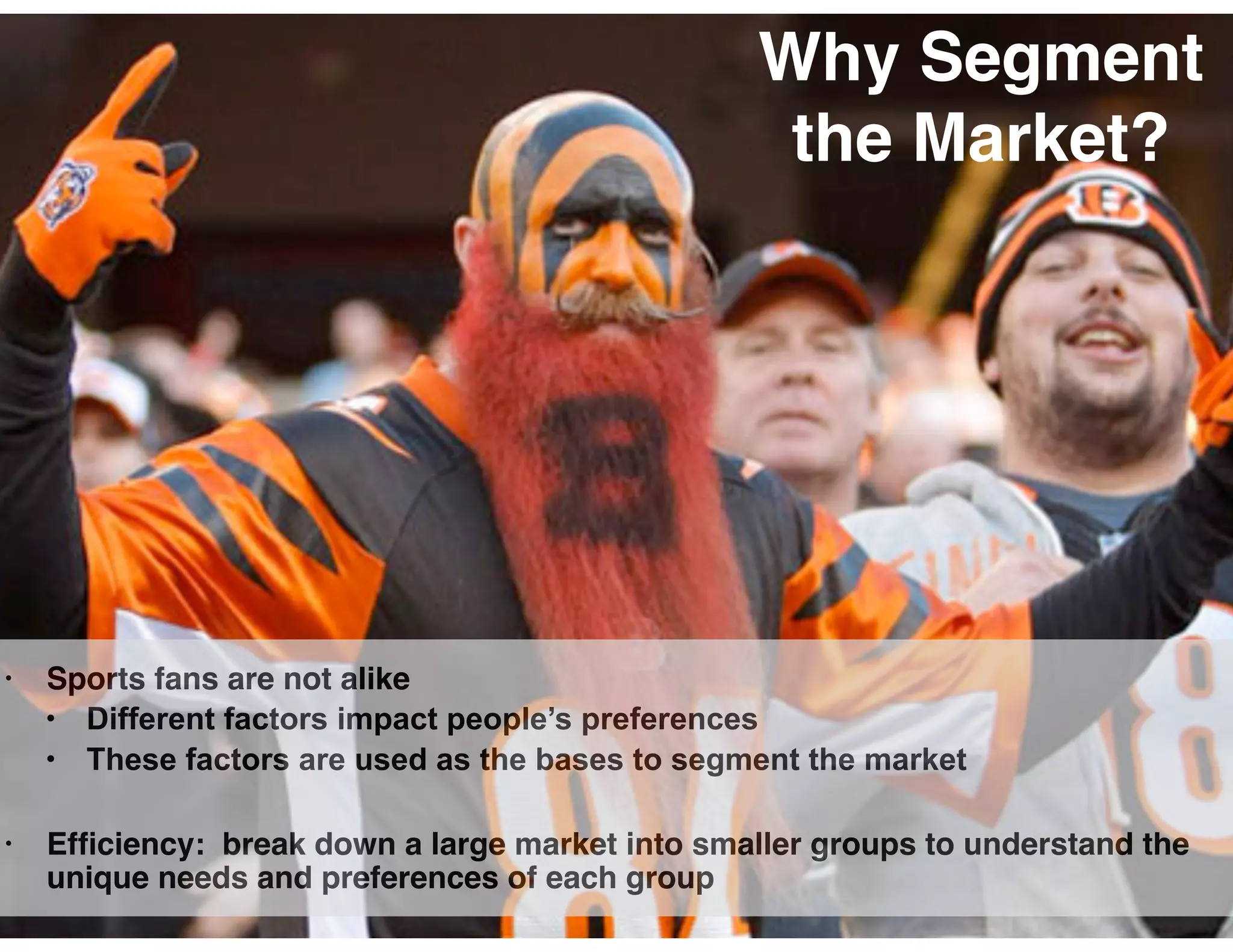
• Sports fans are not alike
• Different factors impact people’s preferences
• These factors are used as the bases to segment the market
• Efficiency: break down a large market into smaller groups to understand the
unique needs and preferences of each group
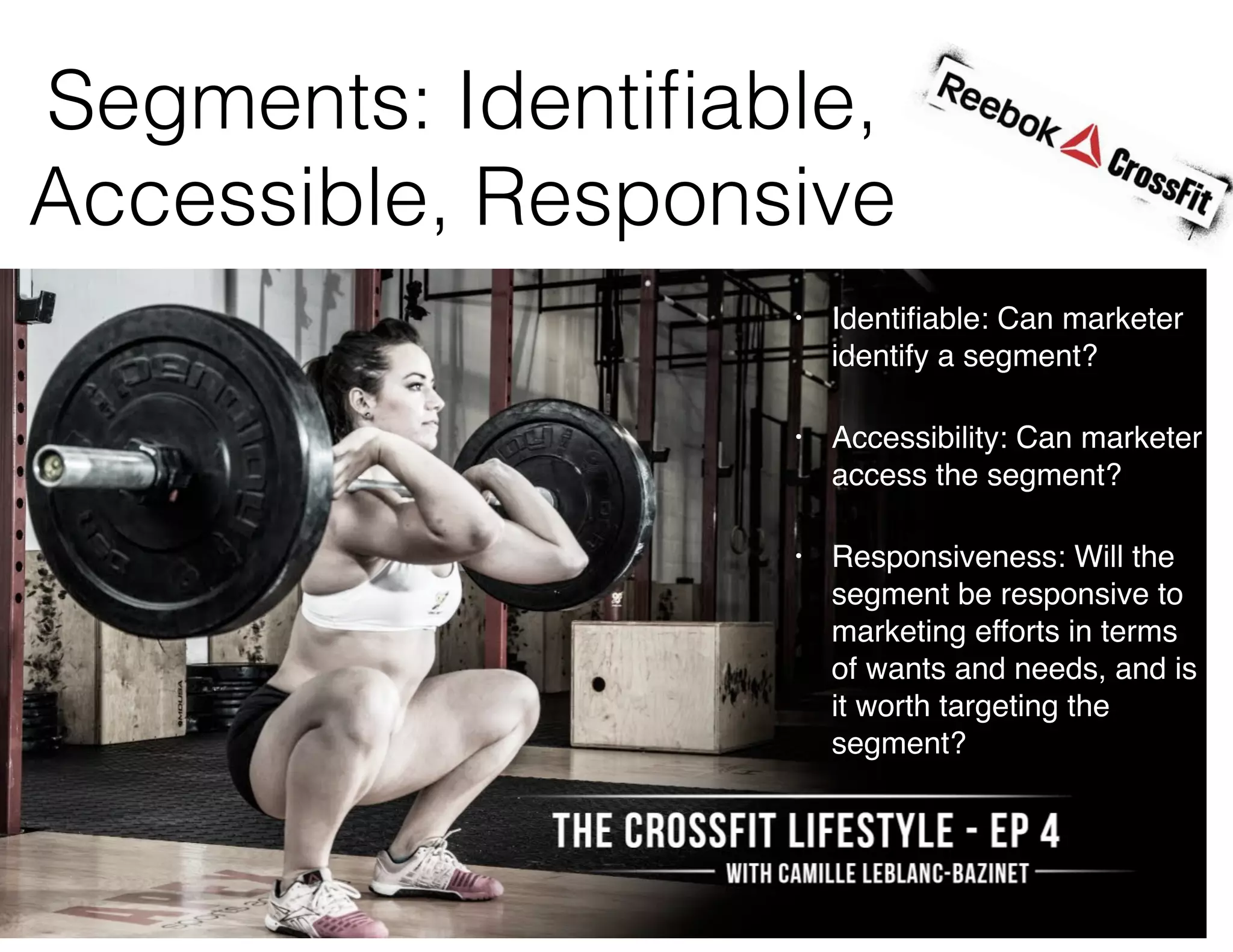
• Identifiable: Can marketer
identify a segment?
• Accessibility: Can marketer
access the segment?
• Responsiveness: Will the
segment be responsive to
marketing efforts in terms
of wants and needs, and is
it worth targeting the
segment?
Segments: Identifiable,
Accessible, Responsive
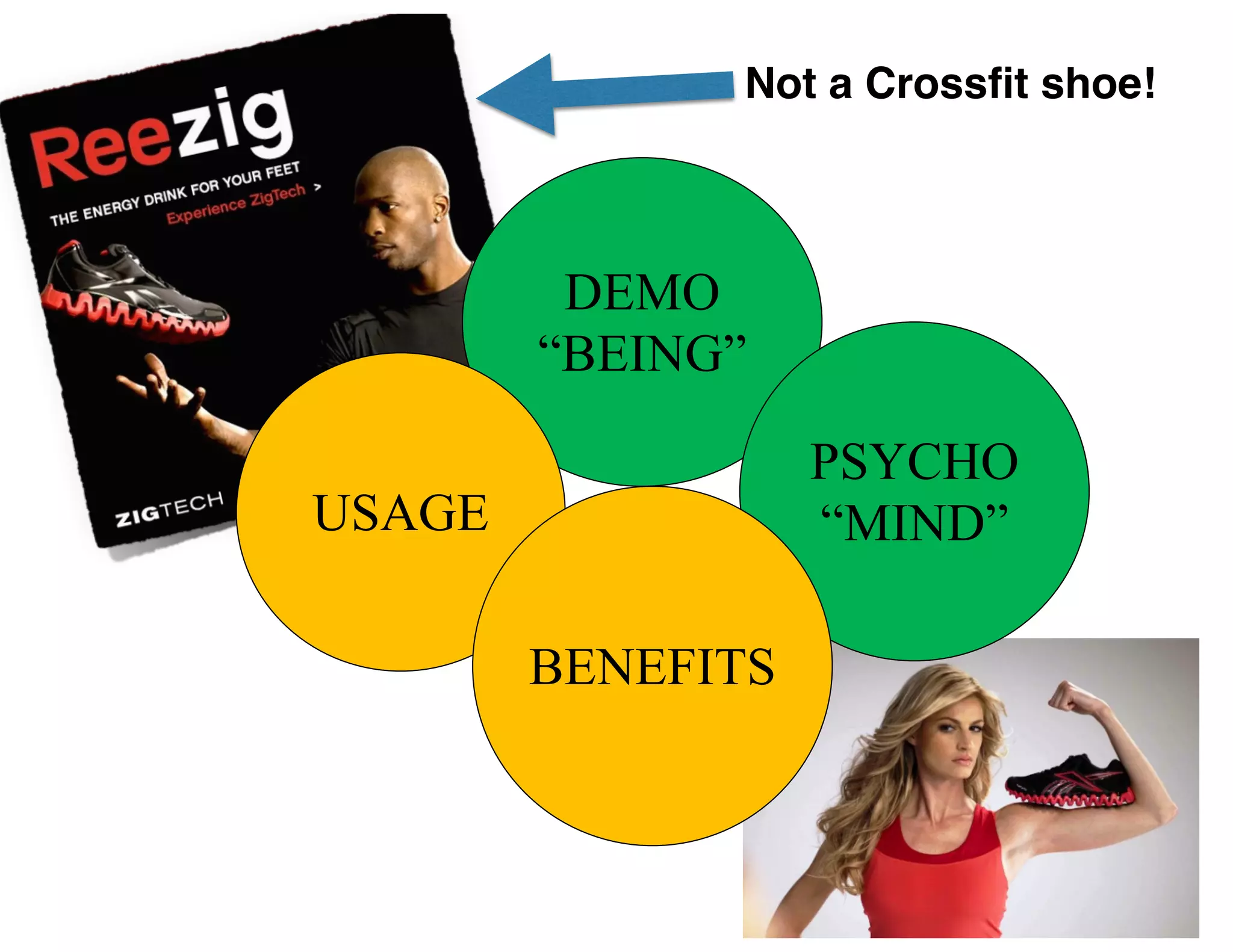
DEMO
“BEING”
PSYCHO
“MIND”USAGE
BENEFITS
Not a Crossfit shoe!
Demos: State of Being
• Age
• Number of children
• Family status [FLC]
• Gender
• Sexual orientation
• Race and ethnicity
• Profession
• Education
• Income [socioeconomic]
• Where a person lives [geographic]
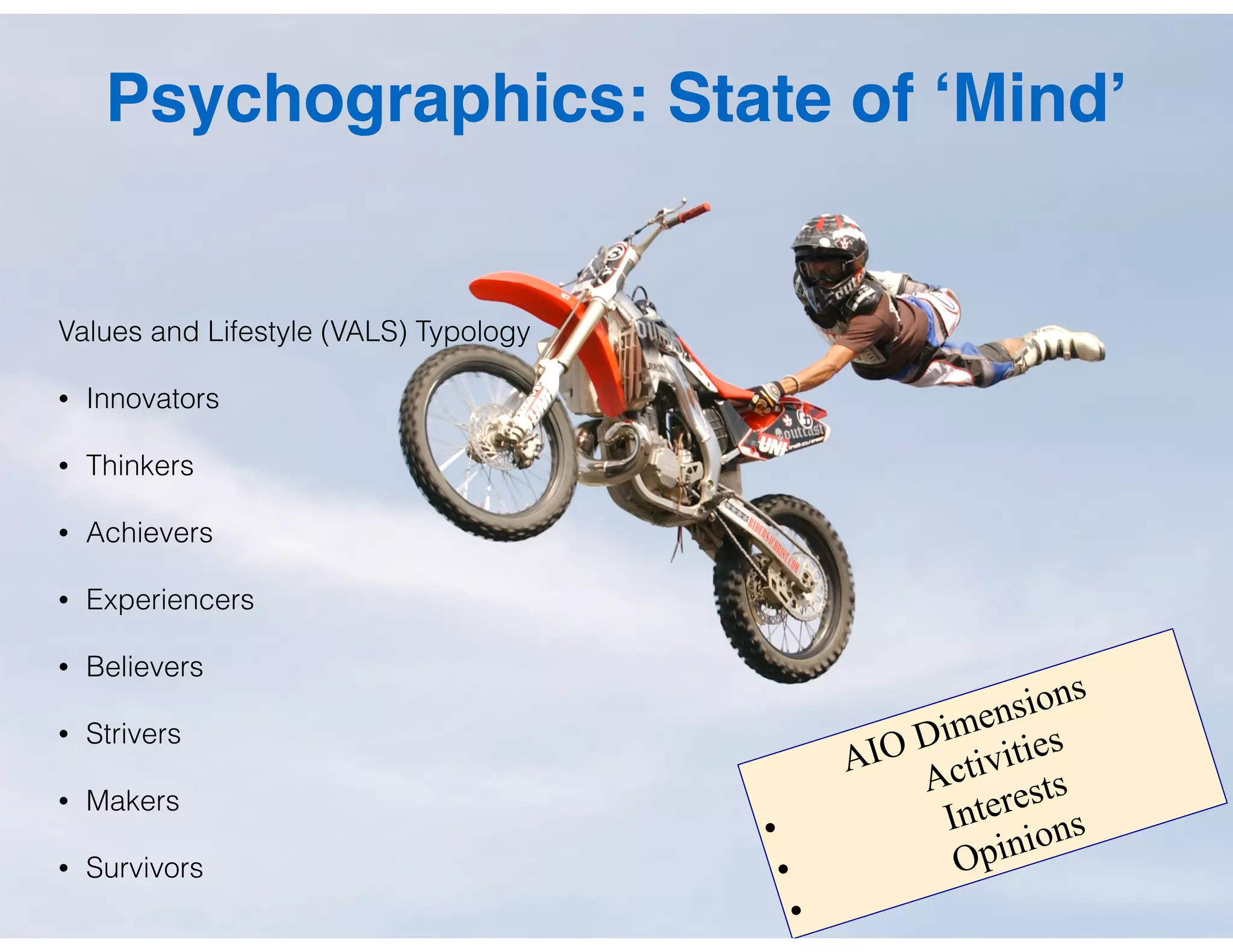
Psychographics: State of ‘Mind’
Values and Lifestyle (VALS) Typology
• Innovators
• Thinkers
• Achievers
• Experiencers
• Believers
• Strivers
• Makers
• Survivors
AIO Dimensions
•
Activities
•
Interests
•
Opinions
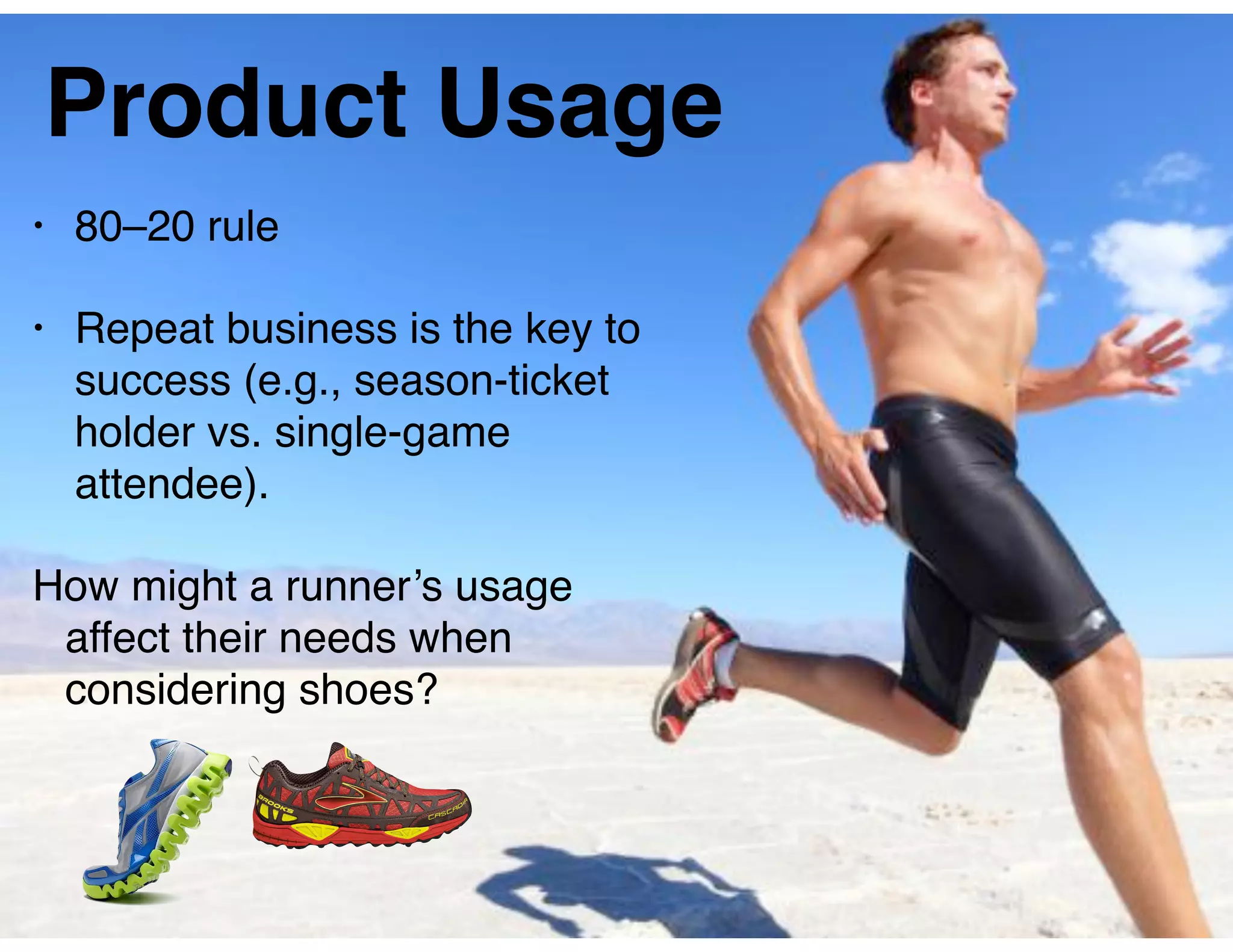
Product Usage
• 80–20 rule
• Repeat business is the key to
success (e.g., season-ticket
holder vs. single-game
attendee).
How might a runner’s usage
affect their needs when
considering shoes?
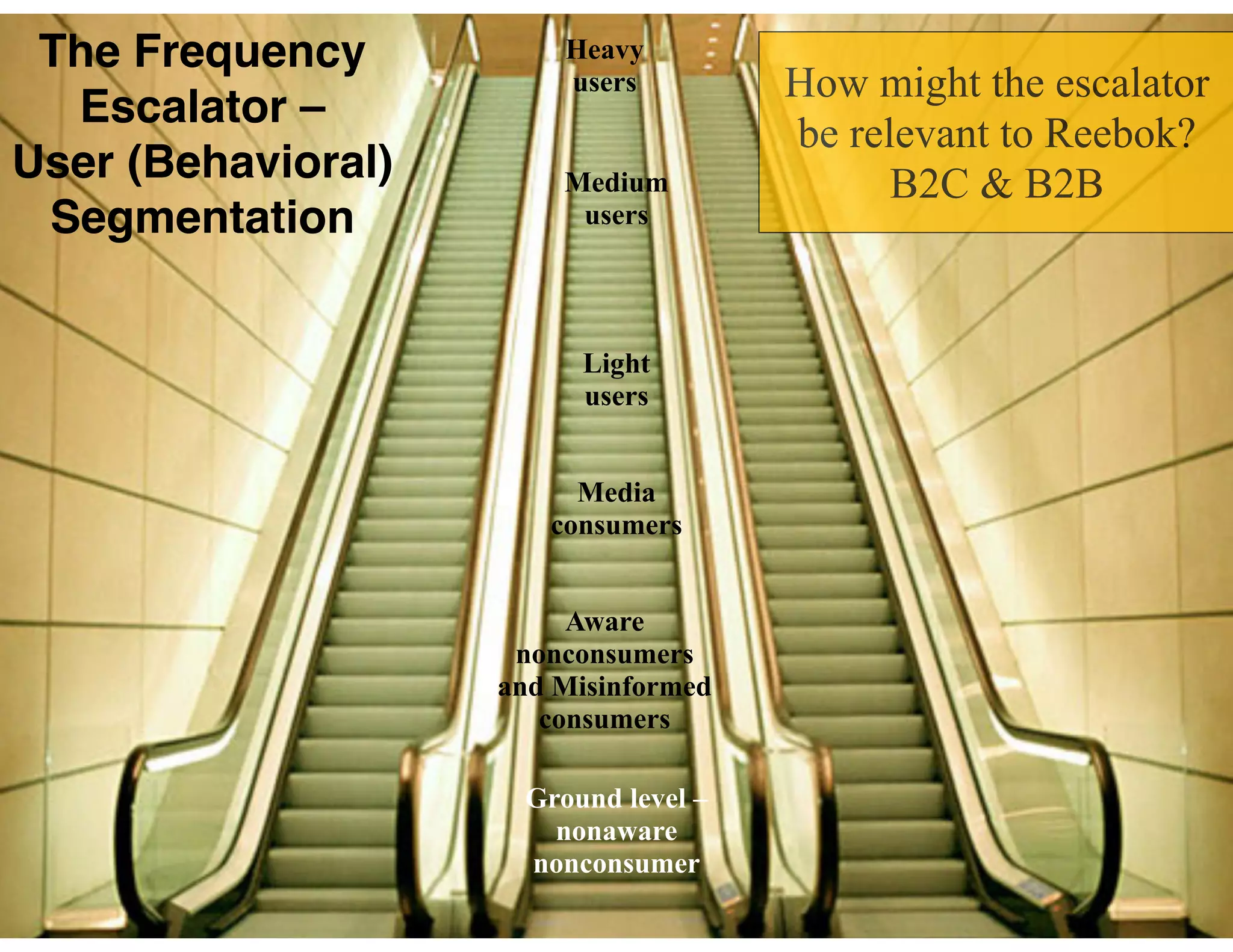
The Frequency
Escalator – 

User (Behavioral)
Segmentation
Ground level –
nonaware
nonconsumer
Aware
nonconsumers
and Misinformed
consumers
Media
consumers
Light
users
Medium
users
Heavy
users How might the escalator
be relevant to Reebok?
B2C & B2B
Benefits
• Socialization
• Excitement
• High performance
• Entertainment
• Affordability
• Affiliation
• Recognition
What does the customer want from the sports experience or
product?
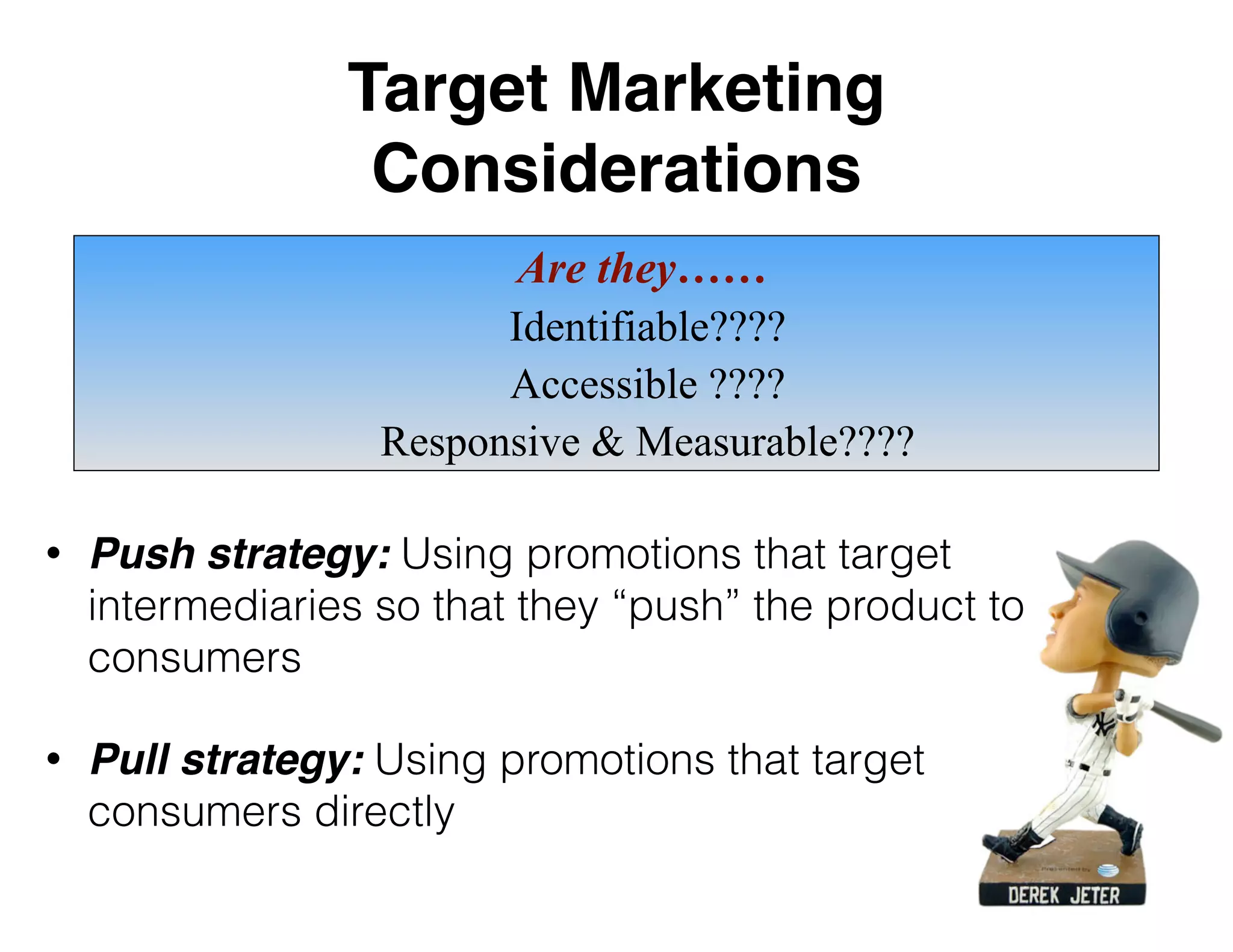
Target Marketing
Considerations
• Push strategy: Using promotions that target
intermediaries so that they “push” the product to
consumers
• Pull strategy: Using promotions that target
consumers directly
Are they……
Identifiable????
Accessible ????
Responsive & Measurable????
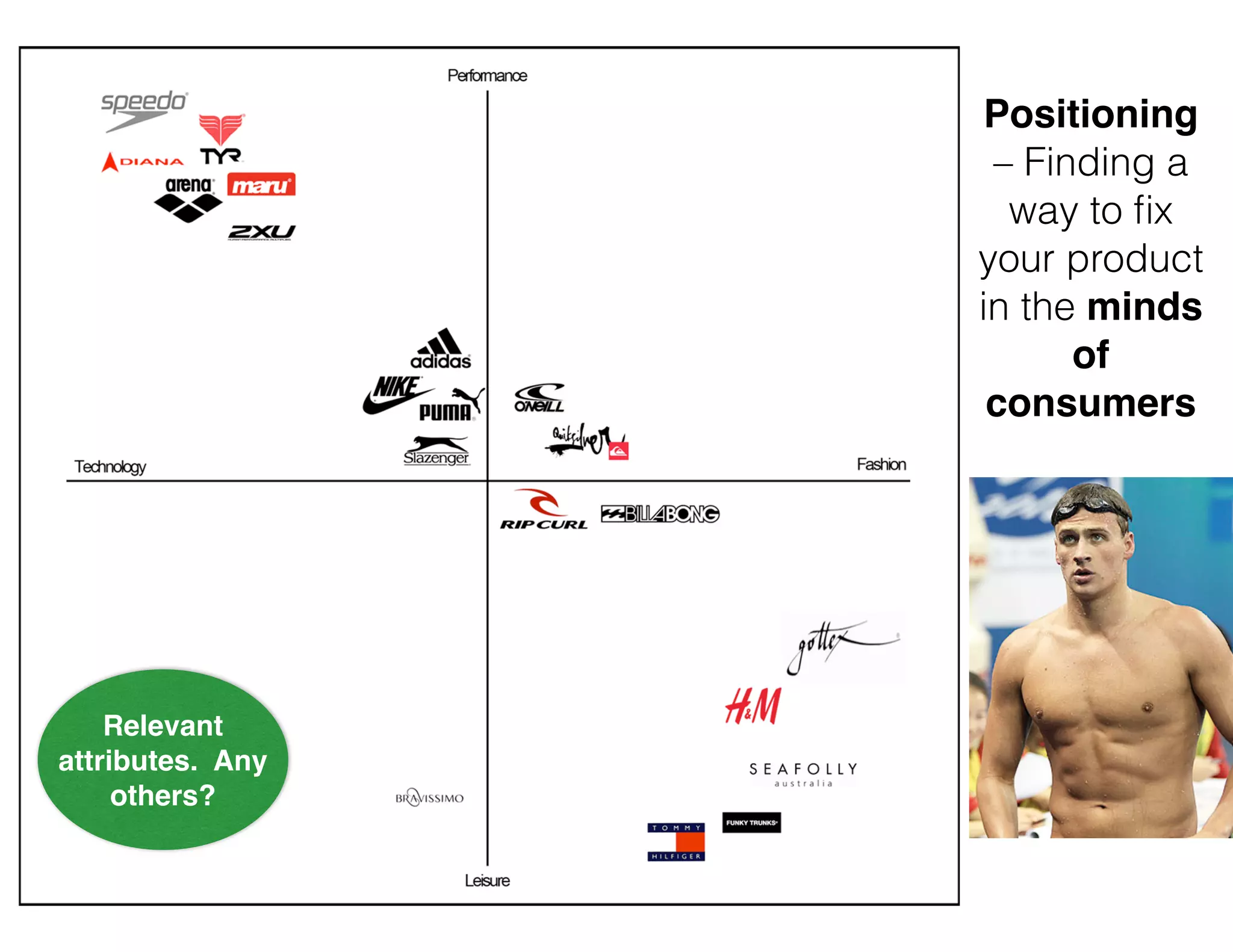
Positioning
– Finding a
way to fix
your product
in the minds
of
consumers
Relevant
attributes. Any
others?
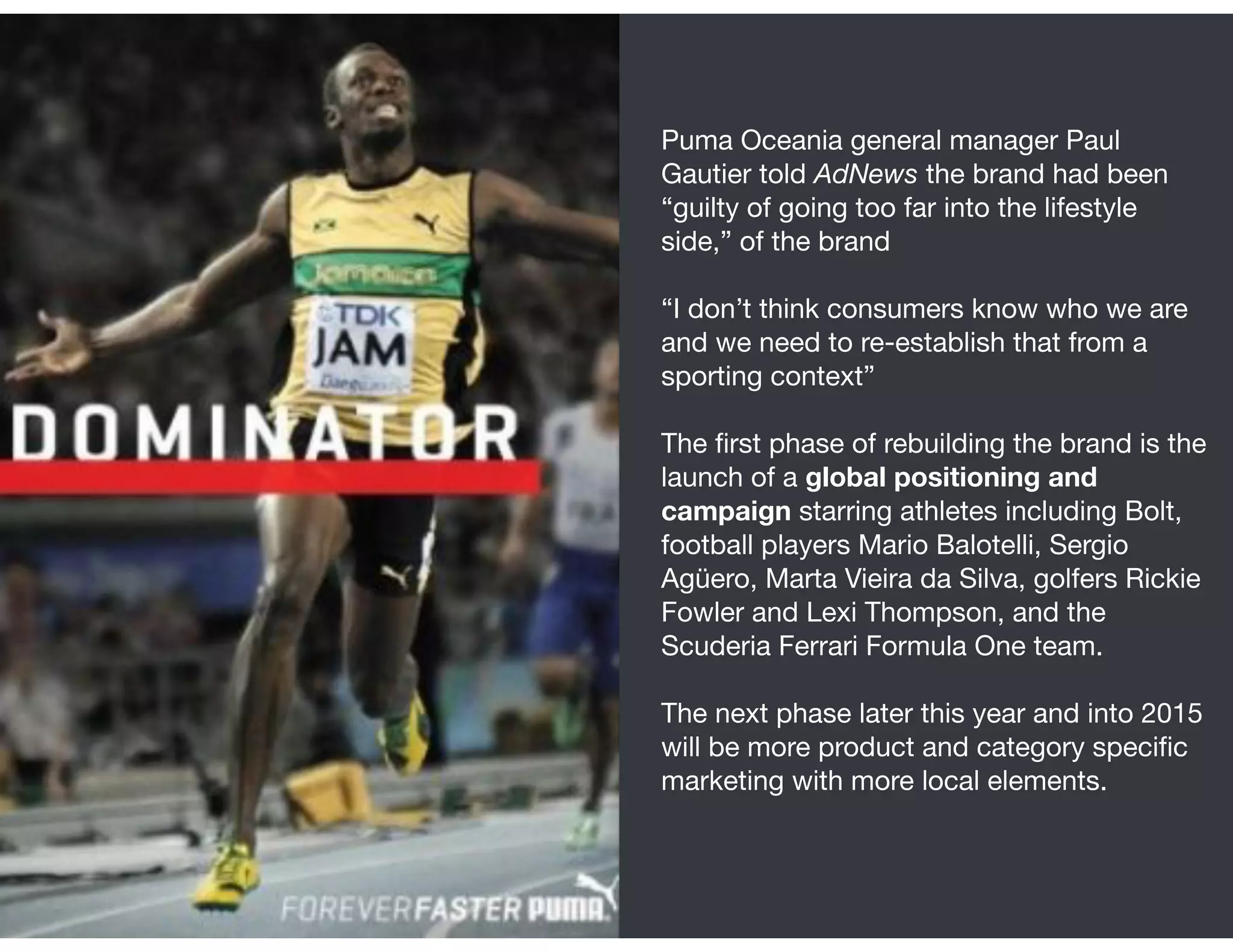
Puma Oceania general manager Paul
Gautier told AdNews the brand had been
“guilty of going too far into the lifestyle
side,” of the brand

“I don’t think consumers know who we are
and we need to re-establish that from a
sporting context”

The first phase of rebuilding the brand is the
launch of a global positioning and
campaign starring athletes including Bolt,
football players Mario Balotelli, Sergio
Agüero, Marta Vieira da Silva, golfers Rickie
Fowler and Lexi Thompson, and the
Scuderia Ferrari Formula One team. 

The next phase later this year and into 2015
will be more product and category specific
marketing with more local elements.
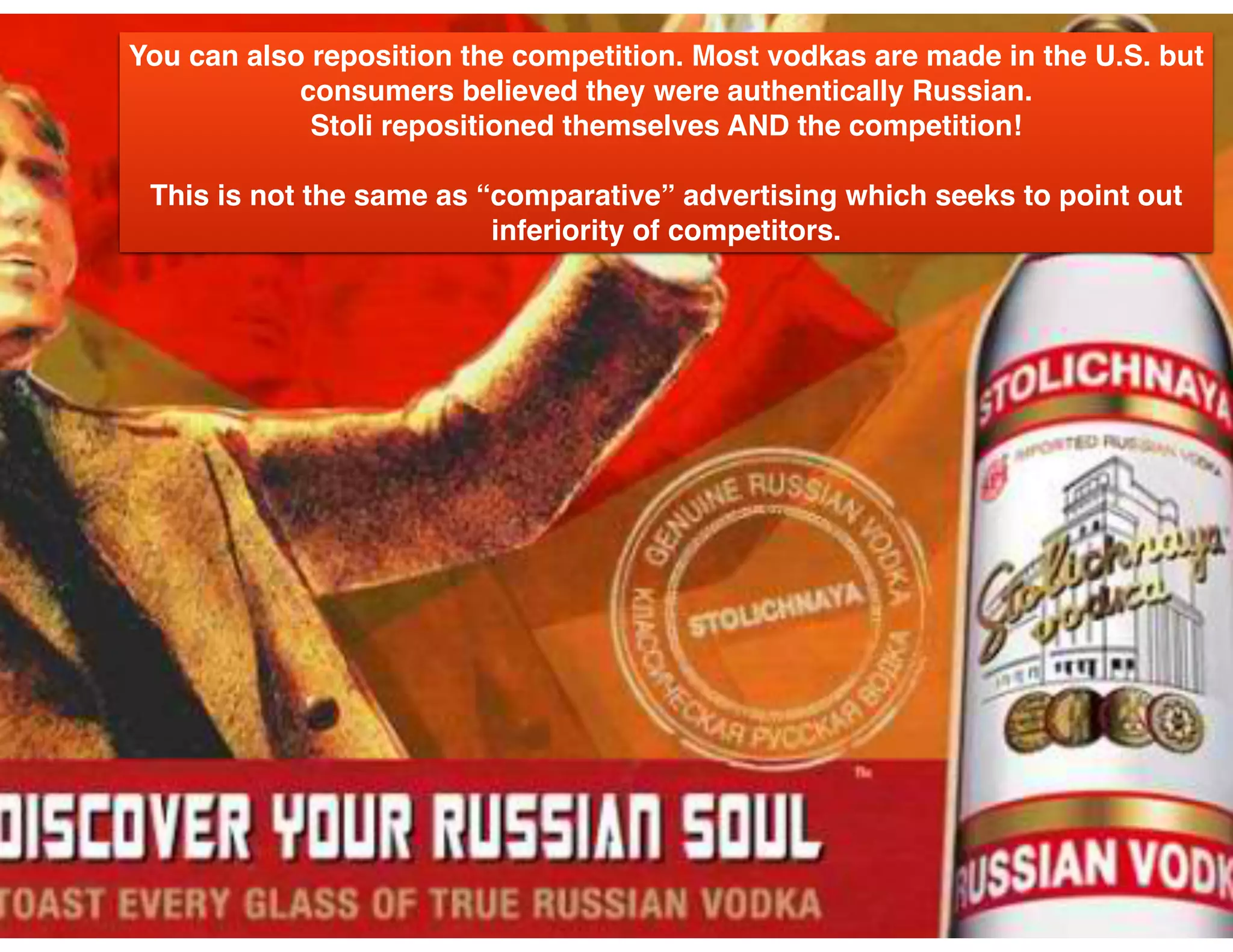
You can also reposition the competition. Most vodkas are made in the U.S. but
consumers believed they were authentically Russian.
Stoli repositioned themselves AND the competition!
This is not the same as “comparative” advertising which seeks to point out
inferiority of competitors.
In your FAST Groups…
Make a perceptual map using the Cyclones & four competitors.
(make a map on PP - you are going to present this)
First, identify 2 important criteria for a specific target market,
then place the Cyclones and the competitors on the map.
Choose either “Teachers” or “Parents” as the target market - as
we need to for our project.
Be able to describe your rationale & how this could be useful to
promoting the Education in Hockey game or hockey games in
general.
• How do you suggest reaching the target market?
• Do the Cyclones need a repositioning for your target audience? Why and how
could you accomplish this?
• In what way could the Cyclones reposition the competition to their own advantage?
• Are there any segments you think the Cyclones could focus on more strategically?
Segmentation & Targeting

Segmentation & Targeting

  • 1.
  • 2.
    Line-up • Role ofsegmentation in the marketing process • Bases of market segmentation in sport • Targeting segments • Positioning a product to your target segments Who buys Reebok products? Describe the Reebok customer(s).
  • 3.
    Segmentation – Targeting– Positioning 1) Segmentation: The process of dividing a large, hetero- geneous market into more homogeneous groups of people, who have similar wants, needs, or demographic profiles, to whom a product may be targeted 2) Targeting: Evaluating segments and selecting segments to concentrate on 3) Positioning: Developing a desired brand image in the minds of the target market
  • 4.
    Why Segment the Market? •Sports fans are not alike • Different factors impact people’s preferences • These factors are used as the bases to segment the market • Efficiency: break down a large market into smaller groups to understand the unique needs and preferences of each group
  • 5.
    • Identifiable: Canmarketer identify a segment? • Accessibility: Can marketer access the segment? • Responsiveness: Will the segment be responsive to marketing efforts in terms of wants and needs, and is it worth targeting the segment? Segments: Identifiable, Accessible, Responsive
  • 6.
  • 7.
    Demos: State ofBeing • Age • Number of children • Family status [FLC] • Gender • Sexual orientation • Race and ethnicity • Profession • Education • Income [socioeconomic] • Where a person lives [geographic]
  • 8.
    Psychographics: State of‘Mind’ Values and Lifestyle (VALS) Typology • Innovators • Thinkers • Achievers • Experiencers • Believers • Strivers • Makers • Survivors AIO Dimensions • Activities • Interests • Opinions
  • 9.
    Product Usage • 80–20rule • Repeat business is the key to success (e.g., season-ticket holder vs. single-game attendee). How might a runner’s usage affect their needs when considering shoes?
  • 10.
    The Frequency Escalator –
 User (Behavioral) Segmentation Ground level – nonaware nonconsumer Aware nonconsumers and Misinformed consumers Media consumers Light users Medium users Heavy users How might the escalator be relevant to Reebok? B2C & B2B
  • 14.
    Benefits • Socialization • Excitement •High performance • Entertainment • Affordability • Affiliation • Recognition What does the customer want from the sports experience or product?
  • 15.
    Target Marketing Considerations • Pushstrategy: Using promotions that target intermediaries so that they “push” the product to consumers • Pull strategy: Using promotions that target consumers directly Are they…… Identifiable???? Accessible ???? Responsive & Measurable????
  • 16.
    Positioning – Finding a wayto fix your product in the minds of consumers Relevant attributes. Any others?
  • 17.
    Puma Oceania generalmanager Paul Gautier told AdNews the brand had been “guilty of going too far into the lifestyle side,” of the brand “I don’t think consumers know who we are and we need to re-establish that from a sporting context”
 The first phase of rebuilding the brand is the launch of a global positioning and campaign starring athletes including Bolt, football players Mario Balotelli, Sergio Agüero, Marta Vieira da Silva, golfers Rickie Fowler and Lexi Thompson, and the Scuderia Ferrari Formula One team. The next phase later this year and into 2015 will be more product and category specific marketing with more local elements.
  • 19.
    You can alsoreposition the competition. Most vodkas are made in the U.S. but consumers believed they were authentically Russian. Stoli repositioned themselves AND the competition! This is not the same as “comparative” advertising which seeks to point out inferiority of competitors.
  • 20.
    In your FASTGroups… Make a perceptual map using the Cyclones & four competitors. (make a map on PP - you are going to present this) First, identify 2 important criteria for a specific target market, then place the Cyclones and the competitors on the map. Choose either “Teachers” or “Parents” as the target market - as we need to for our project. Be able to describe your rationale & how this could be useful to promoting the Education in Hockey game or hockey games in general. • How do you suggest reaching the target market? • Do the Cyclones need a repositioning for your target audience? Why and how could you accomplish this? • In what way could the Cyclones reposition the competition to their own advantage? • Are there any segments you think the Cyclones could focus on more strategically?