Security Testing: Fuzzing 
Andrei Rubaniuk for 
Seattle Code Camp 2012
Agenda 
• Introduction 
• What is Fuzzing? 
• Why Fuzz? 
• How to Fuzz? 
• Fuzzing Demo 
• Q&A 
© 2012 Andrei Rubaniuk 2
Introduction 
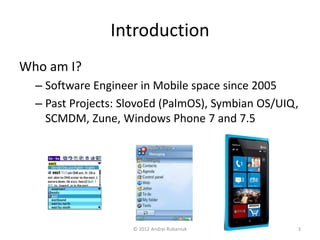
Who am I? 
– Software Engineer in Mobile space since 2005 
– Past Projects: SlovoEd (PalmOS), Symbian OS/UIQ, 
SCMDM, Zune, Windows Phone 7 and 7.5 
© 2012 Andrei Rubaniuk 3
Introduction (continued) 
What am doing now? 
– At Microsoft since October 2008 
– Current organization – Windows Phone 
• SDL Tools Team 
• Helping Windows Phone org to Fuzz their code 
© 2012 Andrei Rubaniuk 4
What is Fuzzing? 
• Testing technique that involves providing 
malformed inputs to software 
• Fuzzed (attacked) process is monitored for 
exceptions, crashes, memory leaks 
• Is commonly used to test programs that 
receive data from unsafe sources (i.e. e-mail 
client, browser, media player) 
© 2012 Andrei Rubaniuk 5
What is Fuzzing? (continued) 
• Attacked process usually has parser (network 
protocols, document viewers) 
• Especially useful against proprietary software 
as it does not require access to source code 
• Became widely used in the past 10-15 years 
© 2012 Andrei Rubaniuk 6
What is Fuzzing? (continued) 
• Is not a substitute for other types of testing 
(unit tests, BVTs/FVTs, stress, etc.) 
• Cannot prove that your code is bug free 
• But will increase confidence in the correctness 
of your code! 
© 2012 Andrei Rubaniuk 7
What is Fuzzing? (continued) 
• Types of Fuzzing 
– Mutational 
• Smart – knows/learns about the data it mutates 
• Dumb – mutates data with no regard to its format 
– Generational 
• Allows to define specific data format (i.e. file structure) 
© 2012 Andrei Rubaniuk 8
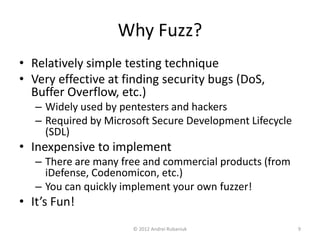
Why Fuzz? 
• Relatively simple testing technique 
• Very effective at finding security bugs (DoS, 
Buffer Overflow, etc.) 
– Widely used by pentesters and hackers 
– Required by Microsoft Secure Development Lifecycle 
(SDL) 
• Inexpensive to implement 
– There are many free and commercial products (from 
iDefense, Codenomicon, etc.) 
– You can quickly implement your own fuzzer! 
• It’s Fun! 
© 2012 Andrei Rubaniuk 9
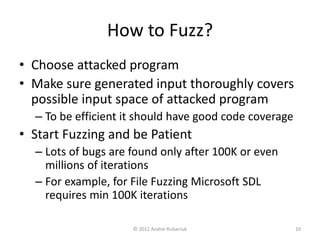
How to Fuzz? 
• Choose attacked program 
• Make sure generated input thoroughly covers 
possible input space of attacked program 
– To be efficient it should have good code coverage 
• Start Fuzzing and be Patient 
– Lots of bugs are found only after 100K or even 
millions of iterations 
– For example, for File Fuzzing Microsoft SDL 
requires min 100K iterations 
© 2012 Andrei Rubaniuk 10
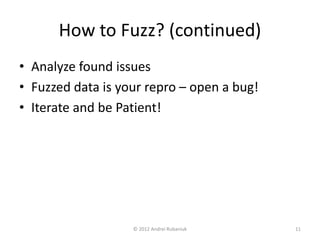
How to Fuzz? (continued) 
• Analyze found issues 
• Fuzzed data is your repro – open a bug! 
• Iterate and be Patient! 
© 2012 Andrei Rubaniuk 11
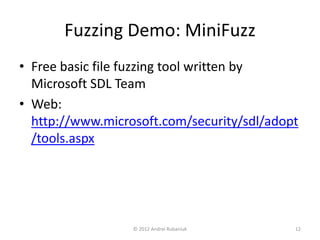
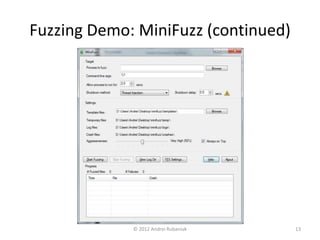
Fuzzing Demo: MiniFuzz 
• Free basic file fuzzing tool written by 
Microsoft SDL Team 
• Web: 
http://www.microsoft.com/security/sdl/adopt 
/tools.aspx 
© 2012 Andrei Rubaniuk 12
Fuzzing Demo: MiniFuzz (continued) 
© 2012 Andrei Rubaniuk 13
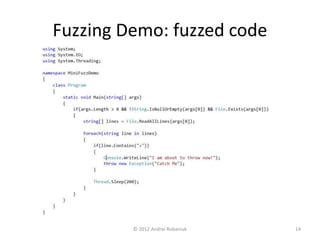
Fuzzing Demo: fuzzed code 
© 2012 Andrei Rubaniuk 14
Fuzzing Demo: Actual Demo 
© 2012 Andrei Rubaniuk 15
Q&A 
© 2012 Andrei Rubaniuk 16
Follow-up 
• Questions? Suggestions? Feedback? 
© 2012 Andrei Rubaniuk 17

Security Testing: Fuzzing

  • 1.
    Security Testing: Fuzzing Andrei Rubaniuk for Seattle Code Camp 2012
  • 2.
    Agenda • Introduction • What is Fuzzing? • Why Fuzz? • How to Fuzz? • Fuzzing Demo • Q&A © 2012 Andrei Rubaniuk 2
  • 3.
    Introduction Who amI? – Software Engineer in Mobile space since 2005 – Past Projects: SlovoEd (PalmOS), Symbian OS/UIQ, SCMDM, Zune, Windows Phone 7 and 7.5 © 2012 Andrei Rubaniuk 3
  • 4.
    Introduction (continued) Whatam doing now? – At Microsoft since October 2008 – Current organization – Windows Phone • SDL Tools Team • Helping Windows Phone org to Fuzz their code © 2012 Andrei Rubaniuk 4
  • 5.
    What is Fuzzing? • Testing technique that involves providing malformed inputs to software • Fuzzed (attacked) process is monitored for exceptions, crashes, memory leaks • Is commonly used to test programs that receive data from unsafe sources (i.e. e-mail client, browser, media player) © 2012 Andrei Rubaniuk 5
  • 6.
    What is Fuzzing?(continued) • Attacked process usually has parser (network protocols, document viewers) • Especially useful against proprietary software as it does not require access to source code • Became widely used in the past 10-15 years © 2012 Andrei Rubaniuk 6
  • 7.
    What is Fuzzing?(continued) • Is not a substitute for other types of testing (unit tests, BVTs/FVTs, stress, etc.) • Cannot prove that your code is bug free • But will increase confidence in the correctness of your code! © 2012 Andrei Rubaniuk 7
  • 8.
    What is Fuzzing?(continued) • Types of Fuzzing – Mutational • Smart – knows/learns about the data it mutates • Dumb – mutates data with no regard to its format – Generational • Allows to define specific data format (i.e. file structure) © 2012 Andrei Rubaniuk 8
  • 9.
    Why Fuzz? •Relatively simple testing technique • Very effective at finding security bugs (DoS, Buffer Overflow, etc.) – Widely used by pentesters and hackers – Required by Microsoft Secure Development Lifecycle (SDL) • Inexpensive to implement – There are many free and commercial products (from iDefense, Codenomicon, etc.) – You can quickly implement your own fuzzer! • It’s Fun! © 2012 Andrei Rubaniuk 9
  • 10.
    How to Fuzz? • Choose attacked program • Make sure generated input thoroughly covers possible input space of attacked program – To be efficient it should have good code coverage • Start Fuzzing and be Patient – Lots of bugs are found only after 100K or even millions of iterations – For example, for File Fuzzing Microsoft SDL requires min 100K iterations © 2012 Andrei Rubaniuk 10
  • 11.
    How to Fuzz?(continued) • Analyze found issues • Fuzzed data is your repro – open a bug! • Iterate and be Patient! © 2012 Andrei Rubaniuk 11
  • 12.
    Fuzzing Demo: MiniFuzz • Free basic file fuzzing tool written by Microsoft SDL Team • Web: http://www.microsoft.com/security/sdl/adopt /tools.aspx © 2012 Andrei Rubaniuk 12
  • 13.
    Fuzzing Demo: MiniFuzz(continued) © 2012 Andrei Rubaniuk 13
  • 14.
    Fuzzing Demo: fuzzedcode © 2012 Andrei Rubaniuk 14
  • 15.
    Fuzzing Demo: ActualDemo © 2012 Andrei Rubaniuk 15
  • 16.
    Q&A © 2012Andrei Rubaniuk 16
  • 17.
    Follow-up • Questions?Suggestions? Feedback? © 2012 Andrei Rubaniuk 17