Security 101:
Protecting Data with Encryption,
Tokenization & Anonymization
Jeff Uehling
Product Management Director, Security
1
Agenda
1 – Encryption
2 – Tokenization
3 – Anonymization
4 – How Syncsort can help
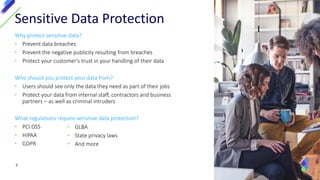
Why protect sensitive data?
• Prevent data breaches
• Prevent the negative publicity resulting from breaches
• Protect your customer’s trust in your handling of their data
Who should you protect your data from?
• Users should see only the data they need as part of their jobs
• Protect your data from internal staff, contractors and business
partners – as well as criminal intruders
What regulations require sensitive data protection?
• PCI DSS
• HIPAA
• GDPR
3
Sensitive Data Protection
• GLBA
• State privacy laws
• And more
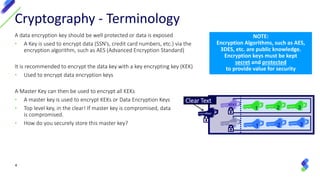
A data encryption key should be well protected or data is exposed
• A Key is used to encrypt data (SSN’s, credit card numbers, etc.) via the
encryption algorithm, such as AES (Advanced Encryption Standard)
It is recommended to encrypt the data key with a key encrypting key (KEK)
• Used to encrypt data encryption keys
A Master Key can then be used to encrypt all KEKs
• A master key is used to encrypt KEKs or Data Encryption Keys
• Top level key, in the clear! If master key is compromised, data
is compromised.
• How do you securely store this master key?
Cryptography - Terminology
1 2 3KEK2
1 2 3
KEK1
Mast
er
Clear Text
NOTE:
Encryption Algorithms, such as AES,
3DES, etc. are public knowledge.
Encryption keys must be kept
secret and protected
to provide value for security
4
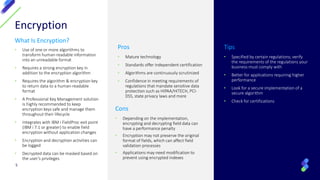
Encryption
What Is Encryption?
• Use of one or more algorithms to
transform human-readable information
into an unreadable format
• Requires a strong encryption key in
addition to the encryption algorithm
• Requires the algorithm & encryption key
to return data to a human-readable
format
• A Professional Key Management solution
is highly recommended to keep
encryption keys safe and manage them
throughout their lifecycle
• Integrates with IBM i FieldProc exit point
(IBM i 7.1 or greater) to enable field
encryption without application changes
• Encryption and decryption activities can
be logged
• Decrypted data can be masked based on
the user’s privileges
Pros
• Mature technology
• Standards offer independent certification
• Algorithms are continuously scrutinized
• Confidence in meeting requirements of
regulations that mandate sensitive data
protection such as HIPAA/HITECH, PCI-
DSS, state privacy laws and more
Tips
• Specified by certain regulations; verify
the requirements of the regulations your
business must comply with
• Better for applications requiring higher
performance
• Look for a secure implementation of a
secure algorithm
• Check for certifications
5
Cons
• Depending on the implementation,
encrypting and decrypting field data can
have a performance penalty
• Encryption may not preserve the original
format of fields, which can affect field
validation processes
• Applications may need modification to
prevent using encrypted indexes
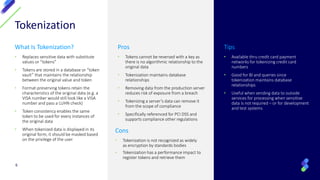
Tokenization
What Is Tokenization?
• Replaces sensitive data with substitute
values or “tokens”
• Tokens are stored in a database or “token
vault” that maintains the relationship
between the original value and token
• Format-preserving tokens retain the
characteristics of the original data (e.g. a
VISA number would still look like a VISA
number and pass a LUHN check)
• Token consistency enables the same
token to be used for every instances of
the original data
• When tokenized data is displayed in its
original form, it should be masked based
on the privilege of the user
Pros
• Tokens cannot be reversed with a key as
there is no algorithmic relationship to the
original data
• Tokenization maintains database
relationships
• Removing data from the production server
reduces risk of exposure from a breach
• Tokenizing a server’s data can remove it
from the scope of compliance
• Specifically referenced for PCI DSS and
supports compliance other regulations
Tips
• Available thru credit card payment
networks for tokenizing credit card
numbers
• Good for BI and queries since
tokenization maintains database
relationships
• Useful when sending data to outside
services for processing when sensitive
data is not required – or for development
and test systems
6
Cons
• Tokenization is not recognized as widely
as encryption by standards bodies
• Tokenization has a performance impact to
register tokens and retrieve them
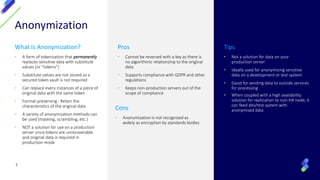
Anonymization
What Is Anonymization?
• A form of tokenization that permanently
replaces sensitive data with substitute
values (or “tokens”)
• Substitute values are not stored so a
secured token vault is not required
• Can replace every instances of a piece of
original data with the same token
• Format-preserving : Retain the
characteristics of the original data
• A variety of anonymization methods can
be used (masking, scrambling, etc.)
• NOT a solution for use on a production
server since tokens are unrecoverable
and original data is required in
production mode
Pros
• Cannot be reversed with a key as there is
no algorithmic relationship to the original
data
• Supports compliance with GDPR and other
regulations
• Keeps non-production servers out of the
scope of compliance
Tips
• Not a solution for data on your
production server
• Ideally used for anonymizing sensitive
data on a development or test system
• Good for sending data to outside services
for processing
• When coupled with a high availability
solution for replication to non-HA node, it
can feed dev/test system with
anonymized data
7
Cons
• Anonymization is not recognized as
widely as encryption by standards bodies
How Syncsort
Can Help
8
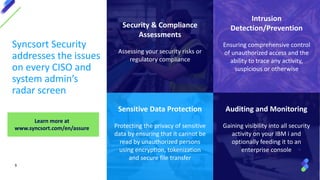
Sensitive Data Protection
Protecting the privacy of sensitive
data by ensuring that it cannot be
read by unauthorized persons
using encryption, tokenization
and secure file transfer
Intrusion
Detection/Prevention
Ensuring comprehensive control
of unauthorized access and the
ability to trace any activity,
suspicious or otherwise
Security & Compliance
Assessments
Assessing your security risks or
regulatory compliance
Auditing and Monitoring
Gaining visibility into all security
activity on your IBM i and
optionally feeding it to an
enterprise console
Syncsort Security
addresses the issues
on every CISO and
system admin’s
radar screen
9
Learn more at
www.syncsort.com/en/assure
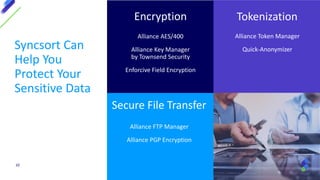
Syncsort Can
Help You
Protect Your
Sensitive Data
10
Alliance FTP Manager
Alliance PGP Encryption
Encryption
Alliance AES/400
Alliance Key Manager
by Townsend Security
Enforcive Field Encryption
Tokenization
Secure File Transfer
Alliance Token Manager
Quick-Anonymizer
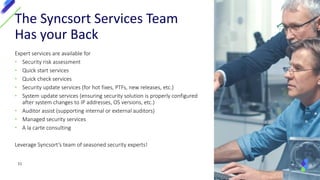
Expert services are available for
• Security risk assessment
• Quick start services
• Quick check services
• Security update services (for hot fixes, PTFs, new releases, etc.)
• System update services (ensuring security solution is properly configured
after system changes to IP addresses, OS versions, etc.)
• Auditor assist (supporting internal or external auditors)
• Managed security services
• A la carte consulting
Leverage Syncsort’s team of seasoned security experts!
The Syncsort Services Team
Has your Back
11
Learn more at
www.syncsort.com/en/assure

Security 101: Protecting Data with Encryption, Tokenization & Anonymization

  • 1.
    Security 101: Protecting Datawith Encryption, Tokenization & Anonymization Jeff Uehling Product Management Director, Security 1
  • 2.
    Agenda 1 – Encryption 2– Tokenization 3 – Anonymization 4 – How Syncsort can help
  • 3.
    Why protect sensitivedata? • Prevent data breaches • Prevent the negative publicity resulting from breaches • Protect your customer’s trust in your handling of their data Who should you protect your data from? • Users should see only the data they need as part of their jobs • Protect your data from internal staff, contractors and business partners – as well as criminal intruders What regulations require sensitive data protection? • PCI DSS • HIPAA • GDPR 3 Sensitive Data Protection • GLBA • State privacy laws • And more
  • 4.
    A data encryptionkey should be well protected or data is exposed • A Key is used to encrypt data (SSN’s, credit card numbers, etc.) via the encryption algorithm, such as AES (Advanced Encryption Standard) It is recommended to encrypt the data key with a key encrypting key (KEK) • Used to encrypt data encryption keys A Master Key can then be used to encrypt all KEKs • A master key is used to encrypt KEKs or Data Encryption Keys • Top level key, in the clear! If master key is compromised, data is compromised. • How do you securely store this master key? Cryptography - Terminology 1 2 3KEK2 1 2 3 KEK1 Mast er Clear Text NOTE: Encryption Algorithms, such as AES, 3DES, etc. are public knowledge. Encryption keys must be kept secret and protected to provide value for security 4
  • 5.
    Encryption What Is Encryption? •Use of one or more algorithms to transform human-readable information into an unreadable format • Requires a strong encryption key in addition to the encryption algorithm • Requires the algorithm & encryption key to return data to a human-readable format • A Professional Key Management solution is highly recommended to keep encryption keys safe and manage them throughout their lifecycle • Integrates with IBM i FieldProc exit point (IBM i 7.1 or greater) to enable field encryption without application changes • Encryption and decryption activities can be logged • Decrypted data can be masked based on the user’s privileges Pros • Mature technology • Standards offer independent certification • Algorithms are continuously scrutinized • Confidence in meeting requirements of regulations that mandate sensitive data protection such as HIPAA/HITECH, PCI- DSS, state privacy laws and more Tips • Specified by certain regulations; verify the requirements of the regulations your business must comply with • Better for applications requiring higher performance • Look for a secure implementation of a secure algorithm • Check for certifications 5 Cons • Depending on the implementation, encrypting and decrypting field data can have a performance penalty • Encryption may not preserve the original format of fields, which can affect field validation processes • Applications may need modification to prevent using encrypted indexes
  • 6.
    Tokenization What Is Tokenization? •Replaces sensitive data with substitute values or “tokens” • Tokens are stored in a database or “token vault” that maintains the relationship between the original value and token • Format-preserving tokens retain the characteristics of the original data (e.g. a VISA number would still look like a VISA number and pass a LUHN check) • Token consistency enables the same token to be used for every instances of the original data • When tokenized data is displayed in its original form, it should be masked based on the privilege of the user Pros • Tokens cannot be reversed with a key as there is no algorithmic relationship to the original data • Tokenization maintains database relationships • Removing data from the production server reduces risk of exposure from a breach • Tokenizing a server’s data can remove it from the scope of compliance • Specifically referenced for PCI DSS and supports compliance other regulations Tips • Available thru credit card payment networks for tokenizing credit card numbers • Good for BI and queries since tokenization maintains database relationships • Useful when sending data to outside services for processing when sensitive data is not required – or for development and test systems 6 Cons • Tokenization is not recognized as widely as encryption by standards bodies • Tokenization has a performance impact to register tokens and retrieve them
  • 7.
    Anonymization What Is Anonymization? •A form of tokenization that permanently replaces sensitive data with substitute values (or “tokens”) • Substitute values are not stored so a secured token vault is not required • Can replace every instances of a piece of original data with the same token • Format-preserving : Retain the characteristics of the original data • A variety of anonymization methods can be used (masking, scrambling, etc.) • NOT a solution for use on a production server since tokens are unrecoverable and original data is required in production mode Pros • Cannot be reversed with a key as there is no algorithmic relationship to the original data • Supports compliance with GDPR and other regulations • Keeps non-production servers out of the scope of compliance Tips • Not a solution for data on your production server • Ideally used for anonymizing sensitive data on a development or test system • Good for sending data to outside services for processing • When coupled with a high availability solution for replication to non-HA node, it can feed dev/test system with anonymized data 7 Cons • Anonymization is not recognized as widely as encryption by standards bodies
  • 8.
  • 9.
    Sensitive Data Protection Protectingthe privacy of sensitive data by ensuring that it cannot be read by unauthorized persons using encryption, tokenization and secure file transfer Intrusion Detection/Prevention Ensuring comprehensive control of unauthorized access and the ability to trace any activity, suspicious or otherwise Security & Compliance Assessments Assessing your security risks or regulatory compliance Auditing and Monitoring Gaining visibility into all security activity on your IBM i and optionally feeding it to an enterprise console Syncsort Security addresses the issues on every CISO and system admin’s radar screen 9 Learn more at www.syncsort.com/en/assure
  • 10.
    Syncsort Can Help You ProtectYour Sensitive Data 10 Alliance FTP Manager Alliance PGP Encryption Encryption Alliance AES/400 Alliance Key Manager by Townsend Security Enforcive Field Encryption Tokenization Secure File Transfer Alliance Token Manager Quick-Anonymizer
  • 11.
    Expert services areavailable for • Security risk assessment • Quick start services • Quick check services • Security update services (for hot fixes, PTFs, new releases, etc.) • System update services (ensuring security solution is properly configured after system changes to IP addresses, OS versions, etc.) • Auditor assist (supporting internal or external auditors) • Managed security services • A la carte consulting Leverage Syncsort’s team of seasoned security experts! The Syncsort Services Team Has your Back 11
  • 12.