Breakfast for the Mind: Securities for 
Private Companies
Thursday, June 2


                                          1
What is a Security? 
Presented by: Shane Stevenson
              Partner


                                2
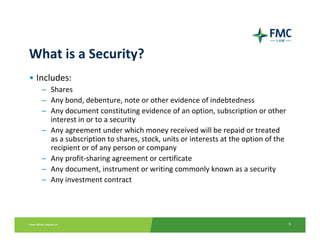
What is a Security?
• Includes:
   – Shares
   – Any bond, debenture, note or other evidence of indebtedness
   – Any document constituting evidence of an option, subscription or other 
     interest in or to a security
   – Any agreement under which money received will be repaid or treated 
     as a subscription to shares, stock, units or interests at the option of the 
     recipient or of any person or company 
   – Any profit‐sharing agreement or certificate
   – Any document, instrument or writing commonly known as a security
   – Any investment contract


                                                                                    3
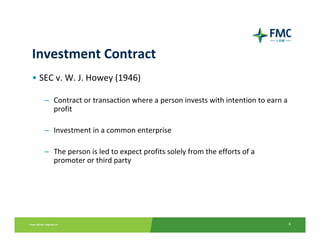
Investment Contract
• SEC v. W. J. Howey (1946)

   – Contract or transaction where a person invests with intention to earn a 
     profit

   – Investment in a common enterprise

   – The person is led to expect profits solely from the efforts of a
     promoter or third party 


                                                                            4
Investment Contract
• Williamson v. Tucker (1981) (US 5th circuit)

• The investors will be relying on the efforts of a the manager if:
   – The agreement leaves little legal power in the hands of the investors 
     (legal test),
   – The investors are inexperienced or unknowledgeable and, in 
     consequence, incapable of exercising management powers (practical 
     test); or
   – Investor is dependent on unique managerial abilities of the manager 
     (practical test). 


                                                                              5
Investment Contract
• State Commissioner of Securities v. Hawaii Market Center Inc. 
  (1971)
• “Risk capital test”
   – Investor furnishes initial value
   – A portion of value is subject to risks of the enterprise
   – Investment is induced by a promise leading to a reasonable 
     expectation that a benefit will accrue
   – Investor does not have right to exercise practical and actual control 
     over management 


                                                                              6
Trade
• Includes: 

   – Any sale or disposition of a security for valuable consideration, 
     whether the terms of payment are on margin, installment or 
     otherwise, but does not include 

   – Any act, advertisement, solicitation, conduct or negotiation made 
     directly or indirectly in furtherance of anything referred to above


                                                                           7
Distribution
•   When used in relation to trading in securities, means 

    –   A trade in securities of an issuer that have not been previously issued 

    –   A trade by or on behalf of an issuer in previously issued securities of 
        that issuer that have been redeemed or purchased by or donated to 
        that issuer

    –   A trade in previously issued securities of an issuer from the holdings 
        of a control person


                                                                                   8
Issuer
• Means a person or company that:

  – Has outstanding securities

  – Is issuing securities

  – Proposes to issues securities


                                    9
Private Issuer
• Means an Issuer:

   – That is not a reporting issuer or an investment fund,

   – Whose securities (except non‐convertible debt):
       • Are subject to transfer restriction contained in the issuers constating
                 documents or security holders’ agreement; and
       • Are owned by not more that 50 people, exclusive of employees and
                 former employees, and

   – Has only distributed designated securities to the permitted list of 
     investors [i.e. relatives, close friends, accredited investors – s. 2.4(2)]. 


                                                                                     10
Reporting Issuer
• Means an Issuer

  – That has filed a prospectus and obtained a receipt for it, 
  – That has shares listed on a stock exchange recognized for that purpose 
    (TSX Venture Exchange), 
  – That has exchanged its securities in an amalgamation, arrangement or 
    similar transaction with a reporting issuer, or 
  – That is declared to be a reporting issuer by order of the Commission. 


                                                                          11
Control Person
• Means any person or company that holds or is one of a 
  combination of persons or companies that holds:

   – A sufficient number of any of the securities of an issuer so as to affect 
     materially the control of that issuer, or

   – More than 20% of the outstanding voting securities of an issuer except 
     where there is evidence showing that the holding of those securities 
     does not affect materially the control of that issuer


                                                                                  12
Private Placement Exemptions: National 
Instrument 45‐106 (Capital Raising Exemptions)
Presented by: Heather Barnhouse
              Associate


                                                 13
General
• NI 45‐106 provides methods to raise capital:  provides 
  exemptions from registration requirement and exemption 
  from prospectus requirement.


                                                            14
General
• All trades are subject to securities legislation, whether entity
  issuing securities is a reporting issuer in that jurisdiction or not;
• Definition of “trade” in securities legislation includes any act, 
  advertisement, solicitation, conduct or negotiation directly or 
  indirectly in furtherance of a trade;
• Person (company) who engages in these activities, or any 
  “trading” activities, must comply with the securities legislation 
  of each jurisdiction in which the trade occurs.
• Multi‐jurisdiction trades: e.g.: distribution from a person in 
  Alberta to a purchaser in BC may be considered a trade in both 
  jurisdictions (filing requirement in both locations).

                                                                      15
Responsibility for Compliance
• The person (entity) distributing or trading securities is 
  responsible for determining when an exemption is available
• The person may rely on factual representations by the 
  purchaser, provided that the person has no reasonable 
  grounds to believe the representations are false
• The person (entity) distributing or trading securities is 
  responsible for determining whether, given the facts available, 
  the exemption is available
• Important to get facts/specifics/particulars of how the person 
  fits within the exemption and thus how the exemption applies.


                                                                 16
Misrepresentation
• Use of exaggeration, innuendo or ambiguity in an oral or 
  written representation about a material fact, or other 
  deceptive behaviour relating to a material fact may be a 
  misrepresentation, for which there are consequences for the 
  issuer (fines/penalties, etc.)


                                                                 17
Exemptions: 1) Private Issuer
• Is not a reporting issuer or an investment fund;
• Its securities, other than non‐convertible debt:
   – Are subject to transfer restriction contained in the issuer’s constating
     documents or shareholders agreement (USA); and
   – Are held by not more that 50 people, exclusive of employees and 
     former employees;
   – Key is that the private issuer must not be a member of the “public” as 
     defined in case law;
   – If private issuer distributes securities under another exemption (i.e. –
     OM), it will no longer be a private issuer; and


                                                                                18
Private Issuer (cont’d)
• Has only distributed securities to the following permitted list 
  of investors:
   – Director, officer, employee, founder or control person

   – Spouse, parent, grandparent, brother, sister, or child of either a 
     director, senior officer, founder or control person or of a spouse of 
     such director, senior officer, founder or control person

   – Close personal friend or close business associate of a director, senior 
     officer, founder or control person


                                                                                19
2) Accredited Investor
• Includes:
   – An individual, either alone or with a spouse, that has “financial assets”
     (cash, securities, or a contract of insurance – generally liquid or easy to 
     liquidate) of at least $1,000,000 (treat spouses as a single investing 
     unit); 

   – An individual with net income before tax (in the last two years) of at 
     least $200,000 (or $300,000 combined with spouse) and reasonably
     expects to exceed that income level in the current calendar year; or 

   – A company that is wholly owned by one or more accredited investors 
     or has net assets of $5,000,000.


                                                                                20
3) Friends, Family and Business Associates
• Includes:
   – A director, executive officer or control person of the issuer or an 
     affiliate of the issuer;
   – A spouse, parent, grandparent, brother, sister or child of a director, 
     executive officer or control person;
   – A parent, grandparent, brother, sister or child of a spouse of a director, 
     executive officer or control person; 
   – A close personal friend or a close business associate of a director, 
     executive officer or control person;
   – A founder of the issuer or a spouse, parent, grandparent, brother, 
     sister, child, close personal friend or close business associate of a 
     founder;


                                                                               21
Friends, Family and Business Associates 
(cont’d)
   – A parent, grandparent, brother, sister or child of the spouse of a 
     founder;
   – A company of which the majority of the voting securities are owned 
     by, or a majority of the directors are, persons described above; and
   – A trust or estate of which all of the beneficiaries are or a majority of 
     the trustees are persons described above.

• In Saskatchewan, investors relying on this exemption must sign 
  a risk acknowledgement form.


                                                                                 22
Definition of a Close Personal Friend
• An individual who knows the director, executive officer, 
  founder or control person well enough and has known them 
  for a sufficient period of time to be in a position to assess their 
  capabilities and trustworthiness.
   – Can include family members not already specifically identified or who 
     may not satisfy all criteria
   – Relationship must be direct
• An individual is NOT a close personal friend solely because the 
  individual is 
   – A relative;
   – A member of the same organization, association or religious group, or
   – A client, customer, former client or former customer.

                                                                              23
Definition of a Close Business Associate
• An individual who has had sufficient prior business dealings 
  with the director, executive officer, founder or control person 
  of the issuer to be in a position to assess their capabilities and 
  trustworthiness

• An individual is not a close business associate solely because 
  the individual is:
   – A member of the same organization, association or religious group; or
   – A client, customer, former client or former customer


                                                                             24
Soliciting Purchasers

• While not prohibited under NI 45‐106, the fact that solicitation 
  was required may give rise to the presumption that an 
  individual is NOT a close personal friend or a close business 
  associate.


                                                                  25
4) Offering Memorandum (“OM”)
• The issuer must prepare an offering memorandum in the form 
  mandated by the instrument

• There is no limit on the number of investors that can 
  participate

• There is no limit on how often you use the exemption 

• In Alberta (and some other provinces), if a purchaser invests 
  more than $10,000, they must be an “eligible investor” to rely 
  on the OM exemption


                                                                    26
OM (cont’d)
• A two day right of rescission 
• Each subscriber is required to complete a risk 
  acknowledgement form
• There is  a right of action for rescission or damages in the 
  event of a misrepresentation in the OM
   – Rescission: 180 days of signing the agreement 
   – Damages: the earlier of 180 days of learning of the misrepresentation 
     or 3 years after signing the purchase agreement.
• Form of OM must comply with form set out in securities 
  regulations
• OM must be filed with Securities Commission

                                                                              27
Eligible Investor
• Definition of “Eligible Investor” someone:  (i) who has obtained 
  advice from an eligibility adviser (someone who is registered 
  as investment dealer) who is authorized to give advice with 
  respect to the type of security being distributed or traded;  (ii) 
  who has net assets of $400,000; or  (iii) who has pre‐tax 
  income (in past two years and expectation to continue in 
  current year) of $75,000, or $125,000 combined with a spouse.
  Eligible Investor:  It would be inappropriate for an issuer to try 
  to circumvent the $10,000 threshold by dividing a subscription 
  in excess of $10,000 by one purchaser into a number of 
  smaller subscriptions of $10,000 or less that are made directly 
  or indirectly by the same purchaser.

                                                                    28
5) Minimum Investment
• Purchases as principal where the acquisition cost is not less 
  than $150,000 paid in cash on closing in a single transaction


                                                                   29
6) Employee, Executive Officer, Director 
and Consultant
• Trade must be voluntary

• Also permits trades to a “permitted assign”:
   –   Trustee
   –   Holding entity
   –   RRSP or RRIF
   –   Spouse
   –   Trustee, holding entity, RRSP or RRIF of spouse


                                                         30
Resale Restrictions
• Securities acquired through any exemption listed in NI 45‐106 
  are subject to resale restrictions (subject to NI 45‐102) and 
  thus are not freely tradable.


                                                                   31
Hidden Disclosure Obligations for Non‐
Private Issuers
Presented by: Shane Stevenson
              Partner


                                         32
• So you have issued “Securities” and are no longer  a  “Private 
  Issuer” but you are NOT a “Reporting Issuer” either?

• And you need to call a Shareholders’ Meeting?

• What Disclosure Obligation Apply?


                                                                    33
Applicable Law – ABCA
• Section 149 – If not a Private Issuer
   – Must give Form of Proxy
• Section 150 – If providing Proxy and more than 15 
  shareholders 
   – Must provide Form of Information Circular
• Regulation 19 – the Form of (i) Proxy and (ii) Information 
                 Circular are as required under the Securities 
                 Act (Alberta)


                                                                  34
• Now we are subject to the Securities Act (Alberta) and Nation 
  Instrument 51‐102 and NI51‐102 Forms F5 and F6


                                                                   35
NI 51‐102 – Content of From of Proxy

• Section 9.4:
   – Disclose in Bold who Solicited the Proxy (e.g. Management)

   – Disclose in Bold that you can appoint a designated person to represent 
     you at meeting

   – Provide options for voting FOR or Against or Withheld – as applicable

   – Virtually identical to Form used by Reporting Issuers


                                                                             36
NI 51‐102 F5 – Form of Information Circular

• NI 51‐102F5:
   – Same disclosure used by Reporting Issuers

   – Very onerous disclosure with 16 Items to cover

   – Requirement to identify Principal Shareholders

   – Requirement to discuss Executive Compensation (see NI 51‐102F6)

   – Requirement to detail any penalties and sanctions of directors and 
     officers which may be something you were not expecting


                                                                           37
NI 51‐102F6 – Executive Compensation

• NI 51‐102F6
  – Compensation Discussion and Analysis
  – Onerous – must detail prior 3 years of executive compensation of each 
    NEO (Named Executive Officer)
  – Incentive Plan Awards 
  – Disclose all stock option and other convertible security plan awards
  – Termination and Changes of Control
  – Executive employment agreement termination provisions need to be
    detailed and details of the agreements e.g. compensation details
  – Director Compensation
  – Director compensation needs to be disclosed


                                                                         38
Potential Benefits of Getting into the 
Practice of Public Company / Reporting 
Issuer Disclosure Practices
• If you are in the process of going public and/or contemplating going 
  public ‐ getting into the practice of preparing quality continuous 
  disclosure (NI 51‐102) will make the IPO process less difficult from an 
  information gathering perspective 

• Much of the requisite information needed for a Prospectus Offering or 
  Combination Transaction will be able to be gathered from your 
  continuous disclosure / information circulars etc.


                                                                             39
Thank you for joining us
Shane Stevenson               780.423.7364    e: shane.stevenson@fmc‐law.com

Heather Barnhouse             780.423.7353    e: heather.barnhouse@fmc‐law.com
The preceding presentation contains examples of the kinds of 
issues private companies looking to hold securities could 
face. If you are faced with one of these issues, please retain 
professional assistance as each situation is unique.

Securities for Private Companies