Unfinished Business: securing full
employment in the UK
Owen Smith MP
Paul Gregg, University of Bath
Laura Gardiner, Resolution Foundation
Neil Carberry,CBI
David Willetts, Resolution Foundation
@resfoundation // #fullemployment
Wifi: 2QAG-guest p: W3lc0m3!!
1
The road to full employment
What the journey looks like and how
to make progress
Paul Gregg & Laura Gardiner
March 2016
2
3
THE IMPORTANCE OF FULL
EMPLOYMENT
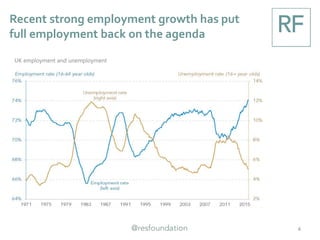
Recent strong employment growth has put
full employment back on the agenda
4
UK employment and unemployment
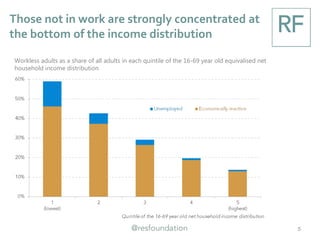
Those not in work are strongly concentrated at
the bottom of the income distribution
5
Workless adults as a share of all adults in each quintile of the 16-69 year old equivalised net
household income distribution
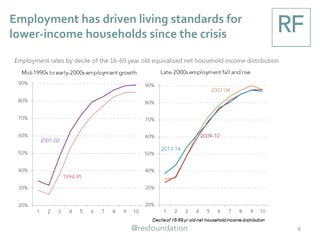
Employment has driven living standards for
lower-income households since the crisis
6
Employment rates by decile of the 16-69 year old equivalised net household income distribution
Full employment is key to future living
standards, and other economic concerns
7
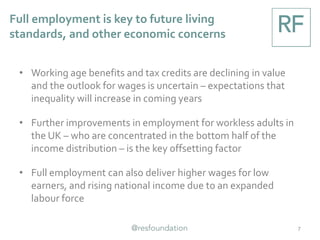
• Working age benefits and tax credits are declining in value
and the outlook for wages is uncertain – expectations that
inequality will increase in coming years
• Further improvements in employment for workless adults in
the UK – who are concentrated in the bottom half of the
income distribution – is the key offsetting factor
• Full employment can also deliver higher wages for low
earners, and rising national income due to an expanded
labour force
8
DEFINING AND QUANTIFYING
FULL EMPLOYMENT
A ‘bottom up’ approach rooted in the UK
experience, built upon three key insights:
9
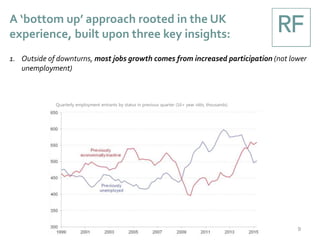
1. Outside of downturns, most jobs growth comes from increased participation (not lower
unemployment)
Quarterly employment entrants by status in previous quarter (16+ year olds, thousands)
A ‘bottom up’ approach rooted in the UK
experience, built upon three key insights:
10
1. Outside of downturns, most jobs growth comes from increased participation (not lower
unemployment)
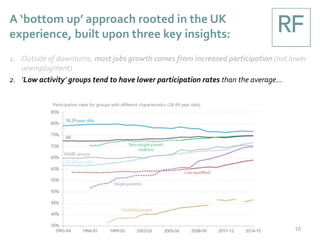
2. ‘Low activity’ groups tend to have lower participation rates than the average…
Participation rates for groups with different characteristics (18-69 year olds)
A ‘bottom up’ approach rooted in the UK
experience, built upon three key insights:
11
1. Outside of downturns, most jobs growth comes from increased participation (not lower
unemployment)
2. ‘Low activity’ groups tend to have lower participation rates than the average…
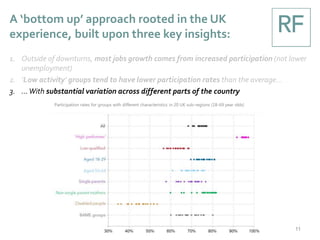
3. …With substantial variation across different parts of the country
Participation rates for groups with different characteristics in 20 UK sub-regions (18-69 year olds)
A ‘bottom up’ approach rooted in the UK
experience, built upon three key insights:
12
1. Outside of downturns, most jobs growth comes from increased participation (not lower
unemployment)
2. ‘Low activity’ groups tend to have lower participation rates than the average…
3. …With substantial variation across different parts of the country
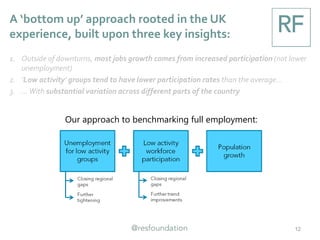
Our approach to benchmarking full employment:
Full employment by the end of the parliament
13
• An increase in the 16-64 year old employment rate
to 78 per cent by 2020-21 – an additional 2 million
people in work relative to today
– The majority of the employment increase (75 per cent) comes
from rising participation
– Those in low activity groups experience large increases in
their employment rates, particularly disabled people, the low-
qualified and BAME groups
– The lowest-performing parts of the country experience the
greatest employment gains, with a 10 ppt+ increase in
Merseyside and the rural North East
14
HOW TO GET TO FULL
EMPLOYMENT
A need for new policy thinking
15
• Policy headwinds – including the National Living
Wage and the Apprenticeship Levy – mean further
employment growth is by no means a given
• Demand itself is not enough – it needs to be
concentrated in lower-employment parts of the
country
• And even when in the right places, employment
demand won’t get us all the way there
automatically
A post-crisis approach to full employment
16
• A broad focus on raising participation, and not just
unemployment or benefit receipt
• A new emphasis on reducing (or delaying)
employment exits
• A recognition that location is of central
importance, both in terms of shaping policy
interventions to local need, and in the need to
deliver regionally-shared employment demand
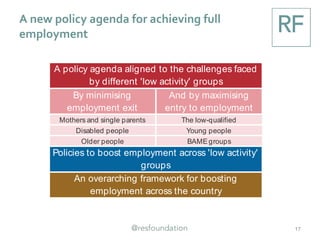
A new policy agenda for achieving full
employment
17
By minimising
employment exit
And by maximising
entry to employment
Mothers and single parents The low-qualified
Disabled people Young people
Older people BAMEgroups
An overarching framework for boosting
employment across the country
A policy agenda aligned to the challenges faced
by different 'low activity' groups
Policies to boost employment across 'low activity'
groups
A new policy agenda for achieving full
employment
18
By minimising
employment exit
And by maximising
entry to employment
Mothers and single parents The low-qualified
Disabled people Young people
Older people BAMEgroups
An overarching framework for boosting
employment across the country
A policy agenda aligned to the challenges faced
by different 'low activity' groups
Policies to boost employment across 'low activity'
groups
A new policy agenda for achieving full
employment
19
By minimising
employment exit
And by maximising
entry to employment
Mothers and single parents The low-qualified
Disabled people Young people
Older people BAMEgroups
An overarching framework for boosting
employment across the country
A policy agenda aligned to the challenges faced
by different 'low activity' groups
Policies to boost employment across 'low activity'
groups
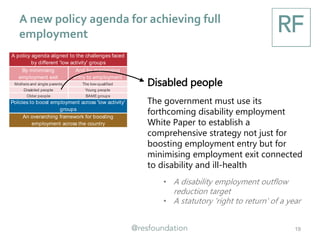
Disabled people
The government must use its
forthcoming disability employment
White Paper to establish a
comprehensive strategy not just for
boosting employment entry but for
minimising employment exit connected
to disability and ill-health
• A disability employment outflow
reduction target
• A statutory 'right to return' of a year
A new policy agenda for achieving full
employment
20
By minimising
employment exit
And by maximising
entry to employment
Mothers and single parents The low-qualified
Disabled people Young people
Older people BAMEgroups
An overarching framework for boosting
employment across the country
A policy agenda aligned to the challenges faced
by different 'low activity' groups
Policies to boost employment across 'low activity'
groups
The low-qualified
The government must use the
opportunity provided by the
Apprenticeship Levy to ensure that
apprenticeships and traineeships are
more appropriately targeted towards
those transitioning from study,
unemployment and inactivity into work
• Target of half of all new
apprenticeships and traineeships
allocated to those coming from
study or who have been out of work
• An apprenticeship access fund
A new policy agenda for achieving full
employment
21
By minimising
employment exit
And by maximising
entry to employment
Mothers and single parents The low-qualified
Disabled people Young people
Older people BAMEgroups
An overarching framework for boosting
employment across the country
A policy agenda aligned to the challenges faced
by different 'low activity' groups
Policies to boost employment across 'low activity'
groups
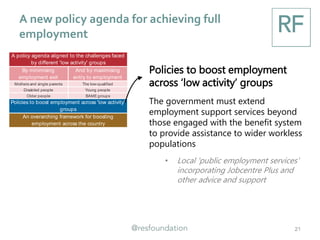
Policies to boost employment
across ‘low activity’ groups
The government must extend
employment support services beyond
those engaged with the benefit system
to provide assistance to wider workless
populations
• Local 'public employment services'
incorporating Jobcentre Plus and
other advice and support
Full employment as a destination worth
targeting: concluding remarks
22
• Our ‘bottom up’ analysis puts meat on the bones of full
employment ambitions, showing the scale of the challenge,
and which groups and areas to target
• Recent employment performance gives us grounds for hope,
but not complacency – an active policy focus is required
– To support the economic conditions conducive to low activity
participation in low-employment areas
– To address the particular employment barriers and challenges faced
by low activity groups
• Full employment is the key tool for achieving inclusive
prosperity
Unfinished Business: securing full
employment in the UK
Owen Smith MP
Paul Gregg, University of Bath
Laura Gardiner, Resolution Foundation
Neil Carberry,CBI
David Willetts, Resolution Foundation
@resfoundation // #fullemployment
Wifi: 2QAG-guest p: W3lc0m3!!
23

Securing full employment in the UK

  • 1.
    Unfinished Business: securingfull employment in the UK Owen Smith MP Paul Gregg, University of Bath Laura Gardiner, Resolution Foundation Neil Carberry,CBI David Willetts, Resolution Foundation @resfoundation // #fullemployment Wifi: 2QAG-guest p: W3lc0m3!! 1
  • 2.
    The road tofull employment What the journey looks like and how to make progress Paul Gregg & Laura Gardiner March 2016 2
  • 3.
    3 THE IMPORTANCE OFFULL EMPLOYMENT
  • 4.
    Recent strong employmentgrowth has put full employment back on the agenda 4 UK employment and unemployment
  • 5.
    Those not inwork are strongly concentrated at the bottom of the income distribution 5 Workless adults as a share of all adults in each quintile of the 16-69 year old equivalised net household income distribution
  • 6.
    Employment has drivenliving standards for lower-income households since the crisis 6 Employment rates by decile of the 16-69 year old equivalised net household income distribution
  • 7.
    Full employment iskey to future living standards, and other economic concerns 7 • Working age benefits and tax credits are declining in value and the outlook for wages is uncertain – expectations that inequality will increase in coming years • Further improvements in employment for workless adults in the UK – who are concentrated in the bottom half of the income distribution – is the key offsetting factor • Full employment can also deliver higher wages for low earners, and rising national income due to an expanded labour force
  • 8.
  • 9.
    A ‘bottom up’approach rooted in the UK experience, built upon three key insights: 9 1. Outside of downturns, most jobs growth comes from increased participation (not lower unemployment) Quarterly employment entrants by status in previous quarter (16+ year olds, thousands)
  • 10.
    A ‘bottom up’approach rooted in the UK experience, built upon three key insights: 10 1. Outside of downturns, most jobs growth comes from increased participation (not lower unemployment) 2. ‘Low activity’ groups tend to have lower participation rates than the average… Participation rates for groups with different characteristics (18-69 year olds)
  • 11.
    A ‘bottom up’approach rooted in the UK experience, built upon three key insights: 11 1. Outside of downturns, most jobs growth comes from increased participation (not lower unemployment) 2. ‘Low activity’ groups tend to have lower participation rates than the average… 3. …With substantial variation across different parts of the country Participation rates for groups with different characteristics in 20 UK sub-regions (18-69 year olds)
  • 12.
    A ‘bottom up’approach rooted in the UK experience, built upon three key insights: 12 1. Outside of downturns, most jobs growth comes from increased participation (not lower unemployment) 2. ‘Low activity’ groups tend to have lower participation rates than the average… 3. …With substantial variation across different parts of the country Our approach to benchmarking full employment:
  • 13.
    Full employment bythe end of the parliament 13 • An increase in the 16-64 year old employment rate to 78 per cent by 2020-21 – an additional 2 million people in work relative to today – The majority of the employment increase (75 per cent) comes from rising participation – Those in low activity groups experience large increases in their employment rates, particularly disabled people, the low- qualified and BAME groups – The lowest-performing parts of the country experience the greatest employment gains, with a 10 ppt+ increase in Merseyside and the rural North East
  • 14.
    14 HOW TO GETTO FULL EMPLOYMENT
  • 15.
    A need fornew policy thinking 15 • Policy headwinds – including the National Living Wage and the Apprenticeship Levy – mean further employment growth is by no means a given • Demand itself is not enough – it needs to be concentrated in lower-employment parts of the country • And even when in the right places, employment demand won’t get us all the way there automatically
  • 16.
    A post-crisis approachto full employment 16 • A broad focus on raising participation, and not just unemployment or benefit receipt • A new emphasis on reducing (or delaying) employment exits • A recognition that location is of central importance, both in terms of shaping policy interventions to local need, and in the need to deliver regionally-shared employment demand
  • 17.
    A new policyagenda for achieving full employment 17 By minimising employment exit And by maximising entry to employment Mothers and single parents The low-qualified Disabled people Young people Older people BAMEgroups An overarching framework for boosting employment across the country A policy agenda aligned to the challenges faced by different 'low activity' groups Policies to boost employment across 'low activity' groups
  • 18.
    A new policyagenda for achieving full employment 18 By minimising employment exit And by maximising entry to employment Mothers and single parents The low-qualified Disabled people Young people Older people BAMEgroups An overarching framework for boosting employment across the country A policy agenda aligned to the challenges faced by different 'low activity' groups Policies to boost employment across 'low activity' groups
  • 19.
    A new policyagenda for achieving full employment 19 By minimising employment exit And by maximising entry to employment Mothers and single parents The low-qualified Disabled people Young people Older people BAMEgroups An overarching framework for boosting employment across the country A policy agenda aligned to the challenges faced by different 'low activity' groups Policies to boost employment across 'low activity' groups Disabled people The government must use its forthcoming disability employment White Paper to establish a comprehensive strategy not just for boosting employment entry but for minimising employment exit connected to disability and ill-health • A disability employment outflow reduction target • A statutory 'right to return' of a year
  • 20.
    A new policyagenda for achieving full employment 20 By minimising employment exit And by maximising entry to employment Mothers and single parents The low-qualified Disabled people Young people Older people BAMEgroups An overarching framework for boosting employment across the country A policy agenda aligned to the challenges faced by different 'low activity' groups Policies to boost employment across 'low activity' groups The low-qualified The government must use the opportunity provided by the Apprenticeship Levy to ensure that apprenticeships and traineeships are more appropriately targeted towards those transitioning from study, unemployment and inactivity into work • Target of half of all new apprenticeships and traineeships allocated to those coming from study or who have been out of work • An apprenticeship access fund
  • 21.
    A new policyagenda for achieving full employment 21 By minimising employment exit And by maximising entry to employment Mothers and single parents The low-qualified Disabled people Young people Older people BAMEgroups An overarching framework for boosting employment across the country A policy agenda aligned to the challenges faced by different 'low activity' groups Policies to boost employment across 'low activity' groups Policies to boost employment across ‘low activity’ groups The government must extend employment support services beyond those engaged with the benefit system to provide assistance to wider workless populations • Local 'public employment services' incorporating Jobcentre Plus and other advice and support
  • 22.
    Full employment asa destination worth targeting: concluding remarks 22 • Our ‘bottom up’ analysis puts meat on the bones of full employment ambitions, showing the scale of the challenge, and which groups and areas to target • Recent employment performance gives us grounds for hope, but not complacency – an active policy focus is required – To support the economic conditions conducive to low activity participation in low-employment areas – To address the particular employment barriers and challenges faced by low activity groups • Full employment is the key tool for achieving inclusive prosperity
  • 23.
    Unfinished Business: securingfull employment in the UK Owen Smith MP Paul Gregg, University of Bath Laura Gardiner, Resolution Foundation Neil Carberry,CBI David Willetts, Resolution Foundation @resfoundation // #fullemployment Wifi: 2QAG-guest p: W3lc0m3!! 23

Editor's Notes

  • #3 Conclusion of nine-month investigation
  • #5 This employment record also compares favourably internationally. The UK currently ranks seventh of 24 developed economies in terms of its employment rate; has recently overtaken Canada to become the third-best performer in the G7; and is making up ground on Germany, Denmark and the Netherlands. Most prominently, the Chancellor has committed to full employment as an ambition for the government, targeting the highest employment rate of G7 economies and a 2 million employment increase within this parliament under this banner. Welcome though these targets are, the lack of further detail means it is not clear that they necessarily represent ‘full employment’, who they benefit, or how they should be achieved. The primary purpose of this report is to address these three questions.
  • #6 Mainly inactive, not unemployed
  • #7 With wages declining in value and other major sources of income such as working-age benefits broadly flat in real terms, it is the strong performance of employment that prevented a deeper fall in living standards for working age households, and then drove forward the early living standards recovery in the past couple of years. As well as driving the recovery in the living standards of working age households, increasing employment has also been strongly progressive in the distribution of these gains (explain chart). This fits into the longer-term story for low and middle income households over the past half-century: to a greater or lesser extent rising employment, particularly for women, has been a key factor in boosting incomes, alongside the role of the working age benefit system.
  • #8 Workless adults with certain characteristics are even more likely to be concentrated in low-income households: disability; low levels of qualifications; from a black, Asian or minority ethnic (BAME) group; or with single parent status (explain chart). This means that the more strongly tilted towards these groups future employment gains are, the richer the rewards in terms of raising the living standards of the poorest. In this way, boosting the size of the labour force pushes out the point at which employment is moderated by accelerating wages or by the central bank, offering the potential to achieve higher growth without inflationary pressures. Of course, more people in work also has a beneficial impact on the working-age welfare bill and can boost tax receipts. And it helps the UK cope with an ageing population and the demands it places on society, the economy and public expenditure.
  • #10 A narrow focus on just the unemployed – and particularly an even narrower focus on benefit claimants – will quickly run out of road. Any substantial employment increase will require bringing new participants into the labour market (or, importantly, keeping participants in for longer).
  • #11 Low activity groups = groups displaying traditional signs of labour market disadvantage. Young people included because of downward employment trends and concerns about wages. We note that while these groups generally experience lower participation, rates have often improved more rapidly than the average, with the progress for single parents and older people particularly marked. This implies that economic- or policy-driven changes in participation are possible.
  • #12 The participation rate for disabled people was 35 per cent in Northern Ireland, compared to a rate of 53 per cent in the South East of England The participation rate for low-qualified people was 57 per cent in Merseyside, compared to a rate of 69 per cent in the East of England.
  • #13 The participation rate for disabled people was 35 per cent in Northern Ireland, compared to a rate of 53 per cent in the South East of England The participation rate for low-qualified people was 57 per cent in Merseyside, compared to a rate of 69 per cent in the East of England.
  • #14 Compared to the end of the previous parliament – the point from which the Chancellor’s set his ambition for a 2 million jobs boost – our full employment measure entails an increase in the number of people in work of 2.4 million. Our measure is therefore slightly more stretching that the Chancellor’s, and provides a picture of what his commitment could constitute and how it could be achieved. For example, our measure entails an increase of almost 1 million in the number of disabled people in work.
  • #16 Set up straw man for each: 1. If current rate of employment growth continued we’d get there no problem Each of these measures provides important new protections and boosts to those in work. But – all else equal – they are also likely to push back against the recent trend towards ever-higher employment levels. 2. It’s all about national growth Of course all else doesn’t have to be equal. Rising demand or specific efforts to boost demand can push up job quantity as well as job quality. Lower-skilled labour very immobile and demand doesn’t naturally shift away from high-employment areas due to migration – a real need to create opportunity in the 3. Labour markets will automatically absorb people And even if we get the demand in the right areas, we can’t expect it to do all the work.
  • #17 Raising participation emanates from our analysis Too often the policy agenda focuses on getting people into work, due to the central role of DWP and the conflation with reducing the welfare bill. For some groups, even successful efforts achieve comparatively low job entry rates, and evidence highlights the damaging effect that losing touch with the labour market can have. Of course we must get better at helping those who do lose touch, but a far more proactive and comprehensive approach involves avoiding this outcome in the first place by stemming flows out of work. Finally, again driven by our analysis we think the policy agenda needs to be location specific. This is both in terms of joining up the devolution, infrastructure and full employment policy areas to push employment demand out to the worst-performing areas, and in terms of joining up interventions at the local level specific to local groups.
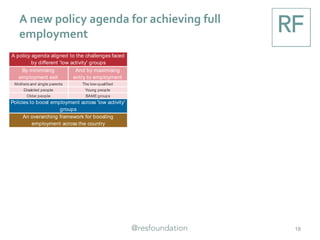
  • #18 12 high-level policy directions, with more detailed recommendations and suggestions beneath each of these. We focus on each of the six low activity groups we have looked at throughout the analysis – for three we suggest the challenge remains the more general job entry agenda. For the other three we think the greatest gains can be made by focusing on exit. We then have 3 directions that span need across low activity groups. And three focused on boosting demand across the regions and sharing what works. Can’t do justice to all of this, so will pick out a few.
  • #20 Given all the changes to ESA, agenda overly focused on benefit off flows rather than employment outcomes, and too focused on employment entry rather than exit. 330,000 move from work to ESA each year. Maintaining attachment to the firm is the key ingredient. Learn lessons from successful maternity policy. These are just a couple of ideas – will present a comprehensive plan in upcoming publication in advance of white paper.
  • #21 Existing approach strongly motivated by hitting a stretching target the government has set itself, without due consideration of who benefits from these opportunities. Only one third of apprentices are new recruits, and a much smaller subset had been out of work before becoming an apprentice. Groups including ethnic minorities significantly under-represented.
  • #22 With the claimant count at an all time low and JCP having to re-think how it operates to support second-earners and those subject to in-work conditionality under UC, now is the time for a rethink. Combining employment and skills services organised by local authorities and LEPs, careers advice, LA NEET obligations, apprenticeship access. Think about commissioning to fill the gap left by much smaller Work Programme.