IJSRD - International Journal for Scientific Research & Development| Vol. 2, Issue 07, 2014 | ISSN (online): 2321-0613
All rights reserved by www.ijsrd.com 442
Secure High Capacity Data Hiding in Images using EDBTC
Sathish1
Akhila S. Shankar 2
Er G.Ahmed Zeeshan3
2,3
Department of Electronics and Communication Engineering
1
SENSE, VIT University 2,3
Global Institute of Engineering and Technology
Abstract— Block truncation coding is an efficient
compression technique which has low computational
complexity but it has two major issues like blocking and
false counter effects .So here we have used error-diffused
BTC that improves above deficiencies using visual low pass
compensation on the bitmap. In this paper complementary
hiding EDBTC is developed to resolve the above issue. In
this project a single water mark is embedded and then
multiple water marks are embedded .usually we use an
adaptive external bias factor to embed the watermark but it
damages the image quality and robustness .So here we use
an extremely small bias factor to control the watermark
embedding and this enables a high capacity scenario without
significantly damaging image quality. Until now a few data
hiding schemes are proposed but it damages the
characteristics of BTC. The security of embedded water
mark is high that it can’t be easy extracted by the malicious
users. The watermark is encrypted by standard encryption
algorithm and then it is embedded.
Keywords: Block Truncation Coding. Data Hiding, Error
Diffusion, Secret Hiding, Spread Spectrum.
I. INTRODUCTION
Block Truncation Coding (BTC), which was proposed by
Delp and Mitchell in 1979 [1], is a strategy for picture
layering. The essential notion of this procedure is to
partition unique picture into numerous non-covered
obstructs, each of which is spoken to by two dissimilar
qualities. In accepted BTC, the two qualities need to
safeguard the first- and second-minute attributes of the first
ever piece. When a BTC picture is transmitted, a
combine of qualities (2x8 bits/block) and the relating
bitmap which stores the game plan of the two qualities
in every piece (1 bit/pixel) are needed. Although BTC
can't furnish practically identical coding pick up as other
up to date squeezing systems, for example Jpeg or
Jpeg2000, the unpredictability of BTC is much lower than
that of these advanced methods, which makes it plausible
for frail handling portion, for example Arm-based
applications. in the writing, numerous approaches have tried
to enhance BTC. The first classification includes
safeguarding the minute trademark of the unique picture
[2], and second class includes enhancing the picture quality
and diminishing the blocking impact [3].
However, the majority of the changes portrayed
above expansion the many-sided quality generously. As of
late, some half toning-based BTC plans have been
advanced to viably enhance picture quality while look
after the computational intricacy in an extremely low style.
Half toning [4] is a method for printing daily paper,
book, or magazine with two unique shades in a color
channel. This system is utilized to render the bitmap of a
BTC piece. When the Human Visual System (HVS) is
included, the half toning-based BTC plans can viably
simplicity the disturbing blocking impact and false form in
conventional BTC. Guo [5] abused blunder dissemination
[6]-[8] to diffuse the quantization mistakes to the
neighboring pixels in the bitmap to keep up the nearby
normal tone, called Error Diffusion Block truncation Coding
(EDBTC).watermarking in EDBTC is misused in this paper
and watermark security is given significance.
II. II. ERROR DIFFUSED BLOCK TRUNCATION CODING
In this method, an EDBTC-based data hiding with a high
image quality and data payload is proposed, in which the
infrastructure of the former EDBTC [12] is briefly introduced in
this section for providing a better comprehension of the
proposed method. The traditional BTC [1] divides an original
image into many non-overlapped blocks of size M x N, and
each block can be processed independently. In this process, the
first- moment (1), second-moment (x2
), and variance ( ) of
the input block are calculated to yield the mean, high-mean,
and low-mean for further BTC processing. The corresponding
calculations are organized below
̅ ∑ ∑ (1)
̅̅̅ ∑ ∑ (2)
=̅̅̅ ̅̅̅̅ (3)
where xj,i denotes the grayscale value of the original
image (X). The concept of the BTC is to preserve the first- and
second-moment characteristics of a block when the original block is
substituted by its quantization levels. Thus, the following two
conditions are maintained:
m̅ = (m-q)a + qb (4)
m̅̅̅ = (m-q) + q (5)
where m = M x N, and q denotes the number of
pixels with values greater than I. The high- and low-mean
used to represent a block can be evaluated as follows
a= ̅ √ (6)
b= ̅ √ (7)
Where the two variables a and b denote the low-
mean and high-mean, respectively. Since BTC is a one-bit
quantizer, I is employed for binarylizing the block. The
result is called bitmap which is used to record the
distributions of the two quantization levels, low-mean and
high-mean,
́ (8)
Where
́ ∑ e (9)
Secure High Capacity Data Hiding in Images using EDBTC
(IJSRD/Vol. 2/Issue 07/2014/098)
All rights reserved by www.ijsrd.com 443
́ (10)
{ (11)
{
̅
̅
(12)
Where hi,1 denotes the element of the bitmap (H), and
yi.j denotes the element of the compressed BTC image (Y).
Since a BTC image normally accompanies with annoying false
contour and blocking effect, an improved scheme, namely
EDBTC.
III. PROPOSED DATA EDBTC HIDING
In this technique, the concept of the secret sharing is
employed to boost the security of the embedded data.
Given a scenario that one watermark (W) is embedded
into two host images (X1
and X2
) by the secret
sharing scheme, the receiver requires to have the two
marked images (Y1
and Y2
) simultaneously for decoding
the corresponding watermark (DW, if it does not suffer
from any attack, it should resemble W). Some of the
methods utilizing this concept also employ an additional
secret key to further improve the security of the watermark.
By doing this, even if the embedding scheme is disclosed,
the watermark is still encrypted safely. The infrastructure of
the proposed encoder and decoder is introduced in detail in
this section. Moreover, the proposed method is extended
to multiple watermarks embedding to increase the
capacity of transmitted information, which is introduced at
the end of this section.
A. Encoder
When an image is divided into blocks for EDBTC
processing, each block is undergone identical processing
procedure,
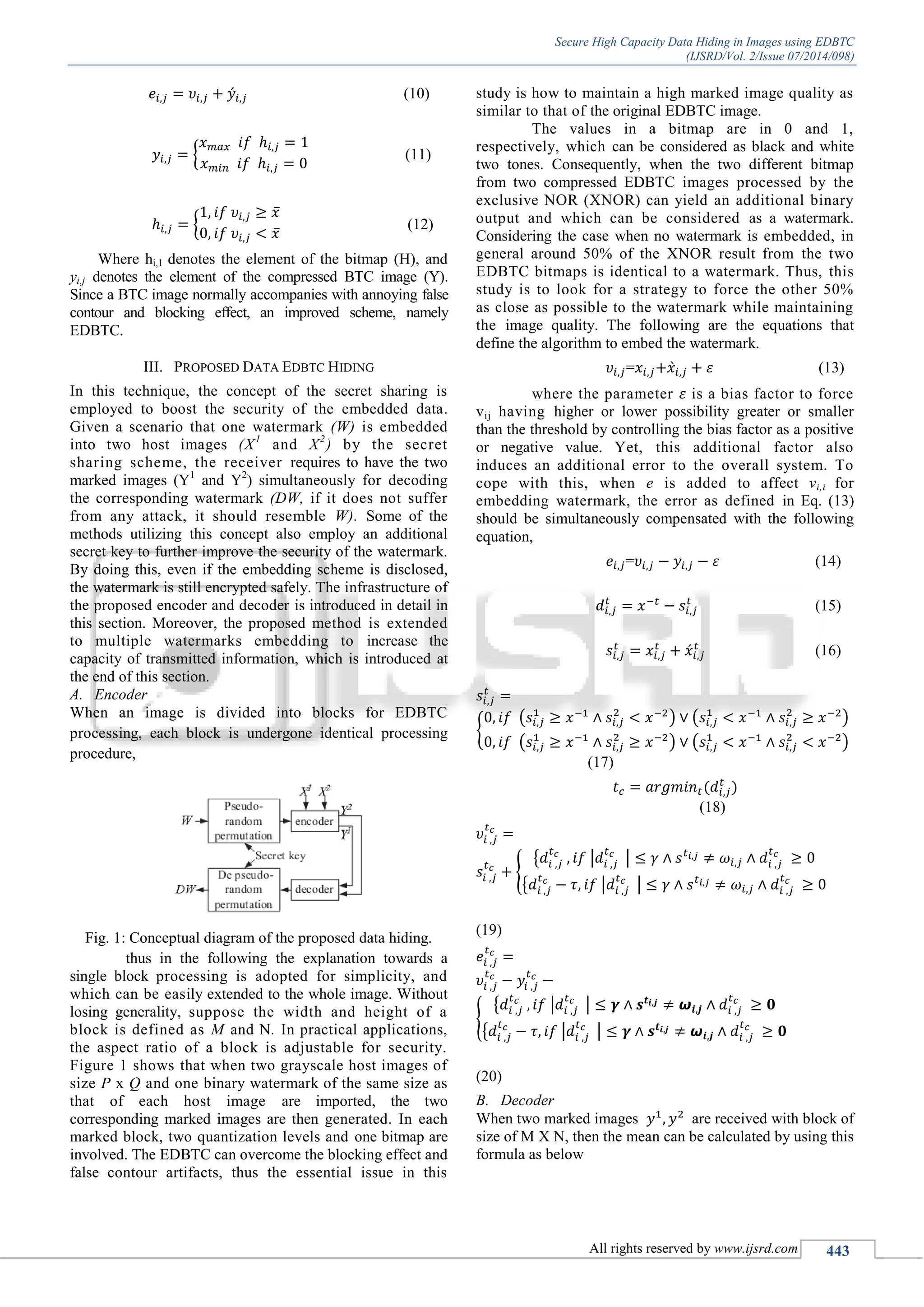
Fig. 1: Conceptual diagram of the proposed data hiding.
thus in the following the explanation towards a
single block processing is adopted for simplicity, and
which can be easily extended to the whole image. Without
losing generality, suppose the width and height of a
block is defined as M and N. In practical applications,
the aspect ratio of a block is adjustable for security.
Figure 1 shows that when two grayscale host images of
size P x Q and one binary watermark of the same size as
that of each host image are imported, the two
corresponding marked images are then generated. In each
marked block, two quantization levels and one bitmap are
involved. The EDBTC can overcome the blocking effect and
false contour artifacts, thus the essential issue in this
study is how to maintain a high marked image quality as
similar to that of the original EDBTC image.
The values in a bitmap are in 0 and 1,
respectively, which can be considered as black and white
two tones. Consequently, when the two different bitmap
from two compressed EDBTC images processed by the
exclusive NOR (XNOR) can yield an additional binary
output and which can be considered as a watermark.
Considering the case when no watermark is embedded, in
general around 50% of the XNOR result from the two
EDBTC bitmaps is identical to a watermark. Thus, this
study is to look for a strategy to force the other 50%
as close as possible to the watermark while maintaining
the image quality. The following are the equations that
define the algorithm to embed the watermark.
= ̀ (13)
where the parameter is a bias factor to force
vij having higher or lower possibility greater or smaller
than the threshold by controlling the bias factor as a positive
or negative value. Yet, this additional factor also
induces an additional error to the overall system. To
cope with this, when e is added to affect vi,i for
embedding watermark, the error as defined in Eq. (13)
should be simultaneously compensated with the following
equation,
= (14)
(15)
́ (16)
{
( ) ( )
( ) ( )
(17)
(18)
{
{ | |
{ | |
(19)
{
{ | |
{ | |
(20)
B. Decoder
When two marked images are received with block of
size of M X N, then the mean can be calculated by using this
formula as below
Secure High Capacity Data Hiding in Images using EDBTC
(IJSRD/Vol. 2/Issue 07/2014/098)
All rights reserved by www.ijsrd.com 444
∑ ∑
(21)
Where t denotes label of the marked image and the
bitmap can be obtained by
{
(22)
The hidden information (DW) can be extracted by
applying XNOR operation over two bitmap of marked
images as below
d ={
(23)
Where 0, 1 represents black and white respectively.
C. Multiple Watermarks Embedding Extension
Suppose a watermark [WP1, WP2....WPS] of size S has
been introduced and T watermarks [ ] are
selected from watermarks to be encrypted.
∑ {
(24)
Where is binary watermark value.
The correlation analysis is formulated by using
below formulae where s is between 1to s denoting label of
watermark and the threshold watermarks are denoted by
(DW) which are embedded into host images.
{
(25)
( )
√
(26)
Where | | √
IV. HIGH SECURE WATERMARKS
The watermarks which are bitmaps of two levels are
changed over into a pseudo arbitrary bits that can't be
distinguished to acquire any handy data. The watermark
pictures hinging on its size are XORed with pseudo irregular
touch created through a particular polynomial. Consequently
by this the securities of the watermarks are expanded and
obscure or noxious individual can't remove the watermark.
Other encryption systems can additionally be utilized as a
part of thought with the Pseudo irregular numbers. Here in
our work to have a fast requisition we have utilized a Pseudo
clamor generator and utilized it to scramble the watermark,
the scrambled watermark is then implanted into the picture
and at last at the recipient end it is decoded to acquire the
definitive watermark.
V. RESULTS AND DISCUSSION
Here we analyze the performance of the proposed data
hiding scheme. We use the Peak Signal to Noise ratio
(PSNR) to trade the images and HVS for quality. We first
take the host images which are of size 512 x 512 grayscale
images and the watermark is of 512 x 512 bitmap images.
We use the algorithm proposed in section III to embed the
watermark over the host images. The watermarked images
and the extracted watermark are shown in figure 2 and 3.
When one watermark is embedded, the marked image
quality and CDR are affected by block size and bias
limitation. Figure 2 shows the variation due to the block
size; we see that block size of 2 has good quality. And in
figure 3 the variation due to bias factor is shown.
Fig. 3: Quality of watermark images for varying block size.
Fig. 4: Quality of watermark images for varying bias factor.
Here we take the bias to be 5, 10, 15, and 20 from
top to bottom in the figure 3.
Fig. 5: CDR plot for different block sizes
We see that an increase in the bias leads to better
retrieved images. In figure 5 we show the CDR (Correct
Decode Rate) plot and we see that for block size of 2 the
results are better. In figure 6 HPSNR is plotted for different
block sizes. In the both figures 5 and 6, blue , green, red bar
Secure High Capacity Data Hiding in Images using EDBTC
(IJSRD/Vol. 2/Issue 07/2014/098)
All rights reserved by www.ijsrd.com 445
corresponds to bias factor 5,10 and 15 respectively. We see
from the bars, CDR as well as PSNR are good for higher
bias and lower block size. Also the security is much
increased than the older once with the inclusion of
cryptography.
Fig. 6: HPSNR for Different block sizes
VI. CONCLUSION
In this paper, a data hiding scheme in EDBTC is proposed
to embed a huge amount of watermarks without
damaging image quality. Then main advantages of the
former EDBTC are still be maintained, and the
blocking effect and the false contour as shown in the
traditional BTC are eliminated. These are useful for data
hiding by providing a higher embedding security,
because it is difficult to aware any unnatural features of the
marked images. In addition, the proposed encoder spreads
watermarks into two marked images, although the
transmission conditions for the two carrier images should
be similar, which thus constrains the possible application
scenarios, the corresponding data security is also
improved with the security sharing concept. Further the
watermarking security is increased by visual cryptography
and by using encryption techniques.
REFERENCES
[1] E. J. Delp and O. R. Mitchell, “Image compression
using block truncation coding,” IEEE Trans.
Communications, 27(9), pp. 1335-1342, Sept. 1979.
[2] V. Udpikar and J. P. Raina, “Modified algorithm
for block truncation coding of monochrome
images,” Electronics Letters, 21(20), pp. 900-902,
Sept. 1985.
[3] Q. Kanafani, A. Beghdadi, and C. Fookes,
“Segmentation-based image compression using BTC-
VQ technique,” IEEE Proc. ISSPA 2003, vol.1,
pp.113-116, Paris 1-4 Jul. 2003.
[4] R. Ulichney, Digital Halftoning. Cambridge, MA:
MIT Press, 1987.
[5] J. M. Guo “Improved block truncation coding using
modified error diffusion,” Electronics Letters, 44(7),
pp. 462-464, Mar. 2008.
[6] R. W. Floyd and L. Steinberg, “An adaptive
algorithm for spatial gray scale,” in Proc. SID 75
Dig.: Society for information Display, pp. 36–37,
1975.
[7] J. F. Jarvis, C. N. Judice, and W. H. Ninke, “A
survey of techniques for the display of continuous-
tone pictures on bilevel displays,” in Comp. Graph.
Image Proc., vol. 5, pp. 13–40, 1976.
[8] P. Stucki, “MECCA-A multiple-error correcting
computation algorithm for bilevel image hardcopy
reproduction,” IBM Res. Lab., Zurich, Switzerland,
Res. Rep. RZ1060, 1981.

Secure High Capacity Data Hiding in Images using EDBTC

  • 1.
    IJSRD - InternationalJournal for Scientific Research & Development| Vol. 2, Issue 07, 2014 | ISSN (online): 2321-0613 All rights reserved by www.ijsrd.com 442 Secure High Capacity Data Hiding in Images using EDBTC Sathish1 Akhila S. Shankar 2 Er G.Ahmed Zeeshan3 2,3 Department of Electronics and Communication Engineering 1 SENSE, VIT University 2,3 Global Institute of Engineering and Technology Abstract— Block truncation coding is an efficient compression technique which has low computational complexity but it has two major issues like blocking and false counter effects .So here we have used error-diffused BTC that improves above deficiencies using visual low pass compensation on the bitmap. In this paper complementary hiding EDBTC is developed to resolve the above issue. In this project a single water mark is embedded and then multiple water marks are embedded .usually we use an adaptive external bias factor to embed the watermark but it damages the image quality and robustness .So here we use an extremely small bias factor to control the watermark embedding and this enables a high capacity scenario without significantly damaging image quality. Until now a few data hiding schemes are proposed but it damages the characteristics of BTC. The security of embedded water mark is high that it can’t be easy extracted by the malicious users. The watermark is encrypted by standard encryption algorithm and then it is embedded. Keywords: Block Truncation Coding. Data Hiding, Error Diffusion, Secret Hiding, Spread Spectrum. I. INTRODUCTION Block Truncation Coding (BTC), which was proposed by Delp and Mitchell in 1979 [1], is a strategy for picture layering. The essential notion of this procedure is to partition unique picture into numerous non-covered obstructs, each of which is spoken to by two dissimilar qualities. In accepted BTC, the two qualities need to safeguard the first- and second-minute attributes of the first ever piece. When a BTC picture is transmitted, a combine of qualities (2x8 bits/block) and the relating bitmap which stores the game plan of the two qualities in every piece (1 bit/pixel) are needed. Although BTC can't furnish practically identical coding pick up as other up to date squeezing systems, for example Jpeg or Jpeg2000, the unpredictability of BTC is much lower than that of these advanced methods, which makes it plausible for frail handling portion, for example Arm-based applications. in the writing, numerous approaches have tried to enhance BTC. The first classification includes safeguarding the minute trademark of the unique picture [2], and second class includes enhancing the picture quality and diminishing the blocking impact [3]. However, the majority of the changes portrayed above expansion the many-sided quality generously. As of late, some half toning-based BTC plans have been advanced to viably enhance picture quality while look after the computational intricacy in an extremely low style. Half toning [4] is a method for printing daily paper, book, or magazine with two unique shades in a color channel. This system is utilized to render the bitmap of a BTC piece. When the Human Visual System (HVS) is included, the half toning-based BTC plans can viably simplicity the disturbing blocking impact and false form in conventional BTC. Guo [5] abused blunder dissemination [6]-[8] to diffuse the quantization mistakes to the neighboring pixels in the bitmap to keep up the nearby normal tone, called Error Diffusion Block truncation Coding (EDBTC).watermarking in EDBTC is misused in this paper and watermark security is given significance. II. II. ERROR DIFFUSED BLOCK TRUNCATION CODING In this method, an EDBTC-based data hiding with a high image quality and data payload is proposed, in which the infrastructure of the former EDBTC [12] is briefly introduced in this section for providing a better comprehension of the proposed method. The traditional BTC [1] divides an original image into many non-overlapped blocks of size M x N, and each block can be processed independently. In this process, the first- moment (1), second-moment (x2 ), and variance ( ) of the input block are calculated to yield the mean, high-mean, and low-mean for further BTC processing. The corresponding calculations are organized below ̅ ∑ ∑ (1) ̅̅̅ ∑ ∑ (2) =̅̅̅ ̅̅̅̅ (3) where xj,i denotes the grayscale value of the original image (X). The concept of the BTC is to preserve the first- and second-moment characteristics of a block when the original block is substituted by its quantization levels. Thus, the following two conditions are maintained: m̅ = (m-q)a + qb (4) m̅̅̅ = (m-q) + q (5) where m = M x N, and q denotes the number of pixels with values greater than I. The high- and low-mean used to represent a block can be evaluated as follows a= ̅ √ (6) b= ̅ √ (7) Where the two variables a and b denote the low- mean and high-mean, respectively. Since BTC is a one-bit quantizer, I is employed for binarylizing the block. The result is called bitmap which is used to record the distributions of the two quantization levels, low-mean and high-mean, ́ (8) Where ́ ∑ e (9)
  • 2.
    Secure High CapacityData Hiding in Images using EDBTC (IJSRD/Vol. 2/Issue 07/2014/098) All rights reserved by www.ijsrd.com 443 ́ (10) { (11) { ̅ ̅ (12) Where hi,1 denotes the element of the bitmap (H), and yi.j denotes the element of the compressed BTC image (Y). Since a BTC image normally accompanies with annoying false contour and blocking effect, an improved scheme, namely EDBTC. III. PROPOSED DATA EDBTC HIDING In this technique, the concept of the secret sharing is employed to boost the security of the embedded data. Given a scenario that one watermark (W) is embedded into two host images (X1 and X2 ) by the secret sharing scheme, the receiver requires to have the two marked images (Y1 and Y2 ) simultaneously for decoding the corresponding watermark (DW, if it does not suffer from any attack, it should resemble W). Some of the methods utilizing this concept also employ an additional secret key to further improve the security of the watermark. By doing this, even if the embedding scheme is disclosed, the watermark is still encrypted safely. The infrastructure of the proposed encoder and decoder is introduced in detail in this section. Moreover, the proposed method is extended to multiple watermarks embedding to increase the capacity of transmitted information, which is introduced at the end of this section. A. Encoder When an image is divided into blocks for EDBTC processing, each block is undergone identical processing procedure, Fig. 1: Conceptual diagram of the proposed data hiding. thus in the following the explanation towards a single block processing is adopted for simplicity, and which can be easily extended to the whole image. Without losing generality, suppose the width and height of a block is defined as M and N. In practical applications, the aspect ratio of a block is adjustable for security. Figure 1 shows that when two grayscale host images of size P x Q and one binary watermark of the same size as that of each host image are imported, the two corresponding marked images are then generated. In each marked block, two quantization levels and one bitmap are involved. The EDBTC can overcome the blocking effect and false contour artifacts, thus the essential issue in this study is how to maintain a high marked image quality as similar to that of the original EDBTC image. The values in a bitmap are in 0 and 1, respectively, which can be considered as black and white two tones. Consequently, when the two different bitmap from two compressed EDBTC images processed by the exclusive NOR (XNOR) can yield an additional binary output and which can be considered as a watermark. Considering the case when no watermark is embedded, in general around 50% of the XNOR result from the two EDBTC bitmaps is identical to a watermark. Thus, this study is to look for a strategy to force the other 50% as close as possible to the watermark while maintaining the image quality. The following are the equations that define the algorithm to embed the watermark. = ̀ (13) where the parameter is a bias factor to force vij having higher or lower possibility greater or smaller than the threshold by controlling the bias factor as a positive or negative value. Yet, this additional factor also induces an additional error to the overall system. To cope with this, when e is added to affect vi,i for embedding watermark, the error as defined in Eq. (13) should be simultaneously compensated with the following equation, = (14) (15) ́ (16) { ( ) ( ) ( ) ( ) (17) (18) { { | | { | | (19) { { | | { | | (20) B. Decoder When two marked images are received with block of size of M X N, then the mean can be calculated by using this formula as below
  • 3.
    Secure High CapacityData Hiding in Images using EDBTC (IJSRD/Vol. 2/Issue 07/2014/098) All rights reserved by www.ijsrd.com 444 ∑ ∑ (21) Where t denotes label of the marked image and the bitmap can be obtained by { (22) The hidden information (DW) can be extracted by applying XNOR operation over two bitmap of marked images as below d ={ (23) Where 0, 1 represents black and white respectively. C. Multiple Watermarks Embedding Extension Suppose a watermark [WP1, WP2....WPS] of size S has been introduced and T watermarks [ ] are selected from watermarks to be encrypted. ∑ { (24) Where is binary watermark value. The correlation analysis is formulated by using below formulae where s is between 1to s denoting label of watermark and the threshold watermarks are denoted by (DW) which are embedded into host images. { (25) ( ) √ (26) Where | | √ IV. HIGH SECURE WATERMARKS The watermarks which are bitmaps of two levels are changed over into a pseudo arbitrary bits that can't be distinguished to acquire any handy data. The watermark pictures hinging on its size are XORed with pseudo irregular touch created through a particular polynomial. Consequently by this the securities of the watermarks are expanded and obscure or noxious individual can't remove the watermark. Other encryption systems can additionally be utilized as a part of thought with the Pseudo irregular numbers. Here in our work to have a fast requisition we have utilized a Pseudo clamor generator and utilized it to scramble the watermark, the scrambled watermark is then implanted into the picture and at last at the recipient end it is decoded to acquire the definitive watermark. V. RESULTS AND DISCUSSION Here we analyze the performance of the proposed data hiding scheme. We use the Peak Signal to Noise ratio (PSNR) to trade the images and HVS for quality. We first take the host images which are of size 512 x 512 grayscale images and the watermark is of 512 x 512 bitmap images. We use the algorithm proposed in section III to embed the watermark over the host images. The watermarked images and the extracted watermark are shown in figure 2 and 3. When one watermark is embedded, the marked image quality and CDR are affected by block size and bias limitation. Figure 2 shows the variation due to the block size; we see that block size of 2 has good quality. And in figure 3 the variation due to bias factor is shown. Fig. 3: Quality of watermark images for varying block size. Fig. 4: Quality of watermark images for varying bias factor. Here we take the bias to be 5, 10, 15, and 20 from top to bottom in the figure 3. Fig. 5: CDR plot for different block sizes We see that an increase in the bias leads to better retrieved images. In figure 5 we show the CDR (Correct Decode Rate) plot and we see that for block size of 2 the results are better. In figure 6 HPSNR is plotted for different block sizes. In the both figures 5 and 6, blue , green, red bar
  • 4.
    Secure High CapacityData Hiding in Images using EDBTC (IJSRD/Vol. 2/Issue 07/2014/098) All rights reserved by www.ijsrd.com 445 corresponds to bias factor 5,10 and 15 respectively. We see from the bars, CDR as well as PSNR are good for higher bias and lower block size. Also the security is much increased than the older once with the inclusion of cryptography. Fig. 6: HPSNR for Different block sizes VI. CONCLUSION In this paper, a data hiding scheme in EDBTC is proposed to embed a huge amount of watermarks without damaging image quality. Then main advantages of the former EDBTC are still be maintained, and the blocking effect and the false contour as shown in the traditional BTC are eliminated. These are useful for data hiding by providing a higher embedding security, because it is difficult to aware any unnatural features of the marked images. In addition, the proposed encoder spreads watermarks into two marked images, although the transmission conditions for the two carrier images should be similar, which thus constrains the possible application scenarios, the corresponding data security is also improved with the security sharing concept. Further the watermarking security is increased by visual cryptography and by using encryption techniques. REFERENCES [1] E. J. Delp and O. R. Mitchell, “Image compression using block truncation coding,” IEEE Trans. Communications, 27(9), pp. 1335-1342, Sept. 1979. [2] V. Udpikar and J. P. Raina, “Modified algorithm for block truncation coding of monochrome images,” Electronics Letters, 21(20), pp. 900-902, Sept. 1985. [3] Q. Kanafani, A. Beghdadi, and C. Fookes, “Segmentation-based image compression using BTC- VQ technique,” IEEE Proc. ISSPA 2003, vol.1, pp.113-116, Paris 1-4 Jul. 2003. [4] R. Ulichney, Digital Halftoning. Cambridge, MA: MIT Press, 1987. [5] J. M. Guo “Improved block truncation coding using modified error diffusion,” Electronics Letters, 44(7), pp. 462-464, Mar. 2008. [6] R. W. Floyd and L. Steinberg, “An adaptive algorithm for spatial gray scale,” in Proc. SID 75 Dig.: Society for information Display, pp. 36–37, 1975. [7] J. F. Jarvis, C. N. Judice, and W. H. Ninke, “A survey of techniques for the display of continuous- tone pictures on bilevel displays,” in Comp. Graph. Image Proc., vol. 5, pp. 13–40, 1976. [8] P. Stucki, “MECCA-A multiple-error correcting computation algorithm for bilevel image hardcopy reproduction,” IBM Res. Lab., Zurich, Switzerland, Res. Rep. RZ1060, 1981.