



Chapter 4 – Point & Figure Patterns and
Analysis – Part II
Section 4 – Chart Pattern Analysis
Presented By :
This Content is Copyright Reserved Rights Copyright 2025@PTAIndia
Agenda
Identify complex point-and-figure chart
patterns
Calculate price projections using vertical
and horizontal counts
Summarize additional uses for point-
and-figure charts
This Content is Copyright Reserved Rights Copyright 2025@PTAIndia
Point & Figure Price Projection
Presented By :
This Content is Copyright Reserved Rights Copyright 2025@PTAIndia
Vertical Count Price Projection Point & Figure Charts
📌 Key Facts on Vertical Count Price Projection
1. What is the Vertical Count Method?
• A trend-based price projection technique in P&F charting.
• Used to estimate potential price targets based on the size of the initial move in a new trend.
• Helps determine how far a trend may extend after a breakout.
2. Key Components
• Column of Xs or Os: The first strong move in a trend.
• Box Size: The price movement required to form each X or O.
• Reversal Factor: The setting for how many boxes constitute a column reversal (typically 3).
• Breakout Level: The price at which the pattern confirms a breakout.
This Content is Copyright Reserved Rights Copyright 2025@PTAIndia
Vertical Count Price Projection Point & Figure Charts
📌 Key Facts on Vertical Count Price Projection
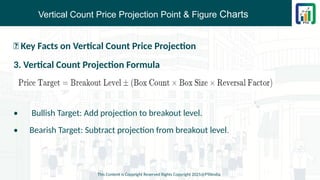
3. Vertical Count Projection Formula
• Bullish Target: Add projection to breakout level.
• Bearish Target: Subtract projection from breakout level.
This Content is Copyright Reserved Rights Copyright 2025@PTAIndia
Vertical Count Price Projection Point & Figure Charts
4. Steps to Calculate Vertical Count Projection
✅ For a Bullish Target:
1. Identify the first column of Xs that starts a new uptrend.
2. Count the number of Xs in this column.
3. Multiply by Box Size and Reversal Factor.
4. Add the result to the breakout price (where the price exceeded prior resistance).
✅ For a Bearish Target:
1. Identify the first column of Os in a new downtrend.
2. Count the number of Os in this column.
3. Multiply by Box Size and Reversal Factor.
4. Subtract the result from the breakdown price (where price fell below prior support).
This Content is Copyright Reserved Rights Copyright 2025@PTAIndia
Vertical Count Price Projection Point & Figure Charts
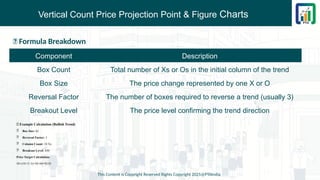
🔹 Formula Breakdown
This Content is Copyright Reserved Rights Copyright 2025@PTAIndia
Component Description
Box Count Total number of Xs or Os in the initial column of the trend
Box Size The price change represented by one X or O
Reversal Factor The number of boxes required to reverse a trend (usually 3)
Breakout Level The price level confirming the trend direction
🔹 Example Calculation (Bullish Trend)
 Box Size: $2
 Reversal Factor: 3
 Column Count: 10 Xs
 Breakout Level: $50
Price Target Calculation:
50+(10×2×3)=50+60=$110
Vertical Count Price Projection Point & Figure Charts
This Content is Copyright Reserved Rights Copyright 2025@PTAIndia
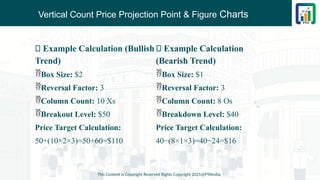
🔹 Example Calculation (Bullish
Trend)
Box Size: $2
Reversal Factor: 3
Column Count: 10 Xs
Breakout Level: $50
Price Target Calculation:
50+(10×2×3)=50+60=$110
🔹 Example Calculation
(Bearish Trend)
Box Size: $1
Reversal Factor: 3
Column Count: 8 Os
Breakdown Level: $40
Price Target Calculation:
40−(8×1×3)=40−24=$16
Vertical Count Price Projection Point & Figure Charts
⚡ Key Takeaways & Pro Tips
✔ The longer the initial column, the bigger the price projection.
✔ Works best in strong trends with clear breakouts.
✔ Confirm projections with support, resistance, and volume analysis.
✔ Use larger box sizes for long-term projections and smaller for short-term.
✔ Always check multiple timeframes for confluence.
This Content is Copyright Reserved Rights Copyright 2025@PTAIndia
Horizontal Count Price Projection
Point & Figure (P&F) Trading
Presented By :
This Content is Copyright Reserved Rights Copyright 2025@PTAIndia
Horizontal Count Price Projection Point & Figure Charts
1. What is the Horizontal Count Method?
• A range-based price projection technique in P&F charting.
• Used to estimate potential price targets based on the width of a consolidation or base
before a breakout.
• Helps determine how far price might move after breaking out of a trading range.
2. Key Components
• Base Formation: The sideways consolidation before a breakout.
• Column Count: The total number of columns in the base.
• Box Size: The price movement required to form each X or O.
• Breakout Level: The price level at which the breakout is confirmed.
This Content is Copyright Reserved Rights Copyright 2025@PTAIndia
Horizontal Count Price Projection Point & Figure Charts
This Content is Copyright Reserved Rights Copyright 2025@PTAIndia
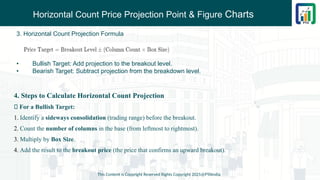
3. Horizontal Count Projection Formula
• Bullish Target: Add projection to the breakout level.
• Bearish Target: Subtract projection from the breakdown level.
4. Steps to Calculate Horizontal Count Projection
✅ For a Bullish Target:
1. Identify a sideways consolidation (trading range) before the breakout.
2. Count the number of columns in the base (from leftmost to rightmost).
3. Multiply by Box Size.
4. Add the result to the breakout price (the price that confirms an upward breakout).
Horizontal Count Price Projection Point & Figure Charts
This Content is Copyright Reserved Rights Copyright 2025@PTAIndia
4. Steps to Calculate Horizontal Count Projection
✅ For a Bearish Target:
1.Identify a sideways base before a downward breakout.
2.Count the number of columns in the base.
3.Multiply by Box Size.
4.Subtract the result from the breakdown price (the price that confirms a
downward breakout).
Horizontal Count Price Projection Point & Figure Charts
This Content is Copyright Reserved Rights Copyright 2025@PTAIndia
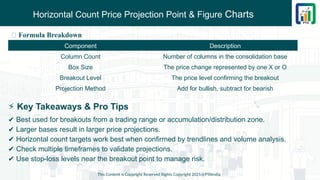
🔹 Formula Breakdown
Component Description
Column Count Number of columns in the consolidation base
Box Size The price change represented by one X or O
Breakout Level The price level confirming the breakout
Projection Method Add for bullish, subtract for bearish
⚡ Key Takeaways & Pro Tips
✔ Best used for breakouts from a trading range or accumulation/distribution zone.
✔ Larger bases result in larger price projections.
✔ Horizontal count targets work best when confirmed by trendlines and volume analysis.
✔ Check multiple timeframes to validate projections.
✔ Use stop-loss levels near the breakout point to manage risk.
Horizontal Count Price Projection Point & Figure Charts
This Content is Copyright Reserved Rights Copyright 2025@PTAIndia
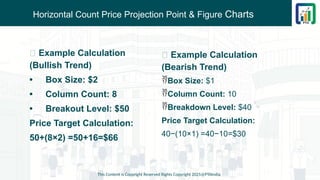
🔹 Example Calculation
(Bullish Trend)
• Box Size: $2
• Column Count: 8
• Breakout Level: $50
Price Target Calculation:
50+(8×2) =50+16=$66
🔹 Example Calculation
(Bearish Trend)
Box Size: $1
Column Count: 10
Breakdown Level: $40
Price Target Calculation:
40−(10×1) =40−10=$30
Relative Strength with Point & Figure Charts
This Content is Copyright Reserved Rights Copyright 2025@PTAIndia
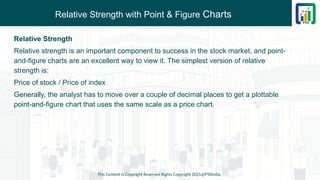
Relative Strength
Relative strength is an important component to success in the stock market, and point-
and-figure charts are an excellent way to view it. The simplest version of relative
strength is:
Price of stock / Price of index
Generally, the analyst has to move over a couple of decimal places to get a plottable
point-and-figure chart that uses the same scale as a price chart.
Steps to Plot RS on a P&F Chart
This Content is Copyright Reserved Rights Copyright 2025@PTAIndia
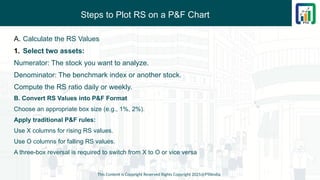
A. Calculate the RS Values
1. Select two assets:
Numerator: The stock you want to analyze.
Denominator: The benchmark index or another stock.
Compute the RS ratio daily or weekly.
B. Convert RS Values into P&F Format
Choose an appropriate box size (e.g., 1%, 2%).
Apply traditional P&F rules:
Use X columns for rising RS values.
Use O columns for falling RS values.
A three-box reversal is required to switch from X to O or vice versa
Steps to Plot RS on a P&F Chart
This Content is Copyright Reserved Rights Copyright 2025@PTAIndia
C. Identify Key Patterns
Breakouts & Trendlines
A double-top breakout (two Xs above a previous column) is bullish.
A double-bottom breakdown (two Os below a previous column) is bearish.
Support & Resistance
Horizontal areas where RS values reverse multiple times indicate strong levels.
Bullish/Bearish Confirmations
If RS confirms a stock's P&F price chart breakout, it strengthens the signal.
If RS diverges, caution is needed.
Steps to Plot RS on a P&F Chart
This Content is Copyright Reserved Rights Copyright 2025@PTAIndia
3. Example of RS P&F Chart Interpretation
If a stock’s RS P&F chart shows a rising column of Xs above a
previous high, it signals strong outperformance.
If RS enters a down column (O’s) after breaking a prior support, it
suggests potential underperformance.
Diffusion Indexes: Cross-Sectional Measurement of a Given Universe
This Content is Copyright Reserved Rights Copyright 2025@PTAIndia
1. What is a Diffusion Index?
• A diffusion index measures the breadth of movement within a dataset, typically
reflecting the percentage of components moving in a particular direction.
• It is a cross-sectional measurement, meaning it evaluates how many elements in a
given universe are expanding vs. contracting at a specific point in time.
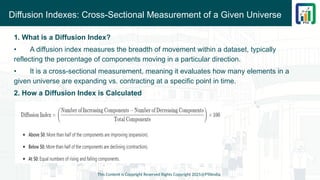
2. How a Diffusion Index is Calculated
Diffusion Indexes: Cross-Sectional Measurement of a Given Universe
This Content is Copyright Reserved Rights Copyright 2025@PTAIndia
3. Common Uses of Diffusion Indexes
✅ Economic Indicators: Used in PMI (Purchasing Managers' Index), employment
surveys, and business outlooks.
✅ Stock Market Breadth Analysis: Measures how many stocks in an index are
advancing vs. declining.
✅ Sector Rotation & Momentum: Identifies strength across industries or asset classes.
✅ Macroeconomic Trends: Helps gauge economic expansion or contraction.
4. Examples of Diffusion Indexes
• ISM Manufacturing PMI → Tracks economic activity in manufacturing.
• Advance-Decline Line → Measures stock market breadth.
• Employment Diffusion Index → Percentage of industries adding jobs.
Diffusion Indexes: Cross-Sectional Measurement of a Given Universe
This Content is Copyright Reserved Rights Copyright 2025@PTAIndia
Key Takeaways & Pro Tips
✔ A rising diffusion index signals broader participation in a trend.
✔ Watch for divergences—if price rises but diffusion weakens,
momentum may fade.
✔ Use diffusion indexes alongside trend analysis for confirmation.
✔ Thresholds (e.g., 60+ for strength, below 40 for weakness) help filter
signals.
Chapter 1 - Price Trend & Volume Analysis
Next Section 5 - Trend Analysis
Presented By :
This Content is Copyright Reserved Rights Copyright 2025@PTAIndia

Section 4 - Chapter 4 - Point-and-Figure Patterns and Analysis - Part II

  • 1.
    Chapter 4 –Point & Figure Patterns and Analysis – Part II Section 4 – Chart Pattern Analysis Presented By : This Content is Copyright Reserved Rights Copyright 2025@PTAIndia
  • 2.
    Agenda Identify complex point-and-figurechart patterns Calculate price projections using vertical and horizontal counts Summarize additional uses for point- and-figure charts This Content is Copyright Reserved Rights Copyright 2025@PTAIndia
  • 3.
    Point & FigurePrice Projection Presented By : This Content is Copyright Reserved Rights Copyright 2025@PTAIndia
  • 4.
    Vertical Count PriceProjection Point & Figure Charts 📌 Key Facts on Vertical Count Price Projection 1. What is the Vertical Count Method? • A trend-based price projection technique in P&F charting. • Used to estimate potential price targets based on the size of the initial move in a new trend. • Helps determine how far a trend may extend after a breakout. 2. Key Components • Column of Xs or Os: The first strong move in a trend. • Box Size: The price movement required to form each X or O. • Reversal Factor: The setting for how many boxes constitute a column reversal (typically 3). • Breakout Level: The price at which the pattern confirms a breakout. This Content is Copyright Reserved Rights Copyright 2025@PTAIndia
  • 5.
    Vertical Count PriceProjection Point & Figure Charts 📌 Key Facts on Vertical Count Price Projection 3. Vertical Count Projection Formula • Bullish Target: Add projection to breakout level. • Bearish Target: Subtract projection from breakout level. This Content is Copyright Reserved Rights Copyright 2025@PTAIndia
  • 6.
    Vertical Count PriceProjection Point & Figure Charts 4. Steps to Calculate Vertical Count Projection ✅ For a Bullish Target: 1. Identify the first column of Xs that starts a new uptrend. 2. Count the number of Xs in this column. 3. Multiply by Box Size and Reversal Factor. 4. Add the result to the breakout price (where the price exceeded prior resistance). ✅ For a Bearish Target: 1. Identify the first column of Os in a new downtrend. 2. Count the number of Os in this column. 3. Multiply by Box Size and Reversal Factor. 4. Subtract the result from the breakdown price (where price fell below prior support). This Content is Copyright Reserved Rights Copyright 2025@PTAIndia
  • 7.
    Vertical Count PriceProjection Point & Figure Charts 🔹 Formula Breakdown This Content is Copyright Reserved Rights Copyright 2025@PTAIndia Component Description Box Count Total number of Xs or Os in the initial column of the trend Box Size The price change represented by one X or O Reversal Factor The number of boxes required to reverse a trend (usually 3) Breakout Level The price level confirming the trend direction 🔹 Example Calculation (Bullish Trend)  Box Size: $2  Reversal Factor: 3  Column Count: 10 Xs  Breakout Level: $50 Price Target Calculation: 50+(10×2×3)=50+60=$110
  • 8.
    Vertical Count PriceProjection Point & Figure Charts This Content is Copyright Reserved Rights Copyright 2025@PTAIndia 🔹 Example Calculation (Bullish Trend) Box Size: $2 Reversal Factor: 3 Column Count: 10 Xs Breakout Level: $50 Price Target Calculation: 50+(10×2×3)=50+60=$110 🔹 Example Calculation (Bearish Trend) Box Size: $1 Reversal Factor: 3 Column Count: 8 Os Breakdown Level: $40 Price Target Calculation: 40−(8×1×3)=40−24=$16
  • 9.
    Vertical Count PriceProjection Point & Figure Charts ⚡ Key Takeaways & Pro Tips ✔ The longer the initial column, the bigger the price projection. ✔ Works best in strong trends with clear breakouts. ✔ Confirm projections with support, resistance, and volume analysis. ✔ Use larger box sizes for long-term projections and smaller for short-term. ✔ Always check multiple timeframes for confluence. This Content is Copyright Reserved Rights Copyright 2025@PTAIndia
  • 10.
    Horizontal Count PriceProjection Point & Figure (P&F) Trading Presented By : This Content is Copyright Reserved Rights Copyright 2025@PTAIndia
  • 11.
    Horizontal Count PriceProjection Point & Figure Charts 1. What is the Horizontal Count Method? • A range-based price projection technique in P&F charting. • Used to estimate potential price targets based on the width of a consolidation or base before a breakout. • Helps determine how far price might move after breaking out of a trading range. 2. Key Components • Base Formation: The sideways consolidation before a breakout. • Column Count: The total number of columns in the base. • Box Size: The price movement required to form each X or O. • Breakout Level: The price level at which the breakout is confirmed. This Content is Copyright Reserved Rights Copyright 2025@PTAIndia
  • 12.
    Horizontal Count PriceProjection Point & Figure Charts This Content is Copyright Reserved Rights Copyright 2025@PTAIndia 3. Horizontal Count Projection Formula • Bullish Target: Add projection to the breakout level. • Bearish Target: Subtract projection from the breakdown level. 4. Steps to Calculate Horizontal Count Projection ✅ For a Bullish Target: 1. Identify a sideways consolidation (trading range) before the breakout. 2. Count the number of columns in the base (from leftmost to rightmost). 3. Multiply by Box Size. 4. Add the result to the breakout price (the price that confirms an upward breakout).
  • 13.
    Horizontal Count PriceProjection Point & Figure Charts This Content is Copyright Reserved Rights Copyright 2025@PTAIndia 4. Steps to Calculate Horizontal Count Projection ✅ For a Bearish Target: 1.Identify a sideways base before a downward breakout. 2.Count the number of columns in the base. 3.Multiply by Box Size. 4.Subtract the result from the breakdown price (the price that confirms a downward breakout).
  • 14.
    Horizontal Count PriceProjection Point & Figure Charts This Content is Copyright Reserved Rights Copyright 2025@PTAIndia 🔹 Formula Breakdown Component Description Column Count Number of columns in the consolidation base Box Size The price change represented by one X or O Breakout Level The price level confirming the breakout Projection Method Add for bullish, subtract for bearish ⚡ Key Takeaways & Pro Tips ✔ Best used for breakouts from a trading range or accumulation/distribution zone. ✔ Larger bases result in larger price projections. ✔ Horizontal count targets work best when confirmed by trendlines and volume analysis. ✔ Check multiple timeframes to validate projections. ✔ Use stop-loss levels near the breakout point to manage risk.
  • 15.
    Horizontal Count PriceProjection Point & Figure Charts This Content is Copyright Reserved Rights Copyright 2025@PTAIndia 🔹 Example Calculation (Bullish Trend) • Box Size: $2 • Column Count: 8 • Breakout Level: $50 Price Target Calculation: 50+(8×2) =50+16=$66 🔹 Example Calculation (Bearish Trend) Box Size: $1 Column Count: 10 Breakdown Level: $40 Price Target Calculation: 40−(10×1) =40−10=$30
  • 16.
    Relative Strength withPoint & Figure Charts This Content is Copyright Reserved Rights Copyright 2025@PTAIndia Relative Strength Relative strength is an important component to success in the stock market, and point- and-figure charts are an excellent way to view it. The simplest version of relative strength is: Price of stock / Price of index Generally, the analyst has to move over a couple of decimal places to get a plottable point-and-figure chart that uses the same scale as a price chart.
  • 17.
    Steps to PlotRS on a P&F Chart This Content is Copyright Reserved Rights Copyright 2025@PTAIndia A. Calculate the RS Values 1. Select two assets: Numerator: The stock you want to analyze. Denominator: The benchmark index or another stock. Compute the RS ratio daily or weekly. B. Convert RS Values into P&F Format Choose an appropriate box size (e.g., 1%, 2%). Apply traditional P&F rules: Use X columns for rising RS values. Use O columns for falling RS values. A three-box reversal is required to switch from X to O or vice versa
  • 18.
    Steps to PlotRS on a P&F Chart This Content is Copyright Reserved Rights Copyright 2025@PTAIndia C. Identify Key Patterns Breakouts & Trendlines A double-top breakout (two Xs above a previous column) is bullish. A double-bottom breakdown (two Os below a previous column) is bearish. Support & Resistance Horizontal areas where RS values reverse multiple times indicate strong levels. Bullish/Bearish Confirmations If RS confirms a stock's P&F price chart breakout, it strengthens the signal. If RS diverges, caution is needed.
  • 19.
    Steps to PlotRS on a P&F Chart This Content is Copyright Reserved Rights Copyright 2025@PTAIndia 3. Example of RS P&F Chart Interpretation If a stock’s RS P&F chart shows a rising column of Xs above a previous high, it signals strong outperformance. If RS enters a down column (O’s) after breaking a prior support, it suggests potential underperformance.
  • 20.
    Diffusion Indexes: Cross-SectionalMeasurement of a Given Universe This Content is Copyright Reserved Rights Copyright 2025@PTAIndia 1. What is a Diffusion Index? • A diffusion index measures the breadth of movement within a dataset, typically reflecting the percentage of components moving in a particular direction. • It is a cross-sectional measurement, meaning it evaluates how many elements in a given universe are expanding vs. contracting at a specific point in time. 2. How a Diffusion Index is Calculated
  • 21.
    Diffusion Indexes: Cross-SectionalMeasurement of a Given Universe This Content is Copyright Reserved Rights Copyright 2025@PTAIndia 3. Common Uses of Diffusion Indexes ✅ Economic Indicators: Used in PMI (Purchasing Managers' Index), employment surveys, and business outlooks. ✅ Stock Market Breadth Analysis: Measures how many stocks in an index are advancing vs. declining. ✅ Sector Rotation & Momentum: Identifies strength across industries or asset classes. ✅ Macroeconomic Trends: Helps gauge economic expansion or contraction. 4. Examples of Diffusion Indexes • ISM Manufacturing PMI → Tracks economic activity in manufacturing. • Advance-Decline Line → Measures stock market breadth. • Employment Diffusion Index → Percentage of industries adding jobs.
  • 22.
    Diffusion Indexes: Cross-SectionalMeasurement of a Given Universe This Content is Copyright Reserved Rights Copyright 2025@PTAIndia Key Takeaways & Pro Tips ✔ A rising diffusion index signals broader participation in a trend. ✔ Watch for divergences—if price rises but diffusion weakens, momentum may fade. ✔ Use diffusion indexes alongside trend analysis for confirmation. ✔ Thresholds (e.g., 60+ for strength, below 40 for weakness) help filter signals.
  • 23.
    Chapter 1 -Price Trend & Volume Analysis Next Section 5 - Trend Analysis Presented By : This Content is Copyright Reserved Rights Copyright 2025@PTAIndia