Chapter 3 – Volatility Indexes and VIX Complex
Section 6 – Volatility Analysis
Presented By :
This Content is Copyright Reserved Rights Copyright 2025@PTAIndia
Agenda
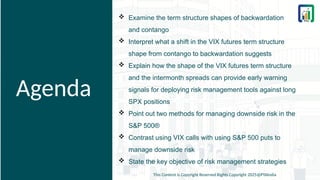
 Examine the term structure shapes of backwardation
and contango
 Interpret what a shift in the VIX futures term structure
shape from contango to backwardation suggests
 Explain how the shape of the VIX futures term structure
and the intermonth spreads can provide early warning
signals for deploying risk management tools against long
SPX positions
 Point out two methods for managing downside risk in the
S&P 500®
 Contrast using VIX calls with using S&P 500 puts to
manage downside risk
 State the key objective of risk management strategies
This Content is Copyright Reserved Rights Copyright 2025@PTAIndia
📊 Key Takeaways : All about VIX
This Content is Copyright Reserved Rights Copyright 2025@PTAIndia
D.webp
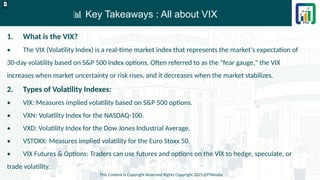
1. What is the VIX?
• The VIX (Volatility Index) is a real-time market index that represents the market's expectation of
30-day volatility based on S&P 500 index options. Often referred to as the "fear gauge," the VIX
increases when market uncertainty or risk rises, and it decreases when the market stabilizes.
2. Types of Volatility Indexes:
• VIX: Measures implied volatility based on S&P 500 options.
• VXN: Volatility Index for the NASDAQ-100.
• VXD: Volatility Index for the Dow Jones Industrial Average.
• VSTOXX: Measures implied volatility for the Euro Stoxx 50.
• VIX Futures & Options: Traders can use futures and options on the VIX to hedge, speculate, or
trade volatility.
📊 Key Takeaways : All about VIX
This Content is Copyright Reserved Rights Copyright 2025@PTAIndia
D.webp
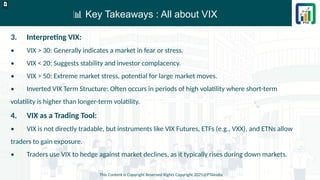
3. Interpreting VIX:
• VIX > 30: Generally indicates a market in fear or stress.
• VIX < 20: Suggests stability and investor complacency.
• VIX > 50: Extreme market stress, potential for large market moves.
• Inverted VIX Term Structure: Often occurs in periods of high volatility where short-term
volatility is higher than longer-term volatility.
4. VIX as a Trading Tool:
• VIX is not directly tradable, but instruments like VIX Futures, ETFs (e.g., VXX), and ETNs allow
traders to gain exposure.
• Traders use VIX to hedge against market declines, as it typically rises during down markets.
📊 Key Takeaways : All about VIX
This Content is Copyright Reserved Rights Copyright 2025@PTAIndia
D.webp
5. VIX and Market Correlation:
• The VIX tends to have an inverse correlation with the S&P 500, meaning when the S&P 500
falls, VIX typically rises (and vice versa).
• VIX spikes often precede short-term market bottoms, offering a potential opportunity for
long trades after a volatility peak.
📊 Cheat Sheet: All about VIX
This Content is Copyright Reserved Rights Copyright 2025@PTAIndia
D.webp
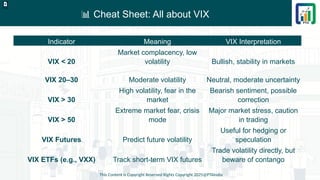
Indicator Meaning VIX Interpretation
VIX < 20
Market complacency, low
volatility Bullish, stability in markets
VIX 20–30 Moderate volatility Neutral, moderate uncertainty
VIX > 30
High volatility, fear in the
market
Bearish sentiment, possible
correction
VIX > 50
Extreme market fear, crisis
mode
Major market stress, caution
in trading
VIX Futures Predict future volatility
Useful for hedging or
speculation
VIX ETFs (e.g., VXX) Track short-term VIX futures
Trade volatility directly, but
beware of contango
📊 Interpretation : All about VIX
This Content is Copyright Reserved Rights Copyright 2025@PTAIndia
D.webp
1. VIX as a Sentiment Indicator:
• A rising VIX indicates growing market uncertainty, typically aligned with a falling market. A
declining VIX signals a more confident and calm market.
2. VIX Movements and Market Direction:
• Historically, when the VIX spikes dramatically, it often signals a market bottom, offering an
opportunity for long positions. A sudden VIX drop often suggests a peak in market volatility,
aligning with market tops.
📊 Interpretation : All about VIX
This Content is Copyright Reserved Rights Copyright 2025@PTAIndia
D.webp
3. Using VIX for Hedging:
• When markets are expected to experience high volatility or a downturn, traders use VIX-
related products to hedge existing equity positions.
• For example, if a trader holds a large stock position, buying VIX calls (or VIX ETFs) can protect
against market drops.
4. Contango and Backwardation in VIX Futures:
• Contango: When futures prices for VIX are higher than the spot VIX, often indicating that the
market expects volatility to increase.
• Backwardation: When futures prices are lower than the spot VIX, signaling that the market
expects volatility to decrease.
📊 Term Structure of VIX Futures & Early Warning Signals
This Content is Copyright Reserved Rights Copyright 2025@PTAIndia
D.webp
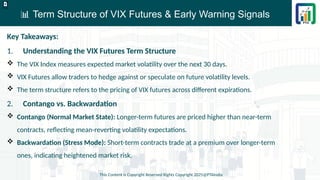
Key Takeaways:
1. Understanding the VIX Futures Term Structure
 The VIX Index measures expected market volatility over the next 30 days.
 VIX Futures allow traders to hedge against or speculate on future volatility levels.
 The term structure refers to the pricing of VIX futures across different expirations.
2. Contango vs. Backwardation
 Contango (Normal Market State): Longer-term futures are priced higher than near-term
contracts, reflecting mean-reverting volatility expectations.
 Backwardation (Stress Mode): Short-term contracts trade at a premium over longer-term
ones, indicating heightened market risk.
📊 Term Structure of VIX Futures & Early Warning Signals
This Content is Copyright Reserved Rights Copyright 2025@PTAIndia
D.webp
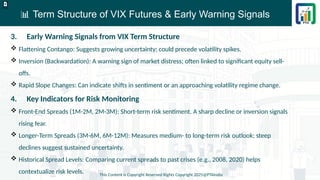
3. Early Warning Signals from VIX Term Structure
 Flattening Contango: Suggests growing uncertainty; could precede volatility spikes.
 Inversion (Backwardation): A warning sign of market distress; often linked to significant equity sell-
offs.
 Rapid Slope Changes: Can indicate shifts in sentiment or an approaching volatility regime change.
4. Key Indicators for Risk Monitoring
 Front-End Spreads (1M-2M, 2M-3M): Short-term risk sentiment. A sharp decline or inversion signals
rising fear.
 Longer-Term Spreads (3M-6M, 6M-12M): Measures medium- to long-term risk outlook; steep
declines suggest sustained uncertainty.
 Historical Spread Levels: Comparing current spreads to past crises (e.g., 2008, 2020) helps
contextualize risk levels.
📊 Term Structure of VIX Futures & Early Warning Signals
This Content is Copyright Reserved Rights Copyright 2025@PTAIndia
D.webp
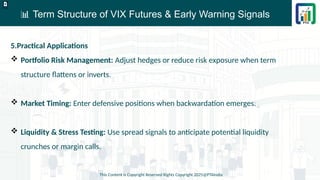
5.Practical Applications
 Portfolio Risk Management: Adjust hedges or reduce risk exposure when term
structure flattens or inverts.
 Market Timing: Enter defensive positions when backwardation emerges.
 Liquidity & Stress Testing: Use spread signals to anticipate potential liquidity
crunches or margin calls.
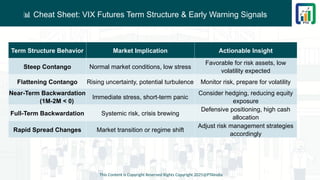
Term Structure Behavior Market Implication Actionable Insight
Steep Contango Normal market conditions, low stress
Favorable for risk assets, low
volatility expected
Flattening Contango Rising uncertainty, potential turbulence Monitor risk, prepare for volatility
Near-Term Backwardation
(1M-2M < 0)
Immediate stress, short-term panic
Consider hedging, reducing equity
exposure
Full-Term Backwardation Systemic risk, crisis brewing
Defensive positioning, high cash
allocation
Rapid Spread Changes Market transition or regime shift
Adjust risk management strategies
accordingly
This Content is Copyright Reserved Rights Copyright 2025@PTAIndia
📊 Cheat Sheet: VIX Futures Term Structure & Early Warning Signals
📊 Trading Strategies Using VIX Futures Term Structure & Early Warning Signals
This Content is Copyright Reserved Rights Copyright 2025@PTAIndia
D.webp
1 . Trading in Contango (Normal Market Conditions)
📌 Market Context:
• VIX futures curve slopes upward, meaning near-term contracts are cheaper than longer-term
contracts.
• Implies that volatility is expected to remain low or revert to the mean.
• Favorable for long equity and short volatility strategies.
📈 Trade Setups:
✅ Short VIX Futures (or Sell VXX, UVXY, TVIX)
• Since VIX futures naturally decay in contango, shorting VIX ETFs or futures can be profitable.
• Roll yield benefits traders who short near-term contracts and roll them forward.
📊 Trading Strategies Using VIX Futures Term Structure & Early Warning Signals
This Content is Copyright Reserved Rights Copyright 2025@PTAIndia
D.webp
1 . Trading in Contango (Normal Market Conditions)
✅ Buy Equity Dips
• If a short-term spike in VIX occurs within a contango structure, it's often a buying opportunity
for equities.
✅ Put Selling or Credit Spreads
• Selling options (e.g., put spreads on SPX) can take advantage of lower implied volatility.
⚠ Risks:
• Unexpected macro events can cause volatility spikes.
• Short VIX trades should have strict risk management (e.g., stop-loss or protective calls).
📊 Trading Strategies Using VIX Futures Term Structure & Early Warning Signals
This Content is Copyright Reserved Rights Copyright 2025@PTAIndia
D.webp
2. Trading in Backwardation (Market Stress Signals)
📌 Market Context:
• Short-term VIX futures are more expensive than long-term contracts.
• Indicates market panic, liquidity stress, or a correction/crash in equities.
📈 Trade Setups:
✅ Long VIX Futures (or Buy VXX, UVXY, TVIX, VXZ)
• Best suited for short-term hedge or crisis protection.
• Volatility spikes tend to be sharp but short-lived, so timing is critical.
📊 Trading Strategies Using VIX Futures Term Structure & Early Warning Signals
This Content is Copyright Reserved Rights Copyright 2025@PTAIndia
D.webp
2 . Trading in Backwardation (Market Stress Signals)
✅ Short Equities or Buy Protective Puts
• When VIX backwardation emerges, it often correlates with equity drawdowns.
• Buying SPX puts or VIX calls provides portfolio protection.
✅ Flight to Safety (Gold, Treasuries, Cash)
• If term structure remains in backwardation for extended periods, rotating into defensive
assets is advisable.
⚠ Risks:
• Timing is critical: VIX spikes are short-lived and decay quickly.
• Mean reversion can cause sudden losses for long volatility positions.
📊 Trading Strategies Using VIX Futures Term Structure & Early Warning Signals
This Content is Copyright Reserved Rights Copyright 2025@PTAIndia
D.webp
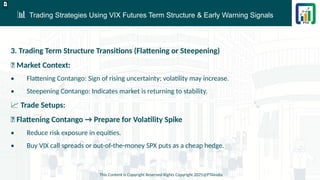
3. Trading Term Structure Transitions (Flattening or Steepening)
📌 Market Context:
• Flattening Contango: Sign of rising uncertainty; volatility may increase.
• Steepening Contango: Indicates market is returning to stability.
📈 Trade Setups:
✅ Flattening Contango → Prepare for Volatility Spike
• Reduce risk exposure in equities.
• Buy VIX call spreads or out-of-the-money SPX puts as a cheap hedge.
📊 Trading Strategies Using VIX Futures Term Structure & Early Warning Signals
This Content is Copyright Reserved Rights Copyright 2025@PTAIndia
D.webp
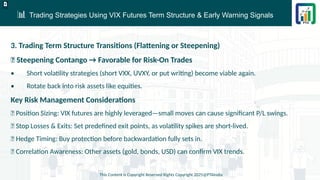
3. Trading Term Structure Transitions (Flattening or Steepening)
✅ Steepening Contango → Favorable for Risk-On Trades
• Short volatility strategies (short VXX, UVXY, or put writing) become viable again.
• Rotate back into risk assets like equities.
Key Risk Management Considerations
✅ Position Sizing: VIX futures are highly leveraged—small moves can cause significant P/L swings.
✅ Stop Losses & Exits: Set predefined exit points, as volatility spikes are short-lived.
✅ Hedge Timing: Buy protection before backwardation fully sets in.
✅ Correlation Awareness: Other assets (gold, bonds, USD) can confirm VIX trends.
Chapter 1 - Analyzing Sentiment in Stock Markets
Next Section 7 – Sentiment
Presented By :
This Content is Copyright Reserved Rights Copyright 2025@PTAIndia

Section 6 - Chapter 3 - Volatility Indexes and VIX Complex.pptx

  • 1.
    Chapter 3 –Volatility Indexes and VIX Complex Section 6 – Volatility Analysis Presented By : This Content is Copyright Reserved Rights Copyright 2025@PTAIndia
  • 2.
    Agenda  Examine theterm structure shapes of backwardation and contango  Interpret what a shift in the VIX futures term structure shape from contango to backwardation suggests  Explain how the shape of the VIX futures term structure and the intermonth spreads can provide early warning signals for deploying risk management tools against long SPX positions  Point out two methods for managing downside risk in the S&P 500®  Contrast using VIX calls with using S&P 500 puts to manage downside risk  State the key objective of risk management strategies This Content is Copyright Reserved Rights Copyright 2025@PTAIndia
  • 3.
    📊 Key Takeaways: All about VIX This Content is Copyright Reserved Rights Copyright 2025@PTAIndia D.webp 1. What is the VIX? • The VIX (Volatility Index) is a real-time market index that represents the market's expectation of 30-day volatility based on S&P 500 index options. Often referred to as the "fear gauge," the VIX increases when market uncertainty or risk rises, and it decreases when the market stabilizes. 2. Types of Volatility Indexes: • VIX: Measures implied volatility based on S&P 500 options. • VXN: Volatility Index for the NASDAQ-100. • VXD: Volatility Index for the Dow Jones Industrial Average. • VSTOXX: Measures implied volatility for the Euro Stoxx 50. • VIX Futures & Options: Traders can use futures and options on the VIX to hedge, speculate, or trade volatility.
  • 4.
    📊 Key Takeaways: All about VIX This Content is Copyright Reserved Rights Copyright 2025@PTAIndia D.webp 3. Interpreting VIX: • VIX > 30: Generally indicates a market in fear or stress. • VIX < 20: Suggests stability and investor complacency. • VIX > 50: Extreme market stress, potential for large market moves. • Inverted VIX Term Structure: Often occurs in periods of high volatility where short-term volatility is higher than longer-term volatility. 4. VIX as a Trading Tool: • VIX is not directly tradable, but instruments like VIX Futures, ETFs (e.g., VXX), and ETNs allow traders to gain exposure. • Traders use VIX to hedge against market declines, as it typically rises during down markets.
  • 5.
    📊 Key Takeaways: All about VIX This Content is Copyright Reserved Rights Copyright 2025@PTAIndia D.webp 5. VIX and Market Correlation: • The VIX tends to have an inverse correlation with the S&P 500, meaning when the S&P 500 falls, VIX typically rises (and vice versa). • VIX spikes often precede short-term market bottoms, offering a potential opportunity for long trades after a volatility peak.
  • 6.
    📊 Cheat Sheet:All about VIX This Content is Copyright Reserved Rights Copyright 2025@PTAIndia D.webp Indicator Meaning VIX Interpretation VIX < 20 Market complacency, low volatility Bullish, stability in markets VIX 20–30 Moderate volatility Neutral, moderate uncertainty VIX > 30 High volatility, fear in the market Bearish sentiment, possible correction VIX > 50 Extreme market fear, crisis mode Major market stress, caution in trading VIX Futures Predict future volatility Useful for hedging or speculation VIX ETFs (e.g., VXX) Track short-term VIX futures Trade volatility directly, but beware of contango
  • 7.
    📊 Interpretation :All about VIX This Content is Copyright Reserved Rights Copyright 2025@PTAIndia D.webp 1. VIX as a Sentiment Indicator: • A rising VIX indicates growing market uncertainty, typically aligned with a falling market. A declining VIX signals a more confident and calm market. 2. VIX Movements and Market Direction: • Historically, when the VIX spikes dramatically, it often signals a market bottom, offering an opportunity for long positions. A sudden VIX drop often suggests a peak in market volatility, aligning with market tops.
  • 8.
    📊 Interpretation :All about VIX This Content is Copyright Reserved Rights Copyright 2025@PTAIndia D.webp 3. Using VIX for Hedging: • When markets are expected to experience high volatility or a downturn, traders use VIX- related products to hedge existing equity positions. • For example, if a trader holds a large stock position, buying VIX calls (or VIX ETFs) can protect against market drops. 4. Contango and Backwardation in VIX Futures: • Contango: When futures prices for VIX are higher than the spot VIX, often indicating that the market expects volatility to increase. • Backwardation: When futures prices are lower than the spot VIX, signaling that the market expects volatility to decrease.
  • 9.
    📊 Term Structureof VIX Futures & Early Warning Signals This Content is Copyright Reserved Rights Copyright 2025@PTAIndia D.webp Key Takeaways: 1. Understanding the VIX Futures Term Structure  The VIX Index measures expected market volatility over the next 30 days.  VIX Futures allow traders to hedge against or speculate on future volatility levels.  The term structure refers to the pricing of VIX futures across different expirations. 2. Contango vs. Backwardation  Contango (Normal Market State): Longer-term futures are priced higher than near-term contracts, reflecting mean-reverting volatility expectations.  Backwardation (Stress Mode): Short-term contracts trade at a premium over longer-term ones, indicating heightened market risk.
  • 10.
    📊 Term Structureof VIX Futures & Early Warning Signals This Content is Copyright Reserved Rights Copyright 2025@PTAIndia D.webp 3. Early Warning Signals from VIX Term Structure  Flattening Contango: Suggests growing uncertainty; could precede volatility spikes.  Inversion (Backwardation): A warning sign of market distress; often linked to significant equity sell- offs.  Rapid Slope Changes: Can indicate shifts in sentiment or an approaching volatility regime change. 4. Key Indicators for Risk Monitoring  Front-End Spreads (1M-2M, 2M-3M): Short-term risk sentiment. A sharp decline or inversion signals rising fear.  Longer-Term Spreads (3M-6M, 6M-12M): Measures medium- to long-term risk outlook; steep declines suggest sustained uncertainty.  Historical Spread Levels: Comparing current spreads to past crises (e.g., 2008, 2020) helps contextualize risk levels.
  • 11.
    📊 Term Structureof VIX Futures & Early Warning Signals This Content is Copyright Reserved Rights Copyright 2025@PTAIndia D.webp 5.Practical Applications  Portfolio Risk Management: Adjust hedges or reduce risk exposure when term structure flattens or inverts.  Market Timing: Enter defensive positions when backwardation emerges.  Liquidity & Stress Testing: Use spread signals to anticipate potential liquidity crunches or margin calls.
  • 12.
    Term Structure BehaviorMarket Implication Actionable Insight Steep Contango Normal market conditions, low stress Favorable for risk assets, low volatility expected Flattening Contango Rising uncertainty, potential turbulence Monitor risk, prepare for volatility Near-Term Backwardation (1M-2M < 0) Immediate stress, short-term panic Consider hedging, reducing equity exposure Full-Term Backwardation Systemic risk, crisis brewing Defensive positioning, high cash allocation Rapid Spread Changes Market transition or regime shift Adjust risk management strategies accordingly This Content is Copyright Reserved Rights Copyright 2025@PTAIndia 📊 Cheat Sheet: VIX Futures Term Structure & Early Warning Signals
  • 13.
    📊 Trading StrategiesUsing VIX Futures Term Structure & Early Warning Signals This Content is Copyright Reserved Rights Copyright 2025@PTAIndia D.webp 1 . Trading in Contango (Normal Market Conditions) 📌 Market Context: • VIX futures curve slopes upward, meaning near-term contracts are cheaper than longer-term contracts. • Implies that volatility is expected to remain low or revert to the mean. • Favorable for long equity and short volatility strategies. 📈 Trade Setups: ✅ Short VIX Futures (or Sell VXX, UVXY, TVIX) • Since VIX futures naturally decay in contango, shorting VIX ETFs or futures can be profitable. • Roll yield benefits traders who short near-term contracts and roll them forward.
  • 14.
    📊 Trading StrategiesUsing VIX Futures Term Structure & Early Warning Signals This Content is Copyright Reserved Rights Copyright 2025@PTAIndia D.webp 1 . Trading in Contango (Normal Market Conditions) ✅ Buy Equity Dips • If a short-term spike in VIX occurs within a contango structure, it's often a buying opportunity for equities. ✅ Put Selling or Credit Spreads • Selling options (e.g., put spreads on SPX) can take advantage of lower implied volatility. ⚠ Risks: • Unexpected macro events can cause volatility spikes. • Short VIX trades should have strict risk management (e.g., stop-loss or protective calls).
  • 15.
    📊 Trading StrategiesUsing VIX Futures Term Structure & Early Warning Signals This Content is Copyright Reserved Rights Copyright 2025@PTAIndia D.webp 2. Trading in Backwardation (Market Stress Signals) 📌 Market Context: • Short-term VIX futures are more expensive than long-term contracts. • Indicates market panic, liquidity stress, or a correction/crash in equities. 📈 Trade Setups: ✅ Long VIX Futures (or Buy VXX, UVXY, TVIX, VXZ) • Best suited for short-term hedge or crisis protection. • Volatility spikes tend to be sharp but short-lived, so timing is critical.
  • 16.
    📊 Trading StrategiesUsing VIX Futures Term Structure & Early Warning Signals This Content is Copyright Reserved Rights Copyright 2025@PTAIndia D.webp 2 . Trading in Backwardation (Market Stress Signals) ✅ Short Equities or Buy Protective Puts • When VIX backwardation emerges, it often correlates with equity drawdowns. • Buying SPX puts or VIX calls provides portfolio protection. ✅ Flight to Safety (Gold, Treasuries, Cash) • If term structure remains in backwardation for extended periods, rotating into defensive assets is advisable. ⚠ Risks: • Timing is critical: VIX spikes are short-lived and decay quickly. • Mean reversion can cause sudden losses for long volatility positions.
  • 17.
    📊 Trading StrategiesUsing VIX Futures Term Structure & Early Warning Signals This Content is Copyright Reserved Rights Copyright 2025@PTAIndia D.webp 3. Trading Term Structure Transitions (Flattening or Steepening) 📌 Market Context: • Flattening Contango: Sign of rising uncertainty; volatility may increase. • Steepening Contango: Indicates market is returning to stability. 📈 Trade Setups: ✅ Flattening Contango → Prepare for Volatility Spike • Reduce risk exposure in equities. • Buy VIX call spreads or out-of-the-money SPX puts as a cheap hedge.
  • 18.
    📊 Trading StrategiesUsing VIX Futures Term Structure & Early Warning Signals This Content is Copyright Reserved Rights Copyright 2025@PTAIndia D.webp 3. Trading Term Structure Transitions (Flattening or Steepening) ✅ Steepening Contango → Favorable for Risk-On Trades • Short volatility strategies (short VXX, UVXY, or put writing) become viable again. • Rotate back into risk assets like equities. Key Risk Management Considerations ✅ Position Sizing: VIX futures are highly leveraged—small moves can cause significant P/L swings. ✅ Stop Losses & Exits: Set predefined exit points, as volatility spikes are short-lived. ✅ Hedge Timing: Buy protection before backwardation fully sets in. ✅ Correlation Awareness: Other assets (gold, bonds, USD) can confirm VIX trends.
  • 19.
    Chapter 1 -Analyzing Sentiment in Stock Markets Next Section 7 – Sentiment Presented By : This Content is Copyright Reserved Rights Copyright 2025@PTAIndia