

Chapter 3 – Candlestick Analysis in the
Real World
Section 4 – Chart Pattern Analysis
Presented By :
This Content is Copyright Reserved Rights Copyright 2025@PTAIndia
Agenda
 Examine the difference between single-candle patterns
and multi-candle patterns
 Summarize the implications for candlestick patterns
when they occur at potential support or resistance zones
 Differentiate between unconfirmed and confirmed
candlestick patterns
 Learn to identify complete and incomplete patterns and
their implications for trading decisions
 Compare the abandoned baby reversal and the island
reversal patterns
 Outline guidelines for interpreting imperfect candlestick
patterns
 Develop the ability to integrate candlestick patterns into
broader chart pattern analysis for better decision making
This Content is Copyright Reserved Rights Copyright 2025@PTAIndia
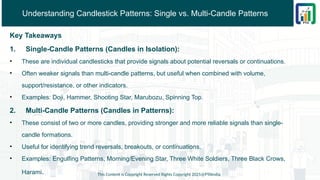
Understanding Candlestick Patterns: Single vs. Multi-Candle Patterns
Key Takeaways
1. Single-Candle Patterns (Candles in Isolation):
• These are individual candlesticks that provide signals about potential reversals or continuations.
• Often weaker signals than multi-candle patterns, but useful when combined with volume,
support/resistance, or other indicators.
• Examples: Doji, Hammer, Shooting Star, Marubozu, Spinning Top.
2. Multi-Candle Patterns (Candles in Patterns):
• These consist of two or more candles, providing stronger and more reliable signals than single-
candle formations.
• Useful for identifying trend reversals, breakouts, or continuations.
• Examples: Engulfing Patterns, Morning/Evening Star, Three White Soldiers, Three Black Crows,
Harami. This Content is Copyright Reserved Rights Copyright 2025@PTAIndia
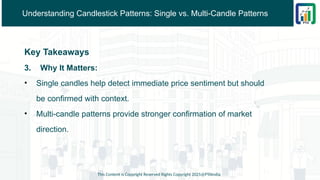
Understanding Candlestick Patterns: Single vs. Multi-Candle Patterns
Key Takeaways
3. Why It Matters:
• Single candles help detect immediate price sentiment but should
be confirmed with context.
• Multi-candle patterns provide stronger confirmation of market
direction.
This Content is Copyright Reserved Rights Copyright 2025@PTAIndia
Understanding Candlestick Patterns: Single vs. Multi-Candle Patterns
This Content is Copyright Reserved Rights Copyright 2025@PTAIndia
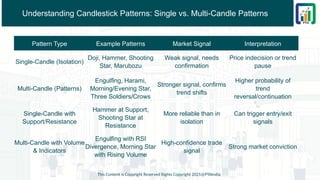
Pattern Type Example Patterns Market Signal Interpretation
Single-Candle (Isolation)
Doji, Hammer, Shooting
Star, Marubozu
Weak signal, needs
confirmation
Price indecision or trend
pause
Multi-Candle (Patterns)
Engulfing, Harami,
Morning/Evening Star,
Three Soldiers/Crows
Stronger signal, confirms
trend shifts
Higher probability of
trend
reversal/continuation
Single-Candle with
Support/Resistance
Hammer at Support,
Shooting Star at
Resistance
More reliable than in
isolation
Can trigger entry/exit
signals
Multi-Candle with Volume
& Indicators
Engulfing with RSI
Divergence, Morning Star
with Rising Volume
High-confidence trade
signal
Strong market conviction
Trading Strategies Using Candlestick Patterns
1. Single-Candle Strategy (Needs Confirmation)
• Strategy: Use single candles as early signals but confirm with
support/resistance, volume, or trend indicators.
• Example:
Hammer at Key Support → Wait for confirmation (next candle closing
higher) before entering long.
Shooting Star at Resistance → Watch for follow-through selling
before shorting.
This Content is Copyright Reserved Rights Copyright 2025@PTAIndia
Trading Strategies Using Candlestick Patterns
2. Multi-Candle Strategy for Stronger Entry Signals
Strategy: Look for multi-candle patterns to confirm a trend change
before entering a trade.
Example:
Bullish Engulfing after a Downtrend → Confirms buying pressure, good
for long entry.
Evening Star at Resistance → Indicates strong bearish reversal,
signals a short position.
This Content is Copyright Reserved Rights Copyright 2025@PTAIndia
Trading Strategies Using Candlestick Patterns
3. Combining with Technical Indicators
• Strategy: Use candlestick patterns with RSI, MACD, or moving
averages for higher accuracy.
• Example:
o Morning Star with RSI < 30 (Oversold) → Strong buy signal.
o Bearish Engulfing with MACD Bearish Crossover → High-
probability short trade.
This Content is Copyright Reserved Rights Copyright 2025@PTAIndia
Trading Strategies Using Candlestick Patterns
4. Risk Management with Candlestick Patterns
• Strategy: Place stop-losses based on candlestick highs/lows
to manage risk.
• Example:
o Hammer at Support → Stop below the low of the Hammer.
o Bearish Engulfing → Stop above the engulfing candle's high.
This Content is Copyright Reserved Rights Copyright 2025@PTAIndia
Trading Strategies Using Candlestick Patterns
Summary
• Single-Candle Patterns = Weak by Themselves, Need Confirmation.
• Multi-Candle Patterns = Stronger & More Reliable Trade Signals.
• Use Support/Resistance, Volume, & Indicators for Confirmation.
• Best for Spotting Reversals, Breakouts, and Trend Continuations.
This Content is Copyright Reserved Rights Copyright 2025@PTAIndia
Candlestick Patterns Near Support & Resistance
Key Takeaways
1. Importance of Context:
o Candlestick patterns near key support or resistance levels have higher reliability than
patterns in the middle of a trend.
o They help confirm trend reversals, breakouts, or failed moves.
2. Support Level Reactions:
o Bullish candlestick patterns at support suggest a potential bounce or trend reversal.
o Bearish candlestick patterns breaking support indicate downtrend continuation.
This Content is Copyright Reserved Rights Copyright 2025@PTAIndia
Candlestick Patterns Near Support & Resistance
Key Takeaways
3. Resistance Level Reactions:
o Bearish candlestick patterns at resistance suggest a potential reversal
downward.
o Bullish breakouts above resistance with strong candlesticks indicate
trend continuation.
4. Confirmation is Crucial:
o A single candlestick pattern should be confirmed by volume, price
follow-through, and other indicators before trading.
This Content is Copyright Reserved Rights Copyright 2025@PTAIndia
Candlestick Patterns Near Support & Resistance
This Content is Copyright Reserved Rights Copyright 2025@PTAIndia
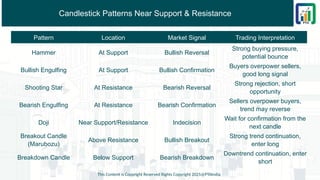
Pattern Location Market Signal Trading Interpretation
Hammer At Support Bullish Reversal
Strong buying pressure,
potential bounce
Bullish Engulfing At Support Bullish Confirmation
Buyers overpower sellers,
good long signal
Shooting Star At Resistance Bearish Reversal
Strong rejection, short
opportunity
Bearish Engulfing At Resistance Bearish Confirmation
Sellers overpower buyers,
trend may reverse
Doji Near Support/Resistance Indecision
Wait for confirmation from the
next candle
Breakout Candle
(Marubozu)
Above Resistance Bullish Breakout
Strong trend continuation,
enter long
Breakdown Candle Below Support Bearish Breakdown
Downtrend continuation, enter
short
Trading Strategies Using Candlestick Patterns Near Support & Resistance
1. Reversal Trades at Support & Resistance
• Strategy: Look for reversal candlestick patterns at key support/resistance
levels for high-probability trades.
• Example:
o Bullish Engulfing at Support → Go Long with a stop below support.
o Shooting Star at Resistance → Go Short with a stop above resistance.
This Content is Copyright Reserved Rights Copyright 2025@PTAIndia
Trading Strategies Using Candlestick Patterns Near Support & Resistance
2. Breakout Confirmation for Trend Continuation
• Strategy: Enter trades when a strong breakout candle closes
above resistance or below support.
• Example:
o Bullish Marubozu above Resistance → Enter Long with stop below
breakout level.
o Bearish Breakdown Candle below Support → Enter Short with stop
above breakdown level.
This Content is Copyright Reserved Rights Copyright 2025@PTAIndia
Trading Strategies Using Candlestick Patterns Near Support & Resistance
3. False Breakout & Trap Setups
• Strategy: Be cautious of false breakouts when price briefly
moves beyond a key level but quickly reverses.
• Example:
o Price breaks resistance but closes below it with a Shooting Star
→ Short on confirmation.
o Price dips below support but closes above with a Hammer →
Go Long.
This Content is Copyright Reserved Rights Copyright 2025@PTAIndia
Trading Strategies Using Candlestick Patterns Near Support & Resistance
4. Combining with Volume & Indicators
• Strategy: Higher volume with a pattern = stronger signal. Use
RSI, MACD, or moving averages for extra confirmation.
• Example:
o Bullish Engulfing at Support + RSI < 30 (Oversold) → Strong
buy signal.
o Bearish Engulfing at Resistance + MACD Bearish Crossover →
Strong short opportunity.
This Content is Copyright Reserved Rights Copyright 2025@PTAIndia
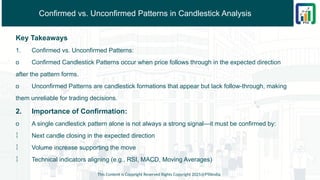
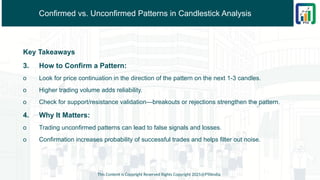
Confirmed vs. Unconfirmed Patterns in Candlestick Analysis
Key Takeaways
1. Confirmed vs. Unconfirmed Patterns:
o Confirmed Candlestick Patterns occur when price follows through in the expected direction
after the pattern forms.
o Unconfirmed Patterns are candlestick formations that appear but lack follow-through, making
them unreliable for trading decisions.
2. Importance of Confirmation:
o A single candlestick pattern alone is not always a strong signal—it must be confirmed by:
 Next candle closing in the expected direction
 Volume increase supporting the move
 Technical indicators aligning (e.g., RSI, MACD, Moving Averages)
This Content is Copyright Reserved Rights Copyright 2025@PTAIndia
Confirmed vs. Unconfirmed Patterns in Candlestick Analysis
Key Takeaways
3. How to Confirm a Pattern:
o Look for price continuation in the direction of the pattern on the next 1-3 candles.
o Higher trading volume adds reliability.
o Check for support/resistance validation—breakouts or rejections strengthen the pattern.
4. Why It Matters:
o Trading unconfirmed patterns can lead to false signals and losses.
o Confirmation increases probability of successful trades and helps filter out noise.
This Content is Copyright Reserved Rights Copyright 2025@PTAIndia
Confirmed vs. Unconfirmed Patterns in Candlestick Analysis
This Content is Copyright Reserved Rights Copyright 2025@PTAIndia
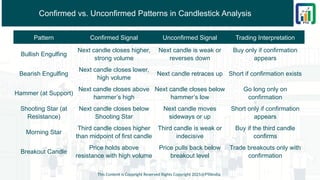
Pattern Confirmed Signal Unconfirmed Signal Trading Interpretation
Bullish Engulfing
Next candle closes higher,
strong volume
Next candle is weak or
reverses down
Buy only if confirmation
appears
Bearish Engulfing
Next candle closes lower,
high volume
Next candle retraces up Short if confirmation exists
Hammer (at Support)
Next candle closes above
hammer’s high
Next candle closes below
hammer’s low
Go long only on
confirmation
Shooting Star (at
Resistance)
Next candle closes below
Shooting Star
Next candle moves
sideways or up
Short only if confirmation
appears
Morning Star
Third candle closes higher
than midpoint of first candle
Third candle is weak or
indecisive
Buy if the third candle
confirms
Breakout Candle
Price holds above
resistance with high volume
Price pulls back below
breakout level
Trade breakouts only with
confirmation
Trading Strategies Based on Confirmation
1. Waiting for Confirmation Before Entering Trades
• Strategy:
Trade only when a candlestick pattern is confirmed by the next 1-2 candles.
• Example:
o Bullish Engulfing → Wait for a second bullish candle to confirm upward
momentum before entering long.
o Bearish Engulfing → Enter short only if the next candle confirms with
further decline.
This Content is Copyright Reserved Rights Copyright 2025@PTAIndia
Trading Strategies Based on Confirmation
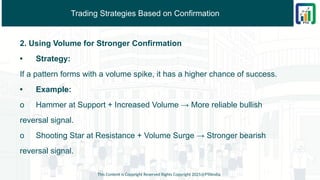
2. Using Volume for Stronger Confirmation
• Strategy:
If a pattern forms with a volume spike, it has a higher chance of success.
• Example:
o Hammer at Support + Increased Volume → More reliable bullish
reversal signal.
o Shooting Star at Resistance + Volume Surge → Stronger bearish
reversal signal.
This Content is Copyright Reserved Rights Copyright 2025@PTAIndia
Trading Strategies Based on Confirmation
3. Combining Confirmation with Indicators
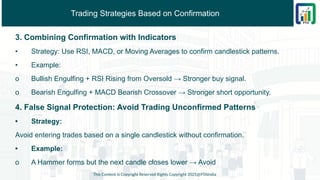
• Strategy: Use RSI, MACD, or Moving Averages to confirm candlestick patterns.
• Example:
o Bullish Engulfing + RSI Rising from Oversold → Stronger buy signal.
o Bearish Engulfing + MACD Bearish Crossover → Stronger short opportunity.
4. False Signal Protection: Avoid Trading Unconfirmed Patterns
• Strategy:
Avoid entering trades based on a single candlestick without confirmation.
• Example:
o A Hammer forms but the next candle closes lower → Avoid
This Content is Copyright Reserved Rights Copyright 2025@PTAIndia
Key Distinction Between Confirmed and Unconfirmed Candlestick Patterns
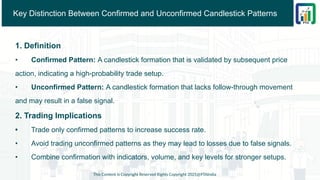
1. Definition
• Confirmed Pattern: A candlestick formation that is validated by subsequent price
action, indicating a high-probability trade setup.
• Unconfirmed Pattern: A candlestick formation that lacks follow-through movement
and may result in a false signal.
2. Trading Implications
• Trade only confirmed patterns to increase success rate.
• Avoid trading unconfirmed patterns as they may lead to losses due to false signals.
• Combine confirmation with indicators, volume, and key levels for stronger setups.
This Content is Copyright Reserved Rights Copyright 2025@PTAIndia
Key Distinction Between Confirmed and Unconfirmed Candlestick Patterns
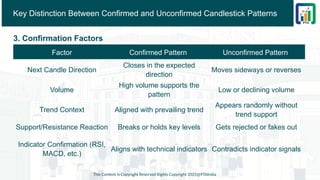
3. Confirmation Factors
This Content is Copyright Reserved Rights Copyright 2025@PTAIndia
Factor Confirmed Pattern Unconfirmed Pattern
Next Candle Direction
Closes in the expected
direction
Moves sideways or reverses
Volume
High volume supports the
pattern
Low or declining volume
Trend Context Aligned with prevailing trend
Appears randomly without
trend support
Support/Resistance Reaction Breaks or holds key levels Gets rejected or fakes out
Indicator Confirmation (RSI,
MACD, etc.)
Aligns with technical indicators Contradicts indicator signals
Key Distinction Between Confirmed and Unconfirmed Candlestick Patterns
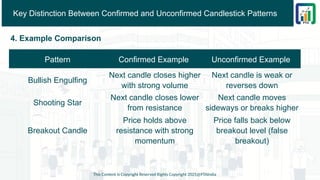
4. Example Comparison
This Content is Copyright Reserved Rights Copyright 2025@PTAIndia
Pattern Confirmed Example Unconfirmed Example
Bullish Engulfing
Next candle closes higher
with strong volume
Next candle is weak or
reverses down
Shooting Star
Next candle closes lower
from resistance
Next candle moves
sideways or breaks higher
Breakout Candle
Price holds above
resistance with strong
momentum
Price falls back below
breakout level (false
breakout)
Flexibility of Candlesticks, Imperfect Candlestick Patterns & Fibonacci Levels
Key Takeaways
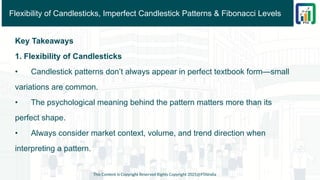
1. Flexibility of Candlesticks
• Candlestick patterns don’t always appear in perfect textbook form—small
variations are common.
• The psychological meaning behind the pattern matters more than its
perfect shape.
• Always consider market context, volume, and trend direction when
interpreting a pattern.
This Content is Copyright Reserved Rights Copyright 2025@PTAIndia
Flexibility of Candlesticks, Imperfect Candlestick Patterns & Fibonacci Levels
Key Takeaways
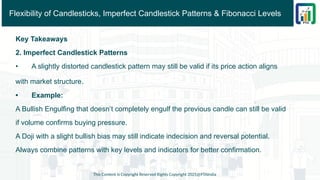
2. Imperfect Candlestick Patterns
• A slightly distorted candlestick pattern may still be valid if its price action aligns
with market structure.
• Example:
A Bullish Engulfing that doesn’t completely engulf the previous candle can still be valid
if volume confirms buying pressure.
A Doji with a slight bullish bias may still indicate indecision and reversal potential.
Always combine patterns with key levels and indicators for better confirmation.
This Content is Copyright Reserved Rights Copyright 2025@PTAIndia
Flexibility of Candlesticks, Imperfect Candlestick Patterns & Fibonacci Levels
Key Takeaways
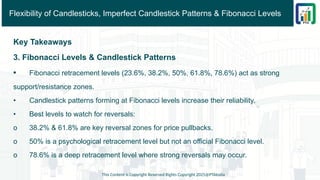
3. Fibonacci Levels & Candlestick Patterns
• Fibonacci retracement levels (23.6%, 38.2%, 50%, 61.8%, 78.6%) act as strong
support/resistance zones.
• Candlestick patterns forming at Fibonacci levels increase their reliability.
• Best levels to watch for reversals:
o 38.2% & 61.8% are key reversal zones for price pullbacks.
o 50% is a psychological retracement level but not an official Fibonacci level.
o 78.6% is a deep retracement level where strong reversals may occur.
This Content is Copyright Reserved Rights Copyright 2025@PTAIndia
Flexibility of Candlesticks, Imperfect Candlestick Patterns & Fibonacci Levels
This Content is Copyright Reserved Rights Copyright 2025@PTAIndia
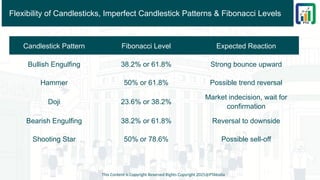
Candlestick Pattern Fibonacci Level Expected Reaction
Bullish Engulfing 38.2% or 61.8% Strong bounce upward
Hammer 50% or 61.8% Possible trend reversal
Doji 23.6% or 38.2%
Market indecision, wait for
confirmation
Bearish Engulfing 38.2% or 61.8% Reversal to downside
Shooting Star 50% or 78.6% Possible sell-off
Flexibility of Candlesticks, Imperfect Candlestick Patterns & Fibonacci Levels
Trading Strategies
1. Trading Imperfect Patterns with Confirmation
• Strategy: Enter a trade only if the market confirms the candlestick signal through:
o Volume increase
o Break of a key support/resistance level
o Trend continuation signals from indicators (RSI, MACD)
2. Fibonacci Retracement + Candlestick Pattern Setup
• Strategy: Identify a retracement to a key Fibonacci level and wait for a strong candlestick reversal
pattern before entering.
• Example:
o Price pulls back to 61.8% Fib retracement → A Bullish Engulfing appears → Enter long with a stop
below the pattern. This Content is Copyright Reserved Rights Copyright 2025@PTAIndia
Flexibility of Candlesticks, Imperfect Candlestick Patterns & Fibonacci Levels
3. Using Fibonacci Extensions for Targets
• Strategy: After entering a trade based on Fibonacci + candlestick confirmation, set
profit targets at:
o 127.2% or 161.8% extension for trend continuation trades.
o Previous swing high/lows for conservative exits.
Final Thoughts
✅ Candlestick patterns are flexible, and slight variations are acceptable.
✅ Fibonacci retracement levels strengthen candlestick signals.
✅ Always confirm patterns with volume, key levels, and indicators.
✅ Combine Fibonacci & candlestick patterns for high-probability setups.
This Content is Copyright Reserved Rights Copyright 2025@PTAIndia
Abandoned Baby & Island Reversals
Presented By :
This Content is Copyright Reserved Rights Copyright 2025@PTAIndia
Abandoned Baby & Island Reversals
Key Takeaways
1. Both patterns signal strong trend reversals but are rare.
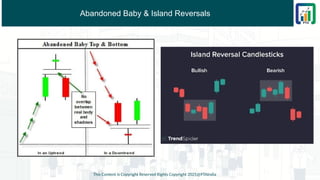
2. Abandoned Baby
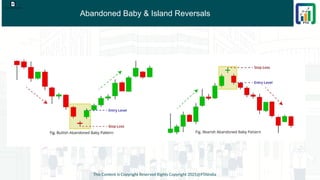
o A three-candle pattern with a gap before and after a Doji.
o Indicates a sudden shift in sentiment (bullish or bearish).
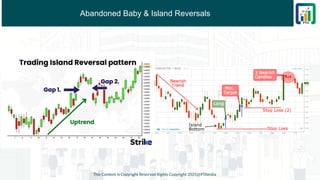
3. Island Reversal
o A cluster of candles separated by gaps from the trend.
o Signifies a major price rejection and trend reversal.
4. High reliability when confirmed by volume and key levels.
5. Best used with support/resistance, volume spikes, and momentum indicators.
This Content is Copyright Reserved Rights Copyright 2025@PTAIndia
Abandoned Baby & Island Reversals
This Content is Copyright Reserved Rights Copyright 2025@PTAIndia
Abandoned Baby & Island Reversals
This Content is Copyright Reserved Rights Copyright 2025@PTAIndia
abandoned_baby.webp
Abandoned Baby & Island Reversals
This Content is Copyright Reserved Rights Copyright 2025@PTAIndia
Abandoned Baby & Island Reversals
This Content is Copyright Reserved Rights Copyright 2025@PTAIndia
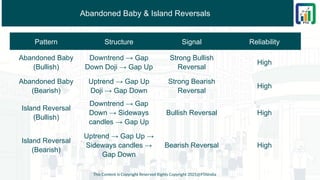
Pattern Structure Signal Reliability
Abandoned Baby
(Bullish)
Downtrend → Gap
Down Doji → Gap Up
Strong Bullish
Reversal
High
Abandoned Baby
(Bearish)
Uptrend → Gap Up
Doji → Gap Down
Strong Bearish
Reversal
High
Island Reversal
(Bullish)
Downtrend → Gap
Down → Sideways
candles → Gap Up
Bullish Reversal High
Island Reversal
(Bearish)
Uptrend → Gap Up →
Sideways candles →
Gap Down
Bearish Reversal High
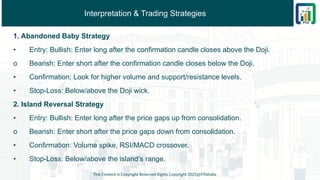
Interpretation & Trading Strategies
1. Abandoned Baby Strategy
• Entry: Bullish: Enter long after the confirmation candle closes above the Doji.
o Bearish: Enter short after the confirmation candle closes below the Doji.
• Confirmation: Look for higher volume and support/resistance levels.
• Stop-Loss: Below/above the Doji wick.
2. Island Reversal Strategy
• Entry: Bullish: Enter long after the price gaps up from consolidation.
o Bearish: Enter short after the price gaps down from consolidation.
• Confirmation: Volume spike, RSI/MACD crossover.
• Stop-Loss: Below/above the island’s range.
This Content is Copyright Reserved Rights Copyright 2025@PTAIndia
Next Chapter 4 - Point-and-Figure Patterns
and Analysis - Part I
Next Section 4 – Charts pattern analysis
Presented By :
This Content is Copyright Reserved Rights Copyright 2025@PTAIndia

Section 4 - Chapter 3 - Candlesticks Analysis in the Real World

  • 1.
    Chapter 3 –Candlestick Analysis in the Real World Section 4 – Chart Pattern Analysis Presented By : This Content is Copyright Reserved Rights Copyright 2025@PTAIndia
  • 2.
    Agenda  Examine thedifference between single-candle patterns and multi-candle patterns  Summarize the implications for candlestick patterns when they occur at potential support or resistance zones  Differentiate between unconfirmed and confirmed candlestick patterns  Learn to identify complete and incomplete patterns and their implications for trading decisions  Compare the abandoned baby reversal and the island reversal patterns  Outline guidelines for interpreting imperfect candlestick patterns  Develop the ability to integrate candlestick patterns into broader chart pattern analysis for better decision making This Content is Copyright Reserved Rights Copyright 2025@PTAIndia
  • 3.
    Understanding Candlestick Patterns:Single vs. Multi-Candle Patterns Key Takeaways 1. Single-Candle Patterns (Candles in Isolation): • These are individual candlesticks that provide signals about potential reversals or continuations. • Often weaker signals than multi-candle patterns, but useful when combined with volume, support/resistance, or other indicators. • Examples: Doji, Hammer, Shooting Star, Marubozu, Spinning Top. 2. Multi-Candle Patterns (Candles in Patterns): • These consist of two or more candles, providing stronger and more reliable signals than single- candle formations. • Useful for identifying trend reversals, breakouts, or continuations. • Examples: Engulfing Patterns, Morning/Evening Star, Three White Soldiers, Three Black Crows, Harami. This Content is Copyright Reserved Rights Copyright 2025@PTAIndia
  • 4.
    Understanding Candlestick Patterns:Single vs. Multi-Candle Patterns Key Takeaways 3. Why It Matters: • Single candles help detect immediate price sentiment but should be confirmed with context. • Multi-candle patterns provide stronger confirmation of market direction. This Content is Copyright Reserved Rights Copyright 2025@PTAIndia
  • 5.
    Understanding Candlestick Patterns:Single vs. Multi-Candle Patterns This Content is Copyright Reserved Rights Copyright 2025@PTAIndia Pattern Type Example Patterns Market Signal Interpretation Single-Candle (Isolation) Doji, Hammer, Shooting Star, Marubozu Weak signal, needs confirmation Price indecision or trend pause Multi-Candle (Patterns) Engulfing, Harami, Morning/Evening Star, Three Soldiers/Crows Stronger signal, confirms trend shifts Higher probability of trend reversal/continuation Single-Candle with Support/Resistance Hammer at Support, Shooting Star at Resistance More reliable than in isolation Can trigger entry/exit signals Multi-Candle with Volume & Indicators Engulfing with RSI Divergence, Morning Star with Rising Volume High-confidence trade signal Strong market conviction
  • 6.
    Trading Strategies UsingCandlestick Patterns 1. Single-Candle Strategy (Needs Confirmation) • Strategy: Use single candles as early signals but confirm with support/resistance, volume, or trend indicators. • Example: Hammer at Key Support → Wait for confirmation (next candle closing higher) before entering long. Shooting Star at Resistance → Watch for follow-through selling before shorting. This Content is Copyright Reserved Rights Copyright 2025@PTAIndia
  • 7.
    Trading Strategies UsingCandlestick Patterns 2. Multi-Candle Strategy for Stronger Entry Signals Strategy: Look for multi-candle patterns to confirm a trend change before entering a trade. Example: Bullish Engulfing after a Downtrend → Confirms buying pressure, good for long entry. Evening Star at Resistance → Indicates strong bearish reversal, signals a short position. This Content is Copyright Reserved Rights Copyright 2025@PTAIndia
  • 8.
    Trading Strategies UsingCandlestick Patterns 3. Combining with Technical Indicators • Strategy: Use candlestick patterns with RSI, MACD, or moving averages for higher accuracy. • Example: o Morning Star with RSI < 30 (Oversold) → Strong buy signal. o Bearish Engulfing with MACD Bearish Crossover → High- probability short trade. This Content is Copyright Reserved Rights Copyright 2025@PTAIndia
  • 9.
    Trading Strategies UsingCandlestick Patterns 4. Risk Management with Candlestick Patterns • Strategy: Place stop-losses based on candlestick highs/lows to manage risk. • Example: o Hammer at Support → Stop below the low of the Hammer. o Bearish Engulfing → Stop above the engulfing candle's high. This Content is Copyright Reserved Rights Copyright 2025@PTAIndia
  • 10.
    Trading Strategies UsingCandlestick Patterns Summary • Single-Candle Patterns = Weak by Themselves, Need Confirmation. • Multi-Candle Patterns = Stronger & More Reliable Trade Signals. • Use Support/Resistance, Volume, & Indicators for Confirmation. • Best for Spotting Reversals, Breakouts, and Trend Continuations. This Content is Copyright Reserved Rights Copyright 2025@PTAIndia
  • 11.
    Candlestick Patterns NearSupport & Resistance Key Takeaways 1. Importance of Context: o Candlestick patterns near key support or resistance levels have higher reliability than patterns in the middle of a trend. o They help confirm trend reversals, breakouts, or failed moves. 2. Support Level Reactions: o Bullish candlestick patterns at support suggest a potential bounce or trend reversal. o Bearish candlestick patterns breaking support indicate downtrend continuation. This Content is Copyright Reserved Rights Copyright 2025@PTAIndia
  • 12.
    Candlestick Patterns NearSupport & Resistance Key Takeaways 3. Resistance Level Reactions: o Bearish candlestick patterns at resistance suggest a potential reversal downward. o Bullish breakouts above resistance with strong candlesticks indicate trend continuation. 4. Confirmation is Crucial: o A single candlestick pattern should be confirmed by volume, price follow-through, and other indicators before trading. This Content is Copyright Reserved Rights Copyright 2025@PTAIndia
  • 13.
    Candlestick Patterns NearSupport & Resistance This Content is Copyright Reserved Rights Copyright 2025@PTAIndia Pattern Location Market Signal Trading Interpretation Hammer At Support Bullish Reversal Strong buying pressure, potential bounce Bullish Engulfing At Support Bullish Confirmation Buyers overpower sellers, good long signal Shooting Star At Resistance Bearish Reversal Strong rejection, short opportunity Bearish Engulfing At Resistance Bearish Confirmation Sellers overpower buyers, trend may reverse Doji Near Support/Resistance Indecision Wait for confirmation from the next candle Breakout Candle (Marubozu) Above Resistance Bullish Breakout Strong trend continuation, enter long Breakdown Candle Below Support Bearish Breakdown Downtrend continuation, enter short
  • 14.
    Trading Strategies UsingCandlestick Patterns Near Support & Resistance 1. Reversal Trades at Support & Resistance • Strategy: Look for reversal candlestick patterns at key support/resistance levels for high-probability trades. • Example: o Bullish Engulfing at Support → Go Long with a stop below support. o Shooting Star at Resistance → Go Short with a stop above resistance. This Content is Copyright Reserved Rights Copyright 2025@PTAIndia
  • 15.
    Trading Strategies UsingCandlestick Patterns Near Support & Resistance 2. Breakout Confirmation for Trend Continuation • Strategy: Enter trades when a strong breakout candle closes above resistance or below support. • Example: o Bullish Marubozu above Resistance → Enter Long with stop below breakout level. o Bearish Breakdown Candle below Support → Enter Short with stop above breakdown level. This Content is Copyright Reserved Rights Copyright 2025@PTAIndia
  • 16.
    Trading Strategies UsingCandlestick Patterns Near Support & Resistance 3. False Breakout & Trap Setups • Strategy: Be cautious of false breakouts when price briefly moves beyond a key level but quickly reverses. • Example: o Price breaks resistance but closes below it with a Shooting Star → Short on confirmation. o Price dips below support but closes above with a Hammer → Go Long. This Content is Copyright Reserved Rights Copyright 2025@PTAIndia
  • 17.
    Trading Strategies UsingCandlestick Patterns Near Support & Resistance 4. Combining with Volume & Indicators • Strategy: Higher volume with a pattern = stronger signal. Use RSI, MACD, or moving averages for extra confirmation. • Example: o Bullish Engulfing at Support + RSI < 30 (Oversold) → Strong buy signal. o Bearish Engulfing at Resistance + MACD Bearish Crossover → Strong short opportunity. This Content is Copyright Reserved Rights Copyright 2025@PTAIndia
  • 18.
    Confirmed vs. UnconfirmedPatterns in Candlestick Analysis Key Takeaways 1. Confirmed vs. Unconfirmed Patterns: o Confirmed Candlestick Patterns occur when price follows through in the expected direction after the pattern forms. o Unconfirmed Patterns are candlestick formations that appear but lack follow-through, making them unreliable for trading decisions. 2. Importance of Confirmation: o A single candlestick pattern alone is not always a strong signal—it must be confirmed by:  Next candle closing in the expected direction  Volume increase supporting the move  Technical indicators aligning (e.g., RSI, MACD, Moving Averages) This Content is Copyright Reserved Rights Copyright 2025@PTAIndia
  • 19.
    Confirmed vs. UnconfirmedPatterns in Candlestick Analysis Key Takeaways 3. How to Confirm a Pattern: o Look for price continuation in the direction of the pattern on the next 1-3 candles. o Higher trading volume adds reliability. o Check for support/resistance validation—breakouts or rejections strengthen the pattern. 4. Why It Matters: o Trading unconfirmed patterns can lead to false signals and losses. o Confirmation increases probability of successful trades and helps filter out noise. This Content is Copyright Reserved Rights Copyright 2025@PTAIndia
  • 20.
    Confirmed vs. UnconfirmedPatterns in Candlestick Analysis This Content is Copyright Reserved Rights Copyright 2025@PTAIndia Pattern Confirmed Signal Unconfirmed Signal Trading Interpretation Bullish Engulfing Next candle closes higher, strong volume Next candle is weak or reverses down Buy only if confirmation appears Bearish Engulfing Next candle closes lower, high volume Next candle retraces up Short if confirmation exists Hammer (at Support) Next candle closes above hammer’s high Next candle closes below hammer’s low Go long only on confirmation Shooting Star (at Resistance) Next candle closes below Shooting Star Next candle moves sideways or up Short only if confirmation appears Morning Star Third candle closes higher than midpoint of first candle Third candle is weak or indecisive Buy if the third candle confirms Breakout Candle Price holds above resistance with high volume Price pulls back below breakout level Trade breakouts only with confirmation
  • 21.
    Trading Strategies Basedon Confirmation 1. Waiting for Confirmation Before Entering Trades • Strategy: Trade only when a candlestick pattern is confirmed by the next 1-2 candles. • Example: o Bullish Engulfing → Wait for a second bullish candle to confirm upward momentum before entering long. o Bearish Engulfing → Enter short only if the next candle confirms with further decline. This Content is Copyright Reserved Rights Copyright 2025@PTAIndia
  • 22.
    Trading Strategies Basedon Confirmation 2. Using Volume for Stronger Confirmation • Strategy: If a pattern forms with a volume spike, it has a higher chance of success. • Example: o Hammer at Support + Increased Volume → More reliable bullish reversal signal. o Shooting Star at Resistance + Volume Surge → Stronger bearish reversal signal. This Content is Copyright Reserved Rights Copyright 2025@PTAIndia
  • 23.
    Trading Strategies Basedon Confirmation 3. Combining Confirmation with Indicators • Strategy: Use RSI, MACD, or Moving Averages to confirm candlestick patterns. • Example: o Bullish Engulfing + RSI Rising from Oversold → Stronger buy signal. o Bearish Engulfing + MACD Bearish Crossover → Stronger short opportunity. 4. False Signal Protection: Avoid Trading Unconfirmed Patterns • Strategy: Avoid entering trades based on a single candlestick without confirmation. • Example: o A Hammer forms but the next candle closes lower → Avoid This Content is Copyright Reserved Rights Copyright 2025@PTAIndia
  • 24.
    Key Distinction BetweenConfirmed and Unconfirmed Candlestick Patterns 1. Definition • Confirmed Pattern: A candlestick formation that is validated by subsequent price action, indicating a high-probability trade setup. • Unconfirmed Pattern: A candlestick formation that lacks follow-through movement and may result in a false signal. 2. Trading Implications • Trade only confirmed patterns to increase success rate. • Avoid trading unconfirmed patterns as they may lead to losses due to false signals. • Combine confirmation with indicators, volume, and key levels for stronger setups. This Content is Copyright Reserved Rights Copyright 2025@PTAIndia
  • 25.
    Key Distinction BetweenConfirmed and Unconfirmed Candlestick Patterns 3. Confirmation Factors This Content is Copyright Reserved Rights Copyright 2025@PTAIndia Factor Confirmed Pattern Unconfirmed Pattern Next Candle Direction Closes in the expected direction Moves sideways or reverses Volume High volume supports the pattern Low or declining volume Trend Context Aligned with prevailing trend Appears randomly without trend support Support/Resistance Reaction Breaks or holds key levels Gets rejected or fakes out Indicator Confirmation (RSI, MACD, etc.) Aligns with technical indicators Contradicts indicator signals
  • 26.
    Key Distinction BetweenConfirmed and Unconfirmed Candlestick Patterns 4. Example Comparison This Content is Copyright Reserved Rights Copyright 2025@PTAIndia Pattern Confirmed Example Unconfirmed Example Bullish Engulfing Next candle closes higher with strong volume Next candle is weak or reverses down Shooting Star Next candle closes lower from resistance Next candle moves sideways or breaks higher Breakout Candle Price holds above resistance with strong momentum Price falls back below breakout level (false breakout)
  • 27.
    Flexibility of Candlesticks,Imperfect Candlestick Patterns & Fibonacci Levels Key Takeaways 1. Flexibility of Candlesticks • Candlestick patterns don’t always appear in perfect textbook form—small variations are common. • The psychological meaning behind the pattern matters more than its perfect shape. • Always consider market context, volume, and trend direction when interpreting a pattern. This Content is Copyright Reserved Rights Copyright 2025@PTAIndia
  • 28.
    Flexibility of Candlesticks,Imperfect Candlestick Patterns & Fibonacci Levels Key Takeaways 2. Imperfect Candlestick Patterns • A slightly distorted candlestick pattern may still be valid if its price action aligns with market structure. • Example: A Bullish Engulfing that doesn’t completely engulf the previous candle can still be valid if volume confirms buying pressure. A Doji with a slight bullish bias may still indicate indecision and reversal potential. Always combine patterns with key levels and indicators for better confirmation. This Content is Copyright Reserved Rights Copyright 2025@PTAIndia
  • 29.
    Flexibility of Candlesticks,Imperfect Candlestick Patterns & Fibonacci Levels Key Takeaways 3. Fibonacci Levels & Candlestick Patterns • Fibonacci retracement levels (23.6%, 38.2%, 50%, 61.8%, 78.6%) act as strong support/resistance zones. • Candlestick patterns forming at Fibonacci levels increase their reliability. • Best levels to watch for reversals: o 38.2% & 61.8% are key reversal zones for price pullbacks. o 50% is a psychological retracement level but not an official Fibonacci level. o 78.6% is a deep retracement level where strong reversals may occur. This Content is Copyright Reserved Rights Copyright 2025@PTAIndia
  • 30.
    Flexibility of Candlesticks,Imperfect Candlestick Patterns & Fibonacci Levels This Content is Copyright Reserved Rights Copyright 2025@PTAIndia Candlestick Pattern Fibonacci Level Expected Reaction Bullish Engulfing 38.2% or 61.8% Strong bounce upward Hammer 50% or 61.8% Possible trend reversal Doji 23.6% or 38.2% Market indecision, wait for confirmation Bearish Engulfing 38.2% or 61.8% Reversal to downside Shooting Star 50% or 78.6% Possible sell-off
  • 31.
    Flexibility of Candlesticks,Imperfect Candlestick Patterns & Fibonacci Levels Trading Strategies 1. Trading Imperfect Patterns with Confirmation • Strategy: Enter a trade only if the market confirms the candlestick signal through: o Volume increase o Break of a key support/resistance level o Trend continuation signals from indicators (RSI, MACD) 2. Fibonacci Retracement + Candlestick Pattern Setup • Strategy: Identify a retracement to a key Fibonacci level and wait for a strong candlestick reversal pattern before entering. • Example: o Price pulls back to 61.8% Fib retracement → A Bullish Engulfing appears → Enter long with a stop below the pattern. This Content is Copyright Reserved Rights Copyright 2025@PTAIndia
  • 32.
    Flexibility of Candlesticks,Imperfect Candlestick Patterns & Fibonacci Levels 3. Using Fibonacci Extensions for Targets • Strategy: After entering a trade based on Fibonacci + candlestick confirmation, set profit targets at: o 127.2% or 161.8% extension for trend continuation trades. o Previous swing high/lows for conservative exits. Final Thoughts ✅ Candlestick patterns are flexible, and slight variations are acceptable. ✅ Fibonacci retracement levels strengthen candlestick signals. ✅ Always confirm patterns with volume, key levels, and indicators. ✅ Combine Fibonacci & candlestick patterns for high-probability setups. This Content is Copyright Reserved Rights Copyright 2025@PTAIndia
  • 33.
    Abandoned Baby &Island Reversals Presented By : This Content is Copyright Reserved Rights Copyright 2025@PTAIndia
  • 34.
    Abandoned Baby &Island Reversals Key Takeaways 1. Both patterns signal strong trend reversals but are rare. 2. Abandoned Baby o A three-candle pattern with a gap before and after a Doji. o Indicates a sudden shift in sentiment (bullish or bearish). 3. Island Reversal o A cluster of candles separated by gaps from the trend. o Signifies a major price rejection and trend reversal. 4. High reliability when confirmed by volume and key levels. 5. Best used with support/resistance, volume spikes, and momentum indicators. This Content is Copyright Reserved Rights Copyright 2025@PTAIndia
  • 35.
    Abandoned Baby &Island Reversals This Content is Copyright Reserved Rights Copyright 2025@PTAIndia
  • 36.
    Abandoned Baby &Island Reversals This Content is Copyright Reserved Rights Copyright 2025@PTAIndia abandoned_baby.webp
  • 37.
    Abandoned Baby &Island Reversals This Content is Copyright Reserved Rights Copyright 2025@PTAIndia
  • 38.
    Abandoned Baby &Island Reversals This Content is Copyright Reserved Rights Copyright 2025@PTAIndia Pattern Structure Signal Reliability Abandoned Baby (Bullish) Downtrend → Gap Down Doji → Gap Up Strong Bullish Reversal High Abandoned Baby (Bearish) Uptrend → Gap Up Doji → Gap Down Strong Bearish Reversal High Island Reversal (Bullish) Downtrend → Gap Down → Sideways candles → Gap Up Bullish Reversal High Island Reversal (Bearish) Uptrend → Gap Up → Sideways candles → Gap Down Bearish Reversal High
  • 39.
    Interpretation & TradingStrategies 1. Abandoned Baby Strategy • Entry: Bullish: Enter long after the confirmation candle closes above the Doji. o Bearish: Enter short after the confirmation candle closes below the Doji. • Confirmation: Look for higher volume and support/resistance levels. • Stop-Loss: Below/above the Doji wick. 2. Island Reversal Strategy • Entry: Bullish: Enter long after the price gaps up from consolidation. o Bearish: Enter short after the price gaps down from consolidation. • Confirmation: Volume spike, RSI/MACD crossover. • Stop-Loss: Below/above the island’s range. This Content is Copyright Reserved Rights Copyright 2025@PTAIndia
  • 40.
    Next Chapter 4- Point-and-Figure Patterns and Analysis - Part I Next Section 4 – Charts pattern analysis Presented By : This Content is Copyright Reserved Rights Copyright 2025@PTAIndia