Common Mechanical Operation
Section 3
Eng. Kareem H. Mokhtar
Belt conveyor
F= 0.02 – 0.04
T3 = 1.1 T2
So we need to calculate mb (mass of belt), midlers (mass of idlers), and m(mass of solid)
Per unit length
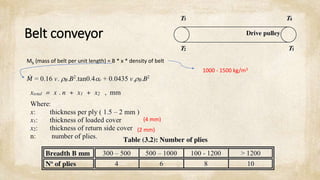
Belt conveyor
Mb (mass of belt per unit length) = B * x * density of belt
1000 - 1500 kg/m3
(4 mm)
(2 mm)
Belt conveyor
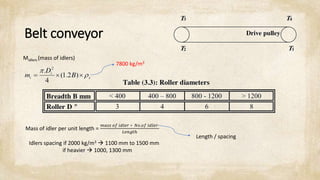
Midlers (mass of idlers)
7800 kg/m3
Mass of idler per unit length =
𝑚𝑎𝑠𝑠 𝑜𝑓 𝑖𝑑𝑙𝑒𝑟 ∗ 𝑁𝑜.𝑜𝑓 𝑖𝑑𝑙𝑒𝑟
𝐿𝑒𝑛𝑔𝑡ℎ
Idlers spacing if 2000 kg/m3  1100 mm to 1500 mm
if heavier  1000, 1300 mm
Length / spacing
Belt conveyor
Mass of solids per unit length = mass flow rate / velocity
Velocity  assume 1 m/s if not stated
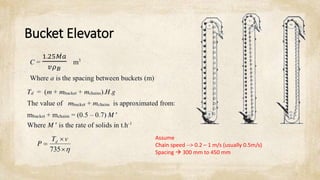
Bucket Elevator
Assume
Chain speed --> 0.2 – 1 m/s (usually 0.5m/s)
Spacing  300 mm to 450 mm
Let us solve
• A) Lecture questions
• B) The sheet
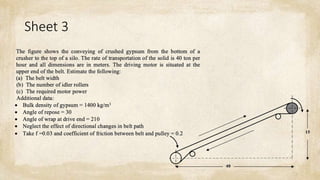
Sheet 3
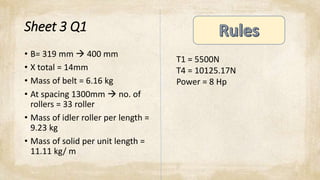
Sheet 3 Q1
• B= 319 mm  400 mm
• X total = 14mm
• Mass of belt = 6.16 kg
• At spacing 1300mm  no. of
rollers = 33 roller
• Mass of idler roller per length =
9.23 kg
• Mass of solid per unit length =
11.11 kg/ m
T1 = 5500N
T4 = 10125.17N
Power = 8 Hp
Sheet 3 Q2
• A bucket elevator is used to lift 20 ton / hr of crushed alumina (of
average size = 10 mm) to a height of 10 m. to be dropped into a bin.
The bulk density is 2000 kg / m³. Select suitable buckets and calculate
the power required to drive the belt.
Sheet 3 Q2 – Final Answer
• At 300 mm spacing
• C = 2.08 L
• Td = 2463.4 N
• P = 3 hp
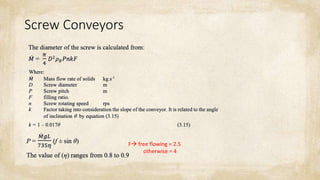
F free flowing = 2.5
otherwise = 4
Screw Conveyors
Screw Conveyors
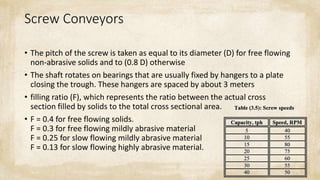
• The pitch of the screw is taken as equal to its diameter (D) for free flowing
non-abrasive solids and to (0.8 D) otherwise
• The shaft rotates on bearings that are usually fixed by hangers to a plate
closing the trough. These hangers are spaced by about 3 meters
• filling ratio (F), which represents the ratio between the actual cross
section filled by solids to the total cross sectional area.
• F = 0.4 for free flowing solids.
F = 0.3 for free flowing mildly abrasive material
F = 0.25 for slow flowing mildly abrasive material
F = 0.13 for slow flowing highly abrasive material.
Sheet 3 – Q3
• Speed = 1.33 RPS
• F= 0.4
• P= D
• D= 230 mm
• Trough = 235 mm
• P= 7 hp
Pneumatic Transportation
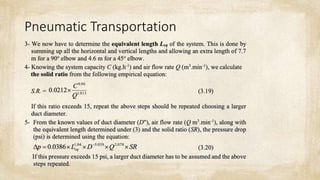
We then assume a duct diameter D (inch) and get the air flow rate in m3.min-1
Pneumatic Transportation
Sheet 3- Q4
• Q= 79.38 m3/min
• Delta p=4.38
• You solve
Section 4

Section 4

  • 1.
    Common Mechanical Operation Section3 Eng. Kareem H. Mokhtar
  • 2.
    Belt conveyor F= 0.02– 0.04 T3 = 1.1 T2 So we need to calculate mb (mass of belt), midlers (mass of idlers), and m(mass of solid) Per unit length
  • 3.
    Belt conveyor Mb (massof belt per unit length) = B * x * density of belt 1000 - 1500 kg/m3 (4 mm) (2 mm)
  • 4.
    Belt conveyor Midlers (massof idlers) 7800 kg/m3 Mass of idler per unit length = 𝑚𝑎𝑠𝑠 𝑜𝑓 𝑖𝑑𝑙𝑒𝑟 ∗ 𝑁𝑜.𝑜𝑓 𝑖𝑑𝑙𝑒𝑟 𝐿𝑒𝑛𝑔𝑡ℎ Idlers spacing if 2000 kg/m3  1100 mm to 1500 mm if heavier  1000, 1300 mm Length / spacing
  • 5.
    Belt conveyor Mass ofsolids per unit length = mass flow rate / velocity Velocity  assume 1 m/s if not stated
  • 6.
    Bucket Elevator Assume Chain speed--> 0.2 – 1 m/s (usually 0.5m/s) Spacing  300 mm to 450 mm
  • 7.
    Let us solve •A) Lecture questions • B) The sheet
  • 8.
  • 9.
    Sheet 3 Q1 •B= 319 mm  400 mm • X total = 14mm • Mass of belt = 6.16 kg • At spacing 1300mm  no. of rollers = 33 roller • Mass of idler roller per length = 9.23 kg • Mass of solid per unit length = 11.11 kg/ m T1 = 5500N T4 = 10125.17N Power = 8 Hp
  • 10.
    Sheet 3 Q2 •A bucket elevator is used to lift 20 ton / hr of crushed alumina (of average size = 10 mm) to a height of 10 m. to be dropped into a bin. The bulk density is 2000 kg / m³. Select suitable buckets and calculate the power required to drive the belt.
  • 11.
    Sheet 3 Q2– Final Answer • At 300 mm spacing • C = 2.08 L • Td = 2463.4 N • P = 3 hp
  • 12.
    F free flowing= 2.5 otherwise = 4 Screw Conveyors
  • 13.
    Screw Conveyors • Thepitch of the screw is taken as equal to its diameter (D) for free flowing non-abrasive solids and to (0.8 D) otherwise • The shaft rotates on bearings that are usually fixed by hangers to a plate closing the trough. These hangers are spaced by about 3 meters • filling ratio (F), which represents the ratio between the actual cross section filled by solids to the total cross sectional area. • F = 0.4 for free flowing solids. F = 0.3 for free flowing mildly abrasive material F = 0.25 for slow flowing mildly abrasive material F = 0.13 for slow flowing highly abrasive material.
  • 14.
    Sheet 3 –Q3 • Speed = 1.33 RPS • F= 0.4 • P= D • D= 230 mm • Trough = 235 mm • P= 7 hp
  • 15.
    Pneumatic Transportation We thenassume a duct diameter D (inch) and get the air flow rate in m3.min-1
  • 16.
  • 17.
  • 18.
    Sheet 3- Q4 •Q= 79.38 m3/min • Delta p=4.38 • You solve