FEMINIST THEORY
Feminist theory is one of the major contemporary
sociological theories, which analyzes the status of women and
men in the society with the purpose of using that knowledge to
better women's lives. Feminist theorists also question the
differences between women, including how race, class,
ethnicity, sexuality, nationality, and age intersect with gender.
Contemporary sociologist Patricia Hill Collins is known
throughout the field for developing, deploying, and
popularizing the concept of inter-
sectionality in her
theory and research.
Patricia Hill Collins
In spite of the double burden of
racial and gender discrimination,
African-American women have developed
a rich intellectual tradition that is not
widely known. In Black Feminist
Thought, originally published in 1990,
Patricia Hill Collins set out to explore
the words and ideas of Black feminist
intellectuals and writers. Black feminist
thought consists of ideas produced by
Black women that clarify a stand-
point of and for Black women.
Feminist theory is most concerned with giving a voice to
women and highlighting the various ways women have
contributed to society. Feminism is often understood as
coming from a group of angry women who are trying to
dominate men. “That is not what feminism is!”
Understood correctly feminism is
a perspective that views society
as traditionally unequal between
men and women and strives for
equality between the sexes.
For example, you might have heard the fact
that men and women, on average, are not paid equally
in some countries. Studies show that even with the
same job where a man would be paid $1.00.Women
are less represented in the government, women are
less likely to be business owners, and women are less
likely to be college professors.
Feminism “originated outside academia
as the ideology of a critical and disruptive
social movement. As such its absorption
into social, let alone political, science has
been partial and selective and there
remains quite a gulf between feminism 'out
there' and feminist political science
(Randall, 2002).
The gender difference perspective examines how
women's location in, and experience of, social situations
differ from men's. For example, cultural feminists look
to the different values associated with womanhood and
feminity as a reason why men and women experience
the social world differently.
GENDER DIFFERENCES
Other feminist theorists believe that the
different roles assigned to women and men
within institutions better explain gender
difference, including the sexual division of labor
in the household. Existential and
phenomenological feminists focus on how women
have been marginalized and defined as the
“other” in patriarchal societies. Women are thus
seen as objects are denied the opportunity for
self-realization.
It is an individualistic form of
feminist theory, which focuses on women's
ability to maintain their equality through
their own actions and choices. Its emphasis
is on making the legal and political rights of women equal to men.
Liberal feminists argue that society holds the false belief that
women are, by nature, less intellectually and physically capable than
men; thus it tends to discriminate against women in the academy, the
forum, and the marketplace. Liberal feminists believe that "female
subordination is rooted in a set of customary and legal constraints
that blocks women's entrance to and success in the so-called public
world". They strive for sexual equality via political and legal reform.
LIBERAL FEMINISM
The goal for liberal feminists in the late 1800s and
early 1900s was to gain women's suffrage under the
idea that they would then gain individual liberty. They
were concerned with gaining freedom through
equality, putting an end to men's cruelty to women,
and gaining the freedom to opportunities to become
full persons. They believed that no government or
custom should prohibit the exercise of personal
freedom. Early liberal feminists had to counter the
assumption that only white men deserved to be full
citizens.
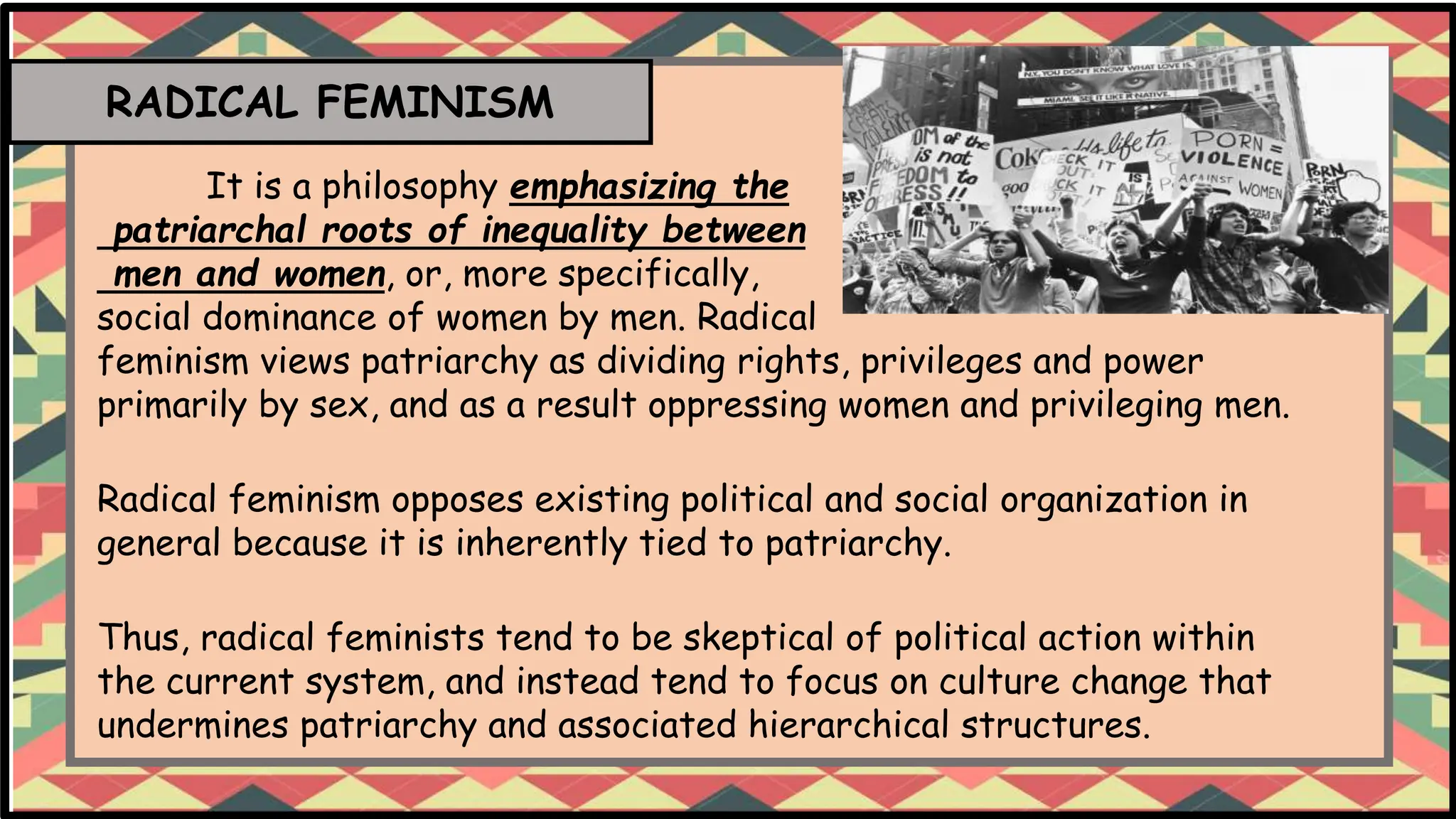
It is a philosophy emphasizing the
patriarchal roots of inequality between
men and women, or, more specifically,
social dominance of women by men. Radical
feminism views patriarchy as dividing rights, privileges and power
primarily by sex, and as a result oppressing women and privileging men.
Radical feminism opposes existing political and social organization in
general because it is inherently tied to patriarchy.
Thus, radical feminists tend to be skeptical of political action within
the current system, and instead tend to focus on culture change that
undermines patriarchy and associated hierarchical structures.
RADICAL FEMINISM
The women's liberation movement
was a collective struggle for equality
that was most active during the late
1960s and 1970s. It sought to free
women from oppression and male
supremacy.
WOMEN'S LIBERATION MOVEMENT
The term was created as a parallel to other liberation and
freedom movements of the time. The root of the idea was
rebellion against colonial powers or a repressive national
government to win independence for a national group and to end
oppression.
• Marxist feminism is a sub-type of feminist
ideology which focuses on the dismantling of
capitalism as a way to liberate women.
• Marxist feminism states that economic inequality,
dependence, political confusion and ultimately unhealthy
social relations between men and women are the root of
women's oppression in the current social context.
• Marxism claims that individuals are under the
oppression of a dominant power structure
• Marxist feminism points out the roll of capitalism in
the oppression of women
MARXIST FEMINISM
THE END
• gfhfshja
FEMINIST THEORY IN THE RESEARCH APPROACH.pptx

FEMINIST THEORY IN THE RESEARCH APPROACH.pptx

  • 1.
  • 2.
    Feminist theory isone of the major contemporary sociological theories, which analyzes the status of women and men in the society with the purpose of using that knowledge to better women's lives. Feminist theorists also question the differences between women, including how race, class, ethnicity, sexuality, nationality, and age intersect with gender. Contemporary sociologist Patricia Hill Collins is known throughout the field for developing, deploying, and popularizing the concept of inter- sectionality in her theory and research.
  • 3.
    Patricia Hill Collins Inspite of the double burden of racial and gender discrimination, African-American women have developed a rich intellectual tradition that is not widely known. In Black Feminist Thought, originally published in 1990, Patricia Hill Collins set out to explore the words and ideas of Black feminist intellectuals and writers. Black feminist thought consists of ideas produced by Black women that clarify a stand- point of and for Black women.
  • 4.
    Feminist theory ismost concerned with giving a voice to women and highlighting the various ways women have contributed to society. Feminism is often understood as coming from a group of angry women who are trying to dominate men. “That is not what feminism is!” Understood correctly feminism is a perspective that views society as traditionally unequal between men and women and strives for equality between the sexes.
  • 5.
    For example, youmight have heard the fact that men and women, on average, are not paid equally in some countries. Studies show that even with the same job where a man would be paid $1.00.Women are less represented in the government, women are less likely to be business owners, and women are less likely to be college professors.
  • 6.
    Feminism “originated outsideacademia as the ideology of a critical and disruptive social movement. As such its absorption into social, let alone political, science has been partial and selective and there remains quite a gulf between feminism 'out there' and feminist political science (Randall, 2002).
  • 7.
    The gender differenceperspective examines how women's location in, and experience of, social situations differ from men's. For example, cultural feminists look to the different values associated with womanhood and feminity as a reason why men and women experience the social world differently. GENDER DIFFERENCES
  • 8.
    Other feminist theoristsbelieve that the different roles assigned to women and men within institutions better explain gender difference, including the sexual division of labor in the household. Existential and phenomenological feminists focus on how women have been marginalized and defined as the “other” in patriarchal societies. Women are thus seen as objects are denied the opportunity for self-realization.
  • 9.
    It is anindividualistic form of feminist theory, which focuses on women's ability to maintain their equality through their own actions and choices. Its emphasis is on making the legal and political rights of women equal to men. Liberal feminists argue that society holds the false belief that women are, by nature, less intellectually and physically capable than men; thus it tends to discriminate against women in the academy, the forum, and the marketplace. Liberal feminists believe that "female subordination is rooted in a set of customary and legal constraints that blocks women's entrance to and success in the so-called public world". They strive for sexual equality via political and legal reform. LIBERAL FEMINISM
  • 10.
    The goal forliberal feminists in the late 1800s and early 1900s was to gain women's suffrage under the idea that they would then gain individual liberty. They were concerned with gaining freedom through equality, putting an end to men's cruelty to women, and gaining the freedom to opportunities to become full persons. They believed that no government or custom should prohibit the exercise of personal freedom. Early liberal feminists had to counter the assumption that only white men deserved to be full citizens.
  • 11.
    It is aphilosophy emphasizing the patriarchal roots of inequality between men and women, or, more specifically, social dominance of women by men. Radical feminism views patriarchy as dividing rights, privileges and power primarily by sex, and as a result oppressing women and privileging men. Radical feminism opposes existing political and social organization in general because it is inherently tied to patriarchy. Thus, radical feminists tend to be skeptical of political action within the current system, and instead tend to focus on culture change that undermines patriarchy and associated hierarchical structures. RADICAL FEMINISM
  • 12.
    The women's liberationmovement was a collective struggle for equality that was most active during the late 1960s and 1970s. It sought to free women from oppression and male supremacy. WOMEN'S LIBERATION MOVEMENT The term was created as a parallel to other liberation and freedom movements of the time. The root of the idea was rebellion against colonial powers or a repressive national government to win independence for a national group and to end oppression.
  • 13.
    • Marxist feminismis a sub-type of feminist ideology which focuses on the dismantling of capitalism as a way to liberate women. • Marxist feminism states that economic inequality, dependence, political confusion and ultimately unhealthy social relations between men and women are the root of women's oppression in the current social context. • Marxism claims that individuals are under the oppression of a dominant power structure • Marxist feminism points out the roll of capitalism in the oppression of women MARXIST FEMINISM
  • 15.
  • 16.