SEARCH ALGORITHMS INAI
• Artificial Intelligence is the study of building agents that act rationally. Most of the time, these
agents perform some kind of search algorithm in the background in order to achieve their tasks.
• A search problem consists of:
• A State Space. Set of all possible states where you can be.
• A Start State. The state from where the search begins.
• A Goal State. A function that looks at the current state returns whether or not it is the goal state.
• The Solution to a search problem is a sequence of actions, called the plan that transforms the start state to the
goal state.
• This plan is achieved through search algorithms.
UNINFORMED SEARCH
ALGORITHMS
• UninformedSearch (also known as Blind Search)
• No additional information on the goal node other than what is provided in the problem definition.
• The main objective is to find a path from the start state to the goal state.
• The plans to reach the goal differ only by:
• The order of actions.
• The length of the action sequence.
• These algorithms can only:
• Generate successors (new states derived from the current state).
• Differentiate between the goal state and non-goal states.
• They do not have any additional heuristics or knowledge about the problem to
guide the search.
5.
UNINFORMED SEARCH
ALGORITHMS
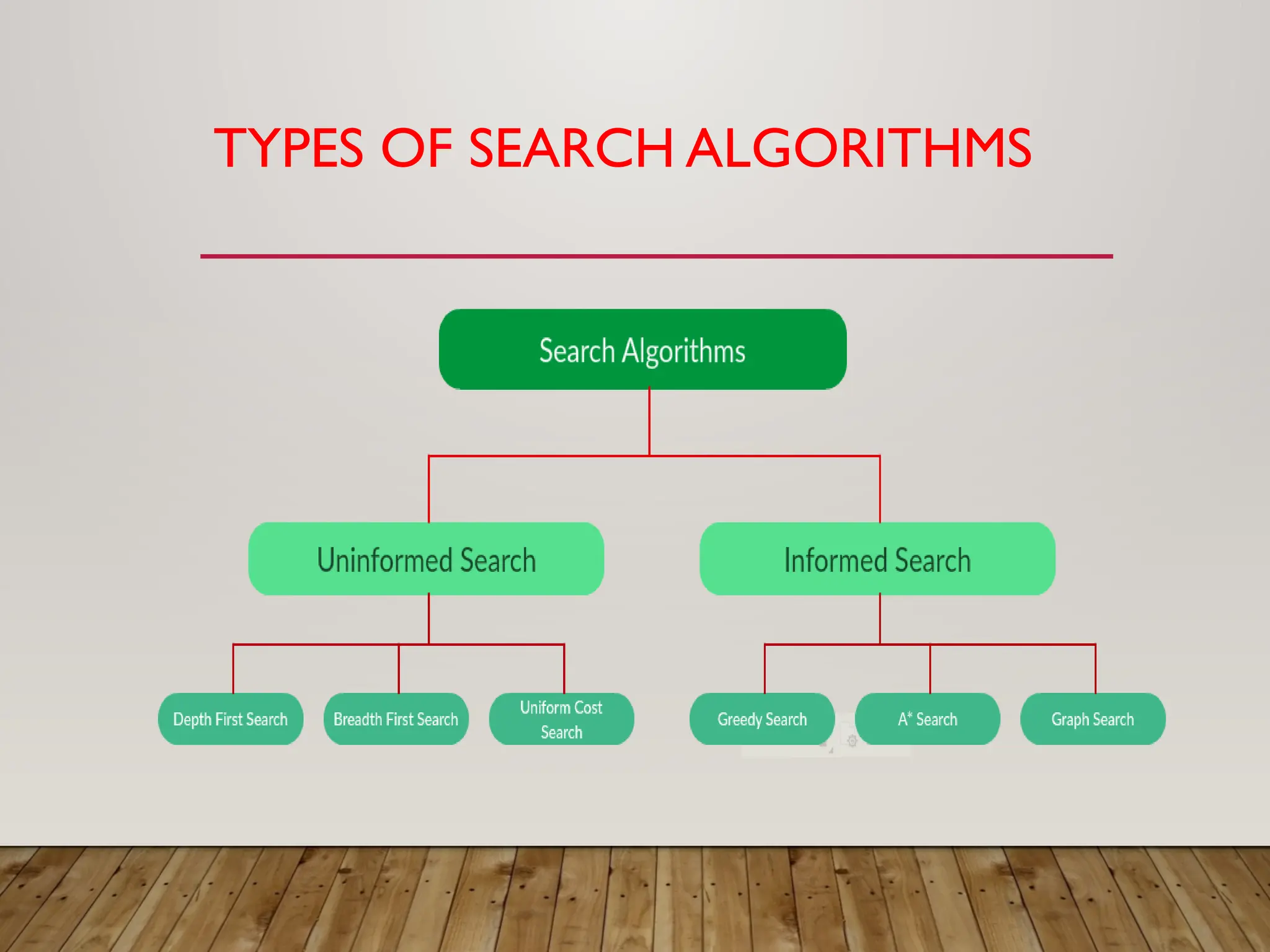
• Uninformedsearch algorithms are;
• Depth First Search
• Breadth First Search
• Uniform Cost Search
• Each of these algorithms will have:
• A problem graph, containing the start node S and the goal node G.
• A strategy, describing the manner in which the graph will be traversed to get to G.
• A fringe, which is a data structure used to store all the possible states (nodes) that you can go
from the current states.
• A tree, that results while traversing to the goal node.
• A solution plan, which the sequence of nodes from S to G.
6.
DEPTH FIRST SEARCH
•Used for traversing or searching tree or graph data structures.
• Start point: Begins at the root node (or an arbitrary node in the case of a graph).
• Exploration strategy:
• Explores as far as possible along each branch before backtracking.
• Search approach:
• Uses a last-in, first-out (LIFO) strategy.
• Implementation:
• Typically implemented using a stack data structure.
• The stack stores nodes to be explored, ensuring that the most recently discovered node is explored first.
7.
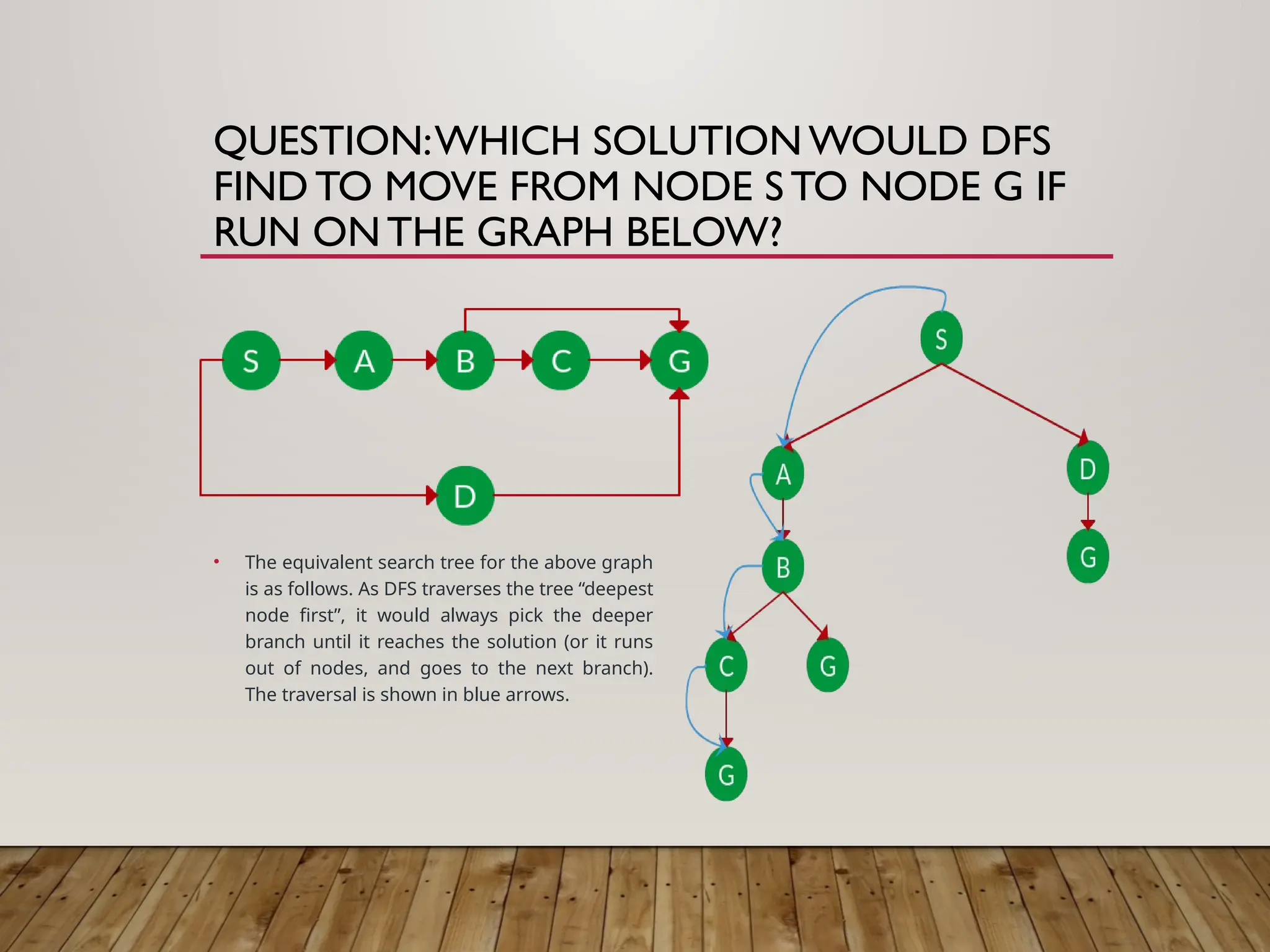
QUESTION:WHICH SOLUTION WOULDDFS
FIND TO MOVE FROM NODE S TO NODE G IF
RUN ONTHE GRAPH BELOW?
• The equivalent search tree for the above graph
is as follows. As DFS traverses the tree “deepest
node first”, it would always pick the deeper
branch until it reaches the solution (or it runs
out of nodes, and goes to the next branch).
The traversal is shown in blue arrows.
BREADTH FIRST SEARCH
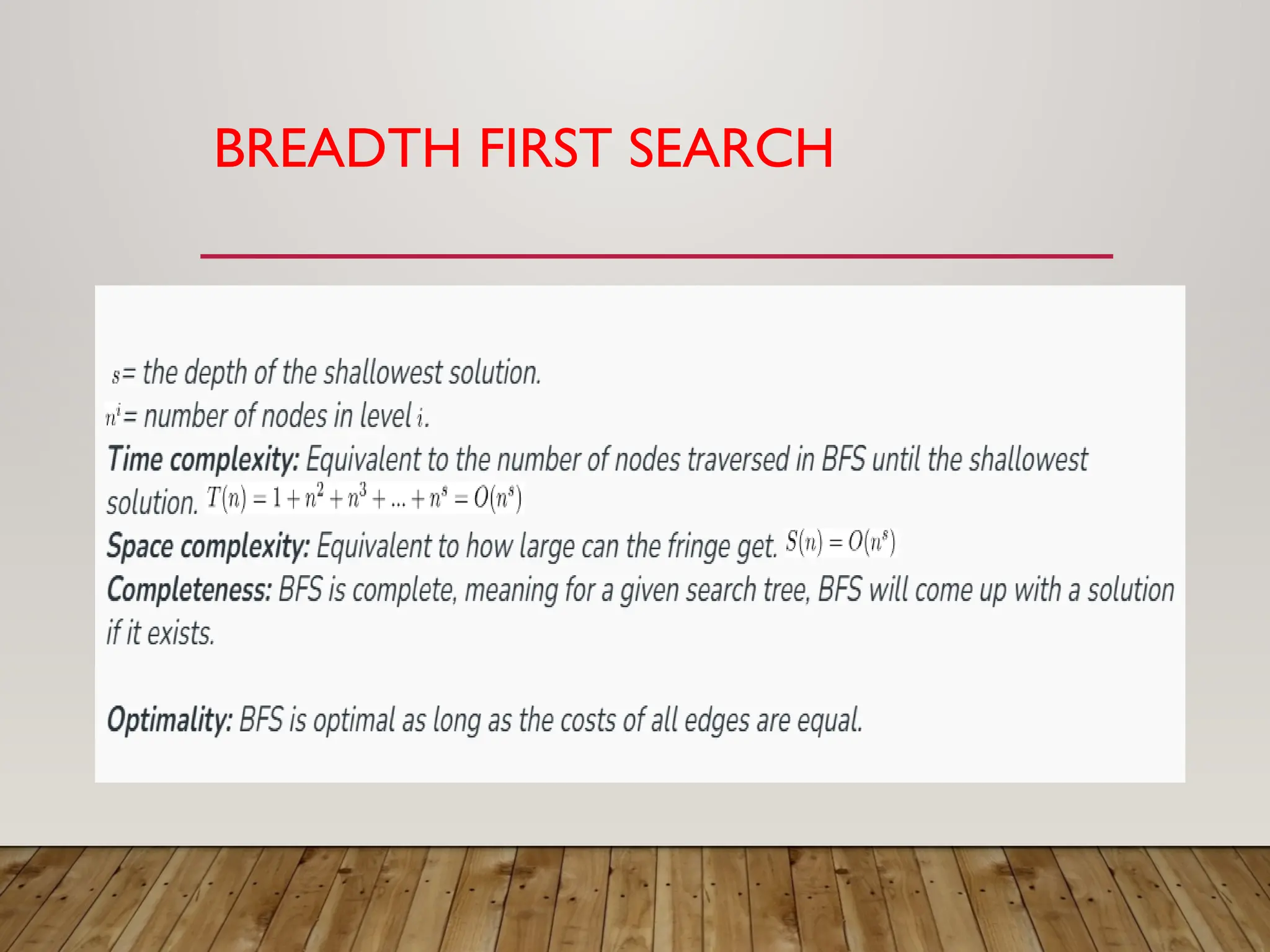
•Breadth-First Search (BFS) is an algorithm used for
traversing or searching tree or graph data structures.
• BFS starts at the root node (or an arbitrary starting node
in a graph).
• It explores all neighbor nodes at the present depth level
before moving on to the next depth level.
• Queue data structure is used to implement BFS.
10.
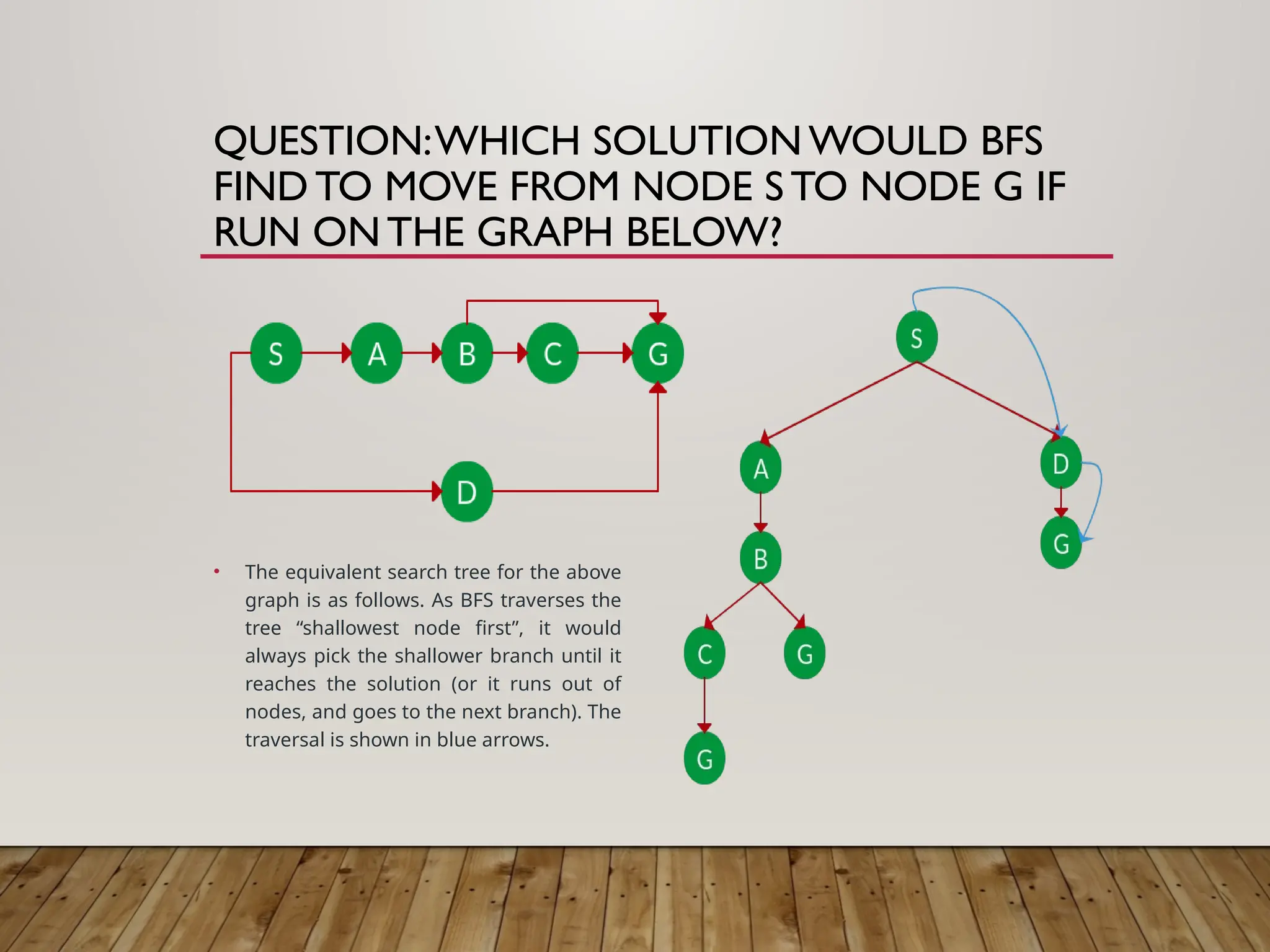
QUESTION:WHICH SOLUTION WOULDBFS
FIND TO MOVE FROM NODE S TO NODE G IF
RUN ONTHE GRAPH BELOW?
• The equivalent search tree for the above
graph is as follows. As BFS traverses the
tree “shallowest node first”, it would
always pick the shallower branch until it
reaches the solution (or it runs out of
nodes, and goes to the next branch). The
traversal is shown in blue arrows.
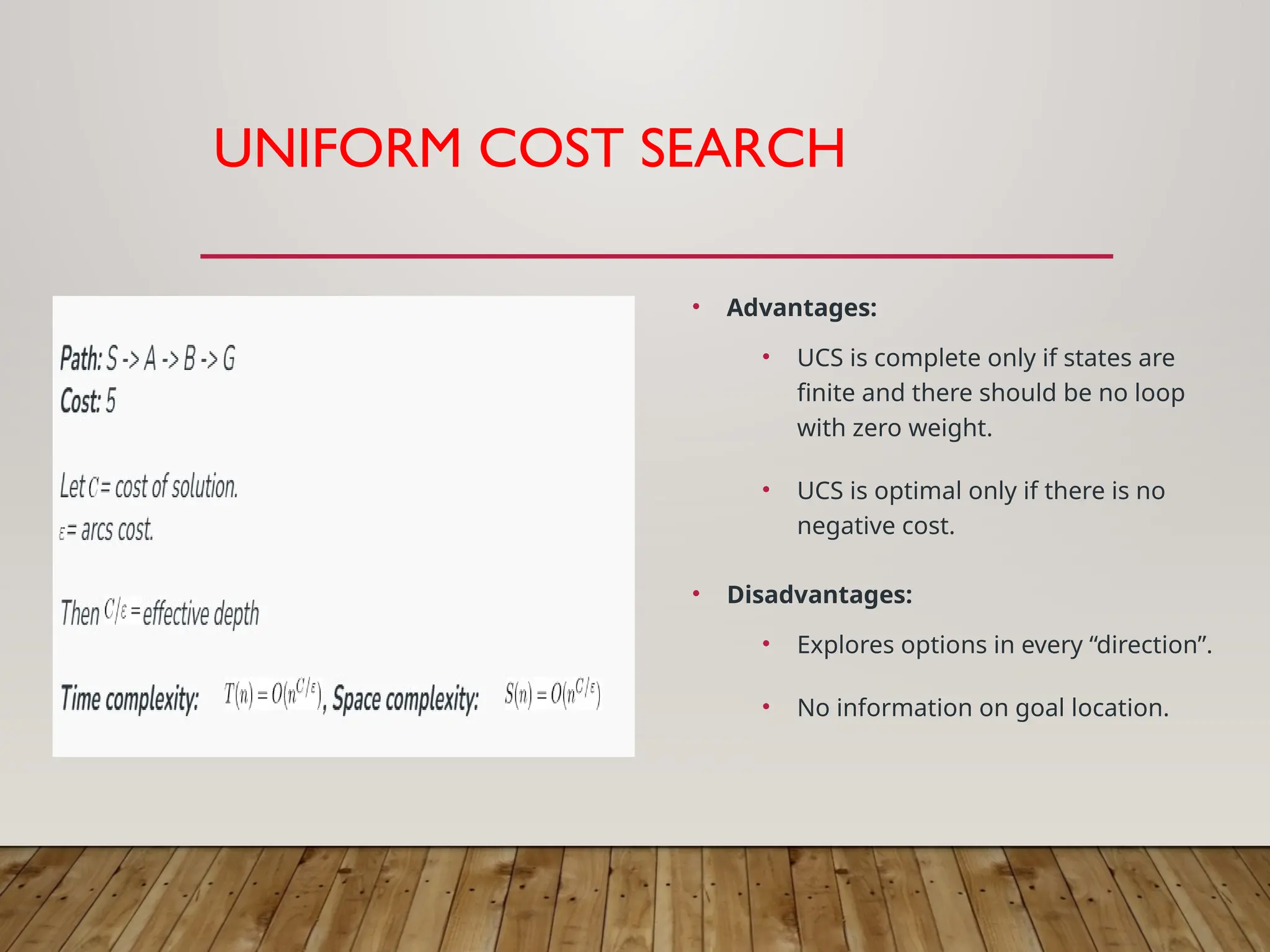
UNIFORM COST SEARCH
•Uniform Cost Search is different from BFS and DFS
because costs are considered.
• Traversing through different edges might have different
costs.
• The goal is to find a path with the least cumulative sum of
costs.
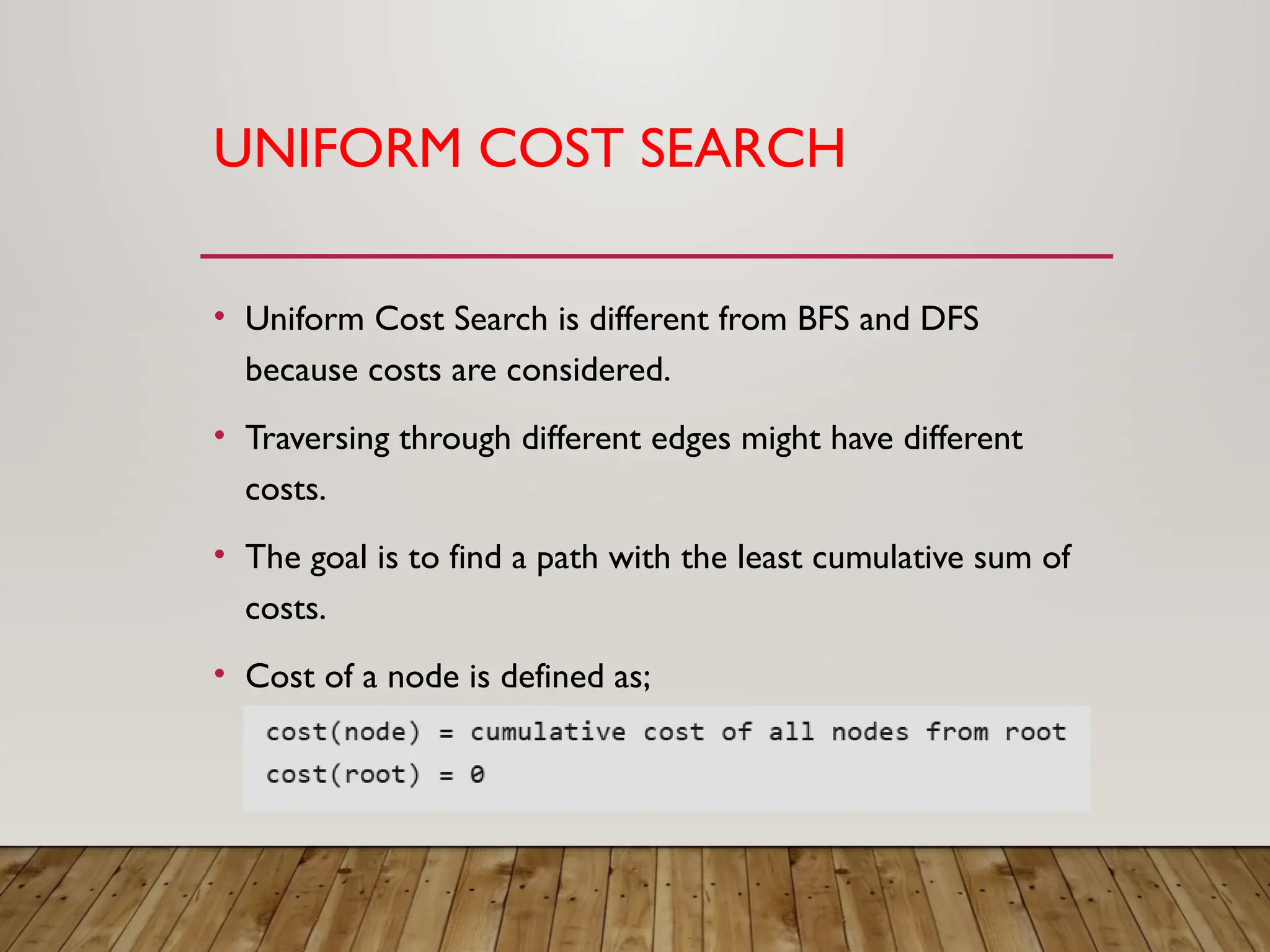
• Cost of a node is defined as;
13.
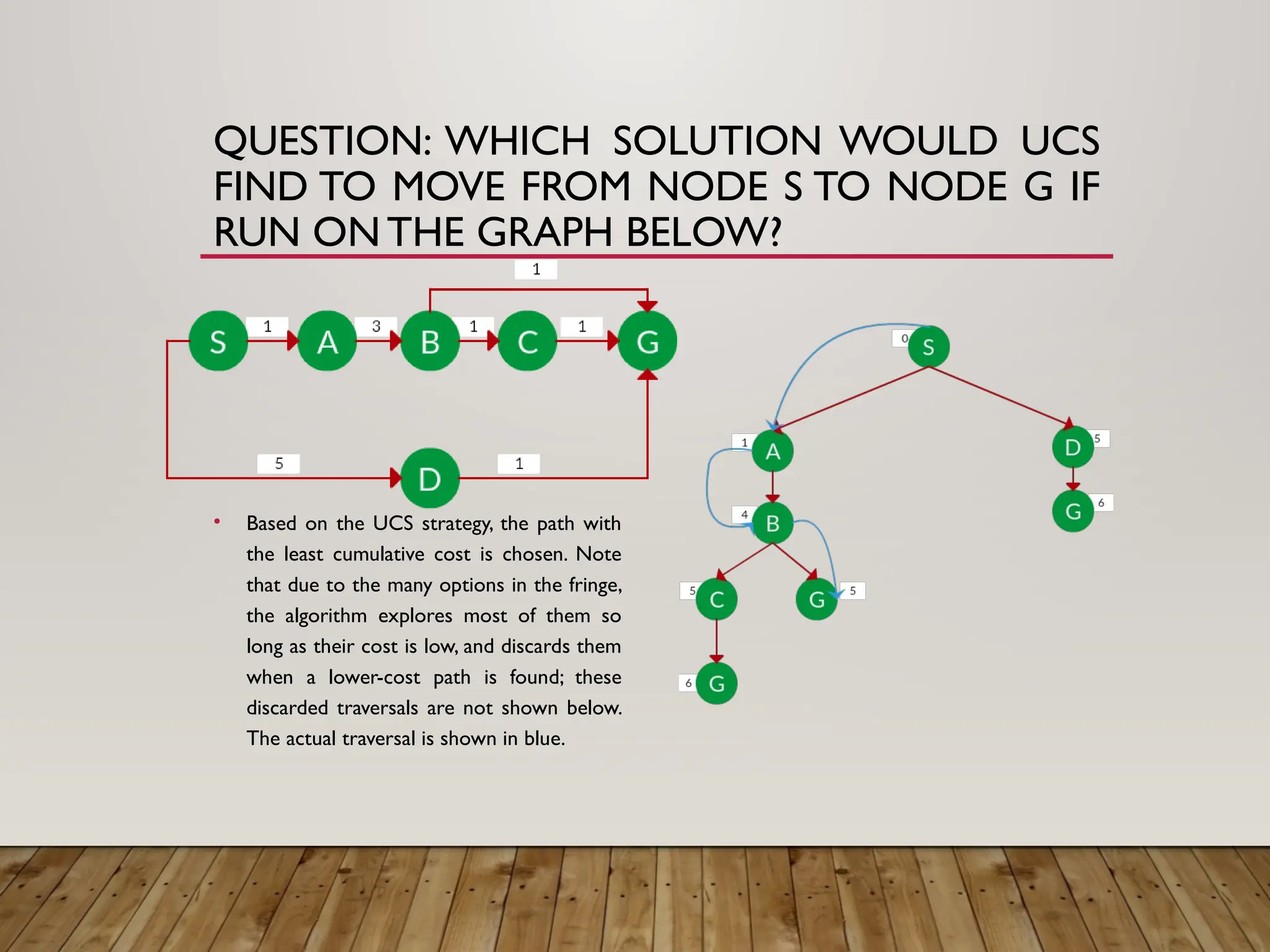
QUESTION: WHICH SOLUTIONWOULD UCS
FIND TO MOVE FROM NODE S TO NODE G IF
RUN ONTHE GRAPH BELOW?
• Based on the UCS strategy, the path with
the least cumulative cost is chosen. Note
that due to the many options in the fringe,
the algorithm explores most of them so
long as their cost is low, and discards them
when a lower-cost path is found; these
discarded traversals are not shown below.
The actual traversal is shown in blue.
14.
UNIFORM COST SEARCH
•Advantages:
• UCS is complete only if states are
finite and there should be no loop
with zero weight.
• UCS is optimal only if there is no
negative cost.
• Disadvantages:
• Explores options in every “direction”.
• No information on goal location.
15.
ROLE OF UNINFORMEDSEARCH ALGORITHM IN AI
1. Pathfinding: One of the most common applications of uninformed search algorithms is in pathfinding
problems, such as finding the shortest path between two points on a map. Algorithms like Breadth-First
Search (BFS) and Depth-First Search (DFS) are used to explore the map and find the optimal path.
2. Puzzle Solving: Uninformed search algorithms are also used in puzzle-solving problems, such as the Eight
Puzzle or the Fifteen Puzzle. These algorithms can be used to find a sequence of moves that lead to the
solution of the puzzle.
3. Game Playing: In game-playing AI, uninformed search algorithms can be used to explore the game tree and
find the optimal sequence of moves to win the game. Algorithms like DFS and BFS are often used in
conjunction with minimax or alpha-beta pruning to improve efficiency.
4. Robot Navigation: Uninformed search algorithms can be used in robotics for path planning and navigation
tasks. Robots can use these algorithms to explore their environment and find the best path to reach a target
location while avoiding obstacles.
5. Web Crawling: Web crawlers use uninformed search algorithms to explore the web and index web pages. BFS
is commonly used in web crawling to systematically visit web pages and follow links to discover new pages.
16.
INFORMED SEARCH ALGORITHMS
•The algorithms have information on the goal state, which helps in more efficient
searching. This information is obtained by something called a heuristic.
1. Greedy Search
2. A* Tree Search
3. A* Graph Search
• Search Heuristics: In an informed search, a heuristic is a function that estimates
how close a state is to the goal state. For example – Manhattan distance,
Euclidean distance, etc. (Lesser the distance, closer the goal.) Different heuristics
are used in different informed algorithms discussed below.
17.
GREEDY SEARCH
• Ingreedy search, we expand the node closest to the goal node. The
“closeness” is estimated by a heuristic h(x).
Heuristic: A heuristic h is defined as-
h(x) = Estimate of distance of node x from the goal node.
Lower the value of h(x), closer is the node from the goal.
Strategy: Expand the node closest to the goal state, i.e. expand the node
with a lower h value.
• Advantage: Works well with informed search problems, with fewer steps to
reach a goal.
• Disadvantage: Can turn into unguided DFS in the worst case.
18.
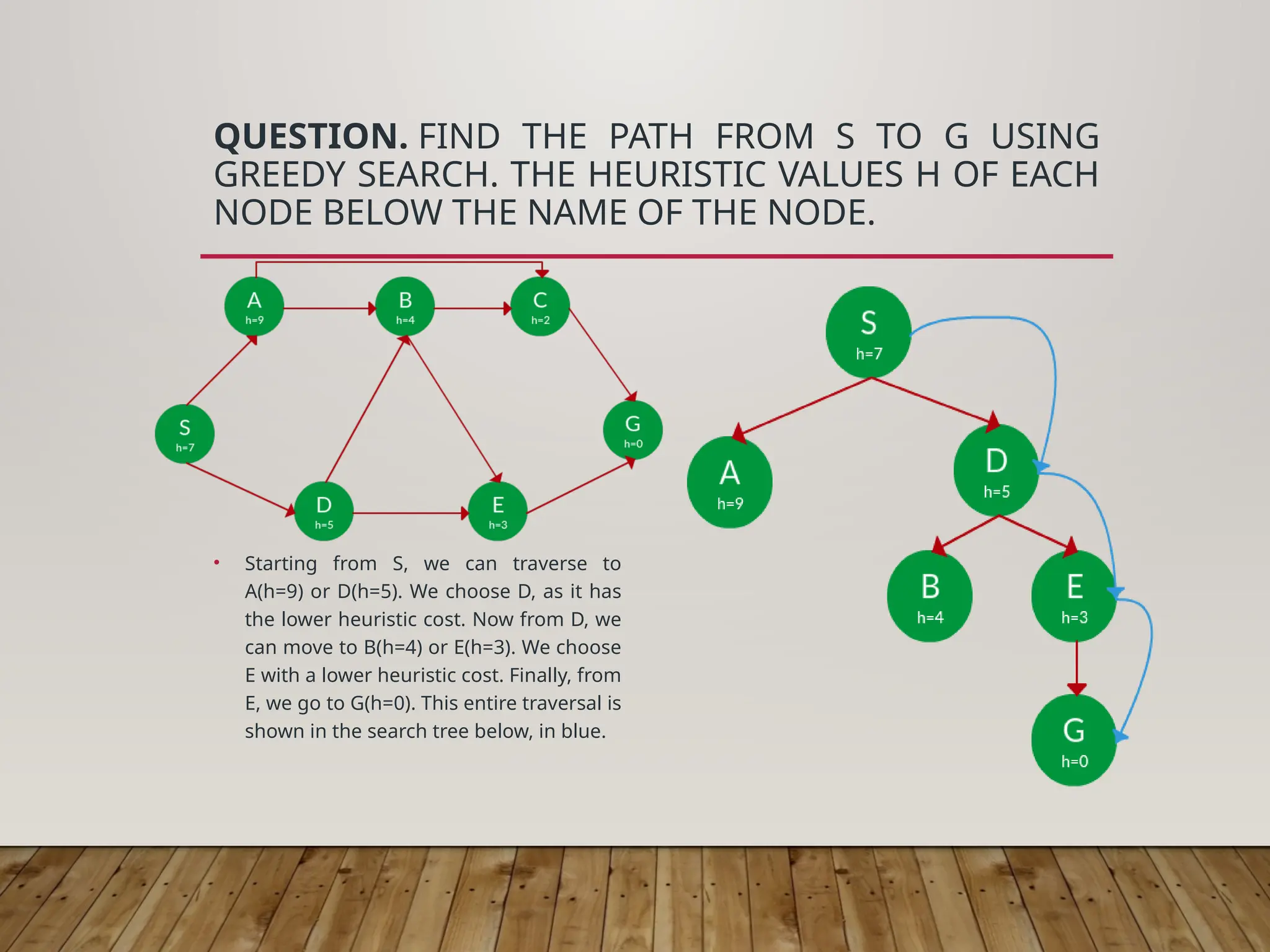
QUESTION. FIND THEPATH FROM S TO G USING
GREEDY SEARCH. THE HEURISTIC VALUES H OF EACH
NODE BELOW THE NAME OF THE NODE.
• Starting from S, we can traverse to
A(h=9) or D(h=5). We choose D, as it has
the lower heuristic cost. Now from D, we
can move to B(h=4) or E(h=3). We choose
E with a lower heuristic cost. Finally, from
E, we go to G(h=0). This entire traversal is
shown in the search tree below, in blue.
19.
A*TREE SEARCH
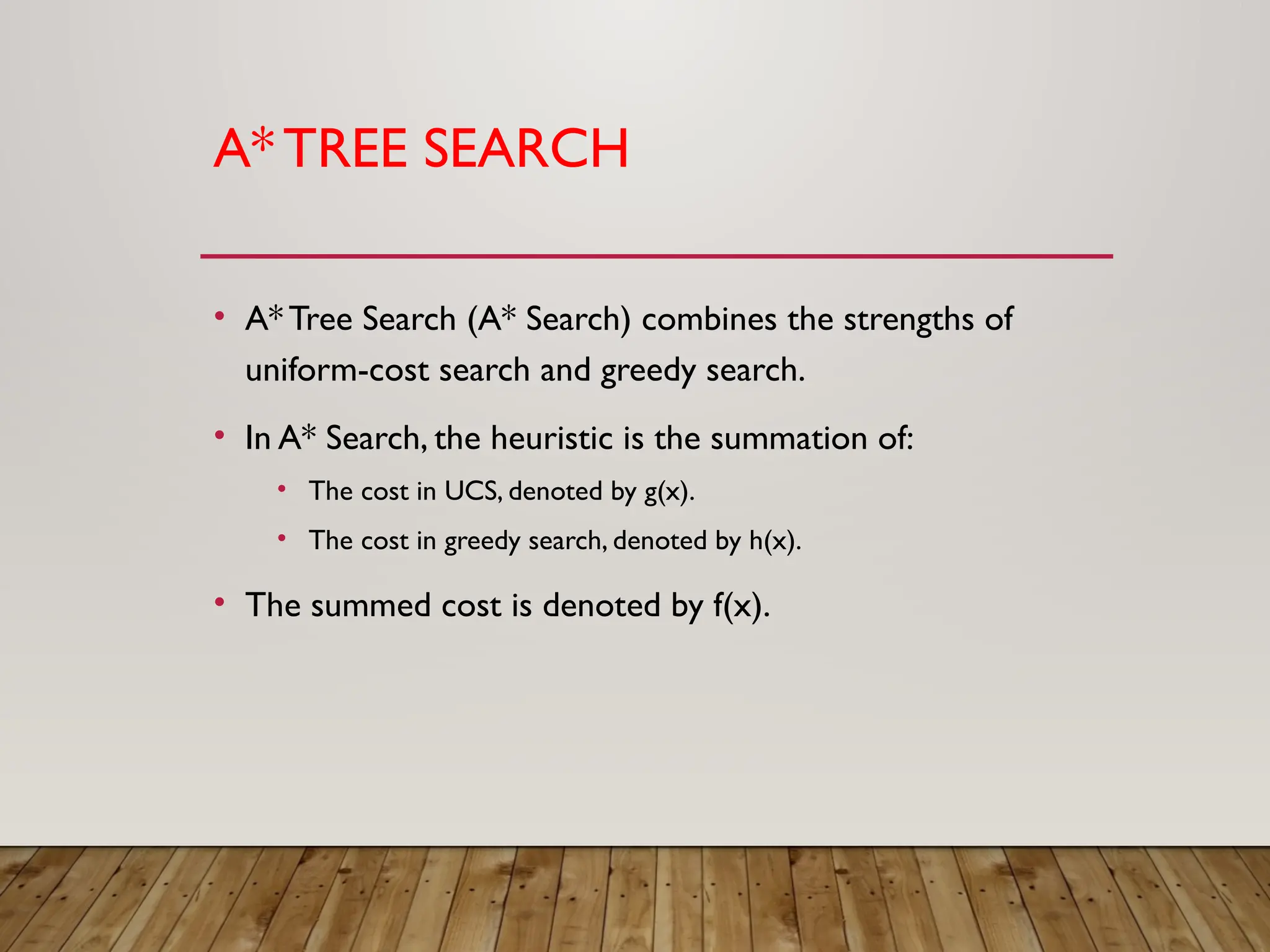
• A*Tree Search (A* Search) combines the strengths of
uniform-cost search and greedy search.
• In A* Search, the heuristic is the summation of:
• The cost in UCS, denoted by g(x).
• The cost in greedy search, denoted by h(x).
• The summed cost is denoted by f(x).
20.
A*TREE SEARCH
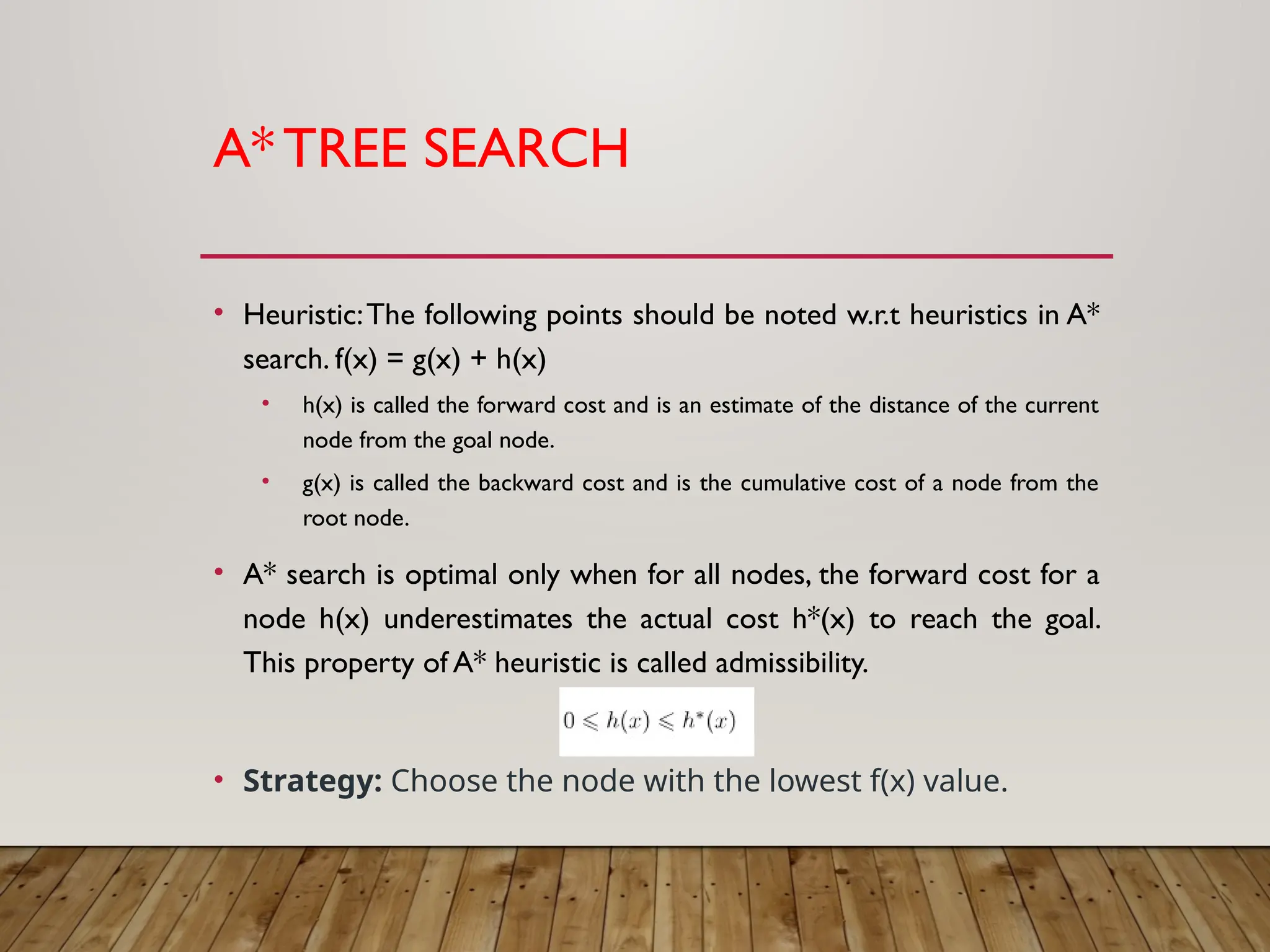
• Heuristic:Thefollowing points should be noted w.r.t heuristics in A*
search. f(x) = g(x) + h(x)
• h(x) is called the forward cost and is an estimate of the distance of the current
node from the goal node.
• g(x) is called the backward cost and is the cumulative cost of a node from the
root node.
• A* search is optimal only when for all nodes, the forward cost for a
node h(x) underestimates the actual cost h*(x) to reach the goal.
This property of A* heuristic is called admissibility.
• Strategy: Choose the node with the lowest f(x) value.
A* GRAPH SEARCH
•A* tree search works well, except that it takes time re-exploring the branches it
has already explored. In other words, if the same node has expanded twice in
different branches of the search tree, A* search might explore both of those
branches, thus wasting time
• A* Graph Search, or simply Graph Search, removes this limitation by adding
this rule: do not expand the same node more than once.
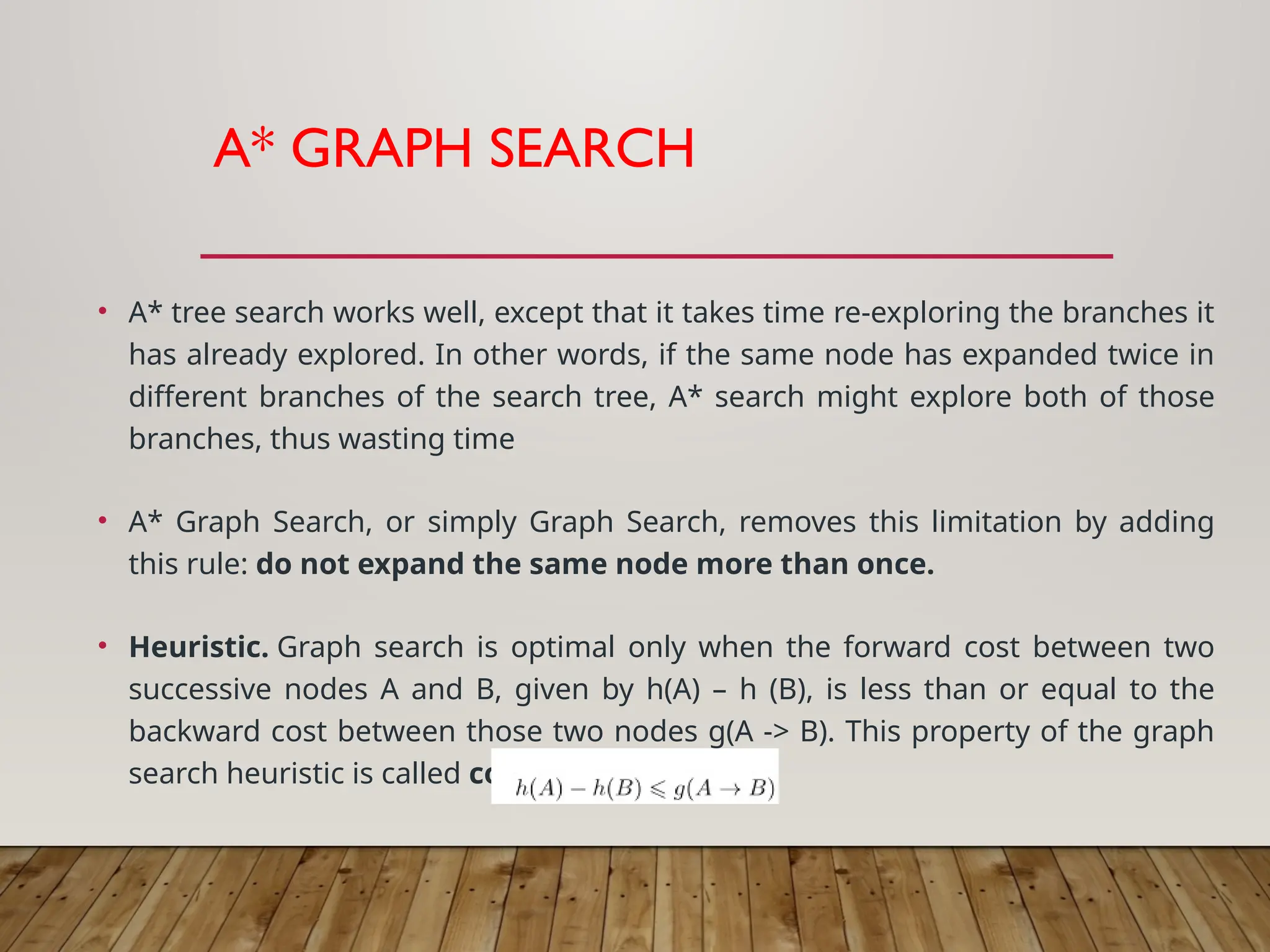
• Heuristic. Graph search is optimal only when the forward cost between two
successive nodes A and B, given by h(A) – h (B), is less than or equal to the
backward cost between those two nodes g(A -> B). This property of the graph
search heuristic is called consistency.
23.
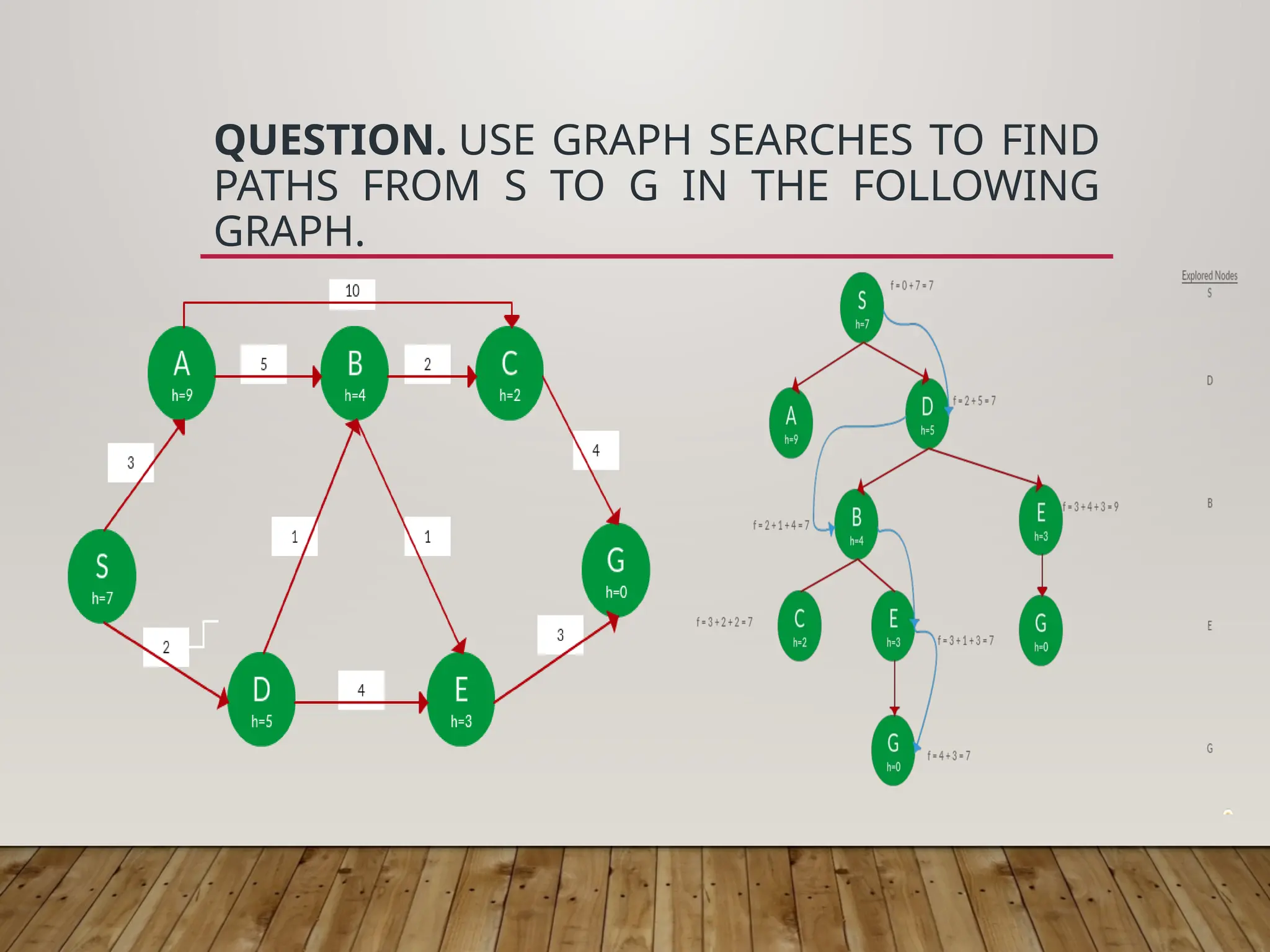
QUESTION. USE GRAPHSEARCHES TO FIND
PATHS FROM S TO G IN THE FOLLOWING
GRAPH.
24.
APPLICATION OF INFORMEDSEARCH
ALGORITHMS
1. Pathfinding in Navigation Systems: Used to calculate the
shortest route from a point A to point B on a map.
2. Game Playing: Helps in determining the best moves in games
like chess or Go by evaluating the most promising moves first.
3. Robotics: Utilized in autonomous navigation where a robot
must find the best path through an environment.
4. Problem Solving in AI: Applied to a range of problems from
scheduling and planning to resource allocation and logistics.
25.
ADVANTAGES OF INFORMEDSEARCH
ALGORITHMS
• Improved Efficiency: Informed search algorithms can
dramatically reduce the search space, leading to faster
solutions.
• Domain-Specific Optimization: The use of heuristics allows
these algorithms to be tailored to specific problem domains.
• Balance Between Optimality and Efficiency: Algorithms
like A* offer a balance, providing optimal solutions with
reasonable resource usage.
26.
CHALLENGES AND CONSIDERATIONS
•Heuristic Design: The effectiveness of informed search
algorithms heavily depends on the quality of the heuristic
function. A poorly designed heuristic can lead to suboptimal
performance.
• Memory Constraints: While informed search algorithms like
A* are powerful, they can require significant memory
resources, especially for large search spaces.
• Trade-offs: Algorithms like beam search introduce a trade-off
between memory usage and solution optimality.