
Navigating the Sustainable Seafood Waters:  The What, Why and How of Sustainable Seafood Steve Lutz, The Perishables Group Heather Tausig, The New England Aquarium Susan Jackson, International Seafood Sustainability Council Ron Rogness, National Fisheries Institute Jeanne von Zastrow, Food Marketing Institute Why is this important to the retail food industry? What are FMI, NFI and other groups doing to help? What are consumers doing about sustainable seafood? How are retailers, suppliers and NGO’s working together? Where can you turn for help on seafood sustainability?
Sustainable Seafood -- What’s the Buzz? The global population growth, increasing demand for seafood and concerns about the long term viability of the world’s seafood supply. In August 2007, 22 FMI member companies formed a “sustainable seafood working group” with this mission: To identify priorities and issues, find ways to cut through the confusing, complicated and complex subject and develop industry guidelines, tools and resources to help retailers, suppliers, consumers and NGO’s work together for solutions.
FMI Industry Position on Sustainable Seafood FMI supports programs to promote a sustainable supply of seafood, and encourages retailers to: Learn about issues Utilize sustainable seafood resources Develop individual company procurement policies for sustainable seafood Consider sustainable seafood certification programs. FMI will partner with suppliers, government, advocacy groups and other experts to assure long term viability of seafood supply. FMI sustainability working group will develop resources, tools and voluntary guidelines for the
FMI Sustainable Seafood Research (May 2010) Respondents over 5Billion $ in sales Increasing momentum on sustainable seafood 93% either working on or have policy/mission/guidelines Environmental organizations are important partners, 60% engaged Suppliers are important partners, 70% engaged on sustainability Traceability is vital, rates 4.1 (on 1-5) as one of highest priorities Complexity and inconsistency are two most significant challenges Retailers want to see increased sales of sustainable products (4.22) Retailers want to see environmental improvements in “unsustainable” products (4.7) and established quantification of environmental progress (4.0) 50% retailers rely on trade associations for policies, goals, standards
Consumers & Sustainability What consumers really know and think about sustainable seafood Steve Lutz Executive Vice President Perishables Group
Research Sponsor Special thanks to: Results in the May issue of Seafood Business
Overview The Sustainability Message is getting out, but what is sticking with consumers? 1,053 consumers surveyed nationally Four US regions and national total Focused on consumer knowledge and attitudes toward seafood sustainability
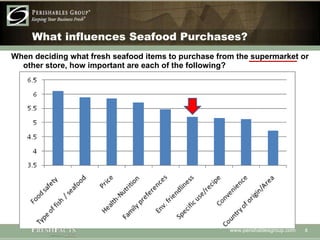
What influences Seafood Purchases? When deciding what fresh seafood items to purchase from the supermarket or other store, how important are each of the following?
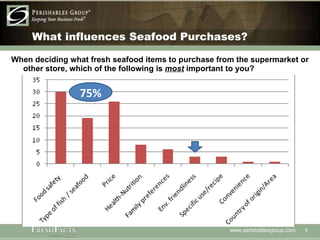
What influences Seafood Purchases? When deciding what fresh seafood items to purchase from the supermarket or other store, which of the following is  most  important to you? 75%
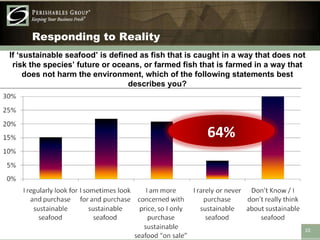
Responding to Reality If ‘sustainable seafood’ is defined as fish that is caught in a way that does not risk the species’ future or oceans, or farmed fish that is farmed in a way that does not harm the environment, which of the following statements best describes you? 64%
Sustainability Message Recall
Sustainability Comparisons
Knowledgeable Seafood Consumers
Sustainability Preference
Sustainability Messaging by Age Group
Key Findings
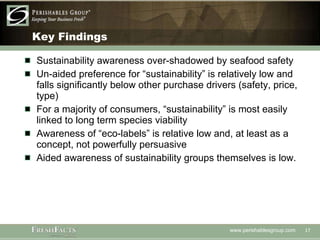
Key Findings Sustainability awareness over-shadowed by seafood safety Un-aided preference for “sustainability” is relatively low and falls significantly below other purchase drivers (safety, price, type) For a majority of consumers, “sustainability” is most easily linked to long term species viability Awareness of “eco-labels” is relative low and, at least as a concept, not powerfully persuasive  Aided awareness of sustainability groups themselves is low.
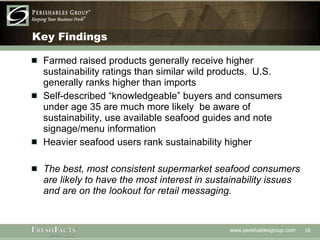
Key Findings Farmed raised products generally receive higher sustainability ratings than similar wild products.  U.S. generally ranks higher than imports Self-described “knowledgeable” buyers and consumers under age 35 are much more likely  be aware of sustainability, use available seafood guides and note signage/menu information Heavier seafood users rank sustainability higher The best, most consistent supermarket seafood consumers are likely to have the most interest in sustainability issues and are on the lookout for retail messaging.
Consumers & Sustainability What consumers really know and think about sustainable seafood Steve Lutz Executive Vice President Perishables Group
 
Heather Tausig Associate Vice President of Conservation New England Aquarium May 12, 2010 Navigating the Sustainable Seafood Waters:  The What, Why and How of Sustainable Seafood
We aim to protect the world’s ocean resources by: raising public awareness and  working with the seafood industry  to advance sustainable practices  within wild-capture fisheries and  aquaculture operations.
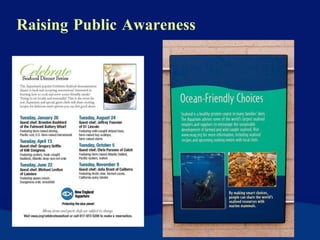
Raising Public Awareness
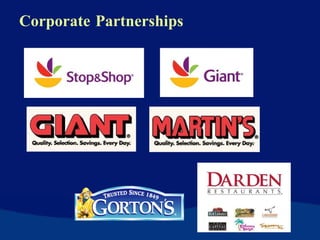
Corporate Partnerships
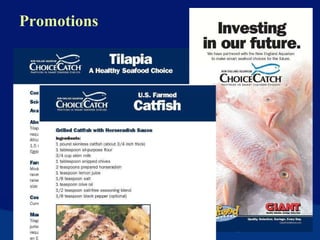
Promotions
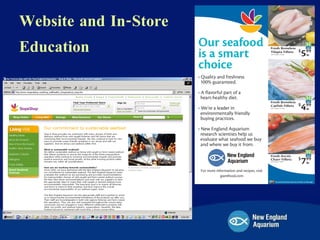
Website and In-Store Education
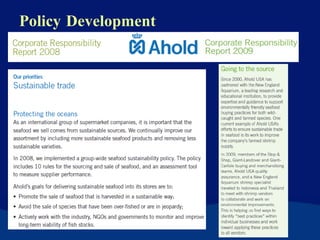
Policy Development
A Common Vision for Environmentally  Responsible  Seafood www.solutionsforseafood.org
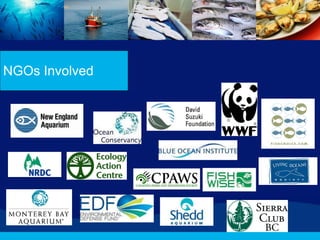
NGOs Involved
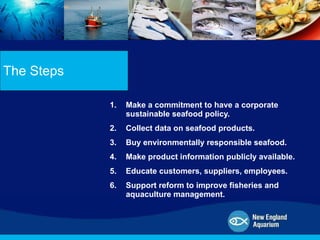
The Steps Make a commitment to have a corporate sustainable seafood policy. Collect data on seafood products. Buy environmentally responsible seafood. Make product information publicly available. Educate customers, suppliers, employees. Support reform to improve fisheries and aquaculture management.
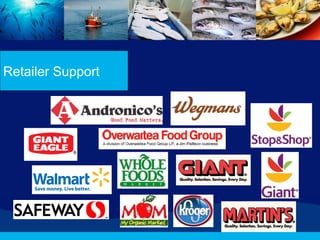
Retailer Support
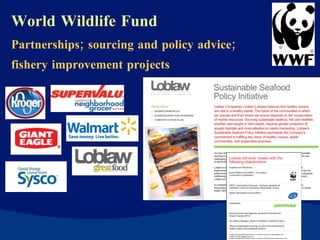
World Wildlife Fund Partnerships; sourcing and policy advice; fishery improvement projects
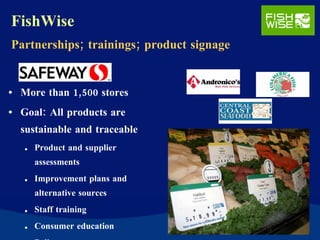
FishWise Partnerships; trainings; product signage More than 1,500 stores Goal: All products are sustainable and traceable Product and supplier assessments Improvement plans and alternative sources Staff training Consumer education Policy engagement
Sustainable Fisheries  Partnership Partnerships; data resource
SeaChoice Partnerships;  sourcing and policy advice Canadian Parks and  Wilderness Society David Suzuki Foundation Ecology Action Centre Living Oceans Society Sierra Club of Canada
FishChoice Sourcing tool
Food Marketing Institute Sustainable Seafood Working Group Goal   Develop tools, resources and strategy to support the entire industry’s journey to sustainability www.fmi.org/sustainability Case studies Retail tools and research Resource list Supplier and NGO Advisory Councils
Resources www.neaq.org/sustainableseafood www.solutionsforseafood.org www.fmi.org /sustainability For more information: Heather Tausig 617-973-0274 [email_address]
 
SM Susan Jackson, President FMI Conference May 12, 2010
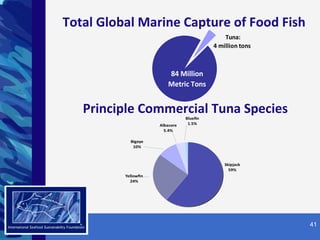
SM Total Global Marine Capture of Food Fish Principle Commercial Tuna Species
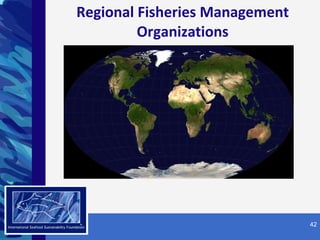
Regional Fisheries Management Organizations SM
Bolton Alimentari Bumble Bee Foods / Clover Leaf Seafoods MW Brands Princes Ltd.  Sea Value Co., Ltd.  SM ISSF Participating Companies StarKist Co. Thai Union Mfg. /  Chicken of the Sea  Tri Marine International WWF FOUNDERS NEW COMPANIES FRINSA Negocios Industriales Real NIRSA S.A.
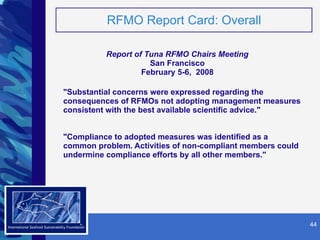
RFMO Report Card: Overall Report of Tuna RFMO Chairs Meeting San Francisco February 5-6,  2008 "Substantial concerns were expressed regarding the consequences of RFMOs not adopting management measures consistent with the best available scientific advice." "Compliance to adopted measures was identified as a common problem. Activities of non-compliant members could undermine compliance efforts by all other members."   SM
ISSF Mission ISSF’s Mission is to undertake science-based initiatives for the long-term conservation and sustainable use of tuna stocks, reducing by-catch and promoting ecosystem health.  Ultimate, Achievable Goal Targeted stocks maintained at or above  levels of abundance capable of supporting maximum sustainable yield in a healthy ecosystem SM
Why The Mission Matters SHELF-STABLE --  90 percent of global tuna catch comes from stocks that are currently in good condition, but of the 90 percent, 18 percent are in decline  RFMO STRUCTURE –  Veto power of individual nations undermines conservation measures. BYCATCH –  Purse seine and longline fishing – 75 percent of global catch – produce bycatch
Issues Being Addressed Conservation Fishing Capacity Bycatch Data IUU SM
SM For more information  www.ISS-Foundation.org
 
Seafood Sustainability: Progress and Opportunities Ron Rogness Sustainability Officer National Fisheries Institute
Progress and Opportunities  Discussion Points  NFI sustainability commitment and engagement  Analysis of US seafood purchases Analysis of US seafood sourcing  Analysis of sustainability options Introduction of certification benchmark initiative
National Fisheries Institute Sustainability Involvement and Commitments Strongly support inclusive, rigorous, transparent NOAA fishery management system for US fisheries Participate on MSC Board of Trustees Participate on International Seafood Sustainability Foundation Board of Directors Coordinate ALLFISH, public-private partnership with World Bank Support Global Aquaculture Alliance Best Aquaculture Practices Working collaboratively with FMI’s Sustainable Seafood Working Group
National Fisheries Institute Sustainability Definition Seafood sustainability means feeding America’s families the fish they enjoy today without endangering ability of generations to fish in the future. Issues not specific to seafood (workers’ rights, social welfare issues) should not be addressed specifically through seafood initiatives, but through other corporate initiatives
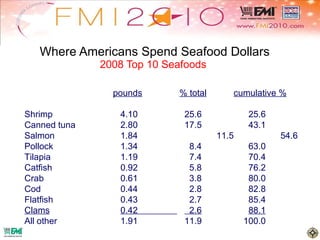
Where Americans Spend Seafood Dollars 2008 Top 10 Seafoods    pounds   % total   cumulative % Shrimp 4.10 25.6    25.6    Canned tuna 2.80 17.5 43.1 Salmon 1.84  11.5 54.6 Pollock   1.34    8.4 63.0 Tilapia 1.19    7.4 70.4 Catfish 0.92  5.8 76.2 Crab 0.61  3.8 80.0 Cod 0.44    2.8 82.8 Flatfish 0.43    2.7 85.4 Clams 0.42    2.6 88.1 All other 1.91  11.9   100.0
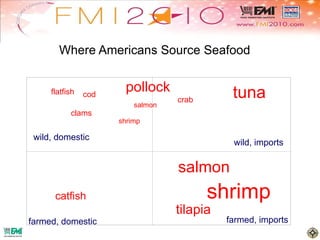
Where Americans Source Seafood wild, domestic wild, imports farmed, domestic farmed, imports pollock catfish tuna shrimp salmon salmon crab cod clams flatfish shrimp tilapia
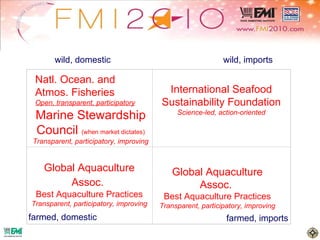
wild, domestic wild, imports farmed, domestic farmed, imports Natl. Ocean. and Atmos. Fisheries Open, transparent, participatory Marine Stewardship Council  (when market dictates) Transparent, participatory, improving International Seafood Sustainability Foundation Science-led, action-oriented Global Aquaculture Assoc.  Best Aquaculture Practices Transparent, participatory, improving Global Aquaculture Assoc.   Best Aquaculture Practices Transparent, participatory, improving
Impartial :  Department of Commerce, NOAA Fisheries and state managers are government managers of nation’s fisheries Objective :  10 national standards ensure sustainable management Participatory :  Congressional debate on Magnuson Stevens Act, NOAA rulemaking process, Council Science and Statistics Committees, Species Plan Teams, and Councils open to NGOs, academics, industry, government  Transparent :  All meetings subject to “sunshine laws” Right of appeal :  Litigation is accepted part of process in event NGO or industry disagrees with Council decisions NFI Views on Sustainability Efforts NOAA Fisheries
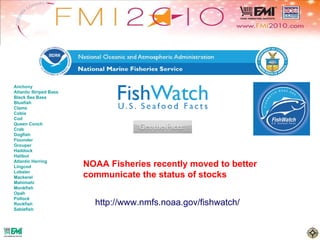
NFI Views on Sustainability Efforts NOAA Communications Anchovy Atlantic Striped Bass Black Sea Bass Bluefish Clams Cobia Cod Queen Conch Crab Dogfish Flounder Grouper Haddock Halibut Atlantic Herring Lingcod Lobster Mackerel Mahimahi Monkfish Opah Pollock Rockfish Sablefish NOAA Fisheries recently moved to better communicate the status of stocks http://www.nmfs.noaa.gov/fishwatch/
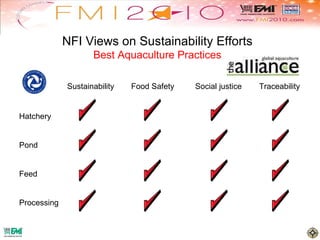
NFI Views on Sustainability Efforts Best Aquaculture Practices Hatchery Pond Feed  Processing Sustainability Food Safety Social justice Traceability
What Should You Look for in Third Party Seafood Sustainability Programs Transparency : Assessment notifications should be provided to public and to fishery under review Independence : Independent  review of methods or standards used Input : A formal process for public input Right of appeal : Appeal processes should be provided for fisheries reviewed Differentiation of Fisheries :  Should recognize distinct fisheries within resources and species Shortcomings in ratings system should give retailers pause before basing sourcing  decisions upon their recommendations
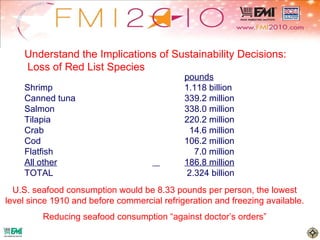
  pounds   Shrimp   1.118 billion  Canned tuna   339.2 million Salmon   338.0 million Tilapia   220.2 million Crab     14.6 million Cod   106.2 million Flatfish     7.0 million All other   186.8 million TOTAL    2.324 billion  U.S. seafood consumption would be 8.33 pounds per person, the lowest level since 1910 and before commercial refrigeration and freezing available. Reducing seafood consumption “against doctor’s orders” Understand the Implications of Sustainability Decisions: Loss of Red List Species
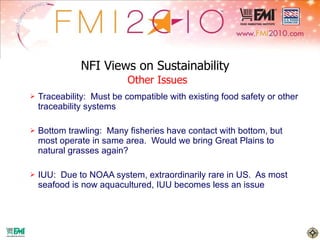
NFI Views on Sustainability   Other Issues Traceability:  Must be compatible with existing food safety or other traceability systems Bottom trawling:  Many fisheries have contact with bottom, but most operate in same area.  Would we bring Great Plains to natural grasses again? IUU:  Due to NOAA system, extraordinarily rare in US.  As most seafood is now aquacultured, IUU becomes less an issue
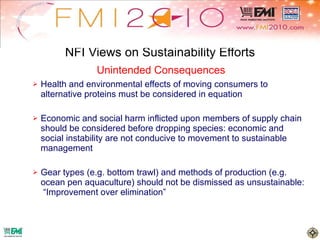
NFI Views on Sustainability Efforts Health and environmental effects of moving consumers to alternative proteins must be considered in equation Economic and social harm inflicted upon members of supply chain should be considered before dropping species: economic and social instability are not conducive to movement to sustainable management Gear types (e.g. bottom trawl) and methods of production (e.g. ocean pen aquaculture) should not be dismissed as unsustainable:  “Improvement over elimination” Unintended Consequences
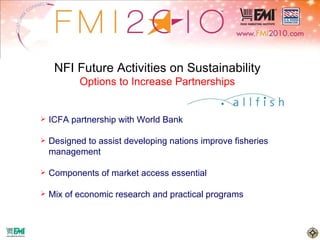
NFI Future Activities on Sustainability Options to Increase Partnerships ICFA partnership with World Bank Designed to assist developing nations improve fisheries management Components of market access essential Mix of economic research and practical programs
NFI Future Activities on Sustainability Options to Increase Partnerships 2009 study highlighted need for both certification schemes and recommendation lists to improve consistency and adhere to FAO guidelines on independence and transparency Highlights need for benchmarking by legitimate authority similar to Consumer Goods Forum’s programs for food safety, workers’ rights and packaging Core principles need to be FAO Fisheries Code of Conduct and related agreements Diverse steering group with supply chain emphasis (developing and developed nations, producers thru retailers)
National Fisheries Institute Suggestions for Retailers Understand what consumers say and what they do --- they are usually different, especially on sustainability Think carefully about your partners.  Many NGOs seek improvements and understand responsibility to current consumers.  Other NGOs do not.  Examine the business impact of your sustainability decisions … not just the  public  relations aspect Demand your suppliers review the sustainability status of your purchases Create your own base knowledge about sustainability --- do some independent research (e.g., NOAA Fisheries Fishwatch website)
National Fisheries Institute Ron Rogness [email_address] Seafood Sustainability Progress and opportunities

Seafood workshop fmi convention (1)

  • 1.
    Navigating the SustainableSeafood Waters: The What, Why and How of Sustainable Seafood Steve Lutz, The Perishables Group Heather Tausig, The New England Aquarium Susan Jackson, International Seafood Sustainability Council Ron Rogness, National Fisheries Institute Jeanne von Zastrow, Food Marketing Institute Why is this important to the retail food industry? What are FMI, NFI and other groups doing to help? What are consumers doing about sustainable seafood? How are retailers, suppliers and NGO’s working together? Where can you turn for help on seafood sustainability?
  • 2.
    Sustainable Seafood --What’s the Buzz? The global population growth, increasing demand for seafood and concerns about the long term viability of the world’s seafood supply. In August 2007, 22 FMI member companies formed a “sustainable seafood working group” with this mission: To identify priorities and issues, find ways to cut through the confusing, complicated and complex subject and develop industry guidelines, tools and resources to help retailers, suppliers, consumers and NGO’s work together for solutions.
  • 3.
    FMI Industry Positionon Sustainable Seafood FMI supports programs to promote a sustainable supply of seafood, and encourages retailers to: Learn about issues Utilize sustainable seafood resources Develop individual company procurement policies for sustainable seafood Consider sustainable seafood certification programs. FMI will partner with suppliers, government, advocacy groups and other experts to assure long term viability of seafood supply. FMI sustainability working group will develop resources, tools and voluntary guidelines for the
  • 4.
    FMI Sustainable SeafoodResearch (May 2010) Respondents over 5Billion $ in sales Increasing momentum on sustainable seafood 93% either working on or have policy/mission/guidelines Environmental organizations are important partners, 60% engaged Suppliers are important partners, 70% engaged on sustainability Traceability is vital, rates 4.1 (on 1-5) as one of highest priorities Complexity and inconsistency are two most significant challenges Retailers want to see increased sales of sustainable products (4.22) Retailers want to see environmental improvements in “unsustainable” products (4.7) and established quantification of environmental progress (4.0) 50% retailers rely on trade associations for policies, goals, standards
  • 5.
    Consumers & SustainabilityWhat consumers really know and think about sustainable seafood Steve Lutz Executive Vice President Perishables Group
  • 6.
    Research Sponsor Specialthanks to: Results in the May issue of Seafood Business
  • 7.
    Overview The SustainabilityMessage is getting out, but what is sticking with consumers? 1,053 consumers surveyed nationally Four US regions and national total Focused on consumer knowledge and attitudes toward seafood sustainability
  • 8.
    What influences SeafoodPurchases? When deciding what fresh seafood items to purchase from the supermarket or other store, how important are each of the following?
  • 9.
    What influences SeafoodPurchases? When deciding what fresh seafood items to purchase from the supermarket or other store, which of the following is most important to you? 75%
  • 10.
    Responding to RealityIf ‘sustainable seafood’ is defined as fish that is caught in a way that does not risk the species’ future or oceans, or farmed fish that is farmed in a way that does not harm the environment, which of the following statements best describes you? 64%
  • 11.
  • 12.
  • 13.
  • 14.
  • 15.
  • 16.
  • 17.
    Key Findings Sustainabilityawareness over-shadowed by seafood safety Un-aided preference for “sustainability” is relatively low and falls significantly below other purchase drivers (safety, price, type) For a majority of consumers, “sustainability” is most easily linked to long term species viability Awareness of “eco-labels” is relative low and, at least as a concept, not powerfully persuasive Aided awareness of sustainability groups themselves is low.
  • 18.
    Key Findings Farmedraised products generally receive higher sustainability ratings than similar wild products. U.S. generally ranks higher than imports Self-described “knowledgeable” buyers and consumers under age 35 are much more likely be aware of sustainability, use available seafood guides and note signage/menu information Heavier seafood users rank sustainability higher The best, most consistent supermarket seafood consumers are likely to have the most interest in sustainability issues and are on the lookout for retail messaging.
  • 19.
    Consumers & SustainabilityWhat consumers really know and think about sustainable seafood Steve Lutz Executive Vice President Perishables Group
  • 20.
  • 21.
    Heather Tausig AssociateVice President of Conservation New England Aquarium May 12, 2010 Navigating the Sustainable Seafood Waters: The What, Why and How of Sustainable Seafood
  • 22.
    We aim toprotect the world’s ocean resources by: raising public awareness and working with the seafood industry to advance sustainable practices within wild-capture fisheries and aquaculture operations.
  • 23.
  • 24.
  • 25.
  • 26.
  • 27.
  • 28.
    A Common Visionfor Environmentally Responsible Seafood www.solutionsforseafood.org
  • 29.
  • 30.
    The Steps Makea commitment to have a corporate sustainable seafood policy. Collect data on seafood products. Buy environmentally responsible seafood. Make product information publicly available. Educate customers, suppliers, employees. Support reform to improve fisheries and aquaculture management.
  • 31.
  • 32.
    World Wildlife FundPartnerships; sourcing and policy advice; fishery improvement projects
  • 33.
    FishWise Partnerships; trainings;product signage More than 1,500 stores Goal: All products are sustainable and traceable Product and supplier assessments Improvement plans and alternative sources Staff training Consumer education Policy engagement
  • 34.
    Sustainable Fisheries Partnership Partnerships; data resource
  • 35.
    SeaChoice Partnerships; sourcing and policy advice Canadian Parks and Wilderness Society David Suzuki Foundation Ecology Action Centre Living Oceans Society Sierra Club of Canada
  • 36.
  • 37.
    Food Marketing InstituteSustainable Seafood Working Group Goal Develop tools, resources and strategy to support the entire industry’s journey to sustainability www.fmi.org/sustainability Case studies Retail tools and research Resource list Supplier and NGO Advisory Councils
  • 38.
    Resources www.neaq.org/sustainableseafood www.solutionsforseafood.orgwww.fmi.org /sustainability For more information: Heather Tausig 617-973-0274 [email_address]
  • 39.
  • 40.
    SM Susan Jackson,President FMI Conference May 12, 2010
  • 41.
    SM Total GlobalMarine Capture of Food Fish Principle Commercial Tuna Species
  • 42.
  • 43.
    Bolton Alimentari BumbleBee Foods / Clover Leaf Seafoods MW Brands Princes Ltd. Sea Value Co., Ltd. SM ISSF Participating Companies StarKist Co. Thai Union Mfg. / Chicken of the Sea Tri Marine International WWF FOUNDERS NEW COMPANIES FRINSA Negocios Industriales Real NIRSA S.A.
  • 44.
    RFMO Report Card:Overall Report of Tuna RFMO Chairs Meeting San Francisco February 5-6, 2008 "Substantial concerns were expressed regarding the consequences of RFMOs not adopting management measures consistent with the best available scientific advice." "Compliance to adopted measures was identified as a common problem. Activities of non-compliant members could undermine compliance efforts by all other members."   SM
  • 45.
    ISSF Mission ISSF’sMission is to undertake science-based initiatives for the long-term conservation and sustainable use of tuna stocks, reducing by-catch and promoting ecosystem health. Ultimate, Achievable Goal Targeted stocks maintained at or above levels of abundance capable of supporting maximum sustainable yield in a healthy ecosystem SM
  • 46.
    Why The MissionMatters SHELF-STABLE -- 90 percent of global tuna catch comes from stocks that are currently in good condition, but of the 90 percent, 18 percent are in decline RFMO STRUCTURE – Veto power of individual nations undermines conservation measures. BYCATCH – Purse seine and longline fishing – 75 percent of global catch – produce bycatch
  • 47.
    Issues Being AddressedConservation Fishing Capacity Bycatch Data IUU SM
  • 48.
    SM For moreinformation  www.ISS-Foundation.org
  • 49.
  • 50.
    Seafood Sustainability: Progressand Opportunities Ron Rogness Sustainability Officer National Fisheries Institute
  • 51.
    Progress and Opportunities Discussion Points NFI sustainability commitment and engagement Analysis of US seafood purchases Analysis of US seafood sourcing Analysis of sustainability options Introduction of certification benchmark initiative
  • 52.
    National Fisheries InstituteSustainability Involvement and Commitments Strongly support inclusive, rigorous, transparent NOAA fishery management system for US fisheries Participate on MSC Board of Trustees Participate on International Seafood Sustainability Foundation Board of Directors Coordinate ALLFISH, public-private partnership with World Bank Support Global Aquaculture Alliance Best Aquaculture Practices Working collaboratively with FMI’s Sustainable Seafood Working Group
  • 53.
    National Fisheries InstituteSustainability Definition Seafood sustainability means feeding America’s families the fish they enjoy today without endangering ability of generations to fish in the future. Issues not specific to seafood (workers’ rights, social welfare issues) should not be addressed specifically through seafood initiatives, but through other corporate initiatives
  • 54.
    Where Americans SpendSeafood Dollars 2008 Top 10 Seafoods pounds % total cumulative % Shrimp 4.10 25.6 25.6 Canned tuna 2.80 17.5 43.1 Salmon 1.84 11.5 54.6 Pollock 1.34 8.4 63.0 Tilapia 1.19 7.4 70.4 Catfish 0.92 5.8 76.2 Crab 0.61 3.8 80.0 Cod 0.44 2.8 82.8 Flatfish 0.43 2.7 85.4 Clams 0.42 2.6 88.1 All other 1.91 11.9 100.0
  • 55.
    Where Americans SourceSeafood wild, domestic wild, imports farmed, domestic farmed, imports pollock catfish tuna shrimp salmon salmon crab cod clams flatfish shrimp tilapia
  • 56.
    wild, domestic wild,imports farmed, domestic farmed, imports Natl. Ocean. and Atmos. Fisheries Open, transparent, participatory Marine Stewardship Council (when market dictates) Transparent, participatory, improving International Seafood Sustainability Foundation Science-led, action-oriented Global Aquaculture Assoc. Best Aquaculture Practices Transparent, participatory, improving Global Aquaculture Assoc. Best Aquaculture Practices Transparent, participatory, improving
  • 57.
    Impartial : Department of Commerce, NOAA Fisheries and state managers are government managers of nation’s fisheries Objective : 10 national standards ensure sustainable management Participatory : Congressional debate on Magnuson Stevens Act, NOAA rulemaking process, Council Science and Statistics Committees, Species Plan Teams, and Councils open to NGOs, academics, industry, government Transparent : All meetings subject to “sunshine laws” Right of appeal : Litigation is accepted part of process in event NGO or industry disagrees with Council decisions NFI Views on Sustainability Efforts NOAA Fisheries
  • 58.
    NFI Views onSustainability Efforts NOAA Communications Anchovy Atlantic Striped Bass Black Sea Bass Bluefish Clams Cobia Cod Queen Conch Crab Dogfish Flounder Grouper Haddock Halibut Atlantic Herring Lingcod Lobster Mackerel Mahimahi Monkfish Opah Pollock Rockfish Sablefish NOAA Fisheries recently moved to better communicate the status of stocks http://www.nmfs.noaa.gov/fishwatch/
  • 59.
    NFI Views onSustainability Efforts Best Aquaculture Practices Hatchery Pond Feed Processing Sustainability Food Safety Social justice Traceability
  • 60.
    What Should YouLook for in Third Party Seafood Sustainability Programs Transparency : Assessment notifications should be provided to public and to fishery under review Independence : Independent review of methods or standards used Input : A formal process for public input Right of appeal : Appeal processes should be provided for fisheries reviewed Differentiation of Fisheries : Should recognize distinct fisheries within resources and species Shortcomings in ratings system should give retailers pause before basing sourcing decisions upon their recommendations
  • 61.
    pounds Shrimp 1.118 billion Canned tuna 339.2 million Salmon 338.0 million Tilapia 220.2 million Crab 14.6 million Cod 106.2 million Flatfish 7.0 million All other 186.8 million TOTAL 2.324 billion U.S. seafood consumption would be 8.33 pounds per person, the lowest level since 1910 and before commercial refrigeration and freezing available. Reducing seafood consumption “against doctor’s orders” Understand the Implications of Sustainability Decisions: Loss of Red List Species
  • 62.
    NFI Views onSustainability Other Issues Traceability: Must be compatible with existing food safety or other traceability systems Bottom trawling: Many fisheries have contact with bottom, but most operate in same area. Would we bring Great Plains to natural grasses again? IUU: Due to NOAA system, extraordinarily rare in US. As most seafood is now aquacultured, IUU becomes less an issue
  • 63.
    NFI Views onSustainability Efforts Health and environmental effects of moving consumers to alternative proteins must be considered in equation Economic and social harm inflicted upon members of supply chain should be considered before dropping species: economic and social instability are not conducive to movement to sustainable management Gear types (e.g. bottom trawl) and methods of production (e.g. ocean pen aquaculture) should not be dismissed as unsustainable: “Improvement over elimination” Unintended Consequences
  • 64.
    NFI Future Activitieson Sustainability Options to Increase Partnerships ICFA partnership with World Bank Designed to assist developing nations improve fisheries management Components of market access essential Mix of economic research and practical programs
  • 65.
    NFI Future Activitieson Sustainability Options to Increase Partnerships 2009 study highlighted need for both certification schemes and recommendation lists to improve consistency and adhere to FAO guidelines on independence and transparency Highlights need for benchmarking by legitimate authority similar to Consumer Goods Forum’s programs for food safety, workers’ rights and packaging Core principles need to be FAO Fisheries Code of Conduct and related agreements Diverse steering group with supply chain emphasis (developing and developed nations, producers thru retailers)
  • 66.
    National Fisheries InstituteSuggestions for Retailers Understand what consumers say and what they do --- they are usually different, especially on sustainability Think carefully about your partners. Many NGOs seek improvements and understand responsibility to current consumers. Other NGOs do not. Examine the business impact of your sustainability decisions … not just the public relations aspect Demand your suppliers review the sustainability status of your purchases Create your own base knowledge about sustainability --- do some independent research (e.g., NOAA Fisheries Fishwatch website)
  • 67.
    National Fisheries InstituteRon Rogness [email_address] Seafood Sustainability Progress and opportunities

Editor's Notes

  • #24 Corporate work  consumer outreach We are an Aquarium, visitors asking for information Few years ago initiated our Celebrate Seafood program that emphasizes positive message Not asking consumers not to eat seafood, but to be mindful of the seafood they are choosing to eat Encourage folks to ask questions…(next slide)
  • #36 Federated Coop Limited (which services 260 coops across Western Canada) Bento Nouveau (a national sushi company that operates sushi counters in grocer stores nationally as well as many other locations).   If you'd like you can also mention our distributor partners: Seacore (Central Canada's largest seafood distributor), Albion Fisheries and Seven Seas (two largest seafood distributors for Western Canada).
  • #37 FishChoice.com will launch a regional sourcing tool in June 2010 that will make it easy to find seafood products that have been fished or farmed in any North American Region (Globally by 2011) FishChoice.com will search for products that a buyer needs – just contact FishChoice through the website and we will find the most sustainable solution  
  • #43 Tuna roam the world’s oceans Multi-lateral treaty organizations have responsibility for managing stocks Parliamentary rules allow fishing nations to veto conservation measures or exempt themselves from coverage National economic intersts, national pride sometimes override environmental considerations
  • #48 WCPO – Support complete, temporary purse seine closure EPO Bigeye – Resolution: refrain from transactions after 9/1/09 with vessels non-compliant IATTC Res. C-09-01 Med Albacore – Resolution: refrain from transactions after 1/1/11 if science-based measures not adopted after assessment IO – Endorsed IOTC Science Committee recommendation for 300,000 ton total annual catch of yellowfin tuna; committed to collaborate with IOTC on science, data, and allocation issues Protected Areas – Support science-based closings to accomplish clear objectives for tuna and ecosystem conservation Bluefin – Statement of concern