Overview of SDTT SRI Program
and future Perspective
Ranchi, 2013
By
Biswanath Sinha
Rice in India
• Rice is staple food for more than 70 per cent of
India’s population
• Rice is grown in 42.1 million hectares of land with
a production of 88 million tonnes.
• Rice occupies 26 per cent of total cropped area
and contributes 24 per cent of total AGDP
• India earns Rs 7,000 crores annually from rice in
foreign exchange
• Rice is source of livelihoods for millions of people
in India
» (Directorate of Rice Research, 2010)
Background of SRI Program
• Decline in labour
• Increasing input cost
• The per capita land availability declined sharply
– 0.37 ha/0.925 acre (1951)
– 0.19 ha/0.47 acres (2001)
– Projected to be 0.13 ha/0.325 acres in 2051
• Increasing Environmental Concerns
• Decline of water source available for agriculture
• Per Capita rice availability is declining
• 221.7 gm/day in 1991
• 206.4 gm/day in 2000
• 175.3 gm/day in 2008
• The potential for growth is more in rainfed areas
SDTT-SRI Program Piloting Phase
(2007-09)
• 65,543 small and marginal farmers covering
18,685 acres in 2009 (kharif and rabi
combined)
• 105 districts or close to a sixth of the total
districts in the country
• Eight states
• Investment in first phase: 10.94 crore
• Reviewed during 2008-09
4
Expansion Phase II (2009-12)
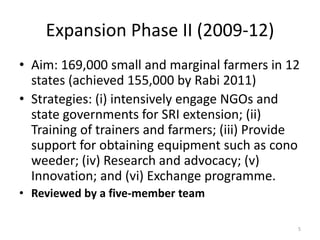
• Aim: 169,000 small and marginal farmers in 12
states (achieved 155,000 by Rabi 2011)
• Strategies: (i) intensively engage NGOs and
state governments for SRI extension; (ii)
Training of trainers and farmers; (iii) Provide
support for obtaining equipment such as cono
weeder; (iv) Research and advocacy; (v)
Innovation; and (vi) Exchange programme.
• Reviewed by a five-member team
5
Achievements are Three Major Types
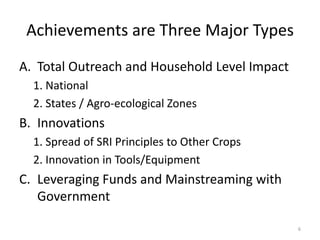
A. Total Outreach and Household Level Impact
1. National
2. States / Agro-ecological Zones
B. Innovations
1. Spread of SRI Principles to Other Crops
2. Innovation in Tools/Equipment
C. Leveraging Funds and Mainstreaming with
Government
6
Program Achievements
• Total Farmer Outreach and Area (2011-12):
– Farmers: 155,000 (Kharif 110,000, Rabi 40,000);
– Area under SRI: 38,206 Acre, other crops 17,446 acre
• Grain Yield and Income
– 46% increase in yield
– 191% increase in income (Rs.13, 416/acre as compared to Rs.
4610/acre)
• Food Security
– 84 days a year for a family of six (Average SRI area per farmer:
0.35 acre)
• Increase in Economic Output
– 2011: Rs. 34 Crore
– 2010: Rs. 24 Crore
7
0
20
40
60
80
100
120
140
160
180
2006-07 2007-08 2008-09 2009-10 2010-11 2011-12
NoofFarmers('000)
YEAR WISE FARMERS COVERAGE
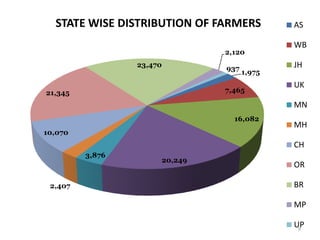
1,975
7,465
16,082
20,249
3,876
2,407
10,070
21,345
23,470
2,120
937
STATE WISE DISTRIBUTION OF FARMERS AS
WB
JH
UK
MN
MH
CH
OR
BR
MP
UP9
Program Achievements (B.1)
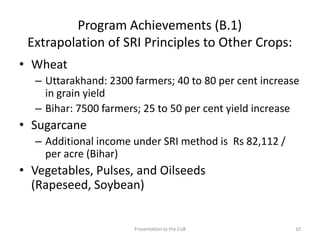
Extrapolation of SRI Principles to Other Crops:
• Wheat
– Uttarakhand: 2300 farmers; 40 to 80 per cent increase
in grain yield
– Bihar: 7500 farmers; 25 to 50 per cent yield increase
• Sugarcane
– Additional income under SRI method is Rs 82,112 /
per acre (Bihar)
• Vegetables, Pulses, and Oilseeds
(Rapeseed, Soybean)
Presentation to the CoB 10
Other Encouraging Developments
• Livolink Foundation with active support from our
SRI partners has been able to mobilise Rs 3 crores
from TRUPTI in Odisha.
• PRADAN Bihar has played major role in
mainstreaming SRI and generating interest at
international level
• The Guradian, Forbes India, etc
• Rongmei Naga Baptist Association is mobilising
weeders from Manipur Government for our SRI
partners
Our Failures
• Our attempts to intervene at state and policy
level has given uneven results
• Research with mainstream institutions has not
taken off at the desired level
• Failure to bring uniformity in extension
mechanism
• Is Livolink Foundation over-burdened: Is there
possibility of 360 review/feedback
Future Direction
Need feedback from all of you
• Intensify the SRI extension in the focussed
regions/states
• Standardizing the extension mechanism
• Initiating research on SRI with established
research institutes (a separate event is being
proposed in June 13 only on research)
• Moving from ‘food security’ to ‘family well-
being’: if needed supplementing with other
activities
•THANKS

Sdtt mumbai

  • 1.
    Overview of SDTTSRI Program and future Perspective Ranchi, 2013 By Biswanath Sinha
  • 2.
    Rice in India •Rice is staple food for more than 70 per cent of India’s population • Rice is grown in 42.1 million hectares of land with a production of 88 million tonnes. • Rice occupies 26 per cent of total cropped area and contributes 24 per cent of total AGDP • India earns Rs 7,000 crores annually from rice in foreign exchange • Rice is source of livelihoods for millions of people in India » (Directorate of Rice Research, 2010)
  • 3.
    Background of SRIProgram • Decline in labour • Increasing input cost • The per capita land availability declined sharply – 0.37 ha/0.925 acre (1951) – 0.19 ha/0.47 acres (2001) – Projected to be 0.13 ha/0.325 acres in 2051 • Increasing Environmental Concerns • Decline of water source available for agriculture • Per Capita rice availability is declining • 221.7 gm/day in 1991 • 206.4 gm/day in 2000 • 175.3 gm/day in 2008 • The potential for growth is more in rainfed areas
  • 4.
    SDTT-SRI Program PilotingPhase (2007-09) • 65,543 small and marginal farmers covering 18,685 acres in 2009 (kharif and rabi combined) • 105 districts or close to a sixth of the total districts in the country • Eight states • Investment in first phase: 10.94 crore • Reviewed during 2008-09 4
  • 5.
    Expansion Phase II(2009-12) • Aim: 169,000 small and marginal farmers in 12 states (achieved 155,000 by Rabi 2011) • Strategies: (i) intensively engage NGOs and state governments for SRI extension; (ii) Training of trainers and farmers; (iii) Provide support for obtaining equipment such as cono weeder; (iv) Research and advocacy; (v) Innovation; and (vi) Exchange programme. • Reviewed by a five-member team 5
  • 6.
    Achievements are ThreeMajor Types A. Total Outreach and Household Level Impact 1. National 2. States / Agro-ecological Zones B. Innovations 1. Spread of SRI Principles to Other Crops 2. Innovation in Tools/Equipment C. Leveraging Funds and Mainstreaming with Government 6
  • 7.
    Program Achievements • TotalFarmer Outreach and Area (2011-12): – Farmers: 155,000 (Kharif 110,000, Rabi 40,000); – Area under SRI: 38,206 Acre, other crops 17,446 acre • Grain Yield and Income – 46% increase in yield – 191% increase in income (Rs.13, 416/acre as compared to Rs. 4610/acre) • Food Security – 84 days a year for a family of six (Average SRI area per farmer: 0.35 acre) • Increase in Economic Output – 2011: Rs. 34 Crore – 2010: Rs. 24 Crore 7
  • 8.
    0 20 40 60 80 100 120 140 160 180 2006-07 2007-08 2008-092009-10 2010-11 2011-12 NoofFarmers('000) YEAR WISE FARMERS COVERAGE
  • 9.
  • 10.
    Program Achievements (B.1) Extrapolationof SRI Principles to Other Crops: • Wheat – Uttarakhand: 2300 farmers; 40 to 80 per cent increase in grain yield – Bihar: 7500 farmers; 25 to 50 per cent yield increase • Sugarcane – Additional income under SRI method is Rs 82,112 / per acre (Bihar) • Vegetables, Pulses, and Oilseeds (Rapeseed, Soybean) Presentation to the CoB 10
  • 11.
    Other Encouraging Developments •Livolink Foundation with active support from our SRI partners has been able to mobilise Rs 3 crores from TRUPTI in Odisha. • PRADAN Bihar has played major role in mainstreaming SRI and generating interest at international level • The Guradian, Forbes India, etc • Rongmei Naga Baptist Association is mobilising weeders from Manipur Government for our SRI partners
  • 12.
    Our Failures • Ourattempts to intervene at state and policy level has given uneven results • Research with mainstream institutions has not taken off at the desired level • Failure to bring uniformity in extension mechanism • Is Livolink Foundation over-burdened: Is there possibility of 360 review/feedback
  • 13.
    Future Direction Need feedbackfrom all of you • Intensify the SRI extension in the focussed regions/states • Standardizing the extension mechanism • Initiating research on SRI with established research institutes (a separate event is being proposed in June 13 only on research) • Moving from ‘food security’ to ‘family well- being’: if needed supplementing with other activities
  • 14.