
Perspectives on SRI For IDS sri meeting 17 th  December 2009
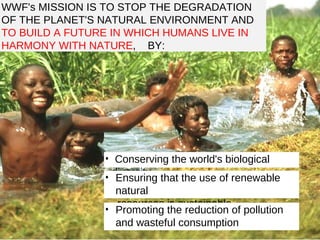
WWF's MISSION IS TO STOP THE DEGRADATION OF THE PLANET'S NATURAL ENVIRONMENT AND  TO BUILD A FUTURE IN WHICH HUMANS LIVE IN HARMONY WITH NATURE ,  BY: Conserving the world's biological diversity Ensuring that the use of renewable natural resources is sustainable Promoting the reduction of pollution and wasteful consumption
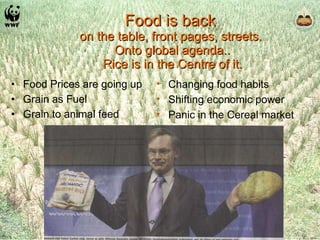
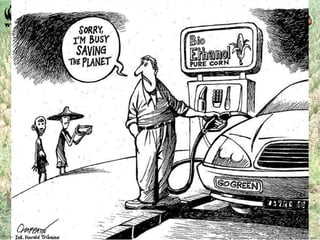
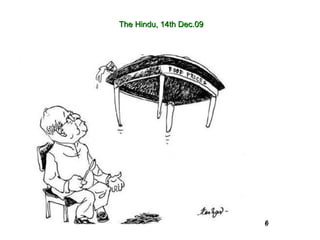
Food is back  on the table, front pages, streets.  Onto global agenda.. Rice is in the Centre of it. Food Prices are going up Grain as Fuel Grain to animal feed Changing food habits Shifting economic power Panic in the Cereal market
 
 
The Hindu, 14th Dec.09 6
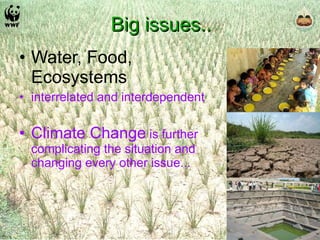
Big issues.. Water, Food, Ecosystems  interrelated and interdependent Climate Change  is further complicating the situation and changing every other issue...
Food crisis  means even more  water crisis…   Rice cultivation Demands  more water Need to produce  more rice with less water…
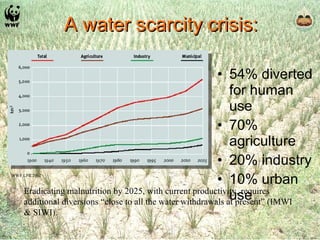
A water scarcity crisis: 54% diverted for human use 70% agriculture 20% industry 10% urban use Eradicating malnutrition by 2025, with current productivity, requires additional diversions “ close to all the water withdrawals at present ” (IMWI & SIWI). WWF LPR 2002
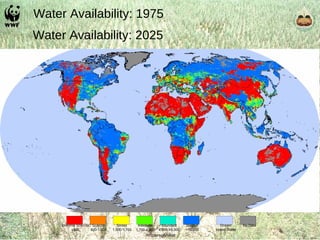
Water Availability: 1975 Water Availability: 2025 Extreme Scarcity <500 Scarcity 500-1,000 Stress 1,000-1,700 Adequate 1,700-4,000 Abundant 4,000-10,000 Surplus >10,000 Ocean/ Inland Water No Data m 3 /person/year
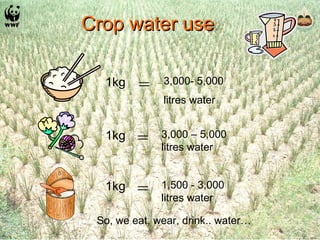
Crop water use So, we eat, wear, drink.. water…  = 1kg 1,500 - 3,000  litres water = 1kg 3,000- 5,000 litres water = 1kg 3,000 – 5,000 litres water
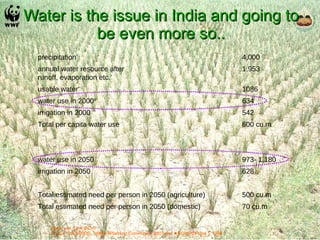
Water is the issue in India and going to be even more so.. Water use (Unit: BCM) Source: *NCIWRDP, 1999a, #Planning Commission 2007 and   NCIWRDP Vol.1, 1999  precipitation * 4,000 annual water resource after  runoff, evaporation etc. * 1,953 usable water * 1086 water use in 2000 # 634 irrigation in 2000 542 Total per capita water use 600 cu.m water use in 2050 973- 1,180 irrigation in 2050 628 Total estimated need per person in 2050 (agriculture) 500 cu.m Total estimated need per person in 2050 (domestic) 70 cu.m
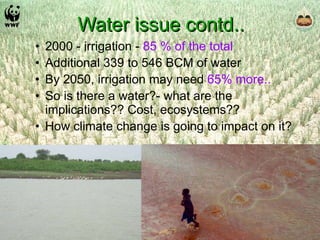
Water issue contd.. 2000 - irrigation -  85 % of the total Additional 339 to 546 BCM of water By 2050, irrigation may need  65% more.. So is there a water?- what are the implications?? Cost, ecosystems?? How climate change is going to impact on it?
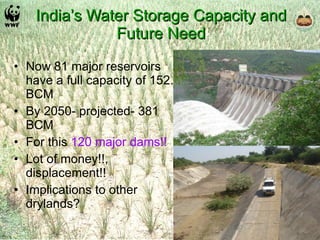
India’s Water Storage Capacity and Future Need Now 81 major reservoirs have a full capacity of 152. BCM By 2050- projected- 381 BCM For this  120 major dams!! Lot of money!!, displacement!! Implications to other drylands?
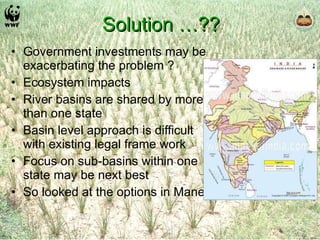
Solution …?? Government investments may be exacerbating the problem ? Ecosystem impacts River basins are shared by more than one state Basin level approach is difficult with existing legal frame work Focus on sub-basins within one state may be next best So looked at the options in Maner
Searching for solutions.. Some initiatives from the project Restoring traditional water infrastructure- Maner sub basin, Godavari basin Cost benefits of Major structures- Polavaram. Establishing dialogues on national issues- Interlinking of rivers. Improving water productivity- SRI, SSI
Experiences with SRI
‘ Green revolution’ is based on one thing.. More ( to get more ) Farmer need to give more (inputs, water, seeds,…)  to get more (production).  After 5 decades  Giving more has become so much more, farmer, Governments nor ecosystem able to give any more.. That is the crisis in agriculture.. ‘More crisis’.
Answer to ‘More crisis’ is Even  more technology, inputs, money.. Bio tech GMs High tech irrigation Industrial agriculture In the process thinking is to focus on more complicated more expensive solutions. Gates is putting some $500 million? to ag research to find solutions ( ‘more’ problem)
‘ More with less’ is major challenge It is conceptual challenge almost negating everything we thought is modern agriculture.  It is management challenge What will (we) experts do?- livelihoods? It is an economic challenge.. Fertilisers, pesticides, companies, dams..
SRI: Back to basics.. It is about productivity of land, labour, water.. There are limits, costs and trade-offs to all of it. It is not how much you produce-  how, with what, for what and how long.. etc. It is about choice for farmers, consumers It is about reducing our foot print- less water use, less pollution, less impact..
Perspectives on SRI.. SRI: Less with More.. 1. Less water requirement  2. Less seed  3. Lesser chemical inputs 4. Soil health improvement through biological activity  5. Reduced duration (by 10 days) 6. Higher yields – Both grain and straw  and more… SRI is neither a new  variety nor a hybrid…  it is  a method  of rice cultivation
December 2, 2009 India could be a new pole of global growth: World Bank president Robert Zoellick Everyone cites India’s Green Revolution. But I’m even more  intrigued by what is known as SRI, or system of rice intensification, and I know this is also an area of interest for PM Manmohan Singh. Using smart water management and planting practices ,  farmers in Tamil Nadu have increased rice yields between 30 and 80 per cent, reduced water use by 30 per cent, and now require significantly less fertilizer.  This  emerging technology not only addresses food security but also the water scarcity challenge that climate change is making all the more dangerous . These are all lessons for our world.
SRI like practice 100 years ago Single seedling planting, row planting,  wider spacing , intercultivation  were practiced  a century ago in India Visit : www.sri-india.net (SRI Newsletter 6)
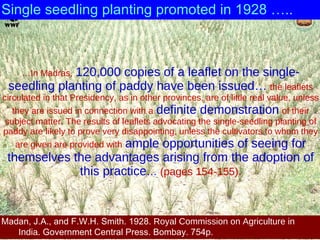
… In Madras,   120,000 copies of a leaflet on the single-seedling planting of paddy have been issued …   the leaflets circulated in that Presidency, as in other provinces, are of little real value, unless they are issued in connection with a   definite demonstration   of their subject matter. The results of leaflets advocating the single-seedling planting of paddy are likely to prove very disappointing, unless the cultivators to whom they are given are provided with   ample opportunities of seeing for themselves the advantages arising from the adoption of this practice …  (pages 154-155). Single seedling planting promoted in 1928 ….. Madan, J.A., and F.W.H. Smith. 1928.  Royal Commission on Agriculture in  India . Government Central Press. Bombay. 754p.
 
 
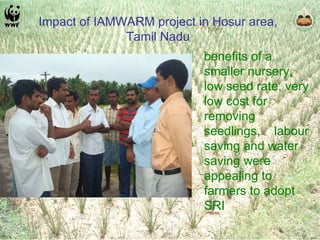
benefits of a smaller nursery, low seed rate, very low cost for removing seedlings,  labour saving and water saving were appealing to farmers to adopt SRI Impact of IAMWARM project in Hosur area, Tamil Nadu
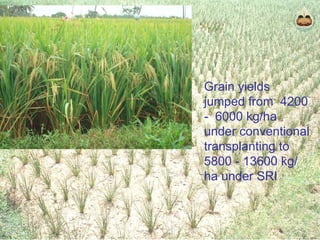
Grain yields jumped from  4200 -  6000 kg/ha under conventional transplanting to 5800 - 13600 kg/ ha under SRI
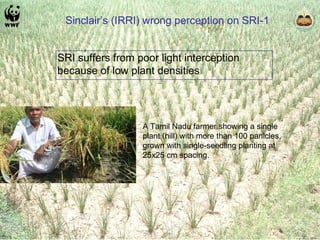
Sinclair’s (IRRI) wrong perception on SRI-1 A Tamil Nadu farmer showing a single plant (hill) with more than 100 panicles, grown with single-seedling planting at 25x25 cm spacing. SRI suffers from poor light interception because of low plant densities
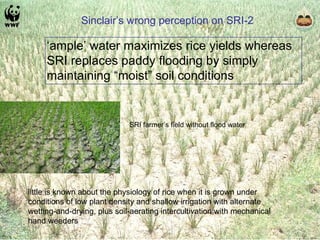
Sinclair’s wrong perception on SRI-2 little is known about the physiology of rice when it is grown under conditions of low plant density and shallow irrigation with alternate wetting-and-drying, plus soil-aerating intercultivation with mechanical hand weeders  SRI farmer’s field without flood water  ‘ ample’ water maximizes rice yields whereas SRI replaces paddy flooding by simply maintaining “moist” soil conditions
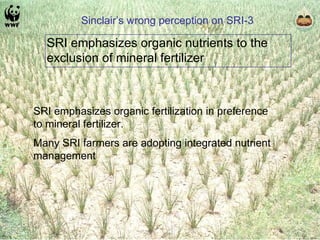
Sinclair’s wrong perception on SRI-3 SRI emphasizes organic fertilization  in preference to  mineral fertilizer.  Many SRI farmers are adopting integrated nutrient management SRI emphasizes organic nutrients to the exclusion of mineral fertilizer
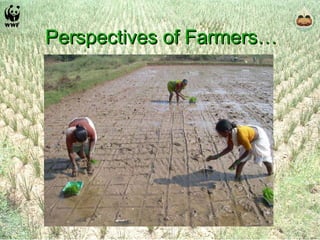
Perspectives of Farmers…
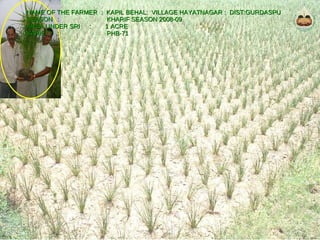
NAME OF THE FARMER  :  KAPIL BEHAL:  VILLAGE HAYATNAGAR :  DIST:GURDASPU SEASON :  KHARIF SEASON 2008-09 AREA UNDER SRI :  1 ACRE VARIETY :  PHB-71
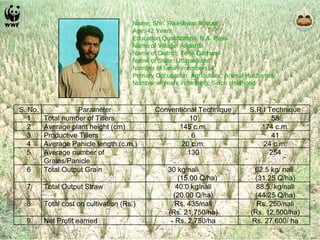
Name: Shri. Rikeshwar Prasad Age: 42 Years Education Qualification: B.A. Pass. Name of Village: Andarthi Name of District: Tehri Garhwal Name of State: Uttarakhand Number of family members: 4 Primary Occupation: Agriculture, Animal Husbandry  Number of years in farming: Since childhood S. No. Parameter Conventional Technique S.R.I Technique 1 Total number of Tillers 10 58 2 Average plant height (cm) 145 c.m. 174 c.m . 3 Productive Tillers 6 41 4 Average Panicle length (c.m.) 20 c.m. 24 c.m. 5 Average number of Grains/Panicle  130 254 6 Total Output Grain  30 kg/nali  (15.00 Q/ha) 62.5 kg/ nali  (31.25 Q/ha) 7 Total Output Straw  40.0 kg/nali (20.00 Q/ha) 88.5. kg/nali (44.25 Q/ha) 8 Total cost on cultivation (Rs.) Rs. 435/nali (Rs. 21,750/ha) Rs. 250/nali (Rs. 12,500/ha) 9 Net Profit earned - Rs. 2,750/ha Rs. 27,600/ ha
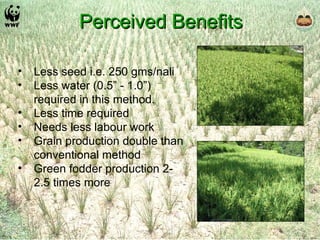
Perceived Benefits Less seed i.e. 250 gms/nali Less water (0.5” - 1.0”)  required in this method.  Less time required Needs less labour work Grain production double than conventional method Green fodder production 2- 2.5 times more
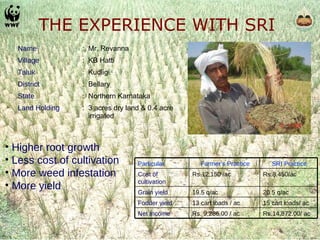
THE EXPERIENCE WITH SRI Higher root growth Less cost of cultivation More weed infestation More yield Name    :   Mr. Revanna  Village   :   KB Hatti  Taluk  :   Kudligi  District    :   Bellary  State  :   Northern Karnataka Land Holding   :   3 acres dry land & 0.4 acre    irrigated Particular Farmer’s Practice SRI Practice Cost of cultivation Rs.12,150 /ac Rs.8,450/ac Grain yield 19.5 q/ac 20.5 q/ac Fodder yield 13 cart loads / ac 15 cart loads/ ac Net Income Rs. 9,286.00 / ac Rs.14,872.00/ ac
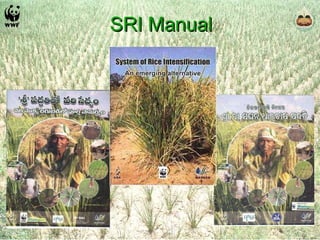
SRI Manual
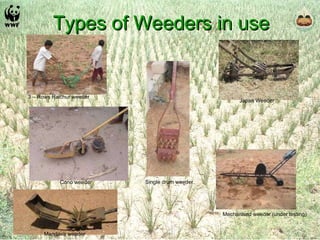
Types of Weeders in use Mechanised weeder (under testing) Japan Weeder Single drum weeder Cono weeder Mandava weeder 3 – Rows Raichur weeder
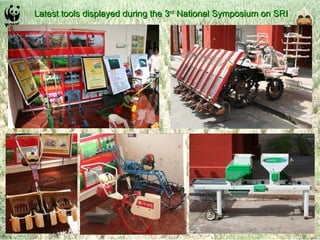
Latest tools displayed during the 3 rd  National Symposium on SRI
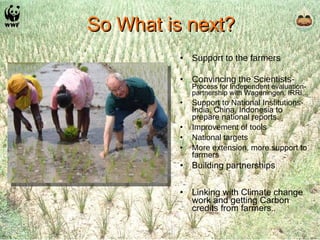
So What is next? Support to the farmers Convincing the Scientists-   Process for Independent evaluation- partnership with Wageningen, IRRI,.. Support to National Institutions-  India, China, Indonesia to prepare national reports. Improvement of tools National targets More extension , more support to farmers Building partnerships Linking with Climate change work and getting Carbon credits from farmers ..
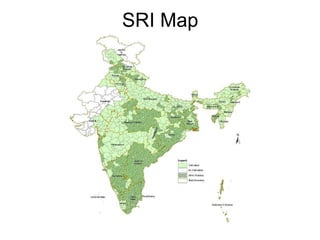
SRI Map
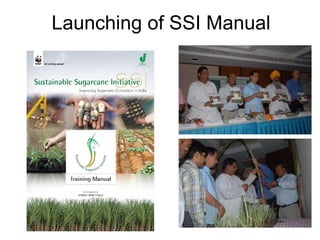
Launching of SSI Manual
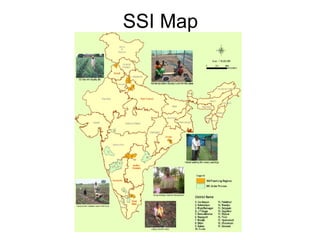
SSI Map
conclusions... It is possible to produce more with less. SRI kind of approaches re-emphaised the need for doing agriculture differently Farmers have accepted and embraced these methods and experimenting with other corps Institutions have to follow what is going on in the real world. 44

Perspectives on SRI: Biksham Gujja

  • 1.
    Perspectives on SRIFor IDS sri meeting 17 th December 2009
  • 2.
    WWF's MISSION ISTO STOP THE DEGRADATION OF THE PLANET'S NATURAL ENVIRONMENT AND TO BUILD A FUTURE IN WHICH HUMANS LIVE IN HARMONY WITH NATURE , BY: Conserving the world's biological diversity Ensuring that the use of renewable natural resources is sustainable Promoting the reduction of pollution and wasteful consumption
  • 3.
    Food is back on the table, front pages, streets. Onto global agenda.. Rice is in the Centre of it. Food Prices are going up Grain as Fuel Grain to animal feed Changing food habits Shifting economic power Panic in the Cereal market
  • 4.
  • 5.
  • 6.
  • 7.
    Big issues.. Water,Food, Ecosystems interrelated and interdependent Climate Change is further complicating the situation and changing every other issue...
  • 8.
    Food crisis means even more water crisis… Rice cultivation Demands more water Need to produce more rice with less water…
  • 9.
    A water scarcitycrisis: 54% diverted for human use 70% agriculture 20% industry 10% urban use Eradicating malnutrition by 2025, with current productivity, requires additional diversions “ close to all the water withdrawals at present ” (IMWI & SIWI). WWF LPR 2002
  • 10.
    Water Availability: 1975Water Availability: 2025 Extreme Scarcity <500 Scarcity 500-1,000 Stress 1,000-1,700 Adequate 1,700-4,000 Abundant 4,000-10,000 Surplus >10,000 Ocean/ Inland Water No Data m 3 /person/year
  • 11.
    Crop water useSo, we eat, wear, drink.. water… = 1kg 1,500 - 3,000 litres water = 1kg 3,000- 5,000 litres water = 1kg 3,000 – 5,000 litres water
  • 12.
    Water is theissue in India and going to be even more so.. Water use (Unit: BCM) Source: *NCIWRDP, 1999a, #Planning Commission 2007 and  NCIWRDP Vol.1, 1999 precipitation * 4,000 annual water resource after runoff, evaporation etc. * 1,953 usable water * 1086 water use in 2000 # 634 irrigation in 2000 542 Total per capita water use 600 cu.m water use in 2050 973- 1,180 irrigation in 2050 628 Total estimated need per person in 2050 (agriculture) 500 cu.m Total estimated need per person in 2050 (domestic) 70 cu.m
  • 13.
    Water issue contd..2000 - irrigation - 85 % of the total Additional 339 to 546 BCM of water By 2050, irrigation may need 65% more.. So is there a water?- what are the implications?? Cost, ecosystems?? How climate change is going to impact on it?
  • 14.
    India’s Water StorageCapacity and Future Need Now 81 major reservoirs have a full capacity of 152. BCM By 2050- projected- 381 BCM For this 120 major dams!! Lot of money!!, displacement!! Implications to other drylands?
  • 15.
    Solution …?? Governmentinvestments may be exacerbating the problem ? Ecosystem impacts River basins are shared by more than one state Basin level approach is difficult with existing legal frame work Focus on sub-basins within one state may be next best So looked at the options in Maner
  • 16.
    Searching for solutions..Some initiatives from the project Restoring traditional water infrastructure- Maner sub basin, Godavari basin Cost benefits of Major structures- Polavaram. Establishing dialogues on national issues- Interlinking of rivers. Improving water productivity- SRI, SSI
  • 17.
  • 18.
    ‘ Green revolution’is based on one thing.. More ( to get more ) Farmer need to give more (inputs, water, seeds,…) to get more (production). After 5 decades Giving more has become so much more, farmer, Governments nor ecosystem able to give any more.. That is the crisis in agriculture.. ‘More crisis’.
  • 19.
    Answer to ‘Morecrisis’ is Even more technology, inputs, money.. Bio tech GMs High tech irrigation Industrial agriculture In the process thinking is to focus on more complicated more expensive solutions. Gates is putting some $500 million? to ag research to find solutions ( ‘more’ problem)
  • 20.
    ‘ More withless’ is major challenge It is conceptual challenge almost negating everything we thought is modern agriculture. It is management challenge What will (we) experts do?- livelihoods? It is an economic challenge.. Fertilisers, pesticides, companies, dams..
  • 21.
    SRI: Back tobasics.. It is about productivity of land, labour, water.. There are limits, costs and trade-offs to all of it. It is not how much you produce- how, with what, for what and how long.. etc. It is about choice for farmers, consumers It is about reducing our foot print- less water use, less pollution, less impact..
  • 22.
    Perspectives on SRI..SRI: Less with More.. 1. Less water requirement 2. Less seed 3. Lesser chemical inputs 4. Soil health improvement through biological activity 5. Reduced duration (by 10 days) 6. Higher yields – Both grain and straw and more… SRI is neither a new variety nor a hybrid… it is a method of rice cultivation
  • 23.
    December 2, 2009India could be a new pole of global growth: World Bank president Robert Zoellick Everyone cites India’s Green Revolution. But I’m even more intrigued by what is known as SRI, or system of rice intensification, and I know this is also an area of interest for PM Manmohan Singh. Using smart water management and planting practices , farmers in Tamil Nadu have increased rice yields between 30 and 80 per cent, reduced water use by 30 per cent, and now require significantly less fertilizer. This emerging technology not only addresses food security but also the water scarcity challenge that climate change is making all the more dangerous . These are all lessons for our world.
  • 24.
    SRI like practice100 years ago Single seedling planting, row planting, wider spacing , intercultivation were practiced a century ago in India Visit : www.sri-india.net (SRI Newsletter 6)
  • 25.
    … In Madras, 120,000 copies of a leaflet on the single-seedling planting of paddy have been issued … the leaflets circulated in that Presidency, as in other provinces, are of little real value, unless they are issued in connection with a definite demonstration of their subject matter. The results of leaflets advocating the single-seedling planting of paddy are likely to prove very disappointing, unless the cultivators to whom they are given are provided with ample opportunities of seeing for themselves the advantages arising from the adoption of this practice … (pages 154-155). Single seedling planting promoted in 1928 ….. Madan, J.A., and F.W.H. Smith. 1928. Royal Commission on Agriculture in India . Government Central Press. Bombay. 754p.
  • 26.
  • 27.
  • 28.
    benefits of asmaller nursery, low seed rate, very low cost for removing seedlings, labour saving and water saving were appealing to farmers to adopt SRI Impact of IAMWARM project in Hosur area, Tamil Nadu
  • 29.
    Grain yields jumpedfrom 4200 - 6000 kg/ha under conventional transplanting to 5800 - 13600 kg/ ha under SRI
  • 30.
    Sinclair’s (IRRI) wrongperception on SRI-1 A Tamil Nadu farmer showing a single plant (hill) with more than 100 panicles, grown with single-seedling planting at 25x25 cm spacing. SRI suffers from poor light interception because of low plant densities
  • 31.
    Sinclair’s wrong perceptionon SRI-2 little is known about the physiology of rice when it is grown under conditions of low plant density and shallow irrigation with alternate wetting-and-drying, plus soil-aerating intercultivation with mechanical hand weeders SRI farmer’s field without flood water ‘ ample’ water maximizes rice yields whereas SRI replaces paddy flooding by simply maintaining “moist” soil conditions
  • 32.
    Sinclair’s wrong perceptionon SRI-3 SRI emphasizes organic fertilization in preference to mineral fertilizer. Many SRI farmers are adopting integrated nutrient management SRI emphasizes organic nutrients to the exclusion of mineral fertilizer
  • 33.
  • 34.
    NAME OF THEFARMER : KAPIL BEHAL: VILLAGE HAYATNAGAR : DIST:GURDASPU SEASON : KHARIF SEASON 2008-09 AREA UNDER SRI : 1 ACRE VARIETY : PHB-71
  • 35.
    Name: Shri. RikeshwarPrasad Age: 42 Years Education Qualification: B.A. Pass. Name of Village: Andarthi Name of District: Tehri Garhwal Name of State: Uttarakhand Number of family members: 4 Primary Occupation: Agriculture, Animal Husbandry Number of years in farming: Since childhood S. No. Parameter Conventional Technique S.R.I Technique 1 Total number of Tillers 10 58 2 Average plant height (cm) 145 c.m. 174 c.m . 3 Productive Tillers 6 41 4 Average Panicle length (c.m.) 20 c.m. 24 c.m. 5 Average number of Grains/Panicle 130 254 6 Total Output Grain 30 kg/nali (15.00 Q/ha) 62.5 kg/ nali (31.25 Q/ha) 7 Total Output Straw 40.0 kg/nali (20.00 Q/ha) 88.5. kg/nali (44.25 Q/ha) 8 Total cost on cultivation (Rs.) Rs. 435/nali (Rs. 21,750/ha) Rs. 250/nali (Rs. 12,500/ha) 9 Net Profit earned - Rs. 2,750/ha Rs. 27,600/ ha
  • 36.
    Perceived Benefits Lessseed i.e. 250 gms/nali Less water (0.5” - 1.0”) required in this method. Less time required Needs less labour work Grain production double than conventional method Green fodder production 2- 2.5 times more
  • 37.
    THE EXPERIENCE WITHSRI Higher root growth Less cost of cultivation More weed infestation More yield Name : Mr. Revanna Village : KB Hatti Taluk : Kudligi District : Bellary State : Northern Karnataka Land Holding : 3 acres dry land & 0.4 acre irrigated Particular Farmer’s Practice SRI Practice Cost of cultivation Rs.12,150 /ac Rs.8,450/ac Grain yield 19.5 q/ac 20.5 q/ac Fodder yield 13 cart loads / ac 15 cart loads/ ac Net Income Rs. 9,286.00 / ac Rs.14,872.00/ ac
  • 38.
  • 39.
    Types of Weedersin use Mechanised weeder (under testing) Japan Weeder Single drum weeder Cono weeder Mandava weeder 3 – Rows Raichur weeder
  • 40.
    Latest tools displayedduring the 3 rd National Symposium on SRI
  • 41.
    So What isnext? Support to the farmers Convincing the Scientists- Process for Independent evaluation- partnership with Wageningen, IRRI,.. Support to National Institutions- India, China, Indonesia to prepare national reports. Improvement of tools National targets More extension , more support to farmers Building partnerships Linking with Climate change work and getting Carbon credits from farmers ..
  • 42.
  • 43.
  • 44.
  • 45.
    conclusions... It ispossible to produce more with less. SRI kind of approaches re-emphaised the need for doing agriculture differently Farmers have accepted and embraced these methods and experimenting with other corps Institutions have to follow what is going on in the real world. 44

Editor's Notes

  • #10 54% of accessible freshwater is currently diverted for human use (UN WWAP 2003). Of the diverted water, globally around 70% is used for agriculture (which is why it is the focus of WWF’s water demand management work), 20% by industry and 10% for domestic use. The quote comes from the 2004 report of the Stockholm and International Water Management Institutes. It highlights the imminent threat to the survival of many freshwater ecosystems if water productivity is not dramatically improved in agriculture.
  • #11 Sub-national Map But, just as “all politics are local” -- all water is local. National averages obscure important regional differences And if you look at the sub-national map of water scarcity you see an even more serious challenge today.