
Effective
Safety Supervision
Welcome!
Goals
1. Describe and discuss why enforcing policies is the
supervisors job
2. Define "adequate supervision" and describe how supervisors
can meet this requirement
Goals
3. Describe supervisor responsibilities for holding employees
accountable
4. Discuss tools for employee motivation
What leadership is NOT
Not power -
•Power derives from status, money, ability to harm,
access to media, control materials, etc.
•Thug who sticks a gun in your back has “power” but
not leadership
The nature of leadership
What leadership is NOT
Not status -
• Status or position may enhance the opportunity for leadership
• Some in with high status or position haven’t a clue how to lead
Not authority -
• Person may have subordinates, but not followers
• People will follow only if person acts as a leader
What leadership is NOT
Not management -
• Management is an organizational skill
• Managers preside over processes, functions, programs
Leadership is not common sense -
• Common sense - What is it? How do we develop it?
• Good sense is individual. Common sense would result in
common leadership styles.
Define Leadership
Leader Style
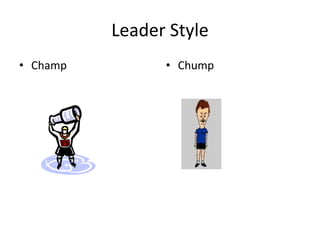
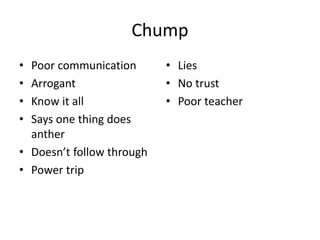
• Champ • Chump
Chump
• Poor communication
• Arrogant
• Know it all
• Says one thing does
anther
• Doesn’t follow through
• Power trip
• Lies
• No trust
• Poor teacher
Champ
• Communicates well
• Sets example
• Approachable
• Teaches
• Consistent
• Sets expectations
• Honest
• Builds trust
• Has your back
GOLDEN RULE
• Treat others the way you want to be treated
Platinum Rule
• Treat people the way they want to be treated
– The key is understanding….
Why did you go after a leadership
position?
What do you think some of the lost
luxuries you lose as a leader?
Lost “Luxuries”
• Thinking mostly of
yourself
• Acting on feelings
• Whining
• Not listening
• Taking sides
• Emotions on sleeve
• Closing your eyes
Gripes go UP
• Movie Clip
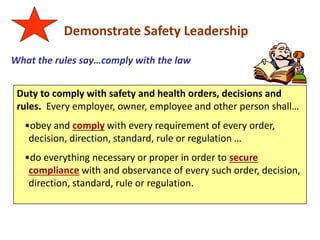
Demonstrate Safety Leadership
What the rules say…comply with the law
Duty to comply with safety and health orders, decisions and
rules. Every employer, owner, employee and other person shall…
•obey and comply with every requirement of every order,
decision, direction, standard, rule or regulation …
•do everything necessary or proper in order to secure
compliance with and observance of every such order, decision,
direction, standard, rule or regulation.
What is the employer’s primary responsibility?
What does “secure compliance” mean in the rule?
Why does the employer have a greater responsibility
than the employee?
Any supervisors or persons in charge of work are held to be the
agents of the employer in the discharge of their authorized duties,
and are at all times responsible for:
(A) The execution in a safe manner of the work under their
supervision; and
(B) The safe conduct of their crew while under their
supervision; and
(C) The safety of all workers under their supervision.
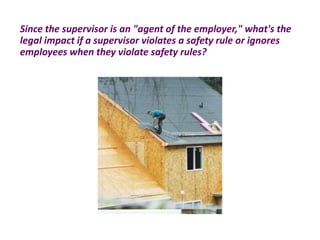
Since the supervisor is an "agent of the employer," what's the
legal impact if a supervisor violates a safety rule or ignores
employees when they violate safety rules?
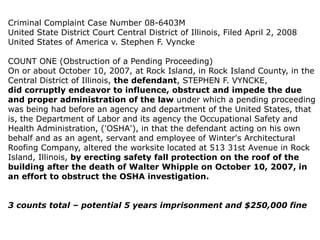
Criminal Complaint Case Number 08-6403M
United State District Court Central District of Illinois, Filed April 2, 2008
United States of America v. Stephen F. Vyncke
COUNT ONE (Obstruction of a Pending Proceeding)
On or about October 10, 2007, at Rock Island, in Rock Island County, in the
Central District of Illinois, the defendant, STEPHEN F. VYNCKE,
did corruptly endeavor to influence, obstruct and impede the due
and proper administration of the law under which a pending proceeding
was being had before an agency and department of the United States, that
is, the Department of Labor and its agency the Occupational Safety and
Health Administration, ('OSHA'), in that the defendant acting on his own
behalf and as an agent, servant and employee of Winter's Architectural
Roofing Company, altered the worksite located at 513 31st Avenue in Rock
Island, Illinois, by erecting safety fall protection on the roof of the
building after the death of Walter Whipple on October 10, 2007, in
an effort to obstruct the OSHA investigation.
3 counts total – potential 5 years imprisonment and $250,000 fine
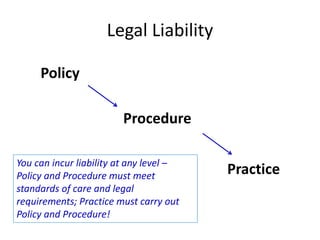
Legal Liability
Policy
Procedure
PracticeYou can incur liability at any level –
Policy and Procedure must meet
standards of care and legal
requirements; Practice must carry out
Policy and Procedure!
Leaders understand cause and effect
• If you want employees who care about their
work…demonstrate care for employees.
• If you want honest and fair employee behavior..treat
employees with honesty and fairness.
• If you want selfless performance… be selfless.
• If you want loyalty… be loyal.
If a supervisor wants to increase employee trust, what must he or
she do?
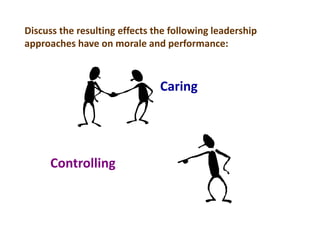
Discuss the resulting effects the following leadership
approaches have on morale and performance:
Caring
Controlling
• People follow because of who you are and
What’s your leadership
style?
Which leadership style the construction supervisor should
use often depends on the willingness of the crew to follow
your lead.
The crew also has to demonstrate that they have the ability
to perform what you ask.
When you choose a leadership style you also are
determining how you will facilitate and coordinate
information
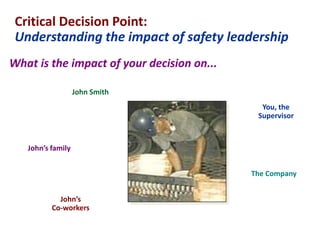
John Smith
John’s
Co-workers
John’s family
You, the
Supervisor
The Company
Critical Decision Point:
Understanding the impact of safety leadership
What is the impact of your decision on...
Employers to furnish safe place of employment. Every employer
shall…
• furnish employment and a place of employment …
• adopt and use such practices, means, methods, operations
and processes …
• do every other thing reasonably necessary …
Provide Resources and Support
What the rules say…provide resources
Let's take a closer look at what's being
said here:
• "employment"
• "place of employment"
• "safe and healthful"
• "devices and safeguards …
• "practices, means, methods, operations,
processes"
• "reasonably necessary"
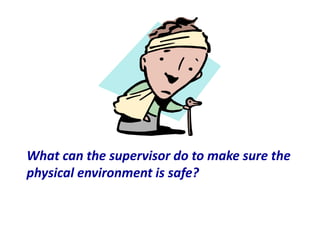
What can the supervisor do to make sure the
physical environment is safe?
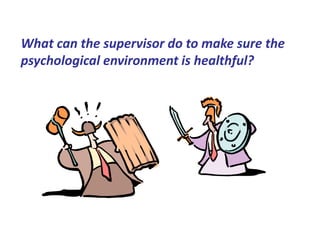
What can the supervisor do to make sure the
psychological environment is healthful?
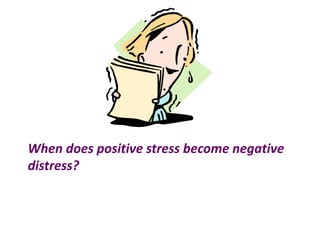
When does positive stress become negative
distress?
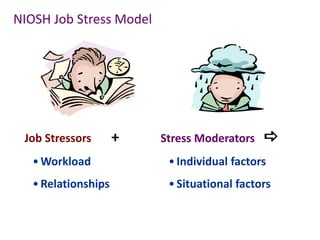
Job Stressors +
•Workload
•Relationships
Stress Moderators a
•Individual factors
•Situational factors
NIOSH Job Stress Model
Provide Effective Safety Training
The employer shall see that workers are properly instructed and
supervised in the safe operation of any machinery, tools,
equipment, process, or practice which they are authorized to use
or apply...
What the rules say…instruct…train…educate
What is safety education?
• Generally, the “why” in safety - describes the consequences
of performance
• Natural consequences = explains the resulting hurt/health
that occurs automatically as a result of our actions
• System consequences = explains the organizational
punishment/reward that may or may not occur as a result of
our actions
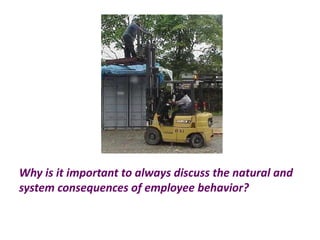
Why is it important to always discuss the natural and
system consequences of employee behavior?
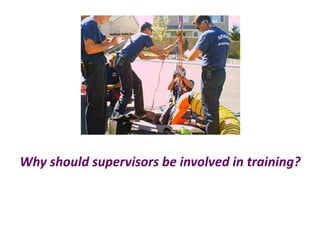
Why should supervisors be involved in training?
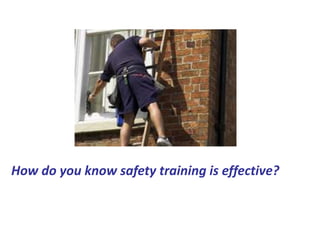
How do you know safety training is effective?
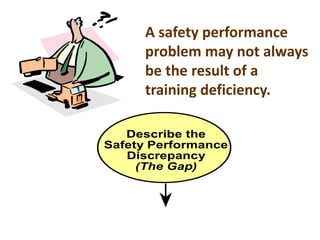
A safety performance
problem may not always
be the result of a
training deficiency.
Describe the
Safety Performance
Discrepancy
(The Gap)
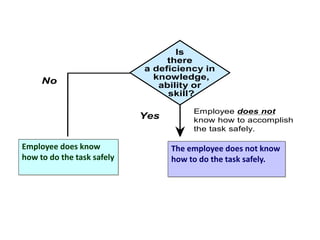
Discrepancy
(The Gap)
Is
there
a deficiency in
knowledge,
ability or
skill?
Has the
employee
performed task
before?
Is the task
accomplishe
often?
Im
Pe
No
NoNo
Employee does not
know how to accomplish
the task safely.
Yes
now
h the
Are
inte
to p
in t
Yes
The employee does not know
how to do the task safely.
Employee does know
how to do the task safely
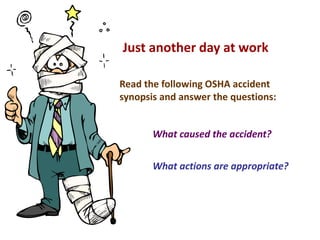
What caused the accident?
What actions are appropriate?
Just another day at work
Read the following OSHA accident
synopsis and answer the questions:
Duty to comply with safety and health orders, decisions and
rules. Every employer, owner, employee and other person shall…
do everything necessary or proper in order to secure compliance
with and observance of every such order, decision, direction,
standard, rule or regulation.
Insist on safe performance
What the rule says…secure, enforce,
require…
Rules for all Workplaces.
(1) Employers’ Responsibilities… (b) The employer shall take all
reasonable means to require employees to…
(2) Employees’ Responsibilities
(a) Employees shall conduct their work in compliance with
the safety rules contained in this code.
(b) All injuries shall be reported immediately to the person in
charge or other responsible representative of the employer.
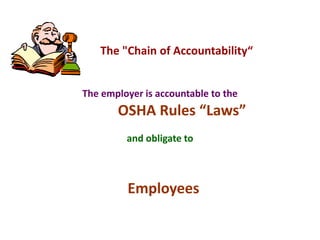
The "Chain of Accountability“
The employer is accountable to the
and obligate to
OSHA Rules “Laws”
Employees
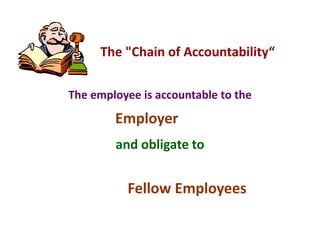
The "Chain of Accountability“
The employee is accountable to the
and obligate to
Employer
Fellow Employees
Want Good Information?
Show Them The LOVE!!
• Accident reporting/investigation should not
be a negative experience
• Your attitude in responding to an accident
report is critical
• Never
– Question the validity of injuries
– Belittle employee behavior/actions
– Discuss write-ups/discipline
How to get desired performance
Challenging Conversations
As a Leader you owe…
• You owe your organization
• You owe it to your team members
• You owe it to yourself
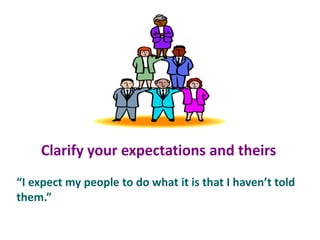
Clarify your expectations and theirs
“I expect my people to do what it is that I haven’t told
them.”
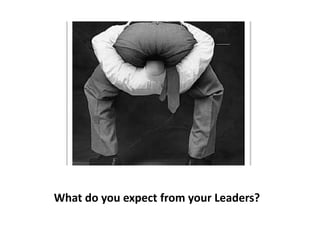
What do you expect from your Leaders?
So how do we deal with problems?
• Check yourself
• Be discreet
• Be specific
• Be positive
Case Studies!!!
• Let’s look at the 4 cases…….
Difficult conversation
1. Be clear about why you are having the
conversation.
2. Be specific. Uncomfortable is okay.
3. Describe what you know.
Difficult conversation
4. Ask for the other side of the story.
5. Explain the way that you feel about the
situation.
6. Provide a course of action
Difficult conversation
7. Describe the consequences.
8. Provide a timeline for changes.
9. Schedule a follow up conversation.
Positive Reinforcement.
When effective, positive reinforcement increase mandatory
and discretionary behavior.
• Employee performs to receive the consequence
• Employee may perform far beyond minimum standards
• Focus is on excellence - success based
What do employees think?
 “If I report a hazard, I will be recognized.”
 “If I make a suggestion that saves us some money, I
will be rewarded.”
Positive Reinforcement
• “I will do more of _____ to get _______.”
• “Reward” must be something they want
• If it does not increase the desired behavior, it’s
not reinforcing
Negative Reinforcement.
When effective, negative reinforcement increases required
behaviors only.
• Employee performs to avoid the consequence - fear based
• Employee performs to minimum standard - just enough to
get by
• Focus is on compliance
What do employees think?
 “If I wear that eye protection, I won’t get
injured.”
 “If I comply with safety rules, I won’t
be disciplined.”
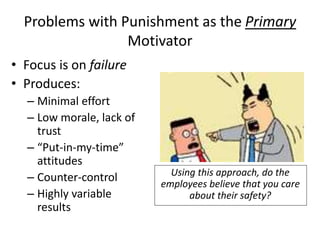
Problems with Punishment as the Primary
Motivator
• Focus is on failure
• Produces:
– Minimal effort
– Low morale, lack of
trust
– “Put-in-my-time”
attitudes
– Counter-control
– Highly variable
results
Using this approach, do the
employees believe that you care
about their safety?
Extinction –
Withholding positive recognition of desired behaviors.
Results in the extinction of desired behaviors.
• No expectation positive consequences
• Employee is ignored - may be perceived as positive or
negative reinforcement
• Initially, the employee will work harder - then gives up
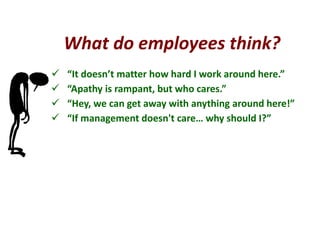
What do employees think?
 “It doesn’t matter how hard I work around here.”
 “Apathy is rampant, but who cares.”
 “Hey, we can get away with anything around here!”
 “If management doesn't care… why should I?”
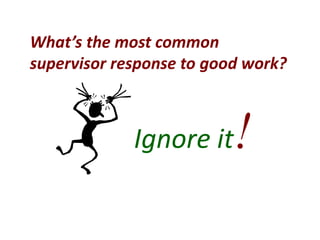
What’s the most common
supervisor response to good work?
Ignore it!
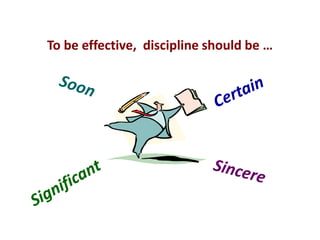
To be effective, discipline should be …
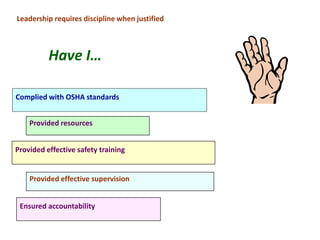
Complied with OSHA standards
Ensured accountability
Provided effective supervision
Provided effective safety training
Provided resources
Leadership requires discipline when justified
Have I…
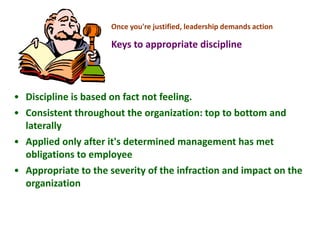
Once you're justified, leadership demands action
Keys to appropriate discipline
• Discipline is based on fact not feeling.
• Consistent throughout the organization: top to bottom and
laterally
• Applied only after it's determined management has met
obligations to employee
• Appropriate to the severity of the infraction and impact on the
organization
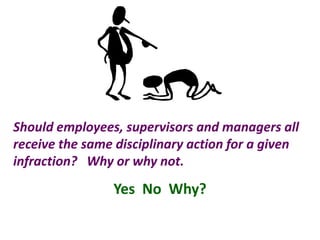
Should employees, supervisors and managers all
receive the same disciplinary action for a given
infraction? Why or why not.
Yes No Why?
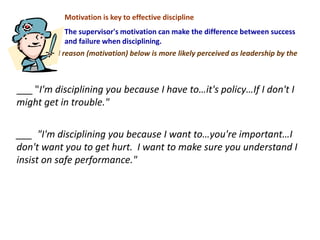
Motivation is key to effective discipline
The supervisor's motivation can make the difference between success
and failure when disciplining.
Which stated reason (motivation) below is more likely perceived as leadership by the
employee?
___ "I'm disciplining you because I have to…it's policy…If I don't I
might get in trouble."
___ "I'm disciplining you because I want to…you're important…I
don't want you to get hurt. I want to make sure you understand I
insist on safe performance."
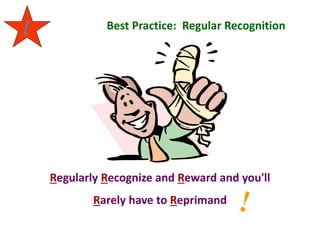
Best Practice: Regular Recognition
Regularly Recognize and Reward and you'll
Rarely have to Reprimand
!
!
What are appropriate safety behaviors to recognize?
________________ with safety rules
________________ injuries
________________ hazards
________________ other employees
Comply
report
report
warn
What's the most common safety
behavior actually rewarded?
Let's Review

sdsc leadership training working

  • 1.
  • 2.
    Goals 1. Describe anddiscuss why enforcing policies is the supervisors job 2. Define "adequate supervision" and describe how supervisors can meet this requirement
  • 3.
    Goals 3. Describe supervisorresponsibilities for holding employees accountable 4. Discuss tools for employee motivation
  • 4.
    What leadership isNOT Not power - •Power derives from status, money, ability to harm, access to media, control materials, etc. •Thug who sticks a gun in your back has “power” but not leadership The nature of leadership
  • 5.
    What leadership isNOT Not status - • Status or position may enhance the opportunity for leadership • Some in with high status or position haven’t a clue how to lead Not authority - • Person may have subordinates, but not followers • People will follow only if person acts as a leader
  • 6.
    What leadership isNOT Not management - • Management is an organizational skill • Managers preside over processes, functions, programs Leadership is not common sense - • Common sense - What is it? How do we develop it? • Good sense is individual. Common sense would result in common leadership styles.
  • 7.
  • 8.
  • 9.
    Chump • Poor communication •Arrogant • Know it all • Says one thing does anther • Doesn’t follow through • Power trip • Lies • No trust • Poor teacher
  • 10.
    Champ • Communicates well •Sets example • Approachable • Teaches • Consistent • Sets expectations • Honest • Builds trust • Has your back
  • 11.
    GOLDEN RULE • Treatothers the way you want to be treated
  • 12.
    Platinum Rule • Treatpeople the way they want to be treated – The key is understanding….
  • 13.
    Why did yougo after a leadership position?
  • 14.
    What do youthink some of the lost luxuries you lose as a leader?
  • 15.
    Lost “Luxuries” • Thinkingmostly of yourself • Acting on feelings • Whining • Not listening • Taking sides • Emotions on sleeve • Closing your eyes
  • 16.
    Gripes go UP •Movie Clip
  • 17.
    Demonstrate Safety Leadership Whatthe rules say…comply with the law Duty to comply with safety and health orders, decisions and rules. Every employer, owner, employee and other person shall… •obey and comply with every requirement of every order, decision, direction, standard, rule or regulation … •do everything necessary or proper in order to secure compliance with and observance of every such order, decision, direction, standard, rule or regulation.
  • 18.
    What is theemployer’s primary responsibility? What does “secure compliance” mean in the rule? Why does the employer have a greater responsibility than the employee?
  • 19.
    Any supervisors orpersons in charge of work are held to be the agents of the employer in the discharge of their authorized duties, and are at all times responsible for: (A) The execution in a safe manner of the work under their supervision; and (B) The safe conduct of their crew while under their supervision; and (C) The safety of all workers under their supervision.
  • 20.
    Since the supervisoris an "agent of the employer," what's the legal impact if a supervisor violates a safety rule or ignores employees when they violate safety rules?
  • 22.
    Criminal Complaint CaseNumber 08-6403M United State District Court Central District of Illinois, Filed April 2, 2008 United States of America v. Stephen F. Vyncke COUNT ONE (Obstruction of a Pending Proceeding) On or about October 10, 2007, at Rock Island, in Rock Island County, in the Central District of Illinois, the defendant, STEPHEN F. VYNCKE, did corruptly endeavor to influence, obstruct and impede the due and proper administration of the law under which a pending proceeding was being had before an agency and department of the United States, that is, the Department of Labor and its agency the Occupational Safety and Health Administration, ('OSHA'), in that the defendant acting on his own behalf and as an agent, servant and employee of Winter's Architectural Roofing Company, altered the worksite located at 513 31st Avenue in Rock Island, Illinois, by erecting safety fall protection on the roof of the building after the death of Walter Whipple on October 10, 2007, in an effort to obstruct the OSHA investigation. 3 counts total – potential 5 years imprisonment and $250,000 fine
  • 23.
    Legal Liability Policy Procedure PracticeYou canincur liability at any level – Policy and Procedure must meet standards of care and legal requirements; Practice must carry out Policy and Procedure!
  • 24.
    Leaders understand causeand effect • If you want employees who care about their work…demonstrate care for employees. • If you want honest and fair employee behavior..treat employees with honesty and fairness. • If you want selfless performance… be selfless. • If you want loyalty… be loyal. If a supervisor wants to increase employee trust, what must he or she do?
  • 25.
    Discuss the resultingeffects the following leadership approaches have on morale and performance: Caring Controlling
  • 26.
    • People followbecause of who you are and What’s your leadership style? Which leadership style the construction supervisor should use often depends on the willingness of the crew to follow your lead. The crew also has to demonstrate that they have the ability to perform what you ask. When you choose a leadership style you also are determining how you will facilitate and coordinate information
  • 27.
    John Smith John’s Co-workers John’s family You,the Supervisor The Company Critical Decision Point: Understanding the impact of safety leadership What is the impact of your decision on...
  • 28.
    Employers to furnishsafe place of employment. Every employer shall… • furnish employment and a place of employment … • adopt and use such practices, means, methods, operations and processes … • do every other thing reasonably necessary … Provide Resources and Support What the rules say…provide resources
  • 29.
    Let's take acloser look at what's being said here: • "employment" • "place of employment" • "safe and healthful" • "devices and safeguards … • "practices, means, methods, operations, processes" • "reasonably necessary"
  • 30.
    What can thesupervisor do to make sure the physical environment is safe?
  • 31.
    What can thesupervisor do to make sure the psychological environment is healthful?
  • 32.
    When does positivestress become negative distress?
  • 33.
    Job Stressors + •Workload •Relationships StressModerators a •Individual factors •Situational factors NIOSH Job Stress Model
  • 34.
    Provide Effective SafetyTraining The employer shall see that workers are properly instructed and supervised in the safe operation of any machinery, tools, equipment, process, or practice which they are authorized to use or apply... What the rules say…instruct…train…educate
  • 35.
    What is safetyeducation? • Generally, the “why” in safety - describes the consequences of performance • Natural consequences = explains the resulting hurt/health that occurs automatically as a result of our actions • System consequences = explains the organizational punishment/reward that may or may not occur as a result of our actions
  • 36.
    Why is itimportant to always discuss the natural and system consequences of employee behavior?
  • 37.
    Why should supervisorsbe involved in training?
  • 38.
    How do youknow safety training is effective?
  • 39.
    A safety performance problemmay not always be the result of a training deficiency. Describe the Safety Performance Discrepancy (The Gap)
  • 40.
    Discrepancy (The Gap) Is there a deficiencyin knowledge, ability or skill? Has the employee performed task before? Is the task accomplishe often? Im Pe No NoNo Employee does not know how to accomplish the task safely. Yes now h the Are inte to p in t Yes The employee does not know how to do the task safely. Employee does know how to do the task safely
  • 41.
    What caused theaccident? What actions are appropriate? Just another day at work Read the following OSHA accident synopsis and answer the questions:
  • 42.
    Duty to complywith safety and health orders, decisions and rules. Every employer, owner, employee and other person shall… do everything necessary or proper in order to secure compliance with and observance of every such order, decision, direction, standard, rule or regulation. Insist on safe performance What the rule says…secure, enforce, require…
  • 43.
    Rules for allWorkplaces. (1) Employers’ Responsibilities… (b) The employer shall take all reasonable means to require employees to… (2) Employees’ Responsibilities (a) Employees shall conduct their work in compliance with the safety rules contained in this code. (b) All injuries shall be reported immediately to the person in charge or other responsible representative of the employer.
  • 44.
    The "Chain ofAccountability“ The employer is accountable to the and obligate to OSHA Rules “Laws” Employees
  • 45.
    The "Chain ofAccountability“ The employee is accountable to the and obligate to Employer Fellow Employees
  • 46.
    Want Good Information? ShowThem The LOVE!! • Accident reporting/investigation should not be a negative experience • Your attitude in responding to an accident report is critical • Never – Question the validity of injuries – Belittle employee behavior/actions – Discuss write-ups/discipline
  • 47.
    How to getdesired performance Challenging Conversations
  • 48.
    As a Leaderyou owe… • You owe your organization • You owe it to your team members • You owe it to yourself
  • 49.
    Clarify your expectationsand theirs “I expect my people to do what it is that I haven’t told them.”
  • 50.
    What do youexpect from your Leaders?
  • 51.
    So how dowe deal with problems? • Check yourself • Be discreet • Be specific • Be positive
  • 52.
    Case Studies!!! • Let’slook at the 4 cases…….
  • 53.
    Difficult conversation 1. Beclear about why you are having the conversation. 2. Be specific. Uncomfortable is okay. 3. Describe what you know.
  • 54.
    Difficult conversation 4. Askfor the other side of the story. 5. Explain the way that you feel about the situation. 6. Provide a course of action
  • 55.
    Difficult conversation 7. Describethe consequences. 8. Provide a timeline for changes. 9. Schedule a follow up conversation.
  • 56.
    Positive Reinforcement. When effective,positive reinforcement increase mandatory and discretionary behavior. • Employee performs to receive the consequence • Employee may perform far beyond minimum standards • Focus is on excellence - success based
  • 57.
    What do employeesthink?  “If I report a hazard, I will be recognized.”  “If I make a suggestion that saves us some money, I will be rewarded.”
  • 58.
    Positive Reinforcement • “Iwill do more of _____ to get _______.” • “Reward” must be something they want • If it does not increase the desired behavior, it’s not reinforcing
  • 59.
    Negative Reinforcement. When effective,negative reinforcement increases required behaviors only. • Employee performs to avoid the consequence - fear based • Employee performs to minimum standard - just enough to get by • Focus is on compliance
  • 60.
    What do employeesthink?  “If I wear that eye protection, I won’t get injured.”  “If I comply with safety rules, I won’t be disciplined.”
  • 61.
    Problems with Punishmentas the Primary Motivator • Focus is on failure • Produces: – Minimal effort – Low morale, lack of trust – “Put-in-my-time” attitudes – Counter-control – Highly variable results Using this approach, do the employees believe that you care about their safety?
  • 62.
    Extinction – Withholding positiverecognition of desired behaviors. Results in the extinction of desired behaviors. • No expectation positive consequences • Employee is ignored - may be perceived as positive or negative reinforcement • Initially, the employee will work harder - then gives up
  • 63.
    What do employeesthink?  “It doesn’t matter how hard I work around here.”  “Apathy is rampant, but who cares.”  “Hey, we can get away with anything around here!”  “If management doesn't care… why should I?”
  • 64.
    What’s the mostcommon supervisor response to good work? Ignore it!
  • 65.
    To be effective,discipline should be …
  • 66.
    Complied with OSHAstandards Ensured accountability Provided effective supervision Provided effective safety training Provided resources Leadership requires discipline when justified Have I…
  • 67.
    Once you're justified,leadership demands action Keys to appropriate discipline • Discipline is based on fact not feeling. • Consistent throughout the organization: top to bottom and laterally • Applied only after it's determined management has met obligations to employee • Appropriate to the severity of the infraction and impact on the organization
  • 68.
    Should employees, supervisorsand managers all receive the same disciplinary action for a given infraction? Why or why not. Yes No Why?
  • 69.
    Motivation is keyto effective discipline The supervisor's motivation can make the difference between success and failure when disciplining. Which stated reason (motivation) below is more likely perceived as leadership by the employee? ___ "I'm disciplining you because I have to…it's policy…If I don't I might get in trouble." ___ "I'm disciplining you because I want to…you're important…I don't want you to get hurt. I want to make sure you understand I insist on safe performance."
  • 70.
    Best Practice: RegularRecognition Regularly Recognize and Reward and you'll Rarely have to Reprimand ! !
  • 71.
    What are appropriatesafety behaviors to recognize? ________________ with safety rules ________________ injuries ________________ hazards ________________ other employees Comply report report warn
  • 72.
    What's the mostcommon safety behavior actually rewarded?
  • 73.