UNIFIED SDN
Mochammad Irzan
irzan@juniper.net
www.juniper.net
2 Copyright © 2013 Juniper Networks, Inc. www.juniper.net
AGENDA
What is SDN?
§ Definition and goals of SDN
§ Analogy with Compute Virtualization
§ Orchestration via the “next-gen SMS”
§ Unified SDN
What parts of the network does SDN touch?
Conclusion
3 Copyright © 2013 Juniper Networks, Inc. www.juniper.net
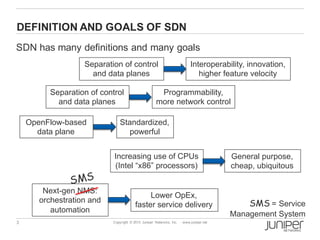
DEFINITION AND GOALS OF SDN
SDN has many definitions and many goals
Separation of control
and data planes
Interoperability, innovation,
higher feature velocity
OpenFlow-based
data plane
Standardized,
powerful
Increasing use of CPUs
(Intel “x86” processors)
General purpose,
cheap, ubiquitous
Next-gen NMS:
orchestration and
automation
Lower OpEx,
faster service delivery SMS = Service
Management System
Separation of control
and data planes
Programmability,
more network control
4 Copyright © 2013 Juniper Networks, Inc. www.juniper.net
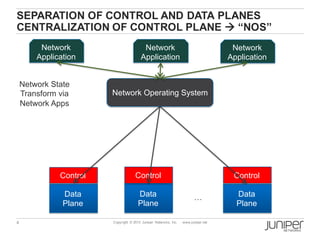
SEPARATION OF CONTROL AND DATA PLANES
CENTRALIZATION OF CONTROL PLANE à “NOS”
Data
Plane
Control
Data
Plane
Control
Data
Plane
Control
…
Network Operating System
Network
Application
Network
Application
Network
Application
Network State
Transform via
Network Apps
5 Copyright © 2013 Juniper Networks, Inc. www.juniper.net
DISCUSSION
What is the real problem at hand?
§ CapEx?
§ OpEx?
§ Resource efficiency?
§ Greater network control?
§ Increasing revenue?
§ Speed of service rollout?
Of course, all of the above J
Will writing network apps achieve these goals?
§ This approach may be tactically suitable for some cases
§ But in general seems too low-level, and ultimately not manageable
6 Copyright © 2013 Juniper Networks, Inc. www.juniper.net
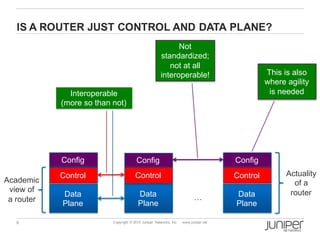
IS A ROUTER JUST CONTROL AND DATA PLANE?
Data
Plane
Control
Data
Plane
Control
Data
Plane
Control
…
Config ConfigConfig
Academic
view of
a router
Actuality
of a
router
Interoperable
(more so than not)
Not
standardized;
not at all
interoperable! This is also
where agility
is needed
7 Copyright © 2013 Juniper Networks, Inc. www.juniper.net
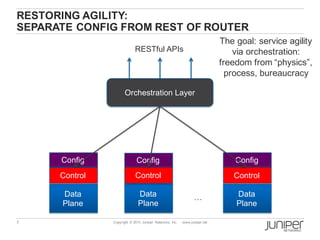
RESTORING AGILITY:
SEPARATE CONFIG FROM REST OF ROUTER
Data
Plane
Control
Data
Plane
Control
Data
Plane
Control
…
Config ConfigConfig
Orchestration Layer
The goal: service agility
via orchestration:
freedom from “physics”,
process, bureaucracy
RESTful APIs
8 Copyright © 2013 Juniper Networks, Inc. www.juniper.net
ORCHESTRATION VIA THE NEXT-GEN
SERVICE MANAGEMENT SYSTEM
Just as in Compute Virtualization, so in networks: we need the
ability to orchestrate and automate
§ especially service creation and management
Such an ability will save OpEx, offer greater network control, and
speed up service rollout, leading to an increase in revenues
§ It will also improve resource efficiency, leading to CapEx savings
But how is this different from current Network Management
Systems, or OSSes?
§ First, let’s describe the approach, then discuss this
9 Copyright © 2013 Juniper Networks, Inc. www.juniper.net
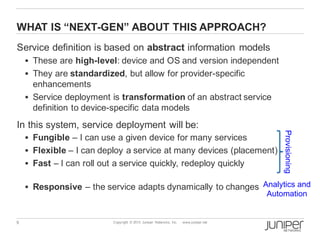
WHAT IS “NEXT-GEN” ABOUT THIS APPROACH?
Service definition is based on abstract information models
§ These are high-level: device and OS and version independent
§ They are standardized, but allow for provider-specific
enhancements
§ Service deployment is transformation of an abstract service
definition to device-specific data models
In this system, service deployment will be:
§ Fungible – I can use a given device for many services
§ Flexible – I can deploy a service at many devices (placement)
§ Fast – I can roll out a service quickly, redeploy quickly
§ Responsive – the service adapts dynamically to changes
Provisioning
Analytics and
Automation
10 Copyright © 2013 Juniper Networks, Inc. www.juniper.net
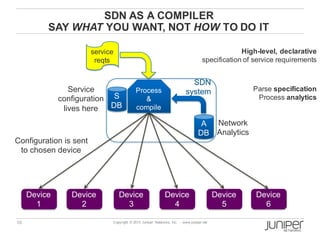
service
reqts
High-level, declarative
specification of service requirements
Parse specification
Process analytics
Device
1
Device
6
Device
5
Device
4
Device
3
Device
2
Network
Analytics
Service
configuration
lives here
SDN AS A COMPILER
SAY WHAT YOU WANT, NOT HOW TO DO IT
Configuration is sent
to chosen device
Process
&
compile
A
DB
SDN
system
S
DB
11 Copyright © 2013 Juniper Networks, Inc. www.juniper.net
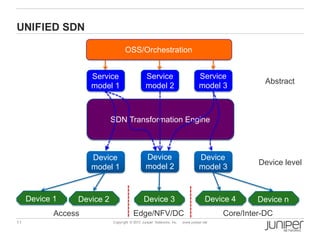
UNIFIED SDN
SDN Transformation Engine
Service
model 1
Service
model 2
Service
model 3
Device
model 1
Device
model 2
Device
model 3
OSS/Orchestration
Device 1 Device 3 Device 4 Device nDevice 2
Access Edge/NFV/DC Core/Inter-DC
Abstract
Device level
12 Copyright © 2013 Juniper Networks, Inc. www.juniper.net
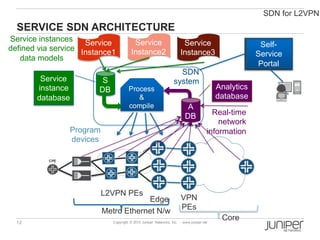
SERVICE SDN ARCHITECTURE
Process
&
compile A
DB
SDN
systemS
DB
Core
VPN
PEs
Edge
CPE
Agg2
Service
Instance1
Service
Instance2
Service
Instance3
Service
instance
database
Real-time
network
information
Metro Ethernet N/w
L2VPN PEs
Analytics
database
Program
devices
Service instances
defined via service
data models
Self-
Service
Portal
SDN for L2VPN
13 Copyright © 2013 Juniper Networks, Inc. www.juniper.net
AGENDA
What is SDN?
What parts of the network does SDN touch?
§ Virtualized Data Centers
§ SDN for NFV
§ Core SDN
§ Access/Edge SDN
Conclusion
14 Copyright © 2013 Juniper Networks, Inc. www.juniper.net
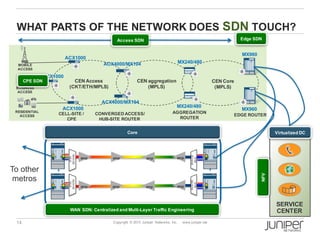
WHAT PARTS OF THE NETWORK DOES SDN TOUCH?
ACX4000/MX104
ACX4000/MX104
MX240/480
MX240/480
MX960
MX960
ACX1000
BUSINESS
ACCESS
RESIDENTIAL
ACCESS
ACX1000
ACX1000
MOBILE
ACCESS
CONVERGED ACCESS/
HUB-SITE ROUTER
AGGREGATION
ROUTER
CELL-SITE /
CPE
EDGE ROUTER
CEN Access
(CKT/ETH/MPLS)
CEN aggregation
(MPLS)
CEN Core
(MPLS)
MUX/DE
MUX
amp amp amp amp
Core
amp amp amp amp
MUX/DE
MUX
MUX/DE
MUX
MUX/DE
MUX
SERVICE
CENTER
To other
metros
Virtualized DC
Access SDN Edge SDN
NFV
WAN SDN: Centralized and Multi-Layer Traffic Engineering
CPE SDN
15 Copyright © 2013 Juniper Networks, Inc. www.juniper.net
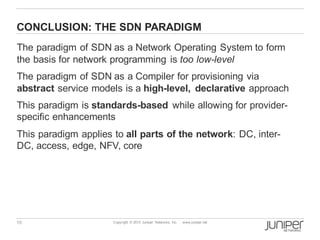
CONCLUSION: THE SDN PARADIGM
The paradigm of SDN as a Network Operating System to form
the basis for network programming is too low-level
The paradigm of SDN as a Compiler for provisioning via
abstract service models is a high-level, declarative approach
This paradigm is standards-based while allowing for provider-
specific enhancements
This paradigm applies to all parts of the network: DC, inter-
DC, access, edge, NFV, core
Juniper  Unified SDN Technical Presentation (SDN Day ITB 2016)

Juniper Unified SDN Technical Presentation (SDN Day ITB 2016)

  • 1.
  • 2.
    2 Copyright ©2013 Juniper Networks, Inc. www.juniper.net AGENDA What is SDN? § Definition and goals of SDN § Analogy with Compute Virtualization § Orchestration via the “next-gen SMS” § Unified SDN What parts of the network does SDN touch? Conclusion
  • 3.
    3 Copyright ©2013 Juniper Networks, Inc. www.juniper.net DEFINITION AND GOALS OF SDN SDN has many definitions and many goals Separation of control and data planes Interoperability, innovation, higher feature velocity OpenFlow-based data plane Standardized, powerful Increasing use of CPUs (Intel “x86” processors) General purpose, cheap, ubiquitous Next-gen NMS: orchestration and automation Lower OpEx, faster service delivery SMS = Service Management System Separation of control and data planes Programmability, more network control
  • 4.
    4 Copyright ©2013 Juniper Networks, Inc. www.juniper.net SEPARATION OF CONTROL AND DATA PLANES CENTRALIZATION OF CONTROL PLANE à “NOS” Data Plane Control Data Plane Control Data Plane Control … Network Operating System Network Application Network Application Network Application Network State Transform via Network Apps
  • 5.
    5 Copyright ©2013 Juniper Networks, Inc. www.juniper.net DISCUSSION What is the real problem at hand? § CapEx? § OpEx? § Resource efficiency? § Greater network control? § Increasing revenue? § Speed of service rollout? Of course, all of the above J Will writing network apps achieve these goals? § This approach may be tactically suitable for some cases § But in general seems too low-level, and ultimately not manageable
  • 6.
    6 Copyright ©2013 Juniper Networks, Inc. www.juniper.net IS A ROUTER JUST CONTROL AND DATA PLANE? Data Plane Control Data Plane Control Data Plane Control … Config ConfigConfig Academic view of a router Actuality of a router Interoperable (more so than not) Not standardized; not at all interoperable! This is also where agility is needed
  • 7.
    7 Copyright ©2013 Juniper Networks, Inc. www.juniper.net RESTORING AGILITY: SEPARATE CONFIG FROM REST OF ROUTER Data Plane Control Data Plane Control Data Plane Control … Config ConfigConfig Orchestration Layer The goal: service agility via orchestration: freedom from “physics”, process, bureaucracy RESTful APIs
  • 8.
    8 Copyright ©2013 Juniper Networks, Inc. www.juniper.net ORCHESTRATION VIA THE NEXT-GEN SERVICE MANAGEMENT SYSTEM Just as in Compute Virtualization, so in networks: we need the ability to orchestrate and automate § especially service creation and management Such an ability will save OpEx, offer greater network control, and speed up service rollout, leading to an increase in revenues § It will also improve resource efficiency, leading to CapEx savings But how is this different from current Network Management Systems, or OSSes? § First, let’s describe the approach, then discuss this
  • 9.
    9 Copyright ©2013 Juniper Networks, Inc. www.juniper.net WHAT IS “NEXT-GEN” ABOUT THIS APPROACH? Service definition is based on abstract information models § These are high-level: device and OS and version independent § They are standardized, but allow for provider-specific enhancements § Service deployment is transformation of an abstract service definition to device-specific data models In this system, service deployment will be: § Fungible – I can use a given device for many services § Flexible – I can deploy a service at many devices (placement) § Fast – I can roll out a service quickly, redeploy quickly § Responsive – the service adapts dynamically to changes Provisioning Analytics and Automation
  • 10.
    10 Copyright ©2013 Juniper Networks, Inc. www.juniper.net service reqts High-level, declarative specification of service requirements Parse specification Process analytics Device 1 Device 6 Device 5 Device 4 Device 3 Device 2 Network Analytics Service configuration lives here SDN AS A COMPILER SAY WHAT YOU WANT, NOT HOW TO DO IT Configuration is sent to chosen device Process & compile A DB SDN system S DB
  • 11.
    11 Copyright ©2013 Juniper Networks, Inc. www.juniper.net UNIFIED SDN SDN Transformation Engine Service model 1 Service model 2 Service model 3 Device model 1 Device model 2 Device model 3 OSS/Orchestration Device 1 Device 3 Device 4 Device nDevice 2 Access Edge/NFV/DC Core/Inter-DC Abstract Device level
  • 12.
    12 Copyright ©2013 Juniper Networks, Inc. www.juniper.net SERVICE SDN ARCHITECTURE Process & compile A DB SDN systemS DB Core VPN PEs Edge CPE Agg2 Service Instance1 Service Instance2 Service Instance3 Service instance database Real-time network information Metro Ethernet N/w L2VPN PEs Analytics database Program devices Service instances defined via service data models Self- Service Portal SDN for L2VPN
  • 13.
    13 Copyright ©2013 Juniper Networks, Inc. www.juniper.net AGENDA What is SDN? What parts of the network does SDN touch? § Virtualized Data Centers § SDN for NFV § Core SDN § Access/Edge SDN Conclusion
  • 14.
    14 Copyright ©2013 Juniper Networks, Inc. www.juniper.net WHAT PARTS OF THE NETWORK DOES SDN TOUCH? ACX4000/MX104 ACX4000/MX104 MX240/480 MX240/480 MX960 MX960 ACX1000 BUSINESS ACCESS RESIDENTIAL ACCESS ACX1000 ACX1000 MOBILE ACCESS CONVERGED ACCESS/ HUB-SITE ROUTER AGGREGATION ROUTER CELL-SITE / CPE EDGE ROUTER CEN Access (CKT/ETH/MPLS) CEN aggregation (MPLS) CEN Core (MPLS) MUX/DE MUX amp amp amp amp Core amp amp amp amp MUX/DE MUX MUX/DE MUX MUX/DE MUX SERVICE CENTER To other metros Virtualized DC Access SDN Edge SDN NFV WAN SDN: Centralized and Multi-Layer Traffic Engineering CPE SDN
  • 15.
    15 Copyright ©2013 Juniper Networks, Inc. www.juniper.net CONCLUSION: THE SDN PARADIGM The paradigm of SDN as a Network Operating System to form the basis for network programming is too low-level The paradigm of SDN as a Compiler for provisioning via abstract service models is a high-level, declarative approach This paradigm is standards-based while allowing for provider- specific enhancements This paradigm applies to all parts of the network: DC, inter- DC, access, edge, NFV, core