Slides
Prepared
by:
Dr.
Mahtab
Alam
UNIT
-IV
Unit Sub Unit
UnitIV
Sales
Organization
and
Salesforce
Sales Organization and Salesforce: Sales
Organization and its types, Specialization Sales
Organization, Staffing the Salesforce, Sales
Training Process, Compensating the Salesforce,
Motivating and Leading the Salesforce,
Evaluating and Controlling the Performance of
the Salesforce, Sales Analysis and Sales Audit,
Ethical and Social Responsibilities of Sales
Personnel.
3.
Slides
Prepared
by:
Dr.
Mahtab
Alam Sales Organization-Meaning
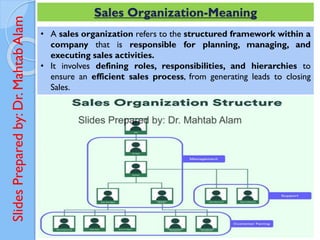
•A sales organization refers to the structured framework within a
company that is responsible for planning, managing, and
executing sales activities.
• It involves defining roles, responsibilities, and hierarchies to
ensure an efficient sales process, from generating leads to closing
Sales.
4.
Slides
Prepared
by:
Dr.
Mahtab
Alam Sales Organization-Definition
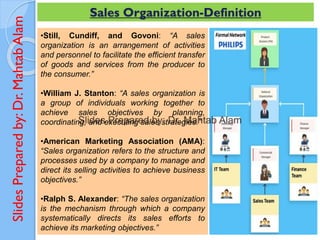
•Still,Cundiff, and Govoni: “A sales
organization is an arrangement of activities
and personnel to facilitate the efficient transfer
of goods and services from the producer to
the consumer.”
•William J. Stanton: “A sales organization is
a group of individuals working together to
achieve sales objectives by planning,
coordinating, and executing sales strategies.”
•American Marketing Association (AMA):
“Sales organization refers to the structure and
processes used by a company to manage and
direct its selling activities to achieve business
objectives.”
•Ralph S. Alexander: “The sales organization
is the mechanism through which a company
systematically directs its sales efforts to
achieve its marketing objectives.”
5.
Slides
Prepared
by:
Dr.
Mahtab
Alam Concept ofSales Organization Structure
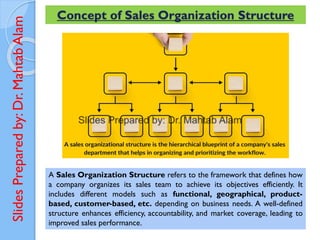
A Sales Organization Structure refers to the framework that defines how
a company organizes its sales team to achieve its objectives efficiently. It
includes different models such as functional, geographical, product-
based, customer-based, etc. depending on business needs. A well-defined
structure enhances efficiency, accountability, and market coverage, leading to
improved sales performance.
6.
Slides
Prepared
by:
Dr.
Mahtab
Alam
1. Defined Hierarchy:Clearly establishes authority and responsibility among
sales personnel.
2. Specialization: Sales roles are divided based on functions, products, or
markets to improve efficiency.
3. Coordination: Ensures seamless collaboration between sales, marketing, and
other departments.
4. Flexibility: Can be adapted to changing market trends, customer needs, and
business growth.
5. Goal-Oriented: Designed to achieve specific sales targets and company
objectives.
6. Customer-Centric: Focuses on delivering value and building long-term
customer relationships.
7. Territorial Division: Often structured based on geographic regions to enhance
market coverage.
8. Performance Measurement: Uses KPIs and sales metrics to evaluate sales
team effectiveness.
9. Motivation and Incentives: Encourages sales teams with rewards,
commissions, and career growth opportunities.
10. Scalability: Can expand as the business grows to accommodate more
customers and sales opportunities.
Features of Sales Organization
Slides
Prepared
by:
Dr.
Mahtab
Alam Importance ofSales Organization
1. Ensures Efficiency: Streamlines sales processes and minimizes duplication of
efforts.
2. Enhances Coordination: Aligns sales with marketing, production, and
customer service.
3. Boosts Sales Performance: Defines roles and responsibilities for better
productivity.
4. Expands Market Coverage: Helps in reaching and serving diverse customer
segments.
5. Improves Customer Satisfaction: Provides structured and responsive
customer support.
6. Facilitates Growth: Supports business expansion with a scalable sales
framework.
7. Enhances Accountability: Sets clear targets and performance metrics for the
sales team.
8. Optimizes Resource Utilization: Allocates sales efforts and budgets efficiently
9.
Slides
Prepared
by:
Dr.
Mahtab
Alam Challenges ofSales Organization Structure
❖ Misalignment with Business Goals: If the structure does not align
with company strategy, sales performance may suffer.
❖ Inefficient Territory Allocation: Poorly assigned sales territories can
lead to underperformance and customer dissatisfaction.
❖ Communication Gaps: Complex structures can create communication
gaps, reducing collaboration between sales, marketing, and customer
service.
❖ Maintenance of Employee Turnover: Poor sales team organization,
lack of incentives, or workload imbalance can lead to high attrition.
❖ Role Ambiguity: Overlapping responsibilities or unclear job roles can
cause inefficiencies and conflicts among sales teams.
❖ Customer Relationship Management Challenges: A structure that
does not prioritize customer needs can lead to poor customer service
and lost opportunities.
❖ Adapting to Market Changes: Traditional sales structures may
struggle to keep up with evolving sales trends, digital transformation,
and AI-driven sales models.
10.
Slides
Prepared
by:
Dr.
Mahtab
Alam Types ofSales Organizational Structure
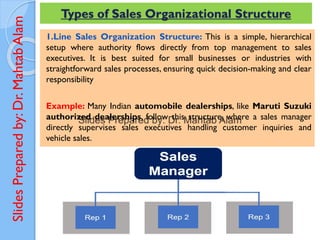
1.Line Sales Organization Structure: This is a simple, hierarchical
setup where authority flows directly from top management to sales
executives. It is best suited for small businesses or industries with
straightforward sales processes, ensuring quick decision-making and clear
responsibility
Example: Many Indian automobile dealerships, like Maruti Suzuki
authorized dealerships, follow this structure, where a sales manager
directly supervises sales executives handling customer inquiries and
vehicle sales.
11.
Slides
Prepared
by:
Dr.
Mahtab
Alam
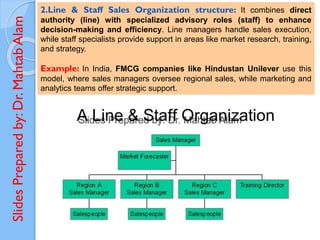
2.Line & StaffSales Organization structure: It combines direct
authority (line) with specialized advisory roles (staff) to enhance
decision-making and efficiency. Line managers handle sales execution,
while staff specialists provide support in areas like market research, training,
and strategy.
Example: In India, FMCG companies like Hindustan Unilever use this
model, where sales managers oversee regional sales, while marketing and
analytics teams offer strategic support.
12.
Slides
Prepared
by:
Dr.
Mahtab
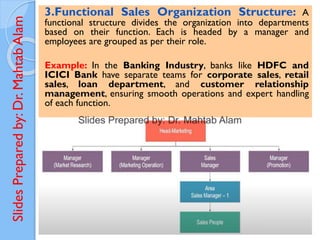
Alam 3.Functional SalesOrganization Structure: A
functional structure divides the organization into departments
based on their function. Each is headed by a manager and
employees are grouped as per their role.
Example: In the Banking Industry, banks like HDFC and
ICICI Bank have separate teams for corporate sales, retail
sales, loan department, and customer relationship
management, ensuring smooth operations and expert handling
of each function.
13.
Slides
Prepared
by:
Dr.
Mahtab
Alam
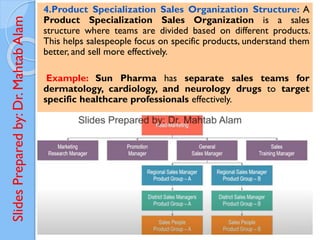
4.Product Specialization SalesOrganization Structure: A
Product Specialization Sales Organization is a sales
structure where teams are divided based on different products.
This helps salespeople focus on specific products, understand them
better, and sell more effectively.
Example: Sun Pharma has separate sales teams for
dermatology, cardiology, and neurology drugs to target
specific healthcare professionals effectively.
14.
Slides
Prepared
by:
Dr.
Mahtab
Alam
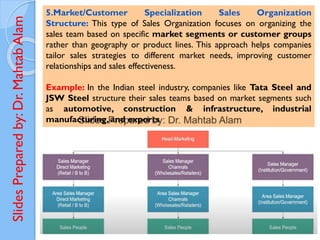
5.Market/Customer Specialization SalesOrganization
Structure: This type of Sales Organization focuses on organizing the
sales team based on specific market segments or customer groups
rather than geography or product lines. This approach helps companies
tailor sales strategies to different market needs, improving customer
relationships and sales effectiveness.
Example: In the Indian steel industry, companies like Tata Steel and
JSW Steel structure their sales teams based on market segments such
as automotive, construction & infrastructure, industrial
manufacturing, and exports
15.
Slides
Prepared
by:
Dr.
Mahtab
Alam
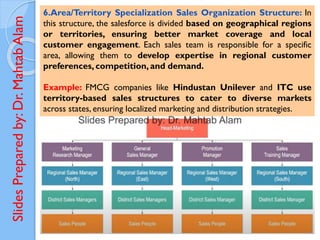
6.Area/Territory Specialization SalesOrganization Structure: In
this structure, the salesforce is divided based on geographical regions
or territories, ensuring better market coverage and local
customer engagement. Each sales team is responsible for a specific
area, allowing them to develop expertise in regional customer
preferences, competition, and demand.
Example: FMCG companies like Hindustan Unilever and ITC use
territory-based sales structures to cater to diverse markets
across states, ensuring localized marketing and distribution strategies.
16.
Slides
Prepared
by:
Dr.
Mahtab
Alam
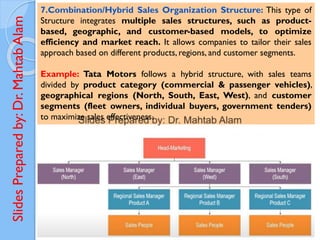
7.Combination/Hybrid Sales OrganizationStructure: This type of
Structure integrates multiple sales structures, such as product-
based, geographic, and customer-based models, to optimize
efficiency and market reach. It allows companies to tailor their sales
approach based on different products, regions, and customer segments.
Example: Tata Motors follows a hybrid structure, with sales teams
divided by product category (commercial & passenger vehicles),
geographical regions (North, South, East, West), and customer
segments (fleet owners, individual buyers, government tenders)
to maximize sales effectiveness.
Slides
Prepared
by:
Dr.
Mahtab
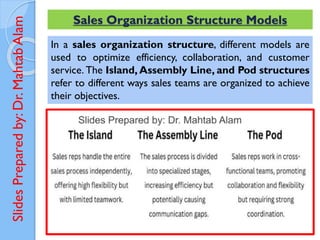
Alam Sales OrganizationStructure Models
In a sales organization structure, different models are
used to optimize efficiency, collaboration, and customer
service. The Island, Assembly Line, and Pod structures
refer to different ways sales teams are organized to achieve
their objectives.
19.
Slides
Prepared
by:
Dr.
Mahtab
Alam
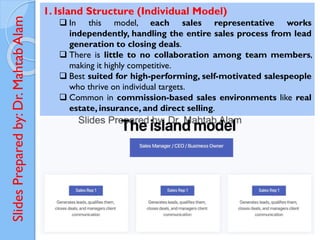
1. Island Structure(Individual Model)
❑ In this model, each sales representative works
independently, handling the entire sales process from lead
generation to closing deals.
❑ There is little to no collaboration among team members,
making it highly competitive.
❑ Best suited for high-performing, self-motivated salespeople
who thrive on individual targets.
❑ Common in commission-based sales environments like real
estate, insurance, and direct selling.
20.
Slides
Prepared
by:
Dr.
Mahtab
Alam
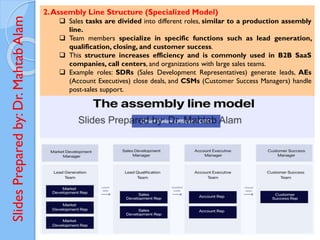
2.Assembly Line Structure(Specialized Model)
❑ Sales tasks are divided into different roles, similar to a production assembly
line.
❑ Team members specialize in specific functions such as lead generation,
qualification, closing, and customer success.
❑ This structure increases efficiency and is commonly used in B2B SaaS
companies, call centers, and organizations with large sales teams.
❑ Example roles: SDRs (Sales Development Representatives) generate leads, AEs
(Account Executives) close deals, and CSMs (Customer Success Managers) handle
post-sales support.
21.
Slides
Prepared
by:
Dr.
Mahtab
Alam
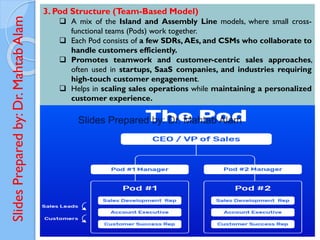
3. Pod Structure(Team-Based Model)
❑ A mix of the Island and Assembly Line models, where small cross-
functional teams (Pods) work together.
❑ Each Pod consists of a few SDRs, AEs, and CSMs who collaborate to
handle customers efficiently.
❑ Promotes teamwork and customer-centric sales approaches,
often used in startups, SaaS companies, and industries requiring
high-touch customer engagement.
❑ Helps in scaling sales operations while maintaining a personalized
customer experience.
22.
Slides
Prepared
by:
Dr.
Mahtab
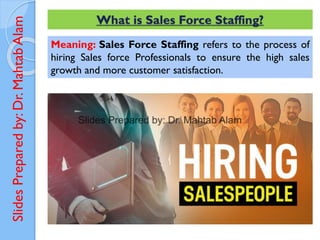
Alam What isSales Force Staffing?
Meaning: Sales Force Staffing refers to the process of
hiring Sales force Professionals to ensure the high sales
growth and more customer satisfaction.
23.
Slides
Prepared
by:
Dr.
Mahtab
Alam Definition ofSales Force Staffing
Johnston & Marshall (2013): “The process of sales force
staffing includes manpower planning, hiring, training,
compensating, motivating, and monitoring salespeople to
enhance overall sales performance and market coverage.”
Jobber & Lancaster (2009): “Staffing the sales force
involves the recruitment, selection, training, and retention of
salespeople to meet the organization’s sales and marketing goals
effectively.”
Stanton, Walker & Spiro (2004): “Sales force staffing is
the process of planning, recruiting, selecting, training,
compensating, and evaluating the sales personnel to ensure the
organization has the right people in the right roles to achieve
sales objectives.”
24.
Slides
Prepared
by:
Dr.
Mahtab
Alam Features ofSales Force Staffing
1. Manpower Planning: Determining the right number of salespeople
based on market demand and business goals.
2. Recruitment & Selection: Identifying, attracting, and selecting
suitable candidates through structured selection processes.
3. Training & Development: Providing sales skills, product knowledge,
and CRM training to enhance performance. Development for futuristic
profiles and assignments.
4. Role Allocation & Deployment: Assigning salespeople based on
geography, product lines, or customer segments.
5. Motivation & Compensation: Using salary, commissions, bonuses,
and incentives to drive sales performance.
6. Performance Evaluation: Measuring effectiveness through KPIs like
revenue, conversion rates, and customer satisfaction.
7. Retention & Career Growth: Implementing strategies to reduce
turnover and provide career advancement opportunities.
8. Adaptability to Market Trends: Ensuring the sales force evolves
with technological advancements and market shifts.
25.
Slides
Prepared
by:
Dr.
Mahtab
Alam Advantages ofSales Force Staffing
✔ Optimized Sales Performance: Ensures the right talent is hired to drive
revenue and market growth.
✔ Efficient Territory Coverage: Proper staffing allows better geographic
and customer segment coverage.
✔ Improved Customer Relationships: Well-trained salespeople enhance
customer satisfaction and loyalty.
✔ Higher Employee Productivity: Right hiring and training result in a
more efficient and motivated sales team.
✔ Better Adaptability to Market Changes: A skilled sales force can
quickly respond to industry trends and competition.
✔ Reduced Employee Turnover: Proper recruitment, motivation, and
career growth opportunities help retain talent.
✔ Stronger Brand Representation: Knowledgeable salespeople improve
brand perception and positioning.
26.
Slides
Prepared
by:
Dr.
Mahtab
Alam Challenges ofSales Force Staffing
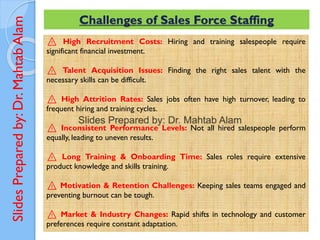
⚠ High Recruitment Costs: Hiring and training salespeople require
significant financial investment.
⚠ Talent Acquisition Issues: Finding the right sales talent with the
necessary skills can be difficult.
⚠ High Attrition Rates: Sales jobs often have high turnover, leading to
frequent hiring and training cycles.
⚠ Inconsistent Performance Levels: Not all hired salespeople perform
equally, leading to uneven results.
⚠ Long Training & Onboarding Time: Sales roles require extensive
product knowledge and skills training.
⚠ Motivation & Retention Challenges: Keeping sales teams engaged and
preventing burnout can be tough.
⚠ Market & Industry Changes: Rapid shifts in technology and customer
preferences require constant adaptation.
27.
Slides
Prepared
by:
Dr.
Mahtab
Alam Process ofSales Force Staffing
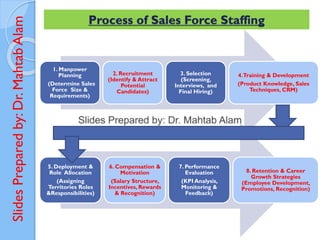
1. Manpower
Planning
(Determine Sales
Force Size &
Requirements)
2. Recruitment
(Identify & Attract
Potential
Candidates)
3. Selection
(Screening,
Interviews, and
Final Hiring)
4.Training & Development
(Product Knowledge, Sales
Techniques, CRM)
5. Deployment &
Role Allocation
(Assigning
Territories Roles
&Responsibilities)
6. Compensation &
Motivation
(Salary Structure,
Incentives, Rewards
& Recognition)
7. Performance
Evaluation
(KPI Analysis,
Monitoring &
Feedback)
8. Retention & Career
Growth Strategies
(Employee Development,
Promotions, Recognition)
28.
Slides
Prepared
by:
Dr.
Mahtab
Alam Sales ForcePlanning
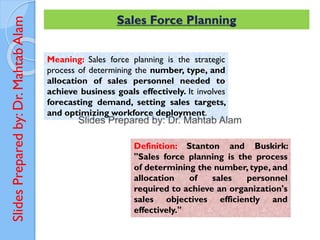
Meaning: Sales force planning is the strategic
process of determining the number, type, and
allocation of sales personnel needed to
achieve business goals effectively. It involves
forecasting demand, setting sales targets,
and optimizing workforce deployment.
Definition: Stanton and Buskirk:
"Sales force planning is the process
of determining the number, type, and
allocation of sales personnel
required to achieve an organization's
sales objectives efficiently and
effectively."
29.
Slides
Prepared
by:
Dr.
Mahtab
Alam Objectives ofSales Force Planning
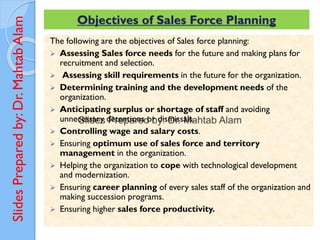
The following are the objectives of Sales force planning:
➢ Assessing Sales force needs for the future and making plans for
recruitment and selection.
➢ Assessing skill requirements in the future for the organization.
➢ Determining training and the development needs of the
organization.
➢ Anticipating surplus or shortage of staff and avoiding
unnecessary detentions or dismissals.
➢ Controlling wage and salary costs.
➢ Ensuring optimum use of sales force and territory
management in the organization.
➢ Helping the organization to cope with technological development
and modernization.
➢ Ensuring career planning of every sales staff of the organization and
making succession programs.
➢ Ensuring higher sales force productivity.
30.
Slides
Prepared
by:
Dr.
Mahtab
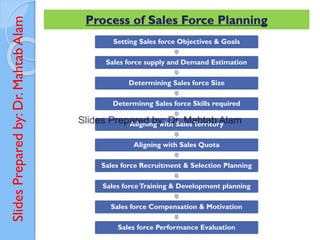
Alam Process ofSales Force Planning
Setting Sales force Objectives & Goals
Sales force supply and Demand Estimation
Determining Sales force Size
Determinng Sales force Skills required
Aligning with SalesTerritory
Aligning with Sales Quota
Sales force Recruitment & Selection Planning
Sales forceTraining & Development planning
Sales force Compensation & Motivation
Sales force Performance Evaluation
31.
Slides
Prepared
by:
Dr.
Mahtab
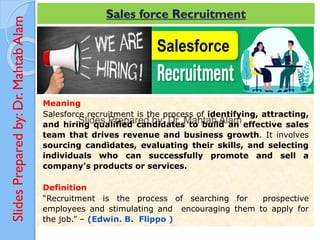
Alam Sales forceRecruitment
Meaning
Salesforce recruitment is the process of identifying, attracting,
and hiring qualified candidates to build an effective sales
team that drives revenue and business growth. It involves
sourcing candidates, evaluating their skills, and selecting
individuals who can successfully promote and sell a
company’s products or services.
Definition
“Recruitment is the process of searching for prospective
employees and stimulating and encouraging them to apply for
the job.” – (Edwin. B. Flippo )
32.
Slides
Prepared
by:
Dr.
Mahtab
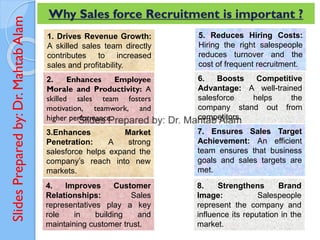
Alam Why Salesforce Recruitment is important ?
1. Drives Revenue Growth:
A skilled sales team directly
contributes to increased
sales and profitability.
2. Enhances Employee
Morale and Productivity: A
skilled sales team fosters
motivation, teamwork, and
higher performance.
3.Enhances Market
Penetration: A strong
salesforce helps expand the
company’s reach into new
markets.
4. Improves Customer
Relationships: Sales
representatives play a key
role in building and
maintaining customer trust.
5. Reduces Hiring Costs:
Hiring the right salespeople
reduces turnover and the
cost of frequent recruitment.
6. Boosts Competitive
Advantage: A well-trained
salesforce helps the
company stand out from
competitors.
7. Ensures Sales Target
Achievement: An efficient
team ensures that business
goals and sales targets are
met.
8. Strengthens Brand
Image: Salespeople
represent the company and
influence its reputation in the
market.
Slides
Prepared
by:
Dr.
Mahtab
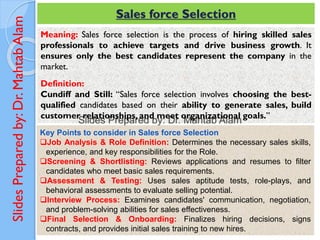
Alam Sales forceSelection
Meaning: Sales force selection is the process of hiring skilled sales
professionals to achieve targets and drive business growth. It
ensures only the best candidates represent the company in the
market.
Definition:
Cundiff and Still: “Sales force selection involves choosing the best-
qualified candidates based on their ability to generate sales, build
customer relationships, and meet organizational goals.”
Key Points to consider in Sales force Selection
❑Job Analysis & Role Definition: Determines the necessary sales skills,
experience, and key responsibilities for the Role.
❑Screening & Shortlisting: Reviews applications and resumes to filter
candidates who meet basic sales requirements.
❑Assessment & Testing: Uses sales aptitude tests, role-plays, and
behavioral assessments to evaluate selling potential.
❑Interview Process: Examines candidates' communication, negotiation,
and problem-solving abilities for sales effectiveness.
❑Final Selection & Onboarding: Finalizes hiring decisions, signs
contracts, and provides initial sales training to new hires.
35.
Slides
Prepared
by:
Dr.
Mahtab
Alam
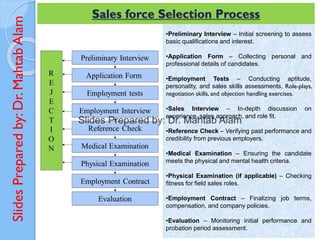
•Preliminary Interview –Initial screening to assess
basic qualifications and interest.
•Application Form – Collecting personal and
professional details of candidates.
•Employment Tests – Conducting aptitude,
personality, and sales skills assessments. Role-plays,
negotiation skills, and objection handling exercises.
•Sales Interview – In-depth discussion on
experience, sales approach, and role fit.
•Reference Check – Verifying past performance and
credibility from previous employers.
•Medical Examination – Ensuring the candidate
meets the physical and mental health criteria.
•Physical Examination (if applicable) – Checking
fitness for field sales roles.
•Employment Contract – Finalizing job terms,
compensation, and company policies.
•Evaluation – Monitoring initial performance and
probation period assessment.
Sales force Selection Process
36.
Slides
Prepared
by:
Dr.
Mahtab
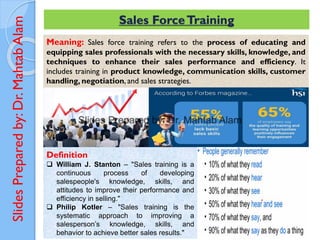
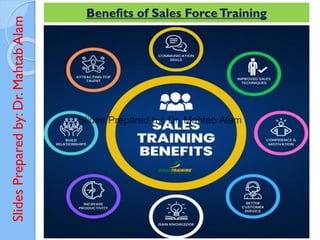
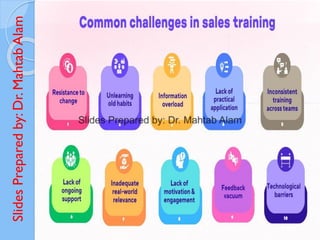
Alam Sales ForceTraining
Meaning:Sales force training refers to the process of educating and
equipping sales professionals with the necessary skills, knowledge, and
techniques to enhance their sales performance and efficiency. It
includes training in product knowledge, communication skills, customer
handling, negotiation, and sales strategies.
Definition
❑ William J. Stanton – "Sales training is a
continuous process of developing
salespeople's knowledge, skills, and
attitudes to improve their performance and
efficiency in selling."
❑ Philip Kotler – "Sales training is the
systematic approach to improving a
salesperson’s knowledge, skills, and
behavior to achieve better sales results."
37.
Slides
Prepared
by:
Dr.
Mahtab
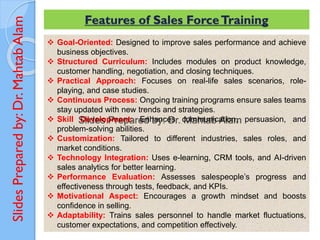
Alam Features ofSales ForceTraining
❖ Goal-Oriented: Designed to improve sales performance and achieve
business objectives.
❖ Structured Curriculum: Includes modules on product knowledge,
customer handling, negotiation, and closing techniques.
❖ Practical Approach: Focuses on real-life sales scenarios, role-
playing, and case studies.
❖ Continuous Process: Ongoing training programs ensure sales teams
stay updated with new trends and strategies.
❖ Skill Development: Enhances communication, persuasion, and
problem-solving abilities.
❖ Customization: Tailored to different industries, sales roles, and
market conditions.
❖ Technology Integration: Uses e-learning, CRM tools, and AI-driven
sales analytics for better learning.
❖ Performance Evaluation: Assesses salespeople’s progress and
effectiveness through tests, feedback, and KPIs.
❖ Motivational Aspect: Encourages a growth mindset and boosts
confidence in selling.
❖ Adaptability: Trains sales personnel to handle market fluctuations,
customer expectations, and competition effectively.
Slides
Prepared
by:
Dr.
Mahtab
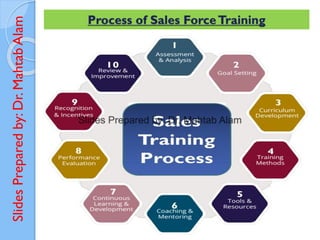
Alam 1. Assessment& Analysis: Identifying the training needs and skill gaps of the
sales team.
2. Goal Setting: Defining clear objectives and expected outcomes of the training
program.
3. Curriculum Development: Designing structured training content tailored to
sales needs.
4. Training Methods: Selecting appropriate methods such as workshops, e-
learning, or role-playing.
5. Tools & Resources: Providing necessary materials, technology, and software for
training.
6. Coaching & Mentoring: Offering guidance, support, and feedback from
experienced mentors.
7. Continuous Learning & Development: Encouraging ongoing skill enhancement
and knowledge updates.
8. Performance Evaluation: Measuring training effectiveness through
assessments and sales performance.
9. Recognition & Incentives: Rewarding top performers to boost motivation and
engagement.
10. Review & Improvement: Regularly analyzing results and refining the training
process for better outcomes.
Slides
Prepared
by:
Dr.
Mahtab
Alam
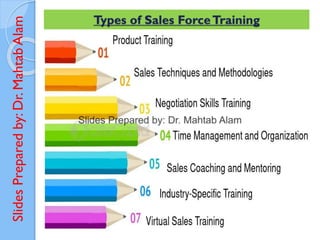
1. Product Training:Educates salespeople about the features,
benefits, and applications of the products they sell. Example: A
smartphone company trains its sales team on the latest device’s
specifications and unique selling points.
2. Sales Techniques and Methodologies: Covers strategies,
approaches, and best practices for effective selling. Example: A
retail company trains employees on consultative selling to better
understand customer needs before making recommendations.
3. Negotiation Skills Training: Enhances the ability to negotiate
deals, handle objections, and close sales successfully. Example: A
real estate firm provides workshops where agents practice
negotiation tactics to finalize property deals.
4. Time Management and Organization: Helps sales teams
optimize their schedules and improve productivity. Example: A
pharmaceutical sales team learns time-blocking techniques to
efficiently schedule client meetings and follow-ups.
44.
Slides
Prepared
by:
Dr.
Mahtab
Alam
5. Sales Coachingand Mentoring: Provides
continuous guidance and feedback from experienced
professionals. Example: A newly hired insurance agent is
assigned a mentor who provides tips on customer handling and
closing deals.
6. Industry-Specific Training: Focuses on knowledge
and trends specific to a particular industry or market.
Example: A financial services company trains its sales team on
banking regulations and investment products.
7. Virtual Sales Training: Equips salespeople with
digital tools and techniques for remote selling. Example:
An e-commerce platform conducts online training on how to
effectively pitch products via video calls and social media.
45.
Slides
Prepared
by:
Dr.
Mahtab
Alam Methods ofSales ForceTraining
1. On-the-Job Training: Learning by performing actual sales tasks
under supervision. Example: A new salesperson shadows a
senior colleague to observe customer interactions.
2. Classroom Training: Formal training sessions with
lectures, discussions, and presentations. Example: A
company conducts a two-day sales workshop on
advanced selling techniques.
2. Role-Playing: Simulating real sales scenarios to practice
handling customers. Example: Trainees act as buyers and
sellers to practice objection handling in a mock sales pitch.
2. E-Learning & Online Modules: Digital courses, webinars,
and virtual simulations. Example: A salesperson completes
an online course on digital marketing strategies.
5. Coaching & Mentoring: Guidance from experienced sales
professionals for skill development. Example: A senior sales
manager mentors a new recruit on negotiation tactics.
46.
Slides
Prepared
by:
Dr.
Mahtab
Alam
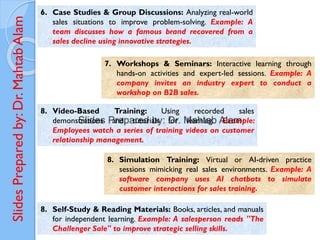
6. Case Studies& Group Discussions: Analyzing real-world
sales situations to improve problem-solving. Example: A
team discusses how a famous brand recovered from a
sales decline using innovative strategies.
7. Workshops & Seminars: Interactive learning through
hands-on activities and expert-led sessions. Example: A
company invites an industry expert to conduct a
workshop on B2B sales.
8. Video-Based Training: Using recorded sales
demonstrations and tutorials for learning. Example:
Employees watch a series of training videos on customer
relationship management.
8. Simulation Training: Virtual or AI-driven practice
sessions mimicking real sales environments. Example: A
software company uses AI chatbots to simulate
customer interactions for sales training.
8. Self-Study & Reading Materials: Books, articles, and manuals
for independent learning. Example: A salesperson reads "The
Challenger Sale" to improve strategic selling skills.
47.
Slides
Prepared
by:
Dr.
Mahtab
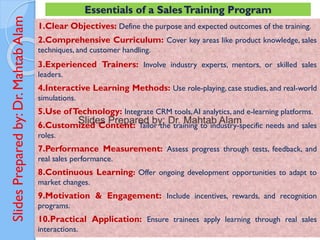
Alam 1.Clear Objectives:Define the purpose and expected outcomes of the training.
2.Comprehensive Curriculum: Cover key areas like product knowledge, sales
techniques, and customer handling.
3.Experienced Trainers: Involve industry experts, mentors, or skilled sales
leaders.
4.Interactive Learning Methods: Use role-playing, case studies, and real-world
simulations.
5.Use ofTechnology: Integrate CRM tools,AI analytics, and e-learning platforms.
6.Customized Content: Tailor the training to industry-specific needs and sales
roles.
7.Performance Measurement: Assess progress through tests, feedback, and
real sales performance.
8.Continuous Learning: Offer ongoing development opportunities to adapt to
market changes.
9.Motivation & Engagement: Include incentives, rewards, and recognition
programs.
10.Practical Application: Ensure trainees apply learning through real sales
interactions.
Essentials of a SalesTraining Program
48.
Slides
Prepared
by:
Dr.
Mahtab
Alam Sales ForceCompensation-Meaning
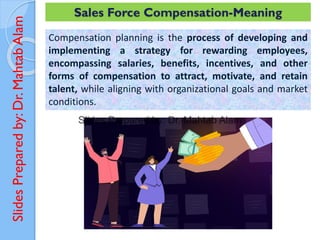
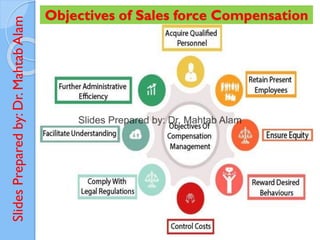
Compensation planning is the process of developing and
implementing a strategy for rewarding employees,
encompassing salaries, benefits, incentives, and other
forms of compensation to attract, motivate, and retain
talent, while aligning with organizational goals and market
conditions.
49.
Slides
Prepared
by:
Dr.
Mahtab
Alam Definition ofCompensation
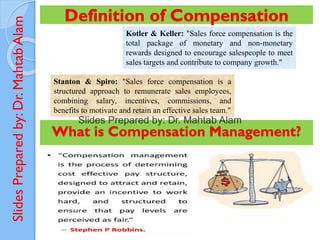
Kotler & Keller: "Sales force compensation is the
total package of monetary and non-monetary
rewards designed to encourage salespeople to meet
sales targets and contribute to company growth."
Stanton & Spiro: "Sales force compensation is a
structured approach to remunerate sales employees,
combining salary, incentives, commissions, and
benefits to motivate and retain an effective sales team."
What is Compensation Management?
50.
Slides
Prepared
by:
Dr.
Mahtab
Alam Features ofSales force Compensation
1. Monetary and Non-Monetary Rewards: It includes both financial incentives
(salary, commission, bonuses) and non-financial rewards (recognition, career
growth opportunities).
2. Performance-Based Structure: Compensation is often linked to sales
performance, ensuring motivation and accountability.
3. Combination of Fixed and Variable Pay: A typical sales compensation plan
consists of a base salary (fixed) and commissions or incentives (variable).
4. Alignment with Organizational Goals: The structure is designed to support the
company’s sales objectives, such as revenue growth, customer acquisition, and
market expansion.
5. Motivational Tool: A well-designed compensation plan encourages salespeople
to achieve higher sales targets and enhances job satisfaction.
6. Fairness and Transparency: Compensation policies should be clear, equitable,
and easily understandable to maintain trust among the sales force.
7. Flexibility and Adaptability: Compensation structures should be adaptable to
changes in market conditions, company goals, and sales roles.
8. Cost-Effectiveness: The plan should balance rewarding employees while
ensuring profitability and sustainability for the company.
9. Legal and Ethical Compliance: Compensation must adhere to labor laws, tax
regulations, and ethical sales practices.
10. Retention and Talent Attraction: A well-structured compensation plan helps in
retaining top-performing salespeople and attracting skilled professionals.
Slides
Prepared
by:
Dr.
Mahtab
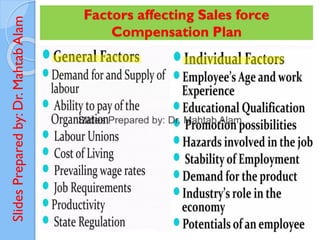
Alam Components ofSales force Compensation
1. Salary: This is the fixed, regular payment that employees receive, usually
monthly. It is typically determined by factors like the job's role, market rates, and
the employee's experience. Salaries are paid to White collar employees (Officers
or Skilled Professionals)
2. Wages: Wages refer to the fixed monetary compensation or payment that an
employer provides to employees in exchange for their work or services. Wages
are typically paid at an hourly rate or a fixed amount per period, such as weekly,
bi-weekly, or monthly. Wages are paid to Blue Collar employees (unskilled, semi-
skilled workers).
❑ Minimum Wage: Governments established the Minimum Wage Act of 1948. The
minimum wage is the lowest hourly rate an employer can pay employees. The
minimum wage is intended to provide a basic standard of living.
❑ Fair Wage: A fair wage, often referred to as a living wage or a just wage, is a
compensation level that is considered to provide employees with a reasonable
standard of living. The concept of a fair wage is rooted in the idea that all workers
should earn enough to support themselves and their families, and it should be
sufficient to cover not only the bare minimum but also some level of comfort and
financial security.
❑ Living Wage: A living wage is a higher wage level calculated to cover an individual or
family's basic living expenses, including housing, food, and healthcare. It is often
higher than the minimum wage.
54.
Slides
Prepared
by:
Dr.
Mahtab
Alam 3. Commissions/Incentives:Commission/Incentives are the variable
compensation amounts paid to employees beyond their regular
salary/wage based on their performance as an individual or team.
4. Bonuses: Bonuses are one-time or periodic payments made to
employees based on their performance, company performance, or
achieving specific goals or targets.
5. Allowances: Allowances refer to amounts of money given to
employees regularly for a particular purpose.
❑ Types of Allowances
(i) House Rent Allowances (HRA): HRA is given by the employers to
the employee to meet the expenses in connection with the rent of the
accommodation, which the employee might have to take.
(ii) Dearness Allowances (DA): DA is paid to employees to
compensate them, at least partially, against the phenomenon of rising
prices. DA is decided as per an agreed formula, considering the increase,
in the cost of living.
(iii) City Compensatory Allowance (CCA): CCA is paid to
employees to compensate them partly for the higher cost of living in
cities, which differs from one type of city to another.
55.
Slides
Prepared
by:
Dr.
Mahtab
Alam
(iv) Conveyance Allowance:Conveyance allowance is an allowance granted to
employees to meet the expenditure incurred on conveyance in performance of duties of
the job; when free conveyance is not provided by the employer.
(v) Children’s Education Allowance: Amount paid at the rate of a certain amount per
child to meet the cost of education of children (subject to a maximum of two children or
more as per the rules of the organization) is called children’s education allowance.
(vi) Medical Allowances: A medical allowance is a defined amount provided by the
company to the employee regardless of whether the individual receives medical treatment
or submits medical bills as medical expenditure to employees and their families.
(vii) Miscellaneous/Others Allowance: It is typically a one-time payment that is given
to an employee to cover the cost of a specific expense or to compensate for a special
circumstance such as
❑ Uniform Allowances
❑ Leave Travel Allowances etc.
❑ Meal Allowances
6. Fringe Benefits: Fringe benefits, also known as employee benefits as non-monetary
forms of compensation that organizations provide to all employees irrespective of
their designation in addition to their regular wages or salaries. These benefits are
designed to enhance the quality of work-life for employees which includes
❑ Subsidized Cafeteria
❑ Insurance
❑ Transportation (Cab/Shuttle Services)
❑ Gym etc.
56.
Slides
Prepared
by:
Dr.
Mahtab
Alam
7. Perquisites/Perks: Perksrefer to privileges enjoyed by a person
because of his/her organizational status in addition to their regular
wages or salaries. These benefits are also designed to enhance the
quality of work-life for employees but are not given to all
employees rather these are given to special job profiles or
designation levels in the organization which includes
❑Company Paid Home
❑Company Paid Cars
❑Servant Facility
❑Free Electricity, Gas &Telephone Bills.
8. Profit Sharing: Employees receive a share of the company's profits,
usually distributed among employees based on a predetermined formula.
9. Stock Option or Equity Grants: Employees can buy company stock
at a reduced price (stock options) or are given shares directly (stock
grants) as a reward for performance or tenure. Some employees receive
stock options or equity grants as part of their compensation package,
allowing them to become partial owners of the company.
57.
Slides
Prepared
by:
Dr.
Mahtab
Alam Types ofSales force Compensation Plan
1.Salary-Based Plans: Fixed salary
regardless of sales performance, ensuring
income stability. Example: A pharmaceutical
sales rep earns a monthly salary of
₹50,000 regardless of sales made.
2.Commission-Based Plans: Earnings are
directly tied to sales performance,
encouraging higher sales. Example: A real
estate agent earns 3% commission on
every property sold and no fixed salary
3. Salary & Bonus-Based Plans: Additional rewards
for achieving or exceeding sales targets. Example: A
car salesperson achieving his sales target
throughout year and with all quality parameters
fulfilled is eligible for Yearly Bonus of Rs
₹1,00,000 along with monthly fixed salary
58.
Slides
Prepared
by:
Dr.
Mahtab
Alam
5. Profit-Sharing Plans:Salespeople receive
a share of the company’s profits based on
overall performance. Example: A software
company distributes 5% of annual profits
among its top-performing sales employees.
6. Territory-Based Plans: Compensation is
based on sales generated within a specific
geographic area. Example: A regional
sales manager earns a percentage of all
sales in their assigned state.
7. Team-Based Plans: Rewards are given
based on collective team sales efforts and
achievements. Example: A group of insurance
agents receives a shared bonus when they
collectively meet their quarterly sales goal.
4. Salary & Commission-Based Plans: Regular
Target is for justifying salary only. Additional rewards
for achieving or exceeding sales targets in the form of
commission is tied-up. Example Selling 20 cars per
month is salary justification but selling additional
will attract 10% margin per unit other than salary
Slides
Prepared
by:
Dr.
Mahtab
Alam
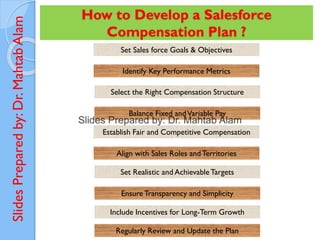
Define Business Objectives
IdentifyKey Performance Metrics
How to Develop a Salesforce
Compensation Plan ?
Set Sales force Goals & Objectives
Balance Fixed andVariable Pay
Select the Right Compensation Structure
Align with Sales Roles andTerritories
Establish Fair and Competitive Compensation
EnsureTransparency and Simplicity
Set Realistic and AchievableTargets
Regularly Review and Update the Plan
Include Incentives for Long-Term Growth
61.
Slides
Prepared
by:
Dr.
Mahtab
Alam
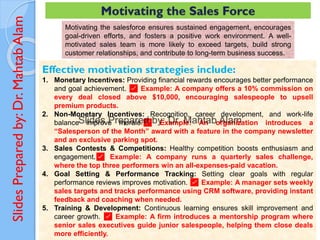
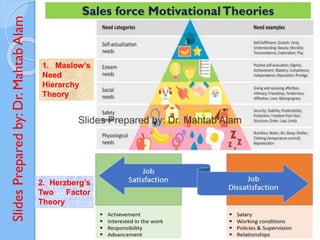
Motivating the SalesForce
Motivating the salesforce ensures sustained engagement, encourages
goal-driven efforts, and fosters a positive work environment. A well-
motivated sales team is more likely to exceed targets, build strong
customer relationships, and contribute to long-term business success.
Effective motivation strategies include:
1. Monetary Incentives: Providing financial rewards encourages better performance
and goal achievement. ✅ Example: A company offers a 10% commission on
every deal closed above $10,000, encouraging salespeople to upsell
premium products.
2. Non-Monetary Incentives: Recognition, career development, and work-life
balance improve morale.✅ Example: An organization introduces a
“Salesperson of the Month” award with a feature in the company newsletter
and an exclusive parking spot.
3. Sales Contests & Competitions: Healthy competition boosts enthusiasm and
engagement.✅ Example: A company runs a quarterly sales challenge,
where the top three performers win an all-expenses-paid vacation.
4. Goal Setting & Performance Tracking: Setting clear goals with regular
performance reviews improves motivation. ✅ Example: A manager sets weekly
sales targets and tracks performance using CRM software, providing instant
feedback and coaching when needed.
5. Training & Development: Continuous learning ensures skill improvement and
career growth. ✅ Example: A firm introduces a mentorship program where
senior sales executives guide junior salespeople, helping them close deals
more efficiently.
Slides
Prepared
by:
Dr.
Mahtab
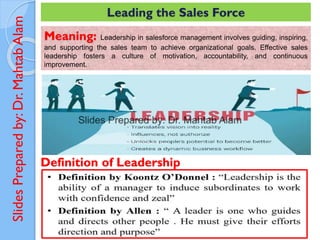
Alam Leading theSales Force
Meaning: Leadership in salesforce management involves guiding, inspiring,
and supporting the sales team to achieve organizational goals. Effective sales
leadership fosters a culture of motivation, accountability, and continuous
improvement.
Definition of Leadership
64.
Slides
Prepared
by:
Dr.
Mahtab
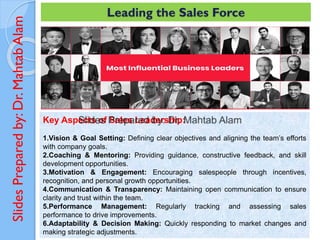
Alam Leading theSales Force
Key Aspects of Sales Leadership:
1.Vision & Goal Setting: Defining clear objectives and aligning the team’s efforts
with company goals.
2.Coaching & Mentoring: Providing guidance, constructive feedback, and skill
development opportunities.
3.Motivation & Engagement: Encouraging salespeople through incentives,
recognition, and personal growth opportunities.
4.Communication & Transparency: Maintaining open communication to ensure
clarity and trust within the team.
5.Performance Management: Regularly tracking and assessing sales
performance to drive improvements.
6.Adaptability & Decision Making: Quickly responding to market changes and
making strategic adjustments.
65.
Slides
Prepared
by:
Dr.
Mahtab
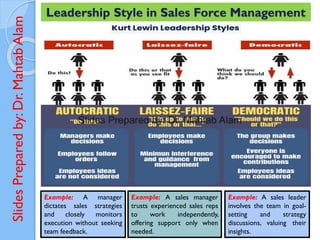
Alam Leadership Stylein Sales Force Management
Example: A manager
dictates sales strategies
and closely monitors
execution without seeking
team feedback.
Example: A sales manager
trusts experienced sales reps
to work independently,
offering support only when
needed.
Example: A sales leader
involves the team in goal-
setting and strategy
discussions, valuing their
insights.
66.
Slides
Prepared
by:
Dr.
Mahtab
Alam
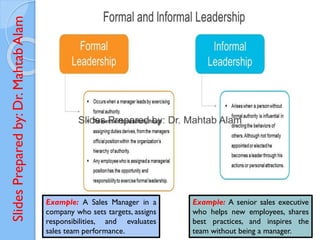
Example: A SalesManager in a
company who sets targets, assigns
responsibilities, and evaluates
sales team performance.
Example: A senior sales executive
who helps new employees, shares
best practices, and inspires the
team without being a manager.
67.
Slides
Prepared
by:
Dr.
Mahtab
Alam
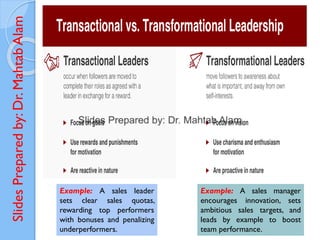
Example: A salesleader
sets clear sales quotas,
rewarding top performers
with bonuses and penalizing
underperformers.
Example: A sales manager
encourages innovation, sets
ambitious sales targets, and
leads by example to boost
team performance.
68.
Slides
Prepared
by:
Dr.
Mahtab
Alam
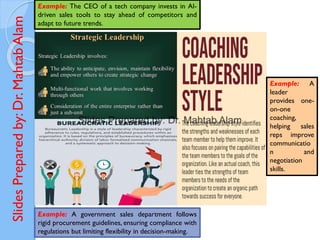
Example: A
leader
provides one-
on-one
coaching,
helpingsales
reps improve
communicatio
n and
negotiation
skills.
Example: The CEO of a tech company invests in AI-
driven sales tools to stay ahead of competitors and
adapt to future trends.
Example: A government sales department follows
rigid procurement guidelines, ensuring compliance with
regulations but limiting flexibility in decision-making.
69.
Slides
Prepared
by:
Dr.
Mahtab
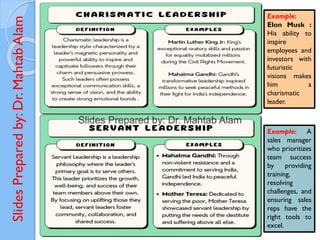
Alam Example:
Elon Musk:
His ability to
inspire
employees and
investors with
futuristic
visions makes
him a
charismatic
leader.
Example: A
sales manager
who prioritizes
team success
by providing
training,
resolving
challenges, and
ensuring sales
reps have the
right tools to
excel.
Slides
Prepared
by:
Dr.
Mahtab
Alam
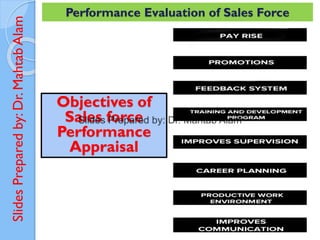
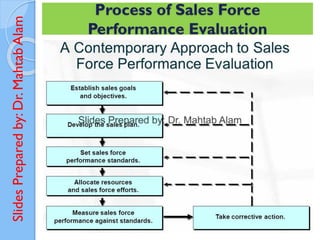
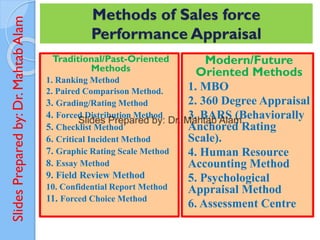
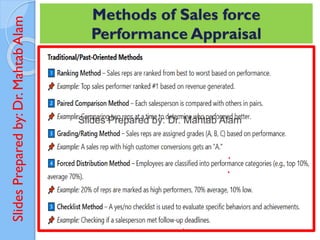
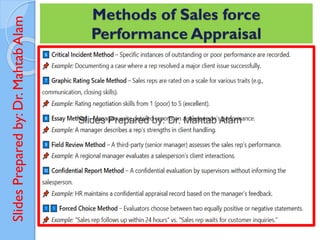
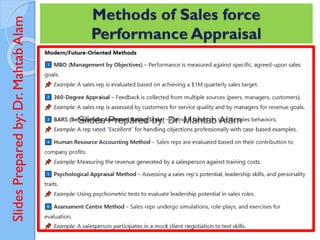
Sales force PerformanceEvaluation
Meaning & Definition
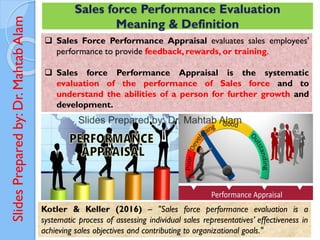
❑ Sales Force Performance Appraisal evaluates sales employees'
performance to provide feedback, rewards, or training.
❑ Sales force Performance Appraisal is the systematic
evaluation of the performance of Sales force and to
understand the abilities of a person for further growth and
development.
Kotler & Keller (2016) – "Sales force performance evaluation is a
systematic process of assessing individual sales representatives’ effectiveness in
achieving sales objectives and contributing to organizational goals."
Slides
Prepared
by:
Dr.
Mahtab
Alam Sales ForceControlling
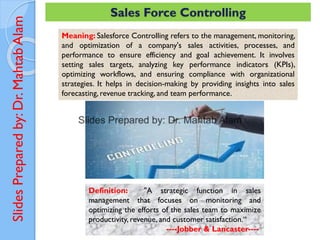
Meaning: Salesforce Controlling refers to the management, monitoring,
and optimization of a company's sales activities, processes, and
performance to ensure efficiency and goal achievement. It involves
setting sales targets, analyzing key performance indicators (KPIs),
optimizing workflows, and ensuring compliance with organizational
strategies. It helps in decision-making by providing insights into sales
forecasting, revenue tracking, and team performance.
Definition: "A strategic function in sales
management that focuses on monitoring and
optimizing the efforts of the sales team to maximize
productivity, revenue, and customer satisfaction.“
----Jobber & Lancaster----
Slides
Prepared
by:
Dr.
Mahtab
Alam
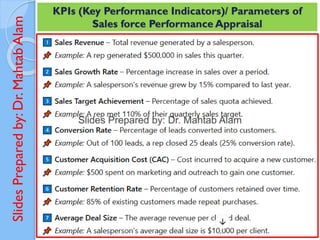
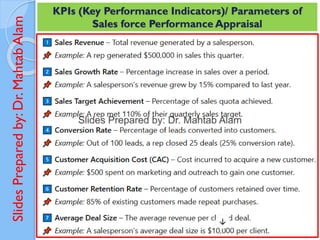
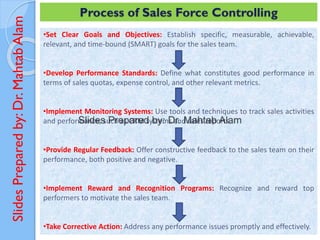
•Set Clear Goalsand Objectives: Establish specific, measurable, achievable,
relevant, and time-bound (SMART) goals for the sales team.
•Develop Performance Standards: Define what constitutes good performance in
terms of sales quotas, expense control, and other relevant metrics.
•Implement Monitoring Systems: Use tools and techniques to track sales activities
and performance, such as CRM systems and sales reports.
•Provide Regular Feedback: Offer constructive feedback to the sales team on their
performance, both positive and negative.
•Implement Reward and Recognition Programs: Recognize and reward top
performers to motivate the sales team.
•Take Corrective Action: Address any performance issues promptly and effectively.
Process of Sales Force Controlling
85.
Slides
Prepared
by:
Dr.
Mahtab
Alam
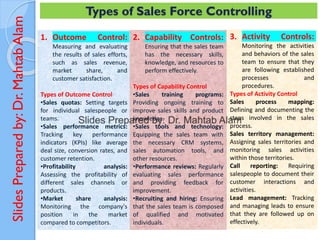
Types of SalesForce Controlling
1. Outcome Control:
Measuring and evaluating
the results of sales efforts,
such as sales revenue,
market share, and
customer satisfaction.
Types of Outcome Control
•Sales quotas: Setting targets
for individual salespeople or
teams.
•Sales performance metrics:
Tracking key performance
indicators (KPIs) like average
deal size, conversion rates, and
customer retention.
•Profitability analysis:
Assessing the profitability of
different sales channels or
products.
•Market share analysis:
Monitoring the company's
position in the market
compared to competitors.
2. Capability Controls:
Ensuring that the sales team
has the necessary skills,
knowledge, and resources to
perform effectively.
Types of Capability Control
•Sales training programs:
Providing ongoing training to
improve sales skills and product
knowledge.
•Sales tools and technology:
Equipping the sales team with
the necessary CRM systems,
sales automation tools, and
other resources.
•Performance reviews: Regularly
evaluating sales performance
and providing feedback for
improvement.
•Recruiting and hiring: Ensuring
that the sales team is composed
of qualified and motivated
individuals.
3. Activity Controls:
Monitoring the activities
and behaviors of the sales
team to ensure that they
are following established
processes and
procedures.
Types of Activity Control
Sales process mapping:
Defining and documenting the
steps involved in the sales
process.
Sales territory management:
Assigning sales territories and
monitoring sales activities
within those territories.
Call reporting: Requiring
salespeople to document their
customer interactions and
activities.
Lead management: Tracking
and managing leads to ensure
that they are followed up on
effectively.
86.
Slides
Prepared
by:
Dr.
Mahtab
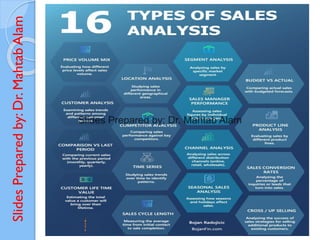
Alam Sales Analysis
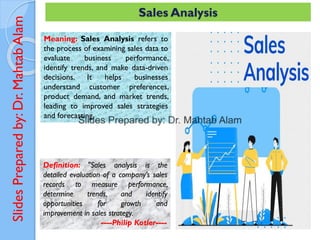
Meaning:Sales Analysis refers to
the process of examining sales data to
evaluate business performance,
identify trends, and make data-driven
decisions. It helps businesses
understand customer preferences,
product demand, and market trends,
leading to improved sales strategies
and forecasting.
Definition: "Sales analysis is the
detailed evaluation of a company’s sales
records to measure performance,
determine trends, and identify
opportunities for growth and
improvement in sales strategy.
----Philip Kotler----
Slides
Prepared
by:
Dr.
Mahtab
Alam Sales Auditing
Meaning
ASales Audit is a systematic and comprehensive evaluation of a company's
sales process, strategies, and performance. It helps in identifying gaps,
inefficiencies, and areas for improvement to enhance overall sales effectiveness
and compliance with business objectives.
Definition
Philip Kotler: "A sales audit is a systematic, independent, and periodic examination
of a company’s sales environment, objectives, strategies, and activities to improve
overall sales effectiveness."
Slides
Prepared
by:
Dr.
Mahtab
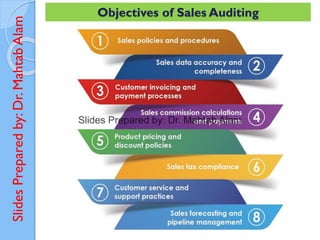
Alam Types ofSales Auditing
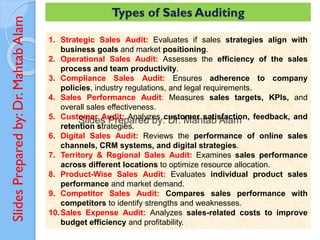
1. Strategic Sales Audit: Evaluates if sales strategies align with
business goals and market positioning.
2. Operational Sales Audit: Assesses the efficiency of the sales
process and team productivity.
3. Compliance Sales Audit: Ensures adherence to company
policies, industry regulations, and legal requirements.
4. Sales Performance Audit: Measures sales targets, KPIs, and
overall sales effectiveness.
5. Customer Audit: Analyzes customer satisfaction, feedback, and
retention strategies.
6. Digital Sales Audit: Reviews the performance of online sales
channels, CRM systems, and digital strategies.
7. Territory & Regional Sales Audit: Examines sales performance
across different locations to optimize resource allocation.
8. Product-Wise Sales Audit: Evaluates individual product sales
performance and market demand.
9. Competitor Sales Audit: Compares sales performance with
competitors to identify strengths and weaknesses.
10.Sales Expense Audit: Analyzes sales-related costs to improve
budget efficiency and profitability.
94.
Slides
Prepared
by:
Dr.
Mahtab
Alam Ethical Responsibilitiesof Sales force
Meaning: & Definition: Ethical responsibility in sales refers to the moral
obligations and professional conduct that salespeople must follow to
ensure fairness, honesty, and integrity in their interactions with
customers, colleagues, and the organization. It involves adhering to
ethical principles, legal regulations, and company policies to build
trust and long-term customer relationships while maintaining
transparency and accountability in the sales process.
95.
Slides
Prepared
by:
Dr.
Mahtab
Alam Principles ofEthical Responsibilities of Sales force
1. Honesty & Transparency:
Provide accurate information
about products/services
without misleading
customers.
2. Fair Pricing & No
Deception: Avoid price
manipulation, hidden charges,
or false claims.
3. Respect for Customers:
Treat customers with dignity,
respect their needs, and
avoid pressure tactics.
4. Confidentiality: Protect
customer data and business
information from unauthorized
use.
5. Fair Competition: Compete
ethically without defaming
competitors or engaging in
unfair trade practices.
6. Compliance with Laws &
Policies: Adhere to company
policies, industry regulations,
and legal frameworks.
7. Avoiding Bribery &
Corruption: Refrain from
offering or accepting unethical
incentives to influence
decisions.
8. Customer-Centric Approach:
Prioritize customer satisfaction
and long-term relationships over
short-term gains.
9. Responsible Advertising &
Promotions: Ensure marketing
and promotional strategies are
truthful and ethical.
10.Accountability & Integrity:
Take responsibility for actions,
own up to mistakes, and
maintain integrity in dealings.
96.
Slides
Prepared
by:
Dr.
Mahtab
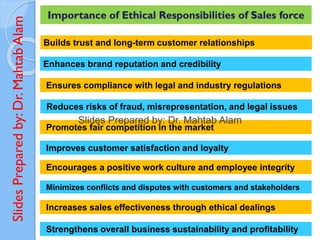
Alam Importance ofEthical Responsibilities of Sales force
Builds trust and long-term customer relationships
Enhances brand reputation and credibility
Ensures compliance with legal and industry regulations
Reduces risks of fraud, misrepresentation, and legal issues
Promotes fair competition in the market
Improves customer satisfaction and loyalty
Encourages a positive work culture and employee integrity
Minimizes conflicts and disputes with customers and stakeholders
Increases sales effectiveness through ethical dealings
Strengthens overall business sustainability and profitability
97.
Slides
Prepared
by:
Dr.
Mahtab
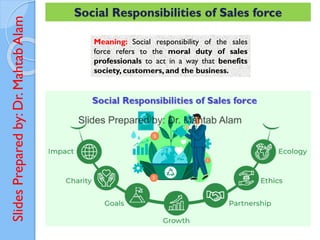
Alam Social Responsibilitiesof Sales force
Meaning: Social responsibility of the sales
force refers to the moral duty of sales
professionals to act in a way that benefits
society, customers, and the business.
98.
Slides
Prepared
by:
Dr.
Mahtab
Alam
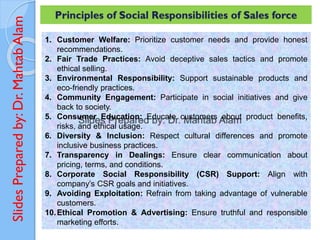
1. Customer Welfare:Prioritize customer needs and provide honest
recommendations.
2. Fair Trade Practices: Avoid deceptive sales tactics and promote
ethical selling.
3. Environmental Responsibility: Support sustainable products and
eco-friendly practices.
4. Community Engagement: Participate in social initiatives and give
back to society.
5. Consumer Education: Educate customers about product benefits,
risks, and ethical usage.
6. Diversity & Inclusion: Respect cultural differences and promote
inclusive business practices.
7. Transparency in Dealings: Ensure clear communication about
pricing, terms, and conditions.
8. Corporate Social Responsibility (CSR) Support: Align with
company’s CSR goals and initiatives.
9. Avoiding Exploitation: Refrain from taking advantage of vulnerable
customers.
10.Ethical Promotion & Advertising: Ensure truthful and responsible
marketing efforts.
Principles of Social Responsibilities of Sales force
99.
Slides
Prepared
by:
Dr.
Mahtab
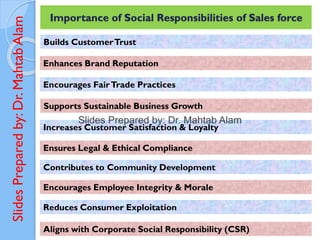
Alam Importance ofSocial Responsibilities of Sales force
Builds CustomerTrust
Enhances Brand Reputation
Encourages FairTrade Practices
Supports Sustainable Business Growth
Increases Customer Satisfaction & Loyalty
Ensures Legal & Ethical Compliance
Contributes to Community Development
Encourages Employee Integrity & Morale
Reduces Consumer Exploitation
Aligns with Corporate Social Responsibility (CSR)