Colm	
  O’hEocha	
  –	
  AgileInnova4on	
  
Slow	
  Down	
  to	
  Speed	
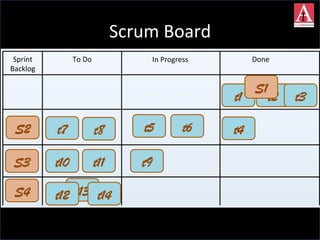
  Up	
  
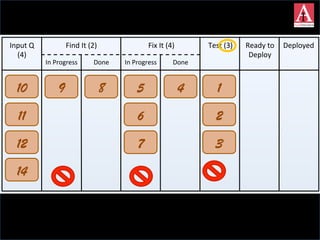
Copyright	
  ©	
  2013	
  AgileInnova4on	
  
1	
  
Where	
  Scrum	
  won’t	
  fit:	
  	
  
Ge2ng	
  Agile	
  with	
  Kanban	
  in	
  IT	
  Ops	
  and	
  
Support	
  
This	
  material	
  is	
  Copyright	
  
Protected	
  under	
  the	
  following	
  
Crea4ve	
  Commons	
  License:	


AGribu4on-­‐ShareAlike	
  3.0	


Please	
  use	
  this	
  material	
  freely	
  
and	
  derive	
  further	
  work	
  from	
  it.	
  
BUT,	
  aGribu4on	
  must	
  be	
  given	
  
to	
  the	
  original	
  author,	
  and	
  
these	
  same	
  rights	
  must	
  govern	
  
all	
  derived	
  works.	


Please	
  use	
  the	
  following	
  
aGribu4on:	
  
“Colm	
  O’hEocha,	
  
AgileInnova4on	
  Ltd.	
  2013:	
  
www.agileinnova4on.eu”	
  	
  
Scrum	
  –	
  CommiGed	
  Sprint	
  Work	
  Items	
  
Commitment:	
  To	
  Work	
  Items	
  
•  Well	
  Groomed/Understood	
  Items	
  
•  Acceptance	
  Criteria/Tests	
  Predefined	
  
•  Short	
  Planning	
  Horizon	
  
•  Evidence	
  Based	
  Planning	
  
•  Explicit	
  Policies	
  (e.g.	
  DoD)	
  
•  Stable,	
  Cross-­‐Func4onal	
  Team	
  
•  Fast	
  Feedback	
  (Inspect	
  &	
  Adapt)	
  
Commitment	
  to	
  Sprint	
  Plan:	
  100%	
  Velocity	
  means	
  we’ll	
  ‘fail’	
  half	
  the	
  4me	
  	
  
Lets	
  Protect	
  Ourselves:	
  Build	
  in	
  a	
  ‘Con4ngency’	
  (or	
  two)	
  
Parkinson's	
  Law:	
  Work	
  expands	
  to	
  fill	
  4me	
  allocated	
  to	
  it	
  
Work	
  Takes	
  Longer	
  
How	
  we	
  Build	
  Predictability	
  (and	
  commit):	
  
Copyright	
  ©	
  2013	
  AgileInnova4on	
  
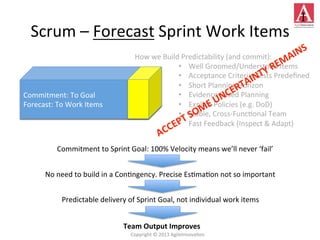
Scrum	
  –	
  Forecast	
  Sprint	
  Work	
  Items	
  
Commitment:	
  To	
  Goal	
  
Forecast:	
  To	
  Work	
  Items	
  
•  Well	
  Groomed/Understood	
  Items	
  
•  Acceptance	
  Criteria/Tests	
  Predefined	
  
•  Short	
  Planning	
  Horizon	
  
•  Evidence	
  Based	
  Planning	
  
•  Explicit	
  Policies	
  (e.g.	
  DoD)	
  
•  Stable,	
  Cross-­‐Func4onal	
  Team	
  
•  Fast	
  Feedback	
  (Inspect	
  &	
  Adapt)	
  
Commitment	
  to	
  Sprint	
  Goal:	
  100%	
  Velocity	
  means	
  we’ll	
  never	
  ‘fail’	
  
No	
  need	
  to	
  build	
  in	
  a	
  Con4ngency.	
  Precise	
  Es4ma4on	
  not	
  so	
  important	
  
Predictable	
  delivery	
  of	
  Sprint	
  Goal,	
  not	
  individual	
  work	
  items	
  
Team	
  Output	
  Improves	
  	
  
How	
  we	
  Build	
  Predictability	
  (and	
  commit):	
  
Copyright	
  ©	
  2013	
  AgileInnova4on	
  
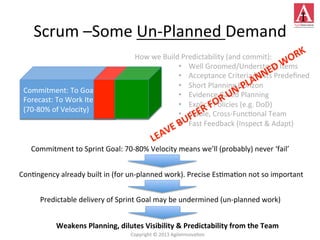
Scrum	
  –Some	
  Un-­‐Planned	
  Demand	
  
Commitment:	
  To	
  Goal	
  
Forecast:	
  To	
  Work	
  Items	
  
(70-­‐80%	
  of	
  Velocity)	
  
•  Well	
  Groomed/Understood	
  Items	
  
•  Acceptance	
  Criteria/Tests	
  Predefined	
  
•  Short	
  Planning	
  Horizon	
  
•  Evidence	
  Based	
  Planning	
  
•  Explicit	
  Policies	
  (e.g.	
  DoD)	
  
•  Stable,	
  Cross-­‐Func4onal	
  Team	
  
•  Fast	
  Feedback	
  (Inspect	
  &	
  Adapt)	
  
Commitment	
  to	
  Sprint	
  Goal:	
  70-­‐80%	
  Velocity	
  means	
  we’ll	
  (probably)	
  never	
  ‘fail’	
  
Con4ngency	
  already	
  built	
  in	
  (for	
  un-­‐planned	
  work).	
  Precise	
  Es4ma4on	
  not	
  so	
  important	
  
Predictable	
  delivery	
  of	
  Sprint	
  Goal	
  may	
  be	
  undermined	
  (un-­‐planned	
  work)	
  
Weakens	
  Planning,	
  dilutes	
  Visibility	
  &	
  Predictability	
  from	
  the	
  Team	
  
How	
  we	
  Build	
  Predictability	
  (and	
  commit):	
  
Copyright	
  ©	
  2013	
  AgileInnova4on	
  
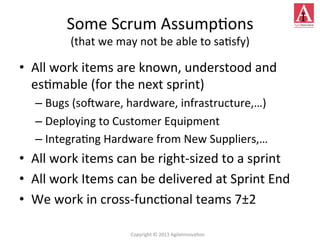
Some	
  Scrum	
  Assump4ons	
  
(that	
  we	
  may	
  not	
  be	
  able	
  to	
  sa4sfy)	
  
•  All	
  work	
  items	
  are	
  known,	
  understood	
  and	
  
es4mable	
  (for	
  the	
  next	
  sprint)	
  
– Bugs	
  (soeware,	
  hardware,	
  infrastructure,…)	
  
– Deploying	
  to	
  Customer	
  Equipment	
  
– Integra4ng	
  Hardware	
  from	
  New	
  Suppliers,…	
  
•  All	
  work	
  items	
  can	
  be	
  right-­‐sized	
  to	
  a	
  sprint	
  
•  All	
  work	
  Items	
  can	
  be	
  delivered	
  at	
  Sprint	
  End	
  
•  We	
  work	
  in	
  cross-­‐func4onal	
  teams	
  7±2	
  
Copyright	
  ©	
  2013	
  AgileInnova4on	
  
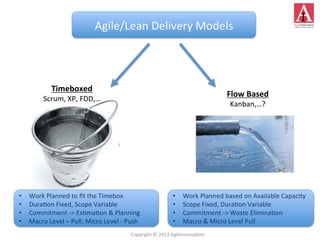
Agile/Lean	
  Delivery	
  Models	
  
Timeboxed	
  
Scrum,	
  XP,	
  FDD,…	
  
Flow	
  Based	
  
Kanban,…?	
  
•  Work	
  Planned	
  based	
  on	
  Available	
  Capacity	
  
•  Scope	
  Fixed,	
  Dura4on	
  Variable	
  
•  Commitment	
  -­‐>	
  Waste	
  Elimina4on	
  
•  Macro	
  &	
  Micro	
  Level	
  Pull	
  
•  Work	
  Planned	
  to	
  fit	
  the	
  Timebox	
  
•  Dura4on	
  Fixed,	
  Scope	
  Variable	
  
•  Commitment	
  -­‐>	
  Es4ma4on	
  &	
  Planning	
  
•  Macro	
  Level	
  –	
  Pull;	
  Micro	
  Level	
  -­‐	
  Push	
  
Copyright	
  ©	
  2013	
  AgileInnova4on	
  
Sprint	
  
Backlog	
  
To	
  Do	
   In	
  Progress	
   Done	
  
t1 t2 t3
t5 t6t7 t4
t9
t8
t10
t13
t11
t12 t14
S1
S2
S3
S4
Scrum	
  Board	
  
Input	
  Q	
  
(4)	
  
Find	
  It	
  (2)	
   Fix	
  It	
  (4)	
   Test	
  (3)	
   Ready	
  to	
  
Deploy	
  
Deployed	
  
In	
  Progress	
   Done	
   In	
  Progress	
   Done	
  
1
2
3
5
6
7
49 810
13
11
12
14
Kanban	
  Mechanics	
  in	
  a	
  Nutshell	
  
IteraLon	
  Based	
  (Scrum)	
   Flow	
  Based	
  (Kanban)	
  
Focus	
  on	
  maximising	
  work	
  done	
  in	
  an	
  sprint	
  
(max	
  Velocity)	
  
Focus	
  on	
  minimising	
  the	
  4me	
  to	
  get	
  a	
  piece	
  
of	
  work	
  from	
  start	
  to	
  finish	
  (min	
  Cycle	
  Time)	
  
WIP	
  limited	
  indirectly	
  (per	
  sprint)	
   WIP	
  limited	
  directly	
  (per	
  workflow	
  state)	
  
Somewhat	
  Predictable,	
  Es4mable	
  Work	
   Interrupt	
  Driven,	
  Highly	
  Variable	
  Demand	
  
Sprints	
  Immutable	
  (by	
  Work	
  Items	
  or	
  Goal)	
   Finish	
  something	
  before	
  you	
  start	
  something	
  
else	
  (expedi4ng	
  excep4onal)	
  
Scope	
  extends	
  to	
  work	
  of	
  the	
  Team	
   Scope	
  extends	
  across	
  a	
  Value	
  Stream	
  
Scope	
  Can	
  Vary	
   Scope	
  Oeen	
  Fixed	
  
Predictability	
  Paramount	
   Responsiveness	
  Paramount	
  
Any	
  type	
  of	
  (Plannable)	
  Work	
   Design	
  for	
  the	
  Work	
  Expected:	
  WIT,	
  CoS,	
  SLA	
  
Coupled	
  I/O	
  cadence	
   Decoupled	
  I/O	
  Cadences	
  
Periodic	
  Retrospec4ves	
   Stop	
  the	
  Line	
  –	
  Fix	
  as	
  it	
  Happens	
  
X-­‐Func4onal,	
  Generalizing	
  Teams	
  (7±2)	
   High	
  Specializa4on	
  with	
  Hand-­‐Offs	
  Possible	
  
Scrum	
  &	
  Kanban	
  Summary	
  -­‐	
  Differences	
  
10	
  
Copyright	
  ©	
  2013	
  AgileInnova4on	
  
•  Scrum	
  
–  Teams	
  may	
  struggle	
  to	
  break	
  up	
  work,	
  deliver	
  
poten;ally	
  releasable	
  product,	
  achieve	
  transparency	
  &	
  
joint	
  responsibility	
  
–  Management	
  may	
  struggle	
  to	
  allow	
  self-­‐organisa;on,	
  
variable	
  scope	
  and	
  to	
  maintain	
  sprint	
  discipline	
  
•  Kanban	
  
–  Teams	
  may	
  struggle	
  with	
  a	
  lack	
  of	
  prescribed	
  
structure	
  (e.g.	
  cadence	
  of	
  events,	
  Scrum	
  roles)	
  
–  Management	
  may	
  struggle	
  with	
  a	
  lack	
  of	
  
commitment,	
  milestones	
  and	
  ‘big-­‐bang’	
  change	
  
11	
  
Both	
  are	
  Simple,	
  Neither	
  are	
  Easy	
  
Copyright	
  ©	
  2013	
  AgileInnova4on	
  
•  Visualising	
  your	
  value	
  stream	
  
•  Defining	
  WITs,	
  CoS,	
  Policies	
  
•  Managing	
  Flow	
  –	
  Balancing	
  Demand	
  to	
  Capacity,	
  
Handling	
  BoGlenecks	
  
•  Stakeholder	
  Engagement	
  Models	
  
•  Input	
  &	
  Output	
  Cadences	
  
•  Metrics	
  &	
  Repor4ng	
  
•  Scaling	
  Kanban	
  
•  Managing	
  Variability	
  
Kanban	
  for	
  Complex	
  Domains:	
  
Copyright	
  ©	
  2013	
  AgileInnova4on	
  
Colm	
  O’hEocha	
  
AgileInnova4on	
  Limited	


www.agileinnova4on.ie	
  
Colm@agileinnova4on.ie	
  
•  Services	
  
–  Pre	
  and	
  Post	
  Agile	
  Adop;on	
  Assessments	
  
–  Working	
  with	
  Senior	
  Management	
  on	
  agile	
  adop;on	
  strategies,	
  
re-­‐structuring,	
  re-­‐skilling	
  
–  Kanban	
  Bootstrap	
  –	
  a	
  structured	
  approach	
  to	
  implemen;ng	
  
Kanban	
  
•  Training	
  and	
  Coaching	
  
–  Professional	
  ScrumMaster	
  and	
  PMI	
  Agile	
  Cer4fied	
  Prac44oner	
  
–  Succeeding	
  with	
  Agile	
  and	
  Scrum	
  –	
  an	
  Agile	
  Primer	
  for	
  the	
  Team	
  
–  Geung	
  Lean	
  with	
  Kanban	
  
–  Execu4ve	
  Briefings	
  on	
  Agile	
  and	
  Lean	
  in	
  IT	
  –	
  benefits,	
  challenges	
  and	
  strategies	
  
–  Product	
  Owner	
  Training	
  
–  Agile	
  Requirements	
  –	
  User	
  Stories	
  and	
  Es4ma4on	
  
–  Agile	
  Tes4ng	
  
13	
  
Agile	
  Innova;on	
  
Lean/Agile	
  Training,	
  Coaching,	
  Consul;ng	
  
Copyright	
  ©	
  2013	
  AgileInnova4on	
  
This	
  material	
  is	
  Copyright	
  
Protected	
  under	
  the	
  following	
  
Crea4ve	
  Commons	
  License:	


AGribu4on-­‐ShareAlike	
  3.0	


Please	
  use	
  this	
  material	
  freely	
  
and	
  derive	
  further	
  work	
  from	
  it.	
  
BUT,	
  aGribu4on	
  must	
  be	
  given	
  
to	
  the	
  original	
  author,	
  and	
  
these	
  same	
  rights	
  must	
  govern	
  
all	
  derived	
  works.	


Please	
  use	
  the	
  following	
  
aGribu4on:	
  
“Colm	
  O’hEocha,	
  
AgileInnova4on	
  Ltd.	
  2010:	
  
www.agileinnova4on.eu”	


Where scrum doesn't fit

  • 1.
      Colm  O’hEocha  –  AgileInnova4on   Slow  Down  to  Speed  Up   Copyright  ©  2013  AgileInnova4on   1   Where  Scrum  won’t  fit:     Ge2ng  Agile  with  Kanban  in  IT  Ops  and   Support  
  • 2.
    This  material  is  Copyright   Protected  under  the  following   Crea4ve  Commons  License:     AGribu4on-­‐ShareAlike  3.0     Please  use  this  material  freely   and  derive  further  work  from  it.   BUT,  aGribu4on  must  be  given   to  the  original  author,  and   these  same  rights  must  govern   all  derived  works.     Please  use  the  following   aGribu4on:   “Colm  O’hEocha,   AgileInnova4on  Ltd.  2013:   www.agileinnova4on.eu”    
  • 3.
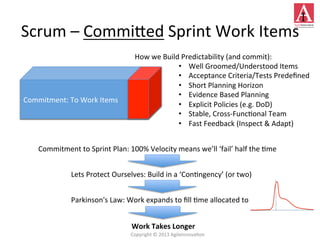
    Scrum  –  CommiGed  Sprint  Work  Items   Commitment:  To  Work  Items   •  Well  Groomed/Understood  Items   •  Acceptance  Criteria/Tests  Predefined   •  Short  Planning  Horizon   •  Evidence  Based  Planning   •  Explicit  Policies  (e.g.  DoD)   •  Stable,  Cross-­‐Func4onal  Team   •  Fast  Feedback  (Inspect  &  Adapt)   Commitment  to  Sprint  Plan:  100%  Velocity  means  we’ll  ‘fail’  half  the  4me     Lets  Protect  Ourselves:  Build  in  a  ‘Con4ngency’  (or  two)   Parkinson's  Law:  Work  expands  to  fill  4me  allocated  to  it   Work  Takes  Longer   How  we  Build  Predictability  (and  commit):   Copyright  ©  2013  AgileInnova4on  
  • 4.
    Scrum  –  Forecast  Sprint  Work  Items   Commitment:  To  Goal   Forecast:  To  Work  Items   •  Well  Groomed/Understood  Items   •  Acceptance  Criteria/Tests  Predefined   •  Short  Planning  Horizon   •  Evidence  Based  Planning   •  Explicit  Policies  (e.g.  DoD)   •  Stable,  Cross-­‐Func4onal  Team   •  Fast  Feedback  (Inspect  &  Adapt)   Commitment  to  Sprint  Goal:  100%  Velocity  means  we’ll  never  ‘fail’   No  need  to  build  in  a  Con4ngency.  Precise  Es4ma4on  not  so  important   Predictable  delivery  of  Sprint  Goal,  not  individual  work  items   Team  Output  Improves     How  we  Build  Predictability  (and  commit):   Copyright  ©  2013  AgileInnova4on  
  • 5.
    Scrum  –Some  Un-­‐Planned  Demand   Commitment:  To  Goal   Forecast:  To  Work  Items   (70-­‐80%  of  Velocity)   •  Well  Groomed/Understood  Items   •  Acceptance  Criteria/Tests  Predefined   •  Short  Planning  Horizon   •  Evidence  Based  Planning   •  Explicit  Policies  (e.g.  DoD)   •  Stable,  Cross-­‐Func4onal  Team   •  Fast  Feedback  (Inspect  &  Adapt)   Commitment  to  Sprint  Goal:  70-­‐80%  Velocity  means  we’ll  (probably)  never  ‘fail’   Con4ngency  already  built  in  (for  un-­‐planned  work).  Precise  Es4ma4on  not  so  important   Predictable  delivery  of  Sprint  Goal  may  be  undermined  (un-­‐planned  work)   Weakens  Planning,  dilutes  Visibility  &  Predictability  from  the  Team   How  we  Build  Predictability  (and  commit):   Copyright  ©  2013  AgileInnova4on  
  • 6.
    Some  Scrum  Assump4ons   (that  we  may  not  be  able  to  sa4sfy)   •  All  work  items  are  known,  understood  and   es4mable  (for  the  next  sprint)   – Bugs  (soeware,  hardware,  infrastructure,…)   – Deploying  to  Customer  Equipment   – Integra4ng  Hardware  from  New  Suppliers,…   •  All  work  items  can  be  right-­‐sized  to  a  sprint   •  All  work  Items  can  be  delivered  at  Sprint  End   •  We  work  in  cross-­‐func4onal  teams  7±2   Copyright  ©  2013  AgileInnova4on  
  • 7.
    Agile/Lean  Delivery  Models   Timeboxed   Scrum,  XP,  FDD,…   Flow  Based   Kanban,…?   •  Work  Planned  based  on  Available  Capacity   •  Scope  Fixed,  Dura4on  Variable   •  Commitment  -­‐>  Waste  Elimina4on   •  Macro  &  Micro  Level  Pull   •  Work  Planned  to  fit  the  Timebox   •  Dura4on  Fixed,  Scope  Variable   •  Commitment  -­‐>  Es4ma4on  &  Planning   •  Macro  Level  –  Pull;  Micro  Level  -­‐  Push   Copyright  ©  2013  AgileInnova4on  
  • 8.
    Sprint   Backlog   To  Do   In  Progress   Done   t1 t2 t3 t5 t6t7 t4 t9 t8 t10 t13 t11 t12 t14 S1 S2 S3 S4 Scrum  Board  
  • 9.
    Input  Q   (4)   Find  It  (2)   Fix  It  (4)   Test  (3)   Ready  to   Deploy   Deployed   In  Progress   Done   In  Progress   Done   1 2 3 5 6 7 49 810 13 11 12 14 Kanban  Mechanics  in  a  Nutshell  
  • 10.
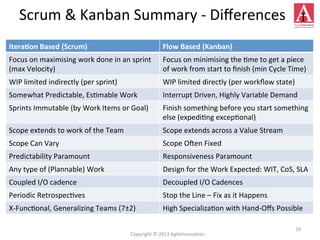
    IteraLon  Based  (Scrum)   Flow  Based  (Kanban)   Focus  on  maximising  work  done  in  an  sprint   (max  Velocity)   Focus  on  minimising  the  4me  to  get  a  piece   of  work  from  start  to  finish  (min  Cycle  Time)   WIP  limited  indirectly  (per  sprint)   WIP  limited  directly  (per  workflow  state)   Somewhat  Predictable,  Es4mable  Work   Interrupt  Driven,  Highly  Variable  Demand   Sprints  Immutable  (by  Work  Items  or  Goal)   Finish  something  before  you  start  something   else  (expedi4ng  excep4onal)   Scope  extends  to  work  of  the  Team   Scope  extends  across  a  Value  Stream   Scope  Can  Vary   Scope  Oeen  Fixed   Predictability  Paramount   Responsiveness  Paramount   Any  type  of  (Plannable)  Work   Design  for  the  Work  Expected:  WIT,  CoS,  SLA   Coupled  I/O  cadence   Decoupled  I/O  Cadences   Periodic  Retrospec4ves   Stop  the  Line  –  Fix  as  it  Happens   X-­‐Func4onal,  Generalizing  Teams  (7±2)   High  Specializa4on  with  Hand-­‐Offs  Possible   Scrum  &  Kanban  Summary  -­‐  Differences   10   Copyright  ©  2013  AgileInnova4on  
  • 11.
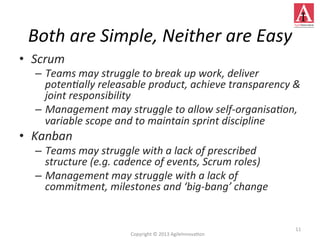
    •  Scrum   – Teams  may  struggle  to  break  up  work,  deliver   poten;ally  releasable  product,  achieve  transparency  &   joint  responsibility   –  Management  may  struggle  to  allow  self-­‐organisa;on,   variable  scope  and  to  maintain  sprint  discipline   •  Kanban   –  Teams  may  struggle  with  a  lack  of  prescribed   structure  (e.g.  cadence  of  events,  Scrum  roles)   –  Management  may  struggle  with  a  lack  of   commitment,  milestones  and  ‘big-­‐bang’  change   11   Both  are  Simple,  Neither  are  Easy   Copyright  ©  2013  AgileInnova4on  
  • 12.
    •  Visualising  your  value  stream   •  Defining  WITs,  CoS,  Policies   •  Managing  Flow  –  Balancing  Demand  to  Capacity,   Handling  BoGlenecks   •  Stakeholder  Engagement  Models   •  Input  &  Output  Cadences   •  Metrics  &  Repor4ng   •  Scaling  Kanban   •  Managing  Variability   Kanban  for  Complex  Domains:   Copyright  ©  2013  AgileInnova4on   Colm  O’hEocha   AgileInnova4on  Limited           www.agileinnova4on.ie   Colm@agileinnova4on.ie  
  • 13.
    •  Services   – Pre  and  Post  Agile  Adop;on  Assessments   –  Working  with  Senior  Management  on  agile  adop;on  strategies,   re-­‐structuring,  re-­‐skilling   –  Kanban  Bootstrap  –  a  structured  approach  to  implemen;ng   Kanban   •  Training  and  Coaching   –  Professional  ScrumMaster  and  PMI  Agile  Cer4fied  Prac44oner   –  Succeeding  with  Agile  and  Scrum  –  an  Agile  Primer  for  the  Team   –  Geung  Lean  with  Kanban   –  Execu4ve  Briefings  on  Agile  and  Lean  in  IT  –  benefits,  challenges  and  strategies   –  Product  Owner  Training   –  Agile  Requirements  –  User  Stories  and  Es4ma4on   –  Agile  Tes4ng   13   Agile  Innova;on   Lean/Agile  Training,  Coaching,  Consul;ng   Copyright  ©  2013  AgileInnova4on  
  • 14.
    This  material  is  Copyright   Protected  under  the  following   Crea4ve  Commons  License:     AGribu4on-­‐ShareAlike  3.0     Please  use  this  material  freely   and  derive  further  work  from  it.   BUT,  aGribu4on  must  be  given   to  the  original  author,  and   these  same  rights  must  govern   all  derived  works.     Please  use  the  following   aGribu4on:   “Colm  O’hEocha,   AgileInnova4on  Ltd.  2010:   www.agileinnova4on.eu”