When to use Scrum ?
When to use Scrum ? (Continuing …. . )
 Product owner
 Scrum master
 Scrum team (5-9 people)
Product Owner
 Maintaining the product backlog
Prioritizing
Presentation of product backlog to the team
 Participation in sprint planning and sprint presentation
 Responsible for product vision and release management
 Can follow sprint via Daily Scrum, Burndown chart and via
Scrum Master
Scrum Team
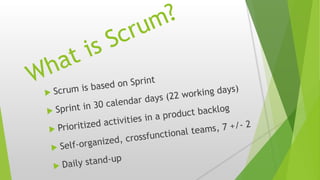
 Teams of 7 +/- 2 participants
 Cross-functional
 Best experts in the domain area
 Maintains the sprint backlog
 Self-organizing
Team decides who shall do what
They inspect and adapt as the sprint goes
along
 Have most of the powers during a sprint
 Responsible for the process
 Responsible for optimizing the Scrum environment
 Responsible for Daily Scrum
 Runs Sprint Retrospective
 Coach
1. Product Owner, Team, and other Stakeholders talk through
Product Backlog Items and prioritization.
2. Team determines how much time it has available to
commit during the Sprint
3. Team selects as much of the Product Backlog as it can
commit to deliver by the end of the Sprint, and turns it
into a plan
- Validates commitment by breaking down into tasks with time
estimates
- Team decides who will do what, when; thinks through sequencing,
dependencies, possible task trades, and so forth.
Daily Scrum
 Daily Scrum must not last more than 15 minutes
 Held same place, same time, every working day
 Participants can not be late
 Anybody can come, but only the team and Scrum
Master can speak
 3 questions answered by each team member
What did I do yesterday?
What am I going to do today?
What are my impediments?
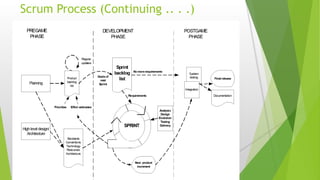
 Definition of the system being developed.
 Create A Product Backlog list is created containing all
the requirements that are currently known.
 The requirements are prioritized
 The effort needed for their implementation is
estimated.
 The product Backlog list is constantly updated .
 Architecture is planned based on the current
items in the Product Backlog.
 In case of an enhancement to an existing system,
the changes needed for implementing the Backlog
items are identified along with the problems they
may cause.
 A design review meeting is held to go over the
proposals for the implementation and decisions
are made on the basis of this review.
 This phase is entered when an agreement has been
made that the environmental variables such as the
requirements are completed.
 In this case, no more items and issues can be found
nor can any new ones be invented. The system is
now ready for the release and the preparation for
this is done during the post-game phase, including
the tasks such as the integration, system testing and
documentation.
Scrum Process (Continuing .. . .)
Who is using Scrum?
 Yahoo
 Sun
 Simens
 Nokia
 Philips
 BBC
 IBM
 US Federal Reserve
 SAP
 H P
 Motorola
 TransUnion
 Google
 Microsoft
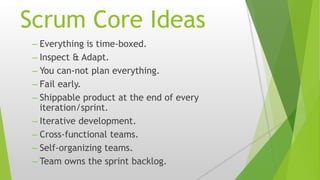
Scrum Core Ideas
– Everything is time-boxed.
– Inspect & Adapt.
– You can-not plan everything.
– Fail early.
– Shippable product at the end of every
iteration/sprint.
– Iterative development.
– Cross-functional teams.
– Self-organizing teams.
– Team owns the sprint backlog.
Thank You 

Scrum

  • 8.
    When to useScrum ?
  • 9.
    When to useScrum ? (Continuing …. . )
  • 10.
     Product owner Scrum master  Scrum team (5-9 people)
  • 11.
    Product Owner  Maintainingthe product backlog Prioritizing Presentation of product backlog to the team  Participation in sprint planning and sprint presentation  Responsible for product vision and release management  Can follow sprint via Daily Scrum, Burndown chart and via Scrum Master
  • 12.
    Scrum Team  Teamsof 7 +/- 2 participants  Cross-functional  Best experts in the domain area  Maintains the sprint backlog  Self-organizing Team decides who shall do what They inspect and adapt as the sprint goes along  Have most of the powers during a sprint
  • 13.
     Responsible forthe process  Responsible for optimizing the Scrum environment  Responsible for Daily Scrum  Runs Sprint Retrospective  Coach
  • 14.
    1. Product Owner,Team, and other Stakeholders talk through Product Backlog Items and prioritization. 2. Team determines how much time it has available to commit during the Sprint 3. Team selects as much of the Product Backlog as it can commit to deliver by the end of the Sprint, and turns it into a plan - Validates commitment by breaking down into tasks with time estimates - Team decides who will do what, when; thinks through sequencing, dependencies, possible task trades, and so forth.
  • 15.
    Daily Scrum  DailyScrum must not last more than 15 minutes  Held same place, same time, every working day  Participants can not be late  Anybody can come, but only the team and Scrum Master can speak  3 questions answered by each team member What did I do yesterday? What am I going to do today? What are my impediments?
  • 20.
     Definition ofthe system being developed.  Create A Product Backlog list is created containing all the requirements that are currently known.  The requirements are prioritized  The effort needed for their implementation is estimated.  The product Backlog list is constantly updated .
  • 21.
     Architecture isplanned based on the current items in the Product Backlog.  In case of an enhancement to an existing system, the changes needed for implementing the Backlog items are identified along with the problems they may cause.  A design review meeting is held to go over the proposals for the implementation and decisions are made on the basis of this review.
  • 24.
     This phaseis entered when an agreement has been made that the environmental variables such as the requirements are completed.  In this case, no more items and issues can be found nor can any new ones be invented. The system is now ready for the release and the preparation for this is done during the post-game phase, including the tasks such as the integration, system testing and documentation.
  • 25.
  • 26.
    Who is usingScrum?  Yahoo  Sun  Simens  Nokia  Philips  BBC  IBM  US Federal Reserve  SAP  H P  Motorola  TransUnion  Google  Microsoft
  • 27.
    Scrum Core Ideas –Everything is time-boxed. – Inspect & Adapt. – You can-not plan everything. – Fail early. – Shippable product at the end of every iteration/sprint. – Iterative development. – Cross-functional teams. – Self-organizing teams. – Team owns the sprint backlog.
  • 29.