Book by Charles Duhigg
Presented by Tomas “KLepo” Klesken at LIC BB 2013
“All our life, so far as it has definite
form, is but a mass of habits.”
William James, 1892
“More than 40 percent of the actions
people performed each day weren’t
actual decisions, but habits.”
Duke University research, 2006
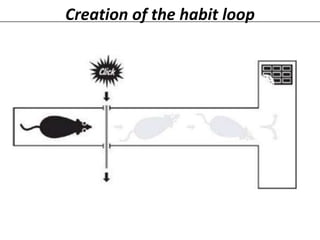
Creation of the habit loop
What is the

doing?

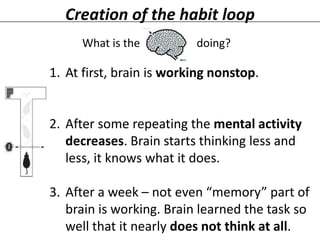
1. At first, brain is working nonstop.

2. After some repeating the mental activity
decreases. Brain starts thinking less and
less, it knows what it does.
3. After a week – not even “memory” part of
brain is working. Brain learned the task so
well that it nearly does not think at all.
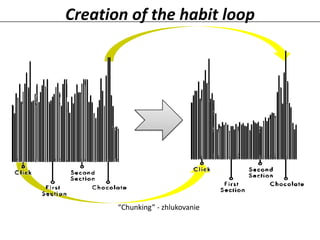
Creation of the habit loop

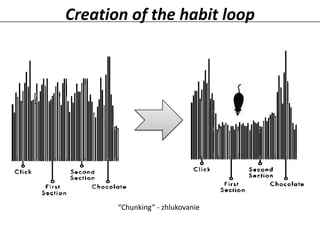
“Chunking” - zhlukovanie
Creation of the habit loop

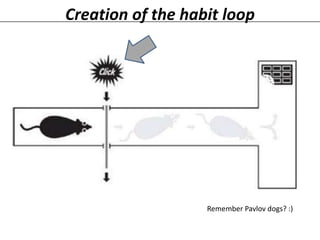
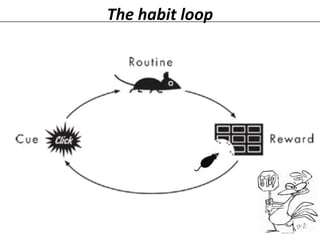
Remember Pavlov dogs? :)
The habit loop
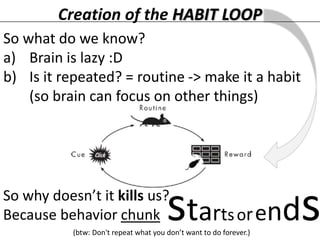
Creation of the HABIT LOOP
So what do we know?
a) Brain is lazy :D
b) Is it repeated? = routine -> make it a habit
(so brain can focus on other things)

star

So why doesn’t it kills us?
Because behavior chunk

ts or en

(btw: Don't repeat what you don’t want to do forever.)

ds
Creation of the habit loop

“Chunking” - zhlukovanie
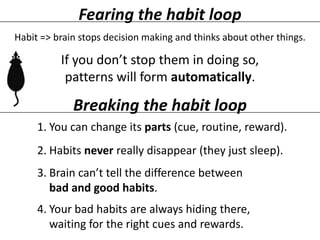
Fearing the habit loop
Habit => brain stops decision making and thinks about other things.

If you don’t stop them in doing so,
patterns will form automatically.

Breaking the habit loop
1. You can change its parts (cue, routine, reward).

2. Habits never really disappear (they just sleep).
3. Brain can’t tell the difference between
bad and good habits.

4. Your bad habits are always hiding there,
waiting for the right cues and rewards.
Habit loop: Addiction

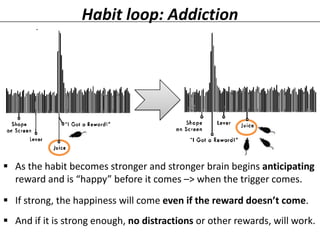
 As the habit becomes stronger and stronger brain begins anticipating
reward and is “happy” before it comes –> when the trigger comes.

 If strong, the happiness will come even if the reward doesn’t come.
 And if it is strong enough, no distractions or other rewards, will work.
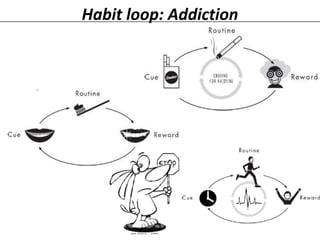
Habit loop: Addiction
Habit loop: Changing habits
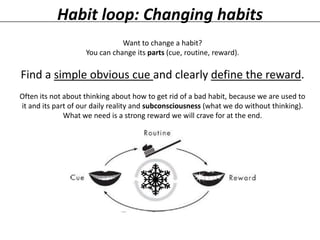
Want to change a habit?
You can change its parts (cue, routine, reward).

Find a simple obvious cue and clearly define the reward.
Often its not about thinking about how to get rid of a bad habit, because we are used to
it and its part of our daily reality and subconsciousness (what we do without thinking).
What we need is a strong reward we will crave for at the end.
Habit loop: Changing habits
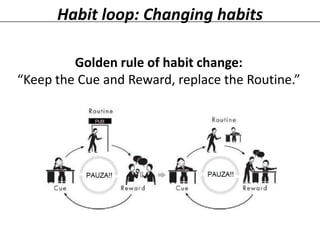
Golden rule of habit change:
“Keep the Cue and Reward, replace the Routine.”
Habit loop: Changing habits
Why do we fail?
1. Stress (under stress we think and selfcontrol less)
2. The original Cue returns and the Routine is back
Supporting the chances of success:
1.
Identify the loop
2.
Do a first step immediately upon deciding
3.
Belief (that change is possible) makes a difference
4.
Group/Team creates belief
(seeing the good examples & peer pressure & .their trust/support in you)
5.
Acting becomes reality (because the group believes in it)
6.
Do something for someone else (don’t be self centered)
7.
One good change will bring a general change – it makes you a better . .
.person by making it easier to adopt other good habits
8.
Adopt small habits (small wins), that will build the big goal
9.
You can not 100% plan the steps, you find them on the way
10. Radical changes are hard to keep, it needs to be long-term
IQ vs. self discipline
“Highly self-disciplined adolescents outperformed their more impulsive peers on
every academic-performance measure.”
“Students who exerted high levels of willpower were more likely to earn higher
grades. They had fewer absences and spent less time browsing internet and
more hours on studying.”
“Self-discipline has a bigger effect on academic performance than does
intellectual talent.”

“The best way to strengthen willpower and give people
an advantage is to make it into a habit.”
“Sometimes it looks like people with great self-control aren’t working hard—but
that’s because they’ve made it automatic.”
Research of University of Pennsylvania, 2005
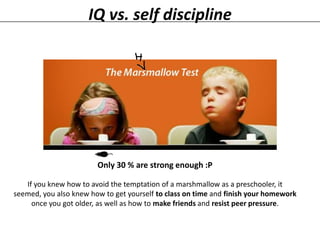
IQ vs. self discipline

Only 30 % are strong enough :P
If you knew how to avoid the temptation of a marshmallow as a preschooler, it
seemed, you also knew how to get yourself to class on time and finish your homework
once you got older, as well as how to make friends and resist peer pressure.
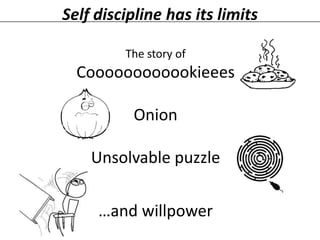
Self discipline has its limits
The story of

Coooooooooookieees
Onion

Unsolvable puzzle
…and willpower
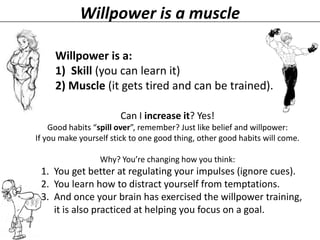
Willpower is a muscle
Willpower is a:
1) Skill (you can learn it)
2) Muscle (it gets tired and can be trained).
Can I increase it? Yes!
Good habits “spill over”, remember? Just like belief and willpower:
If you make yourself stick to one good thing, other good habits will come.
Why? You’re changing how you think:

1. You get better at regulating your impulses (ignore cues).
2. You learn how to distract yourself from temptations.
3. And once your brain has exercised the willpower training,
it is also practiced at helping you focus on a goal.
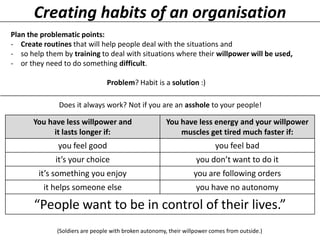
Creating habits of an organisation
Plan the problematic points:
- Create routines that will help people deal with the situations and
- so help them by training to deal with situations where their willpower will be used,
- or they need to do something difficult.
Problem? Habit is a solution :)
Does it always work? Not if you are an asshole to your people!

You have less willpower and
it lasts longer if:

You have less energy and your willpower
muscles get tired much faster if:

you feel good

you feel bad

it’s your choice

you don’t want to do it

it’s something you enjoy

you are following orders

it helps someone else

you have no autonomy

“People want to be in control of their lives.”
(Soldiers are people with broken autonomy, their willpower comes from outside.)
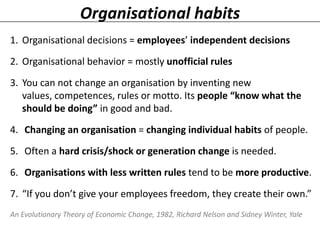
Organisational habits
1. Organisational decisions = employees’ independent decisions

2. Organisational behavior = mostly unofficial rules
3. You can not change an organisation by inventing new
values, competences, rules or motto. Its people “know what the
should be doing” in good and bad.
4. Changing an organisation = changing individual habits of people.
5. Often a hard crisis/shock or generation change is needed.

6. Organisations with less written rules tend to be more productive.
7. “If you don’t give your employees freedom, they create their own.”
An Evolutionary Theory of Economic Change, 1982, Richard Nelson and Sidney Winter, Yale
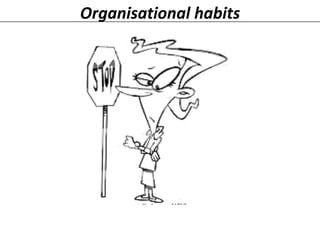
Organisational habits
Making a big change
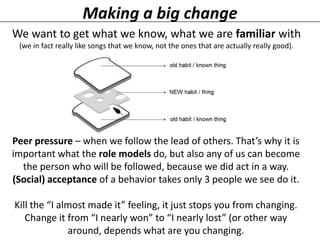
We want to get what we know, what we are familiar with
(we in fact really like songs that we know, not the ones that are actually really good).

Peer pressure – when we follow the lead of others. That’s why it is
important what the role models do, but also any of us can become
the person who will be followed, because we did act in a way.
(Social) acceptance of a behavior takes only 3 people we see do it.
Kill the “I almost made it” feeling, it just stops you from changing.
Change it from “I nearly won” to “I nearly lost” (or other way
around, depends what are you changing.
Making a big change
If you believe you can change
(if you make it a habit)
the change becomes real.

This is the real power of habit: the insight that
your habits are what you choose them to be.
Once that choice occurs—and becomes automatic—the change not only becomes
real, it starts to seem certain that it will happen.

Just like in “Secret”…oooooh :)
Making a change
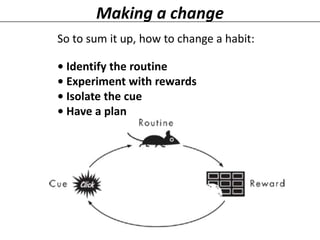
So to sum it up, how to change a habit:
• Identify the routine
• Experiment with rewards
• Isolate the cue
• Have a plan
Screening version - Habits (shortened books)

Screening version - Habits (shortened books)

  • 1.
    Book by CharlesDuhigg Presented by Tomas “KLepo” Klesken at LIC BB 2013
  • 2.
    “All our life,so far as it has definite form, is but a mass of habits.” William James, 1892
  • 3.
    “More than 40percent of the actions people performed each day weren’t actual decisions, but habits.” Duke University research, 2006
  • 4.
    Creation of thehabit loop
  • 5.
    Creation of thehabit loop What is the doing? 1. At first, brain is working nonstop. 2. After some repeating the mental activity decreases. Brain starts thinking less and less, it knows what it does. 3. After a week – not even “memory” part of brain is working. Brain learned the task so well that it nearly does not think at all.
  • 6.
    Creation of thehabit loop “Chunking” - zhlukovanie
  • 7.
    Creation of thehabit loop Remember Pavlov dogs? :)
  • 8.
  • 9.
    Creation of theHABIT LOOP So what do we know? a) Brain is lazy :D b) Is it repeated? = routine -> make it a habit (so brain can focus on other things) star So why doesn’t it kills us? Because behavior chunk ts or en (btw: Don't repeat what you don’t want to do forever.) ds
  • 10.
    Creation of thehabit loop “Chunking” - zhlukovanie
  • 11.
    Fearing the habitloop Habit => brain stops decision making and thinks about other things. If you don’t stop them in doing so, patterns will form automatically. Breaking the habit loop 1. You can change its parts (cue, routine, reward). 2. Habits never really disappear (they just sleep). 3. Brain can’t tell the difference between bad and good habits. 4. Your bad habits are always hiding there, waiting for the right cues and rewards.
  • 12.
    Habit loop: Addiction As the habit becomes stronger and stronger brain begins anticipating reward and is “happy” before it comes –> when the trigger comes.  If strong, the happiness will come even if the reward doesn’t come.  And if it is strong enough, no distractions or other rewards, will work.
  • 13.
  • 14.
    Habit loop: Changinghabits Want to change a habit? You can change its parts (cue, routine, reward). Find a simple obvious cue and clearly define the reward. Often its not about thinking about how to get rid of a bad habit, because we are used to it and its part of our daily reality and subconsciousness (what we do without thinking). What we need is a strong reward we will crave for at the end.
  • 15.
    Habit loop: Changinghabits Golden rule of habit change: “Keep the Cue and Reward, replace the Routine.”
  • 16.
    Habit loop: Changinghabits Why do we fail? 1. Stress (under stress we think and selfcontrol less) 2. The original Cue returns and the Routine is back Supporting the chances of success: 1. Identify the loop 2. Do a first step immediately upon deciding 3. Belief (that change is possible) makes a difference 4. Group/Team creates belief (seeing the good examples & peer pressure & .their trust/support in you) 5. Acting becomes reality (because the group believes in it) 6. Do something for someone else (don’t be self centered) 7. One good change will bring a general change – it makes you a better . . .person by making it easier to adopt other good habits 8. Adopt small habits (small wins), that will build the big goal 9. You can not 100% plan the steps, you find them on the way 10. Radical changes are hard to keep, it needs to be long-term
  • 17.
    IQ vs. selfdiscipline “Highly self-disciplined adolescents outperformed their more impulsive peers on every academic-performance measure.” “Students who exerted high levels of willpower were more likely to earn higher grades. They had fewer absences and spent less time browsing internet and more hours on studying.” “Self-discipline has a bigger effect on academic performance than does intellectual talent.” “The best way to strengthen willpower and give people an advantage is to make it into a habit.” “Sometimes it looks like people with great self-control aren’t working hard—but that’s because they’ve made it automatic.” Research of University of Pennsylvania, 2005
  • 18.
    IQ vs. selfdiscipline Only 30 % are strong enough :P If you knew how to avoid the temptation of a marshmallow as a preschooler, it seemed, you also knew how to get yourself to class on time and finish your homework once you got older, as well as how to make friends and resist peer pressure.
  • 19.
    Self discipline hasits limits The story of Coooooooooookieees Onion Unsolvable puzzle …and willpower
  • 20.
    Willpower is amuscle Willpower is a: 1) Skill (you can learn it) 2) Muscle (it gets tired and can be trained). Can I increase it? Yes! Good habits “spill over”, remember? Just like belief and willpower: If you make yourself stick to one good thing, other good habits will come. Why? You’re changing how you think: 1. You get better at regulating your impulses (ignore cues). 2. You learn how to distract yourself from temptations. 3. And once your brain has exercised the willpower training, it is also practiced at helping you focus on a goal.
  • 21.
    Creating habits ofan organisation Plan the problematic points: - Create routines that will help people deal with the situations and - so help them by training to deal with situations where their willpower will be used, - or they need to do something difficult. Problem? Habit is a solution :) Does it always work? Not if you are an asshole to your people! You have less willpower and it lasts longer if: You have less energy and your willpower muscles get tired much faster if: you feel good you feel bad it’s your choice you don’t want to do it it’s something you enjoy you are following orders it helps someone else you have no autonomy “People want to be in control of their lives.” (Soldiers are people with broken autonomy, their willpower comes from outside.)
  • 22.
    Organisational habits 1. Organisationaldecisions = employees’ independent decisions 2. Organisational behavior = mostly unofficial rules 3. You can not change an organisation by inventing new values, competences, rules or motto. Its people “know what the should be doing” in good and bad. 4. Changing an organisation = changing individual habits of people. 5. Often a hard crisis/shock or generation change is needed. 6. Organisations with less written rules tend to be more productive. 7. “If you don’t give your employees freedom, they create their own.” An Evolutionary Theory of Economic Change, 1982, Richard Nelson and Sidney Winter, Yale
  • 23.
  • 24.
    Making a bigchange We want to get what we know, what we are familiar with (we in fact really like songs that we know, not the ones that are actually really good). Peer pressure – when we follow the lead of others. That’s why it is important what the role models do, but also any of us can become the person who will be followed, because we did act in a way. (Social) acceptance of a behavior takes only 3 people we see do it. Kill the “I almost made it” feeling, it just stops you from changing. Change it from “I nearly won” to “I nearly lost” (or other way around, depends what are you changing.
  • 25.
    Making a bigchange If you believe you can change (if you make it a habit) the change becomes real. This is the real power of habit: the insight that your habits are what you choose them to be. Once that choice occurs—and becomes automatic—the change not only becomes real, it starts to seem certain that it will happen. Just like in “Secret”…oooooh :)
  • 26.
    Making a change Soto sum it up, how to change a habit: • Identify the routine • Experiment with rewards • Isolate the cue • Have a plan