Atomic Habits – Proven Way
To Build Good Habits and
Break Bad Ones
James Clear
Atomic Habits
People think when you want to change your life , you need to
think big. But habits expert James Clear has discovered
another way
He says that real change comes from the compound effect of
hundreds of small decisions – doing two-push ups a day /
meditating for five minutes or reading just one more page
He calls them Atomic-Habits
Forget About Goals – Think Process
Winners and losers have the same
goal
Achieving a goal is only a momentary
change
Goals restrict your happiness
Goals are at odds with long term
progress
How To Inculcate Habits
Decide the type of person you want to
be
Prove it to yourself with small wins
Identity Drives Habits
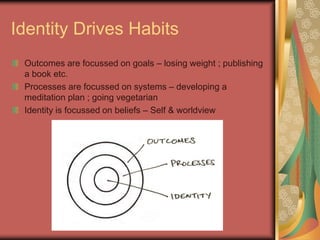
Outcomes are focussed on goals – losing weight ; publishing
a book etc.
Processes are focussed on systems – developing a
meditation plan ; going vegetarian
Identity is focussed on beliefs – Self & worldview
Identity Drives Habits
The goal is not to read a book , the
goal is to become a reader
The goal is not run a marathon , the
goal is to become a runner
The goal is not learn an instrument,
the goal is to become a musician
The goal is not to meditate, the goal is
to be “aware” at all times
Identity Drives Habit
Each time you write a page, you are a
writer
Each time you practice the violin, you
are a musician
Each time you start a workout , you
are an athlete
Each time you meditate, you are
“aware”
Identity
Most proven test scientifically is called
“Big Five” – 5 spectrum of behaviour
Openness to Experience : from curious and inventive on
one end to cautious and consistent on the other
Conscientiousness : organized and efficient to easy
going and spontaneous
Extroversion : outgoing and energetic to solitary and
reserved
Agreeableness : friendly and compassionate to
challenging and detached
Neuroticism : anxious and sensitive to confident, calm
and stable
Atomic Habits
If you are having trouble changing your habits, the
problem isn't you. The problem is your system
You do not rise to the level of your goals. You fall
to the level of your systems
Atoms are the building blocks of molecules, atomic
habits are the building blocks of remarkable
results
Power of 1% - incremental changes
Plateau of Latent Potential ( Remember boiling of
water only happens at 100 degrees C )
The Habit Loop
Cue triggers a craving, which motivates a
response, which provides a reward, which
satisfies the craving and ultimately becomes
associated with the cue to forma neurological
loop
Habit Loop - Cue
Cue is trigger – Brain (amygdala) is constantly looking for
cues that will result in rewards & threats
Awareness is the key to pick the cues
While improving our awareness, we can also create cues by
“Making-It-Obvious”
Making-It-Obvious can be achieved by the following
techniques :
Habit scorecard
Implementation Intention
Habit Stacking
Prime the environment
Habit Scorecard
Objective is to raise the level of awareness from a
nonconscious to conscious level
Pointing & Calling
Habits scorecard is a simple exercise to become
more aware of our behaviour
List what all you do from morning when you wake
up to night when you go to sleep
Then put “+” for good habit ; “-” for bad habit and
“=“ for neutral habit
Implementation Intention
Cues that trigger a habit are many but the most common or
time & location
Implementation Intention leverages both these cues
II sweeps out foggy notions like “I will be more productive” “I
will meditate regularly” “I will be fitter”
I will [ BEHAVIOUR ] at [ TIME ] in [LOCATION ]
Meditation – I will meditate for five minutes at 0700am in Puja room
Reading – I will read two pages everyday at 0800pm in the balcony
Walking – I will walk for 20 minutes everyday at 0600am in the
playground
Habit Stacking
Diderot Effect – Obtaining a new possession creates a spiral
of consumption that leads to additional purchases
To build new habits leverage connectedness of behaviour
Identify a current habit and stack a new behaviour on top –
Habit Stacking
Modified form of Implementation Intention
After [ CURRENT HABIT ] I will [ NEW HABIT ]
Meditation – After I light the agarbathi I will meditate for 5 minutes
Walking – After I remove my work clothes , I will wear my walking dress
and go for 20 minute walking
We can also create a larger stack
After finishing dinner I will wash my plate
After I wash my plate I will wipe the table
After I wipe the table I will put the coffee cup on the table for next
morning
Prime The Environment
Most powerful of all sensory abilities is vision
Of the11 million sensory receptors in human body 10 million
is dedicated to sight
Half of brain’s resources are used for vision
Create visual cues
If you want to remember to take your medication each night put the
bottle next to your bed
If you want to drink more water keep water bottles around the house –
near TV ; bed ; near entrance door
Building good habits is made easy when cues for such habits
are all around the house
Habit Loop - Craving
2nd law of Behaviour Change – make it attractive
Habits are dopamine-driven feedback loop. When dopamine
rises, so does our motivation to act
Temptation bundling is the strategy to pair an action you
want to do with an action you need to do
Premack Principle - “more probable behaviours will reinforce
less probable behaviours”
After [ CURRENT HABIT ] I will [ HABIT I NEED]
After [ HABIT I NEED] I will [ HABIT I WANT ]
If you want to check Facebook, but you need to exercise more :
After I pull out my phone, I will do ten push-ups (need)
After I do ten pushups, I will check Facebook ( want)
Habit Loop - Response
The 3rd law of Behaviour Chang is make-it-easy
The most effective form of learning is practice and not
planning
Focus on taking action,not being in motion
Habit formation is the process by which a behaviour
becomes progressively more automatic through repetition
The amount of time you have been performing a habit is not
as important as the number of times you have performed it
Two-Minute-Rule – when you start a habit it should take
less than two minutes to do
Habit Shaping – start easy and scale different levels
Two Minute Rule
When you start a new habit, it should take les than 2 minutes
to do
Read before sleeping becomes “Read-one-page before sleeping”
Walk for 20 minutes becomes “wear your shoes and go to the ground”
Do 30 min of yoga becomes “Put the yoga mat and sit cross-legged”
The fact is habit must be established before it can be
improved
Strategies like this also reinforce the identity you wish to
build
Once habit is established start the habit-shaping technique
Becoming an Early riser
Phase – 1 : Be home by 10pm every night
Phase – 2 : Have all devices turned off by 10 pm
Phase – 3 : Be in bed by 10pm every night
Phase – 4 : Lights off by 10pm every night
Phase – 5 : Wake up at 0600am every day
Habit Loop - Reward
The 4th law of Behaviour Change is make-it-satisfying
We are more likely to repeat a behaviour when the
experience is satisfying
The The human brain evolved to priorize immediate rewards
over delayed rewards
To get a habit stick you need to feel immediately successful
– even if it’s in a small way
Habit-Tracker is a simple way to measure habit
Habit tracking is obviously beneficial – builds visual cues that can
trigger a repeat of habit
Habit tracking is motivational as it shows progress
Habit tracking is satisfying as it can becomes a form of reward
Don’t break the chain. Never miss twice. If you miss one day
get back on track quickly
Last Words
In habit formation we will reach a point of boredom
Stepping up when it is annoying / painful or boring to do is
what makes the difference between a professional and
amateur
Professionals stick to a schedule and work towards it with a
purpose ; amateurs get pulled off course by the urgencies of
life
The only way to become excellent is to be endlessly
fascinated by doing the same thing over and over.
You have to fall in love with bordeom
Atomic Habits – Proven Way
To Build Good Habits and
Break Bad Ones
James Clear

Atomic Habits-Book Summary

  • 1.
    Atomic Habits –Proven Way To Build Good Habits and Break Bad Ones James Clear
  • 2.
    Atomic Habits People thinkwhen you want to change your life , you need to think big. But habits expert James Clear has discovered another way He says that real change comes from the compound effect of hundreds of small decisions – doing two-push ups a day / meditating for five minutes or reading just one more page He calls them Atomic-Habits
  • 3.
    Forget About Goals– Think Process Winners and losers have the same goal Achieving a goal is only a momentary change Goals restrict your happiness Goals are at odds with long term progress
  • 4.
    How To InculcateHabits Decide the type of person you want to be Prove it to yourself with small wins
  • 5.
    Identity Drives Habits Outcomesare focussed on goals – losing weight ; publishing a book etc. Processes are focussed on systems – developing a meditation plan ; going vegetarian Identity is focussed on beliefs – Self & worldview
  • 6.
    Identity Drives Habits Thegoal is not to read a book , the goal is to become a reader The goal is not run a marathon , the goal is to become a runner The goal is not learn an instrument, the goal is to become a musician The goal is not to meditate, the goal is to be “aware” at all times
  • 7.
    Identity Drives Habit Eachtime you write a page, you are a writer Each time you practice the violin, you are a musician Each time you start a workout , you are an athlete Each time you meditate, you are “aware”
  • 8.
    Identity Most proven testscientifically is called “Big Five” – 5 spectrum of behaviour Openness to Experience : from curious and inventive on one end to cautious and consistent on the other Conscientiousness : organized and efficient to easy going and spontaneous Extroversion : outgoing and energetic to solitary and reserved Agreeableness : friendly and compassionate to challenging and detached Neuroticism : anxious and sensitive to confident, calm and stable
  • 9.
    Atomic Habits If youare having trouble changing your habits, the problem isn't you. The problem is your system You do not rise to the level of your goals. You fall to the level of your systems Atoms are the building blocks of molecules, atomic habits are the building blocks of remarkable results Power of 1% - incremental changes Plateau of Latent Potential ( Remember boiling of water only happens at 100 degrees C )
  • 10.
    The Habit Loop Cuetriggers a craving, which motivates a response, which provides a reward, which satisfies the craving and ultimately becomes associated with the cue to forma neurological loop
  • 11.
    Habit Loop -Cue Cue is trigger – Brain (amygdala) is constantly looking for cues that will result in rewards & threats Awareness is the key to pick the cues While improving our awareness, we can also create cues by “Making-It-Obvious” Making-It-Obvious can be achieved by the following techniques : Habit scorecard Implementation Intention Habit Stacking Prime the environment
  • 12.
    Habit Scorecard Objective isto raise the level of awareness from a nonconscious to conscious level Pointing & Calling Habits scorecard is a simple exercise to become more aware of our behaviour List what all you do from morning when you wake up to night when you go to sleep Then put “+” for good habit ; “-” for bad habit and “=“ for neutral habit
  • 13.
    Implementation Intention Cues thattrigger a habit are many but the most common or time & location Implementation Intention leverages both these cues II sweeps out foggy notions like “I will be more productive” “I will meditate regularly” “I will be fitter” I will [ BEHAVIOUR ] at [ TIME ] in [LOCATION ] Meditation – I will meditate for five minutes at 0700am in Puja room Reading – I will read two pages everyday at 0800pm in the balcony Walking – I will walk for 20 minutes everyday at 0600am in the playground
  • 14.
    Habit Stacking Diderot Effect– Obtaining a new possession creates a spiral of consumption that leads to additional purchases To build new habits leverage connectedness of behaviour Identify a current habit and stack a new behaviour on top – Habit Stacking Modified form of Implementation Intention After [ CURRENT HABIT ] I will [ NEW HABIT ] Meditation – After I light the agarbathi I will meditate for 5 minutes Walking – After I remove my work clothes , I will wear my walking dress and go for 20 minute walking We can also create a larger stack After finishing dinner I will wash my plate After I wash my plate I will wipe the table After I wipe the table I will put the coffee cup on the table for next morning
  • 15.
    Prime The Environment Mostpowerful of all sensory abilities is vision Of the11 million sensory receptors in human body 10 million is dedicated to sight Half of brain’s resources are used for vision Create visual cues If you want to remember to take your medication each night put the bottle next to your bed If you want to drink more water keep water bottles around the house – near TV ; bed ; near entrance door Building good habits is made easy when cues for such habits are all around the house
  • 16.
    Habit Loop -Craving 2nd law of Behaviour Change – make it attractive Habits are dopamine-driven feedback loop. When dopamine rises, so does our motivation to act Temptation bundling is the strategy to pair an action you want to do with an action you need to do Premack Principle - “more probable behaviours will reinforce less probable behaviours” After [ CURRENT HABIT ] I will [ HABIT I NEED] After [ HABIT I NEED] I will [ HABIT I WANT ] If you want to check Facebook, but you need to exercise more : After I pull out my phone, I will do ten push-ups (need) After I do ten pushups, I will check Facebook ( want)
  • 17.
    Habit Loop -Response The 3rd law of Behaviour Chang is make-it-easy The most effective form of learning is practice and not planning Focus on taking action,not being in motion Habit formation is the process by which a behaviour becomes progressively more automatic through repetition The amount of time you have been performing a habit is not as important as the number of times you have performed it Two-Minute-Rule – when you start a habit it should take less than two minutes to do Habit Shaping – start easy and scale different levels
  • 18.
    Two Minute Rule Whenyou start a new habit, it should take les than 2 minutes to do Read before sleeping becomes “Read-one-page before sleeping” Walk for 20 minutes becomes “wear your shoes and go to the ground” Do 30 min of yoga becomes “Put the yoga mat and sit cross-legged” The fact is habit must be established before it can be improved Strategies like this also reinforce the identity you wish to build Once habit is established start the habit-shaping technique Becoming an Early riser Phase – 1 : Be home by 10pm every night Phase – 2 : Have all devices turned off by 10 pm Phase – 3 : Be in bed by 10pm every night Phase – 4 : Lights off by 10pm every night Phase – 5 : Wake up at 0600am every day
  • 19.
    Habit Loop -Reward The 4th law of Behaviour Change is make-it-satisfying We are more likely to repeat a behaviour when the experience is satisfying The The human brain evolved to priorize immediate rewards over delayed rewards To get a habit stick you need to feel immediately successful – even if it’s in a small way Habit-Tracker is a simple way to measure habit Habit tracking is obviously beneficial – builds visual cues that can trigger a repeat of habit Habit tracking is motivational as it shows progress Habit tracking is satisfying as it can becomes a form of reward Don’t break the chain. Never miss twice. If you miss one day get back on track quickly
  • 20.
    Last Words In habitformation we will reach a point of boredom Stepping up when it is annoying / painful or boring to do is what makes the difference between a professional and amateur Professionals stick to a schedule and work towards it with a purpose ; amateurs get pulled off course by the urgencies of life The only way to become excellent is to be endlessly fascinated by doing the same thing over and over. You have to fall in love with bordeom
  • 21.
    Atomic Habits –Proven Way To Build Good Habits and Break Bad Ones James Clear