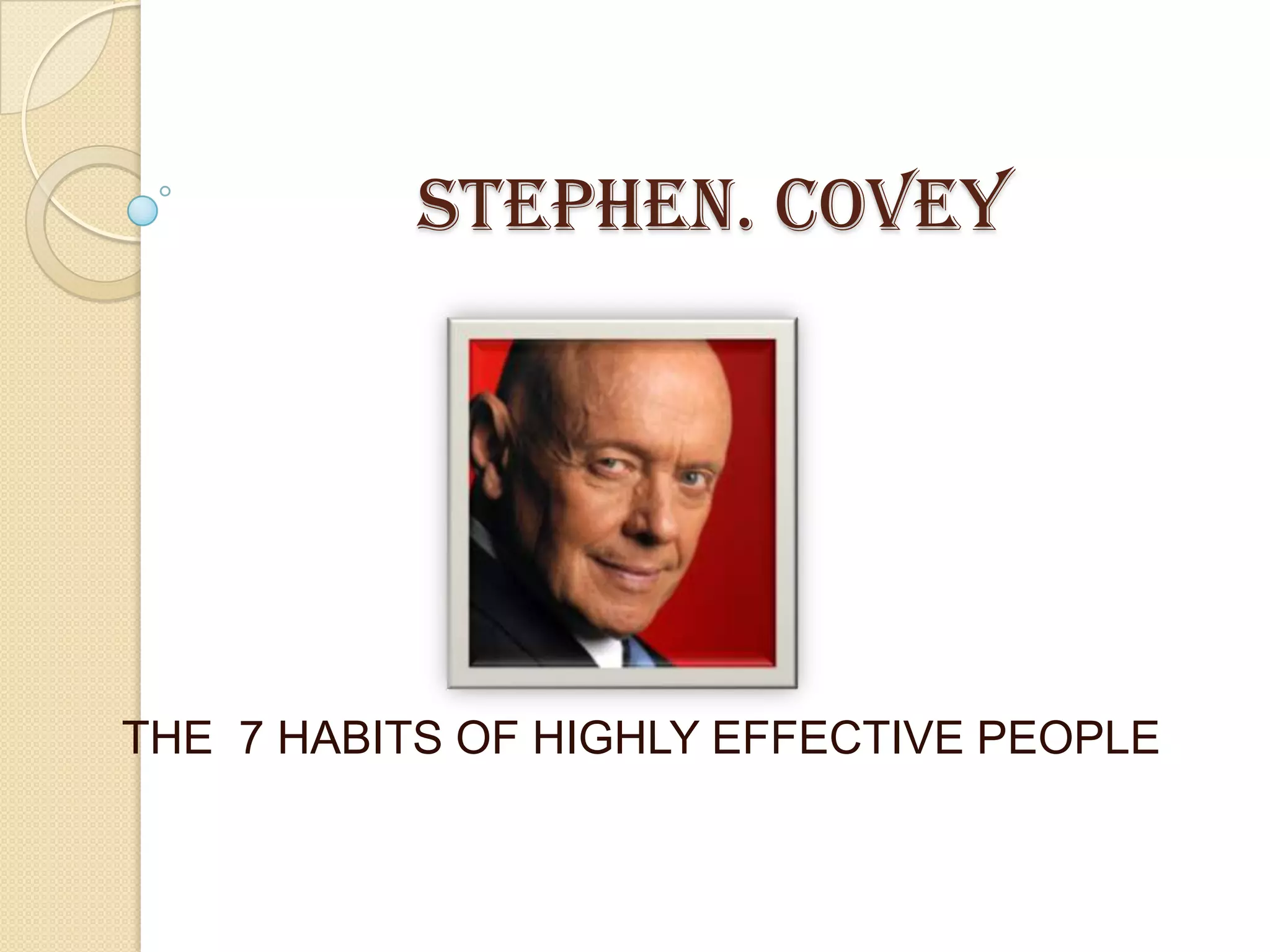
STEPHEN. COVEYTHE  7 HABITS OF HIGHLY EFFECTIVE PEOPLE
AN OVERVIEWpresented a framework for personal effectivenessBased on astute observation that people perceive the world differently.we view the world with our own unique "lens," it is difficult to separate the observation from the observerDon’t let the Challenge daunt you
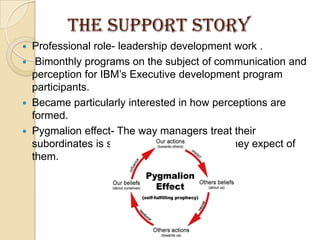
THE SUPPORT STORYProfessional role- leadership development work . Bimonthly programs on the subject of communication and perception for IBM’s Executive development program participants.Became particularly interested in how perceptions are formed.Pygmalion effect- The way managers treat their subordinates is subtly influenced by what they expect of them.
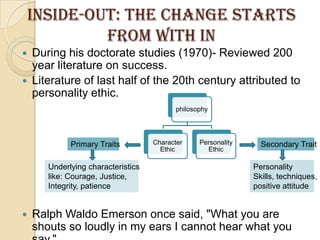
INSIDE-OUT: THE CHANGE STARTS FROM WITH INDuring his doctorate studies (1970)- Reviewed 200 year literature on success.Literature of last half of the 20th century attributed to personality ethic.Ralph Waldo Emerson once said, "What you are shouts so loudly in my ears I cannot hear what you say."Primary TraitsSecondary TraitPersonalitySkills, techniques, positive attitudeUnderlying characteristics like: Courage, Justice, Integrity, patience
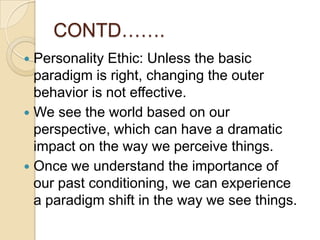
CONTD…….Personality Ethic: Unless the basicparadigm is right, changing the outer behavior is not effective. We see the world based on our perspective, which can have a dramatic impact on the way we perceive things. Once we understand the importance of our past conditioning, we can experience a paradigm shift in the way we see things.
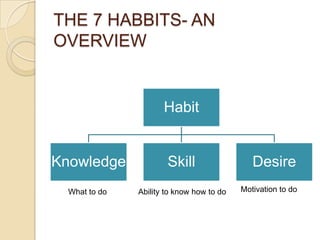
THE 7 HABBITS- AN OVERVIEWMotivation to doWhat to doAbility to know how to do
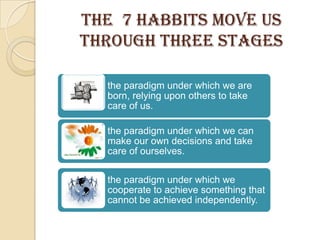
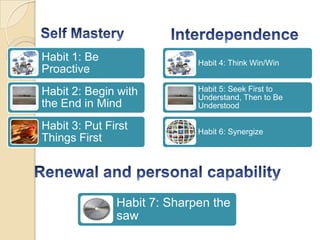
THE  7 HABBITS MOVE US THROUGH THREE STAGES
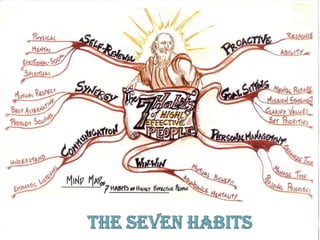
THE SEVEN HABITS
Self MasteryInterdependenceRenewal and personal capability
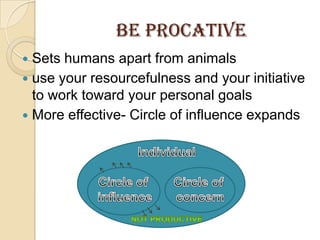
BE PROCATIVESets humans apart from animalsuse your resourcefulness and your initiative to work toward your personal goalsMore effective- Circle of influence expandsIndividualCircle of influenceCircle of concernNot productive
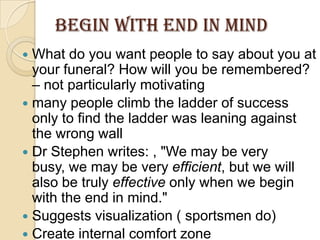
BEGIN WITH END IN MINDWhat do you want people to say about you at your funeral? How will you be remembered? – not particularly motivatingmany people climb the ladder of success only to find the ladder was leaning against the wrong wallDr Stephen writes: , "We may be very busy, we may be very efficient, but we will also be truly effective only when we begin with the end in mind." Suggests visualization ( sportsmen do)Create internal comfort zone
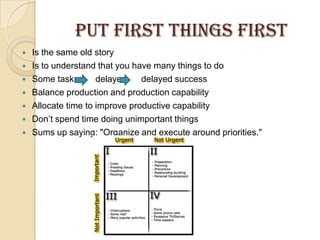
PUT FIRST THINGS FIRSTIs the same old storyIs to understand that you have many things to doSome tasks       delayed      delayed successBalance production and production capabilityAllocate time to improve productive capabilityDon’t spend time doing unimportant thingsSums up saying: "Organize and execute around priorities."
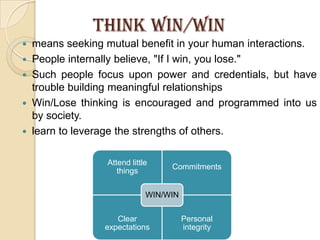
THINK WIN/WINmeans seeking mutual benefit in your human interactions.People internally believe, "If I win, you lose." Such people focus upon power and credentials, but have trouble building meaningful relationshipsWin/Lose thinking is encouraged and programmed into us by society.learn to leverage the strengths of others.
SEEK FIRST TO UNDERSTAND AND Then TO BE UNDERSTOODMost people don't listen, they wait to talkTo grab win-win deals, listenListening shouldn't be selective listening. "Communication experts estimate, in fact, that only 10 percent of our communication is by the words we say. Another 30 percent is represented by our sounds, and 60 percent by our body language.”
SynergizeIt means that the whole is greater than the sum of its partswe must value the differences between people and how they view the world. These differences can be used as a source of insight.Covey says: “ Valueingthe differences is the essence of synergy-the mental, the emotional, the psychological differences between people. And the key to valuing those differences is to realize that all people see the world, not as it is, but as they are."
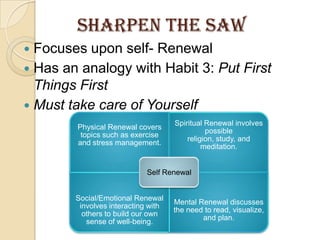
SHARPEN THE SAWFocuses upon self- RenewalHas an analogy with Habit 3: PutFirst Things FirstMust take care of Yourself
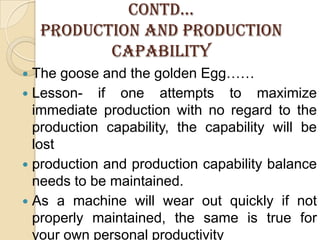
CONTD…PRODUCTION AND PRODUCTION CAPABILITYThe goose and the golden Egg…… Lesson- if one attempts to maximize immediate production with no regard to the production capability, the capability will be lostproduction and production capability balance needs to be maintained.As a machine will wear out quickly if not properly maintained, the same is true for your own personal productivity
Critics AND LEARNINGSDidn't really seem to add any significant insight to the basic theme: First things firstWe have direct control over problems caused by our own behavior. We can solve these problems by changing our habits.Has effective advices for improving ones life.
CONCLUSION“There is a gap or a space between stimulus and response, and the key to both our growth and happiness is how we use that space.”

7 Habbits Of Highly Effective people

  • 1.
    STEPHEN. COVEYTHE 7 HABITS OF HIGHLY EFFECTIVE PEOPLE
  • 2.
    AN OVERVIEWpresented aframework for personal effectivenessBased on astute observation that people perceive the world differently.we view the world with our own unique "lens," it is difficult to separate the observation from the observerDon’t let the Challenge daunt you
  • 3.
    THE SUPPORT STORYProfessionalrole- leadership development work . Bimonthly programs on the subject of communication and perception for IBM’s Executive development program participants.Became particularly interested in how perceptions are formed.Pygmalion effect- The way managers treat their subordinates is subtly influenced by what they expect of them.
  • 4.
    INSIDE-OUT: THE CHANGESTARTS FROM WITH INDuring his doctorate studies (1970)- Reviewed 200 year literature on success.Literature of last half of the 20th century attributed to personality ethic.Ralph Waldo Emerson once said, "What you are shouts so loudly in my ears I cannot hear what you say."Primary TraitsSecondary TraitPersonalitySkills, techniques, positive attitudeUnderlying characteristics like: Courage, Justice, Integrity, patience
  • 5.
    CONTD…….Personality Ethic: Unlessthe basicparadigm is right, changing the outer behavior is not effective. We see the world based on our perspective, which can have a dramatic impact on the way we perceive things. Once we understand the importance of our past conditioning, we can experience a paradigm shift in the way we see things.
  • 6.
    THE 7 HABBITS-AN OVERVIEWMotivation to doWhat to doAbility to know how to do
  • 7.
    THE 7HABBITS MOVE US THROUGH THREE STAGES
  • 8.
  • 9.
  • 10.
    BE PROCATIVESets humansapart from animalsuse your resourcefulness and your initiative to work toward your personal goalsMore effective- Circle of influence expandsIndividualCircle of influenceCircle of concernNot productive
  • 11.
    BEGIN WITH ENDIN MINDWhat do you want people to say about you at your funeral? How will you be remembered? – not particularly motivatingmany people climb the ladder of success only to find the ladder was leaning against the wrong wallDr Stephen writes: , "We may be very busy, we may be very efficient, but we will also be truly effective only when we begin with the end in mind." Suggests visualization ( sportsmen do)Create internal comfort zone
  • 12.
    PUT FIRST THINGSFIRSTIs the same old storyIs to understand that you have many things to doSome tasks delayed delayed successBalance production and production capabilityAllocate time to improve productive capabilityDon’t spend time doing unimportant thingsSums up saying: "Organize and execute around priorities."
  • 13.
    THINK WIN/WINmeans seekingmutual benefit in your human interactions.People internally believe, "If I win, you lose." Such people focus upon power and credentials, but have trouble building meaningful relationshipsWin/Lose thinking is encouraged and programmed into us by society.learn to leverage the strengths of others.
  • 14.
    SEEK FIRST TOUNDERSTAND AND Then TO BE UNDERSTOODMost people don't listen, they wait to talkTo grab win-win deals, listenListening shouldn't be selective listening. "Communication experts estimate, in fact, that only 10 percent of our communication is by the words we say. Another 30 percent is represented by our sounds, and 60 percent by our body language.”
  • 15.
    SynergizeIt means thatthe whole is greater than the sum of its partswe must value the differences between people and how they view the world. These differences can be used as a source of insight.Covey says: “ Valueingthe differences is the essence of synergy-the mental, the emotional, the psychological differences between people. And the key to valuing those differences is to realize that all people see the world, not as it is, but as they are."
  • 16.
    SHARPEN THE SAWFocusesupon self- RenewalHas an analogy with Habit 3: PutFirst Things FirstMust take care of Yourself
  • 17.
    CONTD…PRODUCTION AND PRODUCTIONCAPABILITYThe goose and the golden Egg…… Lesson- if one attempts to maximize immediate production with no regard to the production capability, the capability will be lostproduction and production capability balance needs to be maintained.As a machine will wear out quickly if not properly maintained, the same is true for your own personal productivity
  • 18.
    Critics AND LEARNINGSDidn'treally seem to add any significant insight to the basic theme: First things firstWe have direct control over problems caused by our own behavior. We can solve these problems by changing our habits.Has effective advices for improving ones life.
  • 19.
    CONCLUSION“There is agap or a space between stimulus and response, and the key to both our growth and happiness is how we use that space.”