Presentation Title
Your company information
Presented by:
Ms. Sneha Durugkar
Reg no.PC/2017-X/170
M.S. Pharmacology & Toxicology
NIPER, Guwahati 107/18/18
Contents
207/18/18
Introduction
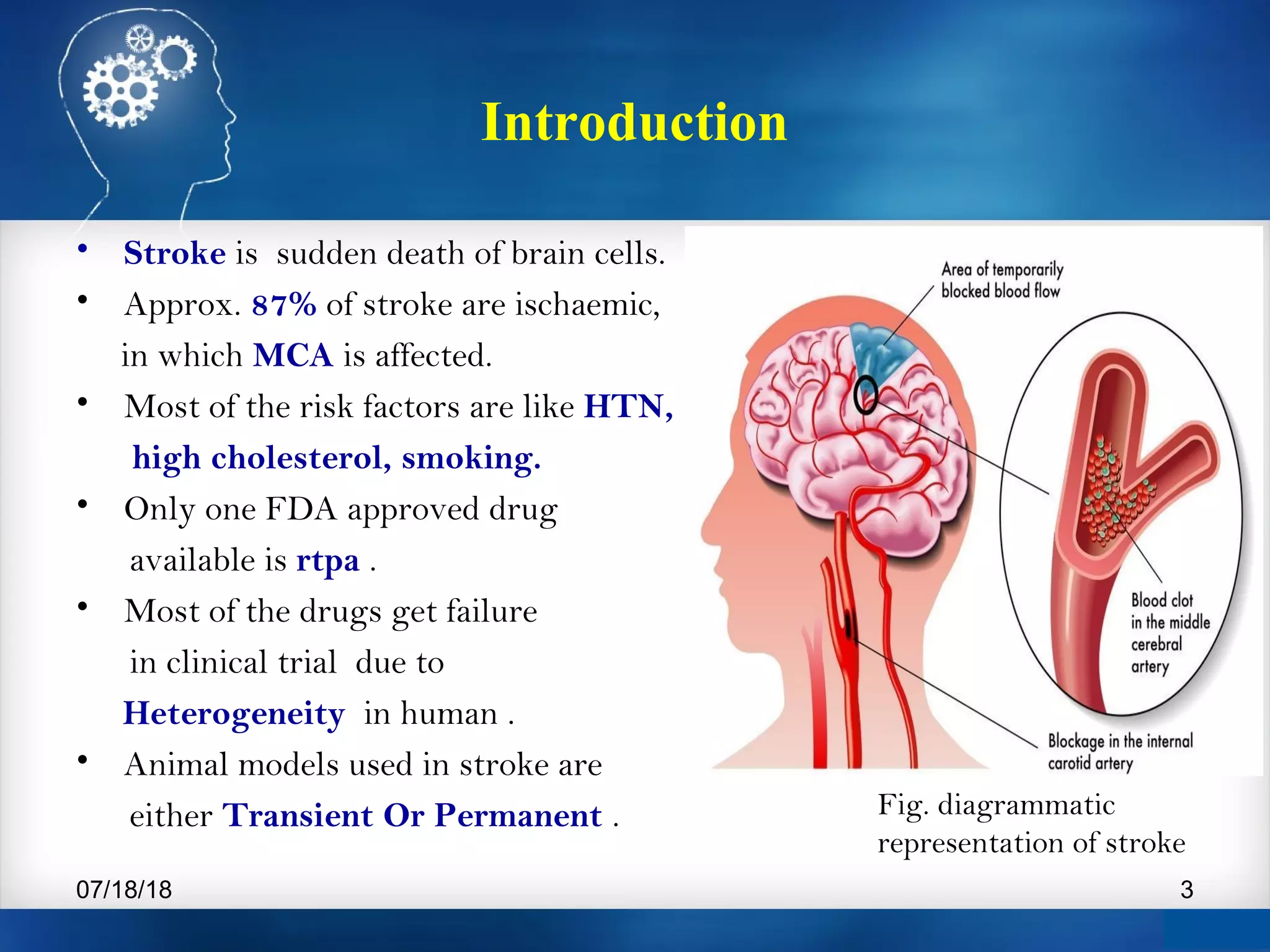
• Stroke is sudden death of brain cells.
• Approx. 87% of stroke are ischaemic,
in which MCA is affected.
• Most of the risk factors are like HTN,
high cholesterol, smoking.
• Only one FDA approved drug
available is rtpa .
• Most of the drugs get failure
in clinical trial due to
Heterogeneity in human .
• Animal models used in stroke are
either Transient Or Permanent .
307/18/18
Fig. diagrammatic
representation of stroke
Middle
cerebral
artery
ICA
07/18/18 4Fig. circle of willis
Fig. Schematic representation of
blood supply by the MCA
Pathophysiology
Vessel occlusion
Cerebral blood flow
widespread cellular depolarization of
Na+
, k+
, ca2+
release of neurotransmitters ( glutamate)
Glutamate receptor activation & accumulation of ca
Lipid peroxidation , FR
generation , proteolytic enzyme
activation
Irreversible
neuronal
damage
507/18/18
ischemia
Energy
production
Energy
production
Failure
of ionic
pumps
Cellular Na, ca , cl
Leucocyte
activation
mediators of
inflammation
Excitotoxin
release
Excitotoxin
release
Stimulation of
phospholipase
FFA
Arachidonic acid
endoperoxidaseendoperoxidase
PG , Leukotrienes
Cell
membrane
injury
Neuronal
death
Protease,NOS,
NO,ONOO
Cytoskeleton &
DNA breakdown,
PARP activation
Cytoskeleton &
DNA breakdown,
PARP activation
Mitochondrial
injury
Mitochondrial
injury
Oxygen
radical
generation
Oxygen
radical
generation
607/18/18
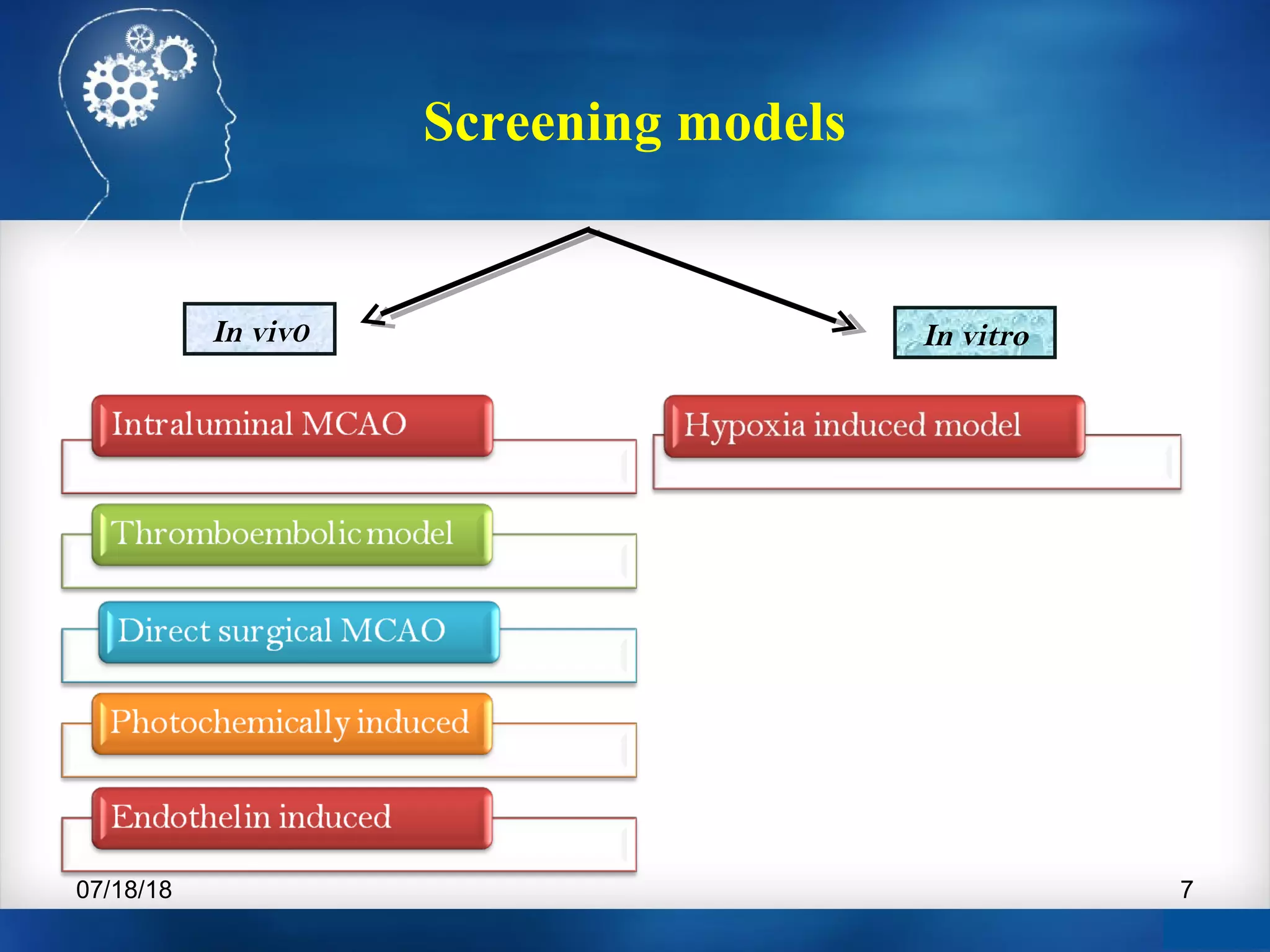
Screening models
In viv0 In vitro
707/18/18
Selection of model
 It depends upon class of drug & its MOA
 Examples:
807/18/18
Electrocoagulation method
• Purpose: to study the oedema & brain swelling & correlate it with
infract size & increased brain volume associated with large MCA stroke.
• Species: Large Animals Like Cat, Miniature Pig, & Baboon.
• Method:
Surgery
(5%
Isoflurane)
Surgery
(5%
Isoflurane)
Electric current( 7W) passed
through tips of fine
diathermy forceps
Electric current( 7W) passed
through tips of fine
diathermy forceps
Cutting of
occluded
portion
Cutting of
occluded
portion
Crystal violet
staining & analyze
Crystal violet
staining & analyze
Ischemic area = cortex area of contralateral side - non
ischemic cortex of ipsilateral side
907/18/18
5-6 min
Cont…
• Advantages: 1) Good reproducibility & low mortality.
2) Permanent ischemia . , visual confirmation.
3) Ability to produce infarct of different size at
different location.
• Disadvantages: 1) Not suitable for thrombolytic drugs
2) Requires cranioctomy.
• Advancement : By Using Devices Like Clips, Hooks ,
Inflatable Cuffs ( Larger Species)
1007/18/18
Chemically Induced Model
Principle: vasoconstriction is induced by either topical or intracerebral inj
of endothelin -1 .
Species : rat or mice ( sprague dawley male rat , 8 weeks old , 250-
300gm)
Method:
Anaesthesized with isoflurane(4%)
rats are housed under a 12:12 light/dark cycle
Surgery is done
3 l of 80 M(PBS) ET1 is infused at a rate ofμ μ
1 l per min.μ
1107/18/18
Cont……
• Advantages: 1) dose dependent ischemia can
be achieved.
2) visual confirmation .
• Disadvantages : 1) stability & potency issues .
Suture closed
Haematoxylin staining done
1207/18/18
Fig. MCA exposure Fig. Neck suture
Fig. staining
Intraluminal MCAOIntraluminal MCAO
• Principle : this technique involves occlusion of the CCA , by
introducing a suture directly into ICA & advancing the suture until it
interrupts the blood supply to MCA .
• Method :
1307/18/18
Limb paralysis
Cont...
Advantages : 1) no cranioctomy is required.
2) induce both permenant & transient ischemia.
Disadvantages: 1) reproducibility is less.
2) not suitable for thrombolytic drugs.
3) MCAO cannot be confirmed visually.
0
Advancement : laser doppler flowmetry probes are used.
Note: filament diameter should be matched to defines body wt. range of
rodent.
1407/18/18
1507/18/18
Güzel A, Rölz R, Nikkhah G, Kahlert UD, Maciaczyk J. A microsurgical procedure for middle cerebral artery occlusion by intraluminal monofilament insertion
technique in the rat: a special emphasis on the methodology. Experimental & translational stroke medicine. 2014 Dec;6(1):6
Cont...
Embolic MCA occlusion
Species : rat, mice, rabbit, cat
Procedure:
Advantages: 1) clinical relevance.
2) occlusion in both cortical & subcortical structure.
Disadvantages: rapid progression so early cytotoxic & vasogenic edema
occurs
Blood drawn from animal to form autologus clots of
specific size .
Introduced into cerebral circulation via cannula inserted
Clot breakdown & reperfusion induced by thrombolytics ( eg rtpa)
1607/18/18
Photo chemically Induced Embolism
• Principle: this method induces a corticle infarct by systemic inj of
photoactive dye in combination with irradiation by light beam transmitted
through the intact skull .
• Species : sprague dawely male rat , 200-250gm
• Method :
SurgerySurgery
systemic inj.4 l of 20mg/ kg roseū
bengal + light wavelength 520nm for
20 min
systemic inj.4 l of 20mg/ kg roseū
bengal + light wavelength 520nm for
20 min
MRI
scanning
MRI
scanning
1707/18/18
Cont…
1807/18/18
Thrombin induced model
• Principle : Microinj. of thrombin induces clot & analyzed for CBF
volume & locomotor activity.
• Species: male swiss mice (25-30gm)
• Method :
After 20 min
19
07/18/18
Surgical exposing
of MCA
Surgical exposing
of MCA
200 Lū tpa (10 mg /kg)
( tail vein)
200 Lū tpa (10 mg /kg)
( tail vein)
Laser doppler
flowmetry analysis
Laser doppler
flowmetry analysis
Animal
anaesthesized
isoflurane (5%)
Animal
anaesthesized
isoflurane (5%)
1 L alpha thrombin i.vū1 L alpha thrombin i.vū
Evaluation test
07/18/18 20
Cylinder testCylinder test Infarct volume analysisInfarct volume analysis
In vitro model
• Principle: The in vitro release of adenosine, inosine, and hypoxanthine
from rat hippocampal slices can be determined with and without drug.
• Species : sprague dawley rat (150-200gm)
• Procedure: brain is decapitated & 400 ūm thick slices
Oxygen &
glucose
supply
No oxygen
& glucose
1-2 hrs 1-2 hrs
Adv: neuroprotective studies
Disadv: ischemic studies not
possible
2107/18/18
Summary
• Stroke is found as 3rd
most leading cause of death , as attack & sudden
death most commonly occurs.
• As aging is also a one of the cause , the neuronal damage cant be
recovered.
• Rtpa & surgical removal of clot are only the treatments for treating
stroke.
• Most of causes are unknown ,so most of the models are getting failure to
mimic the human stroke condition.
• Now a days SHR strains are used to correlate hypertension induced
stroke as well as HLA DR2 transgenic mice model for thrombolytic
studies are used .
• Still research is going on for mimicing the poststroke events which
commonly observed in human cases.
07/18/18 22
References
• Yang S, Liu K, Ding H, Gao H, Zheng X, Ding Z, Xu K, Li P.
Longitudinal in vivo intrinsic optical imaging of cortical blood perfusion
and tissue damage in focal photothrombosis stroke model. Journal of
Cerebral Blood Flow & Metabolism. 2018 Jan 1:0271678X18762636
• Sommer CJ. Ischemic stroke: experimental models and reality. Acta
neuropathologica. 2017 Feb 1;133(2):245-61
• Khodanovich MY, Kisel AA. Animal models of cerebral ischemia. InAIP
Conference Proceedings 2015 Nov 17 (Vol. 1688, No. 1, p. 030037). AIP
Publishing.
• Güzel A, Rölz R, Nikkhah G, Kahlert UD, Maciaczyk J. A microsurgical
procedure for middle cerebral artery occlusion by intraluminal
monofilament insertion technique in the rat: a special emphasis on the
methodology. Experimental & translational stroke medicine. 2014
Dec;6(1):6.
07/18/18 23
Thank you 2407/18/18

Screening model for stroke.

  • 1.
    Presentation Title Your companyinformation Presented by: Ms. Sneha Durugkar Reg no.PC/2017-X/170 M.S. Pharmacology & Toxicology NIPER, Guwahati 107/18/18
  • 2.
  • 3.
    Introduction • Stroke issudden death of brain cells. • Approx. 87% of stroke are ischaemic, in which MCA is affected. • Most of the risk factors are like HTN, high cholesterol, smoking. • Only one FDA approved drug available is rtpa . • Most of the drugs get failure in clinical trial due to Heterogeneity in human . • Animal models used in stroke are either Transient Or Permanent . 307/18/18 Fig. diagrammatic representation of stroke
  • 4.
    Middle cerebral artery ICA 07/18/18 4Fig. circleof willis Fig. Schematic representation of blood supply by the MCA
  • 5.
    Pathophysiology Vessel occlusion Cerebral bloodflow widespread cellular depolarization of Na+ , k+ , ca2+ release of neurotransmitters ( glutamate) Glutamate receptor activation & accumulation of ca Lipid peroxidation , FR generation , proteolytic enzyme activation Irreversible neuronal damage 507/18/18
  • 6.
    ischemia Energy production Energy production Failure of ionic pumps Cellular Na,ca , cl Leucocyte activation mediators of inflammation Excitotoxin release Excitotoxin release Stimulation of phospholipase FFA Arachidonic acid endoperoxidaseendoperoxidase PG , Leukotrienes Cell membrane injury Neuronal death Protease,NOS, NO,ONOO Cytoskeleton & DNA breakdown, PARP activation Cytoskeleton & DNA breakdown, PARP activation Mitochondrial injury Mitochondrial injury Oxygen radical generation Oxygen radical generation 607/18/18
  • 7.
    Screening models In viv0In vitro 707/18/18
  • 8.
    Selection of model It depends upon class of drug & its MOA  Examples: 807/18/18
  • 9.
    Electrocoagulation method • Purpose:to study the oedema & brain swelling & correlate it with infract size & increased brain volume associated with large MCA stroke. • Species: Large Animals Like Cat, Miniature Pig, & Baboon. • Method: Surgery (5% Isoflurane) Surgery (5% Isoflurane) Electric current( 7W) passed through tips of fine diathermy forceps Electric current( 7W) passed through tips of fine diathermy forceps Cutting of occluded portion Cutting of occluded portion Crystal violet staining & analyze Crystal violet staining & analyze Ischemic area = cortex area of contralateral side - non ischemic cortex of ipsilateral side 907/18/18 5-6 min
  • 10.
    Cont… • Advantages: 1)Good reproducibility & low mortality. 2) Permanent ischemia . , visual confirmation. 3) Ability to produce infarct of different size at different location. • Disadvantages: 1) Not suitable for thrombolytic drugs 2) Requires cranioctomy. • Advancement : By Using Devices Like Clips, Hooks , Inflatable Cuffs ( Larger Species) 1007/18/18
  • 11.
    Chemically Induced Model Principle:vasoconstriction is induced by either topical or intracerebral inj of endothelin -1 . Species : rat or mice ( sprague dawley male rat , 8 weeks old , 250- 300gm) Method: Anaesthesized with isoflurane(4%) rats are housed under a 12:12 light/dark cycle Surgery is done 3 l of 80 M(PBS) ET1 is infused at a rate ofμ μ 1 l per min.μ 1107/18/18
  • 12.
    Cont…… • Advantages: 1)dose dependent ischemia can be achieved. 2) visual confirmation . • Disadvantages : 1) stability & potency issues . Suture closed Haematoxylin staining done 1207/18/18 Fig. MCA exposure Fig. Neck suture Fig. staining
  • 13.
    Intraluminal MCAOIntraluminal MCAO •Principle : this technique involves occlusion of the CCA , by introducing a suture directly into ICA & advancing the suture until it interrupts the blood supply to MCA . • Method : 1307/18/18 Limb paralysis
  • 14.
    Cont... Advantages : 1)no cranioctomy is required. 2) induce both permenant & transient ischemia. Disadvantages: 1) reproducibility is less. 2) not suitable for thrombolytic drugs. 3) MCAO cannot be confirmed visually. 0 Advancement : laser doppler flowmetry probes are used. Note: filament diameter should be matched to defines body wt. range of rodent. 1407/18/18
  • 15.
    1507/18/18 Güzel A, RölzR, Nikkhah G, Kahlert UD, Maciaczyk J. A microsurgical procedure for middle cerebral artery occlusion by intraluminal monofilament insertion technique in the rat: a special emphasis on the methodology. Experimental & translational stroke medicine. 2014 Dec;6(1):6 Cont...
  • 16.
    Embolic MCA occlusion Species: rat, mice, rabbit, cat Procedure: Advantages: 1) clinical relevance. 2) occlusion in both cortical & subcortical structure. Disadvantages: rapid progression so early cytotoxic & vasogenic edema occurs Blood drawn from animal to form autologus clots of specific size . Introduced into cerebral circulation via cannula inserted Clot breakdown & reperfusion induced by thrombolytics ( eg rtpa) 1607/18/18
  • 17.
    Photo chemically InducedEmbolism • Principle: this method induces a corticle infarct by systemic inj of photoactive dye in combination with irradiation by light beam transmitted through the intact skull . • Species : sprague dawely male rat , 200-250gm • Method : SurgerySurgery systemic inj.4 l of 20mg/ kg roseū bengal + light wavelength 520nm for 20 min systemic inj.4 l of 20mg/ kg roseū bengal + light wavelength 520nm for 20 min MRI scanning MRI scanning 1707/18/18
  • 18.
  • 19.
    Thrombin induced model •Principle : Microinj. of thrombin induces clot & analyzed for CBF volume & locomotor activity. • Species: male swiss mice (25-30gm) • Method : After 20 min 19 07/18/18 Surgical exposing of MCA Surgical exposing of MCA 200 Lū tpa (10 mg /kg) ( tail vein) 200 Lū tpa (10 mg /kg) ( tail vein) Laser doppler flowmetry analysis Laser doppler flowmetry analysis Animal anaesthesized isoflurane (5%) Animal anaesthesized isoflurane (5%) 1 L alpha thrombin i.vū1 L alpha thrombin i.vū
  • 20.
    Evaluation test 07/18/18 20 CylindertestCylinder test Infarct volume analysisInfarct volume analysis
  • 21.
    In vitro model •Principle: The in vitro release of adenosine, inosine, and hypoxanthine from rat hippocampal slices can be determined with and without drug. • Species : sprague dawley rat (150-200gm) • Procedure: brain is decapitated & 400 ūm thick slices Oxygen & glucose supply No oxygen & glucose 1-2 hrs 1-2 hrs Adv: neuroprotective studies Disadv: ischemic studies not possible 2107/18/18
  • 22.
    Summary • Stroke isfound as 3rd most leading cause of death , as attack & sudden death most commonly occurs. • As aging is also a one of the cause , the neuronal damage cant be recovered. • Rtpa & surgical removal of clot are only the treatments for treating stroke. • Most of causes are unknown ,so most of the models are getting failure to mimic the human stroke condition. • Now a days SHR strains are used to correlate hypertension induced stroke as well as HLA DR2 transgenic mice model for thrombolytic studies are used . • Still research is going on for mimicing the poststroke events which commonly observed in human cases. 07/18/18 22
  • 23.
    References • Yang S,Liu K, Ding H, Gao H, Zheng X, Ding Z, Xu K, Li P. Longitudinal in vivo intrinsic optical imaging of cortical blood perfusion and tissue damage in focal photothrombosis stroke model. Journal of Cerebral Blood Flow & Metabolism. 2018 Jan 1:0271678X18762636 • Sommer CJ. Ischemic stroke: experimental models and reality. Acta neuropathologica. 2017 Feb 1;133(2):245-61 • Khodanovich MY, Kisel AA. Animal models of cerebral ischemia. InAIP Conference Proceedings 2015 Nov 17 (Vol. 1688, No. 1, p. 030037). AIP Publishing. • Güzel A, Rölz R, Nikkhah G, Kahlert UD, Maciaczyk J. A microsurgical procedure for middle cerebral artery occlusion by intraluminal monofilament insertion technique in the rat: a special emphasis on the methodology. Experimental & translational stroke medicine. 2014 Dec;6(1):6. 07/18/18 23
  • 24.