The
IAAPAIssue
Museums &
Expanding Markets
34
Grand Bazaar shops
bring placemaking
and stylish shopping
toVegas
#61 • volume 12, issue 1 • 2016
www.inparkmagazine.com
38 Behind the steel of FerrariWorld’s new coaster 52 Thoroughly modern museums
54 SpaceNext hits the big screens 29 China’s dramatic growth of museums
Miami’s big
bang
Frost Science prepares to
open new state-of-the-art
facility in Museum Park
by Joe Kleiman
From 1976 to 2010, Jack Horkheimer, Executive Director of the
Miami Space Transit Planetarium, gained national renown by
taking PBS viewers on televised tours of the night sky. Six years
after his death, the successor to his planetarium is set to take
visitors not only to the stars, but inside the mind as well.
The new Frost Planetarium, featuring cutting edge, high
resolution (8K, a super-high pixel count) digital dome cinema
(“fulldome”) will be a focal point of the $305 million Patricia
and Phillip Frost Museum of Science. The museum chose the
system for its visual quality and its programming flexibility. (At
press time, the museum had not yet announced the name
of the system provider.) The “Frost Science” facility is the new
incarnation of the former Miami Museum of Science, which
housed the former planetarium. Its projected opening is late
2016, in downtown Miami’s Museum Park, formerly Bicentennial
Park.
In earlier days, Frost Science President & CEO GillianThomas was
aplanetariumoperatoratParis’CitédesSciencesetdel’Industrie.
“I was one of two people programming the planetarium. I felt
very privileged and I want others to experience that feeling,”
she said. As part of its mission, the new planetarium will feature
multimedia programming lessons to the public. There will be
other unique experiences beyond traditional planetarium
programming. For example, Thomas envisions the New World
Symphony playing outside the museum in Museum Park while
the live performance is streamed into the planetarium with
brainwaves projected onto the screen, showing viewers how
the brain reacts to musical composition.
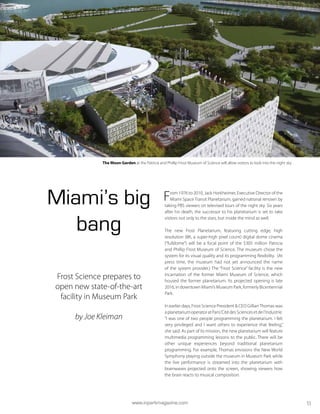
The Moon Garden at the Patricia and Phillip Frost Museum of Science will allow visitors to look into the night sky.
www.inparkmagazine.com 11
Redefining the museum space
Frost Science, as a cornerstone of an expanding performing
arts/museum complex in downtown Miami, is an example of
rethinking what a museum space should entail and developing
new exhibits for that space based around its strengths.
For more than 50 years, the Miami Museum of Science stood in
a small enclave at the rear of the Villa Vizcaya estate, the 1915
home of businessman James Deering. Over the years, there
were plans to expand on the Vizcaya property, but they never
came to fruition. Things started to change around 2003. The
Board knew that museums perform much better when part of
a cultural center, and the Miami-Dade government was looking
to reinvigorate the Museum Park area with arts and culture
development. The Miami Art Museum (now the Perez Art
Museum Miami) agreed to build a new facility at the location.
The Miami Science Museum would as well.
“I joined the museum in 2003,” says Thomas. “There were two
things in place to do at the time – to secure the land in Museum
Park and to obtain a general obligation bond, which we did in
2004. We received funding from the state for a feasibility study
which showed how we will drive the economic region of the
surrounding area.”
Living Core
Among the many new exhibits at Frost Science is the Living Core
Aquarium with a 500,000-gallon central tank. “We always had
popular marine science programs with good links to University
of Miami and Florida International University,” said Thomas.
“When we were looking at how to develop a new science
museum,weevaluatedourstrengths,andwewantedtodevelop
something specific for the South Florida region. Because of our
demographic, it was important to move from a program to an
aquarium. One floor of the aquarium is the introduction; the
floor below simulates a dive. We’ve been developing flexible
“furniture” for the aquariums so we can easily change out fish
and content. The third floor is called The Deep. This aquarium
simulates being deep underwater and you will not be able to
see the walls. Our aquarium experience is also tied into science
and physics components.”
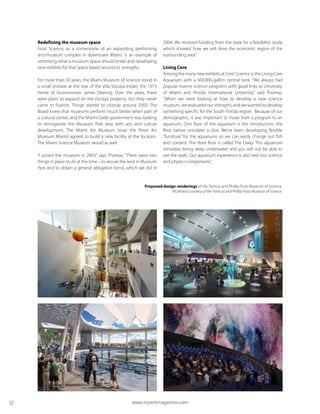
Proposed design renderings of the Patricia and Phillip Frost Museum of Science.
All photos courtesy of the Patricia and Phillip Frost Museum of Science.
www.inparkmagazine.com12
To design the Living Core, museum staff and Thinc design
explored San Francisco’s California Academy of Sciences for
its integration of a major aquarium into a science museum, as
well as other aquariums, including Monterey Bay. They worked
closely on the aquarium concept with Grimshaw Architects,
design architect on the new building. Lyons/Zaremba designed
and Jeff Kennedy Associates fabricated the underwater
environments. This floor will also feature a 90-foot interactive
digital wall for exploring South Florida marine animals not in
the museum’s collection, such as whales and dolphins. Using
a concept from Design I/O, South Africa’s Formula D designed
the interactive media wall of The Deep level, along with another
interactive media installation in a children’s gallery.
Exhibits throughout the museum adhere to one of three key
themes: People, Planet, and Prosperity. Global themes of water,
light, energy, and time, will also be found throughout the
galleries.
Galleries
The Baptist Health People & Science Gallery will concentrate on
health and education. “We all make decisions in life that impact
how our lives turn out,”saidThomas.“This gallery will concentrate
on choices we make in eating, relaxing, learning, exercising, and
connecting.” The People & Science Gallery, designed by Ralph
Appelbaum Associates, will double as an exhibit area and a
socializing space. Among its social components will be a stage
where museum visitors are encouraged to exercise.
The Feathers to the Stars exhibit designed by Casson Mann, will
tell the story of flight from the dinosaurs to the Space Age, with
a special emphasis on South Florida aviation. A key exhibit will
include both interactive horizontal and vertical wind tunnels.
Frost Science is continuing its longstanding relationship as a
Smithsonian Associate and will be obtaining artifacts from the
Smithsonian for inclusion in this exhibit.
Another key exhibition area is the Innovation Center. According
to Thomas, this area will explore the “process of science and
research, and place you in it. It will feature visiting scientists,
mobile links, and concentrate on the challenges of South Florida.
The Innovation Center will link to the jobs of the future.”
10,000 square feet are set aside for traveling exhibits and the
museum plans free events throughout the year both inside
individual galleries, outside in Museum Park and Knight Plaza,
and within public areas of the building.
Keep looking up
Plans are in the works to expand the museum to Florida
International University’s north campus. In addition to housing
classrooms which can be used to educate both students and
teachers, the museum’s raptor center will relocate to this facility
under its new name of the Batchelor Environmental Center.
There is also space for expanding the main museum in Museum
Park by either building its four towers taller or expanding out
into the wetlands.
For its first year, the museum anticipates 725,000 visitors.
Approximately 100,000 will be students, with the remainder split
between tourists and locals.
Jack Horkheimer would end his shows by telling his viewers
to “Keep Looking Up.” With its rooftop Sun and Moon Gardens,
visitors to Frost Science will be able to look up into the night sky.
At The Deep level of the Living Core Aquarium, they’ll look up
into the ocean from below and see sharks swimming overhead.
In the Frost Planetarium, they’ll look up at the highest resolution
images in Miami. And with the museum’s emphasis on the
visitor, their lives are likely to look up as well. • • •
Patricia and Phillip Frost
Museum of Science
Designers, consultants and fabricators
Grimshaw Architects – design architect
Rodriguez and Quiroga Architects Chartered –
executive architect
Visual Acuity – technology consultant; A/V and IT for
building infrastructure
Ralph Appelbaum Associates – concept design and
development, The Baptist Health People & Science
Gallery
Casson Mann – concept design and development,
Feathers to the Stars
Thinc Design – concept design and development,
Living Core
MWH – Living Core life support systems
James Corner Field Operations –
designer for museum project; joint
project with Perez Museum of Art
ArquitectonicaGEO – landscape architect
Atelier Ten - LEED management
Lord Cultural Resources – museum planning
ORCA Consulting – visitor flow and circulation
Randi Korn & Associates – exhibit evaluation
Lyons/Zaremba – exhibit habitat designer
Jeff Kennedy Associates – exhibit habitat fabricator
Design I/O – interactive multimedia
conceptualization
Formula D – interactive multimedia design
www.inparkmagazine.com 13

Miami's big bang

  • 1.
    The IAAPAIssue Museums & Expanding Markets 34 GrandBazaar shops bring placemaking and stylish shopping toVegas #61 • volume 12, issue 1 • 2016 www.inparkmagazine.com 38 Behind the steel of FerrariWorld’s new coaster 52 Thoroughly modern museums 54 SpaceNext hits the big screens 29 China’s dramatic growth of museums
  • 2.
    Miami’s big bang Frost Scienceprepares to open new state-of-the-art facility in Museum Park by Joe Kleiman From 1976 to 2010, Jack Horkheimer, Executive Director of the Miami Space Transit Planetarium, gained national renown by taking PBS viewers on televised tours of the night sky. Six years after his death, the successor to his planetarium is set to take visitors not only to the stars, but inside the mind as well. The new Frost Planetarium, featuring cutting edge, high resolution (8K, a super-high pixel count) digital dome cinema (“fulldome”) will be a focal point of the $305 million Patricia and Phillip Frost Museum of Science. The museum chose the system for its visual quality and its programming flexibility. (At press time, the museum had not yet announced the name of the system provider.) The “Frost Science” facility is the new incarnation of the former Miami Museum of Science, which housed the former planetarium. Its projected opening is late 2016, in downtown Miami’s Museum Park, formerly Bicentennial Park. In earlier days, Frost Science President & CEO GillianThomas was aplanetariumoperatoratParis’CitédesSciencesetdel’Industrie. “I was one of two people programming the planetarium. I felt very privileged and I want others to experience that feeling,” she said. As part of its mission, the new planetarium will feature multimedia programming lessons to the public. There will be other unique experiences beyond traditional planetarium programming. For example, Thomas envisions the New World Symphony playing outside the museum in Museum Park while the live performance is streamed into the planetarium with brainwaves projected onto the screen, showing viewers how the brain reacts to musical composition. The Moon Garden at the Patricia and Phillip Frost Museum of Science will allow visitors to look into the night sky. www.inparkmagazine.com 11
  • 3.
    Redefining the museumspace Frost Science, as a cornerstone of an expanding performing arts/museum complex in downtown Miami, is an example of rethinking what a museum space should entail and developing new exhibits for that space based around its strengths. For more than 50 years, the Miami Museum of Science stood in a small enclave at the rear of the Villa Vizcaya estate, the 1915 home of businessman James Deering. Over the years, there were plans to expand on the Vizcaya property, but they never came to fruition. Things started to change around 2003. The Board knew that museums perform much better when part of a cultural center, and the Miami-Dade government was looking to reinvigorate the Museum Park area with arts and culture development. The Miami Art Museum (now the Perez Art Museum Miami) agreed to build a new facility at the location. The Miami Science Museum would as well. “I joined the museum in 2003,” says Thomas. “There were two things in place to do at the time – to secure the land in Museum Park and to obtain a general obligation bond, which we did in 2004. We received funding from the state for a feasibility study which showed how we will drive the economic region of the surrounding area.” Living Core Among the many new exhibits at Frost Science is the Living Core Aquarium with a 500,000-gallon central tank. “We always had popular marine science programs with good links to University of Miami and Florida International University,” said Thomas. “When we were looking at how to develop a new science museum,weevaluatedourstrengths,andwewantedtodevelop something specific for the South Florida region. Because of our demographic, it was important to move from a program to an aquarium. One floor of the aquarium is the introduction; the floor below simulates a dive. We’ve been developing flexible “furniture” for the aquariums so we can easily change out fish and content. The third floor is called The Deep. This aquarium simulates being deep underwater and you will not be able to see the walls. Our aquarium experience is also tied into science and physics components.” Proposed design renderings of the Patricia and Phillip Frost Museum of Science. All photos courtesy of the Patricia and Phillip Frost Museum of Science. www.inparkmagazine.com12
  • 4.
    To design theLiving Core, museum staff and Thinc design explored San Francisco’s California Academy of Sciences for its integration of a major aquarium into a science museum, as well as other aquariums, including Monterey Bay. They worked closely on the aquarium concept with Grimshaw Architects, design architect on the new building. Lyons/Zaremba designed and Jeff Kennedy Associates fabricated the underwater environments. This floor will also feature a 90-foot interactive digital wall for exploring South Florida marine animals not in the museum’s collection, such as whales and dolphins. Using a concept from Design I/O, South Africa’s Formula D designed the interactive media wall of The Deep level, along with another interactive media installation in a children’s gallery. Exhibits throughout the museum adhere to one of three key themes: People, Planet, and Prosperity. Global themes of water, light, energy, and time, will also be found throughout the galleries. Galleries The Baptist Health People & Science Gallery will concentrate on health and education. “We all make decisions in life that impact how our lives turn out,”saidThomas.“This gallery will concentrate on choices we make in eating, relaxing, learning, exercising, and connecting.” The People & Science Gallery, designed by Ralph Appelbaum Associates, will double as an exhibit area and a socializing space. Among its social components will be a stage where museum visitors are encouraged to exercise. The Feathers to the Stars exhibit designed by Casson Mann, will tell the story of flight from the dinosaurs to the Space Age, with a special emphasis on South Florida aviation. A key exhibit will include both interactive horizontal and vertical wind tunnels. Frost Science is continuing its longstanding relationship as a Smithsonian Associate and will be obtaining artifacts from the Smithsonian for inclusion in this exhibit. Another key exhibition area is the Innovation Center. According to Thomas, this area will explore the “process of science and research, and place you in it. It will feature visiting scientists, mobile links, and concentrate on the challenges of South Florida. The Innovation Center will link to the jobs of the future.” 10,000 square feet are set aside for traveling exhibits and the museum plans free events throughout the year both inside individual galleries, outside in Museum Park and Knight Plaza, and within public areas of the building. Keep looking up Plans are in the works to expand the museum to Florida International University’s north campus. In addition to housing classrooms which can be used to educate both students and teachers, the museum’s raptor center will relocate to this facility under its new name of the Batchelor Environmental Center. There is also space for expanding the main museum in Museum Park by either building its four towers taller or expanding out into the wetlands. For its first year, the museum anticipates 725,000 visitors. Approximately 100,000 will be students, with the remainder split between tourists and locals. Jack Horkheimer would end his shows by telling his viewers to “Keep Looking Up.” With its rooftop Sun and Moon Gardens, visitors to Frost Science will be able to look up into the night sky. At The Deep level of the Living Core Aquarium, they’ll look up into the ocean from below and see sharks swimming overhead. In the Frost Planetarium, they’ll look up at the highest resolution images in Miami. And with the museum’s emphasis on the visitor, their lives are likely to look up as well. • • • Patricia and Phillip Frost Museum of Science Designers, consultants and fabricators Grimshaw Architects – design architect Rodriguez and Quiroga Architects Chartered – executive architect Visual Acuity – technology consultant; A/V and IT for building infrastructure Ralph Appelbaum Associates – concept design and development, The Baptist Health People & Science Gallery Casson Mann – concept design and development, Feathers to the Stars Thinc Design – concept design and development, Living Core MWH – Living Core life support systems James Corner Field Operations – designer for museum project; joint project with Perez Museum of Art ArquitectonicaGEO – landscape architect Atelier Ten - LEED management Lord Cultural Resources – museum planning ORCA Consulting – visitor flow and circulation Randi Korn & Associates – exhibit evaluation Lyons/Zaremba – exhibit habitat designer Jeff Kennedy Associates – exhibit habitat fabricator Design I/O – interactive multimedia conceptualization Formula D – interactive multimedia design www.inparkmagazine.com 13