2
Contents
Instagram Stories
What’s Happening to Facebook?
• Facebook Pixel
• But I Don’t Even Have a Facebook Page!
• The New Facebook Algorithm
• Facebook Updates Offers
#Hashtagging
Millennials and E-commerce
3
Instagram Stories
4
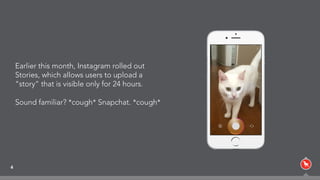
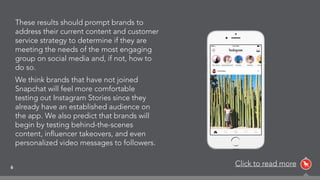
Earlier this month, Instagram rolled out
Stories, which allows users to upload a
“story” that is visible only for 24 hours.
Sound familiar? *cough* Snapchat. *cough*
5
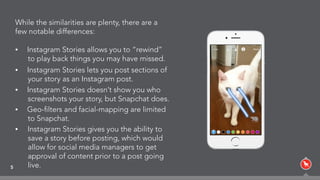
While the similarities are plenty, there are a
few notable differences:
• Instagram Stories allows you to “rewind”
to play back things you may have missed.
• Instagram Stories lets you post sections of
your story as an Instagram post.
• Instagram Stories doesn’t show you who
screenshots your story, but Snapchat does.
• Geo-filters and facial-mapping are limited
to Snapchat.
• Instagram Stories gives you the ability to
save a story before posting, which would
allow for social media managers to get
approval of content prior to a post going
live.
6
Click to read more
These results should prompt brands to
address their current content and customer
service strategy to determine if they are
meeting the needs of the most engaging
group on social media and, if not, how to
do so.
We think brands that have not joined
Snapchat will feel more comfortable
testing out Instagram Stories since they
already have an established audience on
the app. We also predict that brands will
begin by testing behind-the-scenes
content, influencer takeovers, and even
personalized video messages to followers.
7
What’s Happening 

to Facebook?
All the recent changes to Facebook 

are enough to make any marketer’s
head spin!
The platform continues to evolve
almost as quickly as we can report on it.
Keep reading for the latest and
greatest from the social media giant!
8
9
Facebook Pixel
Facebook knows that when it comes to
marketing, if you’re not tracking your
results, you’re wasting your time.
That’s why they introduced the Facebook
pixel earlier this year, which is a
combination of their previous Conversion
and Custom Audience pixels. A pixel in this
case is a tiny piece of code that's placed
on a web page; consumers can never see
it, but it allows marketers to gather relevant
information about their audience.
10
Facebook Pixel
What exactly is the Facebook pixel? It’s a
pixel that “…allows you to place a single
pixel across your entire website to report
conversions, build audiences and get 

rich insights about how people use 

your website.”
11
Facebook PixelFacebook Pixel
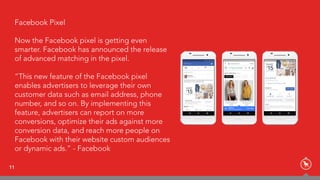
Now the Facebook pixel is getting even
smarter. Facebook has announced the release
of advanced matching in the pixel.
“This new feature of the Facebook pixel
enables advertisers to leverage their own
customer data such as email address, phone
number, and so on. By implementing this
feature, advertisers can report on more
conversions, optimize their ads against more
conversion data, and reach more people on
Facebook with their website custom audiences
or dynamic ads.” - Facebook
12
Facebook PixelFacebook Pixel
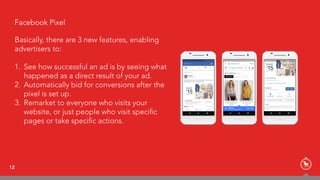
Basically, there are 3 new features, enabling
advertisers to:
1. See how successful an ad is by seeing what
happened as a direct result of your ad.
2. Automatically bid for conversions after the
pixel is set up.
3. Remarket to everyone who visits your
website, or just people who visit specific
pages or take specific actions.
13
Click to read more
Facebook PixelFacebook Pixel
This pixel already seems to be a huge win
for marketers. In beta testing, Facebook
observed an increase of over 10% in
attributed conversions and a 20% increase 

in the reach of retargeting campaigns, per
their blog.
Marketers should update their old
Facebook pixel to this new version
immediately and start taking advantage of
all the benefits.
14
But I Don’t Even Have a Facebook Page!
In June, Facebook announced that they
would allow advertisers to begin targeting
non-Facebook users in order to expand
their ad network.
“Today, we’re expanding Audience
Network so publishers and developers can
show better ads to everyone — including
those who don’t use or aren’t connected to
Facebook,” – Andrew Bosworth VP of
Advertising at Facebook.
15
But I Don’t Even Have a Facebook Page!
By capitalizing on the data obtained from
1.7 billion users, Facebook hopes to
predict the behavior and interests of all
internet users. Facebook claims that not
only will this be of benefit to brands in
terms of advertising, but to users as well as
they will begin to have a more customized
and authentic user experience.
All of this is great news for advertisers, but
users are feeling a bit uneasy about Big
Brother watching them. Stay tuned.
Click to read more
16
The New Facebook Algorithm
Brands are hitting the panic button over
the new Facebook algorithm update. 

In cased you missed it, Facebook
announced in June that they would begin
giving priority to content posted by your
friends and family over posts from Pages*
and publishers.
The move means that the already declining
organic reach of Facebook will only
continue to diminish. So what should
brands do? Exactly what you should have
been doing from the beginning: creating
engaging content!
*Facebook Pages include local businesses or places, companies, organizations or institutions,
brands or products, artists, bands or public figures, entertainment,
17
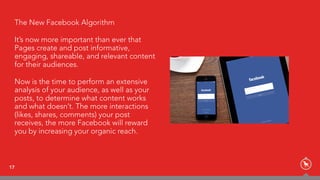
The New Facebook Algorithm
It’s now more important than ever that
Pages create and post informative,
engaging, shareable, and relevant content
for their audiences.
Now is the time to perform an extensive
analysis of your audience, as well as your
posts, to determine what content works
and what doesn’t. The more interactions
(likes, shares, comments) your post
receives, the more Facebook will reward
you by increasing your organic reach.
18
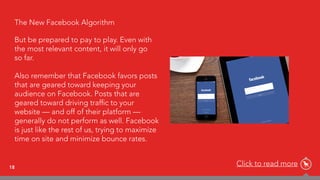
The New Facebook Algorithm
But be prepared to pay to play. Even with
the most relevant content, it will only go 

so far.


Also remember that Facebook favors posts
that are geared toward keeping your
audience on Facebook. Posts that are
geared toward driving traffic to your
website — and off of their platform —
generally do not perform as well. Facebook
is just like the rest of us, trying to maximize
time on site and minimize bounce rates.
Click to read more
19
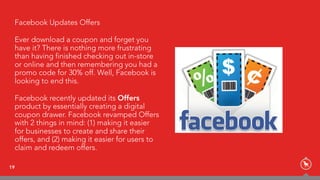
Facebook Updates Offers
Ever download a coupon and forget you
have it? There is nothing more frustrating
than having finished checking out in-store
or online and then remembering you had a
promo code for 30% off. Well, Facebook is
looking to end this.
Facebook recently updated its Offers
product by essentially creating a digital
coupon drawer. Facebook revamped Offers
with 2 things in mind: (1) making it easier
for businesses to create and share their
offers, and (2) making it easier for users to
claim and redeem offers.
20
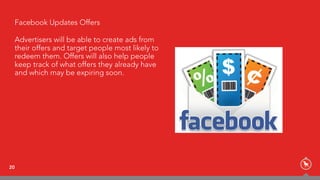
Facebook Updates Offers
Advertisers will be able to create ads from
their offers and target people most likely to
redeem them. Offers will also help people
keep track of what offers they already have
and which may be expiring soon.
21
Facebook Updates Offers
Not only will the changes make coupons more
mobile friendly for users and more targeted for
advertisers, but they also will go a long way
toward solving the issue of shoppers abusing
coupons. Marketers can assign a code to each
coupon that limits how many times it can be
redeemed. This sort of control will drive the
cost down for brands and increase their
potential revenue from the offers.
While Facebook Offers has been around for
more than 4 years, it has not been widely
utilized. We predict that will change in the near
future. The updated product is a win for both
brands and users.
Click to read more
22
#Hashtagging
23
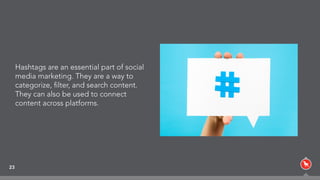
Hashtags are an essential part of social
media marketing. They are a way to
categorize, filter, and search content.
They can also be used to connect
content across platforms.
24
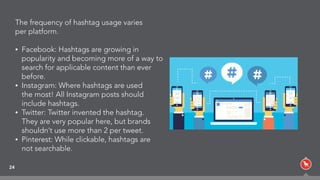
The frequency of hashtag usage varies 

per platform.
• Facebook: Hashtags are growing in
popularity and becoming more of a way to
search for applicable content than ever
before.
• Instagram: Where hashtags are used 

the most! All Instagram posts should
include hashtags.
• Twitter: Twitter invented the hashtag.

They are very popular here, but brands
shouldn’t use more than 2 per tweet.
• Pinterest: While clickable, hashtags are
not searchable.
25
As hashtag usage and strategy evolves, it is
important to identify how your brand will
use hashtags. Will it be only to participate
in trending conversations? To engage with
particular events? As a first comment or in
the copy? Will you use only branded
hashtags or only ones that are used
organically on the channel?
A quick search for hashtag tools will
uncover numerous options to help you
identify what hashtags will be a part of your
strategy and will give you a better idea as
to how to answer the questions above.
26
One way to incorporate a hashtag strategy
is by identifying trending hashtags. On
Twitter, Instagram, and now Facebook, you
can see when a topic or hashtag is
trending. This could be an opportunity for
your brand to engage in that conversation
in a way that is authentic and organic to
the brand. However, be sure not to force a
connection that does not exist!
27
Here are a few things to consider before
proposing a hashtag for a campaign:
1. Are others using the hashtag? If no
one else is using it, what purpose
does it serve? Leave it off unless
you’re creating a new conversation
and have a plan in place to promote
and support it.
2. Are you using the right hashtag? Pro
Tip: Always do a search of a hashtag
prior to including it in a campaign.
Even the most innocent of hashtags
may have connotations that you don’t
want your brand aligned with!
28
3. Are you adding to the conversation?
Consider what benefit you are bringing
to the community.
4. Will your hashtag benefit you? Will
your account benefit from the
increased exposure to people
following the hashtag?
5. Is it relevant and on-brand? Don’t just
use a hashtag to be cool. Users will see
through it and react accordingly.
Let the #hashtagging commence!
Click to read more
29
Millennials and 

E-commerce
30
A new GlobalWebIndex study provides more
information on the role of social 

media in the purchase funnel. While social
platforms do not drive a high number of
direct orders, they still play a role in 

e-commerce.
31
According to the study, 40% of global
consumers ages 16-24 use social media to
research products before they buy. However,
the study also shows that social platforms do
not actually drive many direct orders.
32
Some additional takeaways from the 

report are:
• Facebook accounts for 50% of total social
referrers and 64% of total social revenue.

• Despite an audience 6.5 times smaller
than Twitter, Pinterest drives 16% of 

social revenue.
• Instagram doesn’t drive significant sales
for retailers, but many companies are
leveraging the platform for brand
awareness initiatives.
Click to read more
FOLLOW
SCOUT

SCOUT Social Bark - August 2016

  • 2.
    2 Contents Instagram Stories What’s Happeningto Facebook? • Facebook Pixel • But I Don’t Even Have a Facebook Page! • The New Facebook Algorithm • Facebook Updates Offers #Hashtagging Millennials and E-commerce
  • 3.
  • 4.
    4 Earlier this month,Instagram rolled out Stories, which allows users to upload a “story” that is visible only for 24 hours. Sound familiar? *cough* Snapchat. *cough*
  • 5.
    5 While the similaritiesare plenty, there are a few notable differences: • Instagram Stories allows you to “rewind” to play back things you may have missed. • Instagram Stories lets you post sections of your story as an Instagram post. • Instagram Stories doesn’t show you who screenshots your story, but Snapchat does. • Geo-filters and facial-mapping are limited to Snapchat. • Instagram Stories gives you the ability to save a story before posting, which would allow for social media managers to get approval of content prior to a post going live.
  • 6.
    6 Click to readmore These results should prompt brands to address their current content and customer service strategy to determine if they are meeting the needs of the most engaging group on social media and, if not, how to do so. We think brands that have not joined Snapchat will feel more comfortable testing out Instagram Stories since they already have an established audience on the app. We also predict that brands will begin by testing behind-the-scenes content, influencer takeovers, and even personalized video messages to followers.
  • 7.
  • 8.
    All the recentchanges to Facebook 
 are enough to make any marketer’s head spin! The platform continues to evolve almost as quickly as we can report on it. Keep reading for the latest and greatest from the social media giant! 8
  • 9.
    9 Facebook Pixel Facebook knowsthat when it comes to marketing, if you’re not tracking your results, you’re wasting your time. That’s why they introduced the Facebook pixel earlier this year, which is a combination of their previous Conversion and Custom Audience pixels. A pixel in this case is a tiny piece of code that's placed on a web page; consumers can never see it, but it allows marketers to gather relevant information about their audience.
  • 10.
    10 Facebook Pixel What exactlyis the Facebook pixel? It’s a pixel that “…allows you to place a single pixel across your entire website to report conversions, build audiences and get 
 rich insights about how people use 
 your website.”
  • 11.
    11 Facebook PixelFacebook Pixel Nowthe Facebook pixel is getting even smarter. Facebook has announced the release of advanced matching in the pixel. “This new feature of the Facebook pixel enables advertisers to leverage their own customer data such as email address, phone number, and so on. By implementing this feature, advertisers can report on more conversions, optimize their ads against more conversion data, and reach more people on Facebook with their website custom audiences or dynamic ads.” - Facebook
  • 12.
    12 Facebook PixelFacebook Pixel Basically,there are 3 new features, enabling advertisers to: 1. See how successful an ad is by seeing what happened as a direct result of your ad. 2. Automatically bid for conversions after the pixel is set up. 3. Remarket to everyone who visits your website, or just people who visit specific pages or take specific actions.
  • 13.
    13 Click to readmore Facebook PixelFacebook Pixel This pixel already seems to be a huge win for marketers. In beta testing, Facebook observed an increase of over 10% in attributed conversions and a 20% increase 
 in the reach of retargeting campaigns, per their blog. Marketers should update their old Facebook pixel to this new version immediately and start taking advantage of all the benefits.
  • 14.
    14 But I Don’tEven Have a Facebook Page! In June, Facebook announced that they would allow advertisers to begin targeting non-Facebook users in order to expand their ad network. “Today, we’re expanding Audience Network so publishers and developers can show better ads to everyone — including those who don’t use or aren’t connected to Facebook,” – Andrew Bosworth VP of Advertising at Facebook.
  • 15.
    15 But I Don’tEven Have a Facebook Page! By capitalizing on the data obtained from 1.7 billion users, Facebook hopes to predict the behavior and interests of all internet users. Facebook claims that not only will this be of benefit to brands in terms of advertising, but to users as well as they will begin to have a more customized and authentic user experience. All of this is great news for advertisers, but users are feeling a bit uneasy about Big Brother watching them. Stay tuned. Click to read more
  • 16.
    16 The New FacebookAlgorithm Brands are hitting the panic button over the new Facebook algorithm update. 
 In cased you missed it, Facebook announced in June that they would begin giving priority to content posted by your friends and family over posts from Pages* and publishers. The move means that the already declining organic reach of Facebook will only continue to diminish. So what should brands do? Exactly what you should have been doing from the beginning: creating engaging content! *Facebook Pages include local businesses or places, companies, organizations or institutions, brands or products, artists, bands or public figures, entertainment,
  • 17.
    17 The New FacebookAlgorithm It’s now more important than ever that Pages create and post informative, engaging, shareable, and relevant content for their audiences. Now is the time to perform an extensive analysis of your audience, as well as your posts, to determine what content works and what doesn’t. The more interactions (likes, shares, comments) your post receives, the more Facebook will reward you by increasing your organic reach.
  • 18.
    18 The New FacebookAlgorithm But be prepared to pay to play. Even with the most relevant content, it will only go 
 so far. 
 Also remember that Facebook favors posts that are geared toward keeping your audience on Facebook. Posts that are geared toward driving traffic to your website — and off of their platform — generally do not perform as well. Facebook is just like the rest of us, trying to maximize time on site and minimize bounce rates. Click to read more
  • 19.
    19 Facebook Updates Offers Everdownload a coupon and forget you have it? There is nothing more frustrating than having finished checking out in-store or online and then remembering you had a promo code for 30% off. Well, Facebook is looking to end this. Facebook recently updated its Offers product by essentially creating a digital coupon drawer. Facebook revamped Offers with 2 things in mind: (1) making it easier for businesses to create and share their offers, and (2) making it easier for users to claim and redeem offers.
  • 20.
    20 Facebook Updates Offers Advertiserswill be able to create ads from their offers and target people most likely to redeem them. Offers will also help people keep track of what offers they already have and which may be expiring soon.
  • 21.
    21 Facebook Updates Offers Notonly will the changes make coupons more mobile friendly for users and more targeted for advertisers, but they also will go a long way toward solving the issue of shoppers abusing coupons. Marketers can assign a code to each coupon that limits how many times it can be redeemed. This sort of control will drive the cost down for brands and increase their potential revenue from the offers. While Facebook Offers has been around for more than 4 years, it has not been widely utilized. We predict that will change in the near future. The updated product is a win for both brands and users. Click to read more
  • 22.
  • 23.
    23 Hashtags are anessential part of social media marketing. They are a way to categorize, filter, and search content. They can also be used to connect content across platforms.
  • 24.
    24 The frequency ofhashtag usage varies 
 per platform. • Facebook: Hashtags are growing in popularity and becoming more of a way to search for applicable content than ever before. • Instagram: Where hashtags are used 
 the most! All Instagram posts should include hashtags. • Twitter: Twitter invented the hashtag.
 They are very popular here, but brands shouldn’t use more than 2 per tweet. • Pinterest: While clickable, hashtags are not searchable.
  • 25.
    25 As hashtag usageand strategy evolves, it is important to identify how your brand will use hashtags. Will it be only to participate in trending conversations? To engage with particular events? As a first comment or in the copy? Will you use only branded hashtags or only ones that are used organically on the channel? A quick search for hashtag tools will uncover numerous options to help you identify what hashtags will be a part of your strategy and will give you a better idea as to how to answer the questions above.
  • 26.
    26 One way toincorporate a hashtag strategy is by identifying trending hashtags. On Twitter, Instagram, and now Facebook, you can see when a topic or hashtag is trending. This could be an opportunity for your brand to engage in that conversation in a way that is authentic and organic to the brand. However, be sure not to force a connection that does not exist!
  • 27.
    27 Here are afew things to consider before proposing a hashtag for a campaign: 1. Are others using the hashtag? If no one else is using it, what purpose does it serve? Leave it off unless you’re creating a new conversation and have a plan in place to promote and support it. 2. Are you using the right hashtag? Pro Tip: Always do a search of a hashtag prior to including it in a campaign. Even the most innocent of hashtags may have connotations that you don’t want your brand aligned with!
  • 28.
    28 3. Are youadding to the conversation? Consider what benefit you are bringing to the community. 4. Will your hashtag benefit you? Will your account benefit from the increased exposure to people following the hashtag? 5. Is it relevant and on-brand? Don’t just use a hashtag to be cool. Users will see through it and react accordingly. Let the #hashtagging commence! Click to read more
  • 29.
  • 30.
    30 A new GlobalWebIndexstudy provides more information on the role of social 
 media in the purchase funnel. While social platforms do not drive a high number of direct orders, they still play a role in 
 e-commerce.
  • 31.
    31 According to thestudy, 40% of global consumers ages 16-24 use social media to research products before they buy. However, the study also shows that social platforms do not actually drive many direct orders.
  • 32.
    32 Some additional takeawaysfrom the 
 report are: • Facebook accounts for 50% of total social referrers and 64% of total social revenue.
 • Despite an audience 6.5 times smaller than Twitter, Pinterest drives 16% of 
 social revenue. • Instagram doesn’t drive significant sales for retailers, but many companies are leveraging the platform for brand awareness initiatives. Click to read more
  • 33.