INTRODUCTION TO The BRITISH ISLES
Introduction
The British Isles have a rich history going
back thousands of years.
The history of the United Kingdom includes
also the history of England, Scotland,
Wales and Northern Ireland.
The country of mingle races.
The history is full of invaders, wars,
rulers.
What is the British Isles?
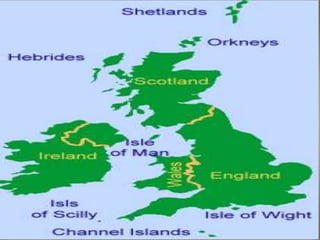
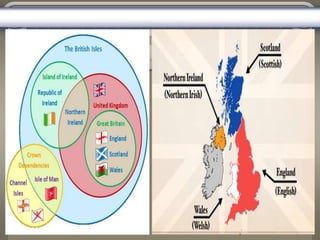
•The British Isles lie off the north-west coast of
continental Europe
•The British Isles is a geographically term which
includes Great Britain, the whole of Ireland, and all
the offshore islands, most notably the Isle of Man
which has its own parliament and laws.
•The British Isles are made up of:
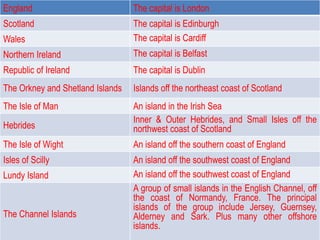
England The capital is London
Scotland The capital is Edinburgh
Wales The capital is Cardiff
Northern Ireland The capital is Belfast
Republic of Ireland The capital is Dublin
The Orkney and Shetland Islands Islands off the northeast coast of Scotland
The Isle of Man An island in the Irish Sea
Hebrides
Inner & Outer Hebrides, and Small Isles off the
northwest coast of Scotland
The Isle of Wight An island off the southern coast of England
Isles of Scilly An island off the southwest coast of England
Lundy Island An island off the southwest coast of England
The Channel Islands
A group of small islands in the English Channel, off
the coast of Normandy, France. The principal
islands of the group include Jersey, Guernsey,
Alderney and Sark. Plus many other offshore
islands.
Is Great Britain as the same as the UK?
Great Britain Vs. United
Kingdom
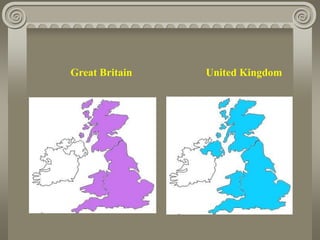
Great Britain United Kingdom
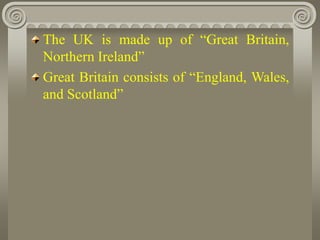
The UK is made up of “Great Britain,
Northern Ireland”
Great Britain consists of “England, Wales,
and Scotland”
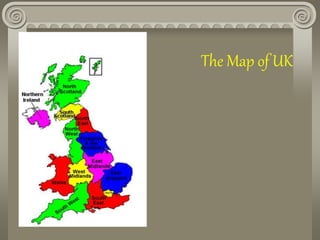
The Map of UK
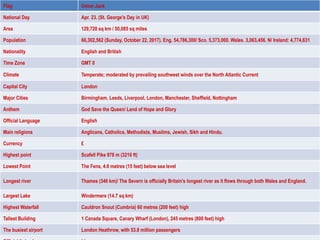
Flag Union Jack
National Day Apr. 23. (St. George's Day in UK)
Area 129,720 sq km / 50,085 sq miles
Population 66,302,562 (Sunday, October 22, 2017). Eng. 54,786,300/ Sco. 5,373,000. Wales. 3,063,456. N/ Ireland: 4,774,631
Nationality English and British
Time Zone GMT 0
Climate Temperate; moderated by prevailing southwest winds over the North Atlantic Current
Capital City London
Major Cities Birmingham, Leeds, Liverpool, London, Manchester, Sheffield, Nottingham
Anthem God Save the Queen/ Land of Hope and Glory
Official Language English
Main religions Anglicans, Catholics, Methodists, Muslims, Jewish, Sikh and Hindu.
Currency £
Highest point Scafell Pike 978 m (3210 ft)
Lowest Point The Fens, 4.6 metres (15 feet) below sea level
Longest river Thames (346 km)/ The Severn is officially Britain's longest river as it flows through both Wales and England.
Largest Lake Windermere (14.7 sq km)
Highest Waterfall Cauldron Snout (Cumbria) 60 metres (200 feet) high
Tallest Building 1 Canada Square, Canary Wharf (London), 245 metres (800 feet) high
The busiest airport London Heathrow, with 53.8 million passengers

Introduction to the british isles

  • 1.
    INTRODUCTION TO TheBRITISH ISLES
  • 2.
    Introduction The British Isleshave a rich history going back thousands of years. The history of the United Kingdom includes also the history of England, Scotland, Wales and Northern Ireland. The country of mingle races. The history is full of invaders, wars, rulers.
  • 3.
    What is theBritish Isles? •The British Isles lie off the north-west coast of continental Europe •The British Isles is a geographically term which includes Great Britain, the whole of Ireland, and all the offshore islands, most notably the Isle of Man which has its own parliament and laws. •The British Isles are made up of:
  • 4.
    England The capitalis London Scotland The capital is Edinburgh Wales The capital is Cardiff Northern Ireland The capital is Belfast Republic of Ireland The capital is Dublin The Orkney and Shetland Islands Islands off the northeast coast of Scotland The Isle of Man An island in the Irish Sea Hebrides Inner & Outer Hebrides, and Small Isles off the northwest coast of Scotland The Isle of Wight An island off the southern coast of England Isles of Scilly An island off the southwest coast of England Lundy Island An island off the southwest coast of England The Channel Islands A group of small islands in the English Channel, off the coast of Normandy, France. The principal islands of the group include Jersey, Guernsey, Alderney and Sark. Plus many other offshore islands.
  • 6.
    Is Great Britainas the same as the UK? Great Britain Vs. United Kingdom
  • 7.
  • 8.
    The UK ismade up of “Great Britain, Northern Ireland” Great Britain consists of “England, Wales, and Scotland”
  • 10.
  • 11.
    Flag Union Jack NationalDay Apr. 23. (St. George's Day in UK) Area 129,720 sq km / 50,085 sq miles Population 66,302,562 (Sunday, October 22, 2017). Eng. 54,786,300/ Sco. 5,373,000. Wales. 3,063,456. N/ Ireland: 4,774,631 Nationality English and British Time Zone GMT 0 Climate Temperate; moderated by prevailing southwest winds over the North Atlantic Current Capital City London Major Cities Birmingham, Leeds, Liverpool, London, Manchester, Sheffield, Nottingham Anthem God Save the Queen/ Land of Hope and Glory Official Language English Main religions Anglicans, Catholics, Methodists, Muslims, Jewish, Sikh and Hindu. Currency £ Highest point Scafell Pike 978 m (3210 ft) Lowest Point The Fens, 4.6 metres (15 feet) below sea level Longest river Thames (346 km)/ The Severn is officially Britain's longest river as it flows through both Wales and England. Largest Lake Windermere (14.7 sq km) Highest Waterfall Cauldron Snout (Cumbria) 60 metres (200 feet) high Tallest Building 1 Canada Square, Canary Wharf (London), 245 metres (800 feet) high The busiest airport London Heathrow, with 53.8 million passengers