SCOPE OF ORTHODONTICS
Presented by- Abhishek Agale.
4th yr.BDS
Roll no. 02
CONTENT
•Introduction
•Alteration in tooth position
•Alteration in skeletal pattern
•Alteration in soft tissue patterns
•Types of orthodontic treatment
•Conclusion
•Reference
INTRODUCTION
Orthodontics is that branch of dentistry
concerned with prevention, interception and
correction of malocclusion and other
abnormalities of dento-facial region.
SCOPE OF ORTHODONTICS
Orthodontic treatment involves the three main tissue
system concerned in dento-facial development,
namely
The dentition
The skeleton &
The facial and jaw musculature
ALTERATION IN TOOTH POSITION
Orthodontic treatment is made possible by the
fact that teeth can be moved throughout the
bone to ideal location by applying appropriate
force on them.
ALTERATION IN SKELETAL PATTERN
Malocclusion may be associated with skeletal
disharmony involving the jaw bones.
Deviations from the normal can arises in size, position
and relationship between these skeletal components.
Orthodontist can bring about changes in all three
planes of spaces
i.e. sagittal, transverse, and vertical.
ALTERATION IN SOFT TISSUE
PATTERN
The soft tissue that envelop the dentition are
greatly influenced by the placement of the
dentition.
It is possible to bring about favorable changes in
the soft tissue pattern by orthodontic treatment.
TYPES OF ORTHODONTIC
TREATMENT
Types of orthodontic treatment we can even classify
these as
1. Preventive orthodontics
2. Interceptive orthodontics
3. Corrective orthodontics
4. Surgical orthodontics
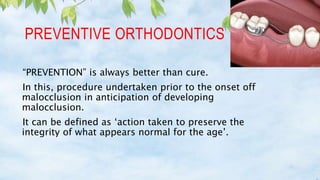
PREVENTIVE ORTHODONTICS
“PREVENTION” is always better than cure.
In this, procedure undertaken prior to the onset off
malocclusion in anticipation of developing
malocclusion.
It can be defined as ‘action taken to preserve the
integrity of what appears normal for the age’.
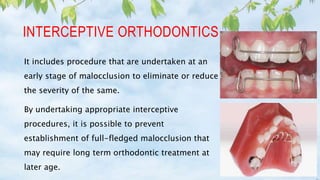
INTERCEPTIVE ORTHODONTICS
It includes procedure that are undertaken at an
early stage of malocclusion to eliminate or reduce
the severity of the same.
By undertaking appropriate interceptive
procedures, it is possible to prevent
establishment of full-fledged malocclusion that
may require long term orthodontic treatment at
later age.
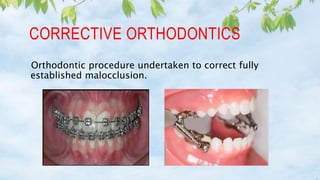
CORRECTIVE ORTHODONTICS
Orthodontic procedure undertaken to correct fully
established malocclusion.
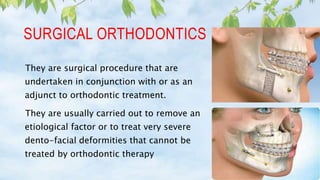
SURGICAL ORTHODONTICS
They are surgical procedure that are
undertaken in conjunction with or as an
adjunct to orthodontic treatment.
They are usually carried out to remove an
etiological factor or to treat very severe
dento-facial deformities that cannot be
treated by orthodontic therapy
SUMMARY
Orthodontics is the study that deals with alignment of teeth and
jaws. It is the dental specialty that deals with diagnosis,
prevention, interception, and correction of malocclusion, as well
as neuromuscular and skeletal abnormalities of the developing
or mature orofacial structures which can be treated by
undertaking various methods.
REFERENCE
orthodontics the art and science- S.I Bhalajhi 7th edition
Scope of orthodontics

Scope of orthodontics

  • 1.
    SCOPE OF ORTHODONTICS Presentedby- Abhishek Agale. 4th yr.BDS Roll no. 02
  • 2.
    CONTENT •Introduction •Alteration in toothposition •Alteration in skeletal pattern •Alteration in soft tissue patterns •Types of orthodontic treatment •Conclusion •Reference
  • 3.
    INTRODUCTION Orthodontics is thatbranch of dentistry concerned with prevention, interception and correction of malocclusion and other abnormalities of dento-facial region.
  • 4.
    SCOPE OF ORTHODONTICS Orthodontictreatment involves the three main tissue system concerned in dento-facial development, namely The dentition The skeleton & The facial and jaw musculature
  • 5.
    ALTERATION IN TOOTHPOSITION Orthodontic treatment is made possible by the fact that teeth can be moved throughout the bone to ideal location by applying appropriate force on them.
  • 6.
    ALTERATION IN SKELETALPATTERN Malocclusion may be associated with skeletal disharmony involving the jaw bones. Deviations from the normal can arises in size, position and relationship between these skeletal components. Orthodontist can bring about changes in all three planes of spaces i.e. sagittal, transverse, and vertical.
  • 7.
    ALTERATION IN SOFTTISSUE PATTERN The soft tissue that envelop the dentition are greatly influenced by the placement of the dentition. It is possible to bring about favorable changes in the soft tissue pattern by orthodontic treatment.
  • 8.
    TYPES OF ORTHODONTIC TREATMENT Typesof orthodontic treatment we can even classify these as 1. Preventive orthodontics 2. Interceptive orthodontics 3. Corrective orthodontics 4. Surgical orthodontics
  • 9.
    PREVENTIVE ORTHODONTICS “PREVENTION” isalways better than cure. In this, procedure undertaken prior to the onset off malocclusion in anticipation of developing malocclusion. It can be defined as ‘action taken to preserve the integrity of what appears normal for the age’.
  • 10.
    INTERCEPTIVE ORTHODONTICS It includesprocedure that are undertaken at an early stage of malocclusion to eliminate or reduce the severity of the same. By undertaking appropriate interceptive procedures, it is possible to prevent establishment of full-fledged malocclusion that may require long term orthodontic treatment at later age.
  • 11.
    CORRECTIVE ORTHODONTICS Orthodontic procedureundertaken to correct fully established malocclusion.
  • 12.
    SURGICAL ORTHODONTICS They aresurgical procedure that are undertaken in conjunction with or as an adjunct to orthodontic treatment. They are usually carried out to remove an etiological factor or to treat very severe dento-facial deformities that cannot be treated by orthodontic therapy
  • 13.
    SUMMARY Orthodontics is thestudy that deals with alignment of teeth and jaws. It is the dental specialty that deals with diagnosis, prevention, interception, and correction of malocclusion, as well as neuromuscular and skeletal abnormalities of the developing or mature orofacial structures which can be treated by undertaking various methods.
  • 14.
    REFERENCE orthodontics the artand science- S.I Bhalajhi 7th edition