SCOOTERS
“A ride to your little one’s dream”
Submitted by-
Arpita Tripathy
Tulasi kumar Nanda
SCOOTERS
Case Study Description
 Scooters is a children’s clothing and gift store that is about to
be opened by the Rodrigues Siblings-Mike ,Ron and Mary.
 The store was to be opened on a city block that has a natural
food coop , a pharmacy & a pet store.
 Situated in the ‘first ring’ of Arizona city,5 miles from central
business district near several small parks , a YMCA and two
grade school – one is a combination of all kindergarten and
extended hour day care and the other one is elementary school
(grades 1-5)
Scooters Clothing store
Pharmacy Store
Food co-op
Pet shop
5 MILES
Central Business
District
Park
KG school
Elementary
school
Extended hour
day care
Description
 A metered on-street parking although there are 6 parking spaces just
behind the store.
 The exterior of the store has a tan stucco textured walls and traditional
south western red tiles are used for roofs.
 Dimension of the interior is 40” x 60” and additional 40” x 20” for
backroom space and the 2nd floor is equally large with office/storage
space for 40” x 20” back area.
 Clothing category-infants , toddlers , kids (boys & girls till size 12) on
the main floor , toys ,books and gifts on the 2nd floor.
 Principle differentiating factor is pricing. Owners want to have an
upscale environment.
 They want playful environmental store and demonstrate that scooter
understands the wants ,likes and needs of young families.
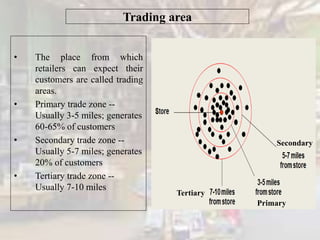
Trading area
• The place from which
retailers can expect their
customers are called trading
areas.
• Primary trade zone --
Usually 3-5 miles; generates
60-65% of customers
• Secondary trade zone --
Usually 5-7 miles; generates
20% of customers
• Tertiary trade zone --
Usually 7-10 miles
Tertiary
Secondary
Primary
Population and potential customer – The neighborhood is getting
filled with young couples, there are two grade schools in the nearby
vicinity.
Accessibility, Visibility and Traffic – Young couples are getting
settled in the area, also it is by the street so no problem of
accessibility and visibility. So it is obvious that the families are
bound to pass-by the store. There are 6 parking space behind the
store and also it has a metered parking.
Competitors and Neighbor – As mentioned there is a natural food
co-op, a pharmacy and a pet store nearby that means there is no
competition from the neighborhood.
Personal factor – The siblings grew up in the area so they are well
accustomed to the area so it is a positive factor for the owner.
FACTORS OF RETAIL LOCATION
TYPE OF STORE – DISCOUNT STORE
 Planned to sell at 30%-40%
off normal retail price. Carries
a wide assortment of products
in clothing and gift.
 The purchase of goods will be
made at off price, promotional
and end lot goods from the
market.
Tan stucco
Traditional
south western
red tiles
Toys , books and gifts
clothing
CONSUMER DEMOGRAPHICS
 Infants: 0-1 years
 Toddlers: 1-3 years
 Pre –Schoolers : 3-5 years
 Elementary -Schoolers: 5-10
years
TARGET MARKET
Affluent Young families
STRENGTH
• The siblings grew up in the
locality so are aware of the
local condition and habits
of people.
• They know the
demographics and culture.
WEAKNESS
• Metered on street parking
• And store parking is
behind the store.
OPPORTUNITY
• Distance of parks is about 5
miles.
• 2 grade schools are nearby.
• Young families are
rehabilitating
THREAT
• Lack of mutual agreement
among the brothers
• Metered parking may drive
away cost conscious
customer
SWOT ANALYSIS
Window display
 Everything the customer sees , both exterior and interior that creates a
positive image of a business and results in attention ,interest , desire
and action.
 Window Display is the ‘visiting card’ of a store.
1. Choose a theme/tell a ‘story’
2. Pick appropriately sized items
3. Use space interestingly
4. Create good lighting
ROLE OF WINDOW DISPLAY
Formulate
marketing and
promotional
strategy
Manage the
implementatio
n of marketing
and promotion
schemes
Present product
and store image
Convey store
related message to
consumer
Projecting
consumer self
image and
preference
View and
appreciate
visual
presentation
Express
preference for
stores and
products
Retailers and
designers
Window
display
Consumers
Rules for Display Planning
 Giving display one dominant theme
 Use of contrast and rhythm to add life to colors and proportion
 Display of props and materials having some connection
 Usage of appropriate color to the season
 Avoid anything that conflicts with sales message.
Window display category
 Close back window
 Semi realistic setting with seasonal display
• In this kind of display the visual
merchandiser presents the essence, the tip
of the iceberg, and leaves the rest to the
active imagination of the shopper.
• This approach is more effective but
simpler approach to merchandise settings.
• Each season brings with it particular
merchandise to feature, and nature
suggests general settings in which to
show it.
• Each season provide a unique opportunity
to encourage customers to start thinking
about what they need for the next season,
and try to buy it
SEMI-REALISTIC WITH
SEASONAL DISPLAY
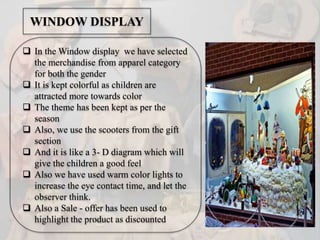
 In the Window display we have selected
the merchandise from apparel category
for both the gender
 It is kept colorful as children are
attracted more towards color
 The theme has been kept as per the
season
 Also, we use the scooters from the gift
section
 And it is like a 3- D diagram which will
give the children a good feel
 Also we have used warm color lights to
increase the eye contact time, and let the
observer think.
 Also a Sale - offer has been used to
highlight the product as discounted
WINDOW DISPLAY
STORY
Here we have tried to portray how kids
are enjoying there childhood days with
the colorful background of a rainbow.
Childhood days are one of the most
beautiful days of a human being.
Children have a very imaginative
thinking and colorful objects attract
children. And as the name of the store
depicts scooter we have tried to showcase
how kids enjoy this kind of rides. Here
we have tried to celebrate the rainy
season, as rainbows are mostly visible
during rainy season.
ELEMENTS TO ATTRACT SHOPPER’S
ATTENTION
Scale, Color or contrast, Repetition,
Humor, Mirrors, Nostalgia, Motion, Surprise or
shock, Props, Lightning
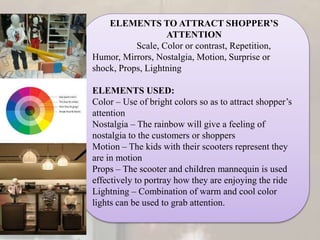
ELEMENTS USED:
Color – Use of bright colors so as to attract shopper’s
attention
Nostalgia – The rainbow will give a feeling of
nostalgia to the customers or shoppers
Motion – The kids with their scooters represent they
are in motion
Props – The scooter and children mannequin is used
effectively to portray how they are enjoying the ride
Lightning – Combination of warm and cool color
lights can be used to grab attention.
Communicating through
Signing
 Retail stores begin to communicate
with potential shoppers before the
shoppers ever enter the store. From the
minute shoppers read the store’s name
or see it’s logo on the storefront, they
are getting a message.
 An effective sign attracts attention and
conveys brand idtentity,giving
shoppers their first impression of what
they will find inside the store.
 One glance at the window display
scooter sells gifts and clothing
products.
SCOOTERS
“A ride to your little one’s
dream”
The first thing shoppers will notice about a store is
“ Décor Package”
Which is a package of all elements like
Walls
Colors
Music
Lights
Fixtures
Images
Scent
Floors
Layouts
Props
That works together to tell a “ Single Story”
Floor Layout
 Simplest type of store layout
in which fixtures and
merchandise are group into
free flowing pattern on the
floor.
 Customers are encouraged to
flow freely through all the
fixtures
First floor
Second floor
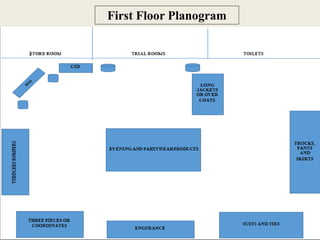
First Floor Planogram
Second Floor Planogram
Ground Floor
 Most of the fixtures present in are wall fixtures so that the kids
can not reach them.
 There is a floor fixture on the ground floor which separates the
trial room and backroom.
 Wall fixtures like wall mounted clothing racks of different sizes
are present in the store. They are attached with props having the
pictures of cartoon characters and balloon cut-outs.
 The wall fixtures are mounted on the either sides of the store.
 The fixtures are white in colour but are attached to multi
coloured props in order to attract the customers, mostly, kids.
Fixtures
• Since the store has a free flow layout, there
products of different age groups and categories
can be found.
• To the left of the entrance, apparels of girls till
size 12 can be found. Beside that apparel of
toddlers are hung.
• To the right of the entrance, coats along with
shirts in them are hung for display.
• Beside the doll house closet, there is a Floor
fixture on which coats for girls are displayed.
• The garments hung on to the fixtures are
displayed on the basis of the colour scheme of
the current season.
• The sizes of the apparels present in the store are
till the size 12 of both boys and girls.
• End users of the apparels are toddlers, girls and
boys.
First floor
• First floor is a game arcade for kids as well as has a
large collection of books just near the entrance.
• For books, there is a floor fixture, i.e., a book
shelf/display shelf is installed. Beside that, a display
pedestal is kept for stuffed toys.
• The colour scheme followed in the décor of the first
floor is based on the current season.
• Many colourful props like saleable alphabet props are
fixed on to the walls which have different posters of
cartoon characters and moral story books.
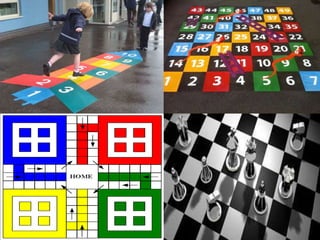
• Large sized chess board and ludo board are fixed on the
floor for the kids as well as for adults to play. Two
stuffed dice are also there for kids to play with it as well
as sit on it.
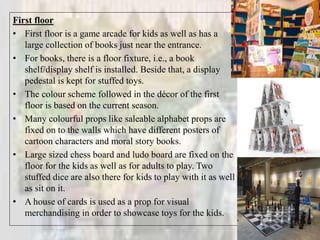
• A house of cards is used as a prop for visual
merchandising in order to showcase toys for the kids.
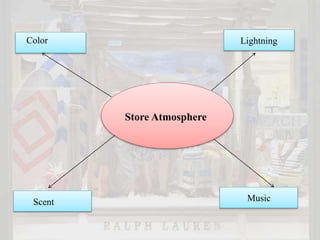
Store Atmosphere
Color Lightning
Scent Music
Atmospherics
 Atmospherics –multiple sensory elements for décor and
layout that appeal to a shopper’s five senses-can be
strategically “layered” into the basic shell of the store to
enhance the shopping environment and build the brand
image of the store.
 This layering entails a simultaneous use of
sight,sound,touch,taste and smell that can actually alter
shopper’s perception of time, encouraging them to
become so comfortable and pleasantly stimulated in the
shopping environment that time becomes less important
than it might otherwise be.
 They shop longer ,see and touch more products and
become more inclined to purchase.
Color Scheme
Entrance
Creative door as per chosen color scheme
SCOOTERS
Colour Scheme
•The colour scheme of the store is taken into consideration,
keeping in eye both the little ones and their parents.
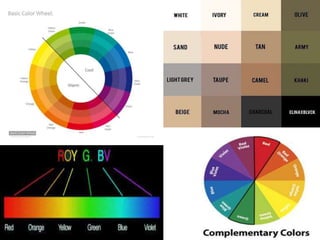
•The colour scheme chosen is complementary scheme and
the colours chosen are shades of red and green, i.e., peach
echo and green flash.
•It is inspired from the colours of the current season.
•The colours used in the interior of the store are majorly
warm and cool colours , i.e., the colours of a rainbow.
•The colour in the exterior of the store is just the opposite
of the interior, i.e., neutral.
•The colors of the product are divided into group according
to their color intensity.Brights –the clearest ,most vivid
primary color intensities.(ROYGBV)
• Neutral colours are the colours that put
focus on. Focus on the store will lead to
curiosity in human beings to know what
is inside.
• Cool colours like blue and green make
the customers feel calm and refreshing
when they enter the store.
• White will give the customer an
experience of cleanliness and pureness.
• Warm colours like red, orange and
yellow attracts and invites the customers
into the store and brings happiness to
them.
Operational signings
 Operational signing can enhance
both store environment and brand
identity-never seem as mundane
as the term “operational” implies.
 Information's on the operational
signs, such as the location of
departments ,checkouts and
restrooms can be communicated
in variety of ways.
 Giving a perception at a glance
that this store will be easy to
locate merchandise and hence
easy to shop.
POS
Graphic Element
• Graphics are used in the stores to give a story or
concept to the store.
• Graphics attract large number of customers into the
store making them curious about the products
available.
• The graphic element adds design strategy and are a
key to a customer’s decision to enter a store or not.
• Effective graphic elements create a strong brand
identity and can positively influence shopper
behavior.
• Such elements can produce visual aids that will
help you communicate ideas.
• For kids wear section, graphics like posters of
cartoon characters are used in order to attract
the kids which will lead to more time duration
to be spent on the floor.
• Life size posters of book covers will help to
attract the kids who are fond of reading stories
or colouring pictures.
• The use of such posters and graphics will help
to create a strong brand image leading an
instant connection with its customers.
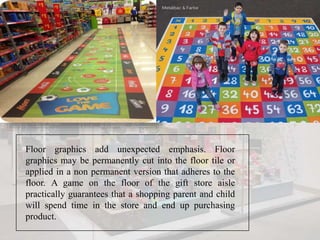
• Floor graphics will add more emphasis where
the parents will be forced by the kids to spend
more time on the floor which will in turn lead
to more chances in sales.
Floor graphics add unexpected emphasis. Floor
graphics may be permanently cut into the floor tile or
applied in a non permanent version that adheres to the
floor. A game on the floor of the gift store aisle
practically guarantees that a shopping parent and child
will spend time in the store and end up purchasing
product.
Atmospheric Elements
 More space for walking
 Normal temperature
 Wall coverings with all the cartoon and comic characters
 Lightning
 Normal sound Level
 Smooth shelfs
 Displays with super heroes
 Colour scheme
LIGHT
 Grab instant attention
 Facilitate the creation
 Light creates the desired emotion like
the feeling of warmth, of clarity, of
curiosity, of wonder, mystery and
even amazement
 Guide the customers' eyes; reveal the
colour and form of the merchandise
SHELF LIGHTING AND CASE LIGHTING
Small or miniature light sources located very close to the objects being
displayed, shielded from the customer’s view. This lighting must be carefully
selected for the particular application to avoid accidental contact with hot
lamps and to prevent damaging the merchandise with too much ultra-violet
radiation or heat.
DISPLAY LIGHTING
Display lighting allows us to draw out the best traits of the merchandise and is
supplementary to the general diffuse lighting. It help us to influence the
customer’s impression by highlighting the product’s best attributes such as
form and texture. If this light is directed too obliquely, it can result in
objectionable shadows.
RACK LIGHTING
The purpose of rack lighting is to attract customers to and allow easy
evaluation of merchandise. The lighting system that is selected should
accomplish two things: fully illuminate the merchandise and accurately
display color and texture. Concealed, baffled light sources can be used in
large, cased wall areas and flush or surface mounted adjustable ceiling accent
lights should be used in open rack areas where the luminance on the clothing
should be greater than the luminance from ambient lighting.
DRESSING ROOM LIGHTING
Dressing room lighting is imperative because this is where the purchase
decision is made. High quality light is needed to provide form and texture to
merchandise and make colors appear natural and realistic. Lighting must be
complimentary to the type of merchandise.
MUSIC SCENT
• Music with a slow tempo
can cause the consumer to
relax;therefore,they spend
more time in the store.
• The scent triggers the customer’s senses
and remind them of the brand and its
products
• Scents can also trigger emotional
responses.
• Cherry blossom – mild, lighter, fruity and
floral fragrance
REFERENCES
• Silent selling –JUDY BELL /KATE TERNUS
• Visual Merchandising- Swati Bhalla, Anurag S
• http://thebwd.com/summers-rainbow-window-display-2010-at-gap/
• https://www.pinterest.com/kreamojza/kids-store-window-
displays/?lp=true
• https://www.thebalance.com/types-of-store-layouts-2890503
• https://www.subastralinc.com/store-fixtures.html
• https://extension.illinois.edu/babysitting/age-preschool.cfm
• https://www.business2community.com/branding/6-reasons-graphic-
design-important-business-think-0928602
• http://www.discoverimagine.com/impression-store-design/
• http://www.c-sgroup.co.uk/blog/the-importance-of-in-store-
graphics-and-displays/
Scooters case study

Scooters case study

  • 1.
    SCOOTERS “A ride toyour little one’s dream” Submitted by- Arpita Tripathy Tulasi kumar Nanda SCOOTERS
  • 2.
    Case Study Description Scooters is a children’s clothing and gift store that is about to be opened by the Rodrigues Siblings-Mike ,Ron and Mary.  The store was to be opened on a city block that has a natural food coop , a pharmacy & a pet store.  Situated in the ‘first ring’ of Arizona city,5 miles from central business district near several small parks , a YMCA and two grade school – one is a combination of all kindergarten and extended hour day care and the other one is elementary school (grades 1-5)
  • 3.
    Scooters Clothing store PharmacyStore Food co-op Pet shop 5 MILES Central Business District Park KG school Elementary school Extended hour day care
  • 4.
    Description  A meteredon-street parking although there are 6 parking spaces just behind the store.  The exterior of the store has a tan stucco textured walls and traditional south western red tiles are used for roofs.  Dimension of the interior is 40” x 60” and additional 40” x 20” for backroom space and the 2nd floor is equally large with office/storage space for 40” x 20” back area.  Clothing category-infants , toddlers , kids (boys & girls till size 12) on the main floor , toys ,books and gifts on the 2nd floor.  Principle differentiating factor is pricing. Owners want to have an upscale environment.  They want playful environmental store and demonstrate that scooter understands the wants ,likes and needs of young families.
  • 5.
    Trading area • Theplace from which retailers can expect their customers are called trading areas. • Primary trade zone -- Usually 3-5 miles; generates 60-65% of customers • Secondary trade zone -- Usually 5-7 miles; generates 20% of customers • Tertiary trade zone -- Usually 7-10 miles Tertiary Secondary Primary
  • 6.
    Population and potentialcustomer – The neighborhood is getting filled with young couples, there are two grade schools in the nearby vicinity. Accessibility, Visibility and Traffic – Young couples are getting settled in the area, also it is by the street so no problem of accessibility and visibility. So it is obvious that the families are bound to pass-by the store. There are 6 parking space behind the store and also it has a metered parking. Competitors and Neighbor – As mentioned there is a natural food co-op, a pharmacy and a pet store nearby that means there is no competition from the neighborhood. Personal factor – The siblings grew up in the area so they are well accustomed to the area so it is a positive factor for the owner. FACTORS OF RETAIL LOCATION
  • 7.
    TYPE OF STORE– DISCOUNT STORE  Planned to sell at 30%-40% off normal retail price. Carries a wide assortment of products in clothing and gift.  The purchase of goods will be made at off price, promotional and end lot goods from the market.
  • 8.
    Tan stucco Traditional south western redtiles Toys , books and gifts clothing
  • 9.
    CONSUMER DEMOGRAPHICS  Infants:0-1 years  Toddlers: 1-3 years  Pre –Schoolers : 3-5 years  Elementary -Schoolers: 5-10 years TARGET MARKET Affluent Young families
  • 10.
    STRENGTH • The siblingsgrew up in the locality so are aware of the local condition and habits of people. • They know the demographics and culture. WEAKNESS • Metered on street parking • And store parking is behind the store. OPPORTUNITY • Distance of parks is about 5 miles. • 2 grade schools are nearby. • Young families are rehabilitating THREAT • Lack of mutual agreement among the brothers • Metered parking may drive away cost conscious customer SWOT ANALYSIS
  • 11.
    Window display  Everythingthe customer sees , both exterior and interior that creates a positive image of a business and results in attention ,interest , desire and action.  Window Display is the ‘visiting card’ of a store. 1. Choose a theme/tell a ‘story’ 2. Pick appropriately sized items 3. Use space interestingly 4. Create good lighting
  • 12.
    ROLE OF WINDOWDISPLAY Formulate marketing and promotional strategy Manage the implementatio n of marketing and promotion schemes Present product and store image Convey store related message to consumer Projecting consumer self image and preference View and appreciate visual presentation Express preference for stores and products Retailers and designers Window display Consumers
  • 13.
    Rules for DisplayPlanning  Giving display one dominant theme  Use of contrast and rhythm to add life to colors and proportion  Display of props and materials having some connection  Usage of appropriate color to the season  Avoid anything that conflicts with sales message.
  • 14.
    Window display category Close back window  Semi realistic setting with seasonal display
  • 15.
    • In thiskind of display the visual merchandiser presents the essence, the tip of the iceberg, and leaves the rest to the active imagination of the shopper. • This approach is more effective but simpler approach to merchandise settings. • Each season brings with it particular merchandise to feature, and nature suggests general settings in which to show it. • Each season provide a unique opportunity to encourage customers to start thinking about what they need for the next season, and try to buy it SEMI-REALISTIC WITH SEASONAL DISPLAY
  • 16.
     In theWindow display we have selected the merchandise from apparel category for both the gender  It is kept colorful as children are attracted more towards color  The theme has been kept as per the season  Also, we use the scooters from the gift section  And it is like a 3- D diagram which will give the children a good feel  Also we have used warm color lights to increase the eye contact time, and let the observer think.  Also a Sale - offer has been used to highlight the product as discounted WINDOW DISPLAY
  • 17.
    STORY Here we havetried to portray how kids are enjoying there childhood days with the colorful background of a rainbow. Childhood days are one of the most beautiful days of a human being. Children have a very imaginative thinking and colorful objects attract children. And as the name of the store depicts scooter we have tried to showcase how kids enjoy this kind of rides. Here we have tried to celebrate the rainy season, as rainbows are mostly visible during rainy season.
  • 18.
    ELEMENTS TO ATTRACTSHOPPER’S ATTENTION Scale, Color or contrast, Repetition, Humor, Mirrors, Nostalgia, Motion, Surprise or shock, Props, Lightning ELEMENTS USED: Color – Use of bright colors so as to attract shopper’s attention Nostalgia – The rainbow will give a feeling of nostalgia to the customers or shoppers Motion – The kids with their scooters represent they are in motion Props – The scooter and children mannequin is used effectively to portray how they are enjoying the ride Lightning – Combination of warm and cool color lights can be used to grab attention.
  • 19.
    Communicating through Signing  Retailstores begin to communicate with potential shoppers before the shoppers ever enter the store. From the minute shoppers read the store’s name or see it’s logo on the storefront, they are getting a message.  An effective sign attracts attention and conveys brand idtentity,giving shoppers their first impression of what they will find inside the store.  One glance at the window display scooter sells gifts and clothing products. SCOOTERS “A ride to your little one’s dream”
  • 20.
    The first thingshoppers will notice about a store is “ Décor Package” Which is a package of all elements like Walls Colors Music Lights Fixtures Images Scent Floors Layouts Props That works together to tell a “ Single Story”
  • 21.
    Floor Layout  Simplesttype of store layout in which fixtures and merchandise are group into free flowing pattern on the floor.  Customers are encouraged to flow freely through all the fixtures
  • 22.
  • 23.
  • 24.
  • 25.
  • 26.
    Ground Floor  Mostof the fixtures present in are wall fixtures so that the kids can not reach them.  There is a floor fixture on the ground floor which separates the trial room and backroom.  Wall fixtures like wall mounted clothing racks of different sizes are present in the store. They are attached with props having the pictures of cartoon characters and balloon cut-outs.  The wall fixtures are mounted on the either sides of the store.  The fixtures are white in colour but are attached to multi coloured props in order to attract the customers, mostly, kids. Fixtures
  • 27.
    • Since thestore has a free flow layout, there products of different age groups and categories can be found. • To the left of the entrance, apparels of girls till size 12 can be found. Beside that apparel of toddlers are hung. • To the right of the entrance, coats along with shirts in them are hung for display. • Beside the doll house closet, there is a Floor fixture on which coats for girls are displayed. • The garments hung on to the fixtures are displayed on the basis of the colour scheme of the current season. • The sizes of the apparels present in the store are till the size 12 of both boys and girls. • End users of the apparels are toddlers, girls and boys.
  • 29.
    First floor • Firstfloor is a game arcade for kids as well as has a large collection of books just near the entrance. • For books, there is a floor fixture, i.e., a book shelf/display shelf is installed. Beside that, a display pedestal is kept for stuffed toys. • The colour scheme followed in the décor of the first floor is based on the current season. • Many colourful props like saleable alphabet props are fixed on to the walls which have different posters of cartoon characters and moral story books. • Large sized chess board and ludo board are fixed on the floor for the kids as well as for adults to play. Two stuffed dice are also there for kids to play with it as well as sit on it. • A house of cards is used as a prop for visual merchandising in order to showcase toys for the kids.
  • 30.
  • 31.
    Atmospherics  Atmospherics –multiplesensory elements for décor and layout that appeal to a shopper’s five senses-can be strategically “layered” into the basic shell of the store to enhance the shopping environment and build the brand image of the store.  This layering entails a simultaneous use of sight,sound,touch,taste and smell that can actually alter shopper’s perception of time, encouraging them to become so comfortable and pleasantly stimulated in the shopping environment that time becomes less important than it might otherwise be.  They shop longer ,see and touch more products and become more inclined to purchase.
  • 32.
  • 33.
    Entrance Creative door asper chosen color scheme SCOOTERS
  • 34.
    Colour Scheme •The colourscheme of the store is taken into consideration, keeping in eye both the little ones and their parents. •The colour scheme chosen is complementary scheme and the colours chosen are shades of red and green, i.e., peach echo and green flash. •It is inspired from the colours of the current season. •The colours used in the interior of the store are majorly warm and cool colours , i.e., the colours of a rainbow. •The colour in the exterior of the store is just the opposite of the interior, i.e., neutral. •The colors of the product are divided into group according to their color intensity.Brights –the clearest ,most vivid primary color intensities.(ROYGBV)
  • 36.
    • Neutral coloursare the colours that put focus on. Focus on the store will lead to curiosity in human beings to know what is inside. • Cool colours like blue and green make the customers feel calm and refreshing when they enter the store. • White will give the customer an experience of cleanliness and pureness. • Warm colours like red, orange and yellow attracts and invites the customers into the store and brings happiness to them.
  • 37.
    Operational signings  Operationalsigning can enhance both store environment and brand identity-never seem as mundane as the term “operational” implies.  Information's on the operational signs, such as the location of departments ,checkouts and restrooms can be communicated in variety of ways.  Giving a perception at a glance that this store will be easy to locate merchandise and hence easy to shop.
  • 38.
  • 40.
    Graphic Element • Graphicsare used in the stores to give a story or concept to the store. • Graphics attract large number of customers into the store making them curious about the products available. • The graphic element adds design strategy and are a key to a customer’s decision to enter a store or not. • Effective graphic elements create a strong brand identity and can positively influence shopper behavior. • Such elements can produce visual aids that will help you communicate ideas.
  • 41.
    • For kidswear section, graphics like posters of cartoon characters are used in order to attract the kids which will lead to more time duration to be spent on the floor. • Life size posters of book covers will help to attract the kids who are fond of reading stories or colouring pictures. • The use of such posters and graphics will help to create a strong brand image leading an instant connection with its customers. • Floor graphics will add more emphasis where the parents will be forced by the kids to spend more time on the floor which will in turn lead to more chances in sales.
  • 43.
    Floor graphics addunexpected emphasis. Floor graphics may be permanently cut into the floor tile or applied in a non permanent version that adheres to the floor. A game on the floor of the gift store aisle practically guarantees that a shopping parent and child will spend time in the store and end up purchasing product.
  • 45.
    Atmospheric Elements  Morespace for walking  Normal temperature  Wall coverings with all the cartoon and comic characters  Lightning  Normal sound Level  Smooth shelfs  Displays with super heroes  Colour scheme
  • 47.
    LIGHT  Grab instantattention  Facilitate the creation  Light creates the desired emotion like the feeling of warmth, of clarity, of curiosity, of wonder, mystery and even amazement  Guide the customers' eyes; reveal the colour and form of the merchandise
  • 48.
    SHELF LIGHTING ANDCASE LIGHTING Small or miniature light sources located very close to the objects being displayed, shielded from the customer’s view. This lighting must be carefully selected for the particular application to avoid accidental contact with hot lamps and to prevent damaging the merchandise with too much ultra-violet radiation or heat.
  • 49.
    DISPLAY LIGHTING Display lightingallows us to draw out the best traits of the merchandise and is supplementary to the general diffuse lighting. It help us to influence the customer’s impression by highlighting the product’s best attributes such as form and texture. If this light is directed too obliquely, it can result in objectionable shadows.
  • 50.
    RACK LIGHTING The purposeof rack lighting is to attract customers to and allow easy evaluation of merchandise. The lighting system that is selected should accomplish two things: fully illuminate the merchandise and accurately display color and texture. Concealed, baffled light sources can be used in large, cased wall areas and flush or surface mounted adjustable ceiling accent lights should be used in open rack areas where the luminance on the clothing should be greater than the luminance from ambient lighting.
  • 51.
    DRESSING ROOM LIGHTING Dressingroom lighting is imperative because this is where the purchase decision is made. High quality light is needed to provide form and texture to merchandise and make colors appear natural and realistic. Lighting must be complimentary to the type of merchandise.
  • 52.
    MUSIC SCENT • Musicwith a slow tempo can cause the consumer to relax;therefore,they spend more time in the store. • The scent triggers the customer’s senses and remind them of the brand and its products • Scents can also trigger emotional responses. • Cherry blossom – mild, lighter, fruity and floral fragrance
  • 53.
    REFERENCES • Silent selling–JUDY BELL /KATE TERNUS • Visual Merchandising- Swati Bhalla, Anurag S • http://thebwd.com/summers-rainbow-window-display-2010-at-gap/ • https://www.pinterest.com/kreamojza/kids-store-window- displays/?lp=true • https://www.thebalance.com/types-of-store-layouts-2890503 • https://www.subastralinc.com/store-fixtures.html • https://extension.illinois.edu/babysitting/age-preschool.cfm • https://www.business2community.com/branding/6-reasons-graphic- design-important-business-think-0928602 • http://www.discoverimagine.com/impression-store-design/ • http://www.c-sgroup.co.uk/blog/the-importance-of-in-store- graphics-and-displays/