Master of Public Affairs
at Sciences Po in Paris
Preparing Young Professionals for Careers of Global Significance
Our Philosophy
Governance implies an approach in which goals of public significance
are addressed by constellations of public and private actors. These
constellations are not driven from the top down. They are not dominated
by any one actor. Instead, they involve multiple, often evolving, coalitions
of interested actors. This is a vision of public affairs in which decisions
are not dictated. They are navigated.
Moreover, there are an increasing number of issues – international
trade, environmental sustainability, health and human security – that
do not easily conform to national or local boundaries. They require a
combination of contextual savoir faire and analytical skill.
The MPA at Sciences Po is designed specifically with these challenges in
mind. The MPA attracts young professionals who seek to impact issues
of global significance, both at the international stage and in their own
cities and countries.
The MPA is based on five commitments:
Provide students with a holistic understanding of public affairs by theory
and practice in equal measure
Engage students with a global and comparative perspective on public
affairs.
Expose students to real policy problems through field-based learning
experiences
Strengthen students’ analytical skills and diagnostic capacities enabling
them to test the effectiveness of policies and public affairs initiatives
Challenge students to confront the ethical issues raised by their actions
in the public sphere.
The MPA is more than a master’s program, it is a community that one belongs to and an experience
that leaves a lasting impression on how we approach society.
Roopa I USA, 2012 GRADUATE
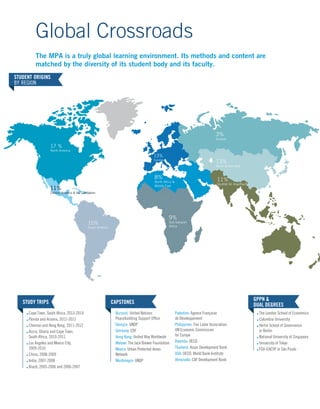
17 %
North America
15%
South America
13%
North  East Asia
3%
Eurasia
11%
South SE Asia/Pacific
13%
Europe
8%
North Africa 
Middle East
9%
Sub Saharan
Africa
The MPA is a truly global learning environment. Its methods and content are
matched by the diversity of its student body and its faculty.
Global Crossroads
student origins
by region
Cape Town, South Africa, 2013-2014
Florida and Arizona, 2012-2013
Chennai and Hong Kong, 2011-2012
Accra, Ghana and Cape Town,
South Africa, 2010-2011
Los Angeles and Mexico City,
2009-2010
China, 2008-2009
India, 2007-2008
Brazil, 2005-2006 and 2006-2007
Burundi: United Nations
Peacebuilding Support Office
Georgia: UNDP
Germany: EDF
Hong Kong: United Way Worldwide
Malawi: The Jack Brewer Foundation
Mexico: Urban Protected Areas
Network
Montenegro: UNDP
GPPN 
DUAL DEGREES
11%
Central America  the Caribbean
Palestine: Agence Française
de Développement
Philippines: Fair Labor Association;
UN Economic Commission
for Europe
Rwanda: OECD
Thailand: Asian Development Bank
USA: OECD, World Bank Institute
Venezuela: CAF Development Bank
CAPSTONESSTUDY TRIPS
The London School of Economics
Columbia University
Hertie School of Governance
in Berlin
National University of Singapore
University of Tokyo
FGV-EAESP in São Paulo
Capstone on
sustainable urban
development
Mexico, 2010

The most distinctive feature of the
MPA is its focus on the people and the
organizations that enact policies on a
daily basis.
This approach requires students to go
to the field to see the interpersonal
relationships and the historical patterns
in which public affairs are embedded.
In the first year, all MPA students travel
together for a major field-based research
project.
In their second year, all MPA students
conduct a year-long capstone project
advising a client on a relevant issue.
In between, students work for
international organizations, governments,
NGOs and private sector companies
as interns. Each step of the way is
integrated with the learning that takes
place in the MPA’s classrooms.
Field-Based Learning
Study Trip on
social welfare
China, 2009

Capstone on
capacity building
Tunisia, 2012

Capstone on
evaluating aid
efficiency
Palestine, 2013

Study Trip on waste
management
Hong Kong, 2012
 Study Trip on
informal economy
India, 2008
THIRD SEMESTER FOURTH SEMESTERSECOND SEMESTERFIRST SEMESTER
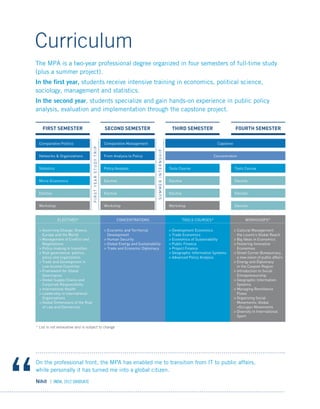
The MPA is a two-year professional degree organized in four semesters of full-time study
(plus a summer project).
In the first year, students receive intensive training in economics, political science,
sociology, management and statistics.
In the second year, students specialize and gain hands-on experience in public policy
analysis, evaluation and implementation through the capstone project.
Curriculum
On the professional front, the MPA has enabled me to transition from IT to public affairs,
while personally it has turned me into a global citizen.
Nihit I INDIA, 2012 GRADUATE
* List is not exhaustive and is subject to change
FIRSTYEARSTUDYTRIP
SUMMERINTERNSHIP
Networks  Organizations From Analysis to Policy Concentration
Statistics Policy Analysis Tools Course Tools Course
Micro-Economics Elective Elective Elective
Elective Elective Elective Elective
Workshop
* List is not exhaustive and is subject to change
 Governing Change: Greece,
Europe and the World
 Management of Conflict and
Negotiations
 Policy-making in transition
 Risk governance: politics,
policy and organization
 Trade and Development in
Low Income Countries
 Framework for Global
Governance
 Global Supply Chains and
Corporate Responsibility
 International Health
 Leadership in International
Organizations
 Global Dimensions of the Rule
of Law and Democracy
Workshop
 Economic and Territorial
Development
 Human Security
 Global Energy and Sustainability
 Trade and Economic Diplomacy
 Development Economics
 Trade Economics
 Economics of Sustainability
 Public Finance
 Project Finance
 Geographic Information Systems
 Advanced Policy Analysis
Workshop Elective
 Cultural Management:
the Louvre’s Global Reach
 Big Ideas in Economics
 Fostering Innovative
Economies
 Street Corner Bureaucracy,
a new vision of public affairs
 Energy and Diplomacy
in the Caspian Region
 Introduction to Social
Entrepreneurship
 Geographic Information
Systems
 Managing Remittance
Flows
 Organizing Social
Movements: Global
«Occupy» Movements
 Diversity in International
Sport
ELECTIVES* CONCENTRATIONS TOOLS COURSES* WORKSHOPS*
Comparative Politics Comparative Management Capstone
MPA students take leadership positions in all fields of public affairs, as policy analysts,
as policy makers and as project leaders. Many students take the MPA as an opportunity
to change between sectors: from the private sector to the public sphere, from NGOs to
government or to international organizations.
European
Commission
African
Development
Bank
Inter-American
Development
Bank
ILO
OECD
UNDP
UNEP
UNESCO
UNICEF
UN Women
World Bank
WTO
Airbus
Facebook
Goldman Sachs
McKinsey
PriceWaterhouseCoopers
Tata
Thales
Total
American Bar Association
Gates Foundation
International Rescue Committee
Natural Resources Defense Council
Save the Children
Médecins sans Frontières
WWF
International Organizations Non-Governmental Organizations
Career-Changing Experience
career paths
before the mpa
career paths
after the mpa
Private Sector
AFD, AUSAID, GIZ, JICA, USAID
Central Bank of Canada, China, Thailand
Ministries of Finance of Colombia,
France, India, Japan, Morocco,
Thailand, UK and the US
Ministries of Foreign Affairs of Japan,
Republic of Korea  the US
Governments
15%
Non-Profit Organization
39%
Private
37%
Public
9%
International Organization
32%
Public
26%
Private
20%
Non-Profit Organization
22 %
International Organization
Sciences Po is among the world’s
premiere institutions of social science
education and research. It occupies a
unique place in French society, enjoying
a close association with the French
government while also maintaining its
status as an independent and highly
selective institution of higher learning.
Though located in the heart of Paris,
Sciences Po is resolutely global in
perspective. Social and cultural diversity
are fundamental to its identity.
The School, also known as the Institut
d’Études Politiques, Paris, was founded
in 1872. It has trained students destined
for leadership in the private sector, to the
upper echelons of public administration, to
politics and to research for over 140 years.
The strengths of Sciences Po come from
its values which emphasize education, a
commitment to intellectual ambition and
a strong sense of social responsibility.
The core teaching strengths of its faculty
lay in law, economics, history, political
science and sociology.
These strengths are enriched by the
high-level research conducted by
Sciences Po’s research centers and
departments including the highly
regarded centers of expertise in the
Sociology of Organizations, European
Studies, Law, Economics and
International Relations.
Sciences Po offers degrees at the
undergraduate, Master of Science,
Professional Masters and Ph.D. levels.
It enrolls about 10,000 students, 40%
of whom come from abroad. Sciences Po
alumni work in international business,
multilateral organizations, positions of
public responsibility, and other fields of
endeavor.
Sciences Po
The great beauty of the MPA is the feeling of community. While many policy schools have
student classes numbering in the hundreds, the small size and selectiveness of the MPA ensures
personalized teaching, interactive classes and a feeling of family among students.
Kieran I AUSTRALIA, 2012 GRADUATE
The program is based in Paris and is designed for young
professionals. Students have between two and ten years of
professional experience at the time of application.
The average age of incoming students is 28.
Requirements for application:
a completed bachelor’s degree
at least 2 years of professional experience
excellent command of English (100 TOEFL IBT, 7.0 IELTS)
For more information about the application process, deadlines and
scholarships: www.sciencespo.fr/mpa
Mailing address
Master of Public Affairs
Sciences Po
27 rue Saint-Guillaume
75337 Paris, France
Office location
117 Boulevard Saint-Germain
4th floor
75006 Paris, France
Tel.: +33 (0)1 45 49 53 76
mpa@sciencespo.fr I www.sciencespo.fr/mpa
www.changerdair.fr©photos:StéphanieLacombe
Admissions

Sciences Po - MPA Program

  • 1.
    Master of PublicAffairs at Sciences Po in Paris Preparing Young Professionals for Careers of Global Significance
  • 2.
    Our Philosophy Governance impliesan approach in which goals of public significance are addressed by constellations of public and private actors. These constellations are not driven from the top down. They are not dominated by any one actor. Instead, they involve multiple, often evolving, coalitions of interested actors. This is a vision of public affairs in which decisions are not dictated. They are navigated. Moreover, there are an increasing number of issues – international trade, environmental sustainability, health and human security – that do not easily conform to national or local boundaries. They require a combination of contextual savoir faire and analytical skill. The MPA at Sciences Po is designed specifically with these challenges in mind. The MPA attracts young professionals who seek to impact issues of global significance, both at the international stage and in their own cities and countries. The MPA is based on five commitments: Provide students with a holistic understanding of public affairs by theory and practice in equal measure Engage students with a global and comparative perspective on public affairs. Expose students to real policy problems through field-based learning experiences Strengthen students’ analytical skills and diagnostic capacities enabling them to test the effectiveness of policies and public affairs initiatives Challenge students to confront the ethical issues raised by their actions in the public sphere. The MPA is more than a master’s program, it is a community that one belongs to and an experience that leaves a lasting impression on how we approach society. Roopa I USA, 2012 GRADUATE
  • 3.
    17 % North America 15% SouthAmerica 13% North East Asia 3% Eurasia 11% South SE Asia/Pacific 13% Europe 8% North Africa Middle East 9% Sub Saharan Africa The MPA is a truly global learning environment. Its methods and content are matched by the diversity of its student body and its faculty. Global Crossroads student origins by region Cape Town, South Africa, 2013-2014 Florida and Arizona, 2012-2013 Chennai and Hong Kong, 2011-2012 Accra, Ghana and Cape Town, South Africa, 2010-2011 Los Angeles and Mexico City, 2009-2010 China, 2008-2009 India, 2007-2008 Brazil, 2005-2006 and 2006-2007 Burundi: United Nations Peacebuilding Support Office Georgia: UNDP Germany: EDF Hong Kong: United Way Worldwide Malawi: The Jack Brewer Foundation Mexico: Urban Protected Areas Network Montenegro: UNDP GPPN DUAL DEGREES 11% Central America the Caribbean Palestine: Agence Française de Développement Philippines: Fair Labor Association; UN Economic Commission for Europe Rwanda: OECD Thailand: Asian Development Bank USA: OECD, World Bank Institute Venezuela: CAF Development Bank CAPSTONESSTUDY TRIPS The London School of Economics Columbia University Hertie School of Governance in Berlin National University of Singapore University of Tokyo FGV-EAESP in São Paulo
  • 4.
    Capstone on sustainable urban development Mexico,2010 The most distinctive feature of the MPA is its focus on the people and the organizations that enact policies on a daily basis. This approach requires students to go to the field to see the interpersonal relationships and the historical patterns in which public affairs are embedded. In the first year, all MPA students travel together for a major field-based research project. In their second year, all MPA students conduct a year-long capstone project advising a client on a relevant issue. In between, students work for international organizations, governments, NGOs and private sector companies as interns. Each step of the way is integrated with the learning that takes place in the MPA’s classrooms. Field-Based Learning Study Trip on social welfare China, 2009 Capstone on capacity building Tunisia, 2012 Capstone on evaluating aid efficiency Palestine, 2013 Study Trip on waste management Hong Kong, 2012 Study Trip on informal economy India, 2008
  • 5.
    THIRD SEMESTER FOURTHSEMESTERSECOND SEMESTERFIRST SEMESTER The MPA is a two-year professional degree organized in four semesters of full-time study (plus a summer project). In the first year, students receive intensive training in economics, political science, sociology, management and statistics. In the second year, students specialize and gain hands-on experience in public policy analysis, evaluation and implementation through the capstone project. Curriculum On the professional front, the MPA has enabled me to transition from IT to public affairs, while personally it has turned me into a global citizen. Nihit I INDIA, 2012 GRADUATE * List is not exhaustive and is subject to change FIRSTYEARSTUDYTRIP SUMMERINTERNSHIP Networks Organizations From Analysis to Policy Concentration Statistics Policy Analysis Tools Course Tools Course Micro-Economics Elective Elective Elective Elective Elective Elective Elective Workshop * List is not exhaustive and is subject to change Governing Change: Greece, Europe and the World Management of Conflict and Negotiations Policy-making in transition Risk governance: politics, policy and organization Trade and Development in Low Income Countries Framework for Global Governance Global Supply Chains and Corporate Responsibility International Health Leadership in International Organizations Global Dimensions of the Rule of Law and Democracy Workshop Economic and Territorial Development Human Security Global Energy and Sustainability Trade and Economic Diplomacy Development Economics Trade Economics Economics of Sustainability Public Finance Project Finance Geographic Information Systems Advanced Policy Analysis Workshop Elective Cultural Management: the Louvre’s Global Reach Big Ideas in Economics Fostering Innovative Economies Street Corner Bureaucracy, a new vision of public affairs Energy and Diplomacy in the Caspian Region Introduction to Social Entrepreneurship Geographic Information Systems Managing Remittance Flows Organizing Social Movements: Global «Occupy» Movements Diversity in International Sport ELECTIVES* CONCENTRATIONS TOOLS COURSES* WORKSHOPS* Comparative Politics Comparative Management Capstone
  • 6.
    MPA students takeleadership positions in all fields of public affairs, as policy analysts, as policy makers and as project leaders. Many students take the MPA as an opportunity to change between sectors: from the private sector to the public sphere, from NGOs to government or to international organizations. European Commission African Development Bank Inter-American Development Bank ILO OECD UNDP UNEP UNESCO UNICEF UN Women World Bank WTO Airbus Facebook Goldman Sachs McKinsey PriceWaterhouseCoopers Tata Thales Total American Bar Association Gates Foundation International Rescue Committee Natural Resources Defense Council Save the Children Médecins sans Frontières WWF International Organizations Non-Governmental Organizations Career-Changing Experience career paths before the mpa career paths after the mpa Private Sector AFD, AUSAID, GIZ, JICA, USAID Central Bank of Canada, China, Thailand Ministries of Finance of Colombia, France, India, Japan, Morocco, Thailand, UK and the US Ministries of Foreign Affairs of Japan, Republic of Korea the US Governments 15% Non-Profit Organization 39% Private 37% Public 9% International Organization 32% Public 26% Private 20% Non-Profit Organization 22 % International Organization
  • 7.
    Sciences Po isamong the world’s premiere institutions of social science education and research. It occupies a unique place in French society, enjoying a close association with the French government while also maintaining its status as an independent and highly selective institution of higher learning. Though located in the heart of Paris, Sciences Po is resolutely global in perspective. Social and cultural diversity are fundamental to its identity. The School, also known as the Institut d’Études Politiques, Paris, was founded in 1872. It has trained students destined for leadership in the private sector, to the upper echelons of public administration, to politics and to research for over 140 years. The strengths of Sciences Po come from its values which emphasize education, a commitment to intellectual ambition and a strong sense of social responsibility. The core teaching strengths of its faculty lay in law, economics, history, political science and sociology. These strengths are enriched by the high-level research conducted by Sciences Po’s research centers and departments including the highly regarded centers of expertise in the Sociology of Organizations, European Studies, Law, Economics and International Relations. Sciences Po offers degrees at the undergraduate, Master of Science, Professional Masters and Ph.D. levels. It enrolls about 10,000 students, 40% of whom come from abroad. Sciences Po alumni work in international business, multilateral organizations, positions of public responsibility, and other fields of endeavor. Sciences Po The great beauty of the MPA is the feeling of community. While many policy schools have student classes numbering in the hundreds, the small size and selectiveness of the MPA ensures personalized teaching, interactive classes and a feeling of family among students. Kieran I AUSTRALIA, 2012 GRADUATE
  • 8.
    The program isbased in Paris and is designed for young professionals. Students have between two and ten years of professional experience at the time of application. The average age of incoming students is 28. Requirements for application: a completed bachelor’s degree at least 2 years of professional experience excellent command of English (100 TOEFL IBT, 7.0 IELTS) For more information about the application process, deadlines and scholarships: www.sciencespo.fr/mpa Mailing address Master of Public Affairs Sciences Po 27 rue Saint-Guillaume 75337 Paris, France Office location 117 Boulevard Saint-Germain 4th floor 75006 Paris, France Tel.: +33 (0)1 45 49 53 76 mpa@sciencespo.fr I www.sciencespo.fr/mpa www.changerdair.fr©photos:StéphanieLacombe Admissions