Refraction of Light
Class10 Science – Chapter: Light –
Reflection and Refraction
Presented by: [Your Name]
2.
What is Refraction?
•Refraction is the bending of light as it passes
from one medium to another.
• Occurs due to change in speed of light in
different media.
3.
Why Does RefractionOccur?
• Light travels at different speeds in different
media.
• Denser the medium, slower the light speed.
• Change in speed causes the ray to bend.
4.
Key Terms
• IncidentRay – The incoming ray of light.
• Refracted Ray – The bent ray in the second
medium.
• Normal – A line perpendicular to the surface
at the point of incidence.
• Angle of Incidence (i) – Angle between
incident ray and normal.
• Angle of Refraction (r) – Angle between
refracted ray and normal.
5.
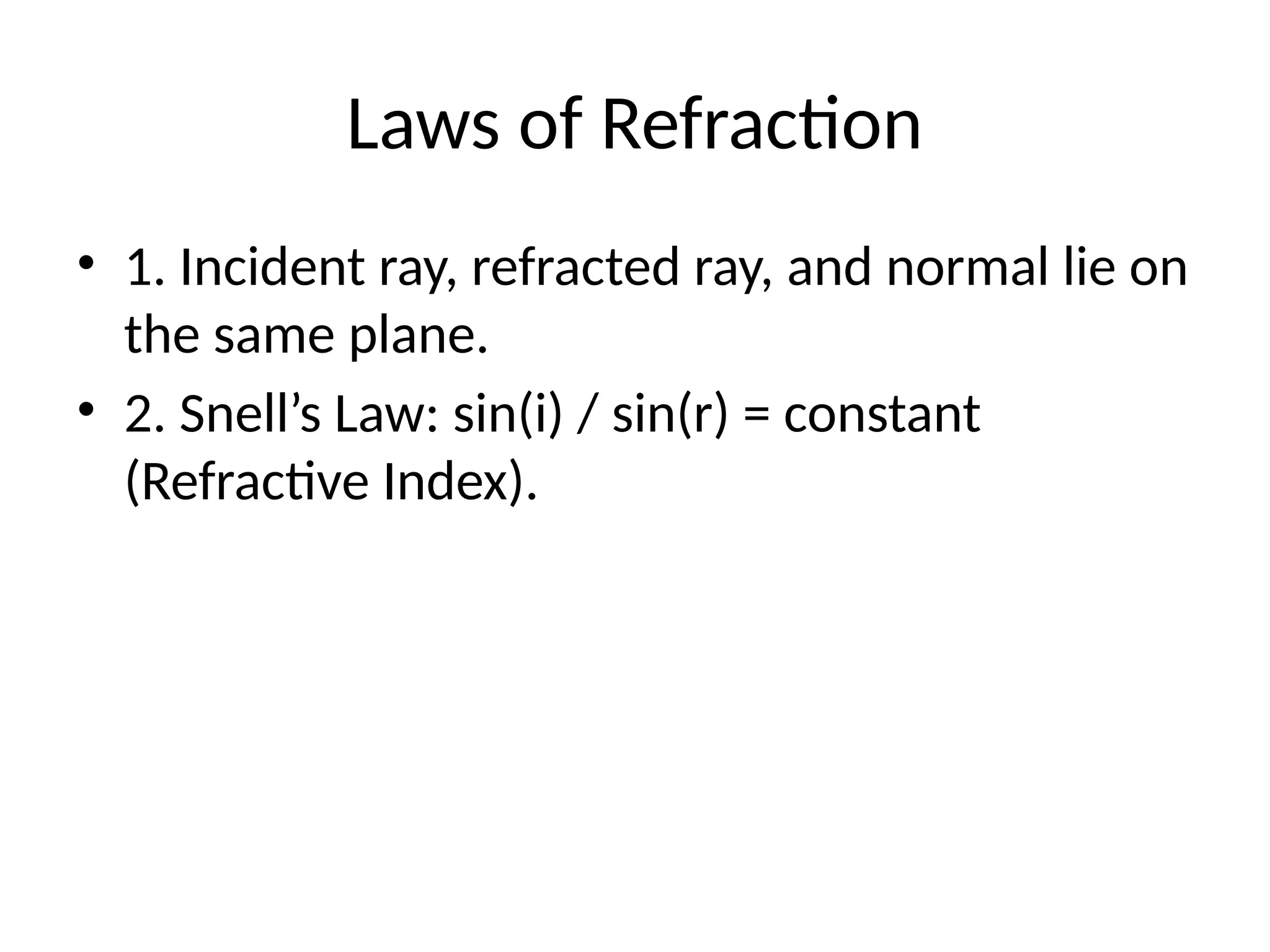
Laws of Refraction
•1. Incident ray, refracted ray, and normal lie on
the same plane.
• 2. Snell’s Law: sin(i) / sin(r) = constant
(Refractive Index).
6.
Refractive Index
• n= Speed of light in vacuum / Speed of light in
medium
• No units.
• Example: Refractive index of water = 1.33
7.
Ray Diagrams
• Airto glass: Ray bends towards normal.
• Glass to air: Ray bends away from normal.
8.
Real Life Examplesof Refraction
• Pencil in water appears bent.
• Pool appears shallower.
• Used in lenses, glasses, and cameras.
• Prism dispersion – light splitting into colors.
9.
Refraction Through Rectangular
GlassSlab
• Light ray bends at entry and exit.
• Emerges parallel to incident ray but shifted –
lateral displacement.
10.
Important Questions forPractice
• 1. Define refraction of light.
• 2. State the laws of refraction.
• 3. Why does a pencil appear bent in water?
• 4. Draw a labelled diagram showing refraction
through a glass slab.
11.
Summary
• Refraction isbending of light due to speed
change.
• Laws of refraction govern light behavior.
• Refractive index helps compare media.
12.
Thank You
• Thankyou! Any questions?
• Refraction helps us understand how light
travels through different media.
![Refraction of Light
Class 10 Science – Chapter: Light –
Reflection and Refraction
Presented by: [Your Name]](https://image.slidesharecdn.com/refractionoflightclass10-250709141130-ac92ff61/75/Science_Refraction_of_Light_Class_10-pptx-1-2048.jpg)