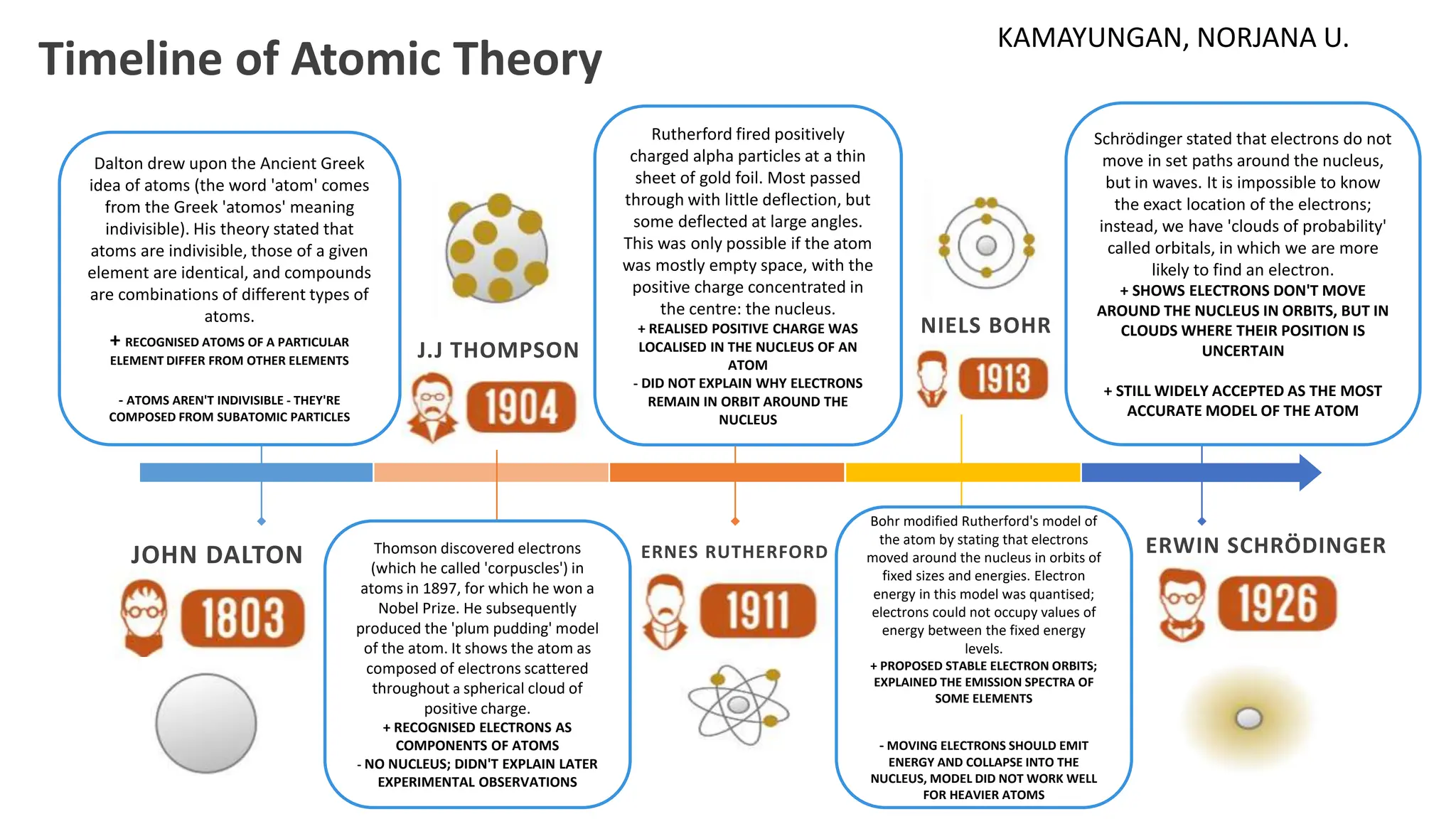
Timeline of Atomic Theory
JOHN DALTON
J.J THOMPSON
ERNES RUTHERFORD
NIELS BOHR
ERWIN SCHRÖDINGER
KAMAYUNGAN, NORJANA U.
Dalton drew upon the Ancient Greek
idea of atoms (the word 'atom' comes
from the Greek 'atomos' meaning
indivisible). His theory stated that
atoms are indivisible, those of a given
element are identical, and compounds
are combinations of different types of
atoms.
+ RECOGNISED ATOMS OF A PARTICULAR
ELEMENT DIFFER FROM OTHER ELEMENTS
- ATOMS AREN'T INDIVISIBLE - THEY'RE
COMPOSED FROM SUBATOMIC PARTICLES
Thomson discovered electrons
(which he called 'corpuscles') in
atoms in 1897, for which he won a
Nobel Prize. He subsequently
produced the 'plum pudding' model
of the atom. It shows the atom as
composed of electrons scattered
throughout a spherical cloud of
positive charge.
+ RECOGNISED ELECTRONS AS
COMPONENTS OF ATOMS
- NO NUCLEUS; DIDN'T EXPLAIN LATER
EXPERIMENTAL OBSERVATIONS
Rutherford fired positively
charged alpha particles at a thin
sheet of gold foil. Most passed
through with little deflection, but
some deflected at large angles.
This was only possible if the atom
was mostly empty space, with the
positive charge concentrated in
the centre: the nucleus.
+ REALISED POSITIVE CHARGE WAS
LOCALISED IN THE NUCLEUS OF AN
ATOM
- DID NOT EXPLAIN WHY ELECTRONS
REMAIN IN ORBIT AROUND THE
NUCLEUS
Bohr modified Rutherford's model of
the atom by stating that electrons
moved around the nucleus in orbits of
fixed sizes and energies. Electron
energy in this model was quantised;
electrons could not occupy values of
energy between the fixed energy
levels.
+ PROPOSED STABLE ELECTRON ORBITS;
EXPLAINED THE EMISSION SPECTRA OF
SOME ELEMENTS
- MOVING ELECTRONS SHOULD EMIT
ENERGY AND COLLAPSE INTO THE
NUCLEUS, MODEL DID NOT WORK WELL
FOR HEAVIER ATOMS
Schrödinger stated that electrons do not
move in set paths around the nucleus,
but in waves. It is impossible to know
the exact location of the electrons;
instead, we have 'clouds of probability'
called orbitals, in which we are more
likely to find an electron.
+ SHOWS ELECTRONS DON'T MOVE
AROUND THE NUCLEUS IN ORBITS, BUT IN
CLOUDS WHERE THEIR POSITION IS
UNCERTAIN
+ STILL WIDELY ACCEPTED AS THE MOST
ACCURATE MODEL OF THE ATOM

Science: Timeline of Atomic_Theory_ Pptx

  • 1.
    Timeline of AtomicTheory JOHN DALTON J.J THOMPSON ERNES RUTHERFORD NIELS BOHR ERWIN SCHRÖDINGER KAMAYUNGAN, NORJANA U. Dalton drew upon the Ancient Greek idea of atoms (the word 'atom' comes from the Greek 'atomos' meaning indivisible). His theory stated that atoms are indivisible, those of a given element are identical, and compounds are combinations of different types of atoms. + RECOGNISED ATOMS OF A PARTICULAR ELEMENT DIFFER FROM OTHER ELEMENTS - ATOMS AREN'T INDIVISIBLE - THEY'RE COMPOSED FROM SUBATOMIC PARTICLES Thomson discovered electrons (which he called 'corpuscles') in atoms in 1897, for which he won a Nobel Prize. He subsequently produced the 'plum pudding' model of the atom. It shows the atom as composed of electrons scattered throughout a spherical cloud of positive charge. + RECOGNISED ELECTRONS AS COMPONENTS OF ATOMS - NO NUCLEUS; DIDN'T EXPLAIN LATER EXPERIMENTAL OBSERVATIONS Rutherford fired positively charged alpha particles at a thin sheet of gold foil. Most passed through with little deflection, but some deflected at large angles. This was only possible if the atom was mostly empty space, with the positive charge concentrated in the centre: the nucleus. + REALISED POSITIVE CHARGE WAS LOCALISED IN THE NUCLEUS OF AN ATOM - DID NOT EXPLAIN WHY ELECTRONS REMAIN IN ORBIT AROUND THE NUCLEUS Bohr modified Rutherford's model of the atom by stating that electrons moved around the nucleus in orbits of fixed sizes and energies. Electron energy in this model was quantised; electrons could not occupy values of energy between the fixed energy levels. + PROPOSED STABLE ELECTRON ORBITS; EXPLAINED THE EMISSION SPECTRA OF SOME ELEMENTS - MOVING ELECTRONS SHOULD EMIT ENERGY AND COLLAPSE INTO THE NUCLEUS, MODEL DID NOT WORK WELL FOR HEAVIER ATOMS Schrödinger stated that electrons do not move in set paths around the nucleus, but in waves. It is impossible to know the exact location of the electrons; instead, we have 'clouds of probability' called orbitals, in which we are more likely to find an electron. + SHOWS ELECTRONS DON'T MOVE AROUND THE NUCLEUS IN ORBITS, BUT IN CLOUDS WHERE THEIR POSITION IS UNCERTAIN + STILL WIDELY ACCEPTED AS THE MOST ACCURATE MODEL OF THE ATOM