Science, Technology
and Society (STS)
Prepared by: Jerel W. Ubarco, RRT, RSO, MSRTc
At the end of this discussion, we must be able to answer the following questions:
1 How do we define
Science?
Technology? And
Society?
2 How do Science, Technology and
Society interact with each other or
how they are related?
3 What is Science, Technology and
Society (STS)?
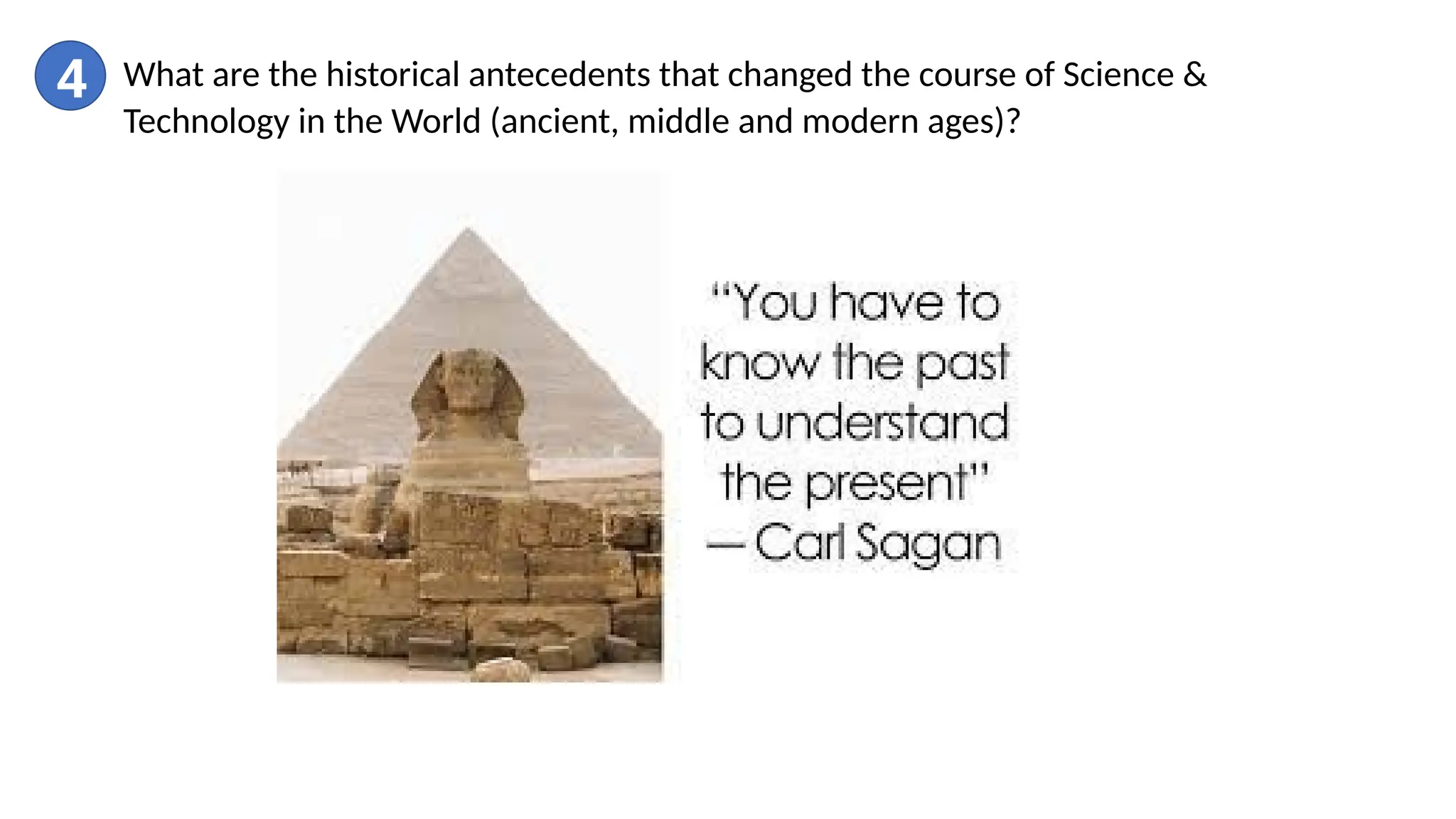
4 What are the historical antecedents that
changed the course of Science & Technology in
the:
a. World (ancient, middle and modern ages)
b. Philippines
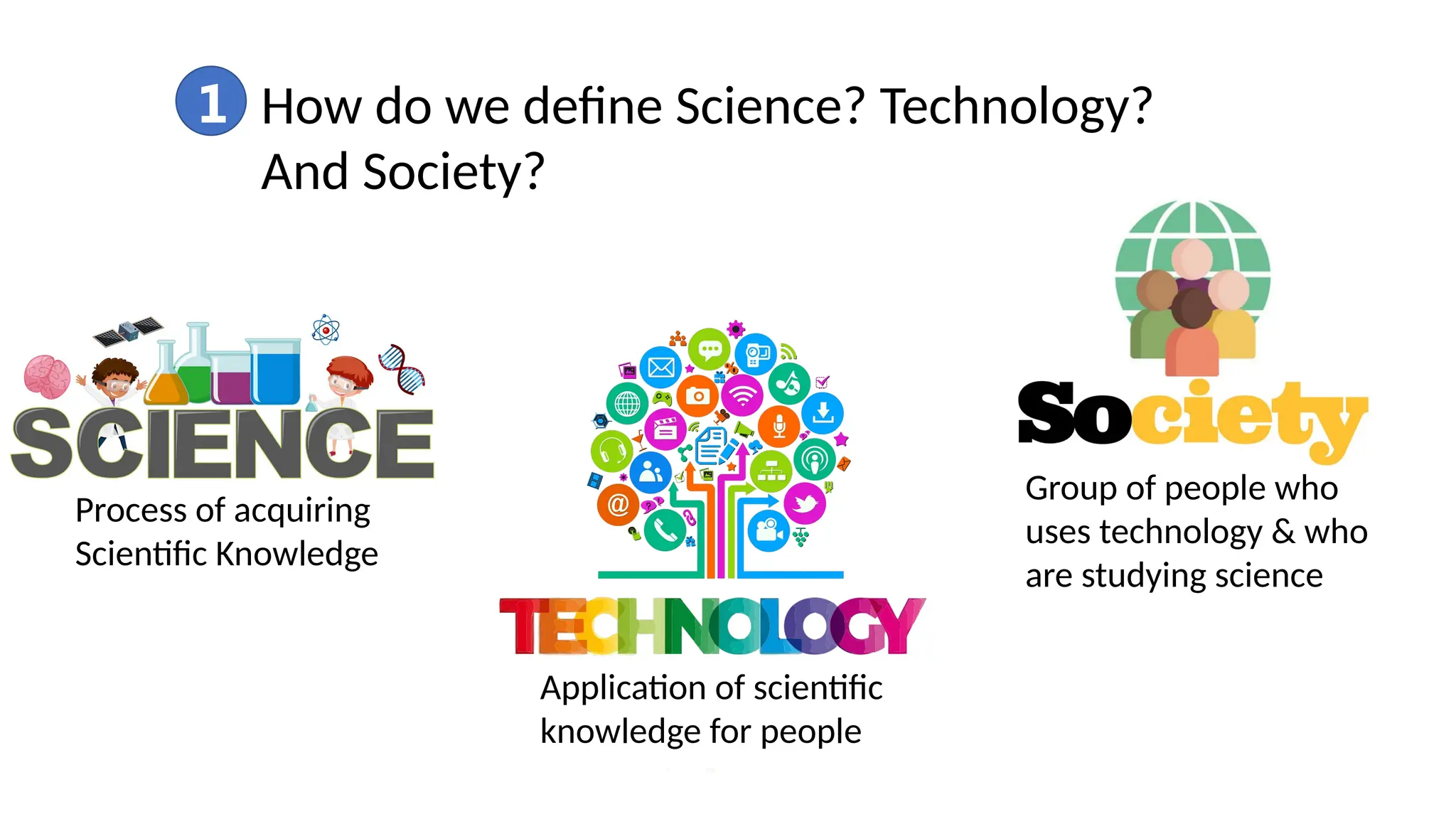
1 How do we define Science? Technology?
And Society?
Came form the Latin word “Scientia” – which
means Knowledge.
As a process used to solve problems of
develop an understanding of nature that
involves testing possible answers.
A system of acquiring knowledge based of
the Scientific method.
 An organized, systematic and methodical
activity of building and organizing knowledge
about the universe behaves through
observation, experimentation or both.
As a discovery of regularity in nature,
enough for natural phenomena to be
describe by principles and laws. Tries to discover facts and relationships
and then tries to create theories that
makes sense of these facts and
relationships.
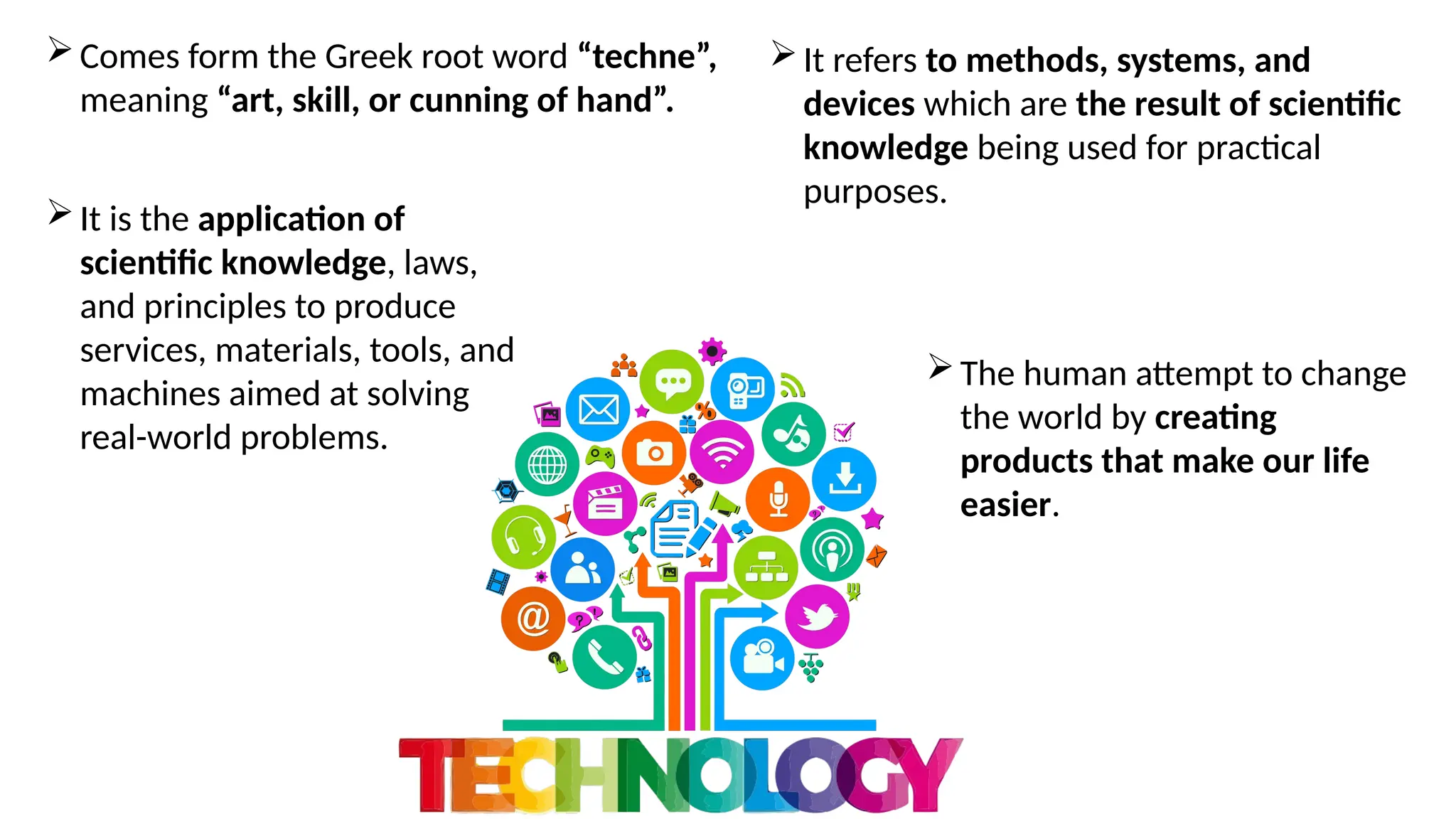
It refers to methods, systems, and
devices which are the result of scientific
knowledge being used for practical
purposes.
Comes form the Greek root word “techne”,
meaning “art, skill, or cunning of hand”.
It is the application of
scientific knowledge, laws,
and principles to produce
services, materials, tools, and
machines aimed at solving
real-world problems.
The human attempt to change
the world by creating
products that make our life
easier.
Came from a Latin word “societas”- which
means “a friendly association with others”.
A large group of people who live together in
an organized way, making decisions about
how to do thins and sharing the work that
needs to be done
A grouping of individuals, which is characterized by common interest
and may have distinctive culture and institutions.
1 How do we define Science? Technology?
And Society?
Process of acquiring
Scientific Knowledge
Application of scientific
knowledge for people
Group of people who
uses technology & who
are studying science
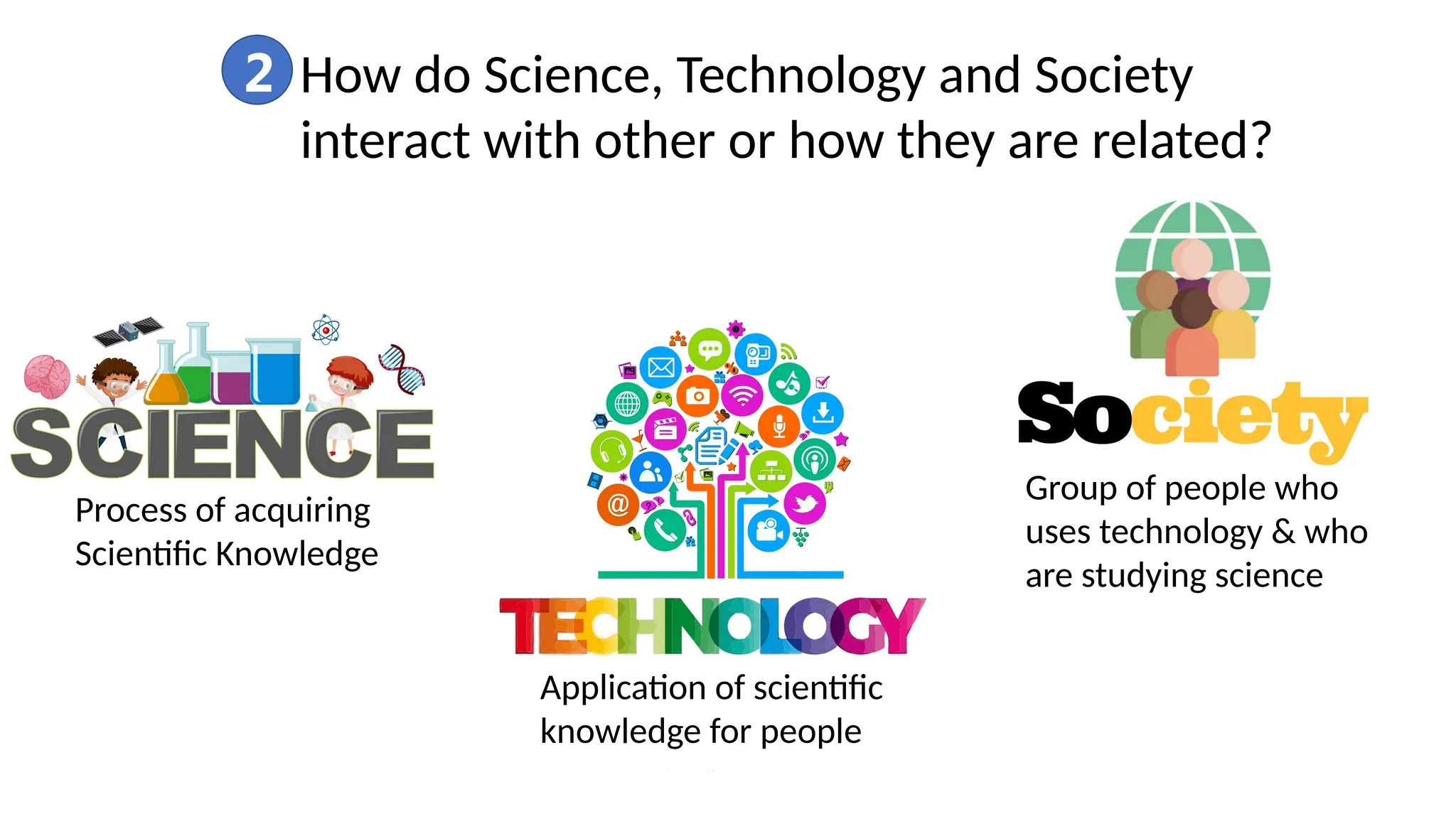
2 How do Science, Technology and Society
interact with other or how they are related?
Process of acquiring
Scientific Knowledge
Application of scientific
knowledge for people
Group of people who
uses technology & who
are studying science
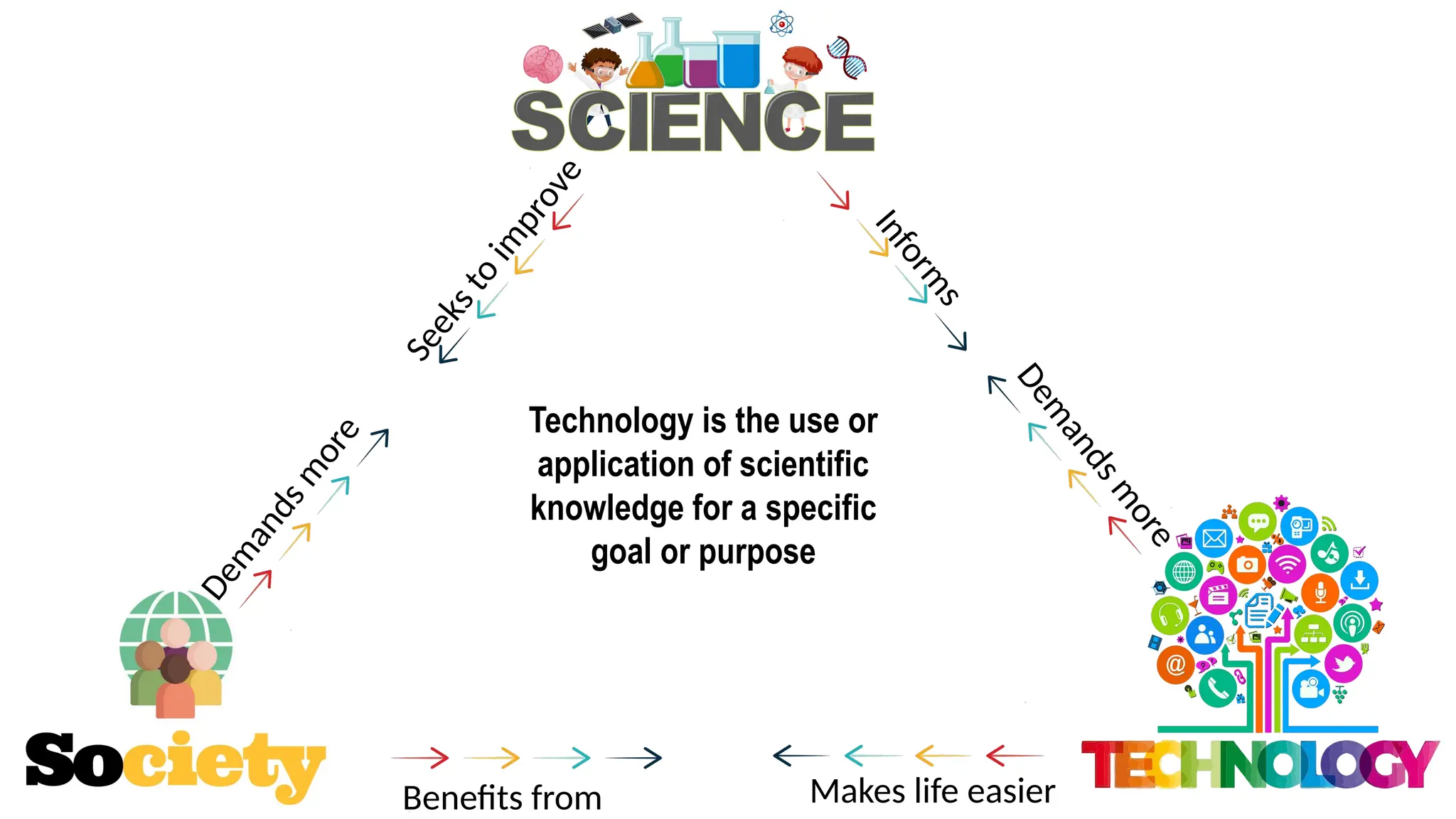
I
n
f
o
r
m
s
D
e
m
a
n
d
s
m
o
r
e
Makes life easier
Benefits from
D
e
m
a
n
d
s
m
o
r
e
S
e
e
k
s
t
o
i
m
p
r
o
v
e
Technology is the use or
application of scientific
knowledge for a specific
goal or purpose
2 How do Science, Technology and Society
interact with other or how they are related?
Science drives technology by making new
technology possible through scientific
breakthrough.
Scientist focus on using science to develop
products.
2 How do Science, Technology and Society
interact with other or how they are related?
Without technology, science experiments
would not be possible.
2 How do Science, Technology and Society
interact with other or how they are related?
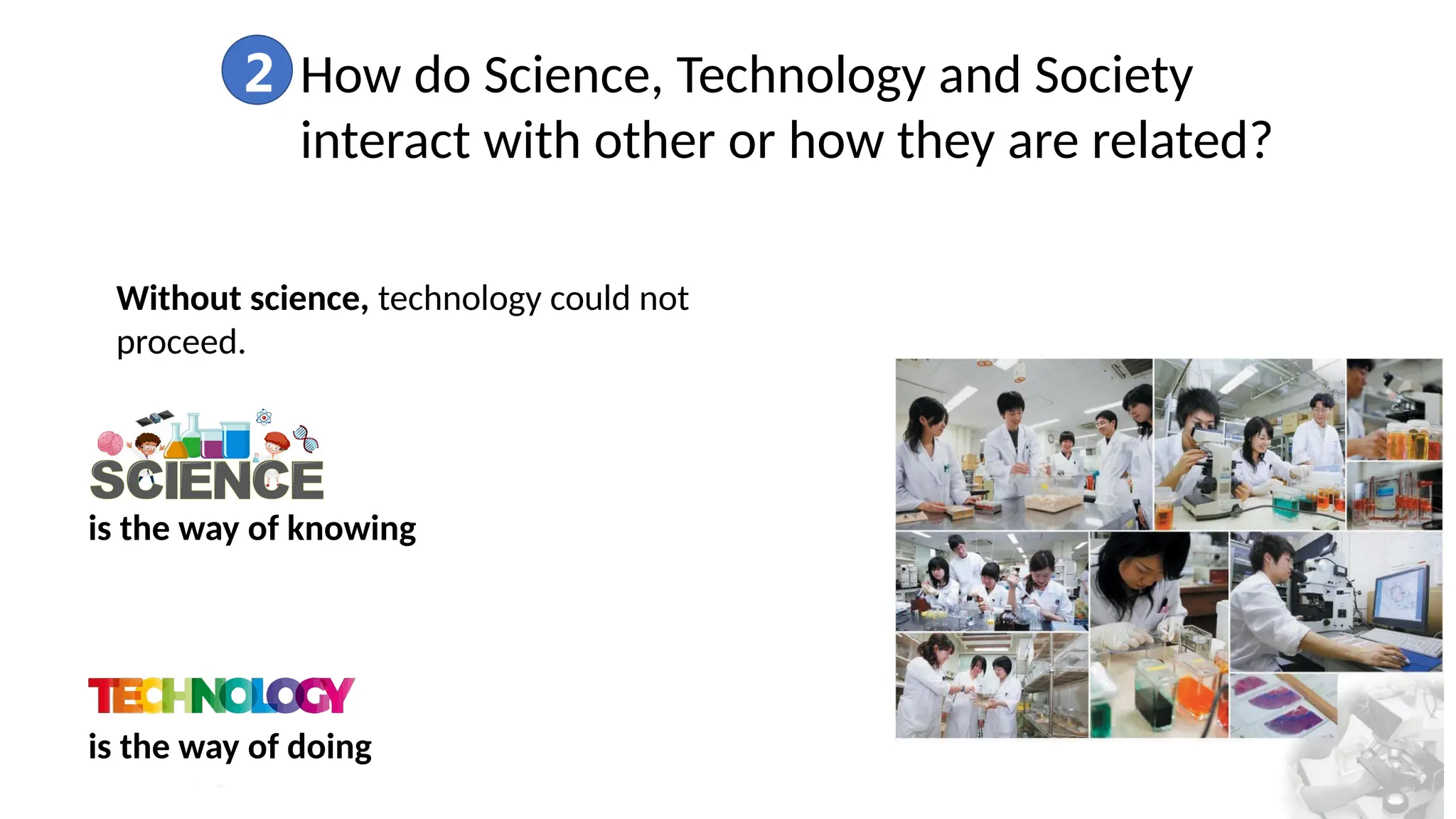
Without science, technology could not
proceed.
is the way of knowing
is the way of doing
2 How do Science, Technology and Society
interact with other or how they are related?
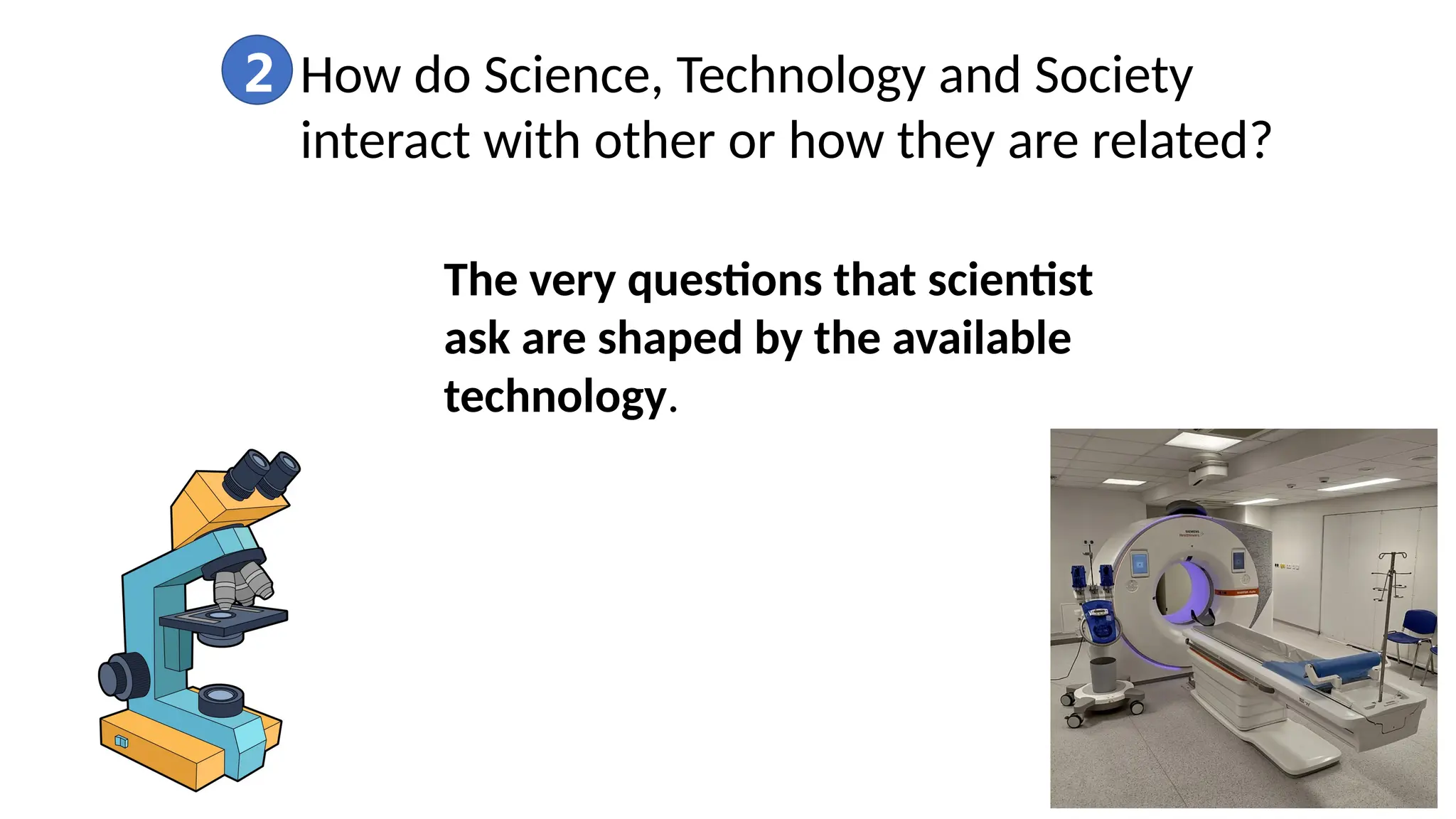
The very questions that scientist
ask are shaped by the available
technology.
2 How do Science, Technology and Society
interact with other or how they are related?
BETTER
WORLD
3 What is Science, Technology & Society (STS)
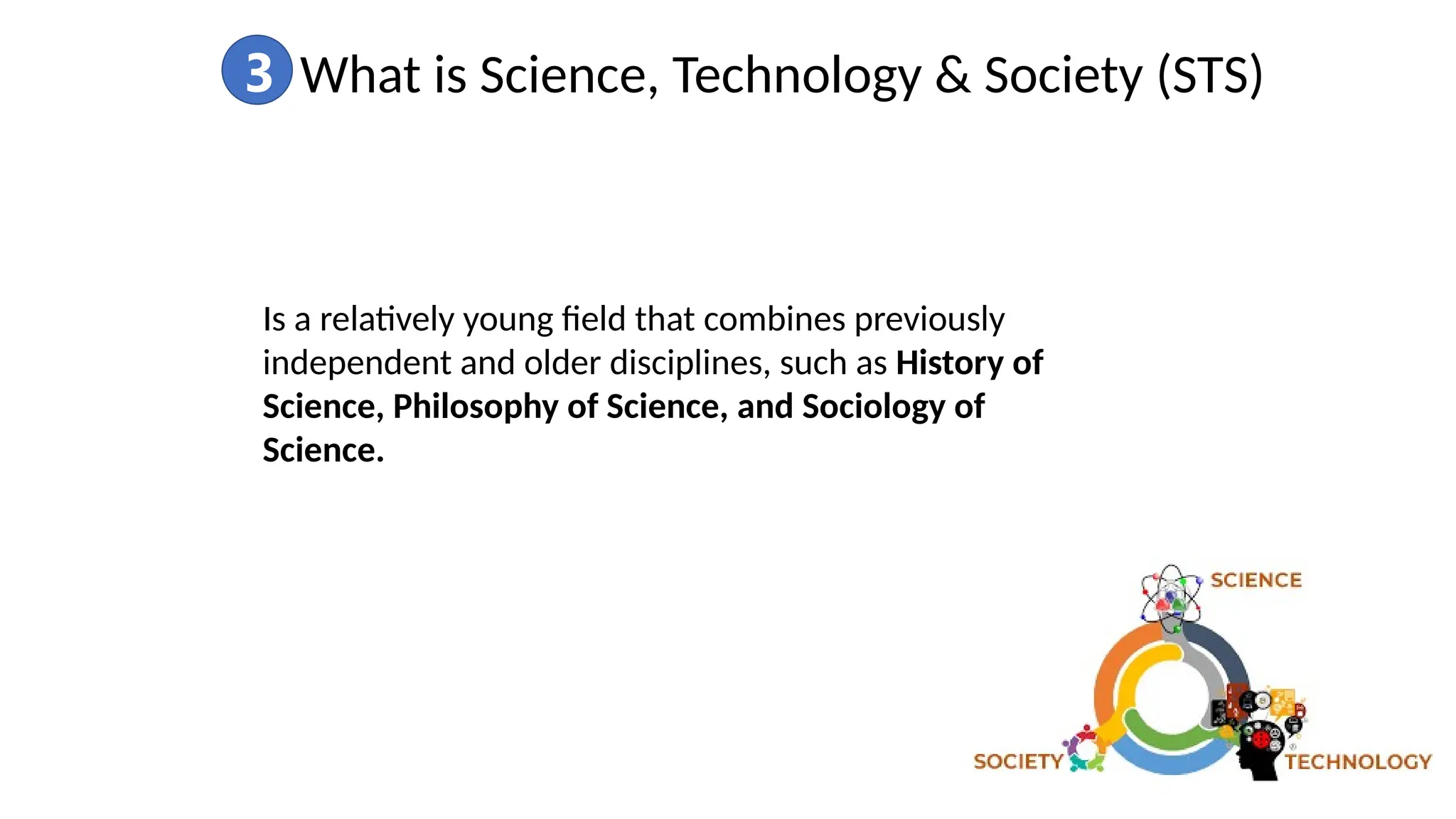
Is a relatively young field that combines previously
independent and older disciplines, such as History of
Science, Philosophy of Science, and Sociology of
Science.
3 What is Science, Technology & Society (STS)
Applies methods drawn from history,
philosophy and sociology to study the nature
of science and technology and ultimately judge
their value and place in society.
3 What is Science, Technology & Society (STS)
Seek to bridge the gap between two traditionally
exclusive culture – humanities and natural science – so
that human will be able to better confront the moral,
ethical, and existential dilemmas brough by the
continued developments in science and technology.
3 What is Science, Technology & Society (STS)
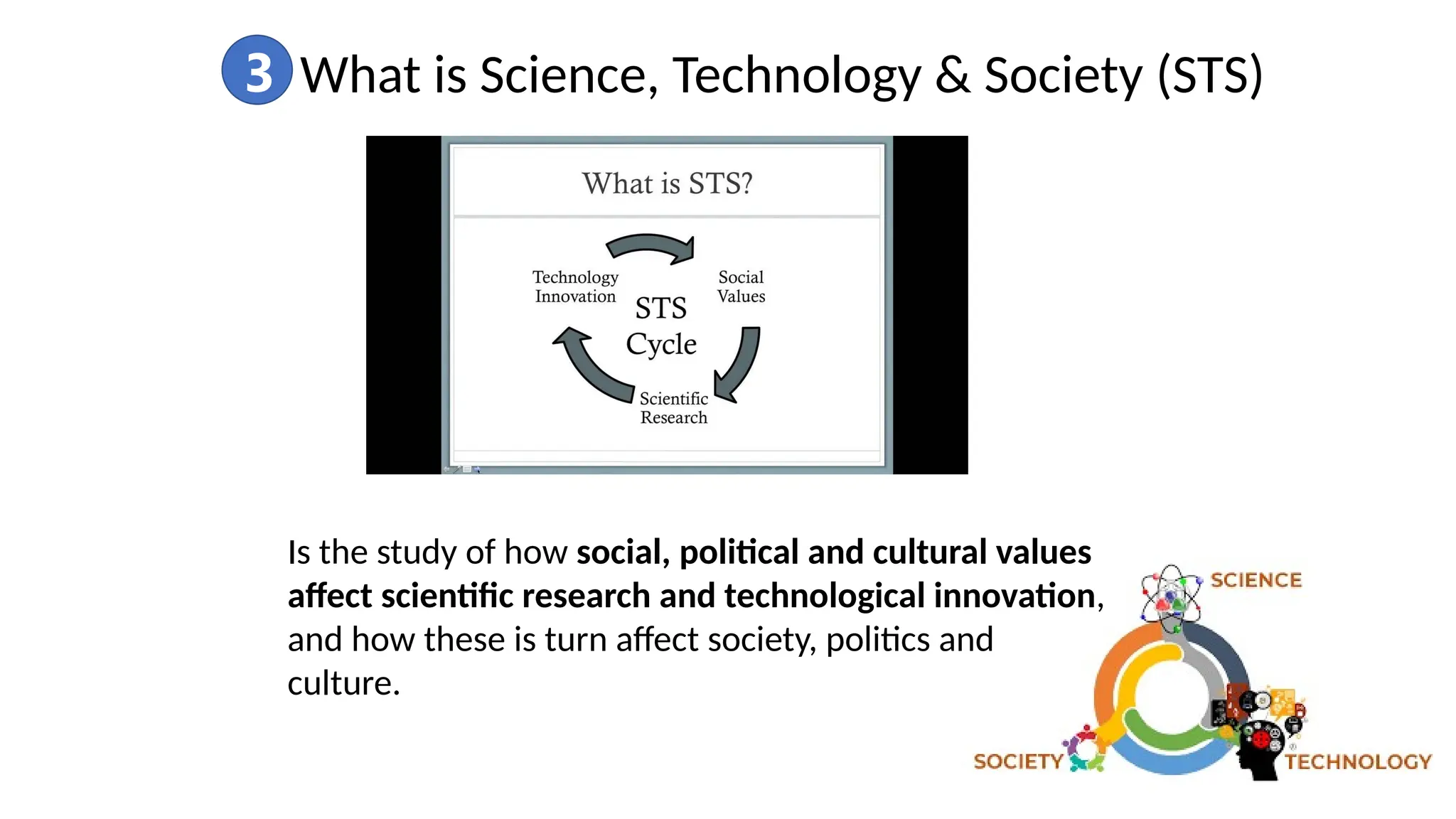
Is the study of how social, political and cultural values
affect scientific research and technological innovation,
and how these is turn affect society, politics and
culture.
4 What are the historical antecedents that changed the course of Science &
Technology in the:
a. World (ancient, middle and modern ages)
b. Philippines
4 What are the historical antecedents that changed the course of Science &
Technology in the World (ancient, middle and modern ages)?
4 What are the historical antecedents that changed the course of Science &
Technology in the World (ancient, middle and modern ages)?
4 What are the historical antecedents that changed the course of Science &
Technology in the World (ancient, middle and modern ages)?
ANTECEDENTS
It is defined as a precursor to the unfolding or existence
of something.
Antecedents of science and technology are factors that paved way for
the presence of advanced and sophisticated scientific and
technological innovations today.
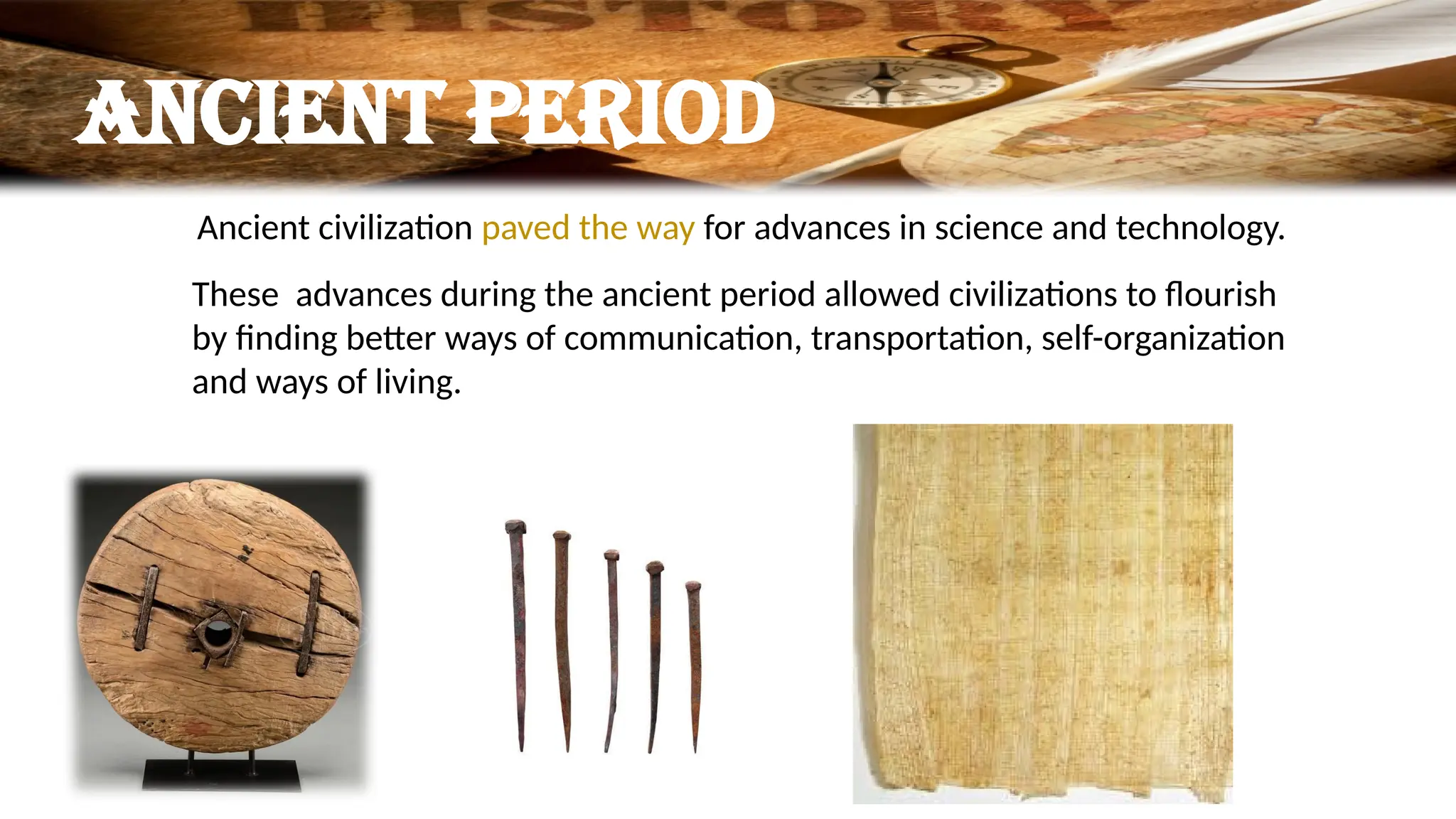
Ancient period
Ancient civilization paved the way for advances in science and technology.
These advances during the ancient period allowed civilizations to flourish
by finding better ways of communication, transportation, self-organization
and ways of living.
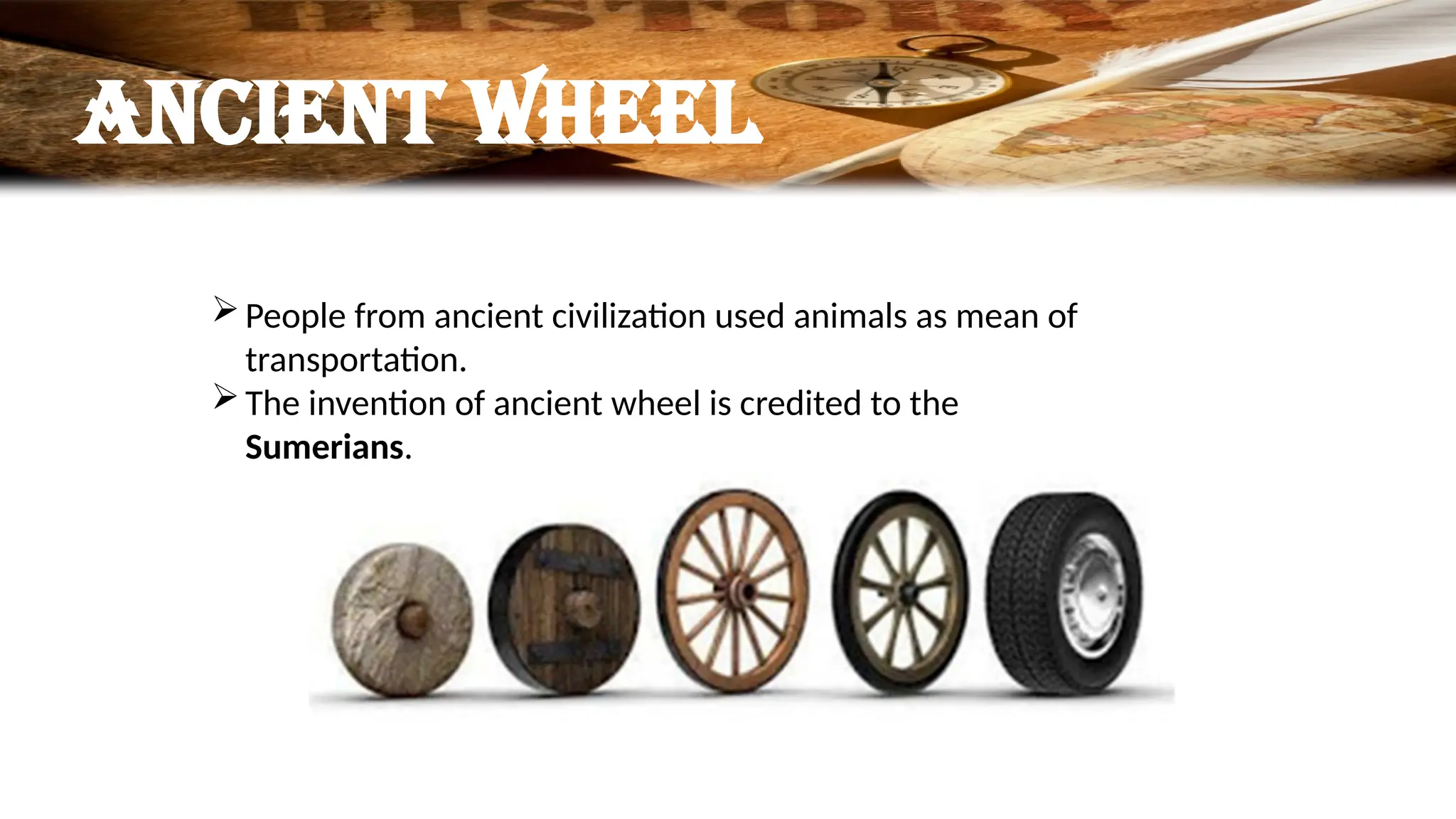
Ancient wheel
People from ancient civilization used animals as mean of
transportation.
The invention of ancient wheel is credited to the
Sumerians.
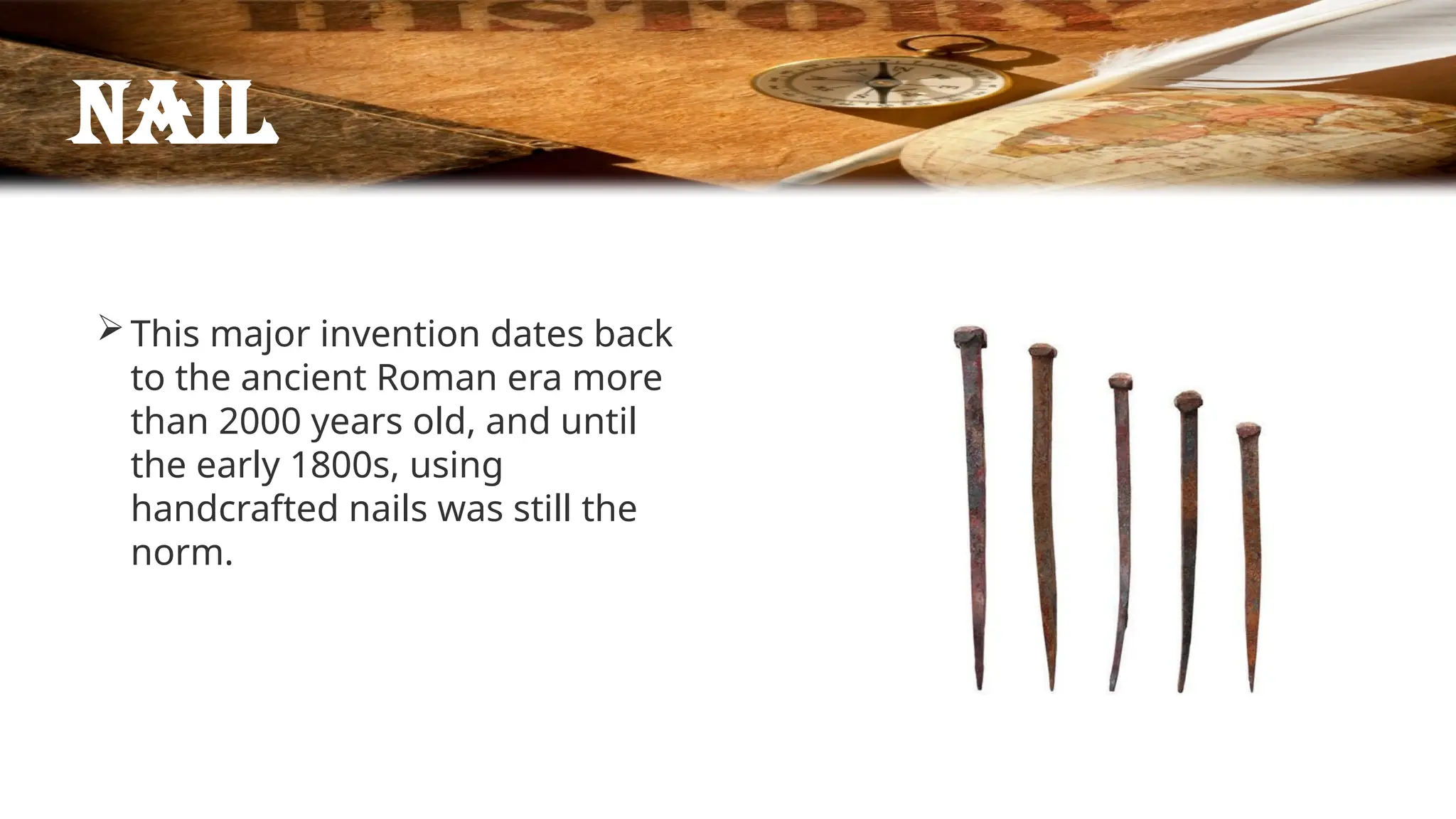
Nail
This major invention dates back
to the ancient Roman era more
than 2000 years old, and until
the early 1800s, using
handcrafted nails was still the
norm.
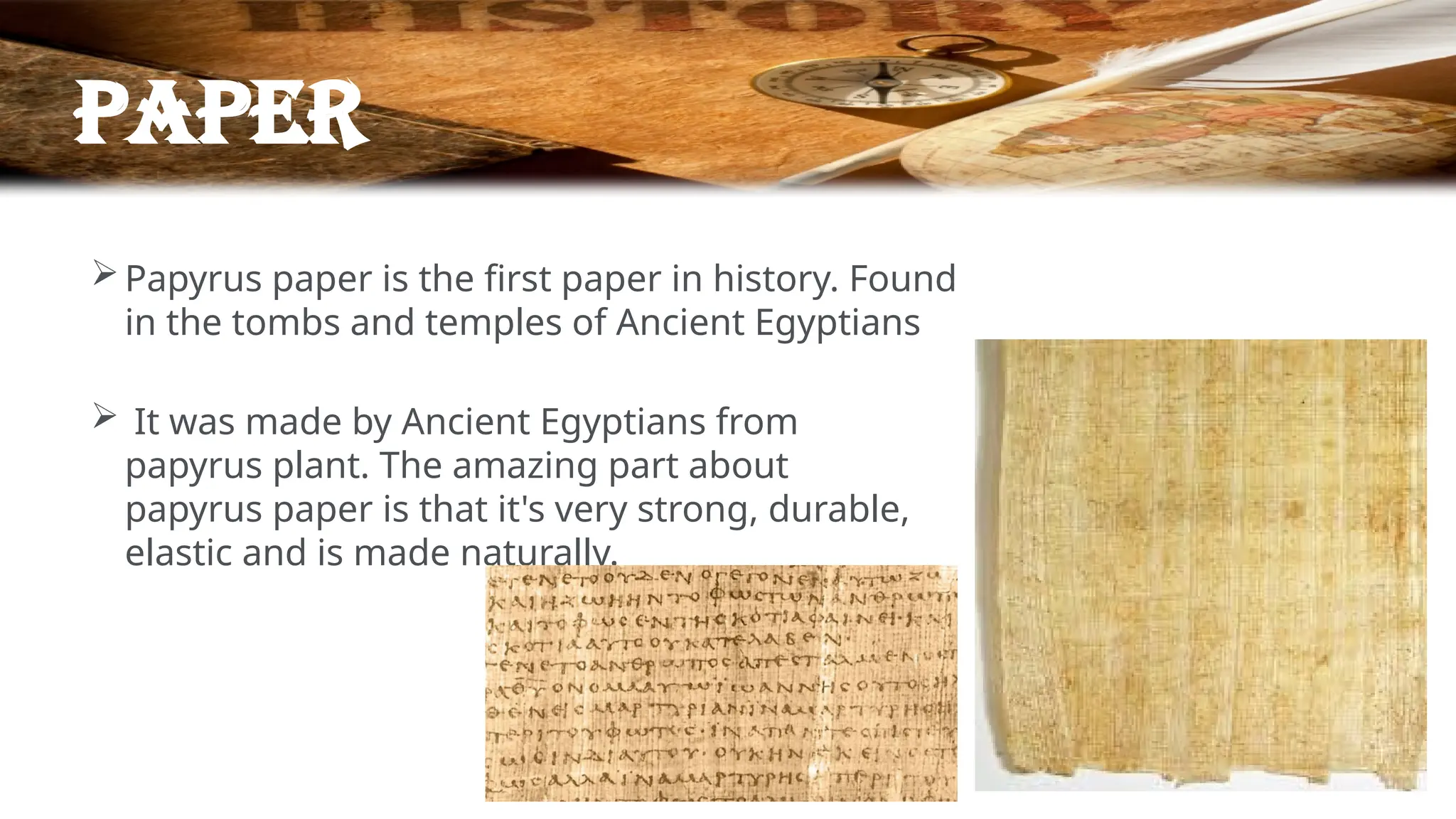
paper
Papyrus paper is the first paper in history. Found
in the tombs and temples of Ancient Egyptians
 It was made by Ancient Egyptians from
papyrus plant. The amazing part about
papyrus paper is that it's very strong, durable,
elastic and is made naturally.
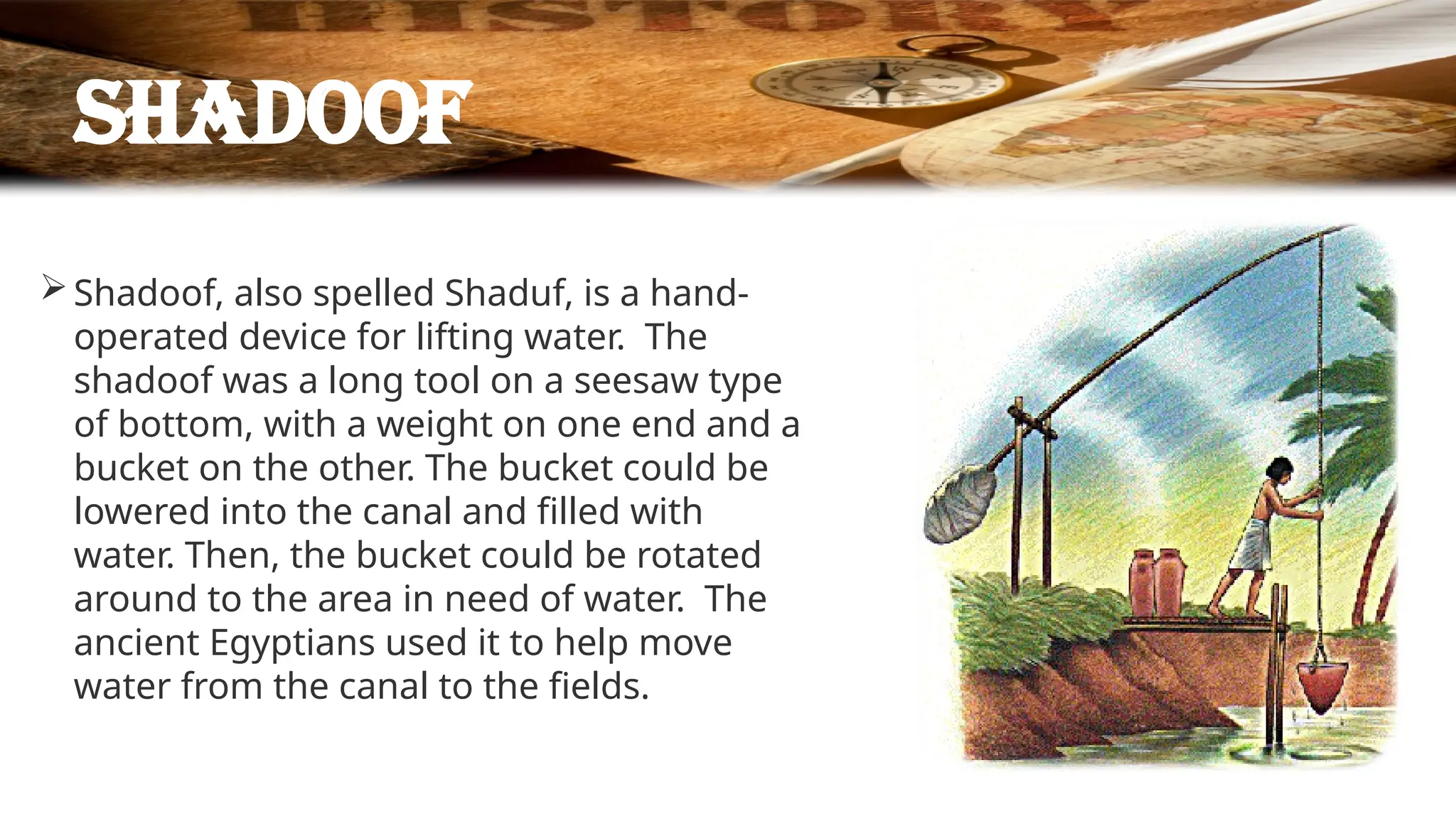
Shadoof
Shadoof, also spelled Shaduf, is a hand-
operated device for lifting water. The
shadoof was a long tool on a seesaw type
of bottom, with a weight on one end and a
bucket on the other. The bucket could be
lowered into the canal and filled with
water. Then, the bucket could be rotated
around to the area in need of water. The
ancient Egyptians used it to help move
water from the canal to the fields.
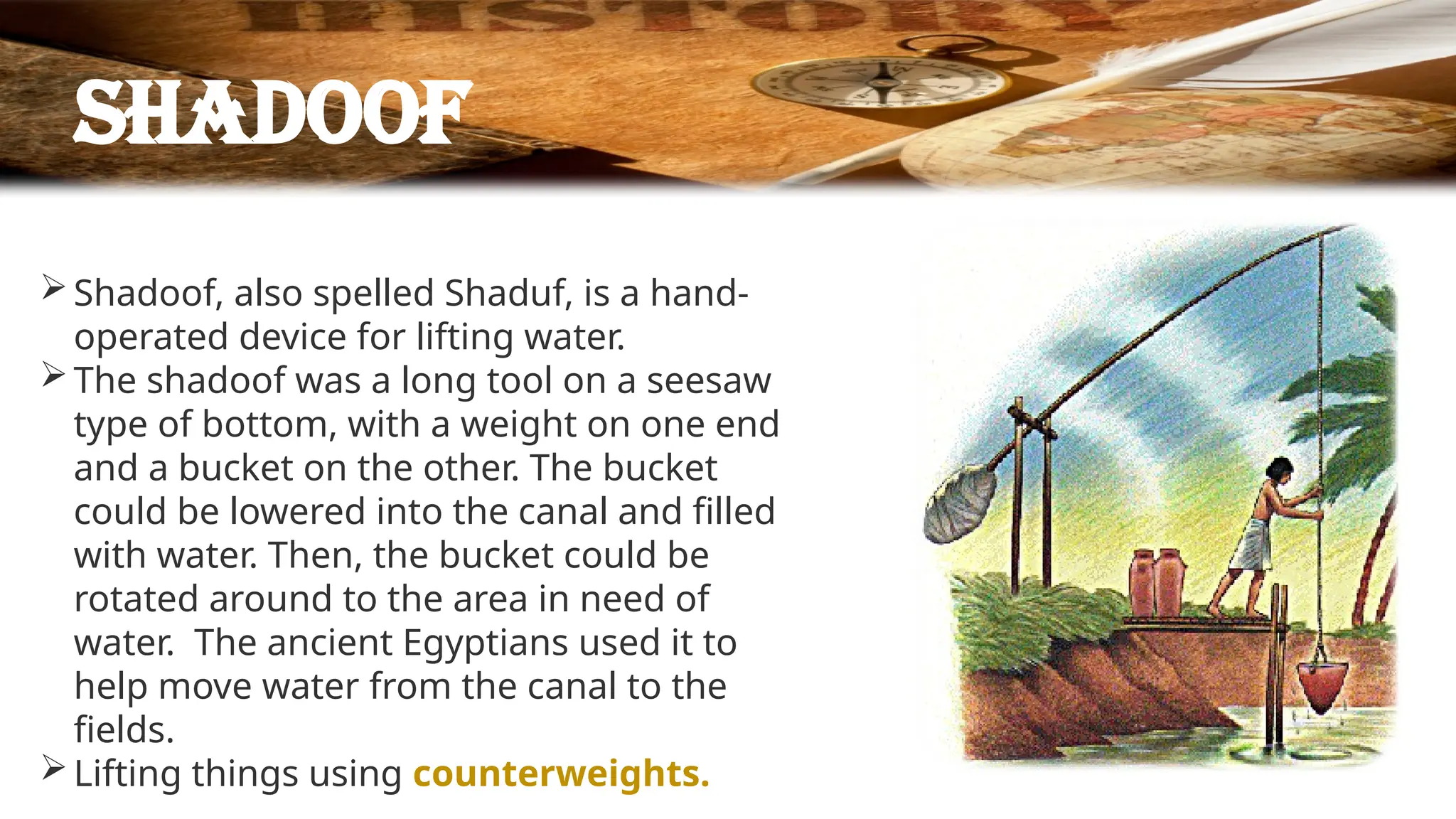
Shadoof
Shadoof, also spelled Shaduf, is a hand-
operated device for lifting water.
The shadoof was a long tool on a seesaw
type of bottom, with a weight on one end
and a bucket on the other. The bucket
could be lowered into the canal and filled
with water. Then, the bucket could be
rotated around to the area in need of
water. The ancient Egyptians used it to
help move water from the canal to the
fields.
Lifting things using counterweights.
AEOLIPILE
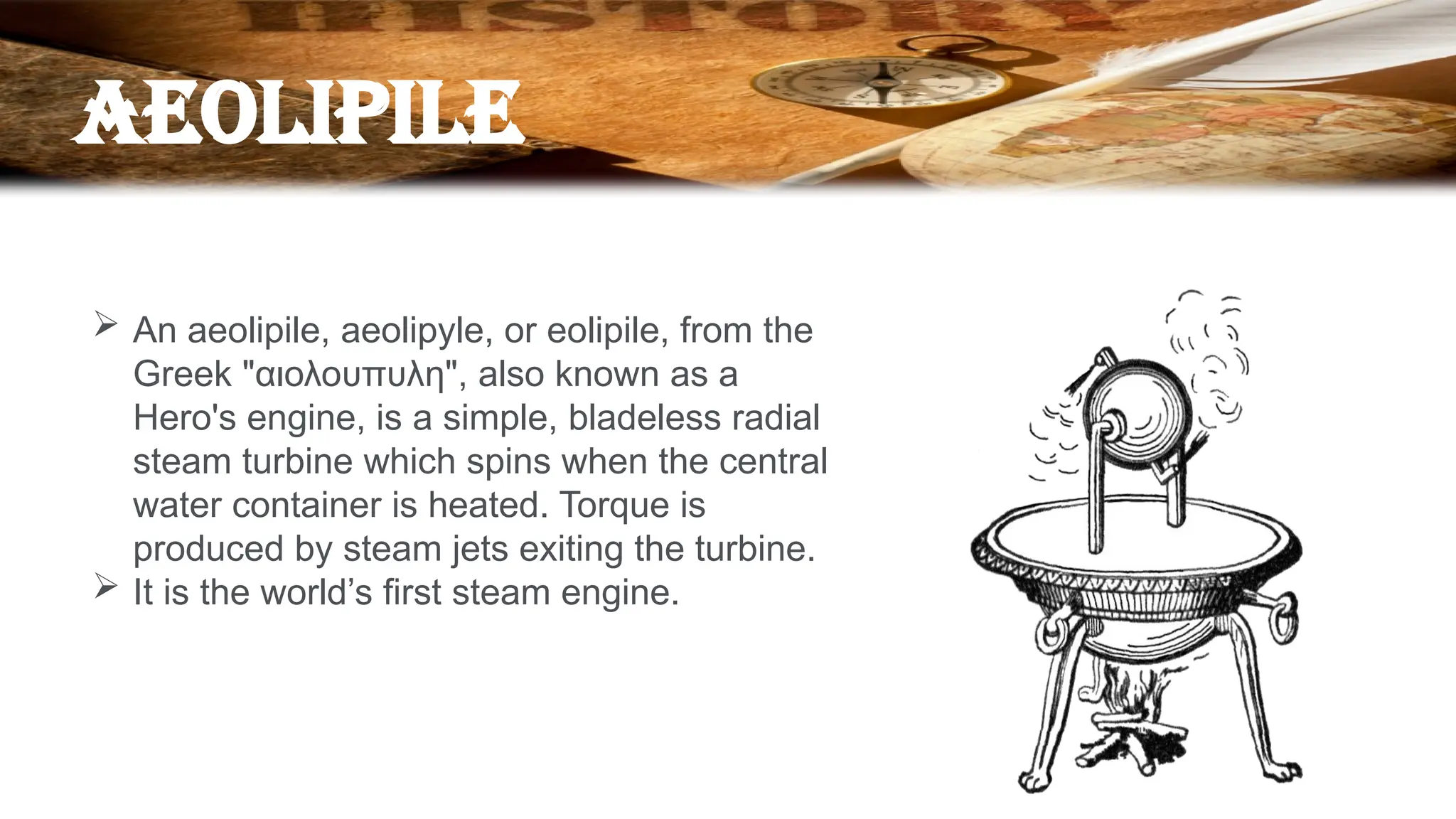
 An aeolipile, aeolipyle, or eolipile, from the
Greek "αιολουπυλη", also known as a
Hero's engine, is a simple, bladeless radial
steam turbine which spins when the central
water container is heated. Torque is
produced by steam jets exiting the turbine.
 It is the world’s first steam engine.
Middle ages
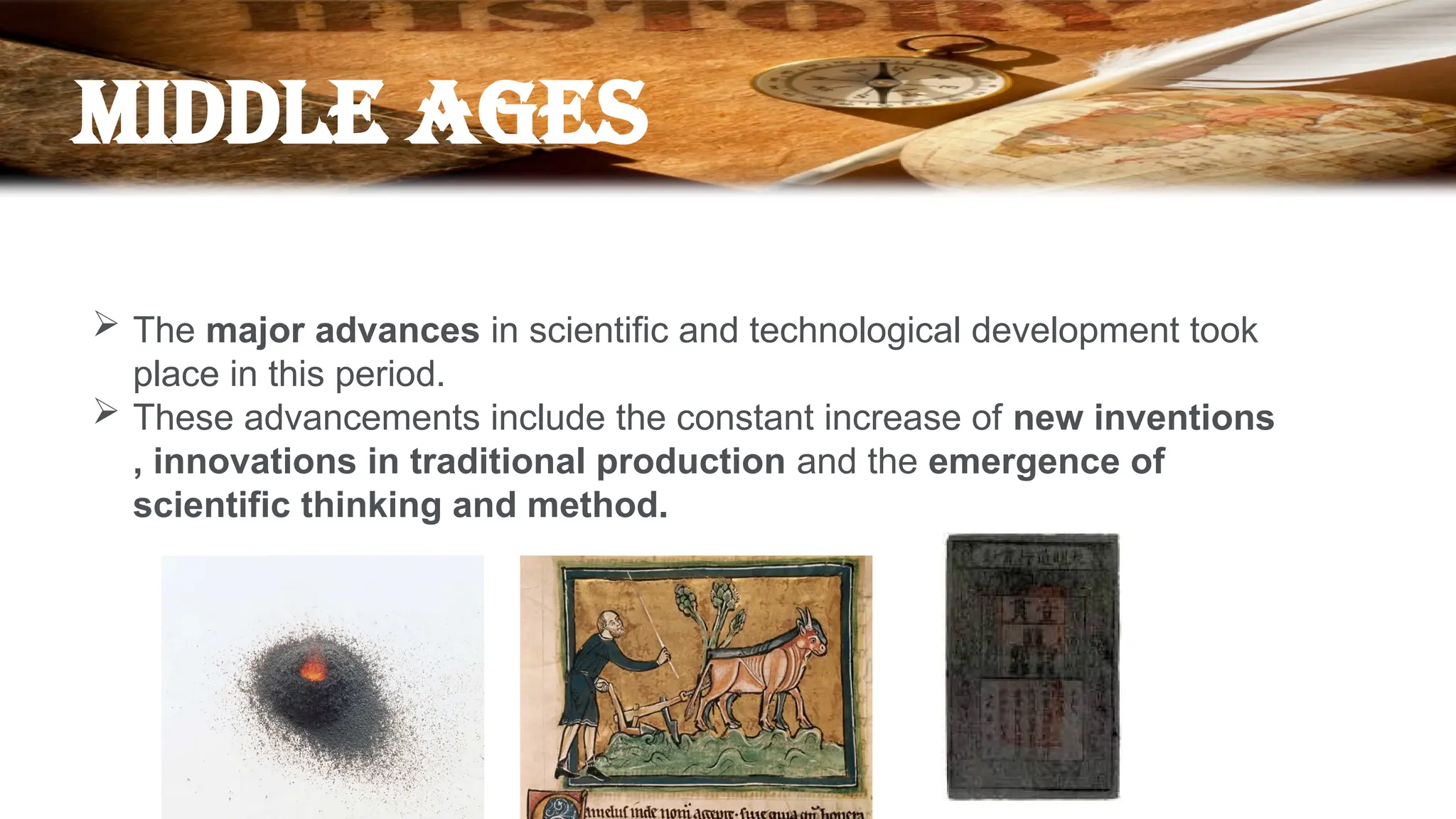
 The major advances in scientific and technological development took
place in this period.
 These advancements include the constant increase of new inventions
, innovations in traditional production and the emergence of
scientific thinking and method.
Heavy plough
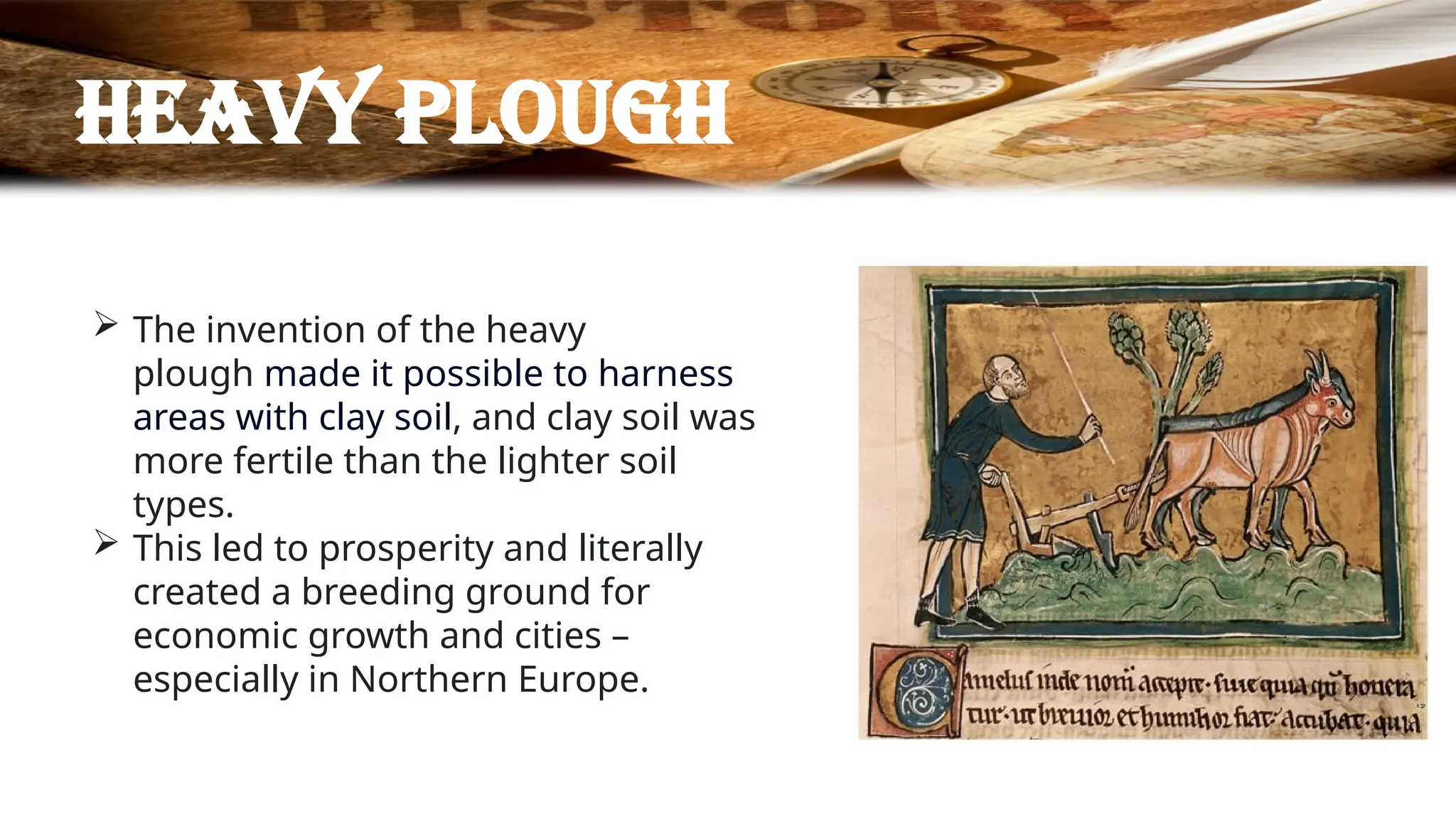
 The invention of the heavy
plough made it possible to harness
areas with clay soil, and clay soil was
more fertile than the lighter soil
types.
 This led to prosperity and literally
created a breeding ground for
economic growth and cities –
especially in Northern Europe.
Gun powder
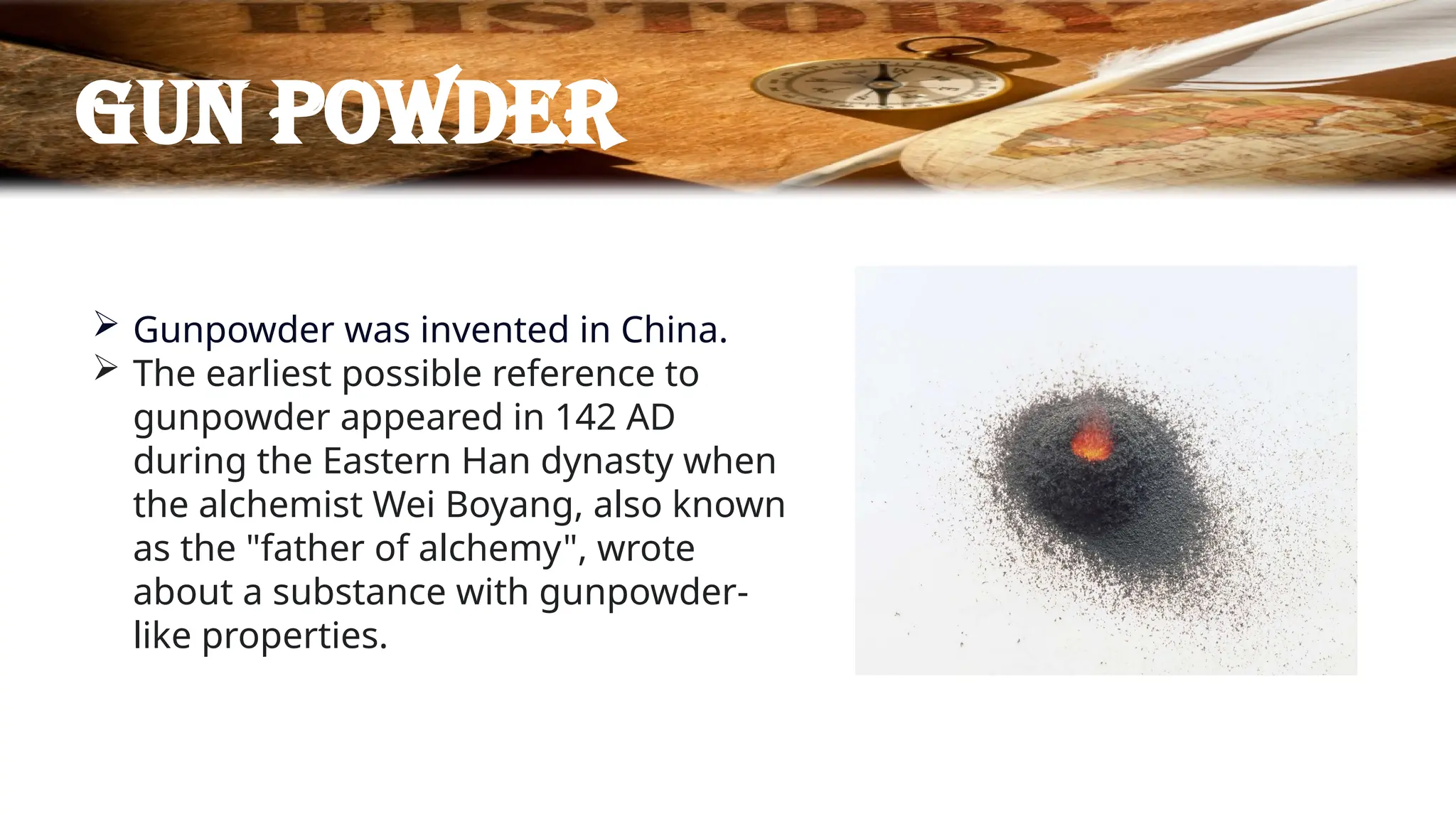
 Gunpowder was invented in China.
 The earliest possible reference to
gunpowder appeared in 142 AD
during the Eastern Han dynasty when
the alchemist Wei Boyang, also known
as the "father of alchemy", wrote
about a substance with gunpowder-
like properties.
Paper money
 First paper money was introduced in
medieval China in the late 10th century
during the rule of the Song dynasty
(960-1279).
 A sophisticated system of production,
issue and withdrawal was gradually
developed to an admirable perfection
achieved during the Mongol Yuan
dynasty (1260-1368).
Mechanical clock
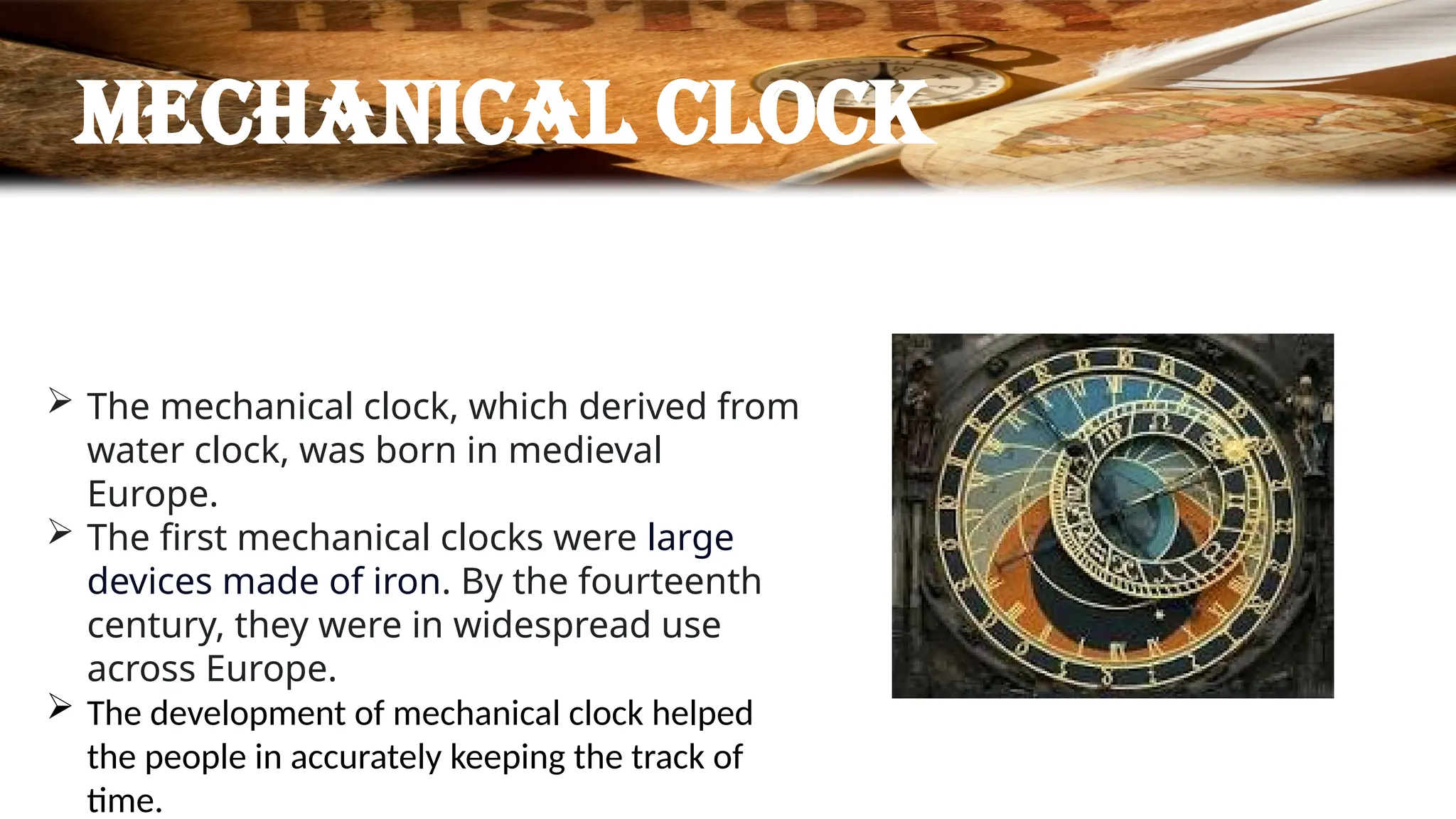
 The mechanical clock, which derived from
water clock, was born in medieval
Europe.
 The first mechanical clocks were large
devices made of iron. By the fourteenth
century, they were in widespread use
across Europe.
 The development of mechanical clock helped
the people in accurately keeping the track of
time.
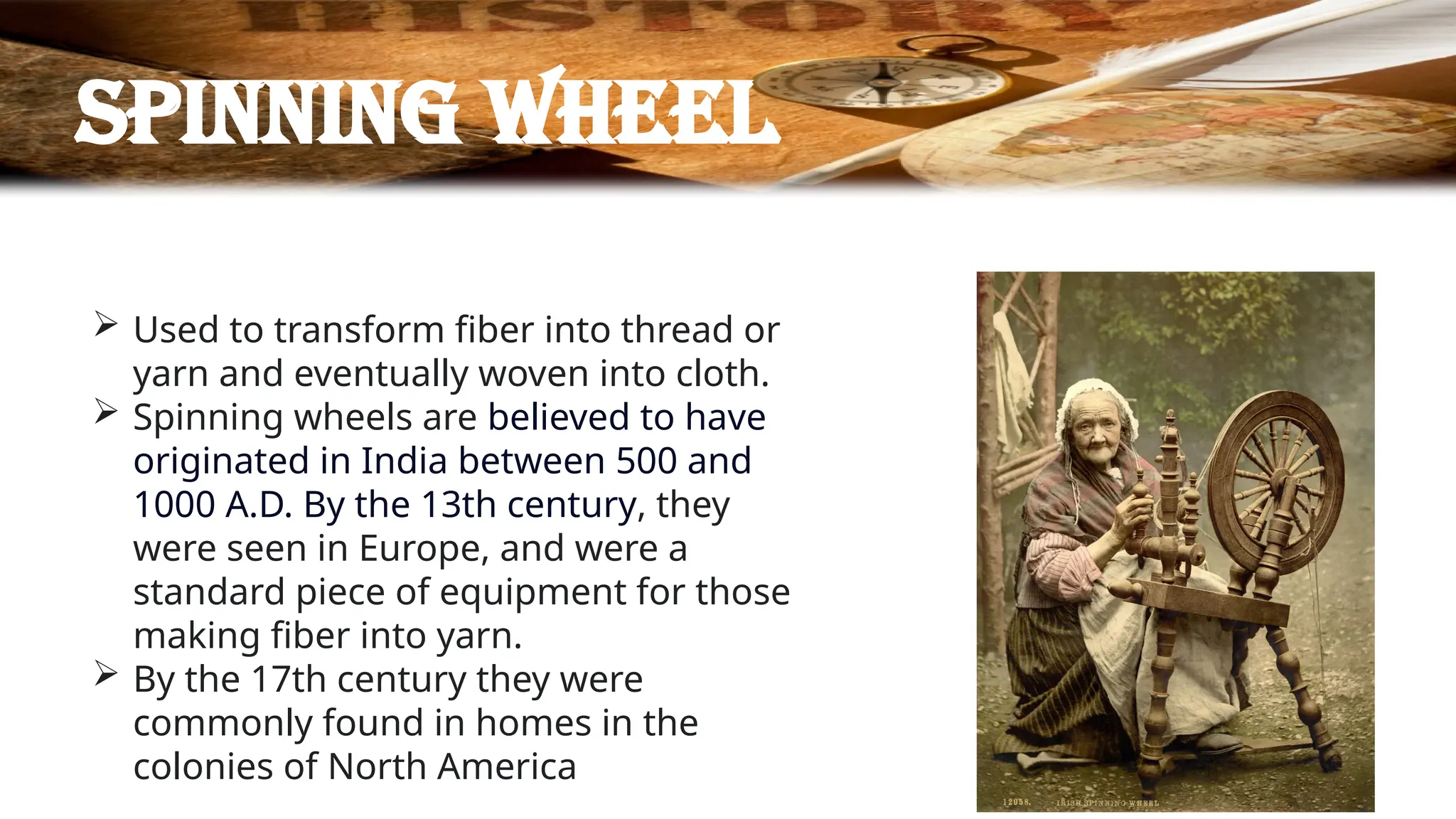
Spinning wheel
 Used to transform fiber into thread or
yarn and eventually woven into cloth.
 Spinning wheels are believed to have
originated in India between 500 and
1000 A.D. By the 13th century, they
were seen in Europe, and were a
standard piece of equipment for those
making fiber into yarn.
 By the 17th century they were
commonly found in homes in the
colonies of North America
compass
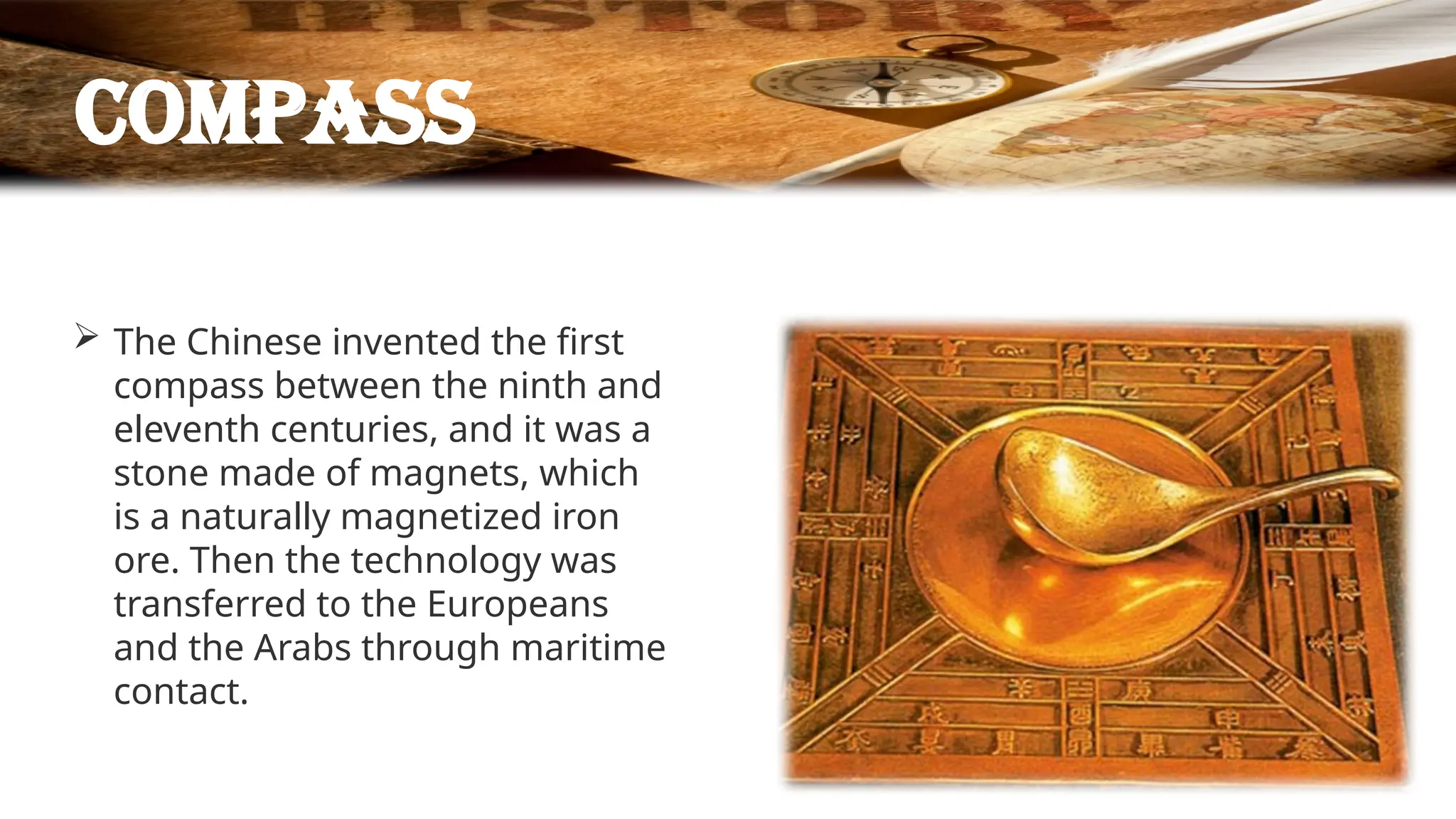
 The Chinese invented the first
compass between the ninth and
eleventh centuries, and it was a
stone made of magnets, which
is a naturally magnetized iron
ore. Then the technology was
transferred to the Europeans
and the Arabs through maritime
contact.
Modern ages
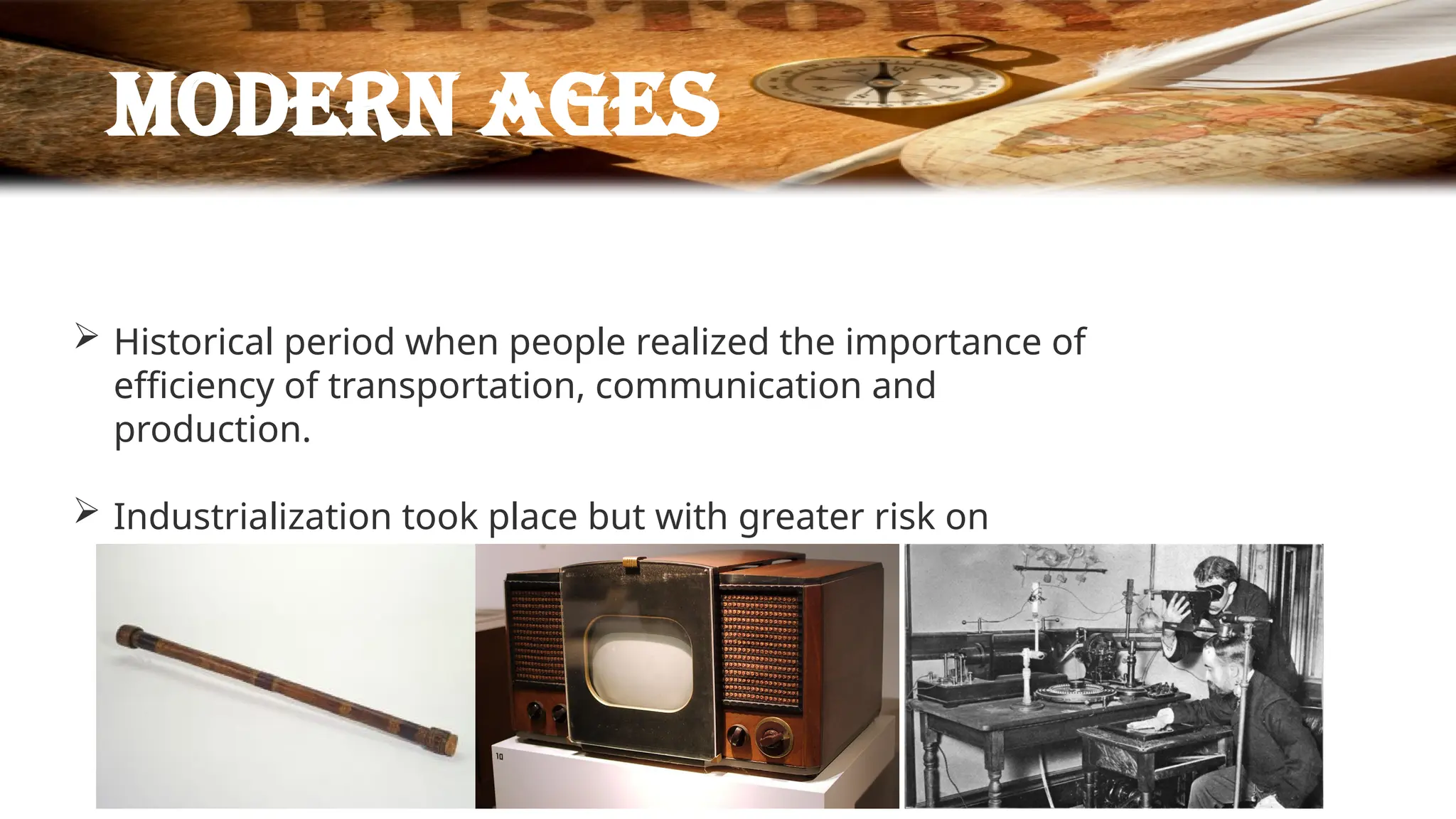
 Historical period when people realized the importance of
efficiency of transportation, communication and
production.
 Industrialization took place but with greater risk on
human health, food safety and environment.
telescope
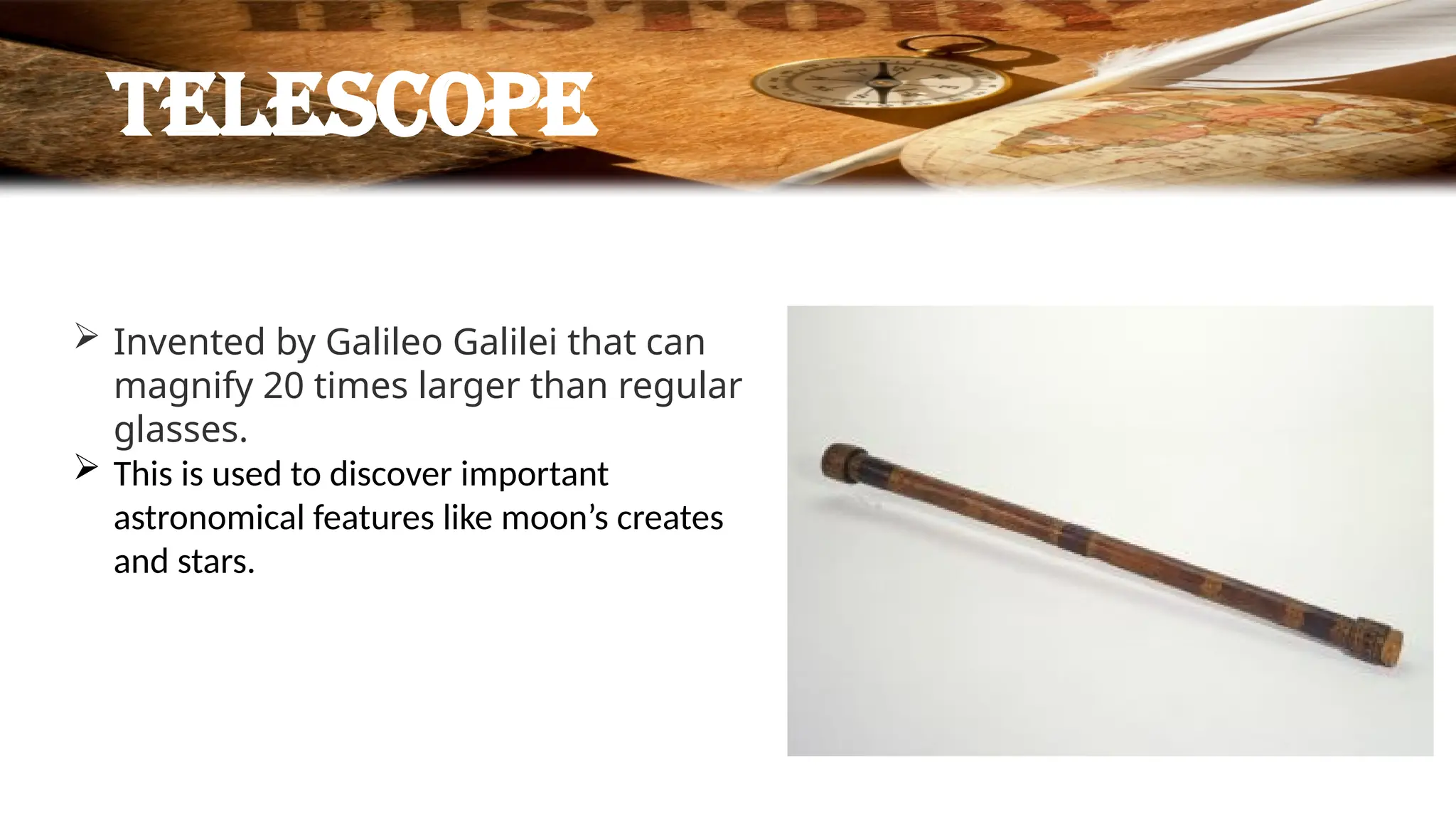
 Invented by Galileo Galilei that can
magnify 20 times larger than regular
glasses.
 This is used to discover important
astronomical features like moon’s creates
and stars.
Compound microscope
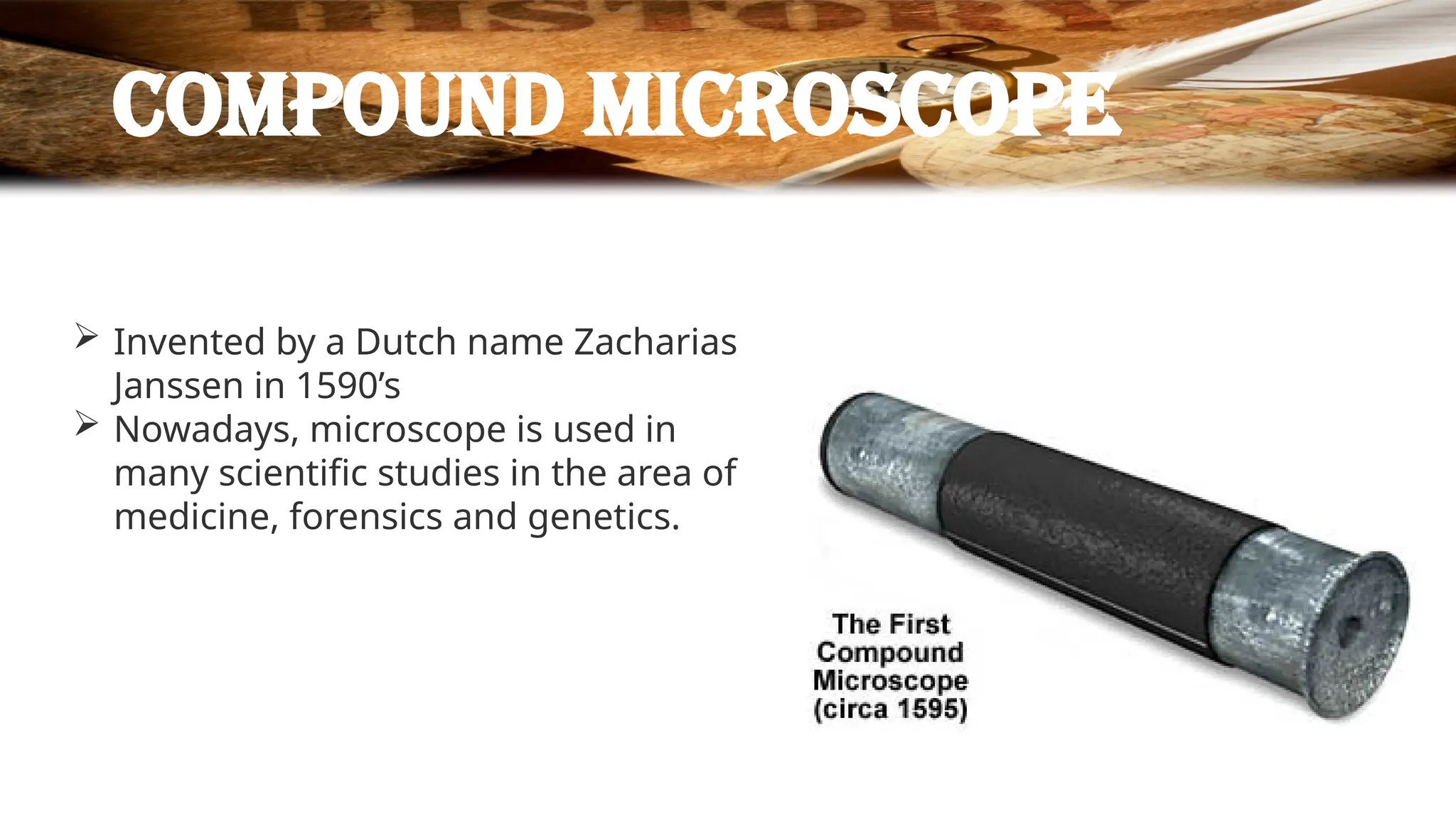
 Invented by a Dutch name Zacharias
Janssen in 1590’s
 Nowadays, microscope is used in
many scientific studies in the area of
medicine, forensics and genetics.
X-ray machine
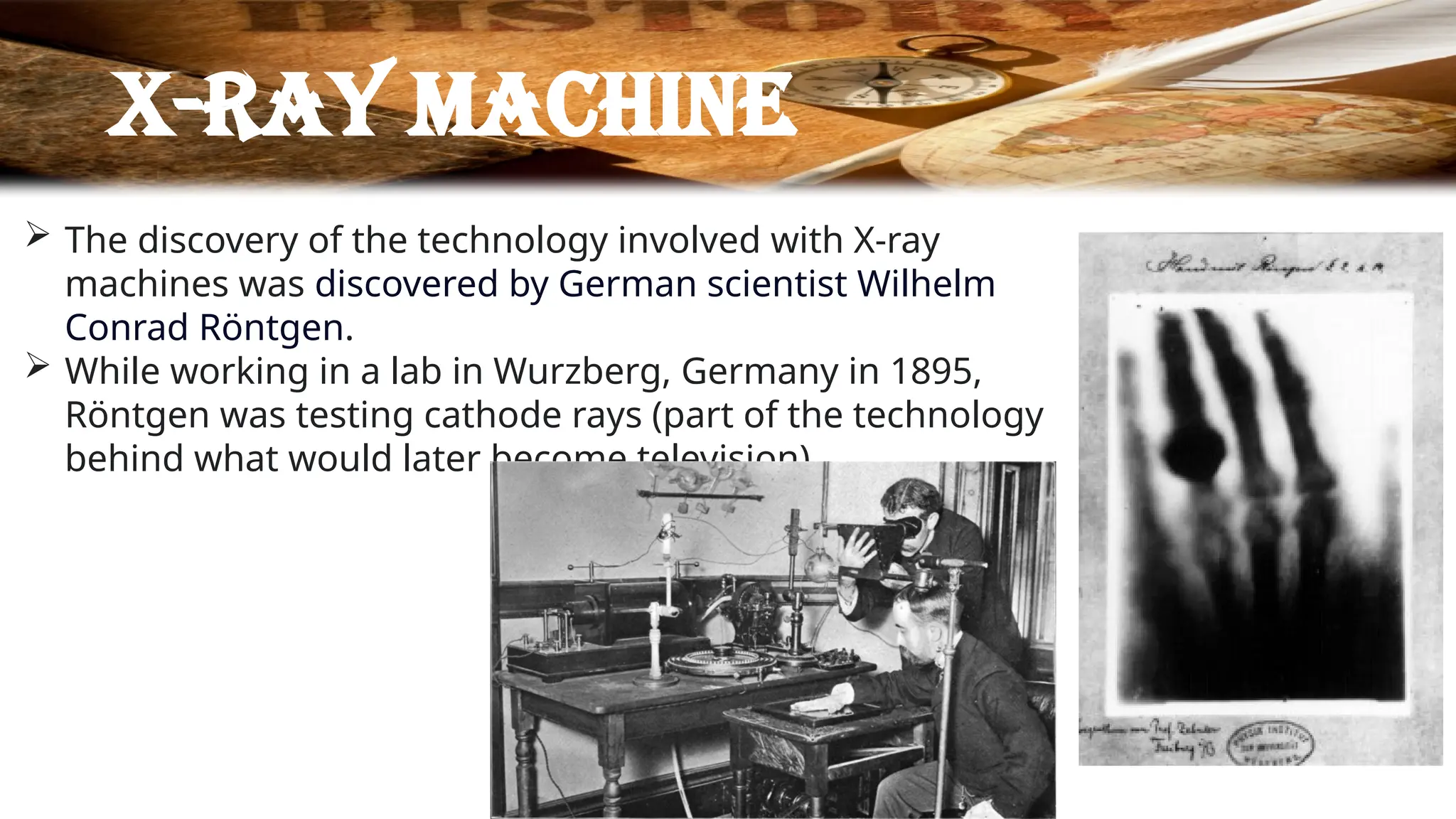
 The discovery of the technology involved with X-ray
machines was discovered by German scientist Wilhelm
Conrad Röntgen.
 While working in a lab in Wurzberg, Germany in 1895,
Röntgen was testing cathode rays (part of the technology
behind what would later become television).
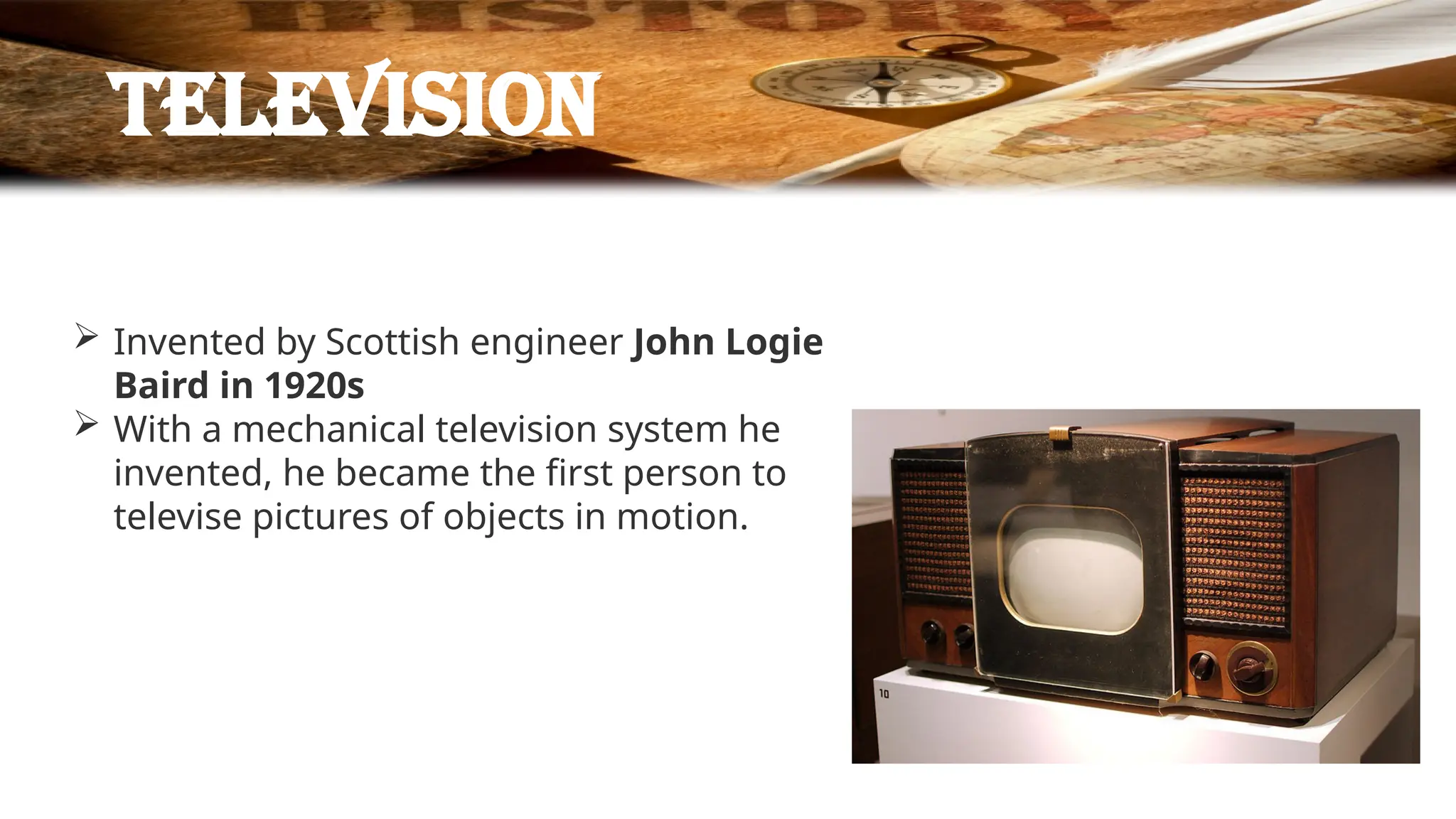
television
 Invented by Scottish engineer John Logie
Baird in 1920s
 With a mechanical television system he
invented, he became the first person to
televise pictures of objects in motion.
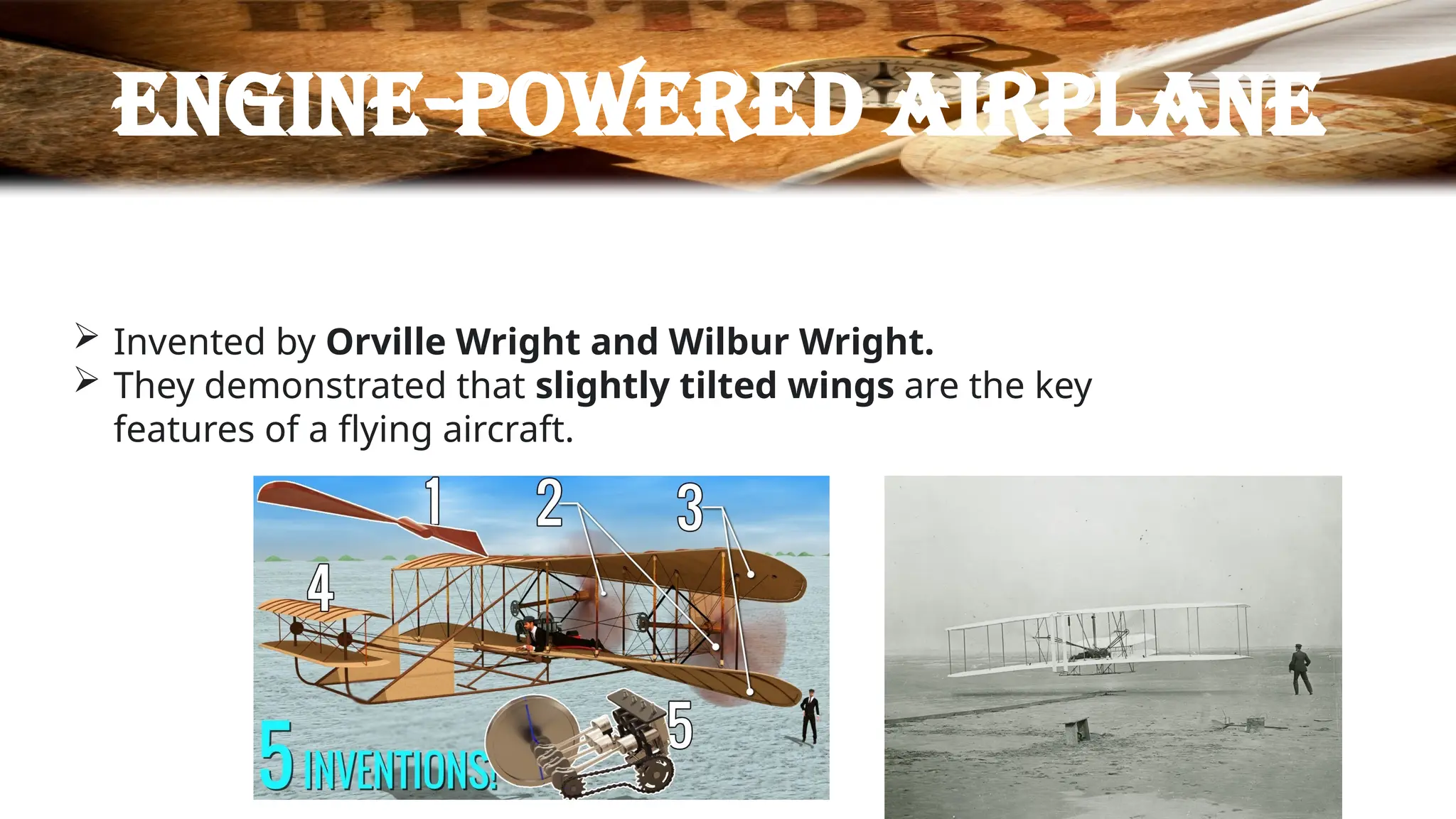
Engine-powered airplane
 Invented by Orville Wright and Wilbur Wright.
 They demonstrated that slightly tilted wings are the key
features of a flying aircraft.
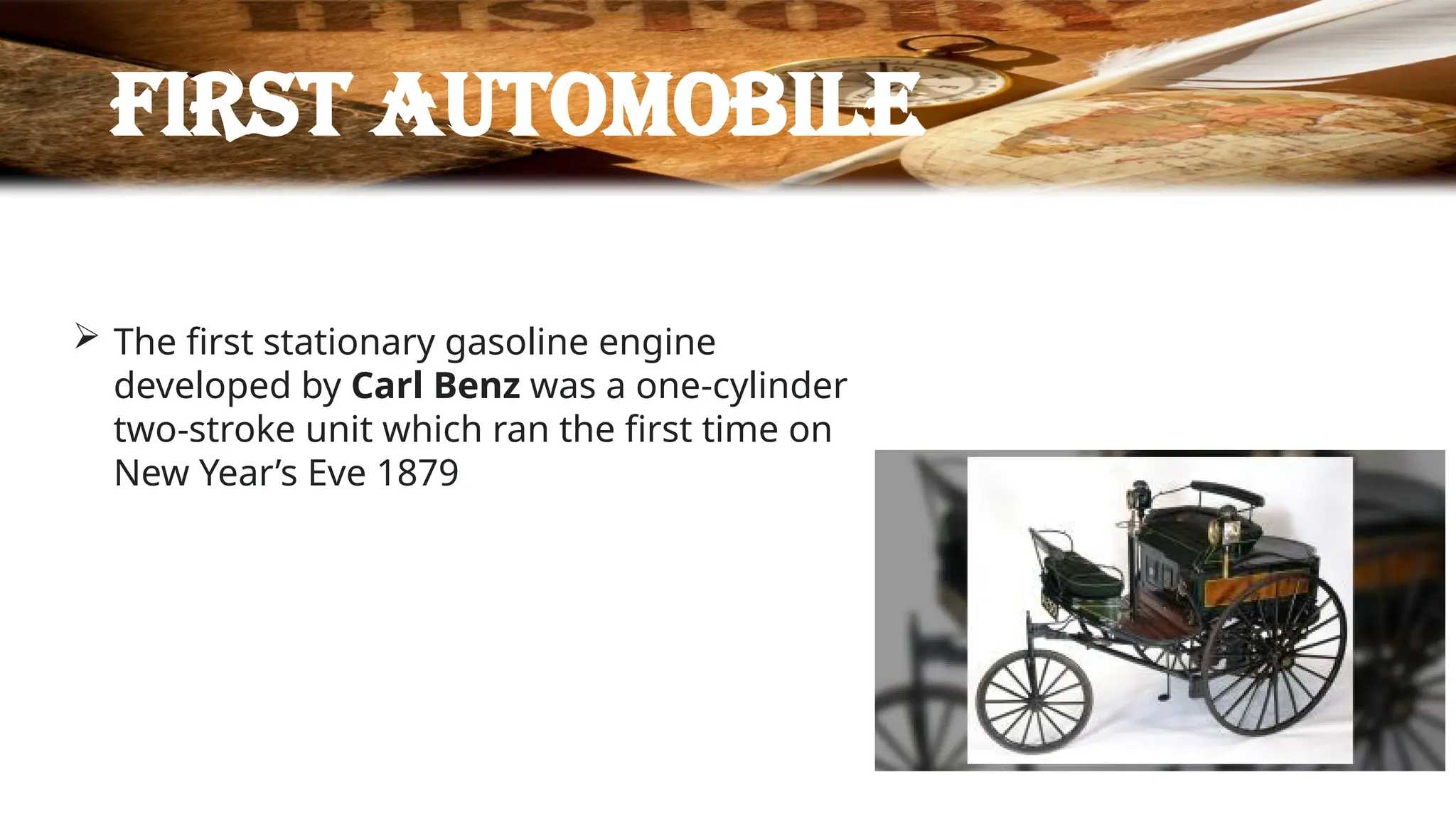
First automobile
 The first stationary gasoline engine
developed by Carl Benz was a one-cylinder
two-stroke unit which ran the first time on
New Year’s Eve 1879

Science-Technology-and-Society introduction

  • 1.
    Science, Technology and Society(STS) Prepared by: Jerel W. Ubarco, RRT, RSO, MSRTc
  • 2.
    At the endof this discussion, we must be able to answer the following questions: 1 How do we define Science? Technology? And Society? 2 How do Science, Technology and Society interact with each other or how they are related? 3 What is Science, Technology and Society (STS)? 4 What are the historical antecedents that changed the course of Science & Technology in the: a. World (ancient, middle and modern ages) b. Philippines
  • 3.
    1 How dowe define Science? Technology? And Society?
  • 4.
    Came form theLatin word “Scientia” – which means Knowledge. As a process used to solve problems of develop an understanding of nature that involves testing possible answers. A system of acquiring knowledge based of the Scientific method.
  • 6.
     An organized,systematic and methodical activity of building and organizing knowledge about the universe behaves through observation, experimentation or both. As a discovery of regularity in nature, enough for natural phenomena to be describe by principles and laws. Tries to discover facts and relationships and then tries to create theories that makes sense of these facts and relationships.
  • 7.
    It refers tomethods, systems, and devices which are the result of scientific knowledge being used for practical purposes. Comes form the Greek root word “techne”, meaning “art, skill, or cunning of hand”. It is the application of scientific knowledge, laws, and principles to produce services, materials, tools, and machines aimed at solving real-world problems. The human attempt to change the world by creating products that make our life easier.
  • 8.
    Came from aLatin word “societas”- which means “a friendly association with others”. A large group of people who live together in an organized way, making decisions about how to do thins and sharing the work that needs to be done A grouping of individuals, which is characterized by common interest and may have distinctive culture and institutions.
  • 9.
    1 How dowe define Science? Technology? And Society? Process of acquiring Scientific Knowledge Application of scientific knowledge for people Group of people who uses technology & who are studying science
  • 10.
    2 How doScience, Technology and Society interact with other or how they are related? Process of acquiring Scientific Knowledge Application of scientific knowledge for people Group of people who uses technology & who are studying science
  • 11.
    I n f o r m s D e m a n d s m o r e Makes life easier Benefitsfrom D e m a n d s m o r e S e e k s t o i m p r o v e Technology is the use or application of scientific knowledge for a specific goal or purpose
  • 12.
    2 How doScience, Technology and Society interact with other or how they are related? Science drives technology by making new technology possible through scientific breakthrough. Scientist focus on using science to develop products.
  • 13.
    2 How doScience, Technology and Society interact with other or how they are related? Without technology, science experiments would not be possible.
  • 14.
    2 How doScience, Technology and Society interact with other or how they are related? Without science, technology could not proceed. is the way of knowing is the way of doing
  • 15.
    2 How doScience, Technology and Society interact with other or how they are related? The very questions that scientist ask are shaped by the available technology.
  • 16.
    2 How doScience, Technology and Society interact with other or how they are related? BETTER WORLD
  • 17.
    3 What isScience, Technology & Society (STS) Is a relatively young field that combines previously independent and older disciplines, such as History of Science, Philosophy of Science, and Sociology of Science.
  • 18.
    3 What isScience, Technology & Society (STS) Applies methods drawn from history, philosophy and sociology to study the nature of science and technology and ultimately judge their value and place in society.
  • 19.
    3 What isScience, Technology & Society (STS) Seek to bridge the gap between two traditionally exclusive culture – humanities and natural science – so that human will be able to better confront the moral, ethical, and existential dilemmas brough by the continued developments in science and technology.
  • 20.
    3 What isScience, Technology & Society (STS) Is the study of how social, political and cultural values affect scientific research and technological innovation, and how these is turn affect society, politics and culture.
  • 21.
    4 What arethe historical antecedents that changed the course of Science & Technology in the: a. World (ancient, middle and modern ages) b. Philippines
  • 22.
    4 What arethe historical antecedents that changed the course of Science & Technology in the World (ancient, middle and modern ages)?
  • 23.
    4 What arethe historical antecedents that changed the course of Science & Technology in the World (ancient, middle and modern ages)?
  • 24.
    4 What arethe historical antecedents that changed the course of Science & Technology in the World (ancient, middle and modern ages)?
  • 25.
    ANTECEDENTS It is definedas a precursor to the unfolding or existence of something. Antecedents of science and technology are factors that paved way for the presence of advanced and sophisticated scientific and technological innovations today.
  • 26.
    Ancient period Ancient civilizationpaved the way for advances in science and technology. These advances during the ancient period allowed civilizations to flourish by finding better ways of communication, transportation, self-organization and ways of living.
  • 27.
    Ancient wheel People fromancient civilization used animals as mean of transportation. The invention of ancient wheel is credited to the Sumerians.
  • 28.
    Nail This major inventiondates back to the ancient Roman era more than 2000 years old, and until the early 1800s, using handcrafted nails was still the norm.
  • 29.
    paper Papyrus paper isthe first paper in history. Found in the tombs and temples of Ancient Egyptians  It was made by Ancient Egyptians from papyrus plant. The amazing part about papyrus paper is that it's very strong, durable, elastic and is made naturally.
  • 30.
    Shadoof Shadoof, also spelledShaduf, is a hand- operated device for lifting water. The shadoof was a long tool on a seesaw type of bottom, with a weight on one end and a bucket on the other. The bucket could be lowered into the canal and filled with water. Then, the bucket could be rotated around to the area in need of water. The ancient Egyptians used it to help move water from the canal to the fields.
  • 31.
    Shadoof Shadoof, also spelledShaduf, is a hand- operated device for lifting water. The shadoof was a long tool on a seesaw type of bottom, with a weight on one end and a bucket on the other. The bucket could be lowered into the canal and filled with water. Then, the bucket could be rotated around to the area in need of water. The ancient Egyptians used it to help move water from the canal to the fields. Lifting things using counterweights.
  • 32.
    AEOLIPILE  An aeolipile,aeolipyle, or eolipile, from the Greek "αιολουπυλη", also known as a Hero's engine, is a simple, bladeless radial steam turbine which spins when the central water container is heated. Torque is produced by steam jets exiting the turbine.  It is the world’s first steam engine.
  • 33.
    Middle ages  Themajor advances in scientific and technological development took place in this period.  These advancements include the constant increase of new inventions , innovations in traditional production and the emergence of scientific thinking and method.
  • 34.
    Heavy plough  Theinvention of the heavy plough made it possible to harness areas with clay soil, and clay soil was more fertile than the lighter soil types.  This led to prosperity and literally created a breeding ground for economic growth and cities – especially in Northern Europe.
  • 35.
    Gun powder  Gunpowderwas invented in China.  The earliest possible reference to gunpowder appeared in 142 AD during the Eastern Han dynasty when the alchemist Wei Boyang, also known as the "father of alchemy", wrote about a substance with gunpowder- like properties.
  • 36.
    Paper money  Firstpaper money was introduced in medieval China in the late 10th century during the rule of the Song dynasty (960-1279).  A sophisticated system of production, issue and withdrawal was gradually developed to an admirable perfection achieved during the Mongol Yuan dynasty (1260-1368).
  • 37.
    Mechanical clock  Themechanical clock, which derived from water clock, was born in medieval Europe.  The first mechanical clocks were large devices made of iron. By the fourteenth century, they were in widespread use across Europe.  The development of mechanical clock helped the people in accurately keeping the track of time.
  • 38.
    Spinning wheel  Usedto transform fiber into thread or yarn and eventually woven into cloth.  Spinning wheels are believed to have originated in India between 500 and 1000 A.D. By the 13th century, they were seen in Europe, and were a standard piece of equipment for those making fiber into yarn.  By the 17th century they were commonly found in homes in the colonies of North America
  • 39.
    compass  The Chineseinvented the first compass between the ninth and eleventh centuries, and it was a stone made of magnets, which is a naturally magnetized iron ore. Then the technology was transferred to the Europeans and the Arabs through maritime contact.
  • 40.
    Modern ages  Historicalperiod when people realized the importance of efficiency of transportation, communication and production.  Industrialization took place but with greater risk on human health, food safety and environment.
  • 41.
    telescope  Invented byGalileo Galilei that can magnify 20 times larger than regular glasses.  This is used to discover important astronomical features like moon’s creates and stars.
  • 42.
    Compound microscope  Inventedby a Dutch name Zacharias Janssen in 1590’s  Nowadays, microscope is used in many scientific studies in the area of medicine, forensics and genetics.
  • 43.
    X-ray machine  Thediscovery of the technology involved with X-ray machines was discovered by German scientist Wilhelm Conrad Röntgen.  While working in a lab in Wurzberg, Germany in 1895, Röntgen was testing cathode rays (part of the technology behind what would later become television).
  • 44.
    television  Invented byScottish engineer John Logie Baird in 1920s  With a mechanical television system he invented, he became the first person to televise pictures of objects in motion.
  • 45.
    Engine-powered airplane  Inventedby Orville Wright and Wilbur Wright.  They demonstrated that slightly tilted wings are the key features of a flying aircraft.
  • 46.
    First automobile  Thefirst stationary gasoline engine developed by Carl Benz was a one-cylinder two-stroke unit which ran the first time on New Year’s Eve 1879

Editor's Notes

  • #2 Antecedents = Previous
  • #4 >Came form the Latin word “Scientia” – which means Knowledge. >As a process used to solve problems of develop an understanding of nature that involves testing possible answers. >A system of acquiring knowledge based of the Scientific method.
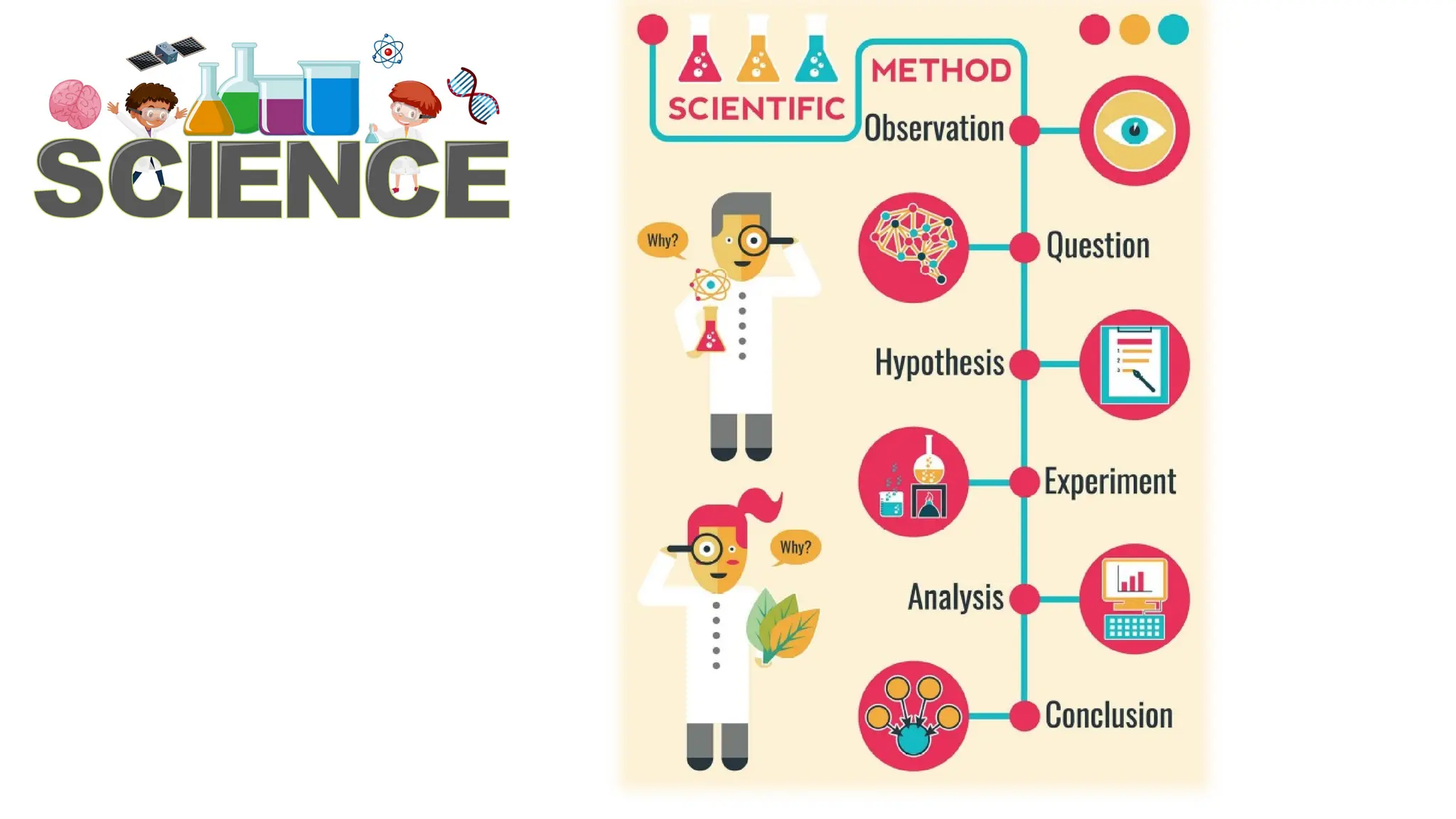
  • #5 >Problem >observation >question >Hypothesis (educated guess) >Experiment (survey) >Analysis >Conclusion
  • #6 (Should undergo scientific methods) Also conduct studies that have sense
  • #7 (Should undergo scientific methods)
  • #8  Give example of Society? (group of people with common goal)
  • #12 X-ray Stethoscope Microscope
  • #17 Humanities - studies of foreign languages, history, philosophy, visual arts, language arts. Natural science – biology, chemistry, physics
  • #19 Humanities - studies of foreign languages, history, philosophy, visual arts, language arts. Natural science – biology, chemistry, physics
  • #31 elevator
  • #35 Before they are using sword and spear
  • #36 Before merchants and traders used precious metals such as gold and silver They realized that using paper money brough advantages because it is easier to keep and transport