SCIENCE AND TECHNOLOGY IN NATION BUILDING
Learning Objectives:
At the end of the unit, you should be able to:
1. discuss the role of Science and technology in Philippine nation-
building;
2. evaluate government policies on Science and technology in
terms of their contributions to nation-building;
3. identify the government's actual science and technology
policies and appraise their impact on the Filipino nation; and
4. cite the importance of science-related programs and projects
in the development of the Philippine economy.
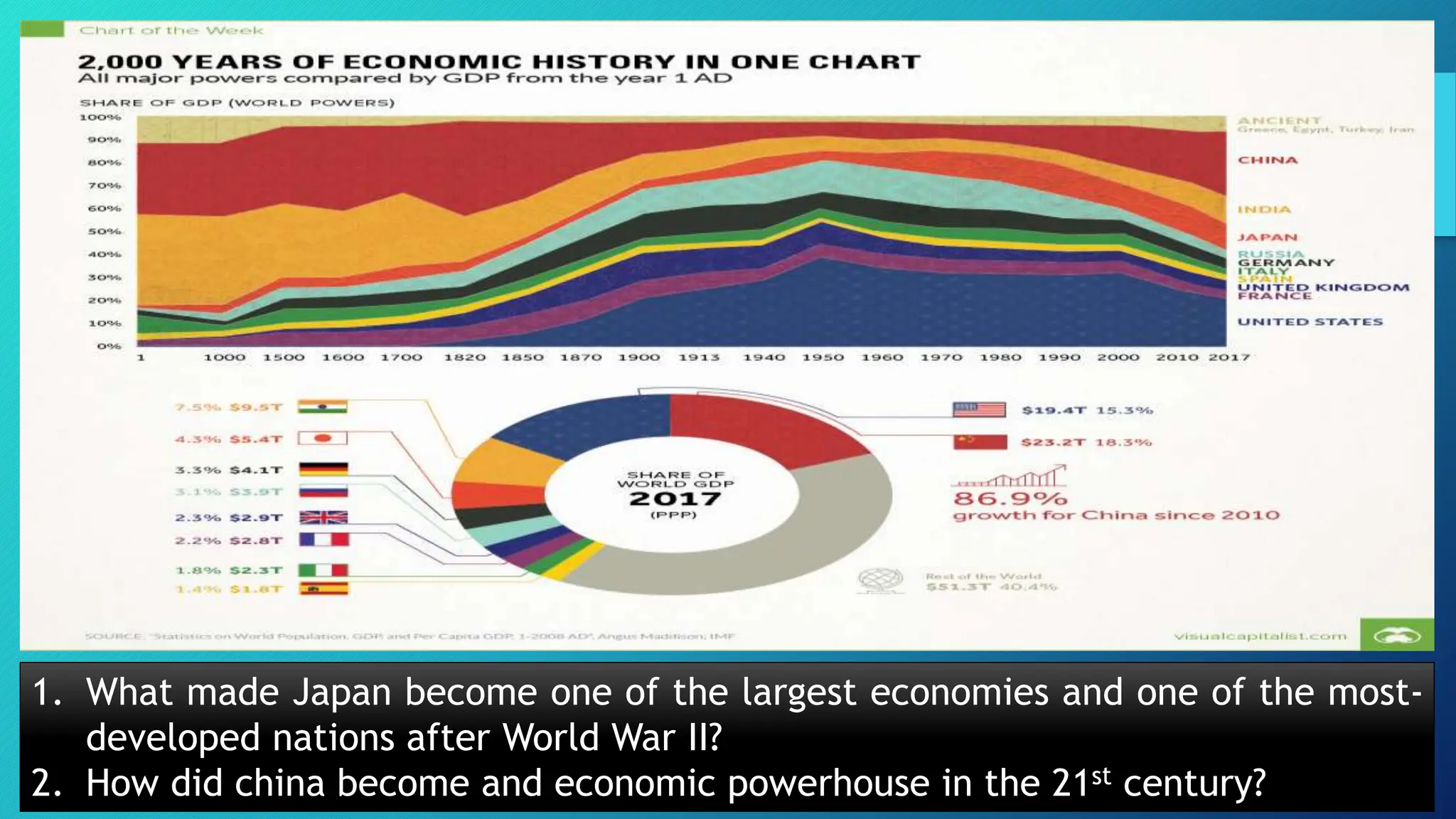
1. What made Japan become one of the largest economies and one of the most-
developed nations after World War II?
2. How did china become and economic powerhouse in the 21st century?
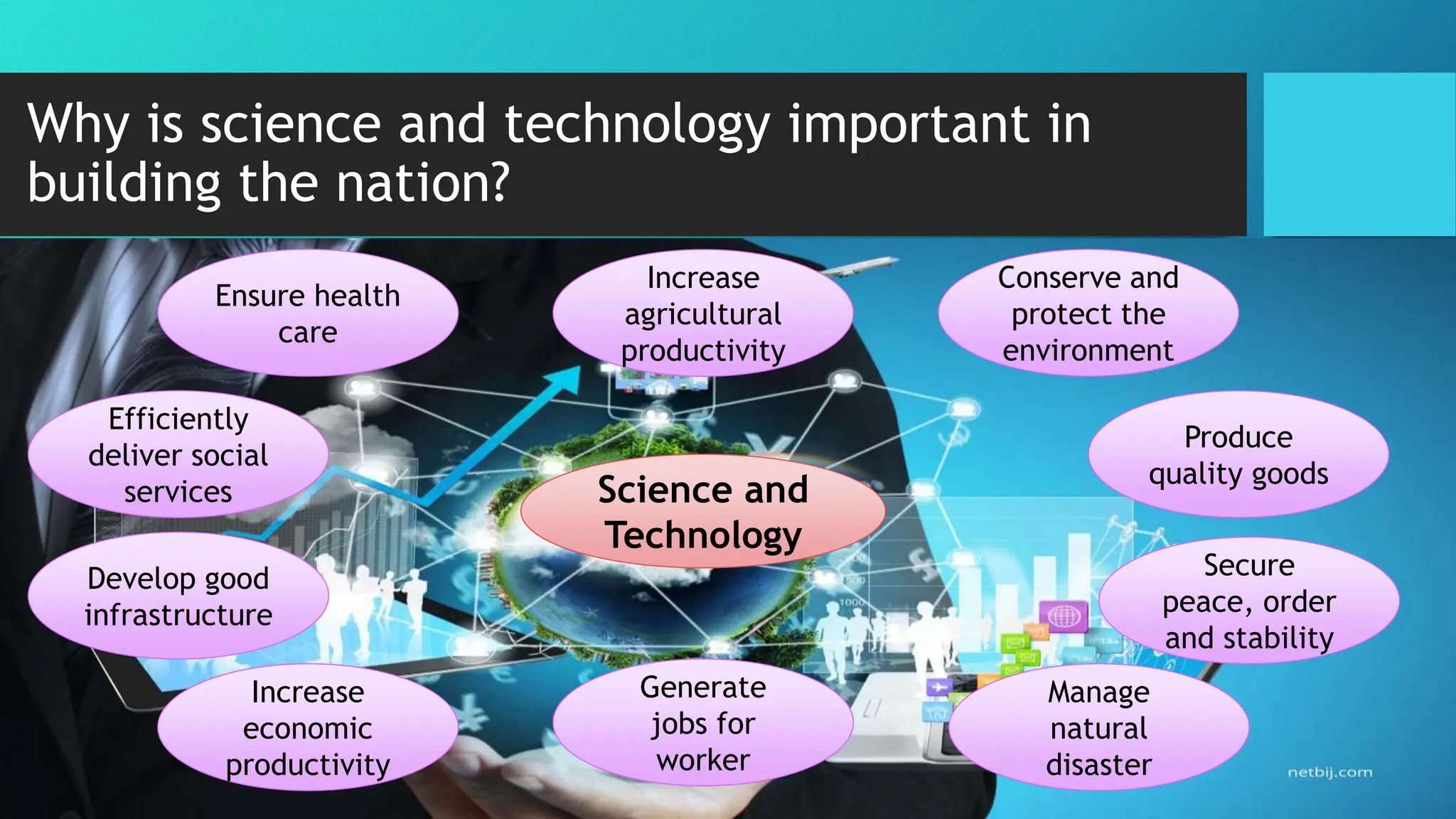
Why is science and technology important in
building the nation?
The state of science and technology
determines part of the socio-economic
progress of country.
It is a well-known fact that national
progress is highly correlated to the
capacity of the country to produce local
industrial goods for domestic needs and
that industrialization is very much
dependent on the capacity of a country to
use science and technology to progress
locally-found raw materials into high-tech
products and tools for households and
other users.
Science and Technology is associated in all means with modernity
and it is an essential tool for rapid development.
 Modernization is the current term for an old process—the process of social change
whereby less developed societies acquire characteristics common to more developed
societies. The process is activated by international, or inter-societal, communication.
 The major categorization is based on economy and the application of science and technology.
 Countries which have a strong base in science and technology are the ones that developed
faster.
 It is estimated by the World Bank that seven of the ten largest economies of the
world by 2020 would be in Asia, China, Japan, India, Thailand, Indonesia, South
Korea, and Taiwan.
Why is science and technology important in
building the nation?
Science and
Technology
Ensure health
care
Increase
agricultural
productivity
Conserve and
protect the
environment
Produce
quality goods
Secure
peace, order
and stability
Increase
economic
productivity
Manage
natural
disaster
Generate
jobs for
worker
Efficiently
deliver social
services
Develop good
infrastructure
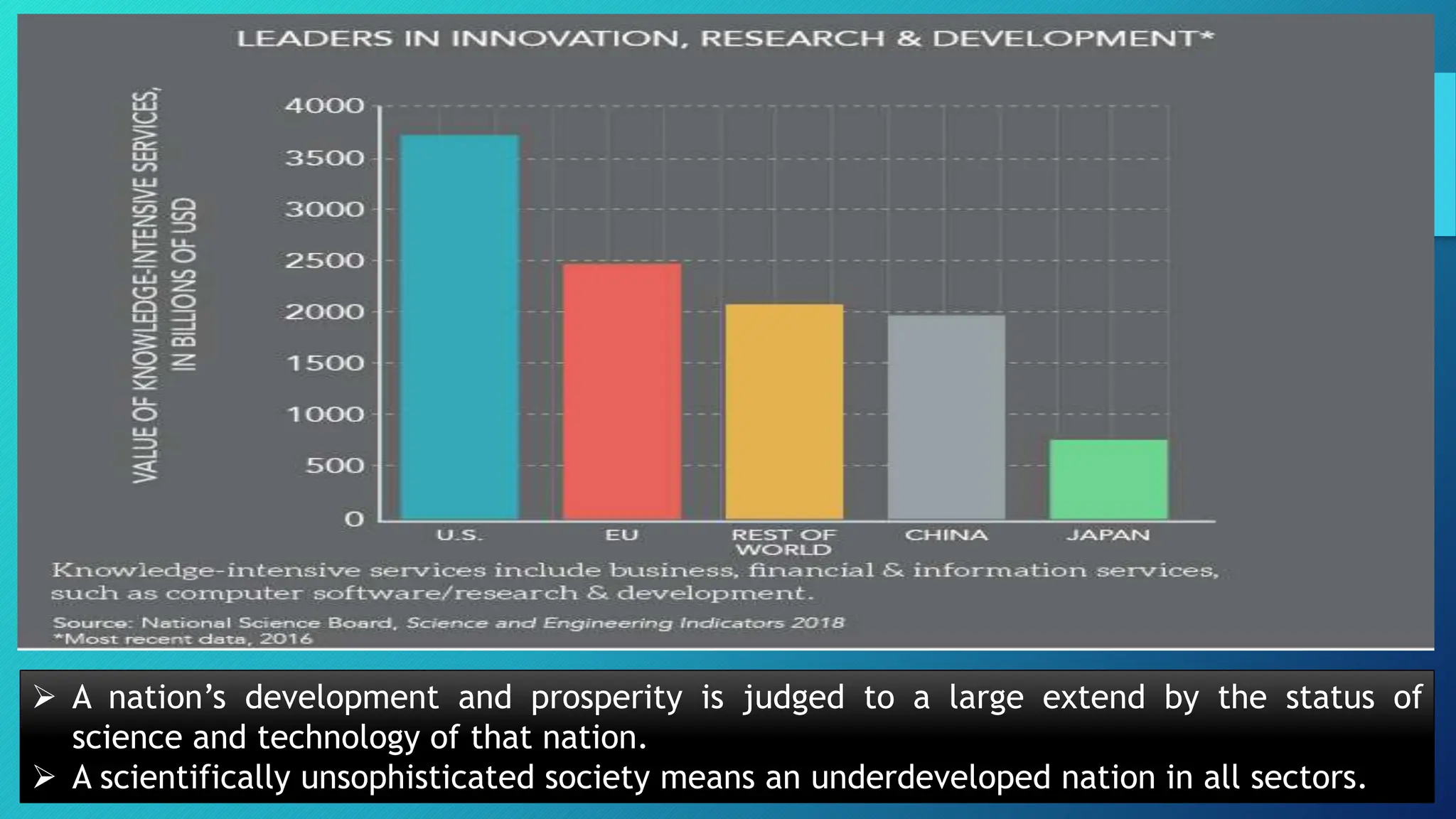
 A nation’s development and prosperity is judged to a large extend by the status of
science and technology of that nation.
 A scientifically unsophisticated society means an underdeveloped nation in all sectors.
Important role Of S&T in the Philippines
1. In the 1987 Philippine constitution, Science and
technology are given priority to "foster patriotism and
nationalism, accelerate social progress, and promote
total human liberation and development.";
2. In section 10, Article XIV, it is stated that "Science and
technology are essential for national development and
progress."
Philippine Government Science and
Technology Agenda
How the Philippine Government manages and
develops Science and technology through its policies
and program?
The government mandates an "increase use of scientific and
technological breakthroughs." The government aims to do this by
"promoting and accelerating technology adoption" and stimulating
innovation." It is based on the Philippine Development Plan 2017-
2022.
• This agency established to "provide central guidance, leadership, and coordination of
research and technical activities and ensure that the findings from such activities are
directed and used in areas of full economic and social benefits for the people."
• It is composed of three (3) sectoral planning councils, seven (7) research, and
development institutes, two (2) collegial bodies, six (6) service institutes, and several
regional and provincial offices
Aims of DOST’s Programs, Projects and Activities
1. Stimulation and innovation
2. Promotion and acceleration of technology adoption
3. Development of critical mass of globally competitive human resources
on Science and Technology
4. Increased productivity and efficiency of micro, small, and medium
entrepreneurs (MSMEs)
5. Ensure resiliency to disaster risks and climate change
6. Reduced inequality in science and technology capacities and
opportunities
7. Achieve practical science and technology governance
Major Development Programs and Personalities in
Science and Technology in the Philippines
Balik Scientist Program
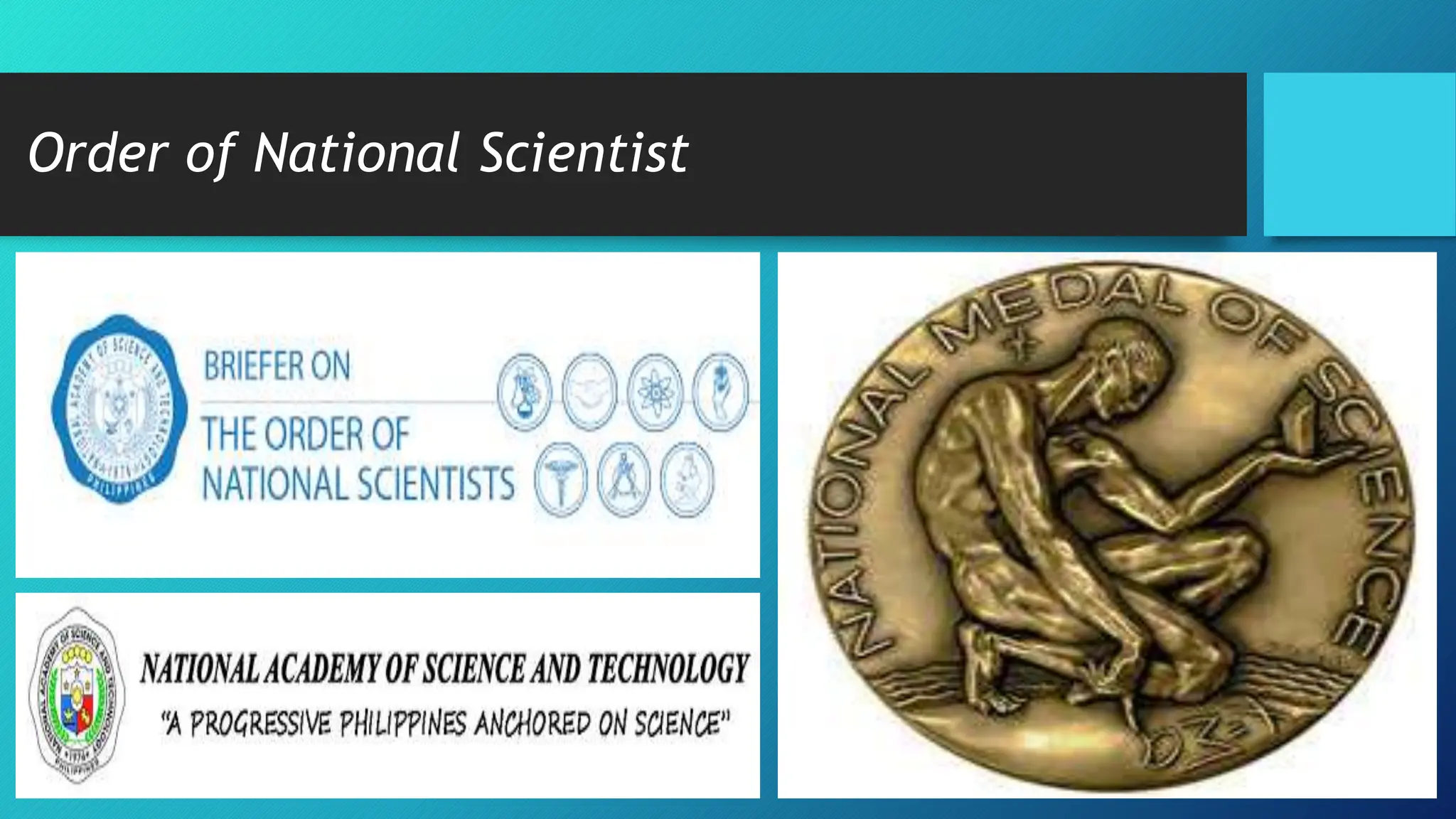
Order of National Scientist
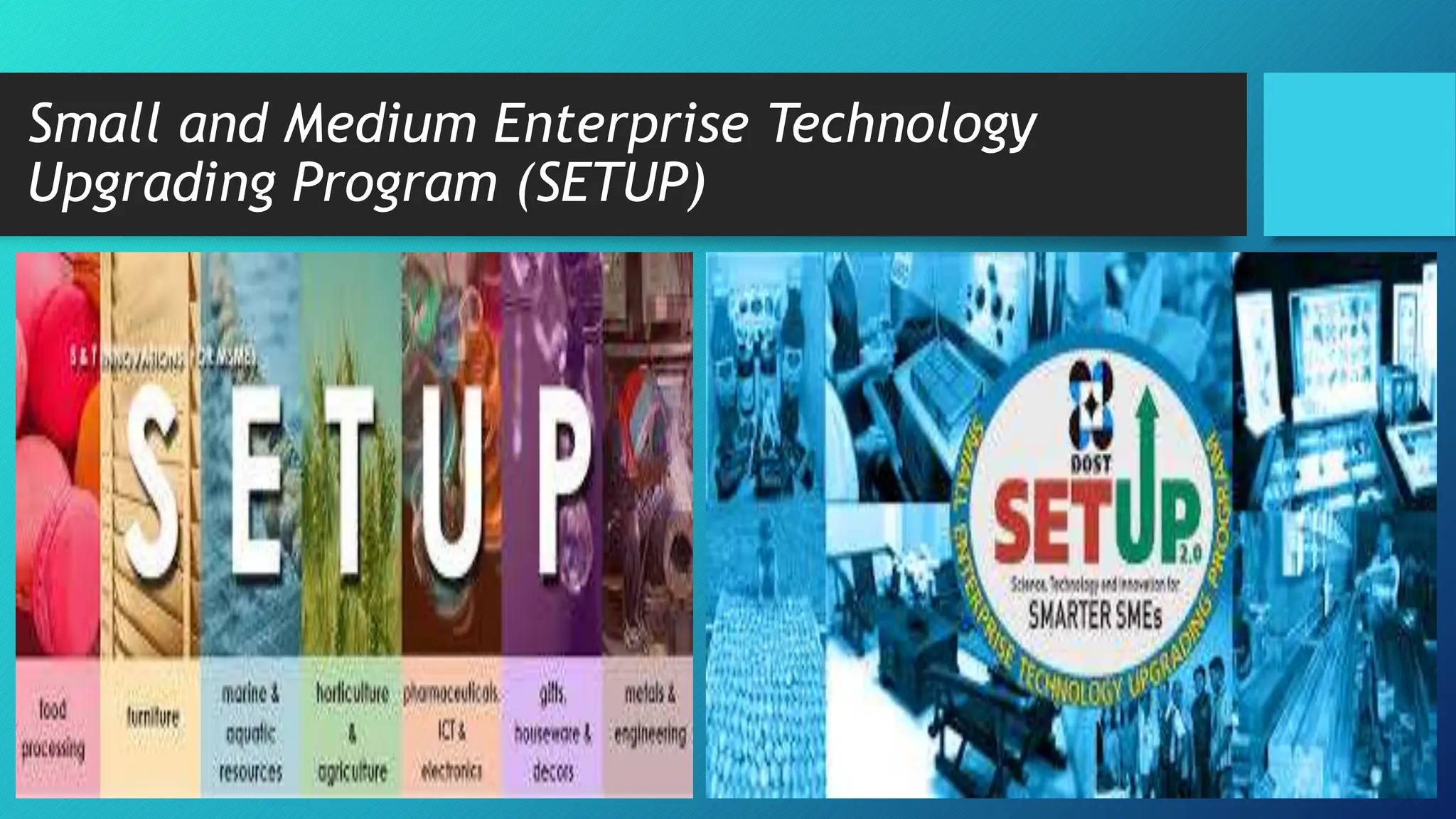
Small and Medium Enterprise Technology
Upgrading Program (SETUP)
Grants-In-Aid Program
Forest Products Research and Development
Institute
Philippine Nuclear Research Institute
Project NOAH (Nationwide Operational
Assessment of Hazards)
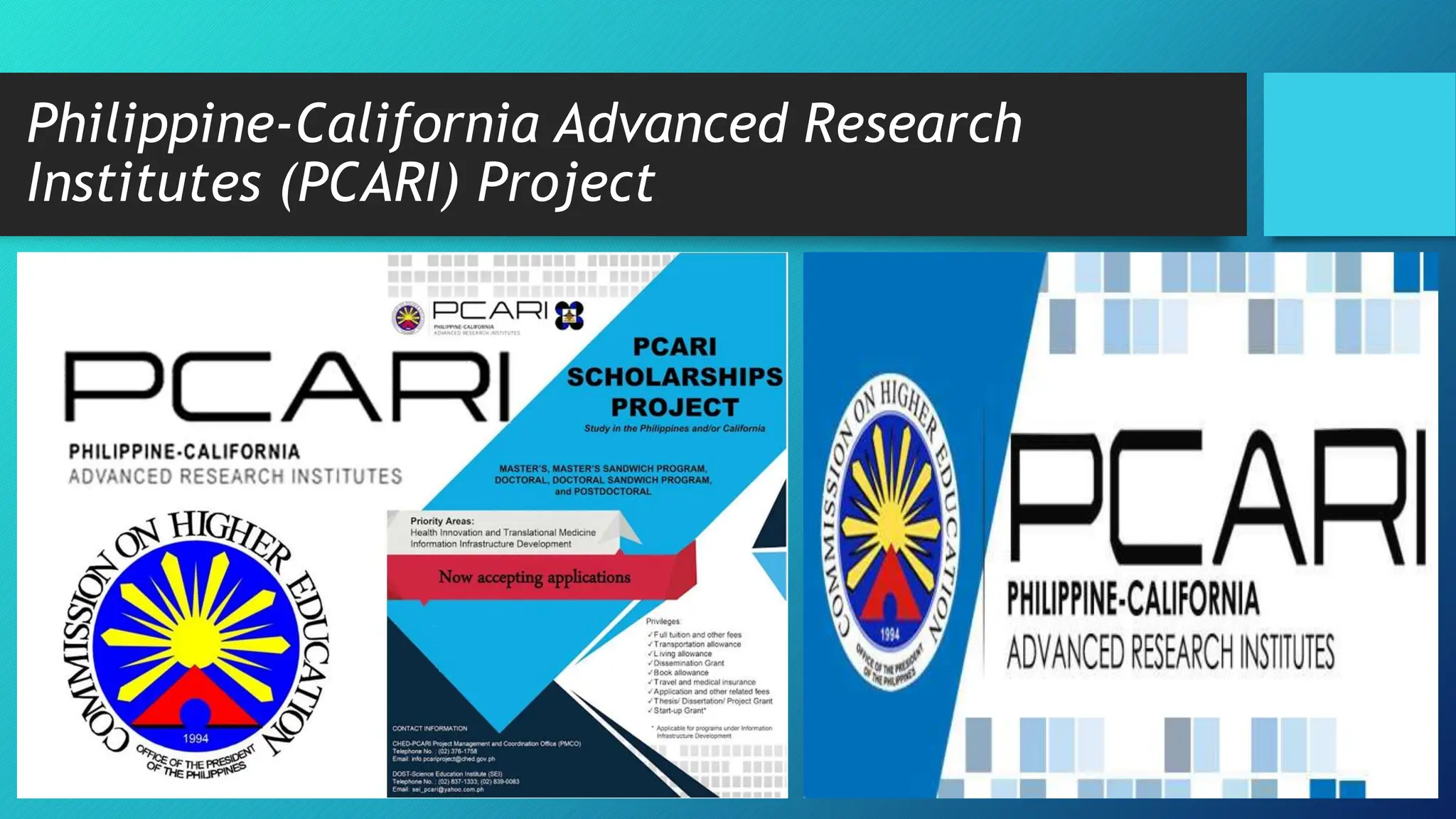
Philippine-California Advanced Research
Institutes (PCARI) Project
Philippine Space Program
THE PHILIPPINE SCIENCE AND TECHNOLOGY
AGENDA AND DEVELOPMENT PROGRAMS
Science and Technology Agenda for National
Development
The Science and Technology Agenda for National Development (STAND) spells out the
areas which will be the focus of scientific and technological efforts in 1993 to 1998.
It is a part of a series of measures that shall be pursued to realize the vision of
Philippines 2000 which is to make the Philippines a newly industrializing country (NIC)
by the end of the century.
The STAND emphasizes the development and utilization of superior technologies to a
level of competitive advantage.
This document indicates the major S&T intervention areas identified from a process of
technical assessment and consultation.
The S&T intervention areas shall serve as basis for developing S&T programs and
projects by implementing agencies and for funding S&T programs and projects of DOST
and other government agencies and institutions.
Role of Science and Technology
Poverty Alleviation
Affordable Energy
Water Supply
Education
Impact of Technology in Society
Technology has improved transportation.
Technology has improved communication.
The World Wide Web.
Technology has improved education and
learning process.
The Harmonized National R&D Agenda (HNRDA)
The HNRDA is organized into 5 sectors:
1. National Integrated Basic Research Agenda
2. Health Research and Development Agenda
3. Agriculture, Aquatic and Natural Resources
4. Industry, Energy and Emerging Technology
5. Disaster Risk Reduction and Climate Change
Adaptation
National Integrated Basic Research Agenda
To express support in the Philippine Development Plan, National Security
Plan, and the Science for Change Program led by DOST, the NIBRA focus on
basic principles of research. It has 6 programs, namely:
• Water Security- TUBIG Program (Tubig ay Buhayin at Ingatan)
• Food and Nutrition Security- SAPAT Program (SaganangPagkain Para
saLahat)
• Health Sufficiency- LIKAS Program (LikasYamansaKalusugan)
• Clean Energy- ALERT Program (Alternative Energy Research Trends)
• Sustainable Community- SAKLAW Program (SaklolosaLawa)
• Inclusive Nation Building- ATIN Program (AngTinigNatin)
Health Research and Development Agenda
• The collaborating agencies for health research and
development agenda are the Philippine Council for Health
Research and Development (PCHRD) under the DOST and the
National Unified Health Research Agenda (NUHRA).
• The research priorities for this agenda include diagnostics,
drug discovery and development, functional foods, hospital
equipment and biomedical devices, information and
communication technology for health, nutrition, food quality
and safety, disaster risk reduction, climate change
adaptation, and molecular technologies for health.
Agriculture, Aquatic and Natural Resources
•The research priorities for agriculture,
aquatic and natural resources include
crops, livestock, aquaculture, forestry,
natural resources and environment,
technology transfer, socio economics, and
policy research.
Industry, Energy and Emerging Technology
• The Philippine Council for Industry, Energy and
Emerging Technology Research and Development
(PCIEERD- DOST) is responsible for the implementation
of research priorities of this agenda.
• The research priorities focus on food and nutrition
security, countryside development, competitive
industry, delivery of social services, intelligent
transport solutions, renewable energy and energy
storage solution, and human security.
Disaster Risk Reduction and Climate Change
Adaptation
• The research priorities for this agenda were evaluated and finalized by
a group of people from the Philippine Institute of Volcanology and
Seismology (PHIVOLCS) and Philippine Atmospheric, Geophysical and
Astronomical Services Administration (PAGASA).
• Its research priorities are directed toward observation and monitoring
networks, technology development and application for monitoring,
modeling and simulation for improvement for monitoring and
forecasting; hazards, vulnerability and risk assessment; warning and
communication of information; technology development and
application for climate change mitigation and adaptation; technology
development and application for disaster risk management and policy.
Agencies responsible for the implementation of
the Harmonized R&D Agenda 2017-2022
• A. Department of Science and Technology (DOST) - the lead agency
responsible for the preparation of Harmonized R&D Agenda.
• B. National Research Council of the Philippines (NRCP) – agency compose of
four thousand researchers, scientists and experts who are tasked to promote
and support basic researches in the country.
• C. Philippine Council for Health Research and Development (PCHRD) – agency
mandated as the national coordinating body for health researches in the
country.
• D. Philippine Council for Industry, Energy and Emerging Technology Research
and Development (PCIEERD) – the agency which aims to strengthen support in
research and development, development of human resource and institution,
diffusion of information and technology, and development of policies.
Agencies responsible for the implementation of
the Harmonized R&D Agenda 2017-2022
• E. Philippine Institute of Volcanology and Seismology (PHIVOLCS) – the agency
which evaluates and harmonizes the agenda for disaster risk reduction and
climate adaptation. It is also responsible for relaying messages to people about
the existence of danger and what can be done to prevent or minimize danger.
• F. Philippine Atmospheric Geophysical and Astronomical Services
Administration (PAGASA) – collaborate whit PHIVOLCS in evaluating and
finalizing the agenda for disaster risk reduction and climate change. This
agency is also responsible for giving typhoon signals and tsunami alert to warn
people of the things to be done for their safety.
• G. Philippine Council for Agriculture, Aquatic and Natural Resources Research
Development (PCAARRD) – agency which conducts a roundtable consultation
with the representative from other agencies doing R&D functions in agriculture,
aquatic and natural resources.
Thank you!
GOD BLESS

Science and Technology in Nation Building.pptx

  • 1.
    SCIENCE AND TECHNOLOGYIN NATION BUILDING
  • 2.
    Learning Objectives: At theend of the unit, you should be able to: 1. discuss the role of Science and technology in Philippine nation- building; 2. evaluate government policies on Science and technology in terms of their contributions to nation-building; 3. identify the government's actual science and technology policies and appraise their impact on the Filipino nation; and 4. cite the importance of science-related programs and projects in the development of the Philippine economy.
  • 3.
    1. What madeJapan become one of the largest economies and one of the most- developed nations after World War II? 2. How did china become and economic powerhouse in the 21st century?
  • 4.
    Why is scienceand technology important in building the nation? The state of science and technology determines part of the socio-economic progress of country. It is a well-known fact that national progress is highly correlated to the capacity of the country to produce local industrial goods for domestic needs and that industrialization is very much dependent on the capacity of a country to use science and technology to progress locally-found raw materials into high-tech products and tools for households and other users.
  • 5.
    Science and Technologyis associated in all means with modernity and it is an essential tool for rapid development.
  • 6.
     Modernization isthe current term for an old process—the process of social change whereby less developed societies acquire characteristics common to more developed societies. The process is activated by international, or inter-societal, communication.
  • 7.
     The majorcategorization is based on economy and the application of science and technology.  Countries which have a strong base in science and technology are the ones that developed faster.
  • 8.
     It isestimated by the World Bank that seven of the ten largest economies of the world by 2020 would be in Asia, China, Japan, India, Thailand, Indonesia, South Korea, and Taiwan.
  • 9.
    Why is scienceand technology important in building the nation? Science and Technology Ensure health care Increase agricultural productivity Conserve and protect the environment Produce quality goods Secure peace, order and stability Increase economic productivity Manage natural disaster Generate jobs for worker Efficiently deliver social services Develop good infrastructure
  • 10.
     A nation’sdevelopment and prosperity is judged to a large extend by the status of science and technology of that nation.  A scientifically unsophisticated society means an underdeveloped nation in all sectors.
  • 11.
    Important role OfS&T in the Philippines 1. In the 1987 Philippine constitution, Science and technology are given priority to "foster patriotism and nationalism, accelerate social progress, and promote total human liberation and development."; 2. In section 10, Article XIV, it is stated that "Science and technology are essential for national development and progress."
  • 12.
    Philippine Government Scienceand Technology Agenda How the Philippine Government manages and develops Science and technology through its policies and program? The government mandates an "increase use of scientific and technological breakthroughs." The government aims to do this by "promoting and accelerating technology adoption" and stimulating innovation." It is based on the Philippine Development Plan 2017- 2022.
  • 13.
    • This agencyestablished to "provide central guidance, leadership, and coordination of research and technical activities and ensure that the findings from such activities are directed and used in areas of full economic and social benefits for the people." • It is composed of three (3) sectoral planning councils, seven (7) research, and development institutes, two (2) collegial bodies, six (6) service institutes, and several regional and provincial offices
  • 14.
    Aims of DOST’sPrograms, Projects and Activities 1. Stimulation and innovation 2. Promotion and acceleration of technology adoption 3. Development of critical mass of globally competitive human resources on Science and Technology 4. Increased productivity and efficiency of micro, small, and medium entrepreneurs (MSMEs) 5. Ensure resiliency to disaster risks and climate change 6. Reduced inequality in science and technology capacities and opportunities 7. Achieve practical science and technology governance
  • 15.
    Major Development Programsand Personalities in Science and Technology in the Philippines
  • 16.
  • 17.
  • 18.
    Small and MediumEnterprise Technology Upgrading Program (SETUP)
  • 19.
  • 20.
    Forest Products Researchand Development Institute
  • 21.
  • 22.
    Project NOAH (NationwideOperational Assessment of Hazards)
  • 23.
  • 24.
  • 25.
    THE PHILIPPINE SCIENCEAND TECHNOLOGY AGENDA AND DEVELOPMENT PROGRAMS
  • 26.
    Science and TechnologyAgenda for National Development The Science and Technology Agenda for National Development (STAND) spells out the areas which will be the focus of scientific and technological efforts in 1993 to 1998. It is a part of a series of measures that shall be pursued to realize the vision of Philippines 2000 which is to make the Philippines a newly industrializing country (NIC) by the end of the century. The STAND emphasizes the development and utilization of superior technologies to a level of competitive advantage. This document indicates the major S&T intervention areas identified from a process of technical assessment and consultation. The S&T intervention areas shall serve as basis for developing S&T programs and projects by implementing agencies and for funding S&T programs and projects of DOST and other government agencies and institutions.
  • 27.
    Role of Scienceand Technology Poverty Alleviation Affordable Energy Water Supply Education
  • 28.
    Impact of Technologyin Society Technology has improved transportation. Technology has improved communication. The World Wide Web. Technology has improved education and learning process.
  • 29.
    The Harmonized NationalR&D Agenda (HNRDA)
  • 30.
    The Harmonized NationalR&D Agenda (HNRDA) The HNRDA is organized into 5 sectors: 1. National Integrated Basic Research Agenda 2. Health Research and Development Agenda 3. Agriculture, Aquatic and Natural Resources 4. Industry, Energy and Emerging Technology 5. Disaster Risk Reduction and Climate Change Adaptation
  • 31.
    National Integrated BasicResearch Agenda To express support in the Philippine Development Plan, National Security Plan, and the Science for Change Program led by DOST, the NIBRA focus on basic principles of research. It has 6 programs, namely: • Water Security- TUBIG Program (Tubig ay Buhayin at Ingatan) • Food and Nutrition Security- SAPAT Program (SaganangPagkain Para saLahat) • Health Sufficiency- LIKAS Program (LikasYamansaKalusugan) • Clean Energy- ALERT Program (Alternative Energy Research Trends) • Sustainable Community- SAKLAW Program (SaklolosaLawa) • Inclusive Nation Building- ATIN Program (AngTinigNatin)
  • 32.
    Health Research andDevelopment Agenda • The collaborating agencies for health research and development agenda are the Philippine Council for Health Research and Development (PCHRD) under the DOST and the National Unified Health Research Agenda (NUHRA). • The research priorities for this agenda include diagnostics, drug discovery and development, functional foods, hospital equipment and biomedical devices, information and communication technology for health, nutrition, food quality and safety, disaster risk reduction, climate change adaptation, and molecular technologies for health.
  • 33.
    Agriculture, Aquatic andNatural Resources •The research priorities for agriculture, aquatic and natural resources include crops, livestock, aquaculture, forestry, natural resources and environment, technology transfer, socio economics, and policy research.
  • 34.
    Industry, Energy andEmerging Technology • The Philippine Council for Industry, Energy and Emerging Technology Research and Development (PCIEERD- DOST) is responsible for the implementation of research priorities of this agenda. • The research priorities focus on food and nutrition security, countryside development, competitive industry, delivery of social services, intelligent transport solutions, renewable energy and energy storage solution, and human security.
  • 35.
    Disaster Risk Reductionand Climate Change Adaptation • The research priorities for this agenda were evaluated and finalized by a group of people from the Philippine Institute of Volcanology and Seismology (PHIVOLCS) and Philippine Atmospheric, Geophysical and Astronomical Services Administration (PAGASA). • Its research priorities are directed toward observation and monitoring networks, technology development and application for monitoring, modeling and simulation for improvement for monitoring and forecasting; hazards, vulnerability and risk assessment; warning and communication of information; technology development and application for climate change mitigation and adaptation; technology development and application for disaster risk management and policy.
  • 36.
    Agencies responsible forthe implementation of the Harmonized R&D Agenda 2017-2022 • A. Department of Science and Technology (DOST) - the lead agency responsible for the preparation of Harmonized R&D Agenda. • B. National Research Council of the Philippines (NRCP) – agency compose of four thousand researchers, scientists and experts who are tasked to promote and support basic researches in the country. • C. Philippine Council for Health Research and Development (PCHRD) – agency mandated as the national coordinating body for health researches in the country. • D. Philippine Council for Industry, Energy and Emerging Technology Research and Development (PCIEERD) – the agency which aims to strengthen support in research and development, development of human resource and institution, diffusion of information and technology, and development of policies.
  • 37.
    Agencies responsible forthe implementation of the Harmonized R&D Agenda 2017-2022 • E. Philippine Institute of Volcanology and Seismology (PHIVOLCS) – the agency which evaluates and harmonizes the agenda for disaster risk reduction and climate adaptation. It is also responsible for relaying messages to people about the existence of danger and what can be done to prevent or minimize danger. • F. Philippine Atmospheric Geophysical and Astronomical Services Administration (PAGASA) – collaborate whit PHIVOLCS in evaluating and finalizing the agenda for disaster risk reduction and climate change. This agency is also responsible for giving typhoon signals and tsunami alert to warn people of the things to be done for their safety. • G. Philippine Council for Agriculture, Aquatic and Natural Resources Research Development (PCAARRD) – agency which conducts a roundtable consultation with the representative from other agencies doing R&D functions in agriculture, aquatic and natural resources.
  • 38.

Editor's Notes

  • #30 In 2017-2022 the Department of Science and Technology prepared this agenda in collaboration with the government and other concerned private agencies and institution to make certain that all the science and technology endeavors are directed toward the realization of economic and social benefits of mankind. The agenda is in line with: AmBisyonNatin 2040: matatag, maginhawa at panatagnabuhay para salahat, which has 3 pillars: Malasakit(enhancing the social public), Pagbabago(reducing in equality) and Kaunlaran (increasing potential growth).