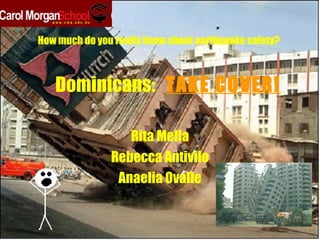
Dominicans:  TAKE COVER! Rita Mella Rebecca Antivilo Anaelia Ovalle How much do you really know about earthquake safety?
A survey was made and taken by several students around the Carol Morgan School campus. Here are some of the alarming results.  Awareness
1. In case of an emergency I have a plan, and the whole family knows what to do and where to go.  A.Yes (54.1%) B. No (45.9%) These results show that in case of an emergency on 50% of people know what to do and where to go. Another 50% have no idea and can be killed by common earthquake hazards like going outside. Results
2. I have a first aid kit, canned food and a can opener, bottled water, battery-operated radio, flashlight, protective clothing and written instructions on how to turn off electricity, gas, and water in case of a disaster.   A.Yes (34.4%) B. No (65.6%)   Only 30% of people have the proper equipment in order to survive a disaster. 65 % of people wont be able to last long enough and withstand a disaster which is very frightening and something should be done about this. The government must try to educate their citizens about having proper equipment and knowledge of earthquakes. Results
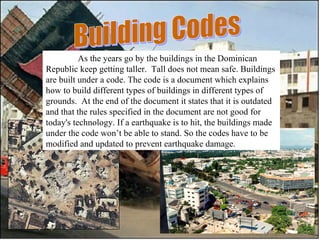
Building Codes As the years go by the buildings in the Dominican Republic keep getting taller.  Tall does not mean safe. Buildings are built under a code. The code is a document which explains how to build different types of buildings in different types of grounds.  At the end of the document it states that it is outdated and that the rules specified in the document are not good for today's technology. If a earthquake is to hit, the buildings made under the code won’t be able to stand. So the codes have to be modified and updated to prevent earthquake damage.
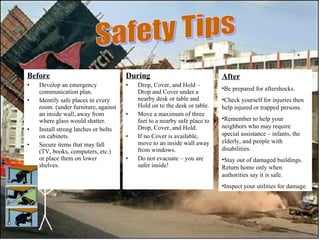
Before Develop an emergency communication plan.  Identify safe places in every room. (under furniture, against an inside wall, away from where glass would shatter.  Install strong latches or bolts on cabinets. Secure items that may fall (TV, books, computers, etc.) or place them on lower shelves. During Drop, Cover, and Hold – Drop and Cover under a nearby desk or table and Hold on to the desk or table.  Move a maximum of three feet to a nearby safe place to Drop, Cover, and Hold. If no Cover is available, move to an inside wall away from windows. Do not evacuate – you are safer inside! After Be prepared for aftershocks. Check yourself for injuries then help injured or trapped persons. Remember to help your neighbors who may require special assistance – infants, the elderly, and people with disabilities. Stay out of damaged buildings. Return home only when authorities say it is safe. Inspect your utilities for damage. Safety Tips
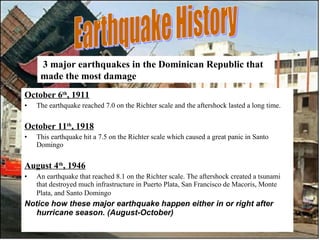
October 6 th , 1911 The earthquake reached 7.0 on the Richter scale and the aftershock lasted a long time.  October 11 th , 1918 This earthquake hit a 7.5 on the Richter scale which caused a great panic in Santo Domingo  August 4 th , 1946 An earthquake that reached 8.1 on the Richter scale. The aftershock created a tsunami that destroyed much infrastructure in Puerto Plata, San Francisco de Macoris, Monte Plata, and Santo Domingo   Notice how these major earthquake happen either in or right after hurricane season. (August-October)   Earthquake History 3 major earthquakes in the Dominican Republic that made the most damage
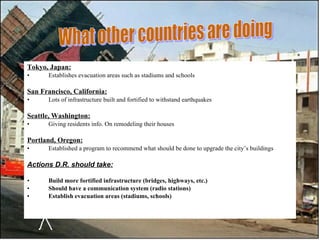
Tokyo, Japan: Establishes evacuation areas such as stadiums and schools San Francisco, California: Lots of infrastructure built and fortified to withstand earthquakes Seattle, Washington: Giving residents info. On remodeling their houses Portland, Oregon: Established a program to recommend what should be done to upgrade the city’s buildings Actions D.R. should take:   Build more fortified infrastructure (bridges, highways, etc.) Should have a communication system (radio stations) Establish evacuation areas (stadiums, schools) What other countries are doing
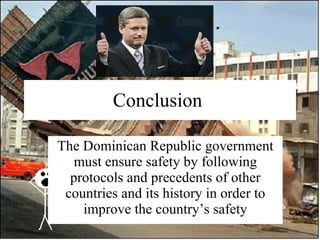
Conclusion  The Dominican Republic government must ensure safety by following protocols and precedents of other countries and its history in order to improve the country’s safety

Science Pbl

  • 1.
    Dominicans: TAKECOVER! Rita Mella Rebecca Antivilo Anaelia Ovalle How much do you really know about earthquake safety?
  • 2.
    A survey wasmade and taken by several students around the Carol Morgan School campus. Here are some of the alarming results.  Awareness
  • 3.
    1. In caseof an emergency I have a plan, and the whole family knows what to do and where to go. A.Yes (54.1%) B. No (45.9%) These results show that in case of an emergency on 50% of people know what to do and where to go. Another 50% have no idea and can be killed by common earthquake hazards like going outside. Results
  • 4.
    2. I havea first aid kit, canned food and a can opener, bottled water, battery-operated radio, flashlight, protective clothing and written instructions on how to turn off electricity, gas, and water in case of a disaster.   A.Yes (34.4%) B. No (65.6%)   Only 30% of people have the proper equipment in order to survive a disaster. 65 % of people wont be able to last long enough and withstand a disaster which is very frightening and something should be done about this. The government must try to educate their citizens about having proper equipment and knowledge of earthquakes. Results
  • 5.
    Building Codes Asthe years go by the buildings in the Dominican Republic keep getting taller. Tall does not mean safe. Buildings are built under a code. The code is a document which explains how to build different types of buildings in different types of grounds. At the end of the document it states that it is outdated and that the rules specified in the document are not good for today's technology. If a earthquake is to hit, the buildings made under the code won’t be able to stand. So the codes have to be modified and updated to prevent earthquake damage.
  • 6.
    Before Develop anemergency communication plan. Identify safe places in every room. (under furniture, against an inside wall, away from where glass would shatter. Install strong latches or bolts on cabinets. Secure items that may fall (TV, books, computers, etc.) or place them on lower shelves. During Drop, Cover, and Hold – Drop and Cover under a nearby desk or table and Hold on to the desk or table. Move a maximum of three feet to a nearby safe place to Drop, Cover, and Hold. If no Cover is available, move to an inside wall away from windows. Do not evacuate – you are safer inside! After Be prepared for aftershocks. Check yourself for injuries then help injured or trapped persons. Remember to help your neighbors who may require special assistance – infants, the elderly, and people with disabilities. Stay out of damaged buildings. Return home only when authorities say it is safe. Inspect your utilities for damage. Safety Tips
  • 7.
    October 6 th, 1911 The earthquake reached 7.0 on the Richter scale and the aftershock lasted a long time. October 11 th , 1918 This earthquake hit a 7.5 on the Richter scale which caused a great panic in Santo Domingo August 4 th , 1946 An earthquake that reached 8.1 on the Richter scale. The aftershock created a tsunami that destroyed much infrastructure in Puerto Plata, San Francisco de Macoris, Monte Plata, and Santo Domingo Notice how these major earthquake happen either in or right after hurricane season. (August-October) Earthquake History 3 major earthquakes in the Dominican Republic that made the most damage
  • 8.
    Tokyo, Japan: Establishesevacuation areas such as stadiums and schools San Francisco, California: Lots of infrastructure built and fortified to withstand earthquakes Seattle, Washington: Giving residents info. On remodeling their houses Portland, Oregon: Established a program to recommend what should be done to upgrade the city’s buildings Actions D.R. should take:   Build more fortified infrastructure (bridges, highways, etc.) Should have a communication system (radio stations) Establish evacuation areas (stadiums, schools) What other countries are doing
  • 9.
    Conclusion TheDominican Republic government must ensure safety by following protocols and precedents of other countries and its history in order to improve the country’s safety