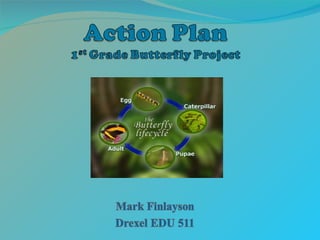
Using technology as the foundation, the first grade students will be able to identify the major parts of a butterfly (head, thorax, abdomen, six legs, and two antennae.  Most butterflies have four wings.). The students will also be able to detail the four major stages in the life cycle of a butterfly (eggs, caterpillar, chrysalis, and butterfly).  Finally, the first grade students will be introduced to the term metamorphosis.  At the end of this unit, the students will be able to define metamorphosis in their own language.
The learners are first grade students with average to below average ability levels.  Two students are full time learning support but are part of this class for Science and Social Studies.  There is one child with ADHD and one child with Asperger’s that are fully mainstreamed.
This is a four week long unit that the first grade students will be involved in. The teacher will introduce the lifecycle of butterflies and the students will get a butterfly kit where they actually watch the eggs turn into the butterfly, chrysalis, and then finally the butterfly. Students will be involved in helping the teacher create a classroom webpage where parents and other. school/community members can view pictures and read the daily observations from the teacher and students. The classroom teacher will utilize a SMART Board and document camera to show and detail changes in the eggs, the major body parts of a butterfly, and to “journal” the daily observations.
The students will conduct basic research with a partner or small groups (with classroom aides, parent volunteers, the Learning Support Teacher, and the classroom teacher) using a variety of websites, and education video clip from Discovery Education, Learn360, Brain Pop, etc…. The students will document their data in MaxWrite in preparation for their final project. The students will input all of their research, pictures, drawings, etc… into their final presentation, a MaxShow document. The students will present their MaxShow presentation to the class using the SMART Board.
The students will be introduced to the following technologies/computer based programs:  SMART Board Document Camera Classroom Website MaxWrite MaxShow Websites www.thebutterflysite.com www.kidsbutterfly.org www.kidzone.ws/animals/monarch_butterfly.htm http://www.billybear4kids.com/butterfly/flutter-fun.html and many more Educational Video Clips Online www.streaming.discoveryeducation.com www.learn360.com www.brainpop.com www.brainpopjr.com www.enchantedlearning.com/subjects/butterfly/activities/lifecycle.shtml
I looked for research that supported the use of technology with primary students.  The research that I found supported teaching young students a variety of technologies and enhancing their “view” of the world.  In my personal experience and based on the research that I found, first grade students are more than capable of handling a variety of technological experiences with teacher guidance.
Students will be assessed based upon the following: Rubric – their culminating project Anecdotal records taken by the teacher through-out the lesson Teacher observations based on partner/group work

Action Plan Edu 511

  • 1.
  • 2.
    Using technology asthe foundation, the first grade students will be able to identify the major parts of a butterfly (head, thorax, abdomen, six legs, and two antennae. Most butterflies have four wings.). The students will also be able to detail the four major stages in the life cycle of a butterfly (eggs, caterpillar, chrysalis, and butterfly). Finally, the first grade students will be introduced to the term metamorphosis. At the end of this unit, the students will be able to define metamorphosis in their own language.
  • 3.
    The learners arefirst grade students with average to below average ability levels. Two students are full time learning support but are part of this class for Science and Social Studies. There is one child with ADHD and one child with Asperger’s that are fully mainstreamed.
  • 4.
    This is afour week long unit that the first grade students will be involved in. The teacher will introduce the lifecycle of butterflies and the students will get a butterfly kit where they actually watch the eggs turn into the butterfly, chrysalis, and then finally the butterfly. Students will be involved in helping the teacher create a classroom webpage where parents and other. school/community members can view pictures and read the daily observations from the teacher and students. The classroom teacher will utilize a SMART Board and document camera to show and detail changes in the eggs, the major body parts of a butterfly, and to “journal” the daily observations.
  • 5.
    The students willconduct basic research with a partner or small groups (with classroom aides, parent volunteers, the Learning Support Teacher, and the classroom teacher) using a variety of websites, and education video clip from Discovery Education, Learn360, Brain Pop, etc…. The students will document their data in MaxWrite in preparation for their final project. The students will input all of their research, pictures, drawings, etc… into their final presentation, a MaxShow document. The students will present their MaxShow presentation to the class using the SMART Board.
  • 6.
    The students willbe introduced to the following technologies/computer based programs: SMART Board Document Camera Classroom Website MaxWrite MaxShow Websites www.thebutterflysite.com www.kidsbutterfly.org www.kidzone.ws/animals/monarch_butterfly.htm http://www.billybear4kids.com/butterfly/flutter-fun.html and many more Educational Video Clips Online www.streaming.discoveryeducation.com www.learn360.com www.brainpop.com www.brainpopjr.com www.enchantedlearning.com/subjects/butterfly/activities/lifecycle.shtml
  • 7.
    I looked forresearch that supported the use of technology with primary students. The research that I found supported teaching young students a variety of technologies and enhancing their “view” of the world. In my personal experience and based on the research that I found, first grade students are more than capable of handling a variety of technological experiences with teacher guidance.
  • 8.
    Students will beassessed based upon the following: Rubric – their culminating project Anecdotal records taken by the teacher through-out the lesson Teacher observations based on partner/group work