Daily Lesson Plan
Grade Level: Grade 6
Learning Area: Science
Quarter: 4th Quarter, Week 1; Day 2
Time Duration: 50 minutes
I. OBJECTIVES
A. CONTENT
STANDARD
Identify the different seasons in the Philippines.
B.
PERFORMANCE
STANDARD
Identifying the different seasons in the Philippines.
C. MOST
ESSENTIAL
LEARNING
COMPETENCY
(MELC)
Identify the different seasons in the Philippines ( S6ES-IVc-
3)
D. UNPACKED
Learning
Objectives
The learners should be able to
1. Identify the different seasons in the Philippines.
2. appreciate the value of teamwork.
II. CONTENT Weather Patterns and Seasons in the Philippines.
III. LEARNING
RESOURCES /
Materials/
Equipment
CG, TG, TV, Laptop, Pictures, Science in our world.
IV. PROCEDURE
A. Reviewing
previous lesson
or presenting the
new lesson
ELICIT (5 minutes).
What was our lesson yesterday?
Our lesson yesterday was all about,
B. Establishing a
purpose for the
lesson
ENGAGE (10 min)
Motivation:
The learners will be group in to two. Each group
representative will pick a word in a box. If the representative
comes from group 1, the chosen word will be guessed by the
“group 2 and if it come from group 2, then group 1 will be
the one to answer and vice versa until the group will guess
the word correctly.
Each group will be given 60 seconds to guess the word.
The teacher will post the words on the board every after the
group game.
C. Presenting
examples
/instances of the
new lesson
The teacher will let his learners to classify the words if it is
appropriately used during wet, dry or both seasons using
Venn diagram.
D. Discussing
new concepts and
practicing new
skills #1
EXPLORE (15 min)
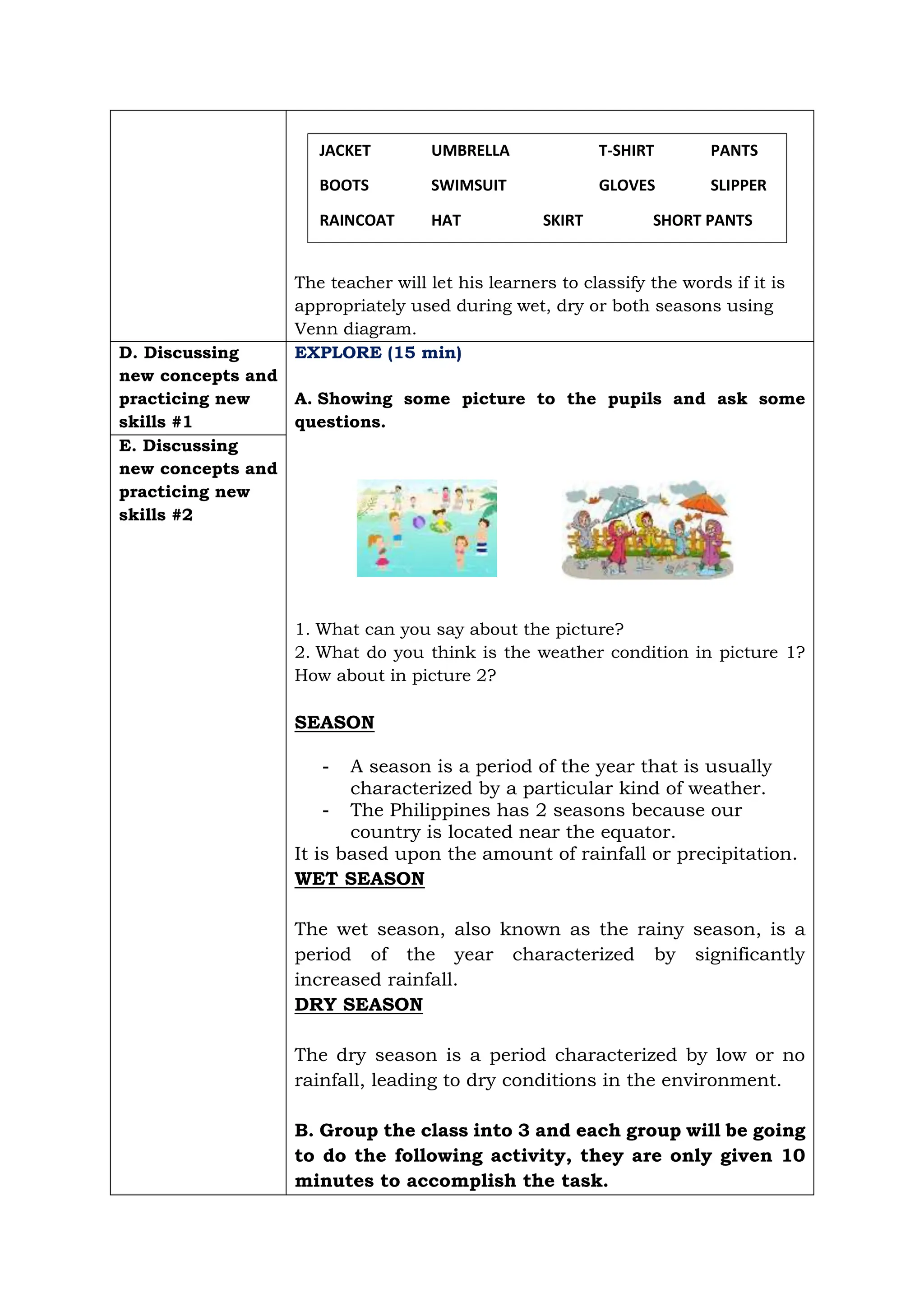
A. Showing some picture to the pupils and ask some
questions.
1. What can you say about the picture?
2. What do you think is the weather condition in picture 1?
How about in picture 2?
SEASON
- A season is a period of the year that is usually
characterized by a particular kind of weather.
- The Philippines has 2 seasons because our
country is located near the equator.
It is based upon the amount of rainfall or precipitation.
WET SEASON
The wet season, also known as the rainy season, is a
period of the year characterized by significantly
increased rainfall.
DRY SEASON
The dry season is a period characterized by low or no
rainfall, leading to dry conditions in the environment.
B. Group the class into 3 and each group will be going
to do the following activity, they are only given 10
minutes to accomplish the task.
E. Discussing
new concepts and
practicing new
skills #2
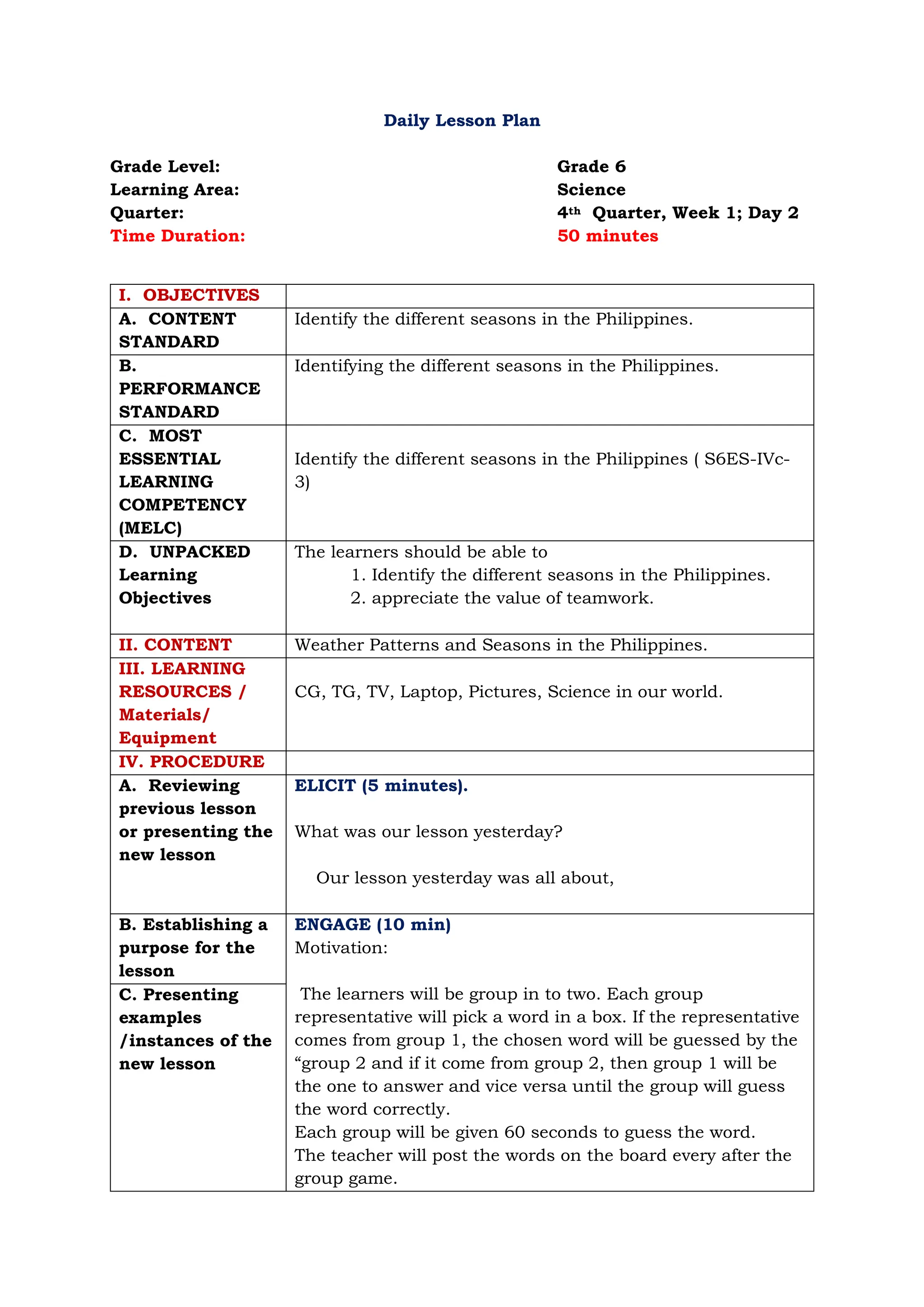
JACKET UMBRELLA T-SHIRT PANTS
BOOTS SWIMSUIT GLOVES SLIPPER
RAINCOAT HAT SKIRT SHORT PANTS
Group 1:
Direction: Fill each box with a phrase that related to given
season. Choose your answers from the box below.
Group 2:
Direction: Fill each box with a phrase that related to given
season. Choose your answers from the box below.
Group 3:
Direction: Base on the given pictures. List down 5 activities
that you can do.
Water shortage
Heavy rains
Flooding
Very hot days
Frequent typhoons
Cold floods
Warm foods
Planting of crops
Drying of crops
Cloudless days
Water shortage
Heavy rains
Flooding
Very hot days
Frequent typhoons
Cold floods
Warm foods
Planting of crops
Drying of crops
Cloudless days
foods
foods
1. 1.
2. 2.
3. 3.
4. 4.
5. 5.
Rubrics in Assessing Group Performance
Description Ratings
1. All members take part in the
group activities.
1 2 3 4 5
2. Members agree and supports
with each other.
1 2 3 4 5
3. Group members keep on the
assigned task.
1 2 3 4 5
4. Group members practice
collaborative skills.
1 2 3 4 5
5. Group members perform well as a
whole.
1 2 3 4 5
1 = Major Difficulty
2 = Requires Improvement
3 = Good
4 = Very Good
5 = Exemplary Presentation of each group.
F. Developing
Mastery EXPLAIN (10 min)
Activity 5: What can you say?
Each group will be given 2 to 3 minutes to present their
outputs.
They will explain their work.
Teacher will supply missing ideas and correct
misconceptions.
Allow someone to explain their output.
G. Finding
practical
applications of
concepts and
skills in daily
living
ELABORATE (10 min)
Direction: Read the following situations and answer.
I. Mang Gerry dries his crops under the sun.
II. The streets are flooded.
H. Making
generalizations
and abstraction
about the lesson
III. Farmlands and other areas are dry with few grasses and
plants.
IV. Farmers are planting crops.
1. Which tells you that it is dry season in the country?
A. 1-2 B. 2-3 C. 3-4 D. 1-3
2. Which tells you that wet or rainy season has come?
A. 1-2 B. 1-3 C. 2-4 D. 3-4
3. What is an advantage of the wet season?
A. 1 B. 2 C. 3 D. 4
Generalization:
How many seasons in the Philippines?
- There are two seasons in the Philippines.
What are the two seasons in the Philippines?
- The two seasons in the Philippines are wet season and dry
season.
I. Evaluating
Learning
EVALUATE (10 minutes)
Direction: Circle the letter of the correct answer.
1. What are the two main seasons in the Philippines?
a) Summer and Winter b) Dry and Wet
b) Fall and Spring d) None of the above
2. Which season is best for planting crops?
a) Dry season b) Wet season c.) None of the above
3. Which season is best for harvesting crops?
a) Dry season b) Wet season c.) None of the above
4. In which season do most typhoons occur in the
Philippines?
A. ) Dry season b) Wet season c.) None of the above
5. What effect does the dry season have on water
supply?
a) Increases water availability
b) b) Reduces water availability
c) c) No effect
d) d) None of the above
J. Additional
activities for
application or
remediation
EXTEND / Agreement:
Directions: A sudden change of season can bring ailments or
harm to the body. On a separate sheet o pad paper, copy the
table below. Put a check on the second column if the activity
prevents ailments or harm to the body and mark X if it does
not.
Answer:
V. REMARKS
VI. REFLECTION
Prepared by: Checked by:
LUCILLE B. ARAQUIN MAY J. RECOSOSA
Teacher - I Master Teacher - I
Approved by:
FELY C. CENAS
Head Teacher - I

Science 6 lesson plan Seasons in the Philippines.doc

  • 1.
    Daily Lesson Plan GradeLevel: Grade 6 Learning Area: Science Quarter: 4th Quarter, Week 1; Day 2 Time Duration: 50 minutes I. OBJECTIVES A. CONTENT STANDARD Identify the different seasons in the Philippines. B. PERFORMANCE STANDARD Identifying the different seasons in the Philippines. C. MOST ESSENTIAL LEARNING COMPETENCY (MELC) Identify the different seasons in the Philippines ( S6ES-IVc- 3) D. UNPACKED Learning Objectives The learners should be able to 1. Identify the different seasons in the Philippines. 2. appreciate the value of teamwork. II. CONTENT Weather Patterns and Seasons in the Philippines. III. LEARNING RESOURCES / Materials/ Equipment CG, TG, TV, Laptop, Pictures, Science in our world. IV. PROCEDURE A. Reviewing previous lesson or presenting the new lesson ELICIT (5 minutes). What was our lesson yesterday? Our lesson yesterday was all about, B. Establishing a purpose for the lesson ENGAGE (10 min) Motivation: The learners will be group in to two. Each group representative will pick a word in a box. If the representative comes from group 1, the chosen word will be guessed by the “group 2 and if it come from group 2, then group 1 will be the one to answer and vice versa until the group will guess the word correctly. Each group will be given 60 seconds to guess the word. The teacher will post the words on the board every after the group game. C. Presenting examples /instances of the new lesson
  • 2.
    The teacher willlet his learners to classify the words if it is appropriately used during wet, dry or both seasons using Venn diagram. D. Discussing new concepts and practicing new skills #1 EXPLORE (15 min) A. Showing some picture to the pupils and ask some questions. 1. What can you say about the picture? 2. What do you think is the weather condition in picture 1? How about in picture 2? SEASON - A season is a period of the year that is usually characterized by a particular kind of weather. - The Philippines has 2 seasons because our country is located near the equator. It is based upon the amount of rainfall or precipitation. WET SEASON The wet season, also known as the rainy season, is a period of the year characterized by significantly increased rainfall. DRY SEASON The dry season is a period characterized by low or no rainfall, leading to dry conditions in the environment. B. Group the class into 3 and each group will be going to do the following activity, they are only given 10 minutes to accomplish the task. E. Discussing new concepts and practicing new skills #2 JACKET UMBRELLA T-SHIRT PANTS BOOTS SWIMSUIT GLOVES SLIPPER RAINCOAT HAT SKIRT SHORT PANTS
  • 3.
    Group 1: Direction: Filleach box with a phrase that related to given season. Choose your answers from the box below. Group 2: Direction: Fill each box with a phrase that related to given season. Choose your answers from the box below. Group 3: Direction: Base on the given pictures. List down 5 activities that you can do. Water shortage Heavy rains Flooding Very hot days Frequent typhoons Cold floods Warm foods Planting of crops Drying of crops Cloudless days Water shortage Heavy rains Flooding Very hot days Frequent typhoons Cold floods Warm foods Planting of crops Drying of crops Cloudless days foods foods
  • 4.
    1. 1. 2. 2. 3.3. 4. 4. 5. 5. Rubrics in Assessing Group Performance Description Ratings 1. All members take part in the group activities. 1 2 3 4 5 2. Members agree and supports with each other. 1 2 3 4 5 3. Group members keep on the assigned task. 1 2 3 4 5 4. Group members practice collaborative skills. 1 2 3 4 5 5. Group members perform well as a whole. 1 2 3 4 5 1 = Major Difficulty 2 = Requires Improvement 3 = Good 4 = Very Good 5 = Exemplary Presentation of each group. F. Developing Mastery EXPLAIN (10 min) Activity 5: What can you say? Each group will be given 2 to 3 minutes to present their outputs. They will explain their work. Teacher will supply missing ideas and correct misconceptions. Allow someone to explain their output. G. Finding practical applications of concepts and skills in daily living ELABORATE (10 min) Direction: Read the following situations and answer. I. Mang Gerry dries his crops under the sun. II. The streets are flooded.
  • 5.
    H. Making generalizations and abstraction aboutthe lesson III. Farmlands and other areas are dry with few grasses and plants. IV. Farmers are planting crops. 1. Which tells you that it is dry season in the country? A. 1-2 B. 2-3 C. 3-4 D. 1-3 2. Which tells you that wet or rainy season has come? A. 1-2 B. 1-3 C. 2-4 D. 3-4 3. What is an advantage of the wet season? A. 1 B. 2 C. 3 D. 4 Generalization: How many seasons in the Philippines? - There are two seasons in the Philippines. What are the two seasons in the Philippines? - The two seasons in the Philippines are wet season and dry season. I. Evaluating Learning EVALUATE (10 minutes) Direction: Circle the letter of the correct answer. 1. What are the two main seasons in the Philippines? a) Summer and Winter b) Dry and Wet b) Fall and Spring d) None of the above 2. Which season is best for planting crops? a) Dry season b) Wet season c.) None of the above 3. Which season is best for harvesting crops? a) Dry season b) Wet season c.) None of the above 4. In which season do most typhoons occur in the Philippines? A. ) Dry season b) Wet season c.) None of the above
  • 6.
    5. What effectdoes the dry season have on water supply? a) Increases water availability b) b) Reduces water availability c) c) No effect d) d) None of the above J. Additional activities for application or remediation EXTEND / Agreement: Directions: A sudden change of season can bring ailments or harm to the body. On a separate sheet o pad paper, copy the table below. Put a check on the second column if the activity prevents ailments or harm to the body and mark X if it does not. Answer: V. REMARKS VI. REFLECTION Prepared by: Checked by: LUCILLE B. ARAQUIN MAY J. RECOSOSA Teacher - I Master Teacher - I Approved by: FELY C. CENAS Head Teacher - I