SCIENCE
6
QUARTE
R 4
Seasons in the
Philippines
Reviewing previous Lesson
Directions: Encircle the letter of the correct
answer below.
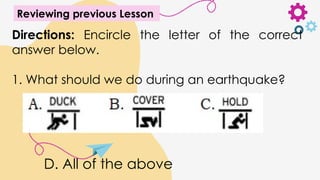
1. What should we do during an earthquake?
D. All of the above
2. What is the best thing to do if there is an
earthquake?
A. Sit and sing a happy song to avoid panic
B. Be calm and do the duck, cover and hold
C. Run for your life
D. shout and ask for help
3. How can we avoid injuries if there are
natural calamities?
A. Stay calm and follow the precautionary
measures practice during calamity drills.
B. Call the emergency hotline immediately.
C. Run outside any facilities you are in.
D. Immediately call your parents and friends.
4. What is an earthquake?
A. It is an event where there is frequent rainfall.
B. An opening of the earth’s crust where lava
and other materials are ejected.
C.A sudden movement or vibration of the crust.
D. The total amount of energy released by the
earth.
5. What is a volcanic eruption?
A. It is an event where there is frequent rainfall.
B. Harmful to living things. They can change the
physical feature of an area.
C. A sudden movement or vibration of the
crust.
D. The total amount of energy released by the
earth.
Look outside the window.
What can you say about the
weather today?
Has it change much from
yesterday?
Today, we will learn about
the season we have in the
Philippines.
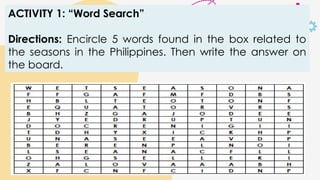
ACTIVITY 1: “Word Search”
Directions: Encircle 5 words found in the box related to
the seasons in the Philippines. Then write the answer on
the board.
Let us read the words found in the
box.
1. wet season
2. dry season
3. tropical
4. Philippines
5. equator
The Philippines’ warm and humid
climate is considered to be one the
healthiest tropical climate in the world.
Its season is influenced by its location
on the equator and the winds that pass
over it. It is located a little north of the
equator. (If globe is available, show the
pupils where the equator and the
Philippines is located)
Because of that, the Philippines receive
vertical rays of sunlight. Much water
evaporates and falls as rain because of
the sun’s heat.
For that reason, we can experience dry
season and rainy or wet season partly in
a year since the earth revolves around
the sun. Different parts of the country
experience a short dry season while
other parts do not have a rainy season.
There are two different seasons experienced
here in our country – wet and dry.
Wet Season is identified by the rainy season
with thunderstorms. Generally, its temperature
during daytime ranges from 30 to 36 degrees
Celsius, and nighttime temperature ranges from
21 to 28 degrees Celsius. The wet season starts
in June, peaks in July to September, and falls
slowly throughout the year-end.
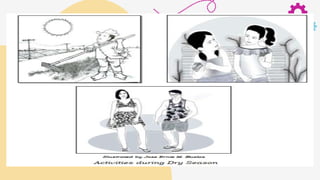
The Dry Season is described by hot and cloudless
days. It happens between January and May and is
generally dry with occasional rain showers.
From January to February, the air is cold and dry. Its
peak is in April with lesser rain showers. The
temperature ranges from 25-32 degrees Celsius
during daytime and 22 degrees Celsius during night
time. In some places during the summer months,
from March to June, the temperature reaches up to
32 degrees Celsius.
Directions: Answer the following questions
in your own words.
1. How many seasons in the Philippines?
2. How will you identify that it is a wet
season?
3. Name some activities you can do
during the dry season?
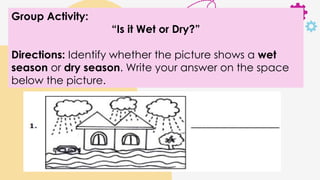
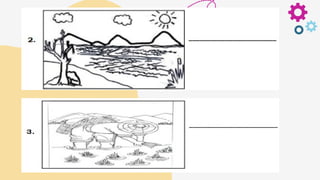
Group Activity:
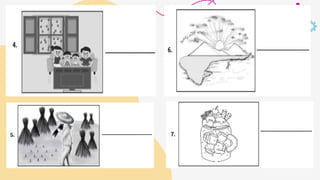
“Is it Wet or Dry?”
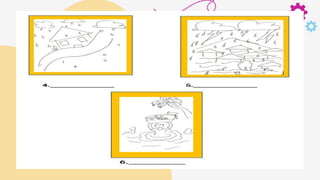
Directions: Identify whether the picture shows a wet
season or dry season. Write your answer on the space
below the picture.
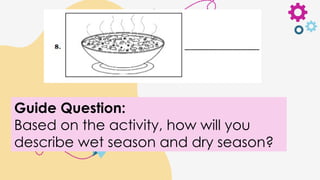
Guide Question:
Based on the activity, how will you
describe wet season and dry season?
What are the two seasons in the
Philippines?
How can you identify wet and dry
season?
What are the activities you can do
during wet and dry season?
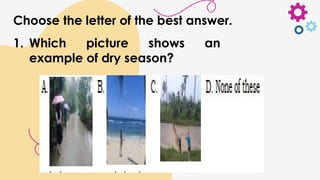
Choose the letter of the best answer.
1. Which picture shows an
example of dry season?
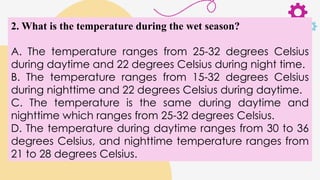
2. What is the temperature during the wet season?
A. The temperature ranges from 25-32 degrees Celsius
during daytime and 22 degrees Celsius during night time.
B. The temperature ranges from 15-32 degrees Celsius
during nighttime and 22 degrees Celsius during daytime.
C. The temperature is the same during daytime and
nighttime which ranges from 25-32 degrees Celsius.
D. The temperature during daytime ranges from 30 to 36
degrees Celsius, and nighttime temperature ranges from
21 to 28 degrees Celsius.
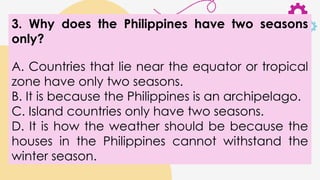
3. Why does the Philippines have two seasons
only?
A. Countries that lie near the equator or tropical
zone have only two seasons.
B. It is because the Philippines is an archipelago.
C. Island countries only have two seasons.
D. It is how the weather should be because the
houses in the Philippines cannot withstand the
winter season.
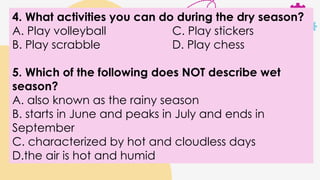
4. What activities you can do during the dry season?
A. Play volleyball C. Play stickers
B. Play scrabble D. Play chess
5. Which of the following does NOT describe wet
season?
A. also known as the rainy season
B. starts in June and peaks in July and ends in
September
C. characterized by hot and cloudless days
D.the air is hot and humid
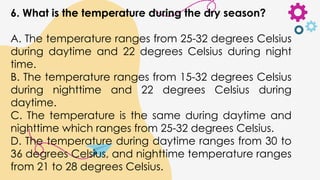
6. What is the temperature during the dry season?
A. The temperature ranges from 25-32 degrees Celsius
during daytime and 22 degrees Celsius during night
time.
B. The temperature ranges from 15-32 degrees Celsius
during nighttime and 22 degrees Celsius during
daytime.
C. The temperature is the same during daytime and
nighttime which ranges from 25-32 degrees Celsius.
D. The temperature during daytime ranges from 30 to
36 degrees Celsius, and nighttime temperature ranges
from 21 to 28 degrees Celsius.
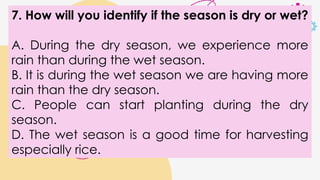
7. How will you identify if the season is dry or wet?
A. During the dry season, we experience more
rain than during the wet season.
B. It is during the wet season we are having more
rain than the dry season.
C. People can start planting during the dry
season.
D. The wet season is a good time for harvesting
especially rice.
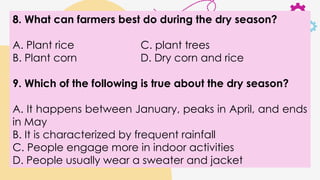
8. What can farmers best do during the dry season?
A. Plant rice C. plant trees
B. Plant corn D. Dry corn and rice
9. Which of the following is true about the dry season?
A. It happens between January, peaks in April, and ends
in May
B. It is characterized by frequent rainfall
C. People engage more in indoor activities
D. People usually wear a sweater and jacket
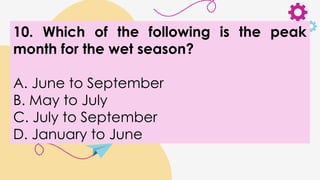
10. Which of the following is the peak
month for the wet season?
A. June to September
B. May to July
C. July to September
D. January to June
THANK YOU
FOR
LISTENING!
SCIENCE
6
QUARTE
R 4
Seasons in the
Philippines
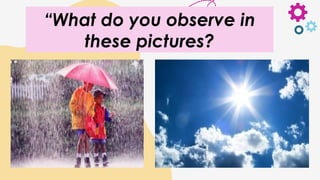
“What do you observe in
these pictures?
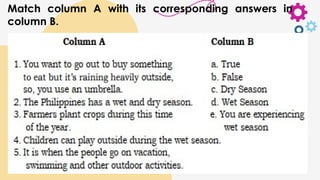
Match column A with its corresponding answers in
column B.
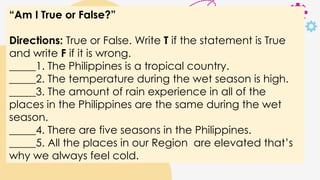
“Am I True or False?”
Directions: True or False. Write T if the statement is True
and write F if it is wrong.
_____1. The Philippines is a tropical country.
_____2. The temperature during the wet season is high.
_____3. The amount of rain experience in all of the
places in the Philippines are the same during the wet
season.
_____4. There are five seasons in the Philippines.
_____5. All the places in our Region are elevated that’s
why we always feel cold.
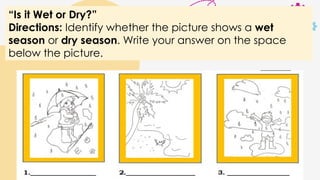
“Is it Wet or Dry?”
Directions: Identify whether the picture shows a wet
season or dry season. Write your answer on the space
below the picture.
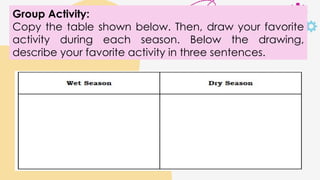
Group Activity:
Copy the table shown below. Then, draw your favorite
activity during each season. Below the drawing,
describe your favorite activity in three sentences.
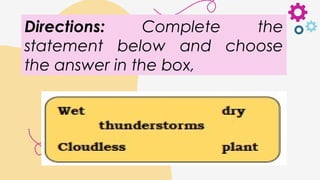
Directions: Complete the
statement below and choose
the answer in the box,
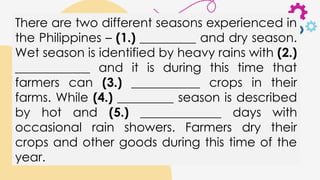
There are two different seasons experienced in
the Philippines – (1.) _________ and dry season.
Wet season is identified by heavy rains with (2.)
____________ and it is during this time that
farmers can (3.) ___________ crops in their
farms. While (4.) _________ season is described
by hot and (5.) _____________ days with
occasional rain showers. Farmers dry their
crops and other goods during this time of the
year.
Directions: Encircle the letter of the best answer.
1. When does dry season occur?
A. June-August C. January-May
B. April-September D. May
2. Which of the following sentences describe wet
season?
A. People love to go swimming during summer.
B. Junie’s family stayed at home due to heavy rain.
C. Aira wants to wear sleeveless and shorts because she
feels hot.
D. Lolo Doming dries his crops on the street.
3. What are the different seasons in the Philippines?
A. Spring and Autumn C. Wet and Dry
B. Winter and Summer D. None of the Above
4. Which sentence is NOT true about the Philippines?
A. The Philippines has four different seasons.
B. It is the warm and humid climate is considered to be
one of the healthiest tropical climates in the world.
C. Has two different seasons – wet and dry.
D. Philippines’ season is influenced by its location on the
equator.
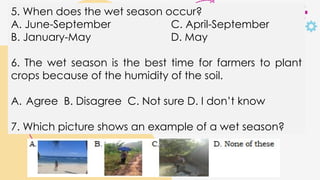
5. When does the wet season occur?
A. June-September C. April-September
B. January-May D. May
6. The wet season is the best time for farmers to plant
crops because of the humidity of the soil.
A. Agree B. Disagree C. Not sure D. I don’t know
7. Which picture shows an example of a wet season?
8. How will you know if the season is dry?
A. The season is dry if the sky is cloudy.
B. The season is dry if the air is hot and humid.
C. The season is dry if the air is cold and dry.
D. None of the above.
9. Which of the following activities you can do during
the wet season?
A. dry crops C. plant crops
B. play basketball D. jogging
10. Children can fly kite outside during the wet season.
A. True B. False C. Not sure D. I don’t know
THANK YOU
FOR
LISTENING!
SCIENCE
6
WEEK 3 DAY 3
Seasons in the
Philippines
Recall yesterday’s discussion.
Discuss what are the two seasons in the
Philippines?
What are the activities you can do during wet
and dry season?
Arrange the jumbled letters to reveal
the correct word.
ERHTAEW
ATEMILC
“What is the meaning of weather? Climate?”
There is often confusion between weather and
climate.
Weather is the condition of the atmosphere at a
particular place over a short period of time,
whereas climate refers to the weather pattern, using
statistical data, of a place over a long enough
period to yield meaningful averages.
The weather may be warm one day and cold
the next day. It may be bright and sunny when
you wake up in the morning and dark and
drizzly in the afternoon.
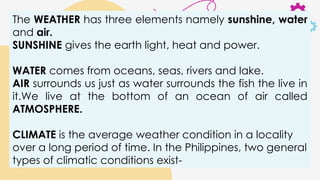
The WEATHER has three elements namely sunshine,
water and air.
SUNSHINE gives the earth light, heat and power.
WATER comes from oceans, seas, rivers and lake.
AIR surrounds us just as water surrounds the fish the live
in it. We live at the bottom of an ocean of air called
ATMOSPHERE.
What causes the changes in weather?
CLIMATE is the average weather condition in a
locality over a long period of time. In the
Philippines, two general types of climatic
conditions exist- DRY and WET SEASON.
During the dry season or summer, it is generally
bright and sunny. Sometimes though, our
atmosphere change from sunny to dark in a
short time rain can fall in the afternoon.
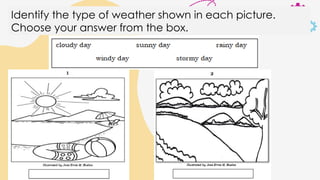
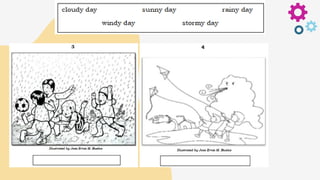
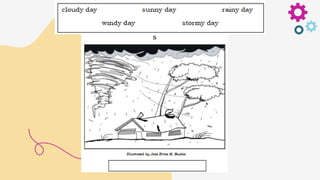
Identify the type of weather shown in each picture.
Choose your answer from the box.
The Philippines has wet and dry season.
Each season has unique characteristics
and effects on the environment and
people.
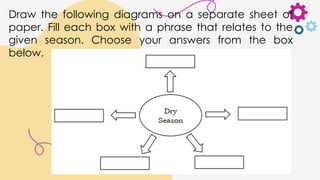
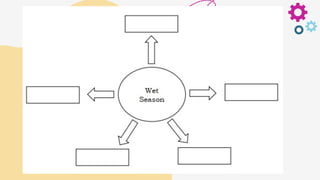
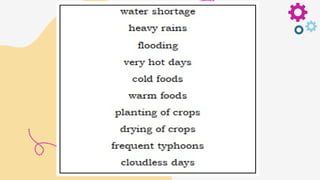
Draw the following diagrams on a separate sheet of
paper. Fill each box with a phrase that relates to the
given season. Choose your answers from the box
below.
The WEATHER has three elements namely sunshine, water
and air.
SUNSHINE gives the earth light, heat and power.
WATER comes from oceans, seas, rivers and lake.
AIR surrounds us just as water surrounds the fish the live in
it.We live at the bottom of an ocean of air called
ATMOSPHERE.
CLIMATE is the average weather condition in a locality
over a long period of time. In the Philippines, two general
types of climatic conditions exist-
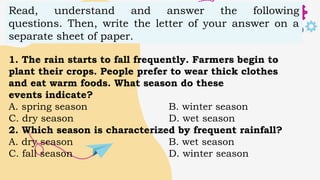
Read, understand and answer the following
questions. Then, write the letter of your answer on a
separate sheet of paper.
1. The rain starts to fall frequently. Farmers begin to
plant their crops. People prefer to wear thick clothes
and eat warm foods. What season do these
events indicate?
A. spring season B. winter season
C. dry season D. wet season
2. Which season is characterized by frequent rainfall?
A. dry season B. wet season
C. fall season D. winter season
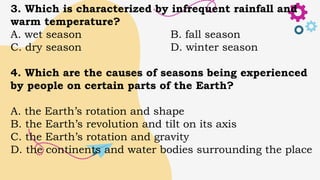
3. Which is characterized by infrequent rainfall and
warm temperature?
A. wet season B. fall season
C. dry season D. winter season
4. Which are the causes of seasons being experienced
by people on certain parts of the Earth?
A. the Earth’s rotation and shape
B. the Earth’s revolution and tilt on its axis
C. the Earth’s rotation and gravity
D. the continents and water bodies surrounding the place
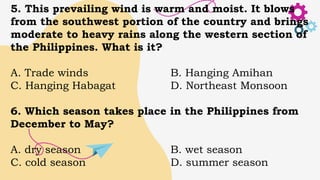
5. This prevailing wind is warm and moist. It blows
from the southwest portion of the country and brings
moderate to heavy rains along the western section of
the Philippines. What is it?
A. Trade winds B. Hanging Amihan
C. Hanging Habagat D. Northeast Monsoon
6. Which season takes place in the Philippines from
December to May?
A. dry season B. wet season
C. cold season D. summer season
7. Which is also known as Hanging Amihan?
A. Eastwest Monsoon
B. Northeast Monsoon
C. Southwest Monsoon
D. Northsouth Monsoon
8. Which season in the Philippines is the best
time for farmers to dry their crops?
A. dry season
B. wet season
C. spring season
D. autumn season
9. Which is influenced by the Northeast
Monsoon?
A. wet season B. dry season
C. winter season D. summer season
10. Which can be experienced during wet
season?
A. warm temperature
B. hot cloudless days
C. shortage of water supply
D. heavy rainfall and frequent typhoons
THANK YOU
FOR
LISTENING!
SCIENCE
6
WEEK 3 DAY 4
Seasons in the
Philippines
What is the difference
between weather and
climate?
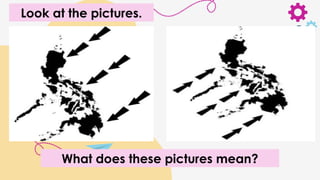
Look at the pictures.
What does these pictures mean?
The Northeast Monsoon and
Southwest Monsoon also contribute
to the seasons in the Philippines.
These prevailing winds blow
consistently in specific direction and
period over particular areas in the
country.
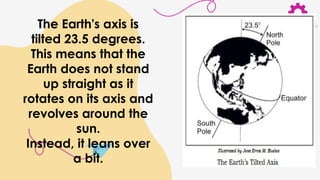
The Earth's axis is
tilted 23.5 degrees.
This means that the
Earth does not stand
up straight as it
rotates on its axis and
revolves around the
sun.
Instead, it leans over
a bit.
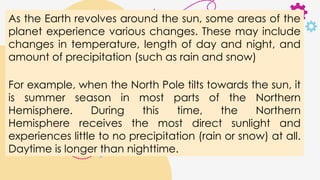
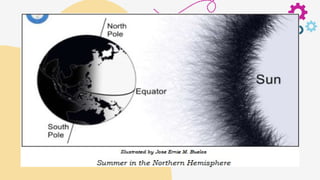
As the Earth revolves around the sun, some areas of the
planet experience various changes. These may include
changes in temperature, length of day and night, and
amount of precipitation (such as rain and snow)
For example, when the North Pole tilts towards the sun, it
is summer season in most parts of the Northern
Hemisphere. During this time, the Northern
Hemisphere receives the most direct sunlight and
experiences little to no precipitation (rain or snow) at all.
Daytime is longer than nighttime.
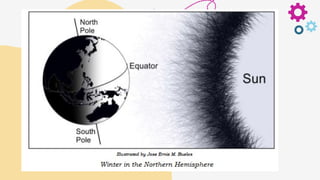
On the other hand, when the North Pole tilts
away from the sun, it is winter season in most
parts of the Northern Hemisphere. During this
time, the Northern Hemisphere receives less
direct sunlight and experiences frequent
precipitation (rain or snow). Nighttime is
longer than daytime. The seasons in the
Northern Hemisphere are the opposite of
those in the Southern Hemisphere.
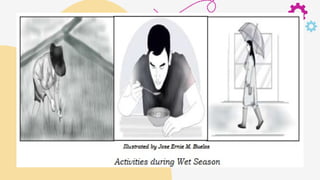
The wet season affects the activities of people.
Farmers plant their crops during this season because
the abundance of rainwater makes their crops
grow quickly.
People prefer to serve and eat warm foods as well as
wear thick and long-sleeved clothes. During the wet
season, people do most of their
activities indoors. When going outdoors, they usually
bring umbrellas and raincoats
The change of seasons in the country is studied and
monitored by the Philippine Atmospheric, Geophysical
and Astronomical Services Administration or PAGASA.
This government agency likewise monitors and informs
the public about weather disturbances.
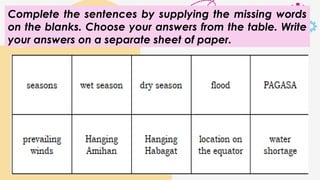
Complete the sentences by supplying the missing words
on the blanks. Choose your answers from the table. Write
your answers on a separate sheet of paper.
1. The season in the Philippines that takes place
during the months of December to May and is
characterized by less rainfall is called _____.
2. The seasons in the Philippines are caused by its
________ and _______.
3. The prevailing wind that blows from the northeast
portion of the country and causes slight to moderate
rainfall in the eastern regions is called _________.
4. Less and infrequent rainfall during dry season leads
to ________ that harms the animals and plants.
5. The prevailing wind that blows from the southwest
portion of the country and causes heavy rainfall in
the western regions is called _________.
6. The season in the Philippines that takes place
during the months June to November and is
characterized by frequent rainfall is called _________.
7. Frequent and heavy rainfall during wet season
sometimes results to _________.
The change of seasons in the country is
studied and monitored by the Philippine
Atmospheric, Geophysical and
Astronomical Services Administration or
PAGASA. This government agency likewise
monitors and informs the public about
weather disturbances.
What have you learned today?
Read, understand and answer the following questions.
Then, write the letter of your answer on a separate sheet
of paper.
1. Which season takes place in the Philippines during the
months of June to November?
A. dry season B. wet season
C. cold season D. summer season
2. Which is also known as Hanging Amihan?
A. Eastwest Monsoon B. Northeast Monsoon
C. Southwest Monsoon D. Northsouth Monsoon
3. Which season is characterized by heavy rain and
typhoons?
A. dry season B. wet season
C. autumn season D. summer season
4. Which is influenced by the Northeast Monsoon or
Hanging Amihan?
A. dry season B. wet season
C. winter season D. summer season
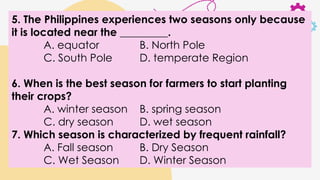
5. The Philippines experiences two seasons only because it
is located near the _________.
A. equator B. North Pole
C. South Pole D. temperate Region
5. The Philippines experiences two seasons only because
it is located near the _________.
A. equator B. North Pole
C. South Pole D. temperate Region
6. When is the best season for farmers to start planting
their crops?
A. winter season B. spring season
C. dry season D. wet season
7. Which season is characterized by frequent rainfall?
A. Fall season B. Dry Season
C. Wet Season D. Winter Season
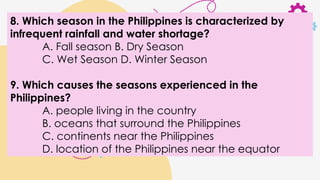
8. Which season in the Philippines is characterized by
infrequent rainfall and water shortage?
A. Fall season B. Dry Season
C. Wet Season D. Winter Season
9. Which causes the seasons experienced in the
Philippines?
A. people living in the country
B. oceans that surround the Philippines
C. continents near the Philippines
D. location of the Philippines near the equator
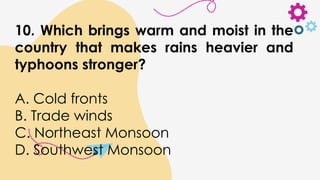
10. Which brings warm and moist in the
country that makes rains heavier and
typhoons stronger?
A. Cold fronts
B. Trade winds
C. Northeast Monsoon
D. Southwest Monsoon

THANK YOU
FOR
LISTENING!

Grade 6 Science Powerpoint Presentation Week 3.pptx.pptx

  • 1.
  • 2.
  • 3.
  • 4.
    Reviewing previous Lesson Directions:Encircle the letter of the correct answer below. 1. What should we do during an earthquake? D. All of the above
  • 5.
    2. What isthe best thing to do if there is an earthquake? A. Sit and sing a happy song to avoid panic B. Be calm and do the duck, cover and hold C. Run for your life D. shout and ask for help
  • 6.
    3. How canwe avoid injuries if there are natural calamities? A. Stay calm and follow the precautionary measures practice during calamity drills. B. Call the emergency hotline immediately. C. Run outside any facilities you are in. D. Immediately call your parents and friends.
  • 7.
    4. What isan earthquake? A. It is an event where there is frequent rainfall. B. An opening of the earth’s crust where lava and other materials are ejected. C.A sudden movement or vibration of the crust. D. The total amount of energy released by the earth.
  • 8.
    5. What isa volcanic eruption? A. It is an event where there is frequent rainfall. B. Harmful to living things. They can change the physical feature of an area. C. A sudden movement or vibration of the crust. D. The total amount of energy released by the earth.
  • 9.
    Look outside thewindow. What can you say about the weather today? Has it change much from yesterday?
  • 10.
    Today, we willlearn about the season we have in the Philippines.
  • 11.
    ACTIVITY 1: “WordSearch” Directions: Encircle 5 words found in the box related to the seasons in the Philippines. Then write the answer on the board.
  • 12.
    Let us readthe words found in the box. 1. wet season 2. dry season 3. tropical 4. Philippines 5. equator
  • 13.
    The Philippines’ warmand humid climate is considered to be one the healthiest tropical climate in the world. Its season is influenced by its location on the equator and the winds that pass over it. It is located a little north of the equator. (If globe is available, show the pupils where the equator and the Philippines is located)
  • 14.
    Because of that,the Philippines receive vertical rays of sunlight. Much water evaporates and falls as rain because of the sun’s heat. For that reason, we can experience dry season and rainy or wet season partly in a year since the earth revolves around the sun. Different parts of the country experience a short dry season while other parts do not have a rainy season.
  • 15.
    There are twodifferent seasons experienced here in our country – wet and dry. Wet Season is identified by the rainy season with thunderstorms. Generally, its temperature during daytime ranges from 30 to 36 degrees Celsius, and nighttime temperature ranges from 21 to 28 degrees Celsius. The wet season starts in June, peaks in July to September, and falls slowly throughout the year-end.
  • 16.
    The Dry Seasonis described by hot and cloudless days. It happens between January and May and is generally dry with occasional rain showers. From January to February, the air is cold and dry. Its peak is in April with lesser rain showers. The temperature ranges from 25-32 degrees Celsius during daytime and 22 degrees Celsius during night time. In some places during the summer months, from March to June, the temperature reaches up to 32 degrees Celsius.
  • 17.
    Directions: Answer thefollowing questions in your own words. 1. How many seasons in the Philippines? 2. How will you identify that it is a wet season? 3. Name some activities you can do during the dry season?
  • 18.
    Group Activity: “Is itWet or Dry?” Directions: Identify whether the picture shows a wet season or dry season. Write your answer on the space below the picture.
  • 21.
    Guide Question: Based onthe activity, how will you describe wet season and dry season?
  • 22.
    What are thetwo seasons in the Philippines? How can you identify wet and dry season? What are the activities you can do during wet and dry season?
  • 23.
    Choose the letterof the best answer. 1. Which picture shows an example of dry season?
  • 24.
    2. What isthe temperature during the wet season? A. The temperature ranges from 25-32 degrees Celsius during daytime and 22 degrees Celsius during night time. B. The temperature ranges from 15-32 degrees Celsius during nighttime and 22 degrees Celsius during daytime. C. The temperature is the same during daytime and nighttime which ranges from 25-32 degrees Celsius. D. The temperature during daytime ranges from 30 to 36 degrees Celsius, and nighttime temperature ranges from 21 to 28 degrees Celsius.
  • 25.
    3. Why doesthe Philippines have two seasons only? A. Countries that lie near the equator or tropical zone have only two seasons. B. It is because the Philippines is an archipelago. C. Island countries only have two seasons. D. It is how the weather should be because the houses in the Philippines cannot withstand the winter season.
  • 26.
    4. What activitiesyou can do during the dry season? A. Play volleyball C. Play stickers B. Play scrabble D. Play chess 5. Which of the following does NOT describe wet season? A. also known as the rainy season B. starts in June and peaks in July and ends in September C. characterized by hot and cloudless days D.the air is hot and humid
  • 27.
    6. What isthe temperature during the dry season? A. The temperature ranges from 25-32 degrees Celsius during daytime and 22 degrees Celsius during night time. B. The temperature ranges from 15-32 degrees Celsius during nighttime and 22 degrees Celsius during daytime. C. The temperature is the same during daytime and nighttime which ranges from 25-32 degrees Celsius. D. The temperature during daytime ranges from 30 to 36 degrees Celsius, and nighttime temperature ranges from 21 to 28 degrees Celsius.
  • 28.
    7. How willyou identify if the season is dry or wet? A. During the dry season, we experience more rain than during the wet season. B. It is during the wet season we are having more rain than the dry season. C. People can start planting during the dry season. D. The wet season is a good time for harvesting especially rice.
  • 29.
    8. What canfarmers best do during the dry season? A. Plant rice C. plant trees B. Plant corn D. Dry corn and rice 9. Which of the following is true about the dry season? A. It happens between January, peaks in April, and ends in May B. It is characterized by frequent rainfall C. People engage more in indoor activities D. People usually wear a sweater and jacket
  • 30.
    10. Which ofthe following is the peak month for the wet season? A. June to September B. May to July C. July to September D. January to June
  • 31.
  • 32.
  • 33.
  • 34.
  • 35.
    “What do youobserve in these pictures?
  • 36.
    Match column Awith its corresponding answers in column B.
  • 37.
    “Am I Trueor False?” Directions: True or False. Write T if the statement is True and write F if it is wrong. _____1. The Philippines is a tropical country. _____2. The temperature during the wet season is high. _____3. The amount of rain experience in all of the places in the Philippines are the same during the wet season. _____4. There are five seasons in the Philippines. _____5. All the places in our Region are elevated that’s why we always feel cold.
  • 38.
    “Is it Wetor Dry?” Directions: Identify whether the picture shows a wet season or dry season. Write your answer on the space below the picture.
  • 40.
    Group Activity: Copy thetable shown below. Then, draw your favorite activity during each season. Below the drawing, describe your favorite activity in three sentences.
  • 41.
    Directions: Complete the statementbelow and choose the answer in the box,
  • 42.
    There are twodifferent seasons experienced in the Philippines – (1.) _________ and dry season. Wet season is identified by heavy rains with (2.) ____________ and it is during this time that farmers can (3.) ___________ crops in their farms. While (4.) _________ season is described by hot and (5.) _____________ days with occasional rain showers. Farmers dry their crops and other goods during this time of the year.
  • 43.
    Directions: Encircle theletter of the best answer. 1. When does dry season occur? A. June-August C. January-May B. April-September D. May 2. Which of the following sentences describe wet season? A. People love to go swimming during summer. B. Junie’s family stayed at home due to heavy rain. C. Aira wants to wear sleeveless and shorts because she feels hot. D. Lolo Doming dries his crops on the street.
  • 44.
    3. What arethe different seasons in the Philippines? A. Spring and Autumn C. Wet and Dry B. Winter and Summer D. None of the Above 4. Which sentence is NOT true about the Philippines? A. The Philippines has four different seasons. B. It is the warm and humid climate is considered to be one of the healthiest tropical climates in the world. C. Has two different seasons – wet and dry. D. Philippines’ season is influenced by its location on the equator.
  • 45.
    5. When doesthe wet season occur? A. June-September C. April-September B. January-May D. May 6. The wet season is the best time for farmers to plant crops because of the humidity of the soil. A. Agree B. Disagree C. Not sure D. I don’t know 7. Which picture shows an example of a wet season?
  • 46.
    8. How willyou know if the season is dry? A. The season is dry if the sky is cloudy. B. The season is dry if the air is hot and humid. C. The season is dry if the air is cold and dry. D. None of the above. 9. Which of the following activities you can do during the wet season? A. dry crops C. plant crops B. play basketball D. jogging 10. Children can fly kite outside during the wet season. A. True B. False C. Not sure D. I don’t know
  • 47.
  • 48.
  • 49.
  • 50.
    Recall yesterday’s discussion. Discusswhat are the two seasons in the Philippines? What are the activities you can do during wet and dry season?
  • 51.
    Arrange the jumbledletters to reveal the correct word. ERHTAEW ATEMILC
  • 52.
    “What is themeaning of weather? Climate?” There is often confusion between weather and climate. Weather is the condition of the atmosphere at a particular place over a short period of time, whereas climate refers to the weather pattern, using statistical data, of a place over a long enough period to yield meaningful averages.
  • 53.
    The weather maybe warm one day and cold the next day. It may be bright and sunny when you wake up in the morning and dark and drizzly in the afternoon.
  • 54.
    The WEATHER hasthree elements namely sunshine, water and air. SUNSHINE gives the earth light, heat and power. WATER comes from oceans, seas, rivers and lake. AIR surrounds us just as water surrounds the fish the live in it. We live at the bottom of an ocean of air called ATMOSPHERE. What causes the changes in weather?
  • 55.
    CLIMATE is theaverage weather condition in a locality over a long period of time. In the Philippines, two general types of climatic conditions exist- DRY and WET SEASON. During the dry season or summer, it is generally bright and sunny. Sometimes though, our atmosphere change from sunny to dark in a short time rain can fall in the afternoon.
  • 56.
    Identify the typeof weather shown in each picture. Choose your answer from the box.
  • 59.
    The Philippines haswet and dry season. Each season has unique characteristics and effects on the environment and people.
  • 60.
    Draw the followingdiagrams on a separate sheet of paper. Fill each box with a phrase that relates to the given season. Choose your answers from the box below.
  • 63.
    The WEATHER hasthree elements namely sunshine, water and air. SUNSHINE gives the earth light, heat and power. WATER comes from oceans, seas, rivers and lake. AIR surrounds us just as water surrounds the fish the live in it.We live at the bottom of an ocean of air called ATMOSPHERE. CLIMATE is the average weather condition in a locality over a long period of time. In the Philippines, two general types of climatic conditions exist-
  • 64.
    Read, understand andanswer the following questions. Then, write the letter of your answer on a separate sheet of paper. 1. The rain starts to fall frequently. Farmers begin to plant their crops. People prefer to wear thick clothes and eat warm foods. What season do these events indicate? A. spring season B. winter season C. dry season D. wet season 2. Which season is characterized by frequent rainfall? A. dry season B. wet season C. fall season D. winter season
  • 65.
    3. Which ischaracterized by infrequent rainfall and warm temperature? A. wet season B. fall season C. dry season D. winter season 4. Which are the causes of seasons being experienced by people on certain parts of the Earth? A. the Earth’s rotation and shape B. the Earth’s revolution and tilt on its axis C. the Earth’s rotation and gravity D. the continents and water bodies surrounding the place
  • 66.
    5. This prevailingwind is warm and moist. It blows from the southwest portion of the country and brings moderate to heavy rains along the western section of the Philippines. What is it? A. Trade winds B. Hanging Amihan C. Hanging Habagat D. Northeast Monsoon 6. Which season takes place in the Philippines from December to May? A. dry season B. wet season C. cold season D. summer season
  • 67.
    7. Which isalso known as Hanging Amihan? A. Eastwest Monsoon B. Northeast Monsoon C. Southwest Monsoon D. Northsouth Monsoon 8. Which season in the Philippines is the best time for farmers to dry their crops? A. dry season B. wet season C. spring season D. autumn season
  • 68.
    9. Which isinfluenced by the Northeast Monsoon? A. wet season B. dry season C. winter season D. summer season 10. Which can be experienced during wet season? A. warm temperature B. hot cloudless days C. shortage of water supply D. heavy rainfall and frequent typhoons
  • 69.
  • 70.
  • 71.
  • 72.
    What is thedifference between weather and climate?
  • 73.
    Look at thepictures. What does these pictures mean?
  • 74.
    The Northeast Monsoonand Southwest Monsoon also contribute to the seasons in the Philippines. These prevailing winds blow consistently in specific direction and period over particular areas in the country.
  • 75.
    The Earth's axisis tilted 23.5 degrees. This means that the Earth does not stand up straight as it rotates on its axis and revolves around the sun. Instead, it leans over a bit.
  • 76.
    As the Earthrevolves around the sun, some areas of the planet experience various changes. These may include changes in temperature, length of day and night, and amount of precipitation (such as rain and snow) For example, when the North Pole tilts towards the sun, it is summer season in most parts of the Northern Hemisphere. During this time, the Northern Hemisphere receives the most direct sunlight and experiences little to no precipitation (rain or snow) at all. Daytime is longer than nighttime.
  • 78.
    On the otherhand, when the North Pole tilts away from the sun, it is winter season in most parts of the Northern Hemisphere. During this time, the Northern Hemisphere receives less direct sunlight and experiences frequent precipitation (rain or snow). Nighttime is longer than daytime. The seasons in the Northern Hemisphere are the opposite of those in the Southern Hemisphere.
  • 80.
    The wet seasonaffects the activities of people. Farmers plant their crops during this season because the abundance of rainwater makes their crops grow quickly. People prefer to serve and eat warm foods as well as wear thick and long-sleeved clothes. During the wet season, people do most of their activities indoors. When going outdoors, they usually bring umbrellas and raincoats
  • 83.
    The change ofseasons in the country is studied and monitored by the Philippine Atmospheric, Geophysical and Astronomical Services Administration or PAGASA. This government agency likewise monitors and informs the public about weather disturbances.
  • 84.
    Complete the sentencesby supplying the missing words on the blanks. Choose your answers from the table. Write your answers on a separate sheet of paper.
  • 85.
    1. The seasonin the Philippines that takes place during the months of December to May and is characterized by less rainfall is called _____. 2. The seasons in the Philippines are caused by its ________ and _______. 3. The prevailing wind that blows from the northeast portion of the country and causes slight to moderate rainfall in the eastern regions is called _________. 4. Less and infrequent rainfall during dry season leads to ________ that harms the animals and plants.
  • 86.
    5. The prevailingwind that blows from the southwest portion of the country and causes heavy rainfall in the western regions is called _________. 6. The season in the Philippines that takes place during the months June to November and is characterized by frequent rainfall is called _________. 7. Frequent and heavy rainfall during wet season sometimes results to _________.
  • 87.
    The change ofseasons in the country is studied and monitored by the Philippine Atmospheric, Geophysical and Astronomical Services Administration or PAGASA. This government agency likewise monitors and informs the public about weather disturbances. What have you learned today?
  • 88.
    Read, understand andanswer the following questions. Then, write the letter of your answer on a separate sheet of paper. 1. Which season takes place in the Philippines during the months of June to November? A. dry season B. wet season C. cold season D. summer season 2. Which is also known as Hanging Amihan? A. Eastwest Monsoon B. Northeast Monsoon C. Southwest Monsoon D. Northsouth Monsoon
  • 89.
    3. Which seasonis characterized by heavy rain and typhoons? A. dry season B. wet season C. autumn season D. summer season 4. Which is influenced by the Northeast Monsoon or Hanging Amihan? A. dry season B. wet season C. winter season D. summer season 5. The Philippines experiences two seasons only because it is located near the _________. A. equator B. North Pole C. South Pole D. temperate Region
  • 90.
    5. The Philippinesexperiences two seasons only because it is located near the _________. A. equator B. North Pole C. South Pole D. temperate Region 6. When is the best season for farmers to start planting their crops? A. winter season B. spring season C. dry season D. wet season 7. Which season is characterized by frequent rainfall? A. Fall season B. Dry Season C. Wet Season D. Winter Season
  • 91.
    8. Which seasonin the Philippines is characterized by infrequent rainfall and water shortage? A. Fall season B. Dry Season C. Wet Season D. Winter Season 9. Which causes the seasons experienced in the Philippines? A. people living in the country B. oceans that surround the Philippines C. continents near the Philippines D. location of the Philippines near the equator
  • 92.
    10. Which bringswarm and moist in the country that makes rains heavier and typhoons stronger? A. Cold fronts B. Trade winds C. Northeast Monsoon D. Southwest Monsoon

  • 93.