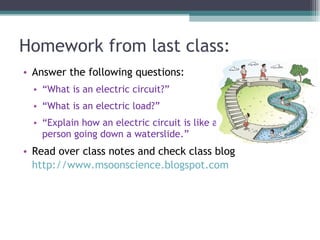
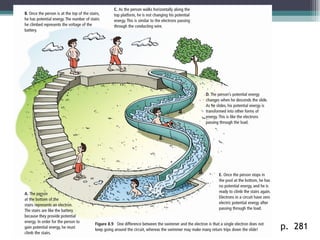
Homework from last class: Answer the following questions: “ What is an electric circuit?” “ What is an electric load?” “ Explain how an electric circuit is like a  person going down a waterslide.” Read over class notes and check class blog http://www.msoonscience.blogspot.com
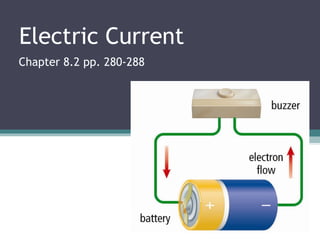
Chapter 8.2 pp. 280-288 Electric Current
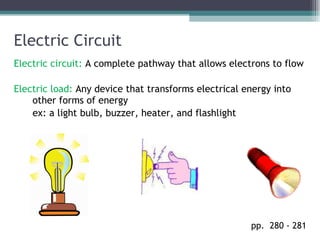
Electric Circuit Electric circuit:  A complete pathway that allows electrons to flow Electric load:  Any device that transforms electrical energy into other forms of energy ex: a light bulb, buzzer, heater, and flashlight pp.  280 - 281
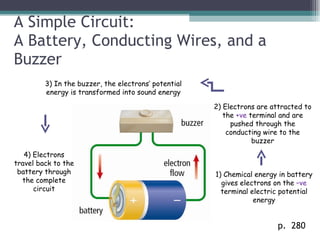
A Simple Circuit: A Battery, Conducting Wires, and a Buzzer p.  280  1) Chemical energy in battery gives electrons on the  –ve  terminal electric potential energy 2) Electrons are attracted to the  +ve  terminal and are pushed through the conducting wire to the buzzer 3) In the buzzer, the electrons’ potential energy is transformed into sound energy 4) Electrons travel back to the battery through the complete circuit
p.  281
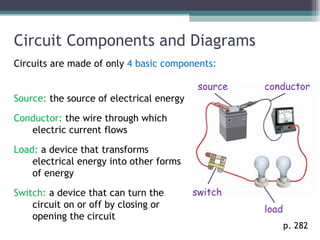
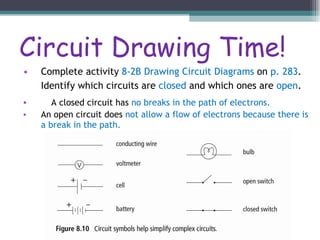
Circuit Components and Diagrams Circuits are made of only  4 basic components: p. 282  Source:   the source of electrical energy Conductor:   the wire through which electric current flows Load:  a device that transforms electrical energy into other forms of energy Switch:   a device that can turn the circuit on or off by closing or opening the circuit source conductor load switch
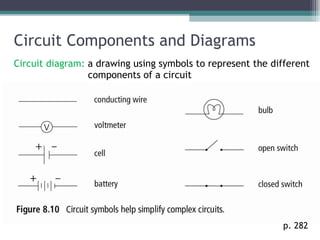
Circuit Components and Diagrams Circuit diagram:  a drawing using symbols to represent the different components of a circuit p. 282
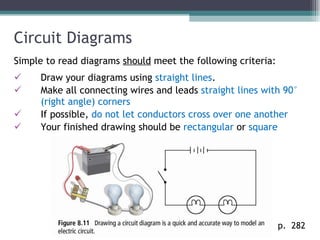
Circuit Diagrams Simple to read diagrams  should  meet the following criteria: Draw your diagrams using  straight lines . Make all connecting wires and leads  straight lines with 90°  (right angle) corners If possible,  do not let conductors cross over one another Your finished drawing should be  rectangular  or  square p.  282
Circuit Drawing Time! Complete activity  8-2B Drawing Circuit Diagrams  on  p. 283 .  Identify which circuits are  closed  and which ones are  open .  A closed circuit has  no breaks in the path of electrons. An open circuit does  not allow a flow of electrons because there is a break in the path.
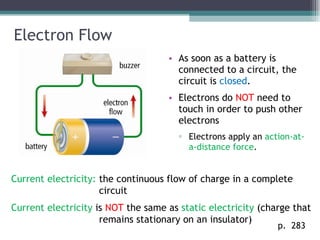
Electron Flow As soon as a battery is connected to a circuit, the circuit is  closed . Electrons do  NOT  need to touch in order to push other electrons Electrons apply an  action-at-a-distance force . p.  283 Current electricity:  the continuous flow of charge in a complete circuit Current electricity  is  NOT  the same as  static electricity  (charge that remains stationary on an insulator)
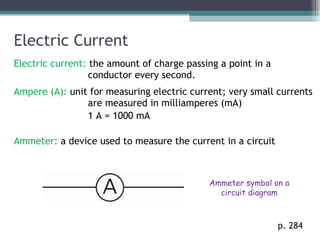
Electric Current Electric current:  the amount of charge passing a point in a conductor every second. Ampere (A):  unit for measuring electric current; very small currents are measured in milliamperes (mA) 1 A = 1000 mA Ammeter:  a device used to measure the current in a circuit p. 284 Ammeter symbol on a circuit diagram
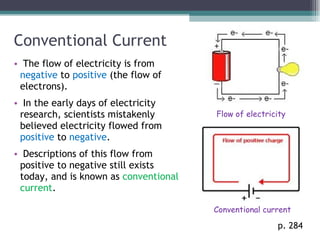
Conventional Current The flow of electricity is from  negative  to  positive  (the flow of electrons).  In the early days of electricity research, scientists mistakenly believed electricity flowed from  positive  to  negative . Descriptions of this flow from positive to negative still exists today, and is known as  conventional current . p. 284 Conventional current Flow of electricity
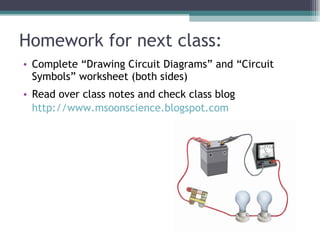
Homework for next class: Complete “Drawing Circuit Diagrams” and “Circuit Symbols” worksheet (both sides) Read over class notes and check class blog http://www.msoonscience.blogspot.com
Works Cited Images taken from the following sources: http://zone.ni.com/devzone/cda/tut/p/id/7114 http://iss.cet.edu/electricity/pages/b14.xml http://schools-demo.clipart.com/search/index?q=buzzer&a=c

Sci 9 Lesson 5 May 11 - Electric Current

  • 1.
    Homework from lastclass: Answer the following questions: “ What is an electric circuit?” “ What is an electric load?” “ Explain how an electric circuit is like a person going down a waterslide.” Read over class notes and check class blog http://www.msoonscience.blogspot.com
  • 2.
    Chapter 8.2 pp.280-288 Electric Current
  • 3.
    Electric Circuit Electriccircuit: A complete pathway that allows electrons to flow Electric load: Any device that transforms electrical energy into other forms of energy ex: a light bulb, buzzer, heater, and flashlight pp. 280 - 281
  • 4.
    A Simple Circuit:A Battery, Conducting Wires, and a Buzzer p. 280 1) Chemical energy in battery gives electrons on the –ve terminal electric potential energy 2) Electrons are attracted to the +ve terminal and are pushed through the conducting wire to the buzzer 3) In the buzzer, the electrons’ potential energy is transformed into sound energy 4) Electrons travel back to the battery through the complete circuit
  • 5.
  • 6.
    Circuit Components andDiagrams Circuits are made of only 4 basic components: p. 282 Source: the source of electrical energy Conductor: the wire through which electric current flows Load: a device that transforms electrical energy into other forms of energy Switch: a device that can turn the circuit on or off by closing or opening the circuit source conductor load switch
  • 7.
    Circuit Components andDiagrams Circuit diagram: a drawing using symbols to represent the different components of a circuit p. 282
  • 8.
    Circuit Diagrams Simpleto read diagrams should meet the following criteria: Draw your diagrams using straight lines . Make all connecting wires and leads straight lines with 90° (right angle) corners If possible, do not let conductors cross over one another Your finished drawing should be rectangular or square p. 282
  • 9.
    Circuit Drawing Time!Complete activity 8-2B Drawing Circuit Diagrams on p. 283 . Identify which circuits are closed and which ones are open . A closed circuit has no breaks in the path of electrons. An open circuit does not allow a flow of electrons because there is a break in the path.
  • 10.
    Electron Flow Assoon as a battery is connected to a circuit, the circuit is closed . Electrons do NOT need to touch in order to push other electrons Electrons apply an action-at-a-distance force . p. 283 Current electricity: the continuous flow of charge in a complete circuit Current electricity is NOT the same as static electricity (charge that remains stationary on an insulator)
  • 11.
    Electric Current Electriccurrent: the amount of charge passing a point in a conductor every second. Ampere (A): unit for measuring electric current; very small currents are measured in milliamperes (mA) 1 A = 1000 mA Ammeter: a device used to measure the current in a circuit p. 284 Ammeter symbol on a circuit diagram
  • 12.
    Conventional Current Theflow of electricity is from negative to positive (the flow of electrons). In the early days of electricity research, scientists mistakenly believed electricity flowed from positive to negative . Descriptions of this flow from positive to negative still exists today, and is known as conventional current . p. 284 Conventional current Flow of electricity
  • 13.
    Homework for nextclass: Complete “Drawing Circuit Diagrams” and “Circuit Symbols” worksheet (both sides) Read over class notes and check class blog http://www.msoonscience.blogspot.com
  • 14.
    Works Cited Imagestaken from the following sources: http://zone.ni.com/devzone/cda/tut/p/id/7114 http://iss.cet.edu/electricity/pages/b14.xml http://schools-demo.clipart.com/search/index?q=buzzer&a=c