2015	
  EXECUTIVE	
  
COMPENSATION	
  TRENDS	
  
BY DANIEL N. JANICH
	
  
Greensfelder,	
  Hemker	
  &	
  Gale	
  
200	
  West	
  Madison	
  St.,	
  Ste	
  2700	
  
Chicago,	
  Illinois	
  60606	
  
Phone:	
  (312)	
  345-­‐5003	
  
Fax:	
  (312)	
  419-­‐1930	
  
dnj.greensfelder.com	
  	
  
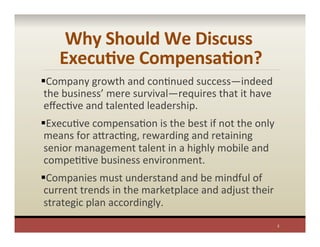
Why	
  Should	
  We	
  Discuss	
  
ExecuAve	
  CompensaAon?	
  
§ Company	
  growth	
  and	
  conPnued	
  success—indeed	
  
the	
  business’	
  mere	
  survival—requires	
  that	
  it	
  have	
  
effecPve	
  and	
  talented	
  leadership.	


§ ExecuPve	
  compensaPon	
  is	
  the	
  best	
  if	
  not	
  the	
  only	
  
means	
  for	
  aYracPng,	
  rewarding	
  and	
  retaining	
  
senior	
  management	
  talent	
  in	
  a	
  highly	
  mobile	
  and	
  
compePPve	
  business	
  environment.	
  
§ Companies	
  must	
  understand	
  and	
  be	
  mindful	
  of	
  
current	
  trends	
  in	
  the	
  marketplace	
  and	
  adjust	
  their	
  
strategic	
  plan	
  accordingly.	
  
2	
  
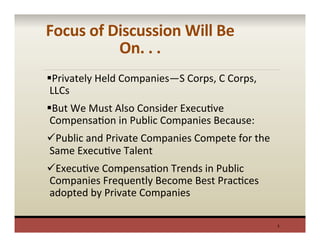
Focus	
  of	
  Discussion	
  Will	
  Be	
  
On.	
  .	
  .	
  
§ Privately	
  Held	
  Companies—S	
  Corps,	
  C	
  Corps,	
  
LLCs	
  
§ But	
  We	
  Must	
  Also	
  Consider	
  ExecuPve	
  
CompensaPon	
  in	
  Public	
  Companies	
  Because:	
  
ü Public	
  and	
  Private	
  Companies	
  Compete	
  for	
  the	
  
Same	
  ExecuPve	
  Talent	
  	
  
ü ExecuPve	
  CompensaPon	
  Trends	
  in	
  Public	
  
Companies	
  Frequently	
  Become	
  Best	
  PracPces	
  
adopted	
  by	
  Private	
  Companies	
  
3	
  
4
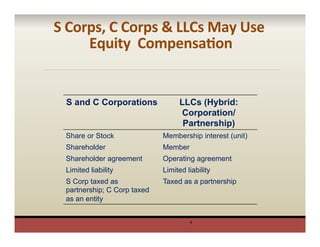
S and C Corporations LLCs (Hybrid:
Corporation/
Partnership)
Share or Stock Membership interest (unit)
Shareholder Member
Shareholder agreement Operating agreement
Limited liability Limited liability
S Corp taxed as
partnership; C Corp taxed
as an entity
Taxed as a partnership
S	
  Corps,	
  C	
  Corps	
  &	
  LLCs	
  May	
  Use	
  
Equity	
  	
  CompensaAon	


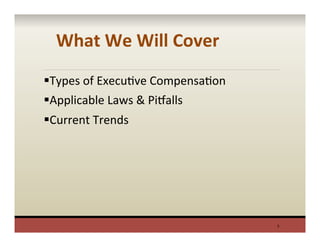
§ Types	
  of	
  ExecuPve	
  CompensaPon	
  
§ Applicable	
  Laws	
  &	
  Pi^alls	
  
§ Current	
  Trends	


5	
  
What	
  We	
  Will	
  Cover	
  	
  
Types	
  of	
  ExecuAve	
  CompensaAon	
  
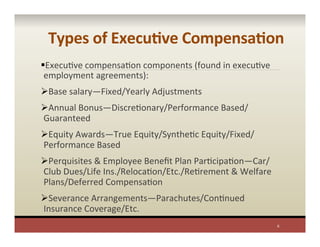
§ ExecuPve	
  compensaPon	
  components	
  (found	
  in	
  execuPve	
  
employment	
  agreements):	
  
Ø Base	
  salary—Fixed/Yearly	
  Adjustments	
  
Ø Annual	
  Bonus—DiscrePonary/Performance	
  Based/
Guaranteed	
  
Ø Equity	
  Awards—True	
  Equity/SynthePc	
  Equity/Fixed/
Performance	
  Based	
  
Ø Perquisites	
  &	
  Employee	
  Benefit	
  Plan	
  ParPcipaPon—Car/
Club	
  Dues/Life	
  Ins./RelocaPon/Etc./RePrement	
  &	
  Welfare	
  	
  
Plans/Deferred	
  CompensaPon	
  
Ø Severance	
  Arrangements—Parachutes/ConPnued	
  
Insurance	
  Coverage/Etc.	
  
6	
  
Variable	
  vs.	
  Fixed	
  ExecuAve	
  
CompensaAon	
  
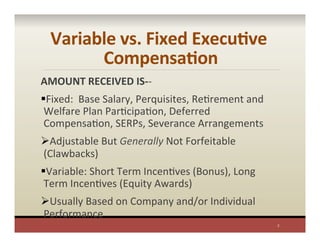
AMOUNT	
  RECEIVED	
  IS-­‐-­‐	
  
§ Fixed:	
  	
  Base	
  Salary,	
  Perquisites,	
  RePrement	
  and	
  
Welfare	
  Plan	
  ParPcipaPon,	
  Deferred	
  
CompensaPon,	
  SERPs,	
  Severance	
  Arrangements	
  
Ø Adjustable	
  But	
  Generally	
  Not	
  Forfeitable	
  
(Clawbacks)	
  
§ Variable:	
  Short	
  Term	
  IncenPves	
  (Bonus),	
  Long	
  
Term	
  IncenPves	
  (Equity	
  Awards)	
  
Ø Usually	
  Based	
  on	
  Company	
  and/or	
  Individual	
  
Performance	
  
7	
  
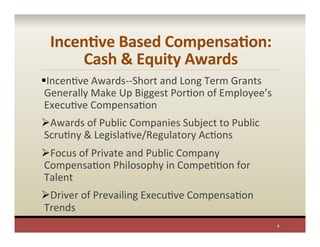
IncenAve	
  Based	
  CompensaAon:	
  
Cash	
  &	
  Equity	
  Awards	
  
§ IncenPve	
  Awards-­‐-­‐Short	
  and	
  Long	
  Term	
  Grants	
  
Generally	
  Make	
  Up	
  Biggest	
  PorPon	
  of	
  Employee’s	
  
ExecuPve	
  CompensaPon	
  
Ø Awards	
  of	
  Public	
  Companies	
  Subject	
  to	
  Public	
  
ScruPny	
  &	
  LegislaPve/Regulatory	
  AcPons	
  
Ø Focus	
  of	
  Private	
  and	
  Public	
  Company	
  
CompensaPon	
  Philosophy	
  in	
  CompePPon	
  for	
  
Talent	
  
Ø Driver	
  of	
  Prevailing	
  ExecuPve	
  CompensaPon	
  
Trends	
  
8	
  
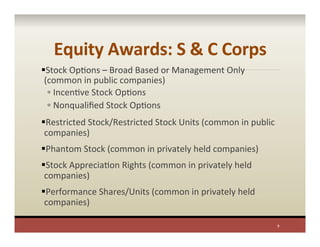
Equity	
  Awards:	
  S	
  &	
  C	
  Corps	
  
§ Stock	
  OpPons	
  –	
  Broad	
  Based	
  or	
  Management	
  Only	
  
(common	
  in	
  public	
  companies)	
  
◦ IncenPve	
  Stock	
  OpPons	
  
◦ Nonqualified	
  Stock	
  OpPons	
  
§ Restricted	
  Stock/Restricted	
  Stock	
  Units	
  (common	
  in	
  public	
  
companies)	
  
§ Phantom	
  Stock	
  (common	
  in	
  privately	
  held	
  companies)	
  
§ Stock	
  AppreciaPon	
  Rights	
  (common	
  in	
  privately	
  held	
  
companies)	
  
§ Performance	
  Shares/Units	
  (common	
  in	
  privately	
  held	
  
companies)	
  
9	
  
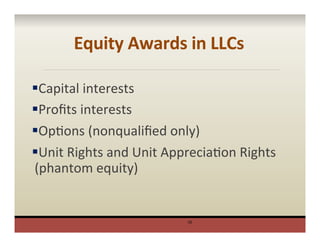
Equity	
  Awards	
  in	
  LLCs	
  
§ Capital	
  interests	
  
§ Profits	
  interests	
  
§ OpPons	
  (nonqualified	
  only)	
  
§ Unit	
  Rights	
  and	
  Unit	
  AppreciaPon	
  Rights	
  
(phantom	
  equity)	


10
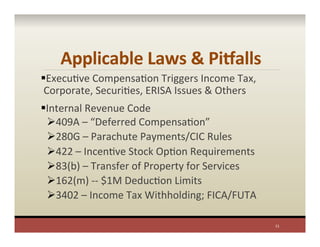
Applicable	
  Laws	
  &	
  PiValls	
  
§ ExecuPve	
  CompensaPon	
  Triggers	
  Income	
  Tax,	
  
Corporate,	
  SecuriPes,	
  ERISA	
  Issues	
  &	
  Others	
  	
  
§ Internal	
  Revenue	
  Code	
  
Ø 409A	
  –	
  “Deferred	
  CompensaPon”	
  	
  
Ø 280G	
  –	
  Parachute	
  Payments/CIC	
  Rules	
  
Ø 422	
  –	
  IncenPve	
  Stock	
  OpPon	
  Requirements	
  
Ø 83(b)	
  –	
  Transfer	
  of	
  Property	
  for	
  Services	
  
Ø 162(m)	
  -­‐-­‐	
  $1M	
  DeducPon	
  Limits	
  
Ø 3402	
  –	
  Income	
  Tax	
  Withholding;	
  FICA/FUTA	


11	
  
Applicable	
  Laws	
  &	
  PiValls	
  
(Cont.)	
  
§ State	
  Corporate	
  Law	
  –	
  Governance	
  Issues	
  
§ ERISA	
  –	
  Is	
  compensaPon	
  arrangement	
  subject	
  to	
  
ERISA?	
  
§ SecuriPes	
  Laws	
  –	
  State	
  and	
  Federal	
  RegistraPon	
  &	
  
ReporPng	
  Requirements.	
  	
  Are	
  there	
  applicable	
  
exempPons	
  that	
  apply?	
  Federal	
  and/or	
  State	
  Laws	
  
may	
  apply	
  
§ Host	
  of	
  AddiPonal	
  Federal	
  Laws	
  –	
  ADEA	
  
(severance),	
  Dodd-­‐Frank	
  (governance),	
  etc.	


12	
  
Current	
  Trends	
  
§ A	
  Period	
  of	
  Intense	
  ScruPny	
  Leads	
  To	
  Greater	
  
Transparency:	
  Disclosure,	
  Disclosure	
  &	
  More	
  Disclosure	
  
Ø Direct	
  impact	
  on	
  Public	
  Companies	
  through	
  Proxies;	
  
Recent	
  Examples:	
  Pay	
  RaPo	
  &	
  Say	
  on	
  Pay	
  Rules;	
  Best	
  
PracPces	
  for	
  Privately	
  Held	
  Companies	
  due	
  to	
  War	
  For	
  
Talent	
  leads	
  to	
  disclosure	
  of	
  company	
  financial	
  performance	
  
§ Performance	
  Based	
  Grants	
  and	
  VesPng	
  	
  
Ø ApplicaPon	
  of	
  Most	
  Suitable	
  Metrics	
  to	
  Measure	
  
Performance	
  –	
  Most	
  Popular	
  =	
  Total	
  Shareholder	
  Return	
  
(TSR),	
  but	
  trend	
  developing	
  to	
  use	
  others,	
  such	
  as	
  EBITDA	
  	
  
13	
  
Current	
  Trends	
  (Cont.)	
  
§ Corporate	
  Governance	
  
Ø Fiduciary	
  Concerns	
  –	
  Shareholders	
  &	
  
Officers	
  
§ Clawbacks	
  –	
  SOX,	
  Dodd-­‐Frank	
  Clawback	
  
Rules	
  for	
  IncenPve	
  CompensaPon;	
  
Forfeitures	
  for	
  Non	
  compete	
  ViolaPons	
  &	
  
Criminal	
  ConvicPons	
  
14	
  
Current	
  Trends	
  (Cont.)	
  
§ Shis	
  Away	
  from	
  Stock	
  OpPon	
  Grants	
  and	
  
Toward	
  Restricted	
  Stock	
  &	
  Other	
  Equity	
  
Vehicles	
  
Ø Broad	
  Based	
  OpPon	
  Plans	
  in	
  Decline	
  –	
  
OpPons	
  &	
  Restricted	
  Stock	
  Grants	
  to	
  Senior	
  
Management	
  
§ 409A	
  Problems	
  ConPnue—Many	
  Pi^alls	
  
Here;	
  Increasing	
  Employer	
  Liability	
  
15	
  
Current	
  Trends	
  (Cont.)	
  
§ Shis	
  Away	
  from	
  DiscrePonary	
  Bonus	
  Plans	
  to	
  
Performance	
  Based	
  Cash	
  Bonus	
  Plans	
  
Ø Short	
  term	
  as	
  well	
  as	
  long	
  term	
  incenPves	
  must	
  
align	
  company	
  performance	
  with	
  execuPve	
  
compensaPon	
  
§ Stock	
  Ownership	
  through	
  SubstanPal	
  Equity	
  Share	
  
§ Perks	
  and	
  SERPs	
  are	
  on	
  downward	
  trend	
  due	
  to	
  
shareholder	
  acPvism	
  
16	
  
Professional	
  Background	
  
Dan Janich	
   is	
   an	
   aYorney	
   pracPcing	
   in	
   the	
   areas	
   of	
   employment	
   law,	
  
employee	
  benefits	
  and	
  execuPve	
  compensaPon	
  in	
  Chicago.	
   	
  His	
  clients	
  
are	
   private	
   and	
   publicly	
   held	
   businesses,	
   C-­‐level	
   execuPves	
   and	
   other	
  
professionals.	
   	
   His	
   experience	
   includes	
   designing	
   and	
   implemenPng	
  
rePrement,	
   welfare	
   and	
   equity	
   compensaPon	
   plans,	
   and	
   execuPve	
  
employment	
  agreements	
  and	
  separaPon	
  packages,	
  and	
  liPgaPng	
  benefit	
  
and	
  execuPve	
  compensaPon	
  claims.	
  	
  
Dan	
  received	
  his	
  undergraduate	
  and	
  professional	
  degrees	
  from	
  Marian	
  
University,	
   Indianapolis	
   (B.A.),	
   The	
   John	
   Marshall	
   Law	
   School,	
   Chicago	
  
(J.D.),	
  and	
  DePaul	
  University	
  College	
  of	
  Law,	
  Chicago	
  (LL.M.	
  in	
  TaxaPon).	
  	
  
He	
  has	
  recently	
  served	
  on	
  the	
  Board	
  of	
  the	
  NaPonal	
  Center	
  for	
  Employee	
  
Ownership	
  (NCEO)	
  and	
  the	
  Senior	
  Editorial	
  Board	
  for	
  Employee	
  Benefits	
  
Law	
   treaPse,	
   and	
   is	
   currently	
   an	
   acPve	
   member	
   of	
   the	
   NCEO	
   and	
   the	
  
NaPonal	
  AssociaPon	
  of	
  Stock	
  Plan	
  Professionals	
  (NASPP).	


17	
  
Any	
  QuesAons?	
  
18	
  

2015 Executive Compensation Trends

  • 1.
    2015  EXECUTIVE   COMPENSATION  TRENDS   BY DANIEL N. JANICH   Greensfelder,  Hemker  &  Gale   200  West  Madison  St.,  Ste  2700   Chicago,  Illinois  60606   Phone:  (312)  345-­‐5003   Fax:  (312)  419-­‐1930   dnj.greensfelder.com    
  • 2.
    Why  Should  We  Discuss   ExecuAve  CompensaAon?   § Company  growth  and  conPnued  success—indeed   the  business’  mere  survival—requires  that  it  have   effecPve  and  talented  leadership.       § ExecuPve  compensaPon  is  the  best  if  not  the  only   means  for  aYracPng,  rewarding  and  retaining   senior  management  talent  in  a  highly  mobile  and   compePPve  business  environment.   § Companies  must  understand  and  be  mindful  of   current  trends  in  the  marketplace  and  adjust  their   strategic  plan  accordingly.   2  
  • 3.
    Focus  of  Discussion  Will  Be   On.  .  .   § Privately  Held  Companies—S  Corps,  C  Corps,   LLCs   § But  We  Must  Also  Consider  ExecuPve   CompensaPon  in  Public  Companies  Because:   ü Public  and  Private  Companies  Compete  for  the   Same  ExecuPve  Talent     ü ExecuPve  CompensaPon  Trends  in  Public   Companies  Frequently  Become  Best  PracPces   adopted  by  Private  Companies   3  
  • 4.
    4 S and CCorporations LLCs (Hybrid: Corporation/ Partnership) Share or Stock Membership interest (unit) Shareholder Member Shareholder agreement Operating agreement Limited liability Limited liability S Corp taxed as partnership; C Corp taxed as an entity Taxed as a partnership S  Corps,  C  Corps  &  LLCs  May  Use   Equity    CompensaAon    
  • 5.
    § Types  of  ExecuPve  CompensaPon   § Applicable  Laws  &  Pi^alls   § Current  Trends       5   What  We  Will  Cover    
  • 6.
    Types  of  ExecuAve  CompensaAon   § ExecuPve  compensaPon  components  (found  in  execuPve   employment  agreements):   Ø Base  salary—Fixed/Yearly  Adjustments   Ø Annual  Bonus—DiscrePonary/Performance  Based/ Guaranteed   Ø Equity  Awards—True  Equity/SynthePc  Equity/Fixed/ Performance  Based   Ø Perquisites  &  Employee  Benefit  Plan  ParPcipaPon—Car/ Club  Dues/Life  Ins./RelocaPon/Etc./RePrement  &  Welfare     Plans/Deferred  CompensaPon   Ø Severance  Arrangements—Parachutes/ConPnued   Insurance  Coverage/Etc.   6  
  • 7.
    Variable  vs.  Fixed  ExecuAve   CompensaAon   AMOUNT  RECEIVED  IS-­‐-­‐   § Fixed:    Base  Salary,  Perquisites,  RePrement  and   Welfare  Plan  ParPcipaPon,  Deferred   CompensaPon,  SERPs,  Severance  Arrangements   Ø Adjustable  But  Generally  Not  Forfeitable   (Clawbacks)   § Variable:  Short  Term  IncenPves  (Bonus),  Long   Term  IncenPves  (Equity  Awards)   Ø Usually  Based  on  Company  and/or  Individual   Performance   7  
  • 8.
    IncenAve  Based  CompensaAon:   Cash  &  Equity  Awards   § IncenPve  Awards-­‐-­‐Short  and  Long  Term  Grants   Generally  Make  Up  Biggest  PorPon  of  Employee’s   ExecuPve  CompensaPon   Ø Awards  of  Public  Companies  Subject  to  Public   ScruPny  &  LegislaPve/Regulatory  AcPons   Ø Focus  of  Private  and  Public  Company   CompensaPon  Philosophy  in  CompePPon  for   Talent   Ø Driver  of  Prevailing  ExecuPve  CompensaPon   Trends   8  
  • 9.
    Equity  Awards:  S  &  C  Corps   § Stock  OpPons  –  Broad  Based  or  Management  Only   (common  in  public  companies)   ◦ IncenPve  Stock  OpPons   ◦ Nonqualified  Stock  OpPons   § Restricted  Stock/Restricted  Stock  Units  (common  in  public   companies)   § Phantom  Stock  (common  in  privately  held  companies)   § Stock  AppreciaPon  Rights  (common  in  privately  held   companies)   § Performance  Shares/Units  (common  in  privately  held   companies)   9  
  • 10.
    Equity  Awards  in  LLCs   § Capital  interests   § Profits  interests   § OpPons  (nonqualified  only)   § Unit  Rights  and  Unit  AppreciaPon  Rights   (phantom  equity)     10
  • 11.
    Applicable  Laws  &  PiValls   § ExecuPve  CompensaPon  Triggers  Income  Tax,   Corporate,  SecuriPes,  ERISA  Issues  &  Others     § Internal  Revenue  Code   Ø 409A  –  “Deferred  CompensaPon”     Ø 280G  –  Parachute  Payments/CIC  Rules   Ø 422  –  IncenPve  Stock  OpPon  Requirements   Ø 83(b)  –  Transfer  of  Property  for  Services   Ø 162(m)  -­‐-­‐  $1M  DeducPon  Limits   Ø 3402  –  Income  Tax  Withholding;  FICA/FUTA     11  
  • 12.
    Applicable  Laws  &  PiValls   (Cont.)   § State  Corporate  Law  –  Governance  Issues   § ERISA  –  Is  compensaPon  arrangement  subject  to   ERISA?   § SecuriPes  Laws  –  State  and  Federal  RegistraPon  &   ReporPng  Requirements.    Are  there  applicable   exempPons  that  apply?  Federal  and/or  State  Laws   may  apply   § Host  of  AddiPonal  Federal  Laws  –  ADEA   (severance),  Dodd-­‐Frank  (governance),  etc.       12  
  • 13.
    Current  Trends   § A  Period  of  Intense  ScruPny  Leads  To  Greater   Transparency:  Disclosure,  Disclosure  &  More  Disclosure   Ø Direct  impact  on  Public  Companies  through  Proxies;   Recent  Examples:  Pay  RaPo  &  Say  on  Pay  Rules;  Best   PracPces  for  Privately  Held  Companies  due  to  War  For   Talent  leads  to  disclosure  of  company  financial  performance   § Performance  Based  Grants  and  VesPng     Ø ApplicaPon  of  Most  Suitable  Metrics  to  Measure   Performance  –  Most  Popular  =  Total  Shareholder  Return   (TSR),  but  trend  developing  to  use  others,  such  as  EBITDA     13  
  • 14.
    Current  Trends  (Cont.)   § Corporate  Governance   Ø Fiduciary  Concerns  –  Shareholders  &   Officers   § Clawbacks  –  SOX,  Dodd-­‐Frank  Clawback   Rules  for  IncenPve  CompensaPon;   Forfeitures  for  Non  compete  ViolaPons  &   Criminal  ConvicPons   14  
  • 15.
    Current  Trends  (Cont.)   § Shis  Away  from  Stock  OpPon  Grants  and   Toward  Restricted  Stock  &  Other  Equity   Vehicles   Ø Broad  Based  OpPon  Plans  in  Decline  –   OpPons  &  Restricted  Stock  Grants  to  Senior   Management   § 409A  Problems  ConPnue—Many  Pi^alls   Here;  Increasing  Employer  Liability   15  
  • 16.
    Current  Trends  (Cont.)   § Shis  Away  from  DiscrePonary  Bonus  Plans  to   Performance  Based  Cash  Bonus  Plans   Ø Short  term  as  well  as  long  term  incenPves  must   align  company  performance  with  execuPve   compensaPon   § Stock  Ownership  through  SubstanPal  Equity  Share   § Perks  and  SERPs  are  on  downward  trend  due  to   shareholder  acPvism   16  
  • 17.
    Professional  Background   DanJanich   is   an   aYorney   pracPcing   in   the   areas   of   employment   law,   employee  benefits  and  execuPve  compensaPon  in  Chicago.    His  clients   are   private   and   publicly   held   businesses,   C-­‐level   execuPves   and   other   professionals.     His   experience   includes   designing   and   implemenPng   rePrement,   welfare   and   equity   compensaPon   plans,   and   execuPve   employment  agreements  and  separaPon  packages,  and  liPgaPng  benefit   and  execuPve  compensaPon  claims.     Dan  received  his  undergraduate  and  professional  degrees  from  Marian   University,   Indianapolis   (B.A.),   The   John   Marshall   Law   School,   Chicago   (J.D.),  and  DePaul  University  College  of  Law,  Chicago  (LL.M.  in  TaxaPon).     He  has  recently  served  on  the  Board  of  the  NaPonal  Center  for  Employee   Ownership  (NCEO)  and  the  Senior  Editorial  Board  for  Employee  Benefits   Law   treaPse,   and   is   currently   an   acPve   member   of   the   NCEO   and   the   NaPonal  AssociaPon  of  Stock  Plan  Professionals  (NASPP).       17  
  • 18.