Schools as Complex
Systems
Creating Learning Organizations
Carlos Trullén Calvo
The World We Live In
A Knowledge Based Society is the type of Society
“that is needed to compete and succeed in the
changing economic and political dynamics of the
modern world”1
.
“In a changing world, we want the EU to
become a smart, sustainable and inclusive
economy.”2
1. http://www.oas.org/en/topics/knowledge_society.asp
2. http://ec.europa.eu/europe2020/index_en.htm
“Policies need to prepare for a
shifting world”3
.
3. http://www.oas.org/en/topics/knowledge_society.asp
The Globalisation Paradox
Integrated Vs Multipolar
Complexus: Connected
Inter-connected
The world is becoming more and
more…
GlobalComplex
?
Science and Complexity
Warren Weaver (1948)
Simplicity
Organized Complexity Disorganized Complexity
Problems
Problems of Simplicity
Classical Science and
Technology
Problems of Disorganized Complexity
Statistics
Problems of Organized
Complexity System Thinking
Terrorism
Water supply
Climate change
Social inequality
Strategic Objective 2:
Empowering Learners to be Creative and Responsible Global Citizens
“Holistic Changes
need to be made”
Departments
Processes
Pupils
Families
Regional Authorities
Teachers’ social context
Schools as Complex Systems
…
Adaptive LearningAdaptive Learning
The Viable System Model4
System 3 System 4
4. Pérez Ríos (2013)
Adaptation…
… to a
Changing World
How can we handle with Changing?...
By LEARNING
TEAM
Complex Open System composed by individuals who5
:
1.Are interdependent in their tasks
2.Share responsibility for their outcomes
3.See themselves and are seen by others as a social entity
5. Cohen & Bailey (1997)
Systemic and Integrative Model
for Team Learning6
6. Decuyper at al. (2010)
Ambidexterity
Exploration Exploitation
System 4 System 3
Systemic and Integrative Model
for Team Learning6
6. Decuyper at al. (2010)
Facilitating
Learning
Facilitating
Learning
Let Teachers work together!!
Learning Organization
Is organized, both Culturally and Structurally, to continuously
produce Innovation, Flexibility and Improvement .7
Social Interaction
Shared Understandings
7. Huysman (2000)
An Organizational Learning
Framework8
8. Crossan et al. (1994)
Exploration
Exploitation
SECI Model of Knowledge Creation9
9. Nonaka (1994)
g
i
o
Legend
Individual
Group
Organization
Socialization Externalization
CombinationInternalization
i i
i
i
i
i
i
i
g
g
g g
g
o
i
g
o
Tacit
Knowledge
Tacit
Knowledge
Explicit
Knowledge
Explicit
Knowledge
Explicit
Knowledge
Explicit
Knowledge
Tacit
Knowledge
Tacit
Knowledge
Moving forward a Learning Organization
Adaptive
Learning
Adaptive
Learning
Generative
Learning
Generative
Learning
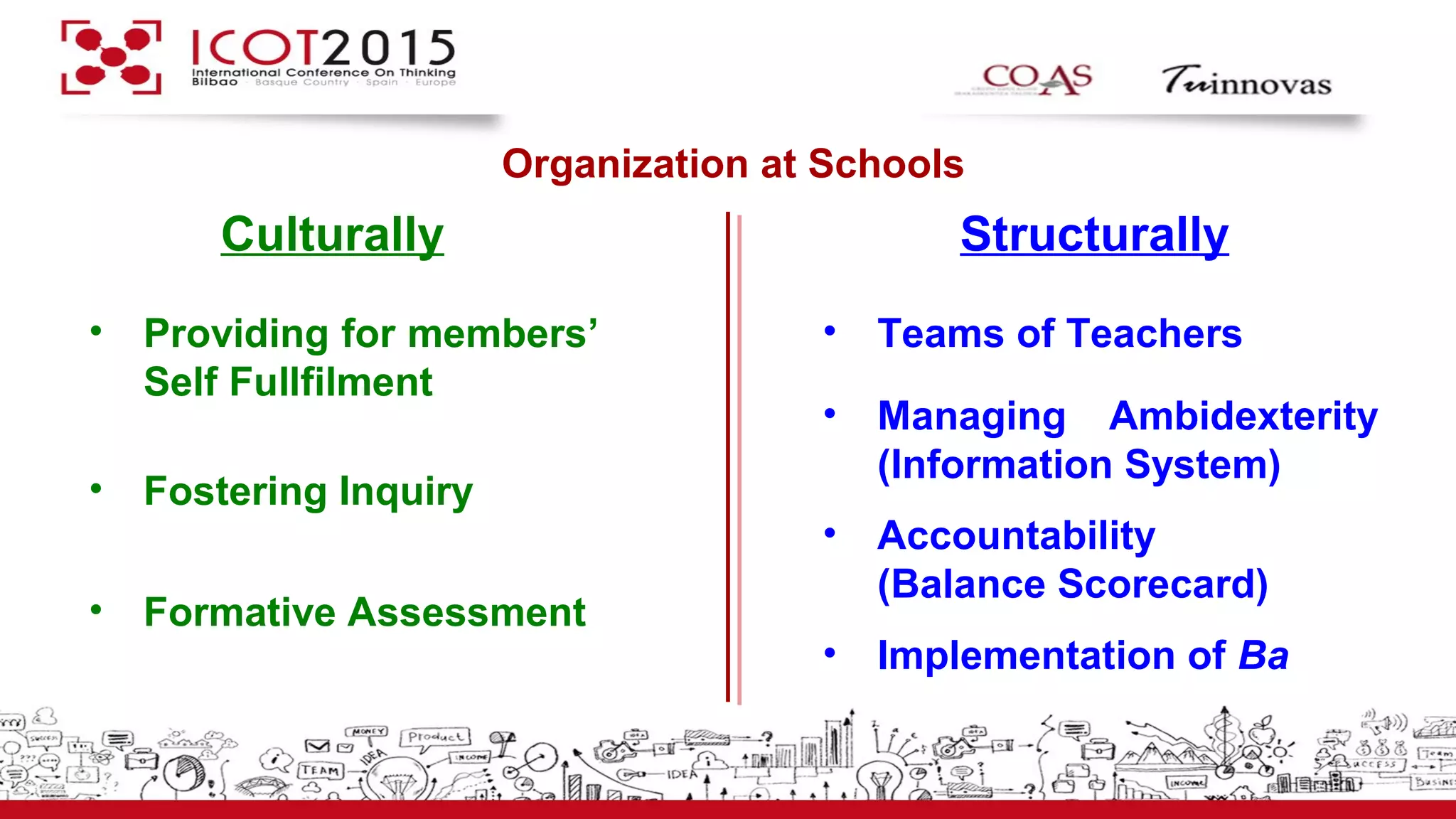
Organization at Schools
Culturally Structurally
• Teams of Teachers
• Managing Ambidexterity
(Information System)
• Accountability
(Balance Scorecard)
• Implementation of Ba
• Formative Assessment
• Fostering Inquiry
• Providing for members’
Self Fullfilment
Thank You
Carlos Trullén Calvo
aTaW Education
Organizational Management Consultancy
consulting@ataweducation.com
@carlos_trullen

Schools as Complex Systems. Creating Learning Organizations