Title Here
October 9, 2015
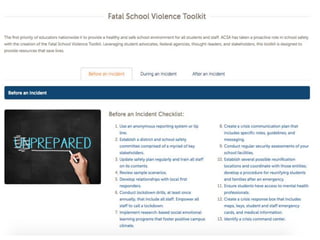
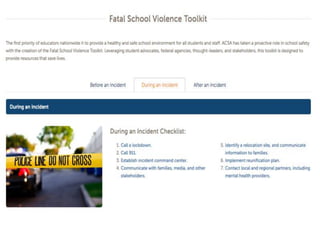
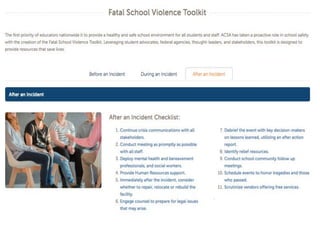
Fatal School Violence Toolkit:
Before/During/After
ACSA Leadership Summit
November 2018, San Diego
http://bit.ly/ACSASummit2018
Outcomes….
• Build your own capacity and that of your staff
• Review recent data of school violence and why fatal
school violence is impacting the work we do around
safety
• Delve into the online toolkit and become familiar with the

resources in it
• Familiarization with the National Center for School Crisis
and Bereavement and its resources/services
• Take a look at a resource from a school district used to
communicate and reassure
Today’s Presenters..
• Sandy Clifton – ACSA Past President
• Dr. Lisa Gonzales – ACSA Past President, Asst Sup –
Dublin USD
• Jesus Montana – Administrative Sargeant, San Diego
USD Police Department
• Dean Waddell - Keenan
Our Why?
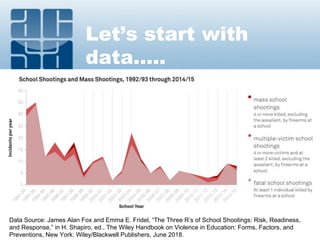
Data Source: James Alan Fox and Emma E. Fridel, “The Three R’s of School Shootings: Risk, Readiness,
and Response,” in H. Shapiro, ed., The Wiley Handbook on Violence in Education: Forms, Factors, and
Preventions, New York: Wiley/Blackwell Publishers, June 2018.
Let’s start with
data…..
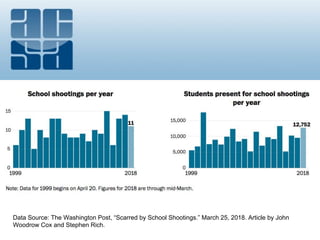
Data Source: The Washington Post, “Scarred by School Shootings.” March 25, 2018. Article by John
Woodrow Cox and Stephen Rich.
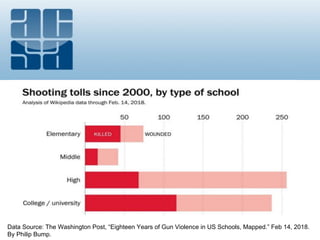
Data Source: The Washington Post, “Eighteen Years of Gun Violence in US Schools, Mapped.” Feb 14, 2018.
By Philip Bump.
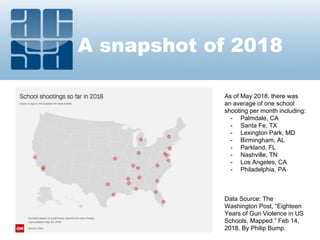
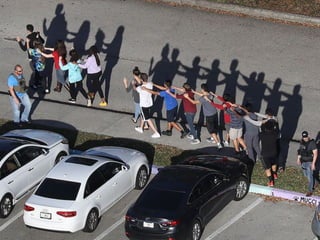
A snapshot of 2018
As of May 2018, there was
an average of one school
shooting per month including:
- Palmdale, CA
- Santa Fe, TX
- Lexington Park, MD
- Birmingham, AL
- Parkland, FL
- Nashville, TN
- Los Angeles, CA
- Philadelphia, PA
Data Source: The
Washington Post, “Eighteen
Years of Gun Violence in US
Schools, Mapped.” Feb 14,
2018. By Philip Bump.
With that said….
● Mass school shootings are incredibly
rare events.
● Shooting incidents involving students
have been declining since the 1990s.
● More students die in bike accidents and
pool drownings.
● But….
School communities are
forever changed...
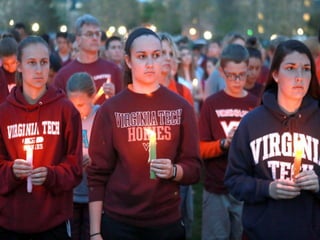
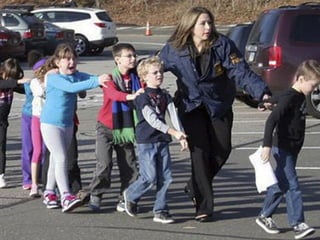
What those figures fail to capture, though, is the collateral
damage of this uniquely American crisis. Beginning with
Columbine in 1999, more than 187,000 students attending at
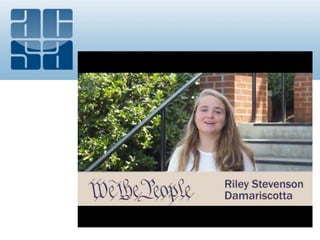
least 193 primary or secondary schools have experienced a
shooting on campus during school hours, according to a
year-long Washington Post analysis. This means that the
number of children who have been shaken by gunfire in the
places they go to learn exceeds the population of Eugene,
Ore., or Fort Lauderdale, Fla.
Many are never the same.
What does Gen Z
say?
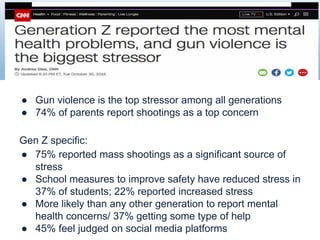
● Gun violence is the top stressor among all generations
● 74% of parents report shootings as a top concern
Gen Z specific:
● 75% reported mass shootings as a significant source of
stress
● School measures to improve safety have reduced stress in
37% of students; 22% reported increased stress
● More likely than any other generation to report mental
health concerns/ 37% getting some type of help
● 45% feel judged on social media platforms
What is believed to be
behind school violence?
Five Factors of Violence:
1. Predatory bullying & marginalization
2. Weaponized social media
3. Inadequate access to mental health
support
4. Media coverage
5. Firearms
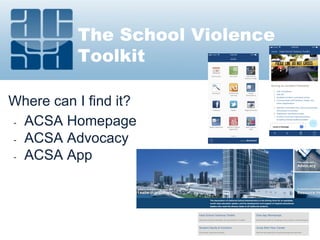
The School Violence
Toolkit
Where can I find it?
- ACSA Homepage
- ACSA Advocacy
- ACSA App
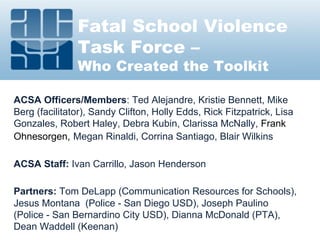
Fatal School Violence
Task Force –
Who Created the Toolkit
ACSA Officers/Members: Ted Alejandre, Kristie Bennett, Mike
Berg (facilitator), Sandy Clifton, Holly Edds, Rick Fitzpatrick, Lisa
Gonzales, Robert Haley, Debra Kubin, Clarissa McNally, Frank
Ohnesorgen, Megan Rinaldi, Corrina Santiago, Blair Wilkins
ACSA Staff: Ivan Carrillo, Jason Henderson
Partners: Tom DeLapp (Communication Resources for Schools),
Jesus Montana (Police - San Diego USD), Joseph Paulino
(Police - San Bernardino City USD), Dianna McDonald (PTA),
Dean Waddell (Keenan)
Supporting students and staff
in the aftermath of crisis
David J Schonfeld, MD, FAAP
Suzanne Dworak-Peck
School of Social Work and Pediatrics
University of Southern California and
Children’s Hospital Los Angeles
Schonfel@usc.edu
Director, National Center for School Crisis and Bereavement
www.schoolcrisiscenter.org
1-877-536-NCSCB (1-877-536-2722)
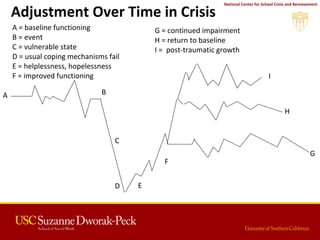
National Center for School Crisis and Bereavement
A B
C
D E
F
G
H
I
A = baseline functioning
B = event
C = vulnerable state
D = usual coping mechanisms fail
E = helplessness, hopelessness
F = improved functioning
G = continued impairment
H = return to baseline
I = post-traumatic growth
Adjustment Over Time in Crisis
National Center for School Crisis and Bereavement
Through an interdisciplinary team of medical, mental
health, and school professionals, the NCSCB provides:
• Confidential on-site/remote technical assistance and
consultation for school leadership and professionals
• Practical and timely advice via a 24/7 toll-free
number and email
• Ongoing support in the immediate aftermath of a
crisis and throughout the long-term recovery period
• Educational resources and crisis management tools
• School staff training and community presentations;
professional development for range of professional
audiences
National Center for School Crisis and Bereavement
• Help meet needs, both short- and long-term
• Advise on models of crisis mental health services,
staffing, training, policies, etc.
• Offer staff support; HR issues
• Address individual staff needs
• Prepare them to address educational impact and
academic supports
• Suicide postvention
• Commemoration and memorialization
What do we do when we consult?
National Center for School Crisis and Bereavement
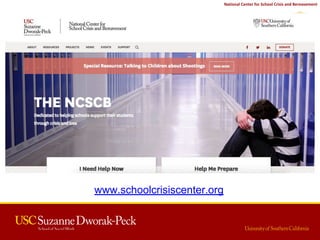
www.schoolcrisiscenter.org
OMSD’S CURRENT SAFETY PRACTICES
✕ Relationships/Culture
✕ Visibility/Vigilance
✕ Review Norms/Protocols
✕ Ongoing Training/Practice Drills and
Evaluation of Process for responding to
various incidents:
➢Social Media
➢Earthquake
➢Medical Emergencies
➢Fire Safety Procedures
➢Drills / Emergency Response
➢Disruptive or Threatening Behavior
➢Lockdowns/Precautionary Lockdowns
✕ Partnership with Local Law
Enforcement & First Responders
(911-local PD trainings)
✕ Locked Rooms/Gates
✕ Fingerprint screening of
employee/volunteer/contractor
✕ Regular Safety Committee and
District Risk Management Team
Meetings to discuss best safety
practices
✕ Improved Communication Tools
(Text Messages/Training Manuals)
✕ Safety Campaign
“See Something, Hear Something, Say
Something”
PBIS/CPI
Restorative Practices
✕ Internal Alert System
✕ Visitor Management System
✕ Protocols & Trainings
✕ Additional Installation of
Gates/Fences
✕ Updated Video Camera
Surveillance/Radios (Virtual Patrol)
PARTNERSHIPS WITH LOCAL LAW
ENFORCEMENT/FIRST RESPONDERS
✕ Alignment of protocols (citation authority, common
practices and vocabulary, etc.) with CJUHSD, local law
enforcement agencies (Ontario & Montclair PDs), and
County law enforcement agencies (Sheriffs
Department)
✕ 24 hour access to OMSD staff
✕ Regular Meetings
✕ Training with OMSD Safety Department
✕ PD has virtual access to OMSD cameras
✕ Dedicated Resource Officers at Middle
Schools
32
PARTNERSHIPS WITH LOCAL LAW
ENFORCEMENT/FIRST RESPONDERS
✕ Site assessments
✕ Mapping of school sites/facilities provided to First
Responders (updated annually)
✕ Lock box access (Fire Department)
✕ Ongoing updates on laws and regulation
✕ Regular advisement/consults on a school matter
✕ Emergency contacts and procedure updates
✕ Transition & support of students from OMSD to high
school
✕ Attend local law enforcement workshops/trainings
33
What is ACSA doing?
● Getting the word out - sharing the toolkit
○ Does your region need a presentation?
● Webinar - Wednesday, December 12th - AM
● Publishing articles on school safety
● Partnering with like-minded organizations to further the
legislation, advocacy
● Intentional national lobbying - March and September
visits to Washington DC
What is ACSA doing?
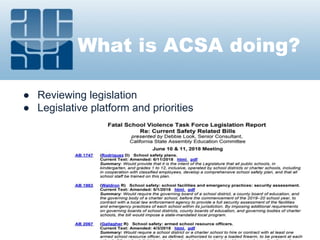
● Reviewing legislation
● Legislative platform and priorities
Quick Q&A
School Violence Toolkit

School Violence Toolkit

  • 1.
    Title Here October 9,2015 Fatal School Violence Toolkit: Before/During/After ACSA Leadership Summit November 2018, San Diego http://bit.ly/ACSASummit2018
  • 3.
    Outcomes…. • Build yourown capacity and that of your staff • Review recent data of school violence and why fatal school violence is impacting the work we do around safety • Delve into the online toolkit and become familiar with the resources in it • Familiarization with the National Center for School Crisis and Bereavement and its resources/services • Take a look at a resource from a school district used to communicate and reassure
  • 4.
    Today’s Presenters.. • SandyClifton – ACSA Past President • Dr. Lisa Gonzales – ACSA Past President, Asst Sup – Dublin USD • Jesus Montana – Administrative Sargeant, San Diego USD Police Department • Dean Waddell - Keenan
  • 5.
  • 6.
    Data Source: JamesAlan Fox and Emma E. Fridel, “The Three R’s of School Shootings: Risk, Readiness, and Response,” in H. Shapiro, ed., The Wiley Handbook on Violence in Education: Forms, Factors, and Preventions, New York: Wiley/Blackwell Publishers, June 2018. Let’s start with data…..
  • 7.
    Data Source: TheWashington Post, “Scarred by School Shootings.” March 25, 2018. Article by John Woodrow Cox and Stephen Rich.
  • 8.
    Data Source: TheWashington Post, “Eighteen Years of Gun Violence in US Schools, Mapped.” Feb 14, 2018. By Philip Bump.
  • 9.
    A snapshot of2018 As of May 2018, there was an average of one school shooting per month including: - Palmdale, CA - Santa Fe, TX - Lexington Park, MD - Birmingham, AL - Parkland, FL - Nashville, TN - Los Angeles, CA - Philadelphia, PA Data Source: The Washington Post, “Eighteen Years of Gun Violence in US Schools, Mapped.” Feb 14, 2018. By Philip Bump.
  • 10.
    With that said…. ●Mass school shootings are incredibly rare events. ● Shooting incidents involving students have been declining since the 1990s. ● More students die in bike accidents and pool drownings. ● But….
  • 16.
    School communities are foreverchanged... What those figures fail to capture, though, is the collateral damage of this uniquely American crisis. Beginning with Columbine in 1999, more than 187,000 students attending at least 193 primary or secondary schools have experienced a shooting on campus during school hours, according to a year-long Washington Post analysis. This means that the number of children who have been shaken by gunfire in the places they go to learn exceeds the population of Eugene, Ore., or Fort Lauderdale, Fla. Many are never the same.
  • 18.
    What does GenZ say? ● Gun violence is the top stressor among all generations ● 74% of parents report shootings as a top concern Gen Z specific: ● 75% reported mass shootings as a significant source of stress ● School measures to improve safety have reduced stress in 37% of students; 22% reported increased stress ● More likely than any other generation to report mental health concerns/ 37% getting some type of help ● 45% feel judged on social media platforms
  • 19.
    What is believedto be behind school violence? Five Factors of Violence: 1. Predatory bullying & marginalization 2. Weaponized social media 3. Inadequate access to mental health support 4. Media coverage 5. Firearms
  • 20.
    The School Violence Toolkit Wherecan I find it? - ACSA Homepage - ACSA Advocacy - ACSA App
  • 24.
    Fatal School Violence TaskForce – Who Created the Toolkit ACSA Officers/Members: Ted Alejandre, Kristie Bennett, Mike Berg (facilitator), Sandy Clifton, Holly Edds, Rick Fitzpatrick, Lisa Gonzales, Robert Haley, Debra Kubin, Clarissa McNally, Frank Ohnesorgen, Megan Rinaldi, Corrina Santiago, Blair Wilkins ACSA Staff: Ivan Carrillo, Jason Henderson Partners: Tom DeLapp (Communication Resources for Schools), Jesus Montana (Police - San Diego USD), Joseph Paulino (Police - San Bernardino City USD), Dianna McDonald (PTA), Dean Waddell (Keenan)
  • 26.
    Supporting students andstaff in the aftermath of crisis David J Schonfeld, MD, FAAP Suzanne Dworak-Peck School of Social Work and Pediatrics University of Southern California and Children’s Hospital Los Angeles Schonfel@usc.edu Director, National Center for School Crisis and Bereavement www.schoolcrisiscenter.org 1-877-536-NCSCB (1-877-536-2722)
  • 27.
    National Center forSchool Crisis and Bereavement A B C D E F G H I A = baseline functioning B = event C = vulnerable state D = usual coping mechanisms fail E = helplessness, hopelessness F = improved functioning G = continued impairment H = return to baseline I = post-traumatic growth Adjustment Over Time in Crisis
  • 28.
    National Center forSchool Crisis and Bereavement Through an interdisciplinary team of medical, mental health, and school professionals, the NCSCB provides: • Confidential on-site/remote technical assistance and consultation for school leadership and professionals • Practical and timely advice via a 24/7 toll-free number and email • Ongoing support in the immediate aftermath of a crisis and throughout the long-term recovery period • Educational resources and crisis management tools • School staff training and community presentations; professional development for range of professional audiences
  • 29.
    National Center forSchool Crisis and Bereavement • Help meet needs, both short- and long-term • Advise on models of crisis mental health services, staffing, training, policies, etc. • Offer staff support; HR issues • Address individual staff needs • Prepare them to address educational impact and academic supports • Suicide postvention • Commemoration and memorialization What do we do when we consult?
  • 30.
    National Center forSchool Crisis and Bereavement www.schoolcrisiscenter.org
  • 31.
    OMSD’S CURRENT SAFETYPRACTICES ✕ Relationships/Culture ✕ Visibility/Vigilance ✕ Review Norms/Protocols ✕ Ongoing Training/Practice Drills and Evaluation of Process for responding to various incidents: ➢Social Media ➢Earthquake ➢Medical Emergencies ➢Fire Safety Procedures ➢Drills / Emergency Response ➢Disruptive or Threatening Behavior ➢Lockdowns/Precautionary Lockdowns ✕ Partnership with Local Law Enforcement & First Responders (911-local PD trainings) ✕ Locked Rooms/Gates ✕ Fingerprint screening of employee/volunteer/contractor ✕ Regular Safety Committee and District Risk Management Team Meetings to discuss best safety practices ✕ Improved Communication Tools (Text Messages/Training Manuals) ✕ Safety Campaign “See Something, Hear Something, Say Something” PBIS/CPI Restorative Practices ✕ Internal Alert System ✕ Visitor Management System ✕ Protocols & Trainings ✕ Additional Installation of Gates/Fences ✕ Updated Video Camera Surveillance/Radios (Virtual Patrol)
  • 32.
    PARTNERSHIPS WITH LOCALLAW ENFORCEMENT/FIRST RESPONDERS ✕ Alignment of protocols (citation authority, common practices and vocabulary, etc.) with CJUHSD, local law enforcement agencies (Ontario & Montclair PDs), and County law enforcement agencies (Sheriffs Department) ✕ 24 hour access to OMSD staff ✕ Regular Meetings ✕ Training with OMSD Safety Department ✕ PD has virtual access to OMSD cameras ✕ Dedicated Resource Officers at Middle Schools 32
  • 33.
    PARTNERSHIPS WITH LOCALLAW ENFORCEMENT/FIRST RESPONDERS ✕ Site assessments ✕ Mapping of school sites/facilities provided to First Responders (updated annually) ✕ Lock box access (Fire Department) ✕ Ongoing updates on laws and regulation ✕ Regular advisement/consults on a school matter ✕ Emergency contacts and procedure updates ✕ Transition & support of students from OMSD to high school ✕ Attend local law enforcement workshops/trainings 33
  • 34.
    What is ACSAdoing? ● Getting the word out - sharing the toolkit ○ Does your region need a presentation? ● Webinar - Wednesday, December 12th - AM ● Publishing articles on school safety ● Partnering with like-minded organizations to further the legislation, advocacy ● Intentional national lobbying - March and September visits to Washington DC
  • 35.
    What is ACSAdoing? ● Reviewing legislation ● Legislative platform and priorities
  • 36.