Budget Update
School Board Meeting
April 27, 2020
Presented by:
Dr. Lisa Gonzales
Chief Business Officer
Outcomes
● Share perspectives of Contra Costa Health Services
● Explain a typical economically driven recession and the historical impacts
● Identify where we are currently seeing savings/expense differentials
● Review COLA and Property Tax implications
● Present cash flow and what happens when we do not have it available
● Discuss strategies to effectively manage cash
● Share levels of speed of recovery and impact
● Identify budget development considerations tied to economic changes
2
3
What are Contra Costa Health Services, County of
Santa Clara Public Health Department advising?
● A vaccine won’t be readily available for 12-18 months
● A second wave of infections are expected in the Oct/Nov
timeframe
● Children/staff with significant health conditions will continue to
be vulnerable
● Teaching and reinforcing prevention behaviors will be critical
● A continuum of distance/blended learning will be needed
● Strategies for social distancing will need to be explored
● Ongoing attendance issues
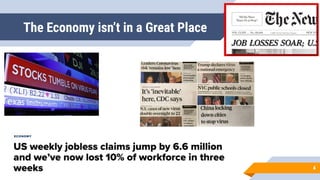
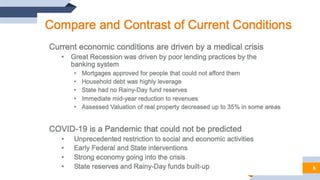
The Economy isn’t in a Great Place
4
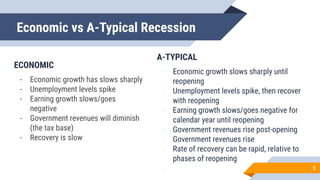
Economic vs A-Typical Recession
5
ECONOMIC
- Economic growth has slows sharply
- Unemployment levels spike
- Earning growth slows/goes
negative
- Government revenues will diminish
(the tax base)
- Recovery is slow
A-TYPICAL
- Economic growth slows sharply until
reopening
- Unemployment levels spike, then recover
with reopening
- Earning growth slows/goes negative for
calendar year until reopening
- Government revenues rise post-opening
- Government revenues rise
- Rate of recovery can be rapid, relative to
phases of reopening
-
6
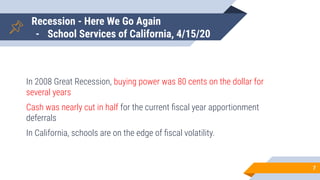
Recession - Here We Go Again
- School Services of California, 4/15/20
7
In 2008 Great Recession, buying power was 80 cents on the dollar for
several years
Cash was nearly cut in half for the current fiscal year apportionment
deferrals
In California, schools are on the edge of fiscal volatility.
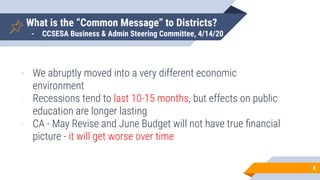
What is the “Common Message” to Districts?
- CCSESA Business & Admin Steering Committee, 4/14/20
8
- We abruptly moved into a very different economic
environment
- Recessions tend to last 10-15 months, but effects on public
education are longer lasting
- CA - May Revise and June Budget will not have true financial
picture - it will get worse over time
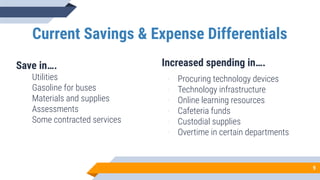
Current Savings & Expense Differentials
9
Save in….
Utilities
Gasoline for buses
Materials and supplies
Assessments
Some contracted services
Increased spending in….
- Procuring technology devices
- Technology infrastructure
- Online learning resources
- Cafeteria funds
- Custodial supplies
- Overtime in certain departments
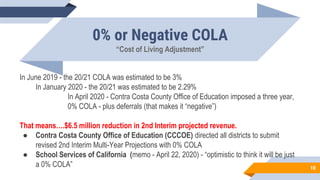
0% or Negative COLA
“Cost of Living Adjustment”
In June 2019 - the 20/21 COLA was estimated to be 3%
In January 2020 - the 20/21 was estimated to be 2.29%
In April 2020 - Contra Costa County Office of Education imposed a three year,
0% COLA - plus deferrals (that makes it “negative”)
That means….$6.5 million reduction in 2nd Interim projected revenue.
● Contra Costa County Office of Education (CCCOE) directed all districts to submit
revised 2nd Interim Multi-Year Projections with 0% COLA
● School Services of California (memo - April 22, 2020) - “optimistic to think it will be just
a 0% COLA” 10
11
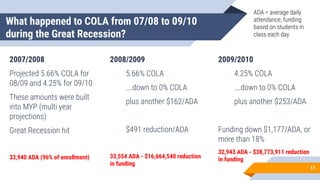
What happened to COLA from 07/08 to 09/10
during the Great Recession?
2007/2008
Projected 5.66% COLA for
08/09 and 4.25% for 09/10
These amounts were built
into MYP (multi year
projections)
Great Recession hit
33,940 ADA (96% of enrollment)
2008/2009
- 5.66% COLA
….down to 0% COLA
plus another $162/ADA
- $491 reduction/ADA
33,554 ADA - $16,664,540 reduction
in funding
2009/2010
- 4.25% COLA
….down to 0% COLA
plus another $253/ADA
Funding down $1,177/ADA, or
more than 18%
32,943 ADA - $38,773,911 reduction
in funding
ADA = average daily
attendance, funding
based on students in
class each day
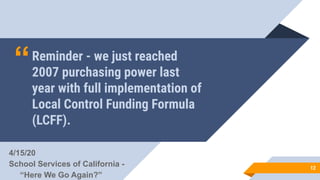
“Reminder - we just reached
2007 purchasing power last
year with full implementation of
Local Control Funding Formula
(LCFF).
12
4/15/20
School Services of California -
“Here We Go Again?”
13
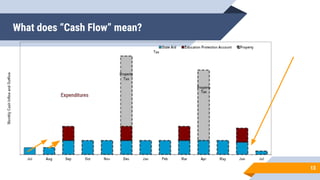
What does “Cash Flow” mean?
14
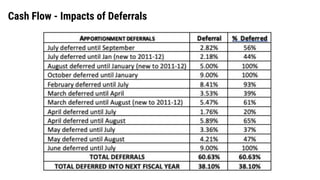
Cash Flow - Impacts of Deferrals
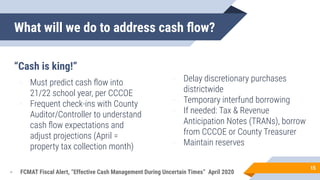
What will we do to address cash flow?
15
“Cash is king!”
- Must predict cash flow into
21/22 school year, per CCCOE
- Frequent check-ins with County
Auditor/Controller to understand
cash flow expectations and
adjust projections (April =
property tax collection month)
- Delay discretionary purchases
districtwide
- Temporary interfund borrowing
- If needed: Tax & Revenue
Anticipation Notes (TRANs), borrow
from CCCOE or County Treasurer
- Maintain reserves
- FCMAT Fiscal Alert, “Effective Cash Management During Uncertain Times” April 2020
16
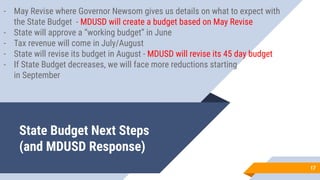
State Budget Next Steps
(and MDUSD Response)
17
- May Revise where Governor Newsom gives us details on what to expect with
the State Budget - MDUSD will create a budget based on May Revise
- State will approve a “working budget” in June
- Tax revenue will come in July/August
- State will revise its budget in August - MDUSD will revise its 45 day budget
- If State Budget decreases, we will face more reductions starting
in September
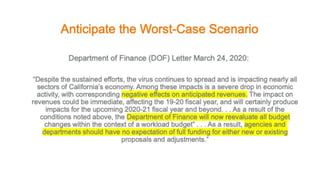
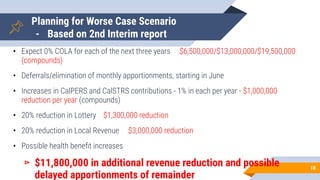
Planning for Worse Case Scenario
- Based on 2nd Interim report
• Expect 0% COLA for each of the next three years $6,500,000/$13,000,000/$19,500,000
(compounds)
• Deferrals/elimination of monthly apportionments, starting in June
• Increases in CalPERS and CalSTRS contributions - 1% in each per year - $1,000,000
reduction per year (compounds)
• 20% reduction in Lottery $1,300,000 reduction
• 20% reduction in Local Revenue $3,000,000 reduction
• Possible health benefit increases
▻ $11,800,000 in additional revenue reduction and possible
delayed apportionments of remainder
18
▰ Board Q&A
19

MDUSD Budget Update - April 2020

  • 1.
    Budget Update School BoardMeeting April 27, 2020 Presented by: Dr. Lisa Gonzales Chief Business Officer
  • 2.
    Outcomes ● Share perspectivesof Contra Costa Health Services ● Explain a typical economically driven recession and the historical impacts ● Identify where we are currently seeing savings/expense differentials ● Review COLA and Property Tax implications ● Present cash flow and what happens when we do not have it available ● Discuss strategies to effectively manage cash ● Share levels of speed of recovery and impact ● Identify budget development considerations tied to economic changes 2
  • 3.
    3 What are ContraCosta Health Services, County of Santa Clara Public Health Department advising? ● A vaccine won’t be readily available for 12-18 months ● A second wave of infections are expected in the Oct/Nov timeframe ● Children/staff with significant health conditions will continue to be vulnerable ● Teaching and reinforcing prevention behaviors will be critical ● A continuum of distance/blended learning will be needed ● Strategies for social distancing will need to be explored ● Ongoing attendance issues
  • 4.
    The Economy isn’tin a Great Place 4
  • 5.
    Economic vs A-TypicalRecession 5 ECONOMIC - Economic growth has slows sharply - Unemployment levels spike - Earning growth slows/goes negative - Government revenues will diminish (the tax base) - Recovery is slow A-TYPICAL - Economic growth slows sharply until reopening - Unemployment levels spike, then recover with reopening - Earning growth slows/goes negative for calendar year until reopening - Government revenues rise post-opening - Government revenues rise - Rate of recovery can be rapid, relative to phases of reopening -
  • 6.
  • 7.
    Recession - HereWe Go Again - School Services of California, 4/15/20 7 In 2008 Great Recession, buying power was 80 cents on the dollar for several years Cash was nearly cut in half for the current fiscal year apportionment deferrals In California, schools are on the edge of fiscal volatility.
  • 8.
    What is the“Common Message” to Districts? - CCSESA Business & Admin Steering Committee, 4/14/20 8 - We abruptly moved into a very different economic environment - Recessions tend to last 10-15 months, but effects on public education are longer lasting - CA - May Revise and June Budget will not have true financial picture - it will get worse over time
  • 9.
    Current Savings &Expense Differentials 9 Save in…. Utilities Gasoline for buses Materials and supplies Assessments Some contracted services Increased spending in…. - Procuring technology devices - Technology infrastructure - Online learning resources - Cafeteria funds - Custodial supplies - Overtime in certain departments
  • 10.
    0% or NegativeCOLA “Cost of Living Adjustment” In June 2019 - the 20/21 COLA was estimated to be 3% In January 2020 - the 20/21 was estimated to be 2.29% In April 2020 - Contra Costa County Office of Education imposed a three year, 0% COLA - plus deferrals (that makes it “negative”) That means….$6.5 million reduction in 2nd Interim projected revenue. ● Contra Costa County Office of Education (CCCOE) directed all districts to submit revised 2nd Interim Multi-Year Projections with 0% COLA ● School Services of California (memo - April 22, 2020) - “optimistic to think it will be just a 0% COLA” 10
  • 11.
    11 What happened toCOLA from 07/08 to 09/10 during the Great Recession? 2007/2008 Projected 5.66% COLA for 08/09 and 4.25% for 09/10 These amounts were built into MYP (multi year projections) Great Recession hit 33,940 ADA (96% of enrollment) 2008/2009 - 5.66% COLA ….down to 0% COLA plus another $162/ADA - $491 reduction/ADA 33,554 ADA - $16,664,540 reduction in funding 2009/2010 - 4.25% COLA ….down to 0% COLA plus another $253/ADA Funding down $1,177/ADA, or more than 18% 32,943 ADA - $38,773,911 reduction in funding ADA = average daily attendance, funding based on students in class each day
  • 12.
    “Reminder - wejust reached 2007 purchasing power last year with full implementation of Local Control Funding Formula (LCFF). 12 4/15/20 School Services of California - “Here We Go Again?”
  • 13.
    13 What does “CashFlow” mean?
  • 14.
    14 Cash Flow -Impacts of Deferrals
  • 15.
    What will wedo to address cash flow? 15 “Cash is king!” - Must predict cash flow into 21/22 school year, per CCCOE - Frequent check-ins with County Auditor/Controller to understand cash flow expectations and adjust projections (April = property tax collection month) - Delay discretionary purchases districtwide - Temporary interfund borrowing - If needed: Tax & Revenue Anticipation Notes (TRANs), borrow from CCCOE or County Treasurer - Maintain reserves - FCMAT Fiscal Alert, “Effective Cash Management During Uncertain Times” April 2020
  • 16.
  • 17.
    State Budget NextSteps (and MDUSD Response) 17 - May Revise where Governor Newsom gives us details on what to expect with the State Budget - MDUSD will create a budget based on May Revise - State will approve a “working budget” in June - Tax revenue will come in July/August - State will revise its budget in August - MDUSD will revise its 45 day budget - If State Budget decreases, we will face more reductions starting in September
  • 18.
    Planning for WorseCase Scenario - Based on 2nd Interim report • Expect 0% COLA for each of the next three years $6,500,000/$13,000,000/$19,500,000 (compounds) • Deferrals/elimination of monthly apportionments, starting in June • Increases in CalPERS and CalSTRS contributions - 1% in each per year - $1,000,000 reduction per year (compounds) • 20% reduction in Lottery $1,300,000 reduction • 20% reduction in Local Revenue $3,000,000 reduction • Possible health benefit increases ▻ $11,800,000 in additional revenue reduction and possible delayed apportionments of remainder 18
  • 19.