School life
Teachers open the door, but you must enter
by yourself.
Chinese proverb
How do you understand the words
“a good education”?
Do you need a good education?
Why do you need it?
How can you get it?
What does school mean to you?
School
Pupils Teachers School activities
School rules Punishment
School building Classrooms
School uniform
What do you like most in your school?
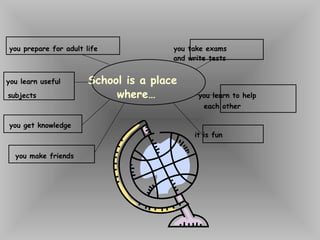
you prepare for adult life you take exams
and write tests
you learn useful School is a place
subjects where… you learn to help
each other
you get knowledge
it is fun
you make friends
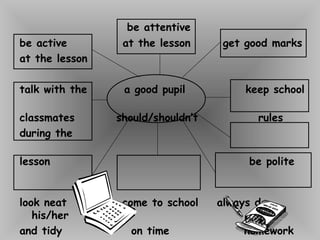
be attentive
be active at the lesson get good marks
at the lesson
talk with the a good pupil keep school
classmates should/shouldn’t rules
during the
lesson be polite
look neat come to school always do
his/her
and tidy on time homework
What do you do to be a good pupil?
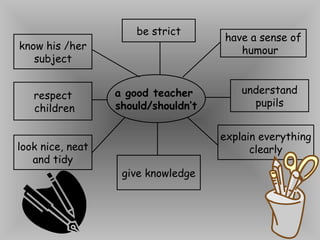
a good teacher
should/shouldn’t
know his /her
subject
have a sense of
humour
understand
pupils
explain everything
clearlylook nice, neat
and tidy
give knowledge
be strict
respect
children
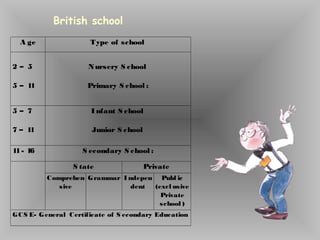
British school
A ge Type of school
2 – 5
5 – 11
Nursery S chool
Primary S chool :
5 – 7
7 – 11
I nfant S chool
Junior S chool
11- 16 S econdary S chool :
S tate Private
Comprehen
sive
Grammar I ndepen
dent
Publ ic
(excl usive
Private
school )
GCS E- General Certificate of S econdary Education
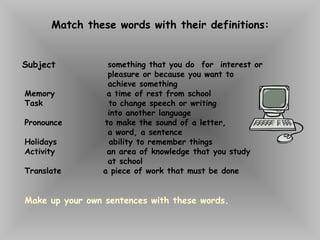
Match these words with their definitions:
something that you do for interest or
pleasure or because you want to
achieve something
Memory a time of rest from school
Task to change speech or writing
into another language
Pronounce to make the sound of a letter,
a word, a sentence
Holidays ability to remember things
Activity an area of knowledge that you study
at school
Translate a piece of work that must be done
Make up your own sentences with these words.
Subject
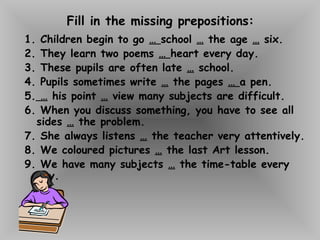
Fill in the missing prepositions:
1. Children begin to go … school … the age … six.
2. They learn two poems … heart every day.
3. These pupils are often late … school.
4. Pupils sometimes write … the pages … a pen.
5. … his point … view many subjects are difficult.
6. When you discuss something, you have to see all
sides … the problem.
7. She always listens … the teacher very attentively.
8. We coloured pictures … the last Art lesson.
9. We have many subjects … the time-table every
day.
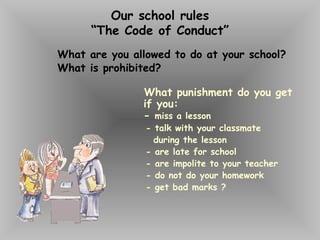
Our school rules
“The Code of Conduct”
What are you allowed to do at your school?
What is prohibited?
What punishment do you get
if you:
- miss a lesson
- talk with your classmate
during the lesson
- are late for school
- are impolite to your teacher
- do not do your homework
- get bad marks ?
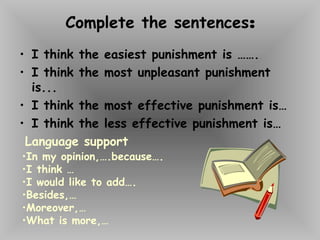
Complete the sentences:
• I think the easiest punishment is …….
• I think the most unpleasant punishment
is...
• I think the most effective punishment is…
• I think the less effective punishment is…
Language support
•In my opinion,….because….
•I think …
•I would like to add….
•Besides,…
•Moreover,…
•What is more,…
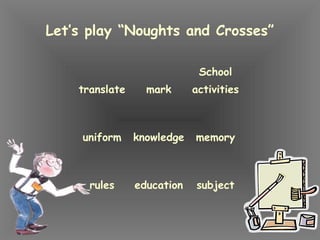
Let’s play “Noughts and Crosses”
translate mark
School
activities
uniform knowledge memory
rules education subject
Thank you
for the lesson
Good bye

School in our life

  • 1.
    School life Teachers openthe door, but you must enter by yourself. Chinese proverb
  • 2.
    How do youunderstand the words “a good education”? Do you need a good education? Why do you need it? How can you get it?
  • 3.
    What does schoolmean to you? School Pupils Teachers School activities School rules Punishment School building Classrooms School uniform What do you like most in your school?
  • 4.
    you prepare foradult life you take exams and write tests you learn useful School is a place subjects where… you learn to help each other you get knowledge it is fun you make friends
  • 5.
    be attentive be activeat the lesson get good marks at the lesson talk with the a good pupil keep school classmates should/shouldn’t rules during the lesson be polite look neat come to school always do his/her and tidy on time homework
  • 6.
    What do youdo to be a good pupil?
  • 7.
    a good teacher should/shouldn’t knowhis /her subject have a sense of humour understand pupils explain everything clearlylook nice, neat and tidy give knowledge be strict respect children
  • 8.
    British school A geType of school 2 – 5 5 – 11 Nursery S chool Primary S chool : 5 – 7 7 – 11 I nfant S chool Junior S chool 11- 16 S econdary S chool : S tate Private Comprehen sive Grammar I ndepen dent Publ ic (excl usive Private school ) GCS E- General Certificate of S econdary Education
  • 9.
    Match these wordswith their definitions: something that you do for interest or pleasure or because you want to achieve something Memory a time of rest from school Task to change speech or writing into another language Pronounce to make the sound of a letter, a word, a sentence Holidays ability to remember things Activity an area of knowledge that you study at school Translate a piece of work that must be done Make up your own sentences with these words. Subject
  • 10.
    Fill in themissing prepositions: 1. Children begin to go … school … the age … six. 2. They learn two poems … heart every day. 3. These pupils are often late … school. 4. Pupils sometimes write … the pages … a pen. 5. … his point … view many subjects are difficult. 6. When you discuss something, you have to see all sides … the problem. 7. She always listens … the teacher very attentively. 8. We coloured pictures … the last Art lesson. 9. We have many subjects … the time-table every day.
  • 11.
    Our school rules “TheCode of Conduct” What are you allowed to do at your school? What is prohibited? What punishment do you get if you: - miss a lesson - talk with your classmate during the lesson - are late for school - are impolite to your teacher - do not do your homework - get bad marks ?
  • 12.
    Complete the sentences: •I think the easiest punishment is ……. • I think the most unpleasant punishment is... • I think the most effective punishment is… • I think the less effective punishment is… Language support •In my opinion,….because…. •I think … •I would like to add…. •Besides,… •Moreover,… •What is more,…
  • 13.
    Let’s play “Noughtsand Crosses” translate mark School activities uniform knowledge memory rules education subject
  • 14.
    Thank you for thelesson Good bye