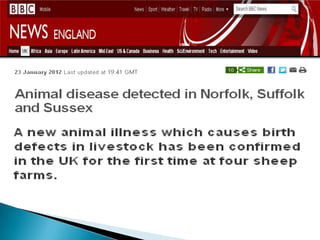
Schmallenberg Virus is a new emerging
livestock disease that has been detected in
Belgium, Germany, the Netherlands and the
UK.
    It is similar to some other animal disease
pathogens, such as Akabane and Shamonda
viruses, which are transmitted by vectors, such
as midges, mosquitoes and ticks.
    The virus has been associated with brief
mild/moderate            disease          (milk
drop, pyrexia, diarrhoea) in adult cattle and
late abortion or birth defects in newborn
cattle, sheep and goats.
Schmallenberg virus
“The disease first emerged
  in the Netherlands and
    Germany last year.”
   Between August and October 2011, outbreaks of
    disease in adult cattle that included mild to
    moderate fever, reduced milk yield, loss of
    appetite, loss of body condition and diarrhoea were
    reported in both the Netherlands and Germany.
    Testing for common causes proved negative.
   From November 2011, abortion and stillbirths
    associated with foetal abnormalities, affecting
    mainly sheep but also cattle and goats, were
    identified in the Netherlands, Germany and
    Belgium.
   A new virus was identified in December 2011 as the
    cause of both conditions. This was named
    „Schmallenberg virus‟ after the German town where
    the virus was first identified.
“The Animal Health and
    Veterinary Laboratories
  Agency, which detected the
disease in the UK farms, said it
 was continuing to monitor it.”
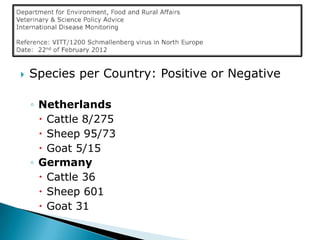
   Species per Country: Positive or Negative

    ◦ Netherlands
       Cattle 8/275
       Sheep 95/73
       Goat 5/15
    ◦ Germany
       Cattle 36
       Sheep 601
       Goat 31
“It can lead to late abortions and
    birth deformities in newborn
  sheep, goats and cattle and is
      thought to be spread by
              midges.”
“In adult cows, cases of acute infection have
resulted in diarrhoea, fever, a reduction in milk
yield, with a full and rapid recovery over several
days. Affected herds had outbreaks of disease
lasting two to three weeks.
    In newborn animals and fetuses, the disease
has been presented as malformations including
bent limbs and fixed joints, brain deformities and
marked damage to the spinal cord. Some animals
are born with a normal outer appearance but have
nervous signs such as a „dummy‟ presentation or
blindness, ataxia, recumbency, an inability to suck
and sometimes fits. The foetal deformities vary
depending on when infection occurred during
pregnancy.”
   National Farmers' Union chief livestock
    adviser Peter Garbutt said: "I would urge
    farmers to remain extra vigilant for signs of
    this   disease    and   take    all  sensible
    precautions to prevent infection."
   The Department for Food, Environment and
    Rural Affairs and the National Farmers
    Union are urging farmers and vets to report
    any suspicious cases.
“There is unlikely to be a risk to human health
from Schmallenberg virus; but this is not yet certain.
      Farmers and veterinary surgeons are advised
to take sensible hygiene precautions when working
with livestock and abortion material. Although
several members of the group of related viruses can
affect humans, the ability to do so is thought to be
due to a gene sequence which is not present in
Schmallenberg virus.
      Pregnant women should not have contact with
sheep and goats at lambing/kidding time due to
risks of exposure to other disease causing
organisms.”
   Can lead to late abortions and birth deformities
    in newborn sheep, goats and cattle
   Reduced milk yield and diarrhea for adult cows
   First emerged in the Netherlands and Germany in
    2011
   Virus named after the German town where it was
    first seen
   Different organizations advises farms to report
    any suspicious cases and to take precautions to
    prevent infections.
   Unlikely risk to harm human; but advised to take
    hygienic precautions
   http://www.bbc.co.uk/news/uk-england-
    16693474
   http://vla.defra.gov.uk/science/sci_schmalle
    nberg.htm
   http://www.defra.gov.uk/animal-diseases/a-
    z/schmallenberg-virus/
   http://www.defra.gov.uk/animal-
    diseases/files/poa-schmallenberg-update-
    120222.pdf

Schmallenberg virus

  • 2.
    Schmallenberg Virus isa new emerging livestock disease that has been detected in Belgium, Germany, the Netherlands and the UK. It is similar to some other animal disease pathogens, such as Akabane and Shamonda viruses, which are transmitted by vectors, such as midges, mosquitoes and ticks. The virus has been associated with brief mild/moderate disease (milk drop, pyrexia, diarrhoea) in adult cattle and late abortion or birth defects in newborn cattle, sheep and goats.
  • 3.
  • 5.
    “The disease firstemerged in the Netherlands and Germany last year.”
  • 6.
    Between August and October 2011, outbreaks of disease in adult cattle that included mild to moderate fever, reduced milk yield, loss of appetite, loss of body condition and diarrhoea were reported in both the Netherlands and Germany. Testing for common causes proved negative.  From November 2011, abortion and stillbirths associated with foetal abnormalities, affecting mainly sheep but also cattle and goats, were identified in the Netherlands, Germany and Belgium.  A new virus was identified in December 2011 as the cause of both conditions. This was named „Schmallenberg virus‟ after the German town where the virus was first identified.
  • 7.
    “The Animal Healthand Veterinary Laboratories Agency, which detected the disease in the UK farms, said it was continuing to monitor it.”
  • 8.
    Species per Country: Positive or Negative ◦ Netherlands  Cattle 8/275  Sheep 95/73  Goat 5/15 ◦ Germany  Cattle 36  Sheep 601  Goat 31
  • 9.
    “It can leadto late abortions and birth deformities in newborn sheep, goats and cattle and is thought to be spread by midges.”
  • 10.
    “In adult cows,cases of acute infection have resulted in diarrhoea, fever, a reduction in milk yield, with a full and rapid recovery over several days. Affected herds had outbreaks of disease lasting two to three weeks. In newborn animals and fetuses, the disease has been presented as malformations including bent limbs and fixed joints, brain deformities and marked damage to the spinal cord. Some animals are born with a normal outer appearance but have nervous signs such as a „dummy‟ presentation or blindness, ataxia, recumbency, an inability to suck and sometimes fits. The foetal deformities vary depending on when infection occurred during pregnancy.”
  • 12.
    National Farmers' Union chief livestock adviser Peter Garbutt said: "I would urge farmers to remain extra vigilant for signs of this disease and take all sensible precautions to prevent infection."  The Department for Food, Environment and Rural Affairs and the National Farmers Union are urging farmers and vets to report any suspicious cases.
  • 14.
    “There is unlikelyto be a risk to human health from Schmallenberg virus; but this is not yet certain. Farmers and veterinary surgeons are advised to take sensible hygiene precautions when working with livestock and abortion material. Although several members of the group of related viruses can affect humans, the ability to do so is thought to be due to a gene sequence which is not present in Schmallenberg virus. Pregnant women should not have contact with sheep and goats at lambing/kidding time due to risks of exposure to other disease causing organisms.”
  • 15.
    Can lead to late abortions and birth deformities in newborn sheep, goats and cattle  Reduced milk yield and diarrhea for adult cows  First emerged in the Netherlands and Germany in 2011  Virus named after the German town where it was first seen  Different organizations advises farms to report any suspicious cases and to take precautions to prevent infections.  Unlikely risk to harm human; but advised to take hygienic precautions
  • 16.
    http://www.bbc.co.uk/news/uk-england- 16693474  http://vla.defra.gov.uk/science/sci_schmalle nberg.htm  http://www.defra.gov.uk/animal-diseases/a- z/schmallenberg-virus/  http://www.defra.gov.uk/animal- diseases/files/poa-schmallenberg-update- 120222.pdf