INTRODUCTION TO APPLICATION
DEVELOPMENT
OVERVIEW

   Intro to Application Development

   Types of Application

   Authoring System

   Authoring Process

   Programming Languages


                                       2
APPLICATION DEVELOPMENT
   Application development is a complex and dynamic
    process:
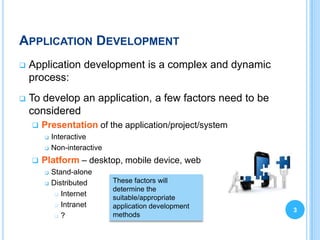
   To develop an application, a few factors need to be
    considered
       Presentation of the application/project/system
           Interactive
           Non-interactive
       Platform – desktop, mobile device, web
           Stand-alone
           Distributed       These factors will
                              determine the
              Internet
                              suitable/appropriate
              Intranet       application development
                                                          3
              ?              methods
APPLICATION DEVELOPMENT
    Types of application
      education,
      entertainment,

      E-commerce

      Etc..


                            4
APPLICATION DEVELOPMENT - METHODS
Authoring                     Programming

 Applications specially       Languages specify how
  designed to integrate         the media is presented
  and present media             and user interactions
  elements.                     carried out.
 Developers can               Requires command of
  concentrate on                the language.
  design, interactivity, an    Is time consuming.
  d functionality of the
  project
                                                         5
AUTHORING SYSTEM
6
AUTHORING SYSTEM
 Is software designed for creation of multimedia
  projects.
 Is a program which has pre-programmed elements
  for the development of interactive multimedia
  software titles

   Applications are used to:
     Assemble media elements
     Synchronize content
     Design user interface
     Provide user interactivity
                                                    7
AUTHORING METAPHORS
   Authoring applications are grouped around three
    metaphors:
                                  Scissor - A metaphor to represent „cut‟
     Card – page based
     Icon – event driven
     Timeline

   A metaphor is a comparison of
    one thing to another to enhance         Is there any
    understanding                           other metaphor

   Metaphors help orient developer
    to how the software organizes the
    media, sequences events, and
    presents final project.                                                 8
CARD METAPHOR
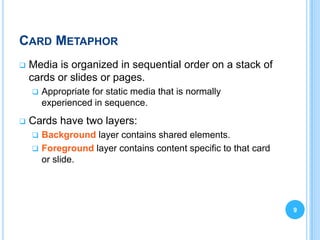
   Media is organized in sequential order on a stack of
    cards or slides or pages.
       Appropriate for static media that is normally
        experienced in sequence.
   Cards have two layers:
     Background layer contains shared elements.
     Foreground layer contains content specific to that card
      or slide.


                                                                9
CARD METAPHOR
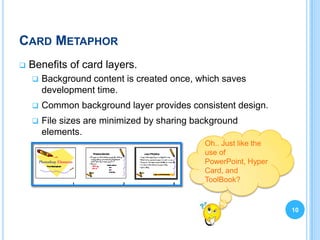
   Benefits of card layers.
       Background content is created once, which saves
        development time.
       Common background layer provides consistent design.
       File sizes are minimized by sharing background
        elements.
                                              Oh.. Just like the
                                              use of
                                              PowerPoint, Hyper
                                              Card, and
                                              ToolBook?


                                                                   10
ICON METAPHOR
   Icons define media and forms of interactivity.
   Icons are placed on a flowline to create the
    application structure.
       Each icon has a dialog box with properties and
        parameters identified by the developer.
       Flowlines let developers visualize and adjust the
        structure of the application.
   Branching routines add controls for user interaction


                                                            11
ICON METAPHOR
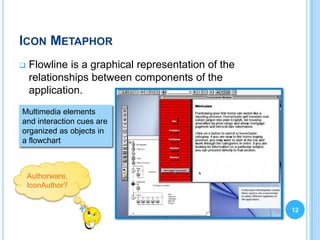
   Flowline is a graphical representation of the
    relationships between components of the
    application.
Multimedia elements
and interaction cues are
organized as objects in
a flowchart


    Authorware,
    IconAuthor?


                                                    12
TIMELINE METAPHOR
   Organizes media and interactivity as sequence of
    frames.
       Each frame can have multiple layers.
       Layers define the stacking order of the content to be
        displayed.
   Appropriate for dynamic media as the media can by
    synchronized precisely over time.


                                                                13
TIMELINE METAPHOR
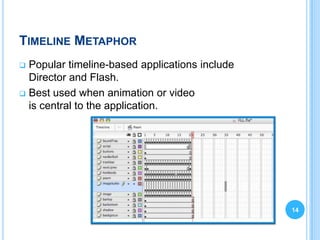
 Popular timeline-based applications include
  Director and Flash.
 Best used when animation or video
  is central to the application.


                                                14
AUTHORING PROCESS
15   A series of interrelated tasks from project design to
     delivery
AUTHORING PROCESS
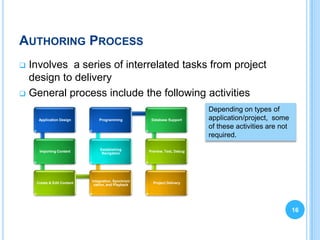
 Involves a series of interrelated tasks from project
  design to delivery
 General process include the following activities

                                                                            Depending on types of
     Application Design         Programming           Database Support      application/project, some
                                                                            of these activities are not
                                                                            required.
                                Establishing
     Importing Content                               Preview, Test, Debug
                                 Navigation


                            Integration, Synchroni
    Create & Edit Content                              Project Delivery
                             zation, and Playback


                                                                                                          16
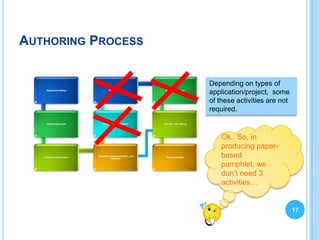
AUTHORING PROCESS


                                                                                      Depending on types of
    Application Design              Programming                 Database Support
                                                                                      application/project, some
                                                                                      of these activities are not
                                                                                      required.
    Importing Content          Establishing Navigation         Preview, Test, Debug


                                                                                          Ok.. So, in
                                                                                          producing paper-
   Create & Edit Content
                           Integration, Synchronization, and
                                        Playback
                                                                 Project Delivery         based
                                                                                          pamphlet, we
                                                                                          don‟t need 3
                                                                                          activities…


                                                                                                                    17
APPLICATIONS DESIGN
   Authoring software supports the design process.
       Outline view in PowerPoint structures presentation.
       Storyboard development is common in complex
        applications.
          Storyboard is a series of screen sketches to guide
          development process.


                                                                18
IMPORTING CONTENT
   Media is generally created in media-specific
    applications and imported into the authoring
    environment.
     File formats for imported media are important.
     Conversion utilities within the application are useful.


                                                                19
CREATE AND EDIT CONTENT
   All authoring applications include some tools for
    creating and editing media content. For example:
       Text adjustments to font size and color.
       Paint tools to add shapes and edit image features.
       Sound adjustment on volume, duration.
       Animation changes to speed and direction.


                                                             20
INTEGRATION, SYNCHRONIZATION,             AND
PLAYBACK
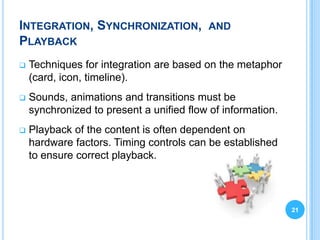
   Techniques for integration are based on the metaphor
    (card, icon, timeline).
   Sounds, animations and transitions must be
    synchronized to present a unified flow of information.
   Playback of the content is often dependent on
    hardware factors. Timing controls can be established
    to ensure correct playback.


                                                             21
ESTABLISHING NAVIGATION
   Authoring software can establish the order of the
    content on playback.
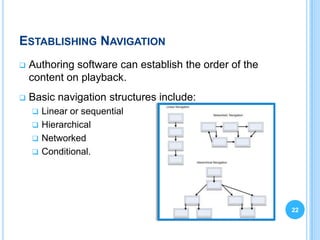
   Basic navigation structures include:
     Linear or sequential
     Hierarchical
     Networked
     Conditional.


                                                        22
PROGRAMMING
   Provides more flexibility and control.
       For projects with extensive interactivity, custom features.
   Two programming methods.
       Script: series of commands specifying properties or
        behavior of an element in the project.
         Commands are interpreted as the project is executed.
         Support authoring, e.g use of Lingo script in Director


       Icon: dialog boxes allow the developer to specify
        parameters for icon's use.
           Does not require programming knowledge but does limit
            commands to icon parameters.
                                                                      23
DATABASE SUPPORT
   Some projects may require access to a collection of
    related files to store and retrieve user input.
       Tutorials have databases of related facts to test
        comprehension.
       User stores answers for future reference and scoring.
   Authorware and Director applications offer an
    interface to a database.


                                                                24
PREVIEW, TEST, DEBUG
   Projects are created in the development mode.
       Necessary to preview the project as it will appear in the
        final product and test the components of the screen
        displays.
       Authoring applications often have a preview mode to test
        the assembled project during development.
           Debugger tools can identify errors in program code.


                                                                    25
PROJECT DELIVERY
 Projects are published so they play outside the
  authoring environment.
 Two approaches to publishing.
        Project requires a separate player program to present the
         multimedia content.
            QuickTime, Flash, and MediaPlayer programs are free player
             downloads.
        Project embeds the player in the multimedia project.
          Larger files, but project is a stand-alone application.
          often used on CD or DVD distribution since there is adequate

           storage to contain the player file and the developer is assured the
           proper program is available for playback.

    Web multimedia projects rely on a Player program on the client computer.       26
    This reduces file size for speedier download times. Client, however, may
    need to download the latest update of the player software on their computer.
CHOOSING AN AUTHORING APPLICATION
   No single authoring tool is suitable for all projects.
    To select the right application:
       Consider the subject (static or dynamic media).
       Consider the media (source file formats compatible).
       Consider delivery (where used, means of distribution).
       Consider maintenance (expertise needed to revise
        content, frequent update cycles).


                                                                 27
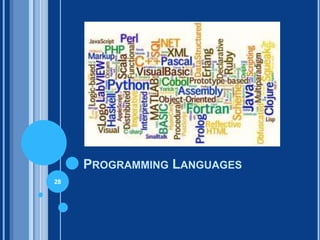
PROGRAMMING LANGUAGES
28
PROGRAMMING LANGUAGES
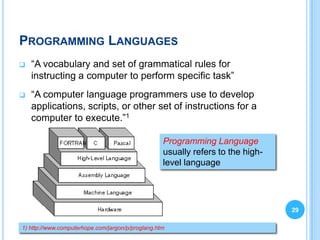
   “A vocabulary and set of grammatical rules for
    instructing a computer to perform specific task”
   “A computer language programmers use to develop
    applications, scripts, or other set of instructions for a
    computer to execute.”1

                                                   Programming Language
                                                   usually refers to the high-
                                                   level language


                                                                                 29

1) http://www.computerhope.com/jargon/p/proglang.htm
PROGRAMMING LANGUAGES
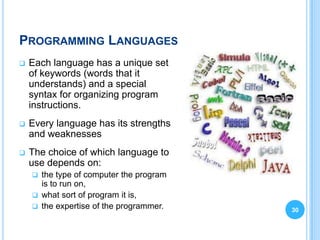
   Each language has a unique set
    of keywords (words that it
    understands) and a special
    syntax for organizing program
    instructions.
   Every language has its strengths
    and weaknesses
   The choice of which language to
    use depends on:
     the type of computer the program
      is to run on,
     what sort of program it is,
     the expertise of the programmer.   30
ADDITIONAL READINGS


    http://www.giac.org/cissp-papers/97.pdf
    http://www.egyankosh.ac.in/bitstream/123456789/34036/1/
     Unit-3.pdf


                                                               31

Scct2013 topic5-introto applicationdevelopment

  • 1.
  • 2.
    OVERVIEW  Intro to Application Development  Types of Application  Authoring System  Authoring Process  Programming Languages 2
  • 3.
    APPLICATION DEVELOPMENT  Application development is a complex and dynamic process:  To develop an application, a few factors need to be considered  Presentation of the application/project/system  Interactive  Non-interactive  Platform – desktop, mobile device, web  Stand-alone  Distributed These factors will determine the  Internet suitable/appropriate  Intranet application development 3  ? methods
  • 4.
    APPLICATION DEVELOPMENT  Types of application  education,  entertainment,  E-commerce  Etc.. 4
  • 5.
    APPLICATION DEVELOPMENT -METHODS Authoring Programming  Applications specially  Languages specify how designed to integrate the media is presented and present media and user interactions elements. carried out.  Developers can  Requires command of concentrate on the language. design, interactivity, an  Is time consuming. d functionality of the project 5
  • 6.
  • 7.
    AUTHORING SYSTEM  Issoftware designed for creation of multimedia projects.  Is a program which has pre-programmed elements for the development of interactive multimedia software titles  Applications are used to:  Assemble media elements  Synchronize content  Design user interface  Provide user interactivity 7
  • 8.
    AUTHORING METAPHORS  Authoring applications are grouped around three metaphors: Scissor - A metaphor to represent „cut‟  Card – page based  Icon – event driven  Timeline  A metaphor is a comparison of one thing to another to enhance Is there any understanding other metaphor  Metaphors help orient developer to how the software organizes the media, sequences events, and presents final project. 8
  • 9.
    CARD METAPHOR  Media is organized in sequential order on a stack of cards or slides or pages.  Appropriate for static media that is normally experienced in sequence.  Cards have two layers:  Background layer contains shared elements.  Foreground layer contains content specific to that card or slide. 9
  • 10.
    CARD METAPHOR  Benefits of card layers.  Background content is created once, which saves development time.  Common background layer provides consistent design.  File sizes are minimized by sharing background elements. Oh.. Just like the use of PowerPoint, Hyper Card, and ToolBook? 10
  • 11.
    ICON METAPHOR  Icons define media and forms of interactivity.  Icons are placed on a flowline to create the application structure.  Each icon has a dialog box with properties and parameters identified by the developer.  Flowlines let developers visualize and adjust the structure of the application.  Branching routines add controls for user interaction 11
  • 12.
    ICON METAPHOR  Flowline is a graphical representation of the relationships between components of the application. Multimedia elements and interaction cues are organized as objects in a flowchart Authorware, IconAuthor? 12
  • 13.
    TIMELINE METAPHOR  Organizes media and interactivity as sequence of frames.  Each frame can have multiple layers.  Layers define the stacking order of the content to be displayed.  Appropriate for dynamic media as the media can by synchronized precisely over time. 13
  • 14.
    TIMELINE METAPHOR  Populartimeline-based applications include Director and Flash.  Best used when animation or video is central to the application. 14
  • 15.
    AUTHORING PROCESS 15 A series of interrelated tasks from project design to delivery
  • 16.
    AUTHORING PROCESS  Involvesa series of interrelated tasks from project design to delivery  General process include the following activities Depending on types of Application Design Programming Database Support application/project, some of these activities are not required. Establishing Importing Content Preview, Test, Debug Navigation Integration, Synchroni Create & Edit Content Project Delivery zation, and Playback 16
  • 17.
    AUTHORING PROCESS Depending on types of Application Design Programming Database Support application/project, some of these activities are not required. Importing Content Establishing Navigation Preview, Test, Debug Ok.. So, in producing paper- Create & Edit Content Integration, Synchronization, and Playback Project Delivery based pamphlet, we don‟t need 3 activities… 17
  • 18.
    APPLICATIONS DESIGN  Authoring software supports the design process.  Outline view in PowerPoint structures presentation.  Storyboard development is common in complex applications.  Storyboard is a series of screen sketches to guide development process. 18
  • 19.
    IMPORTING CONTENT  Media is generally created in media-specific applications and imported into the authoring environment.  File formats for imported media are important.  Conversion utilities within the application are useful. 19
  • 20.
    CREATE AND EDITCONTENT  All authoring applications include some tools for creating and editing media content. For example:  Text adjustments to font size and color.  Paint tools to add shapes and edit image features.  Sound adjustment on volume, duration.  Animation changes to speed and direction. 20
  • 21.
    INTEGRATION, SYNCHRONIZATION, AND PLAYBACK  Techniques for integration are based on the metaphor (card, icon, timeline).  Sounds, animations and transitions must be synchronized to present a unified flow of information.  Playback of the content is often dependent on hardware factors. Timing controls can be established to ensure correct playback. 21
  • 22.
    ESTABLISHING NAVIGATION  Authoring software can establish the order of the content on playback.  Basic navigation structures include:  Linear or sequential  Hierarchical  Networked  Conditional. 22
  • 23.
    PROGRAMMING  Provides more flexibility and control.  For projects with extensive interactivity, custom features.  Two programming methods.  Script: series of commands specifying properties or behavior of an element in the project.  Commands are interpreted as the project is executed.  Support authoring, e.g use of Lingo script in Director  Icon: dialog boxes allow the developer to specify parameters for icon's use.  Does not require programming knowledge but does limit commands to icon parameters. 23
  • 24.
    DATABASE SUPPORT  Some projects may require access to a collection of related files to store and retrieve user input.  Tutorials have databases of related facts to test comprehension.  User stores answers for future reference and scoring.  Authorware and Director applications offer an interface to a database. 24
  • 25.
    PREVIEW, TEST, DEBUG  Projects are created in the development mode.  Necessary to preview the project as it will appear in the final product and test the components of the screen displays.  Authoring applications often have a preview mode to test the assembled project during development.  Debugger tools can identify errors in program code. 25
  • 26.
    PROJECT DELIVERY  Projectsare published so they play outside the authoring environment.  Two approaches to publishing.  Project requires a separate player program to present the multimedia content.  QuickTime, Flash, and MediaPlayer programs are free player downloads.  Project embeds the player in the multimedia project.  Larger files, but project is a stand-alone application.  often used on CD or DVD distribution since there is adequate storage to contain the player file and the developer is assured the proper program is available for playback. Web multimedia projects rely on a Player program on the client computer. 26 This reduces file size for speedier download times. Client, however, may need to download the latest update of the player software on their computer.
  • 27.
    CHOOSING AN AUTHORINGAPPLICATION  No single authoring tool is suitable for all projects. To select the right application:  Consider the subject (static or dynamic media).  Consider the media (source file formats compatible).  Consider delivery (where used, means of distribution).  Consider maintenance (expertise needed to revise content, frequent update cycles). 27
  • 28.
  • 29.
    PROGRAMMING LANGUAGES  “A vocabulary and set of grammatical rules for instructing a computer to perform specific task”  “A computer language programmers use to develop applications, scripts, or other set of instructions for a computer to execute.”1 Programming Language usually refers to the high- level language 29 1) http://www.computerhope.com/jargon/p/proglang.htm
  • 30.
    PROGRAMMING LANGUAGES  Each language has a unique set of keywords (words that it understands) and a special syntax for organizing program instructions.  Every language has its strengths and weaknesses  The choice of which language to use depends on:  the type of computer the program is to run on,  what sort of program it is,  the expertise of the programmer. 30
  • 31.
    ADDITIONAL READINGS  http://www.giac.org/cissp-papers/97.pdf  http://www.egyankosh.ac.in/bitstream/123456789/34036/1/ Unit-3.pdf 31