


Scaling Agile Teams
Ron Lichty | Ron Lichty Consulting
Ron@RonLichty.com | www.ronlichty.com
* Addison Wesley (Amazon, BarnesandNoble, InformIT.com, Safari)
http://ManagingTheUnmanageable.net <-----tools, excerpts, more rules of thumb
© Ron Lichty 2
*
© Ron Lichty 3
http://ManagingTheUnmanageable.net <-----and pointers to video training
The Study of Product Team Performance
http://www.ronlichty.com/study.html
4© Ron Lichty
Ron Lichty,
Managing Software People & Teams
SOFTWEST
Untangling the Knots; Making Things Hum
• process
• culture
• communication
• planning
• rigor
© Ron Lichty 6
Software Development Organizations
Struggle with Structure
7
• Startups: When does our team become 2 teams?
• Larger orgs: Divide teams by components or by user function?
• Every org: As teams grow, when and how do we split them?
• Distributed teams: How do we distribute work geographically?
• Managers: What’s our role?
• Enterprises: Pools or teams?
• Teams: What is a team, anyway?
© Ron Lichty
A Couple Context Points for this Talk
8
The point is not to do Agile. The point is to
be effective. Agile provides us insights.
 --Al Shalloway, agile author/trainer/coach
Developing software is a team sport.
 --observation from 30 years managing programmers
© Ron Lichty
What’s the Ideal Team Size?
• Give me some answers in the chat window
© Ron Lichty 9
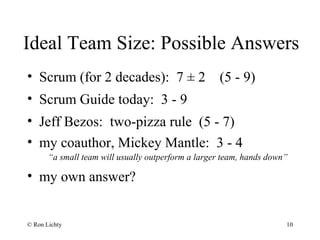
Ideal Team Size: Possible Answers
• Scrum (for 2 decades): 7 ± 2 (5 - 9)
• Scrum Guide today: 3 - 9
• Jeff Bezos: two-pizza rule (5 - 7)
• my coauthor, Mickey Mantle: 3 - 4
“a small team will usually outperform a larger team, hands down”
• my own answer?
© Ron Lichty 10
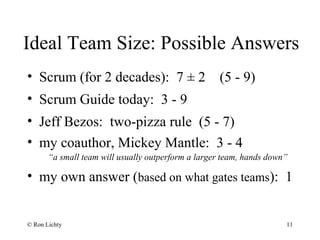
Ideal Team Size: Possible Answers
• Scrum (for 2 decades): 7 ± 2 (5 - 9)
• Scrum Guide today: 3 - 9
• Jeff Bezos: two-pizza rule (5 - 7)
• my coauthor, Mickey Mantle: 3 - 4
“a small team will usually outperform a larger team, hands down”
• my own answer (based on what gates teams): 1
© Ron Lichty 11
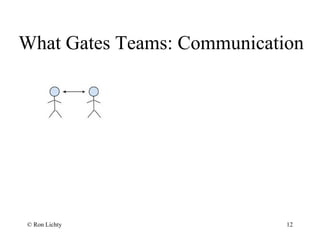
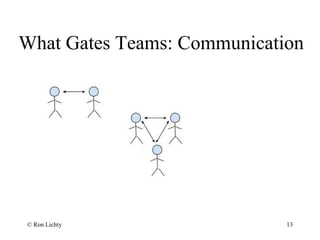
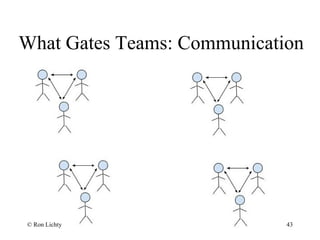
What Gates Teams: Communication
© Ron Lichty 12
What Gates Teams: Communication
© Ron Lichty 13
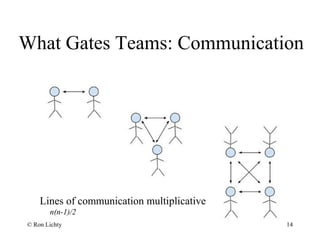
What Gates Teams: Communication
Lines of communication multiplicative
n(n-1)/2
© Ron Lichty 14
Ideal Team Size: 1
• all the communication is neuron-to-neuron
• J. Richard Hackman, Harvard: Team theory
“Research consistently shows that teams underperform...”
“problems with coordination and motivation typically chip away at
the benefits of collaboration”
• so what’s the issue?
© Ron Lichty 15
Ideal Team Size: 1
• all the communication is neuron-to-neuron
• J. Richard Hackman, Harvard: Team theory
“Research consistently shows that teams underperform...”
“problems with coordination and motivation typically chip away at
the benefits of collaboration”
• so what’s the issue?
• not many applications these days a single programmer can write
© Ron Lichty 16
Ideal Team Size: 1
• all the communication is neuron-to-neuron
• J. Richard Hackman, Harvard: Team theory
“Research consistently shows that teams underperform...”
“problems with coordination and motivation typically chip away at
the benefits of collaboration”
• so what’s the issue?
• not many applications these days a single programmer can write
• not many full-stack developers who can handle every part of an application
© Ron Lichty 17
Ideal Team Size: 3 - 4
• Mickey Mantle:
“a small team will usually outperform a larger team, hands down”
• Daniel Pupius, co-founder, Range:
“a sole genius isn’t going to solve problems in the way a group can”
• but even just Javascript: stacks of frameworks
MEAN - MongoDB - Express.js - AngularJS - Node.js
• ...and we run out of engineering bandwidth
© Ron Lichty 18
Ideal Team Size: two pizzas
• Jeff Bezos:
“5-7 people”
© Ron Lichty 19
Ideal Team Size: two pizzas
• Jeff Bezos:
“5-7 people, depending on their appetites”
© Ron Lichty 20
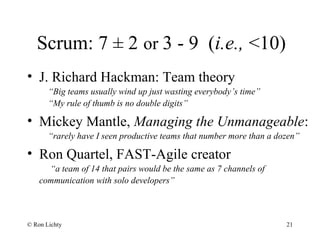
Scrum: 7 ± 2 or 3 - 9 (i.e., <10)
• J. Richard Hackman: Team theory
“Big teams usually wind up just wasting everybody’s time”
“My rule of thumb is no double digits”
• Mickey Mantle, Managing the Unmanageable:
“rarely have I seen productive teams that number more than a dozen”
• Ron Quartel, FAST-Agile creator
“a team of 14 that pairs would be the same as 7 channels of
communication with solo developers”
© Ron Lichty 21
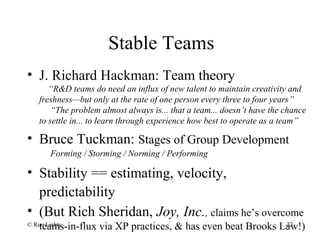
Stable Teams
• J. Richard Hackman: Team theory
“R&D teams do need an influx of new talent to maintain creativity and
freshness—but only at the rate of one person every three to four years”
“The problem almost always is... that a team... doesn’t have the chance
to settle in... to learn through experience how best to operate as a team”
• Bruce Tuckman: Stages of Group Development
Forming / Storming / Norming / Performing
• Stability == estimating, velocity,
predictability
• (But Rich Sheridan, Joy, Inc., claims he’s overcome
teams-in-flux via XP practices, & has even beat Brooks Law!)© Ron Lichty 22
Splitting Growing Teams
• When and how do we divide a team > 9?
– Don’t: Keep the team intact
– Cell division
– Split the team
– Hybrid split
© Ron Lichty 23
Keep the Team Intact
• The “maximum of 9” is a guideline, not a law!
• But! recognize the communication burden
• Give focus to communication effectiveness
• Support Re-Forming / Storming / Norming / Performing
© Ron Lichty 24
Cell Division
• Cleave off a small team
© Ron Lichty 25
Cell Division
• Cleave off a small team
Steve Gray, Slalom: Find a smaller area of functionality
that a smaller part of the team can be spawned off to address
Daniel Pupius, co-founder, Range: Peel off a stable island
while the larger remaining group deals with the larger, less-
defined surface area
© Ron Lichty 26
Splitting Teams
• Give some thought to Conway’s Law
“Organizations which design systems... are constrained to
produce designs which are copies of the communication
structures of these organizations.”
Glyn Morrison’s variant: “Software development
organizations ship their organization chart.”
Eric Raymond’s variant: “If you have four groups
working on a compiler, you’ll get a 4-pass compiler.”
© Ron Lichty 27
Splitting Teams
• Give some thought to Conway’s Law
“Organizations which design systems... are constrained to
produce designs which are copies of the communication
structures of these organizations.”
Glyn Morrison’s variant: “Software development
organizations ship their organization chart.”
Eric Raymond’s variant: “If you have four groups
working on a compiler, you’ll get a 4-pass compiler.”
Al Shalloway’s variant: “When development groups
change how their development staff are organized, their
current application architecture will work against them.”
© Ron Lichty 28
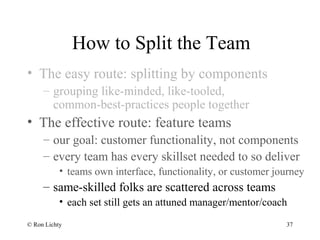
How to Split the Team
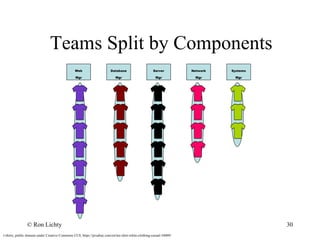
• The easy route: splitting by components
– grouping like-minded, like-tooled,
common-best-practices people together
© Ron Lichty 29
Teams Split by Components
Web
Mgr
Database
Mgr
Server
Mgr
Network
Mgr
Systems
Mgr
t-shirts, public domain under Creative Commons CC0, https://pixabay.com/en/tee-shirt-white-clothing-casual-34009/
© Ron Lichty 30
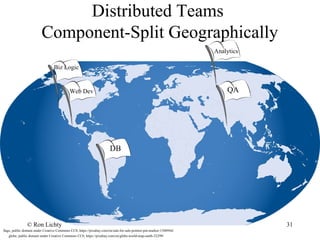
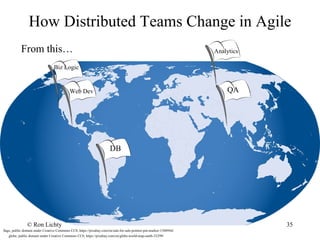
Distributed Teams
Component-Split Geographically
flags, public domain under Creative Commons CC0, https://pixabay.com/en/sale-for-sale-pointer-pin-marker-1500944/
QA
Analytics
Biz Logic
Web Dev
DB
globe, public domain under Creative Commons CC0, https://pixabay.com/en/globe-world-map-earth-32299/
© Ron Lichty 31
How to Split the Team
• The easy route: splitting by components
– grouping like-minded, like-tooled,
common-best-practices people together
– easy management model
– teams each get an attuned manager/mentor/coach
• The problem:
– our goal: customer functionality, not components
– customer functionality requires multiple components
• incessant inter-team dependencies
• costly high-bandwidth, inter-team communication© Ron Lichty 32
How to Split the Team
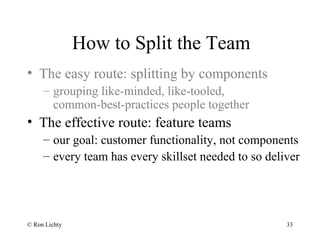
• The easy route: splitting by components
– grouping like-minded, like-tooled,
common-best-practices people together
• The effective route: feature teams
– our goal: customer functionality, not components
– every team has every skillset needed to so deliver
© Ron Lichty 33
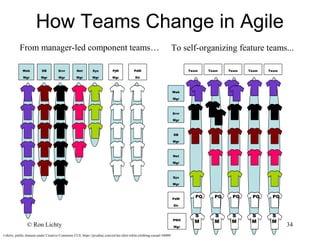
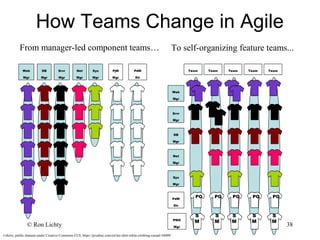
How Teams Change in Agile
Web
Mgr
DB
Mgr
Srvr
Mgr
Net
Mgr
Sys
Mgr
PjM
Mgr
PdM
Dir
Web
Mgr
DB
Mgr
Srvr
Mgr
Net
Mgr
Sys
Mgr
PMO
Mgr
PdM
Dir
PO PO PO PO PO
S
M
S
M
S
M
S
M
S
M
Team Team Team Team Team
From manager-led component teams… To self-organizing feature teams...
t-shirts, public domain under Creative Commons CC0, https://pixabay.com/en/tee-shirt-white-clothing-casual-34009/
© Ron Lichty 34
How Distributed Teams Change in Agile
From this…
flags, public domain under Creative Commons CC0, https://pixabay.com/en/sale-for-sale-pointer-pin-marker-1500944/
QA
Analytics
Biz Logic
Web Dev
DB
globe, public domain under Creative Commons CC0, https://pixabay.com/en/globe-world-map-earth-32299/
© Ron Lichty 35
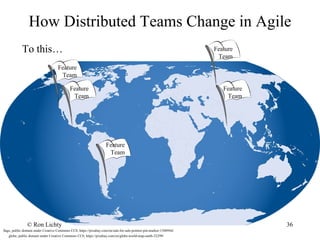
To this…
How Distributed Teams Change in Agile
Feature
Team
Feature
Team
Feature
Team
Feature
Team
Feature
Team
flags, public domain under Creative Commons CC0, https://pixabay.com/en/sale-for-sale-pointer-pin-marker-1500944/
globe, public domain under Creative Commons CC0, https://pixabay.com/en/globe-world-map-earth-32299/
© Ron Lichty 36
How to Split the Team
• The easy route: splitting by components
– grouping like-minded, like-tooled,
common-best-practices people together
• The effective route: feature teams
– our goal: customer functionality, not components
– every team has every skillset needed to so deliver
• teams own interface, functionality, or customer journey
– same-skilled folks are scattered across teams
• each set still gets an attuned manager/mentor/coach
© Ron Lichty 37
How Teams Change in Agile
Web
Mgr
DB
Mgr
Srvr
Mgr
Net
Mgr
Sys
Mgr
PjM
Mgr
PdM
Dir
Web
Mgr
DB
Mgr
Srvr
Mgr
Net
Mgr
Sys
Mgr
PMO
Mgr
PdM
Dir
PO PO PO PO PO
S
M
S
M
S
M
S
M
S
M
Team Team Team Team Team
From manager-led component teams… To self-organizing feature teams...
t-shirts, public domain under Creative Commons CC0, https://pixabay.com/en/tee-shirt-white-clothing-casual-34009/
© Ron Lichty 38
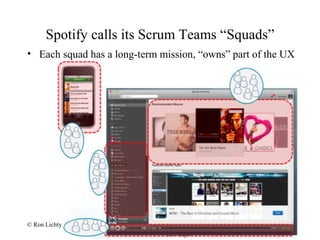
Spotify calls its Scrum Teams “Squads”
• Each squad has a long-term mission, “owns” part of the UX
© Ron Lichty
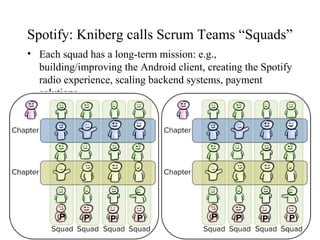
Spotify: Kniberg calls Scrum Teams “Squads”
• Each squad has a long-term mission: e.g.,
building/improving the Android client, creating the Spotify
radio experience, scaling backend systems, payment
solutions, …
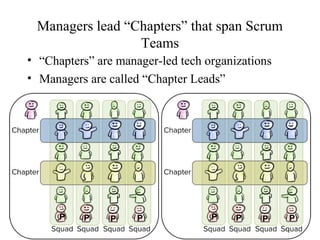
Managers lead “Chapters” that span Scrum
Teams
• “Chapters” are manager-led tech organizations
• Managers are called “Chapter Leads”
Splitting Teams: a second trap
• The easy route: splitting by components
– grouping like-minded, like-tooled,
common-best-practices people together
• The effective route: feature teams (or squads)
– each delivers customer functionality
• A second trap: tiny feature teams/squads/pods
– the problems:
• pods become silos
• high-bandwidth communication is needed among pods
© Ron Lichty 42
What Gates Teams: Communication
© Ron Lichty 43
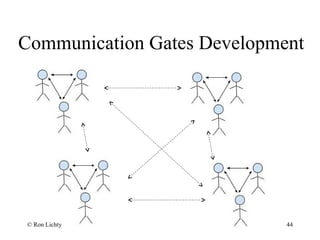
Communication Gates Development
© Ron Lichty 44
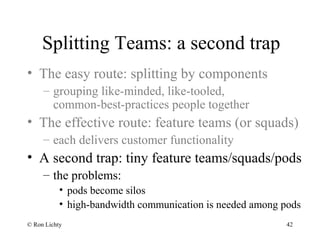
Splitting Teams: a second trap
• The easy route: splitting by components
– grouping like-minded, like-tooled,
common-best-practices people together
• The effective route: feature teams (or squads)
– each delivers customer functionality
• A second trap: tiny feature teams/squads/pods
– the problems:
• pods become silos
• high-bandwidth communication is needed among pods
– with enough growth, it can be a trap for us all© Ron Lichty 45
Splitting Teams: a trap solution
• The easy route: splitting by components
– grouping like-minded, like-tooled,
common-best-practices people together
• The effective route: feature teams (or squads)
– each delivers customer functionality
• A second trap: tiny feature teams/squads/pods
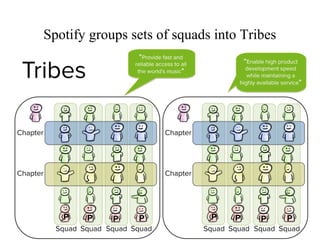
– Spotify groups sets of squads into Tribes
– Zenefits groups sets of pods into Superpods
© Ron Lichty 46
Spotify groups sets of squads into Tribes
Hybrid Split
• Teams / Sub-teams hybrid model
– Startup with a team of 15 had been unproductive
– PdM ID’d 3 customer functionality workstreams
• but not long-running streams of features
– Split the team into 3 cross-functional sub-teams
• but stability was still at the larger team level
• and the code base was monolithic
– We did Planning, Demos and Retros by sub-team
– Standups, daily:
• first 11 minutes all together for sharing, dependencies
• then split up by sub-team for progress, 6 mins. planning© Ron Lichty
One More Model for Team Structuring
• FAST-Agile
– Organization of 40-plus
– Teams self-form every two days
• Around PdM’s 5 highest value initiatives
• Plan Tues/Thurs mornings
• Share outcomes Wed/Fri afternoons
© Ron Lichty 49
Regardless of Structure
• Make onboarding new team members a best practice
• Plan for architectural guidance across teams
• Fly geographically distributed teams together
• Plan cross-team, cross-geo, cross-tech hackathons
• Weekly all-hands show-and-tells have real value
– Leverage: align sprint reviews / demos with all-hands
• Remember Conway’s Law: You ship your organization!
• Make experiments of structure & process change
• Create a culture of psychological safety!
• Don’t just do agile, be agile!
© Ron Lichty 50
Team Structure Take-Aways
• Software development is a team sport
• There’s no one agile way to do things
• The point is to be effective / delight customers
• Organize teams to deliver customer value
• Cross-functional feature teams enable critical
communication / collaboration
• We’d stick with teams of 3 if we could
– But avoid cross-team communication overhead!
© Ron Lichty 51
Ron Lichty Consulting
• Software leadership, coaching, training, consulting:
– http://ronlichty.com, Ron@RonLichty.com
• The book:
Managing the Unmanageable:
Rules, Tools & Insights for Managing Software People & Teams
– http://ManagingTheUnmanageable.net <-----tools, excerpts, more rules of thumb
• The video training:
LiveLessons: Managing Software People and Teams
– http://ManagingTheUnmanageable.net/video.html
• The study:
The Study of Product Team Performance
– http://ronlichty.com/study.html
• Training:
The Agile Manager
Managing Software People and Teams
Zero to Agile in Three Days
52
Informit.com/lichty
Save 50% on Video Training
• Use code VIDEO50
Save 35% on Book
• Use code SWDEV35
• Good on print, eBooks, and video
• eBook files include PDF, EPUB, and MOBI
Discount codes applicable only at informit.com
Also available on the Safari Bookshelf
Ron Lichty Consulting
• Mentoring, coaching, training, consulting:
– http://ronlichty.com, Ron@RonLichty.com
• The book:
Managing the Unmanageable:
Rules, Tools & Insights for Managing Software People & Teams
– http://ManagingTheUnmanageable.net <-----tools, excerpts, more rules of thumb
• The video training:
LiveLessons: Managing Software People and Teams
– http://ManagingTheUnmanageable.net/video.html
• The study:
The Study of Product Team Performance
– http://ronlichty.com/study.html
• Training:
The Agile Manager
Managing Software People and Teams
Zero to Agile in Three Days
54
© Ron Lichty 55

Scaling Agile Teams

  • 1.
    Scaling Agile Teams RonLichty | Ron Lichty Consulting Ron@RonLichty.com | www.ronlichty.com
  • 2.
    * Addison Wesley(Amazon, BarnesandNoble, InformIT.com, Safari) http://ManagingTheUnmanageable.net <-----tools, excerpts, more rules of thumb © Ron Lichty 2 *
  • 3.
    © Ron Lichty3 http://ManagingTheUnmanageable.net <-----and pointers to video training
  • 4.
    The Study ofProduct Team Performance http://www.ronlichty.com/study.html 4© Ron Lichty
  • 5.
    Ron Lichty, Managing SoftwarePeople & Teams SOFTWEST
  • 6.
    Untangling the Knots;Making Things Hum • process • culture • communication • planning • rigor © Ron Lichty 6
  • 7.
    Software Development Organizations Strugglewith Structure 7 • Startups: When does our team become 2 teams? • Larger orgs: Divide teams by components or by user function? • Every org: As teams grow, when and how do we split them? • Distributed teams: How do we distribute work geographically? • Managers: What’s our role? • Enterprises: Pools or teams? • Teams: What is a team, anyway? © Ron Lichty
  • 8.
    A Couple ContextPoints for this Talk 8 The point is not to do Agile. The point is to be effective. Agile provides us insights.  --Al Shalloway, agile author/trainer/coach Developing software is a team sport.  --observation from 30 years managing programmers © Ron Lichty
  • 9.
    What’s the IdealTeam Size? • Give me some answers in the chat window © Ron Lichty 9
  • 10.
    Ideal Team Size:Possible Answers • Scrum (for 2 decades): 7 ± 2 (5 - 9) • Scrum Guide today: 3 - 9 • Jeff Bezos: two-pizza rule (5 - 7) • my coauthor, Mickey Mantle: 3 - 4 “a small team will usually outperform a larger team, hands down” • my own answer? © Ron Lichty 10
  • 11.
    Ideal Team Size:Possible Answers • Scrum (for 2 decades): 7 ± 2 (5 - 9) • Scrum Guide today: 3 - 9 • Jeff Bezos: two-pizza rule (5 - 7) • my coauthor, Mickey Mantle: 3 - 4 “a small team will usually outperform a larger team, hands down” • my own answer (based on what gates teams): 1 © Ron Lichty 11
  • 12.
    What Gates Teams:Communication © Ron Lichty 12
  • 13.
    What Gates Teams:Communication © Ron Lichty 13
  • 14.
    What Gates Teams:Communication Lines of communication multiplicative n(n-1)/2 © Ron Lichty 14
  • 15.
    Ideal Team Size:1 • all the communication is neuron-to-neuron • J. Richard Hackman, Harvard: Team theory “Research consistently shows that teams underperform...” “problems with coordination and motivation typically chip away at the benefits of collaboration” • so what’s the issue? © Ron Lichty 15
  • 16.
    Ideal Team Size:1 • all the communication is neuron-to-neuron • J. Richard Hackman, Harvard: Team theory “Research consistently shows that teams underperform...” “problems with coordination and motivation typically chip away at the benefits of collaboration” • so what’s the issue? • not many applications these days a single programmer can write © Ron Lichty 16
  • 17.
    Ideal Team Size:1 • all the communication is neuron-to-neuron • J. Richard Hackman, Harvard: Team theory “Research consistently shows that teams underperform...” “problems with coordination and motivation typically chip away at the benefits of collaboration” • so what’s the issue? • not many applications these days a single programmer can write • not many full-stack developers who can handle every part of an application © Ron Lichty 17
  • 18.
    Ideal Team Size:3 - 4 • Mickey Mantle: “a small team will usually outperform a larger team, hands down” • Daniel Pupius, co-founder, Range: “a sole genius isn’t going to solve problems in the way a group can” • but even just Javascript: stacks of frameworks MEAN - MongoDB - Express.js - AngularJS - Node.js • ...and we run out of engineering bandwidth © Ron Lichty 18
  • 19.
    Ideal Team Size:two pizzas • Jeff Bezos: “5-7 people” © Ron Lichty 19
  • 20.
    Ideal Team Size:two pizzas • Jeff Bezos: “5-7 people, depending on their appetites” © Ron Lichty 20
  • 21.
    Scrum: 7 ±2 or 3 - 9 (i.e., <10) • J. Richard Hackman: Team theory “Big teams usually wind up just wasting everybody’s time” “My rule of thumb is no double digits” • Mickey Mantle, Managing the Unmanageable: “rarely have I seen productive teams that number more than a dozen” • Ron Quartel, FAST-Agile creator “a team of 14 that pairs would be the same as 7 channels of communication with solo developers” © Ron Lichty 21
  • 22.
    Stable Teams • J.Richard Hackman: Team theory “R&D teams do need an influx of new talent to maintain creativity and freshness—but only at the rate of one person every three to four years” “The problem almost always is... that a team... doesn’t have the chance to settle in... to learn through experience how best to operate as a team” • Bruce Tuckman: Stages of Group Development Forming / Storming / Norming / Performing • Stability == estimating, velocity, predictability • (But Rich Sheridan, Joy, Inc., claims he’s overcome teams-in-flux via XP practices, & has even beat Brooks Law!)© Ron Lichty 22
  • 23.
    Splitting Growing Teams •When and how do we divide a team > 9? – Don’t: Keep the team intact – Cell division – Split the team – Hybrid split © Ron Lichty 23
  • 24.
    Keep the TeamIntact • The “maximum of 9” is a guideline, not a law! • But! recognize the communication burden • Give focus to communication effectiveness • Support Re-Forming / Storming / Norming / Performing © Ron Lichty 24
  • 25.
    Cell Division • Cleaveoff a small team © Ron Lichty 25
  • 26.
    Cell Division • Cleaveoff a small team Steve Gray, Slalom: Find a smaller area of functionality that a smaller part of the team can be spawned off to address Daniel Pupius, co-founder, Range: Peel off a stable island while the larger remaining group deals with the larger, less- defined surface area © Ron Lichty 26
  • 27.
    Splitting Teams • Givesome thought to Conway’s Law “Organizations which design systems... are constrained to produce designs which are copies of the communication structures of these organizations.” Glyn Morrison’s variant: “Software development organizations ship their organization chart.” Eric Raymond’s variant: “If you have four groups working on a compiler, you’ll get a 4-pass compiler.” © Ron Lichty 27
  • 28.
    Splitting Teams • Givesome thought to Conway’s Law “Organizations which design systems... are constrained to produce designs which are copies of the communication structures of these organizations.” Glyn Morrison’s variant: “Software development organizations ship their organization chart.” Eric Raymond’s variant: “If you have four groups working on a compiler, you’ll get a 4-pass compiler.” Al Shalloway’s variant: “When development groups change how their development staff are organized, their current application architecture will work against them.” © Ron Lichty 28
  • 29.
    How to Splitthe Team • The easy route: splitting by components – grouping like-minded, like-tooled, common-best-practices people together © Ron Lichty 29
  • 30.
    Teams Split byComponents Web Mgr Database Mgr Server Mgr Network Mgr Systems Mgr t-shirts, public domain under Creative Commons CC0, https://pixabay.com/en/tee-shirt-white-clothing-casual-34009/ © Ron Lichty 30
  • 31.
    Distributed Teams Component-Split Geographically flags,public domain under Creative Commons CC0, https://pixabay.com/en/sale-for-sale-pointer-pin-marker-1500944/ QA Analytics Biz Logic Web Dev DB globe, public domain under Creative Commons CC0, https://pixabay.com/en/globe-world-map-earth-32299/ © Ron Lichty 31
  • 32.
    How to Splitthe Team • The easy route: splitting by components – grouping like-minded, like-tooled, common-best-practices people together – easy management model – teams each get an attuned manager/mentor/coach • The problem: – our goal: customer functionality, not components – customer functionality requires multiple components • incessant inter-team dependencies • costly high-bandwidth, inter-team communication© Ron Lichty 32
  • 33.
    How to Splitthe Team • The easy route: splitting by components – grouping like-minded, like-tooled, common-best-practices people together • The effective route: feature teams – our goal: customer functionality, not components – every team has every skillset needed to so deliver © Ron Lichty 33
  • 34.
    How Teams Changein Agile Web Mgr DB Mgr Srvr Mgr Net Mgr Sys Mgr PjM Mgr PdM Dir Web Mgr DB Mgr Srvr Mgr Net Mgr Sys Mgr PMO Mgr PdM Dir PO PO PO PO PO S M S M S M S M S M Team Team Team Team Team From manager-led component teams… To self-organizing feature teams... t-shirts, public domain under Creative Commons CC0, https://pixabay.com/en/tee-shirt-white-clothing-casual-34009/ © Ron Lichty 34
  • 35.
    How Distributed TeamsChange in Agile From this… flags, public domain under Creative Commons CC0, https://pixabay.com/en/sale-for-sale-pointer-pin-marker-1500944/ QA Analytics Biz Logic Web Dev DB globe, public domain under Creative Commons CC0, https://pixabay.com/en/globe-world-map-earth-32299/ © Ron Lichty 35
  • 36.
    To this… How DistributedTeams Change in Agile Feature Team Feature Team Feature Team Feature Team Feature Team flags, public domain under Creative Commons CC0, https://pixabay.com/en/sale-for-sale-pointer-pin-marker-1500944/ globe, public domain under Creative Commons CC0, https://pixabay.com/en/globe-world-map-earth-32299/ © Ron Lichty 36
  • 37.
    How to Splitthe Team • The easy route: splitting by components – grouping like-minded, like-tooled, common-best-practices people together • The effective route: feature teams – our goal: customer functionality, not components – every team has every skillset needed to so deliver • teams own interface, functionality, or customer journey – same-skilled folks are scattered across teams • each set still gets an attuned manager/mentor/coach © Ron Lichty 37
  • 38.
    How Teams Changein Agile Web Mgr DB Mgr Srvr Mgr Net Mgr Sys Mgr PjM Mgr PdM Dir Web Mgr DB Mgr Srvr Mgr Net Mgr Sys Mgr PMO Mgr PdM Dir PO PO PO PO PO S M S M S M S M S M Team Team Team Team Team From manager-led component teams… To self-organizing feature teams... t-shirts, public domain under Creative Commons CC0, https://pixabay.com/en/tee-shirt-white-clothing-casual-34009/ © Ron Lichty 38
  • 39.
    Spotify calls itsScrum Teams “Squads” • Each squad has a long-term mission, “owns” part of the UX © Ron Lichty
  • 40.
    Spotify: Kniberg callsScrum Teams “Squads” • Each squad has a long-term mission: e.g., building/improving the Android client, creating the Spotify radio experience, scaling backend systems, payment solutions, …
  • 41.
    Managers lead “Chapters”that span Scrum Teams • “Chapters” are manager-led tech organizations • Managers are called “Chapter Leads”
  • 42.
    Splitting Teams: asecond trap • The easy route: splitting by components – grouping like-minded, like-tooled, common-best-practices people together • The effective route: feature teams (or squads) – each delivers customer functionality • A second trap: tiny feature teams/squads/pods – the problems: • pods become silos • high-bandwidth communication is needed among pods © Ron Lichty 42
  • 43.
    What Gates Teams:Communication © Ron Lichty 43
  • 44.
  • 45.
    Splitting Teams: asecond trap • The easy route: splitting by components – grouping like-minded, like-tooled, common-best-practices people together • The effective route: feature teams (or squads) – each delivers customer functionality • A second trap: tiny feature teams/squads/pods – the problems: • pods become silos • high-bandwidth communication is needed among pods – with enough growth, it can be a trap for us all© Ron Lichty 45
  • 46.
    Splitting Teams: atrap solution • The easy route: splitting by components – grouping like-minded, like-tooled, common-best-practices people together • The effective route: feature teams (or squads) – each delivers customer functionality • A second trap: tiny feature teams/squads/pods – Spotify groups sets of squads into Tribes – Zenefits groups sets of pods into Superpods © Ron Lichty 46
  • 47.
    Spotify groups setsof squads into Tribes
  • 48.
    Hybrid Split • Teams/ Sub-teams hybrid model – Startup with a team of 15 had been unproductive – PdM ID’d 3 customer functionality workstreams • but not long-running streams of features – Split the team into 3 cross-functional sub-teams • but stability was still at the larger team level • and the code base was monolithic – We did Planning, Demos and Retros by sub-team – Standups, daily: • first 11 minutes all together for sharing, dependencies • then split up by sub-team for progress, 6 mins. planning© Ron Lichty
  • 49.
    One More Modelfor Team Structuring • FAST-Agile – Organization of 40-plus – Teams self-form every two days • Around PdM’s 5 highest value initiatives • Plan Tues/Thurs mornings • Share outcomes Wed/Fri afternoons © Ron Lichty 49
  • 50.
    Regardless of Structure •Make onboarding new team members a best practice • Plan for architectural guidance across teams • Fly geographically distributed teams together • Plan cross-team, cross-geo, cross-tech hackathons • Weekly all-hands show-and-tells have real value – Leverage: align sprint reviews / demos with all-hands • Remember Conway’s Law: You ship your organization! • Make experiments of structure & process change • Create a culture of psychological safety! • Don’t just do agile, be agile! © Ron Lichty 50
  • 51.
    Team Structure Take-Aways •Software development is a team sport • There’s no one agile way to do things • The point is to be effective / delight customers • Organize teams to deliver customer value • Cross-functional feature teams enable critical communication / collaboration • We’d stick with teams of 3 if we could – But avoid cross-team communication overhead! © Ron Lichty 51
  • 52.
    Ron Lichty Consulting •Software leadership, coaching, training, consulting: – http://ronlichty.com, Ron@RonLichty.com • The book: Managing the Unmanageable: Rules, Tools & Insights for Managing Software People & Teams – http://ManagingTheUnmanageable.net <-----tools, excerpts, more rules of thumb • The video training: LiveLessons: Managing Software People and Teams – http://ManagingTheUnmanageable.net/video.html • The study: The Study of Product Team Performance – http://ronlichty.com/study.html • Training: The Agile Manager Managing Software People and Teams Zero to Agile in Three Days 52
  • 53.
    Informit.com/lichty Save 50% onVideo Training • Use code VIDEO50 Save 35% on Book • Use code SWDEV35 • Good on print, eBooks, and video • eBook files include PDF, EPUB, and MOBI Discount codes applicable only at informit.com Also available on the Safari Bookshelf
  • 54.
    Ron Lichty Consulting •Mentoring, coaching, training, consulting: – http://ronlichty.com, Ron@RonLichty.com • The book: Managing the Unmanageable: Rules, Tools & Insights for Managing Software People & Teams – http://ManagingTheUnmanageable.net <-----tools, excerpts, more rules of thumb • The video training: LiveLessons: Managing Software People and Teams – http://ManagingTheUnmanageable.net/video.html • The study: The Study of Product Team Performance – http://ronlichty.com/study.html • Training: The Agile Manager Managing Software People and Teams Zero to Agile in Three Days 54
  • 55.

Editor's Notes

  • #3 Managing the Unmanageable: Rules, Tools, and Insights for Managing Software People and Teams
  • #5 But I’m also the coauthor of the periodic Study of Product Team Performance. In each of the studies, we’ve asked product teams members – developers, testers, PdMs, PjMs, PgMs, scrum masters, … – around the world ...to tell us if they considered their teams to be high performance, low performance or something in between. And then we asked about various of their practices.
  • #22 https://hbr.org/2009/05/why-teams-dont-work J. Richard Hackman, the Edgar Pierce Professor of Social and Organizational Psychology at Harvard University and a leading expert on teams
  • #23 https://hbr.org/2009/05/why-teams-dont-work J. Richard Hackman, the Edgar Pierce Professor of Social and Organizational Psychology at Harvard University and a leading expert on teams
  • #24 https://hbr.org/2009/05/why-teams-dont-work J. Richard Hackman, the Edgar Pierce Professor of Social and Organizational Psychology at Harvard University and a leading expert on teams
  • #25 https://hbr.org/2009/05/why-teams-dont-work J. Richard Hackman, the Edgar Pierce Professor of Social and Organizational Psychology at Harvard University and a leading expert on teams
  • #26 https://hbr.org/2009/05/why-teams-dont-work J. Richard Hackman, the Edgar Pierce Professor of Social and Organizational Psychology at Harvard University and a leading expert on teams
  • #27 https://hbr.org/2009/05/why-teams-dont-work J. Richard Hackman, the Edgar Pierce Professor of Social and Organizational Psychology at Harvard University and a leading expert on teams
  • #28 https://hbr.org/2009/05/why-teams-dont-work J. Richard Hackman, the Edgar Pierce Professor of Social and Organizational Psychology at Harvard University and a leading expert on teams
  • #29 https://hbr.org/2009/05/why-teams-dont-work J. Richard Hackman, the Edgar Pierce Professor of Social and Organizational Psychology at Harvard University and a leading expert on teams
  • #30 https://hbr.org/2009/05/why-teams-dont-work J. Richard Hackman, the Edgar Pierce Professor of Social and Organizational Psychology at Harvard University and a leading expert on teams
  • #31 https://hbr.org/2009/05/why-teams-dont-work J. Richard Hackman, the Edgar Pierce Professor of Social and Organizational Psychology at Harvard University and a leading expert on teams
  • #32 https://pixabay.com/en/tee-shirt-purple-fashion-design-34002/ https://pixabay.com/en/tee-shirt-maroon-clothing-casual-34008/ https://pixabay.com/en/tee-shirt-black-fashion-design-34001/ https://pixabay.com/en/tee-shirt-pink-clothing-casual-34006/ https://pixabay.com/en/tee-shirt-green-fashion-design-34004/ https://pixabay.com/en/tee-shirt-white-clothing-casual-34009/
  • #33 https://hbr.org/2009/05/why-teams-dont-work J. Richard Hackman, the Edgar Pierce Professor of Social and Organizational Psychology at Harvard University and a leading expert on teams
  • #34 https://hbr.org/2009/05/why-teams-dont-work J. Richard Hackman, the Edgar Pierce Professor of Social and Organizational Psychology at Harvard University and a leading expert on teams
  • #35 https://pixabay.com/en/tee-shirt-purple-fashion-design-34002/ https://pixabay.com/en/tee-shirt-maroon-clothing-casual-34008/ https://pixabay.com/en/tee-shirt-black-fashion-design-34001/ https://pixabay.com/en/tee-shirt-pink-clothing-casual-34006/ https://pixabay.com/en/tee-shirt-green-fashion-design-34004/ https://pixabay.com/en/tee-shirt-white-clothing-casual-34009/
  • #36 https://pixabay.com/en/tee-shirt-purple-fashion-design-34002/ https://pixabay.com/en/tee-shirt-maroon-clothing-casual-34008/ https://pixabay.com/en/tee-shirt-black-fashion-design-34001/ https://pixabay.com/en/tee-shirt-pink-clothing-casual-34006/ https://pixabay.com/en/tee-shirt-green-fashion-design-34004/ https://pixabay.com/en/tee-shirt-white-clothing-casual-34009/
  • #37 https://pixabay.com/en/tee-shirt-purple-fashion-design-34002/ https://pixabay.com/en/tee-shirt-maroon-clothing-casual-34008/ https://pixabay.com/en/tee-shirt-black-fashion-design-34001/ https://pixabay.com/en/tee-shirt-pink-clothing-casual-34006/ https://pixabay.com/en/tee-shirt-green-fashion-design-34004/ https://pixabay.com/en/tee-shirt-white-clothing-casual-34009/
  • #38 https://hbr.org/2009/05/why-teams-dont-work J. Richard Hackman, the Edgar Pierce Professor of Social and Organizational Psychology at Harvard University and a leading expert on teams
  • #39 https://pixabay.com/en/tee-shirt-purple-fashion-design-34002/ https://pixabay.com/en/tee-shirt-maroon-clothing-casual-34008/ https://pixabay.com/en/tee-shirt-black-fashion-design-34001/ https://pixabay.com/en/tee-shirt-pink-clothing-casual-34006/ https://pixabay.com/en/tee-shirt-green-fashion-design-34004/ https://pixabay.com/en/tee-shirt-white-clothing-casual-34009/
  • #40 “Scaling Agile @ Spotify”, Henrik Kniberg &amp; Anders Ivarsson
  • #41 “Scaling Agile @ Spotify”, Henrik Kniberg &amp; Anders Ivarsson
  • #42 “Scaling Agile @ Spotify”, Henrik Kniberg &amp; Anders Ivarsson
  • #43 https://hbr.org/2009/05/why-teams-dont-work J. Richard Hackman, the Edgar Pierce Professor of Social and Organizational Psychology at Harvard University and a leading expert on teams
  • #46 https://hbr.org/2009/05/why-teams-dont-work J. Richard Hackman, the Edgar Pierce Professor of Social and Organizational Psychology at Harvard University and a leading expert on teams
  • #47 https://hbr.org/2009/05/why-teams-dont-work J. Richard Hackman, the Edgar Pierce Professor of Social and Organizational Psychology at Harvard University and a leading expert on teams
  • #48 “Scaling Agile @ Spotify”, Henrik Kniberg &amp; Anders Ivarsson Each tribe has a tribe lead who is responsible for providing the best possible habitat for the squads within that tribe.
  • #49 https://hbr.org/2009/05/why-teams-dont-work J. Richard Hackman, the Edgar Pierce Professor of Social and Organizational Psychology at Harvard University and a leading expert on teams
  • #50 https://hbr.org/2009/05/why-teams-dont-work J. Richard Hackman, the Edgar Pierce Professor of Social and Organizational Psychology at Harvard University and a leading expert on teams
  • #51 https://hbr.org/2009/05/why-teams-dont-work J. Richard Hackman, the Edgar Pierce Professor of Social and Organizational Psychology at Harvard University and a leading expert on teams
  • #52 https://hbr.org/2009/05/why-teams-dont-work J. Richard Hackman, the Edgar Pierce Professor of Social and Organizational Psychology at Harvard University and a leading expert on teams