Scaled Agile Framework
adopting agile at enterprise scale
A Scrum is to the agile team as SAFe is to the agile enterprise
• SAFe tackles the tough issues – architecture, integration, funding, governance
and roles at scale
• SAFe is based on Lean and Agile principles
• SAFe’s strength is that it appeals to large organizations who are not Agile. It
confirms that the Big Guys know the stuff and that all that’s needed is for the
Little Guys to rush around doing what they’re told. SAFe is trying to build a
framework enterprises will buy
Dean Leffingwell
Co-founder, Chief Methodologist
Recognized as the one of the world’s foremost authorities on
Lean-Agile best practices. Was involved at the beginning of RUP
He currently serves as Chief Methodologist to Scaled Agile, Inc.,
which he co-founded in 2011.
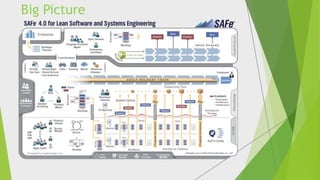
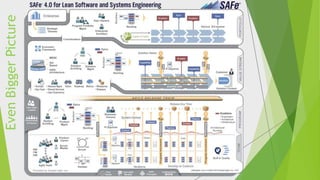
Big Picture
There are three levels in SAF:
1. Portfolio
 Highest level of concern in SAF
 A collection of value streams which are budgeted via lean-agile budgeting
mechanisms
 Connected to the enterprise strategy by a set of strategic themes
 Investment themes drive budget allocations
 Themes are done as part of the budgeting process with a lifespan of 6-12 months
 Epics define large development initiatives that encapsulate the new development
necessary to realize the benefits of investment themes
 There are business epics (customer-facing) and architectural epics (technology
solutions)
 A portfolio Kanban system is used to capture and analyze epics
 Enterprise architecture is a first class citizen. The concept of intentional
architecture provides a set of planned initiatives to enhance solution design,
performance, security and usability.
There are three levels in SAF:
2. Program
 Agile Release Train (ART) is the primary vehicle for value delivery at the program
level. It delivers a value stream for the organization.
 Between 5 and 10 teams work together on a train. They synchronize their release
and iteration boundaries.
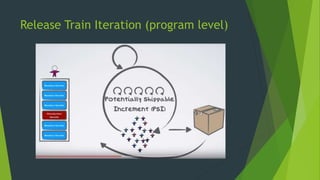
 Every 10 weeks (5 iterations) a train delivers a Potentially Shippable Increment (PSI).
A demo and inspect and adapt sessions are held. Planning begins for the next PSI.
 PSIs provide a steady cadence for the development cycle. They are separate from the
concept of market releases, which can happen more or less frequently and on a
different schedule.
 SAFe makes a distinction between content (what the system does) and design (how
the system does it) with separate “authority” for each (Program Manager and System
Architect)
New program level roles
 Product Manager
 System Architect
 Release Train Engineer (RTE)
 UX and Shared Resources (e.g., security, DBA)
 System Team
 Release Management Team
There are three levels in SAF:
3. Team
 Scrum with XP or Kanban engineering practices are used.
 Define/Build/Test (DBT) teams (5-9 members) deliver working, fully tested software
every two weeks
 Teams share common iteration start/stop dates and durations
 Teams use stories to deliver value
 Stories carry Customer’s requirements
 Product Owner has content authority over story creation and acceptance
 Team Backlog consists of User and Enabler Stories, which are identified during PSI
planning
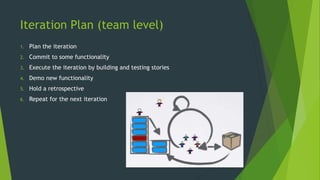
Iteration Plan (team level)
1. Plan the iteration
2. Commit to some functionality
3. Execute the iteration by building and testing stories
4. Demo new functionality
5. Hold a retrospective
6. Repeat for the next iteration
Release Train Iteration (program level)
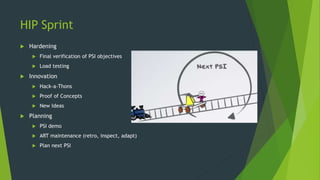
HIP Sprint
 Hardening
 Final verification of PSI objectives
 Load testing
 Innovation
 Hack-a-Thons
 Proof of Concepts
 New Ideas
 Planning
 PSI demo
 ART maintenance (retro, inspect, adapt)
 Plan next PSI
Enablers
 Enablers are technical initiatives meant to enable and support the
development of business initiatives
 Enablers exist at all levels of SAFe: Enabler Epics, Enabler Features, Enabler
Stories
 Enablers generally fall into one of three categories:
1. Exploration – to build understanding of what is needed by Customer, to evaluate
alternatives
2. Architecture – to enable smoother and faster development
3. Infrastructure – to build and enhance development and testing environments
 Some enablers may become Nonfunctional Requirements
EvenBiggerPicture
Useful Links
 http://www.scaledagileframework.com/
 https://www.rallydev.com/blog/agile/40-things-you-need-know-about-
scaled-agile-framework
 https://en.wikipedia.org/wiki/Scaled_Agile_Framework

Scaled agile framework (SAFe) - adopting agile at enterprise scale

  • 1.
    Scaled Agile Framework adoptingagile at enterprise scale
  • 2.
    A Scrum isto the agile team as SAFe is to the agile enterprise • SAFe tackles the tough issues – architecture, integration, funding, governance and roles at scale • SAFe is based on Lean and Agile principles • SAFe’s strength is that it appeals to large organizations who are not Agile. It confirms that the Big Guys know the stuff and that all that’s needed is for the Little Guys to rush around doing what they’re told. SAFe is trying to build a framework enterprises will buy Dean Leffingwell Co-founder, Chief Methodologist Recognized as the one of the world’s foremost authorities on Lean-Agile best practices. Was involved at the beginning of RUP He currently serves as Chief Methodologist to Scaled Agile, Inc., which he co-founded in 2011.
  • 3.
  • 4.
    There are threelevels in SAF: 1. Portfolio  Highest level of concern in SAF  A collection of value streams which are budgeted via lean-agile budgeting mechanisms  Connected to the enterprise strategy by a set of strategic themes  Investment themes drive budget allocations  Themes are done as part of the budgeting process with a lifespan of 6-12 months  Epics define large development initiatives that encapsulate the new development necessary to realize the benefits of investment themes  There are business epics (customer-facing) and architectural epics (technology solutions)  A portfolio Kanban system is used to capture and analyze epics  Enterprise architecture is a first class citizen. The concept of intentional architecture provides a set of planned initiatives to enhance solution design, performance, security and usability.
  • 5.
    There are threelevels in SAF: 2. Program  Agile Release Train (ART) is the primary vehicle for value delivery at the program level. It delivers a value stream for the organization.  Between 5 and 10 teams work together on a train. They synchronize their release and iteration boundaries.  Every 10 weeks (5 iterations) a train delivers a Potentially Shippable Increment (PSI). A demo and inspect and adapt sessions are held. Planning begins for the next PSI.  PSIs provide a steady cadence for the development cycle. They are separate from the concept of market releases, which can happen more or less frequently and on a different schedule.  SAFe makes a distinction between content (what the system does) and design (how the system does it) with separate “authority” for each (Program Manager and System Architect)
  • 6.
    New program levelroles  Product Manager  System Architect  Release Train Engineer (RTE)  UX and Shared Resources (e.g., security, DBA)  System Team  Release Management Team
  • 7.
    There are threelevels in SAF: 3. Team  Scrum with XP or Kanban engineering practices are used.  Define/Build/Test (DBT) teams (5-9 members) deliver working, fully tested software every two weeks  Teams share common iteration start/stop dates and durations  Teams use stories to deliver value  Stories carry Customer’s requirements  Product Owner has content authority over story creation and acceptance  Team Backlog consists of User and Enabler Stories, which are identified during PSI planning
  • 8.
    Iteration Plan (teamlevel) 1. Plan the iteration 2. Commit to some functionality 3. Execute the iteration by building and testing stories 4. Demo new functionality 5. Hold a retrospective 6. Repeat for the next iteration
  • 9.
    Release Train Iteration(program level)
  • 10.
    HIP Sprint  Hardening Final verification of PSI objectives  Load testing  Innovation  Hack-a-Thons  Proof of Concepts  New Ideas  Planning  PSI demo  ART maintenance (retro, inspect, adapt)  Plan next PSI
  • 11.
    Enablers  Enablers aretechnical initiatives meant to enable and support the development of business initiatives  Enablers exist at all levels of SAFe: Enabler Epics, Enabler Features, Enabler Stories  Enablers generally fall into one of three categories: 1. Exploration – to build understanding of what is needed by Customer, to evaluate alternatives 2. Architecture – to enable smoother and faster development 3. Infrastructure – to build and enhance development and testing environments  Some enablers may become Nonfunctional Requirements
  • 12.
  • 13.
    Useful Links  http://www.scaledagileframework.com/ https://www.rallydev.com/blog/agile/40-things-you-need-know-about- scaled-agile-framework  https://en.wikipedia.org/wiki/Scaled_Agile_Framework