Microsoft Solutions
Frameworks
EXPONENTE: JAVIER DI FELICE
C.I 18.948.613
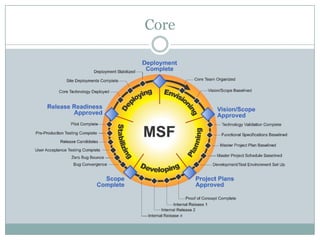
Core
Fundacional principles
 The following are the eight foundational principles,










which form the backbone for the other models and
disciplines of MSF:
1. Faster open communication
2. Work towards a shared vision
3. Empower team members
4. Establish clear accountability and shared
responsibility
5. Focus on delivering business value
6. Stay agile, expect change
7. Invest in quality
8. Learn from all experiences
Msf Models
 1. MSF Team Model. This describes the role of various team members in a









software development project. The members of this team would be:
Product Management: Mainly deals with customers and define project
requirements, also ensures customer expectations are met.
Program Management: Maintains project development and delivery to the
customer
Architecture: Responsible for solution design, making sure the solution
design optimally satisfies all needs and expectations
Development: Develops according to the specifications.
Test: Tests and assures product quality
Release/Operations: Ensures smooth deployment and operations of the
software
User Experience: Supports issues of the users.
One person may be assigned to perform multiple roles. MSF also has
suggestion on how to combine responsibilities such as the developer should
not be assigned to any other role.
Msf Models
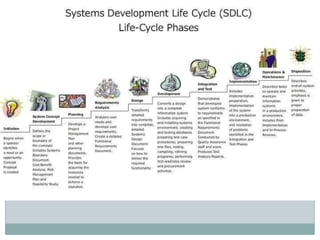
 2. MSF Governance Model. This describes the different stages in processing








for a project. The MSF Governance Model has five overlapping tracks of
activity (see below), each with a defined quality goal. These tracks of
activity define what needs to be accomplished and leave how they are
accomplished to the team selected methodology. For instance, these tracks
can be small in scope and performed quickly to be consistent with an Agile
methodology, or can be serialized and elongated to be consistent with a
Waterfall methodology.
Envision - think about what needs to be accomplished and identify
constraints
Plan - plan and design a solution to meet the needs and expectations within
those constraints
Build - build the solution
Stabilize - validate that the solution meets the needs and expectations...
"synch and stabilize"
Deploy - deploy the solution
Agile software development
 Agile software development is a group of software

development methods based on iterative and
incremental development, where requirements and
solutions evolve through collaboration between selforganizing, cross-functional teams. It promotes
adaptive planning, evolutionary development and
delivery, a time-boxed iterative approach, and
encourages rapid and flexible response to change. It
is a conceptual framework that promotes foreseen
tight interactions throughout the development cycle.
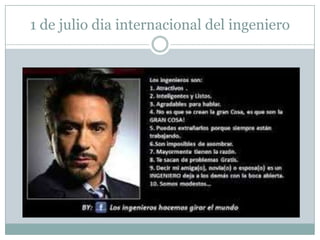
1 de julio dia internacional del ingeniero

Material de exposición de MSF

  • 1.
  • 2.
  • 3.
    Fundacional principles  Thefollowing are the eight foundational principles,         which form the backbone for the other models and disciplines of MSF: 1. Faster open communication 2. Work towards a shared vision 3. Empower team members 4. Establish clear accountability and shared responsibility 5. Focus on delivering business value 6. Stay agile, expect change 7. Invest in quality 8. Learn from all experiences
  • 4.
    Msf Models  1.MSF Team Model. This describes the role of various team members in a         software development project. The members of this team would be: Product Management: Mainly deals with customers and define project requirements, also ensures customer expectations are met. Program Management: Maintains project development and delivery to the customer Architecture: Responsible for solution design, making sure the solution design optimally satisfies all needs and expectations Development: Develops according to the specifications. Test: Tests and assures product quality Release/Operations: Ensures smooth deployment and operations of the software User Experience: Supports issues of the users. One person may be assigned to perform multiple roles. MSF also has suggestion on how to combine responsibilities such as the developer should not be assigned to any other role.
  • 5.
    Msf Models  2.MSF Governance Model. This describes the different stages in processing      for a project. The MSF Governance Model has five overlapping tracks of activity (see below), each with a defined quality goal. These tracks of activity define what needs to be accomplished and leave how they are accomplished to the team selected methodology. For instance, these tracks can be small in scope and performed quickly to be consistent with an Agile methodology, or can be serialized and elongated to be consistent with a Waterfall methodology. Envision - think about what needs to be accomplished and identify constraints Plan - plan and design a solution to meet the needs and expectations within those constraints Build - build the solution Stabilize - validate that the solution meets the needs and expectations... "synch and stabilize" Deploy - deploy the solution
  • 6.
    Agile software development Agile software development is a group of software development methods based on iterative and incremental development, where requirements and solutions evolve through collaboration between selforganizing, cross-functional teams. It promotes adaptive planning, evolutionary development and delivery, a time-boxed iterative approach, and encourages rapid and flexible response to change. It is a conceptual framework that promotes foreseen tight interactions throughout the development cycle.
  • 8.
    1 de juliodia internacional del ingeniero